Skip to content

A satin dress often looks simple on the surface, but behind that smooth shine lies one of the most sensitive construction challenges in apparel manufacturing. Satin fabric reacts strongly to tension, seam direction, heat, and even minor pattern inaccuracies. A 1–2 cm deviation in measurement or a slightly wrong stitch density can completely change drape behavior, waist flow, or hem balance. This is why many production issues in satin dresses do not start in the factory—they start in the tech pack.
A strong tech pack acts like a shared language between design intention and factory execution. It translates visual ideas into measurable, repeatable instructions that reduce interpretation errors during sampling and bulk production. Without it, even experienced factories may produce inconsistent results across sizes or batches.
A satin dress tech pack is a structured document that defines garment measurements, fabric specifications, construction details, stitching methods, trims, and finishing requirements. It ensures that design intent is translated into accurate production instructions, reducing sampling errors and improving manufacturing consistency across sizes and factories.
Many brands underestimate how technical satin really is until the first sample arrives slightly off—too stiff at the waist, uneven at seams, or distorted under lighting. At that moment, the problem is rarely production skill; it is missing precision in documentation. A well-built tech pack prevents that cycle before it starts.
There is a recurring pattern seen in professional production rooms: two brands submit similar satin dress designs, but only one achieves a perfect first sample. The difference is not creativity—it is clarity. And clarity always begins with the tech pack.
What Is a Satin Dress Tech Pack?
A satin dress often looks simple on the surface, but behind that smooth shine lies one of the most sensitive construction challenges in apparel manufacturing. Satin fabric reacts strongly to tension, seam direction, heat, and even minor pattern inaccuracies. A 1–2 cm deviation in measurement or a slightly wrong stitch density can completely change drape behavior, waist flow, or hem balance. This is why many production issues in satin dresses do not start in the factory—they start in the tech pack.
A strong tech pack acts like a shared language between design intention and factory execution. It translates visual ideas into measurable, repeatable instructions that reduce interpretation errors during sampling and bulk production. Without it, even experienced factories may produce inconsistent results across sizes or batches.
A satin dress tech pack is a structured document that defines garment measurements, fabric specifications, construction details, stitching methods, trims, and finishing requirements. It ensures that design intent is translated into accurate production instructions, reducing sampling errors and improving manufacturing consistency across sizes and factories.
Many brands underestimate how technical satin really is until the first sample arrives slightly off—too stiff at the waist, uneven at seams, or distorted under lighting. At that moment, the problem is rarely production skill; it is missing precision in documentation. A well-built tech pack prevents that cycle before it starts.
There is a recurring pattern seen in professional production rooms: two brands submit similar satin dress designs, but only one achieves a perfect first samp

What does a satin dress tech pack include?
A satin dress tech pack is not a single sheet—it is a structured production system. Each section controls one part of manufacturing logic.
| Section | Content | Factory Function |
|---|---|---|
| Technical sketch | Front / back flat drawing | Defines silhouette and structure |
| Measurement sheet | Size-by-size specs | Controls fit consistency |
| Fabric sheet | GSM, composition, finish | Ensures correct material sourcing |
| Construction detail | Seam, dart, panel rules | Guides pattern making |
| Trim list | Zippers, lining, labels | Controls assembly accuracy |
| Stitch rules | Stitch type, density | Ensures durability & appearance |
| Packing instruction | Folding, bagging | Final product presentation |
For satin dresses, missing even one element (especially fabric weight or seam direction) often leads to visible drape imbalance or fit distortion.
Why satin requires stricter technical control than other fabrics?
Satin behaves differently from structured fabrics because it has high surface sensitivity and low structural stability.
Key technical risks:
- Slippage during cutting: fabric shifts by 2–5 mm easily
- Seam visibility: stitch irregularity shows under light
- Drape instability: small pattern changes alter silhouette flow
- Heat sensitivity: ironing can permanently affect gloss level
- Edge curling: improper finishing causes hem distortion
| Factor | Cotton Dress | Satin Dress |
|---|---|---|
| Cutting tolerance | ±2 cm | ±0.5–1 cm |
| Seam visibility risk | Low | High |
| Drape sensitivity | Medium | Very High |
| Rework probability | 10–15% | 25–40% without strong tech pack |
Because of these characteristics, satin dresses require tighter technical definition before sampling begins.
What measurements must be included for satin dresses?
Satin dresses rely heavily on precision fit because fabric does not “hide” structural errors.
Core measurement points include:
- Bust circumference (front/back split recommended)
- Waist position and drop height
- Hip placement alignment
- Shoulder strap length and angle
- Center front length vs side seam length
- Hem sweep width
- Dart position and intake value
Example Measurement Table (Standard Fit Dress):
| Size | Bust (cm) | Waist (cm) | Hip (cm) | Length (cm) |
|---|---|---|---|---|
| S | 84 | 66 | 92 | 85 |
| M | 88 | 70 | 96 | 86 |
| L | 92 | 74 | 100 | 87 |
Even a 1 cm shift in waist or hip placement can change drape balance significantly in satin fabric, especially in bias-cut designs.
What fabric and construction details are required?
Satin dresses depend heavily on correct fabric engineering and construction alignment.
Required fabric information:
- Fabric type: charmeuse / duchess / stretch satin
- Composition: polyester, silk blend, or spandex mix
- GSM range: 80–160 GSM depending on design
- Stretch direction: warp or weft confirmation
- Surface finish: glossy, semi-matte, washed satin
- Shrinkage tolerance: ±3–5%
Construction requirements:
- Seam type: French seam / overlock / bound seam
- Stitch density: 3.0–3.5 mm (standard satin)
- Reinforcement zones: zipper, bust, slit
- Lining specification: chiffon / satin / stretch lining
- Hem finishing: narrow hem / rolled hem / facing
Without these details, factories may choose substitutes that look similar but behave completely differently in wear.
Why is a tech pack critical for sampling accuracy and cost control?
Sampling errors in satin dresses are usually not caused by sewing skill but by incomplete technical input.
Common issues when tech packs are weak:
- 2–3 extra sample rounds required
- Fabric re-order due to incorrect GSM selection
- Fit imbalance in bust or waist area
- Visible seam distortion after pressing
- Mismatch between lining and outer fabric behavior
Impact comparison:
| Stage | Weak Tech Pack | Strong Tech Pack |
|---|---|---|
| Sample cycles | 3–4 rounds | 1–2 rounds |
| Development time | 15–25 days longer | Controlled timeline |
| Fabric waste | High | Low |
| Fit accuracy | Inconsistent | Stable |
A complete tech pack reduces decision ambiguity at every stage—pattern making, cutting, sewing, and finishing.
What defines a production-ready satin dress tech pack?
A satin dress tech pack is considered production-ready when it eliminates interpretation gaps at factory level.
Key indicators:
- Pattern maker can draft without asking clarification questions
- Fabric sourcing team can confirm material without alternatives
- Sample room can execute full garment without revision notes
- QC team can inspect using measurable standards only
Production-ready tech packs must clearly answer:
- What is the exact silhouette structure?
- What fabric must be used (no substitution risk)?
- How should each component be constructed step by step?
When these three questions are fully defined, production becomes stable and scalable.
What Information Should Be Included?
A satin dress tech pack only works when the information inside is complete, measurable, and aligned with production reality. Missing or vague data is the main reason for sampling delays, fit issues, and fabric mismatches.
For satin dresses, the level of detail must be higher than standard woven garments because fabric behavior is sensitive to even small deviations in weight, seam direction, and structure balance.
A complete tech pack reduces sampling revision cycles by 30–50% and improves first-sample accuracy significantly, especially in fluid silhouettes like satin slip dresses, bodycon dresses, and bias-cut styles.
Which measurements are required for satin dresses?
Satin dresses rely heavily on precision fit mapping because fabric does not naturally correct structure errors. Every key point must be clearly defined.
Core measurement points include:
- Bust circumference (front/back split recommended)
- Waist position (natural waist vs dropped waist)
- Hip position alignment
- Shoulder strap length and angle
- Armhole depth (if applicable)
- Center front length vs side seam length
- Hem sweep width (critical for flow control)
- Dart intake value and position
Example Measurement Table (Production Standard):
| Size | Bust (cm) | Waist (cm) | Hip (cm) | Length (cm) | Hem Sweep |
|---|---|---|---|---|---|
| S | 84 | 66 | 92 | 85 | 102 |
| M | 88 | 70 | 96 | 86 | 106 |
| L | 92 | 74 | 100 | 87 | 110 |
Key control point:
A deviation of 1 cm in waist placement or 0.5 cm in strap angle can change the entire drape balance in satin garments.
What fabric details must be specified?
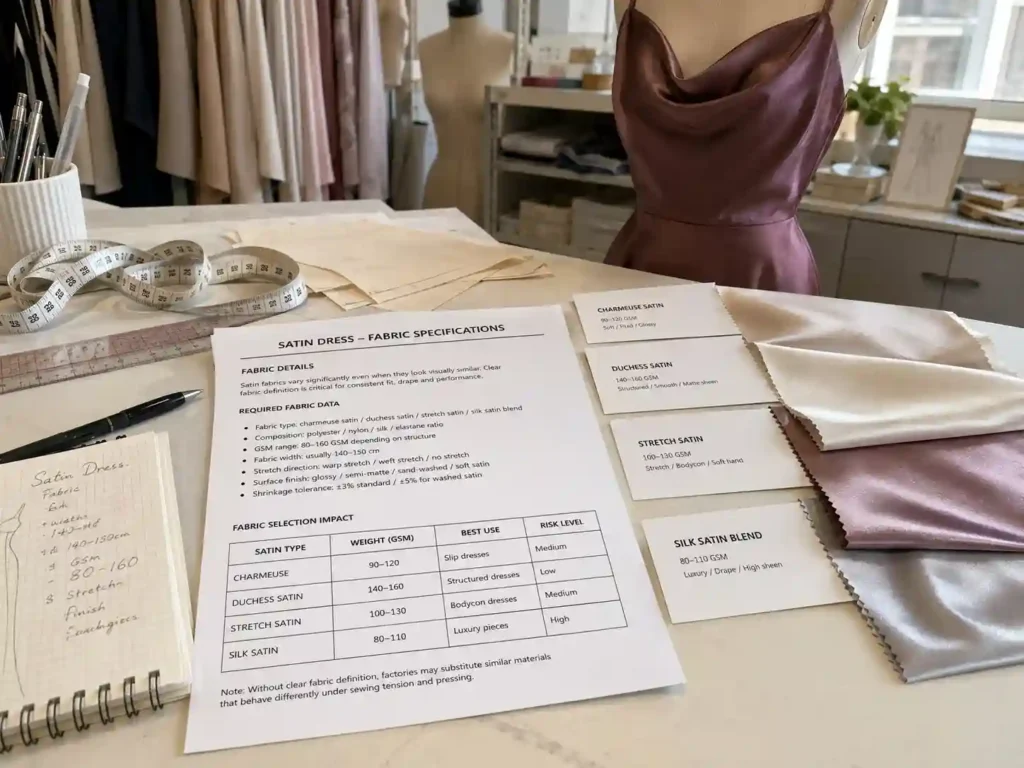
Fabric specification is one of the most critical parts of a satin dress tech pack. Satin fabrics vary significantly even when they look visually similar.
Required fabric data:
- Fabric type: charmeuse satin / duchess satin / stretch satin / silk satin blend
- Composition: polyester / nylon / silk / elastane ratio
- GSM range: 80–160 GSM depending on structure
- Fabric width: usually 140–150 cm
- Stretch direction: warp stretch / weft stretch / no stretch
- Surface finish: glossy / semi-matte / sand-washed / soft satin
- Shrinkage tolerance: ±3% standard / ±5% for washed satin
Fabric Selection Impact Table:
| Satin Type | Weight (GSM) | Best Use | Risk Level |
|---|---|---|---|
| Charmeuse | 90–120 | Slip dresses | Medium |
| Duchess Satin | 140–160 | Structured dresses | Low |
| Stretch Satin | 100–130 | Bodycon dresses | Medium |
| Silk Satin | 80–110 | Luxury pieces | High |
Without clear fabric definition, factories may substitute similar materials that behave differently under sewing tension and pressing.
What trims and construction details are required?
Trims and construction define both garment stability and visual finish. In satin dresses, trim selection directly affects comfort, durability, and seam appearance.
Required trim information:
- Zipper type (invisible / coil / metal, brand preference like YKK)
- Lining fabric (chiffon / satin / stretch lining)
- Elastic type (if waist support is required)
- Hook & eye placement (center back or side seam)
- Boning structure (for structured bodice designs)
- Label type and placement (heat transfer / woven label)
Construction details must include:
- Seam type: French seam / overlocked seam / bound seam
- Seam allowance: typically 0.7 cm–1.5 cm depending on structure
- Stitch density: 3.0–3.5 mm for satin fabrics
- Reinforcement zones: zipper base, slit opening, bust point
- Edge finishing: rolled hem / narrow hem / facing finish
Trim Risk Comparison Table:
| Component | Incorrect Choice Risk | Production Impact |
|---|---|---|
| Zipper | High | Breakage / misalignment |
| Lining | Medium | Drape distortion |
| Stitch type | High | Visible seam marks |
| Elastic | Medium | Waist instability |
Do sketches and technical drawings matter?
Visual drawings are essential but must support measurable data, not replace it. In satin dress production, sketches guide structure understanding, but cannot guarantee accuracy alone.
Required visual components:
- Flat technical sketch (front and back)
- Close-up detail drawings (neckline, waist, slit)
- Stitch line mapping
- Panel breakdown diagram
- Dart and seam placement illustration
Important control point:
A sketch without measurements leads to interpretation variance. A factory may understand shape correctly but execute completely different proportions.
Best practice is combining:
- Sketch (visual structure)
- Measurement sheet (numerical control)
- Construction notes (execution rules)
This combination ensures consistency from sampling to bulk production.
Why missing information leads to production failure in satin dresses?
Satin garments are highly sensitive to incomplete technical input. Even small gaps create compounding errors during production.
Most common missing points include:
- Undefined lining thickness
- Missing seam direction for bias-cut areas
- No stretch direction specification
- No hem finishing standard
- No grading logic between sizes
Production risk impact:
| Missing Info | Result in Sampling |
|---|---|
| Lining detail | Dress collapses or becomes stiff |
| Seam direction | Uneven drape |
| Fabric GSM | Wrong weight selection |
| Grading rule | Size inconsistency |
In real factory conditions, missing data forces technicians to “assume,” and assumptions are the main cause of repeated sampling cycles.
What level of detail ensures stable production output?
A satin dress tech pack becomes production-stable when every element is measurable and directly executable.
Key stability indicators:
- Every measurement has tolerance defined (±0.5–1.5 cm)
- Fabric specification includes GSM + composition + finish
- Seam type is defined per construction zone
- Trim list includes brand or standard reference
- Visual drawings match measurement logic
When all five elements are complete, production accuracy improves significantly:
- First sample success rate increases by 40–70%
- Fabric waste decreases by 10–20%
- Development timeline becomes predictable
How to Structure a Tech Pack Step by Step?
A satin dress tech pack must follow a clear production logic sequence, not a random collection of files. The structure determines whether a factory can move directly into sampling or needs repeated clarification.
In real garment development, especially satin dresses, structure affects accuracy more than creativity. A well-structured tech pack reduces sampling cycles by 30–50% and prevents misinterpretation in pattern making, cutting, and sewing stages.
Start from design intent and silhouette definition
The first step is converting visual inspiration into a measurable garment direction. Without this step, every later stage becomes inconsistent.
Key inputs include:
- Dress silhouette type (slip / bodycon / A-line / bias cut)
- Neckline structure (straight / cowl / V-neck / asymmetric)
- Strap design (thin / wide / adjustable / cross-back)
- Fit intention (tight fit / relaxed drape / structured waist)
- Occasion category (evening / cocktail / resort)
Common mistake:
Only providing reference images without defining silhouette logic. Satin reacts differently depending on cut direction, so unclear structure leads to unpredictable drape outcomes.
Define garment construction and panel breakdown
After silhouette definition, the next step is building the structural framework of the dress.
Construction must clearly show:
- Front panel structure (1-piece / 2-piece / princess seam)
- Back panel structure (zipper seam / open back / smocking area)
- Dart placement (bust dart / waist dart / no dart)
- Seam direction (straight grain / bias cut)
- Side seam shaping logic
Production impact example:
| Construction clarity | Factory result |
|---|---|
| Fully defined panels | Accurate first sample |
| Missing dart info | Fit imbalance |
| No seam direction | Drape distortion |
Satin is especially sensitive to bias cutting—without clear panel mapping, fabric flow becomes inconsistent.
Set fabric specification and behavior rules
Fabric definition must go beyond naming the material. It must describe how the fabric behaves during production and wear.
Required data:
- Fabric type (charmeuse / duchess / stretch satin)
- Composition ratio (polyester / silk / spandex)
- GSM range (80–160 GSM typical range)
- Stretch direction (warp / weft / none)
- Shrinkage tolerance (±3% standard)
- Surface finish (glossy / matte / washed)
Fabric control table:
| Element | Specification Range | Risk if Missing |
|---|---|---|
| GSM | 90–160 | Wrong drape weight |
| Stretch | 0–20% | Fit inconsistency |
| Finish | Gloss / matte | Visual mismatch |
Fabric behavior directly influences seam tension, lining selection, and final silhouette stability.
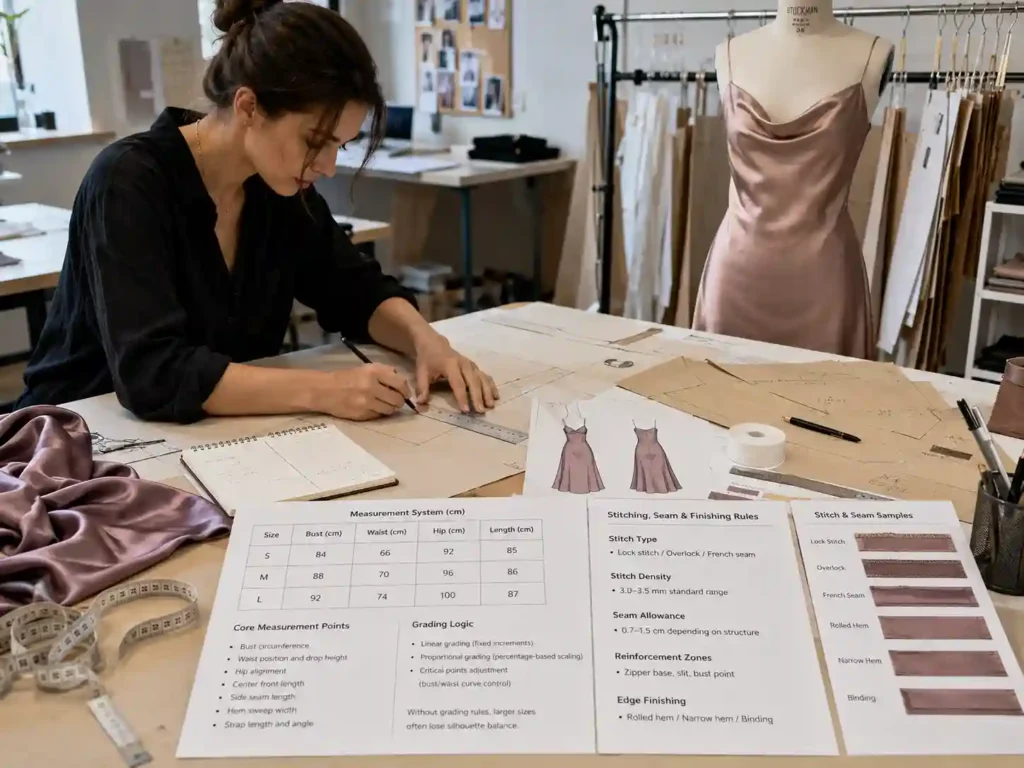
Build measurement system with grading logic
Measurement structure is one of the most important parts of a tech pack. It defines how the garment scales across sizes.
Core measurement points:
- Bust circumference
- Waist position and drop height
- Hip alignment
- Center front length
- Side seam length
- Hem sweep width
- Strap length and angle
Standard measurement example:
| Size | Bust (cm) | Waist (cm) | Hip (cm) | Length (cm) |
|---|---|---|---|---|
| S | 84 | 66 | 92 | 85 |
| M | 88 | 70 | 96 | 86 |
| L | 92 | 74 | 100 | 87 |
Grading logic must define:
- Linear grading (fixed increments)
- Proportional grading (percentage-based scaling)
- Critical points adjustment (bust/waist curve control)
Without grading rules, larger sizes often lose silhouette balance.
Specify stitching, seam, and finishing rules
Satin dresses require controlled stitching because surface quality is highly visible.
Key specifications:
- Stitch type: lock stitch / overlock / French seam
- Stitch density: 3.0–3.5 mm standard range
- Seam allowance: 0.7–1.5 cm depending on structure
- Reinforcement zones: zipper base, slit, bust point
- Edge finishing: rolled hem / narrow hem / binding
Stitch risk comparison:
| Stitch issue | Visual impact |
|---|---|
| Too dense | Fabric puckering |
| Too loose | Seam opening |
| Wrong type | Visible seam lines |
Correct stitching ensures satin surface remains smooth under lighting.
Add trims, lining, and structural support details
Trim selection defines both comfort and durability in satin dresses.
Required details:
- Zipper type (invisible recommended)
- Lining fabric (chiffon / satin / stretch lining)
- Elastic usage (waist or back support)
- Hook & eye placement
- Boning structure (for fitted bodices)
- Label position and method
Trim impact table:
| Component | Function | Risk if incorrect |
|---|---|---|
| Lining | Drape stability | Shape collapse |
| Zipper | Closure alignment | Misfit or break |
| Boning | Structure support | Bodice deformation |
Final technical sketch and validation check
The final step is aligning all technical data with visual representation.
Required drawings:
- Front and back flat sketch
- Close-up construction details
- Stitch line mapping
- Panel breakdown illustration
- Measurement annotation overlay
Before moving to sampling, a validation check should confirm:
- Measurements match sketches
- Fabric type aligns with construction
- Stitch rules match fabric behavior
- Trim selection supports structure
Validation checklist:
| Check item | Status required |
|---|---|
| Measurement completeness | 100% defined |
| Fabric confirmed | Yes |
| Construction mapped | Yes |
| Stitch rules defined | Yes |
| Trims finalized | Yes |
Why structured tech packs reduce sampling failures
When structure is followed correctly, production becomes predictable instead of experimental.
Typical improvements:
- First sample accuracy improves by 40–70%
- Sampling cycles reduced from 3–4 to 1–2
- Fabric waste reduced by 10–20%
- Development timeline becomes stable and measurable
A structured tech pack is not documentation—it is the control system that keeps satin dress production stable from design to bulk output.
How to Avoid Production Errors in Satin Dresses?
Production errors in satin dresses usually do not come from sewing skill—they come from missing control points in fabric specification, construction logic, and measurement alignment. Satin is highly sensitive to tension, seam direction, and heat, which means even small technical gaps can create visible defects in final garments.
A structured control system in the tech pack reduces production errors by 40–70% and significantly improves first-sample accuracy, especially for bias-cut or fitted satin silhouettes.
What are the most common production errors in satin dresses?
Satin dresses tend to fail in predictable areas. These issues are not random—they are directly linked to missing technical instructions before sampling begins.
Common production errors include:
- Seam puckering caused by incorrect stitch density
- Uneven drape due to wrong grainline direction
- Bust or waist imbalance from inaccurate dart placement
- Fabric shine inconsistency caused by improper pressing
- Zipper wave or rippling in back seams
- Hem twisting due to unstable fabric cutting
Error frequency impact table:
| Error Type | Root Cause | Visual Impact | Occurrence Rate (without control) |
|---|---|---|---|
| Seam puckering | Wrong stitch density | High | 35–50% |
| Drape imbalance | Grainline misalignment | Very High | 40–60% |
| Fit distortion | Poor grading logic | High | 30–45% |
| Zipper ripple | Weak reinforcement | Medium | 25–40% |
Most of these issues appear during first sampling when tech pack data is incomplete or unclear.
How does fabric specification control production accuracy?
Fabric is the most sensitive factor in satin dress production. Small changes in GSM, stretch direction, or finish can completely change garment behavior.
Key control points include:
- GSM must be fixed within ±5% tolerance
- Stretch direction must be clearly marked (warp or weft)
- Fabric finish must be defined (glossy / semi-matte / washed)
- Shrinkage rate must be confirmed before cutting
- Fabric width must be aligned with pattern layout
Fabric risk comparison:
| Fabric Issue | Production Result | Severity |
|---|---|---|
| Wrong GSM | Heavy or collapsed drape | High |
| Incorrect stretch | Tight or loose fit zones | High |
| Unknown shrinkage | Size inconsistency after wash | Very High |
Factories often substitute similar-looking satin if specifications are unclear, which leads to completely different garment behavior.
Why do pattern and grainline mistakes cause major defects?
Satin is extremely sensitive to grainline direction. Unlike structured fabrics, satin does not self-correct during wear, so any deviation becomes visible immediately.
Typical grainline-related issues:
- Bias cut not aligned properly → twisting dress body
- Straight grain used instead of bias → stiff drape
- Panel mismatch → asymmetric side seams
- Uneven cutting tension → warped hemline
Grainline impact table:
| Cutting Direction | Expected Result | Error Outcome |
|---|---|---|
| Correct bias cut | Fluid drape | Balanced silhouette |
| Incorrect bias | Twisting body | Hem imbalance |
| Straight grain error | Stiff structure | Poor movement |
Even a 2–3 degree deviation in cutting direction can affect the final silhouette in satin garments.
How do measurement and grading errors affect satin dresses?
Measurement errors are amplified in satin because fabric does not absorb structural inconsistencies. Every size must follow a controlled grading logic.
Common issues include:
- Waist position shifting across sizes
- Bust curve not scaling proportionally
- Hip width misalignment in larger sizes
- Dress length inconsistency between sizes
Grading impact table:
| Measurement Area | Small Error Impact | Production Risk |
|---|---|---|
| Bust | Tightness or gaping | High |
| Waist | Drape imbalance | Very High |
| Hip | Fit distortion | High |
| Length | Silhouette break | Medium |
A 1 cm grading error in waist or hip area can completely change the visual balance of a satin dress.
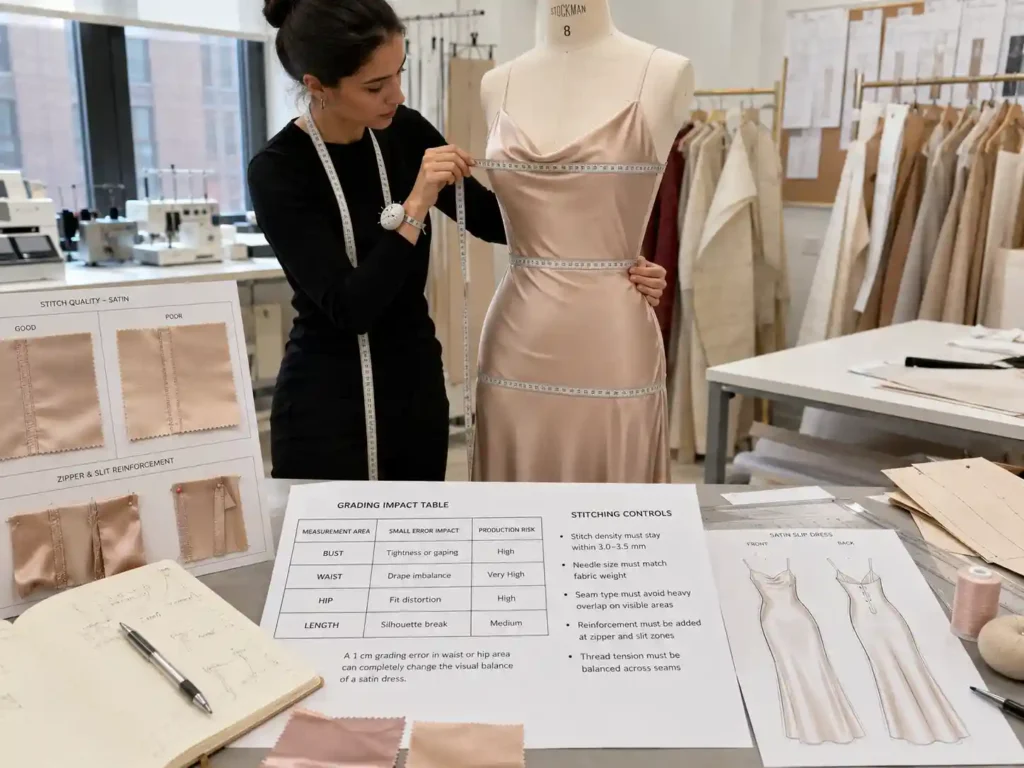
How does stitching control prevent visible surface defects?
Satin fabric shows every stitch clearly, so incorrect sewing parameters directly affect product appearance.
Critical stitching controls:
- Stitch density must stay within 3.0–3.5 mm
- Needle size must match fabric weight
- Seam type must avoid heavy overlap on visible areas
- Reinforcement must be added at zipper and slit zones
- Thread tension must be balanced across seams
Stitching risk table:
| Stitch Issue | Cause | Visual Result |
|---|---|---|
| Too dense | Over-tight tension | Fabric puckering |
| Too loose | Low tension | Seam opening |
| Wrong needle | Fabric damage | Surface marks |
Proper stitching control prevents surface distortion under light reflection, which is critical in satin garments.
How do construction and lining errors affect final garment quality?
Construction structure defines how satin behaves on the body. Without clear instructions, factories may choose different internal methods that change final output.
Common construction issues:
- Missing or incorrect lining weight
- Wrong seam allowance distribution
- Unstable dart positioning
- Improper zipper reinforcement
- No structure support in bodice area
Construction impact table:
| Construction Element | Error Result |
|---|---|
| Lining mismatch | Collapsed silhouette |
| Dart misplacement | Uneven bust shape |
| Weak zipper base | Back ripple formation |
| Wrong seam allowance | Fit inconsistency |
Lining alone can change drape behavior by 20–30% depending on weight and fabric type.
What control system reduces satin dress production errors?
A stable control system in tech pack development ensures every stage of production follows measurable instructions instead of assumptions.
Key control elements:
- Fixed fabric specification before sampling
- Locked measurement sheet with tolerance range
- Defined grainline and panel mapping
- Standard stitch density rules
- Verified trim and lining selection
Production stability result:
| Control Level | Sampling Cycles | Error Rate |
|---|---|---|
| Low control | 3–4 rounds | High |
| Medium control | 2–3 rounds | Medium |
| High control | 1–2 rounds | Low |
When all control points are defined before sampling, satin dress production becomes predictable, reducing rework and improving first-sample success rate by up to 70%.
What Makes a Tech Pack Factory-Ready?
A tech pack becomes factory-ready only when it removes interpretation from production and replaces it with measurable, executable instructions. In satin dress manufacturing, this is critical because fabric behavior is sensitive and cannot rely on visual assumptions alone.
A factory-ready tech pack allows pattern makers, sample rooms, and QC teams to work independently without repeated clarification. When structured correctly, it reduces sampling rounds by 30–60% and improves first-sample accuracy significantly.
What defines a factory-ready tech pack in real production?
A factory-ready tech pack is not defined by volume or number of pages, but by execution clarity on the factory floor.
Key requirements:
- Every measurement must be complete with tolerance range
- Fabric specification must be fully locked (no substitution room)
- Construction steps must be logically sequenced
- Stitch type and density must be defined per seam area
- Trim list must include exact specification or equivalent standard
- Visual sketch must match measurement structure exactly
If any one of these elements is missing, production teams must “interpret,” which increases error risk.
How complete should measurement and tolerance data be?
Measurement clarity determines whether a garment can be reproduced consistently across sizes and production batches.
A factory-ready tech pack must include:
- Full size range (XS–XL or custom grading)
- Key points: bust, waist, hip, length, strap, hem sweep
- Position control (waist drop, bust point alignment)
- Tolerance range per measurement
Standard tolerance reference:
| Area | Recommended Tolerance | Risk if Not Defined |
|---|---|---|
| Bust | ±1 cm | Fit inconsistency |
| Waist | ±1 cm | Drape imbalance |
| Hip | ±1–1.5 cm | Silhouette distortion |
| Length | ±1.5 cm | Proportion change |
Without tolerance rules, factories rely on internal judgment, which leads to inconsistent batch output.
How should fabric specification be defined for production clarity?
Fabric specification is one of the most important factory-ready checkpoints. Satin is particularly sensitive to substitution because similar-looking materials behave differently.
A complete specification must include:
- Fabric type (charmeuse, duchess, stretch satin)
- Composition ratio (polyester, silk, spandex blend)
- GSM range (e.g., 90–160 GSM)
- Fabric width (typically 140–150 cm)
- Stretch direction (warp, weft, or none)
- Surface finish (glossy, semi-matte, washed)
- Shrinkage allowance (±3–5%)
Fabric control impact:
| Missing Info | Production Result |
|---|---|
| GSM not defined | Wrong drape weight |
| Stretch direction missing | Fit distortion |
| Finish not specified | Visual mismatch |
Factories can only guarantee consistency when fabric parameters are fully locked before sampling.
What construction details are required to avoid interpretation errors?
Construction logic defines how fabric pieces interact during sewing. In satin dresses, unclear construction leads directly to drape instability and uneven structure.
Factory-ready construction must include:
- Panel breakdown (front, back, side pieces)
- Dart placement and intake values
- Seam direction (bias or straight grain)
- Zipper positioning and reinforcement method
- Lining attachment method (full/partial)
- Hem finishing method
Construction clarity comparison:
| Construction Detail | Outcome |
|---|---|
| Fully defined panels | Accurate sample |
| Missing dart logic | Fit imbalance |
| No seam direction | Twisted drape |
| No lining instruction | Structure collapse |
Satin dresses depend heavily on internal structure stability, not only external shape.
How do stitching and trim definitions affect production quality?
Stitching and trims determine both durability and surface appearance. Satin is highly visible under light, so incorrect stitching immediately affects product quality.
Required specifications:
- Stitch type (lock stitch, French seam, overlock)
- Stitch density (3.0–3.5 mm standard)
- Thread type and thickness
- Reinforcement zones (zipper, slit, bust point)
- Trim details (zipper brand, lining weight, elastic type)
Stitch risk table:
| Issue | Cause | Visual Effect |
|---|---|---|
| Puckering | High density | Fabric distortion |
| Seam opening | Low density | Weak structure |
| Uneven line | Wrong tension | Poor appearance |
Trim selection also affects long-term durability, especially in fitted satin silhouettes.

What role do sketches play in factory readiness?
Technical sketches are the visual confirmation of all structured data in the tech pack. However, sketches alone cannot guarantee production accuracy unless aligned with measurements and construction logic.
A factory-ready sketch includes:
- Front and back flat drawings
- Zoom-in construction details
- Stitch line indications
- Panel separation marks
- Measurement annotations
Key control point:
If sketch and measurement sheet do not match exactly, factories will default to visual interpretation, increasing error risk significantly.
What separates a production-ready tech pack from a basic one?
The difference is not complexity—it is usability in real production.
| Feature | Basic Tech Pack | Factory-Ready Tech Pack |
|---|---|---|
| Measurements | Partial | Fully defined + tolerance |
| Fabric | General name | Full specification |
| Construction | Visual only | Step-by-step logic |
| Stitching | Not defined | Fully controlled |
| Trim details | Missing or vague | Fully specified |
| Execution outcome | High revision rate | Stable first sample |
A factory-ready tech pack removes guesswork entirely and allows production teams to execute directly from documentation.
Why factory-ready tech packs reduce sampling cycles and cost?
When all production variables are clearly defined, factories no longer need trial-based interpretation.
Measured improvements:
- Sampling cycles reduced from 3–4 to 1–2 rounds
- Fabric waste reduced by 10–20%
- Development timeline shortened by 25–40%
- First-sample accuracy improved by up to 70%
In satin dress production, clarity at the tech pack stage directly determines cost efficiency and final garment consistency.
How Do Manufacturers Use Tech Packs in Sampling?
A tech pack becomes operational only when it enters the sampling room. At this stage, manufacturers translate all technical data into physical garments. For satin dresses, sampling is especially sensitive because fabric behavior reacts differently under cutting, stitching, and pressing conditions.
A complete tech pack allows sampling teams to execute without repeated clarification. In structured production systems, a strong tech pack can reduce sampling rounds from 3–4 cycles to 1–2 cycles and improve first-sample accuracy by up to 70%.
How does the factory interpret a tech pack before sampling starts?
Before any cutting begins, manufacturers first break down the tech pack into production modules. Each department extracts relevant information:
- Pattern team: silhouette, measurements, construction logic
- Fabric team: GSM, composition, stretch direction
- Sample room: stitching method, assembly sequence
- QC team: measurement tolerance and finishing standards
At this stage, missing or unclear data is flagged immediately. If fabric specification or construction logic is incomplete, sampling is paused to avoid material waste.
Pre-sampling evaluation checklist:
| Item | Factory Action | Risk if Missing |
|---|---|---|
| Fabric specification | Source matching fabric | Wrong material selection |
| Measurement sheet | Draft base pattern | Fit inconsistency |
| Construction notes | Plan sewing process | Assembly errors |
| Stitch rules | Set machine settings | Seam defects |
How is fabric sourcing controlled during sampling?
Fabric selection is one of the first physical steps after reviewing the tech pack. Satin requires strict matching because similar fabrics behave differently during sewing and pressing.
Manufacturers check:
- GSM accuracy (within ±5% range)
- Fabric stretch direction
- Surface finish consistency
- Color lab dip confirmation
- Shrinkage test results before cutting
If fabric is not fully defined in the tech pack, factories may propose alternatives, which often leads to drape variation or fit distortion.
Fabric control flow:
| Step | Action | Outcome |
|---|---|---|
| 1 | Tech pack review | Identify fabric specs |
| 2 | Supplier matching | Find closest material |
| 3 | Lab dip testing | Confirm color accuracy |
| 4 | Pre-cut approval | Lock material for sampling |
How is the first sample produced using the tech pack?
Once fabric is confirmed, the sampling room begins production. The tech pack acts as the only instruction source.
Execution steps:
- Pattern maker creates base pattern using measurement sheet
- Fabric is laid and cut according to grainline rules
- Sewing team follows stitch density and seam instructions
- Assembly follows construction sequence step by step
- Finishing team applies pressing and hemming standards
For satin dresses, the most critical control points during sampling are:
- Bias alignment accuracy
- Seam smoothness under light
- Draping balance on body form
Even small deviations in stitch tension or seam direction are visible in satin fabric.
How do manufacturers evaluate the first sample?
After the first sample is completed, internal evaluation begins. The tech pack is used as the reference benchmark.
Evaluation includes:
- Measurement accuracy against spec sheet
- Fabric behavior under movement
- Seam alignment and visibility
- Zipper and trim performance
- Overall silhouette consistency
Sample evaluation table:
| Evaluation Area | Acceptable Range | Common Issue |
|---|---|---|
| Bust fit | ±1 cm | Tight or loose tension |
| Waist position | ±1 cm | Drape imbalance |
| Seam straightness | Visual alignment | Wave distortion |
| Hem balance | Level tolerance | Twisting |
If deviations exceed tolerance, revision sampling is required.
What feedback loop happens after sample review?
Once the first sample is reviewed, feedback is documented and compared against the tech pack.
Typical feedback loop:
- Identify deviation points
- Compare with original tech pack instructions
- Adjust pattern or construction details
- Confirm fabric or trim correction if needed
- Produce revised sample
In well-prepared tech packs, feedback is usually minor. In incomplete tech packs, multiple revision cycles are required.
Sampling cycle comparison:
| Tech Pack Quality | Sampling Cycles | Development Time |
|---|---|---|
| Low detail | 3–4 rounds | 20–30 days |
| Medium detail | 2–3 rounds | 15–25 days |
| Factory-ready | 1–2 rounds | 10–18 days |

Why does tech pack accuracy determine sampling success?
Sampling success is not dependent on sewing ability alone. It depends on how clearly the garment is defined before production starts.
A strong tech pack ensures:
- No interpretation during cutting
- No ambiguity in construction
- No guesswork in fabric behavior
- No variation in measurement scaling
For satin dresses, where fabric sensitivity is high, even small documentation gaps can lead to visible defects. A complete tech pack turns sampling from a trial process into a controlled execution system.
What is the final outcome of a well-used tech pack in sampling?
When manufacturers work with a complete tech pack, sampling becomes predictable and efficient.
Typical results include:
- First sample accuracy above 80–90%
- Reduced fabric waste by 10–20%
- Faster approval cycles
- Stable transition into bulk production
- Lower cost per development style
A tech pack is not only documentation—it becomes the operational guide that keeps sampling aligned with production expectations from start to finish.
Start Your Custom Dress Development
If your brand is currently working with inspiration images but struggling with inconsistent sampling results, unclear factory communication, or repeated revisions, the next step is not more design—it is structured production clarity.
Jinfeng Apparel supports global fashion brands in converting inspiration photos into production-ready dresses with clear specifications, stable sampling processes, and scalable OEM/ODM manufacturing support.
From initial image breakdown to bulk production, each stage is aligned with factory execution logic to reduce errors and improve launch speed.
If you are developing your next dress collection, you can share your inspiration images and receive a production-ready development pathway tailored to your design direction.
Contact Jinfeng Apparel to start your custom dress development today.