Skip to content

A skater dress looks easy when it is hanging on a rail: a fitted upper section, a clear waistline, and a skirt that opens into a light, youthful flare. In production, however, that apparently simple silhouette is surprisingly sensitive. Move the waistline by one centimeter, choose a knit with weak recovery, or hem a circular skirt before the fabric settles, and the finished garment can look noticeably different from the approved sample.
Skater dresses are manufactured by converting a design into a fitted bodice and flared-skirt pattern, testing the selected fabric, producing and fitting samples, grading the approved pattern, cutting controlled fabric layers, assembling the bodice and skirt, stabilizing the waist seam, finishing the hem, and inspecting measurements, balance, workmanship, labels, and packaging before shipment.
The real manufacturing challenge is not producing one attractive sample. It is repeating the same bust fit, waist position, skirt sweep, hem level, and wearing comfort across several colors, a full size range, and hundreds or thousands of garments. A black sample may look perfect, while an ivory bulk version becomes transparent and a red version hangs lower at the back. The following process explains where those differences begin and how experienced teams control them before cartons are closed.
What Is a Skater Dress?
A skater dress combines a fitted or shaped bodice with a skirt that flares from a defined waistline. The skirt may be panelled, gathered, half-circle, or full-circle. Its recognizable appearance comes from the contrast between a controlled upper body and a lower section that moves freely without fitting closely around the hips.
What Defines the Shape?
A skater dress is not defined by skirt length alone. Its identity comes from the way a relatively close-fitting bodice meets a noticeably fuller skirt. Most versions place that transition near the natural waist, although a raised or slightly dropped seam can be used to change the proportion. The bodice may be shaped with darts, princess seams, curved side seams, stretch reduction, or an internal support layer, depending on the fabric and intended wearing occasion.
The skirt is responsible for the movement associated with the style. A gently flared panelled skirt creates a controlled everyday outline, while a half-circle construction adds stronger sweep without using as much material as a full circle. A full-circle skirt creates the most dramatic rotation, yet it also increases fabric consumption and introduces more bias sections that may lengthen while hanging. The visually strongest construction is therefore not always the most efficient or the most stable in bulk production.
Four relationships decide whether the finished silhouette feels balanced: the waist seam must sit at the intended body position; the bodice must remain stable under the skirt weight; the flare must be distributed evenly around the body; and the hem must settle to a consistent level. A garment can meet its measurement chart and still look wrong when one of these relationships is neglected. A low back waist, for example, can make the entire skirt appear to fall backward even when the nominal skirt length is correct.
How Is It Different?
Skater dresses, A-line dresses, and fit-and-flare dresses overlap, but the terms are not interchangeable in production. An A-line dress may widen gradually from the bust, underarm, waist, or hip and may not contain a horizontal waist seam at all. Fit-and-flare is a broader category covering many dresses with a shaped upper body and a fuller lower section. A skater dress usually has a clearer waist break, a lighter visual character, and a skirt designed to show movement during walking or turning.
These distinctions matter because style names alone do not give a pattern maker enough information. Two reference images described as skater dresses may use completely different skirt geometries, waist positions, lining systems, and fabric weights. A development pack should therefore identify the finished waist position, total skirt length, panel count, approximate hem sweep, intended fit, and desired movement. Those details reduce interpretation errors far more effectively than repeating a trend label in the product name.
| Dress Type | Upper-Body Fit | Flare Starting Point | Typical Movement | Frequent Production Concern |
| Skater dress | Fitted or shaped | Defined waist | Moderate to strong | Waist stretching and uneven hem |
| A-line dress | Semi-fitted | Bust, waist, or hip | Controlled | Side-seam and front-back balance |
| Fit-and-flare dress | Fitted | Waist or high hip | Moderate to full | Bodice-to-skirt proportion |
| Bodycon dress | Close-fitting | Little or no flare | Minimal | Stretch recovery and seam tension |
| Babydoll dress | Loose below bust | Empire line | Soft volume | Excess fullness and proportion |
Which Variations Are Common?
Skater dresses appear in casualwear, partywear, graduation collections, resort ranges, homecoming programs, and seasonal fashion capsules. The same basic silhouette can feel relaxed in cotton-spandex, polished in satin, romantic in lace, or sharply structured in ponte. Common versions include jersey mini dresses, long-sleeve ponte styles, sleeveless printed woven dresses, satin party pieces, lace-overlay occasion dresses, corset-inspired bodices, mesh-panel club styles, and layered tulle or organza skirts.
Construction complexity can vary widely. A simple knit style may use a relatively small group of main pattern pieces and pull over the head without a zipper. A lined occasion style may require separate shell and lining pieces, cups, interfacing, a zipper, sleeves, facings, decorative panels, and multiple skirt layers. More pieces do not automatically create better quality, but they increase cutting time, sewing operations, matching requirements, and inspection points. The most commercially dependable version is normally the one whose visual impact can be repeated without making the process unnecessarily fragile.
- Jersey mini dresses for casual and club collections
- Ponte styles with a cleaner, more structured flare
- Satin and lace versions for party or graduation programs
- Printed woven dresses for resort and seasonal ranges
- Corset-inspired bodices with panelled or circular skirts
Is It a Figure-Skating Dress?
A women’s fashion skater dress is different from a professional figure-skating costume. The names overlap because the fashion silhouette was influenced by the short, flared movement associated with skating outfits, but the technical expectations are not the same. Performance costumes are engineered for athletic extension, rapid movement, stage visibility, and secure decoration, while fashion versions are designed for retail sizing, walking, sitting, photography, washing, and normal garment care.
A figure-skating costume may use four-way stretch performance fabric, attached briefs, reinforced embellishment, stretch mesh, rhinestones, and highly mobile sleeve construction. A fashion skater dress may be knitted or woven and can prioritize softness, structured volume, occasionwear presentation, or cost control. Clear development language matters. Describing a product as a ‘women’s fashion skater mini dress with a fitted bodice and half-circle skirt’ prevents sourcing teams from quoting athletic fabrics or competition-specific construction that the collection does not require.
Which Fabrics Work Best?
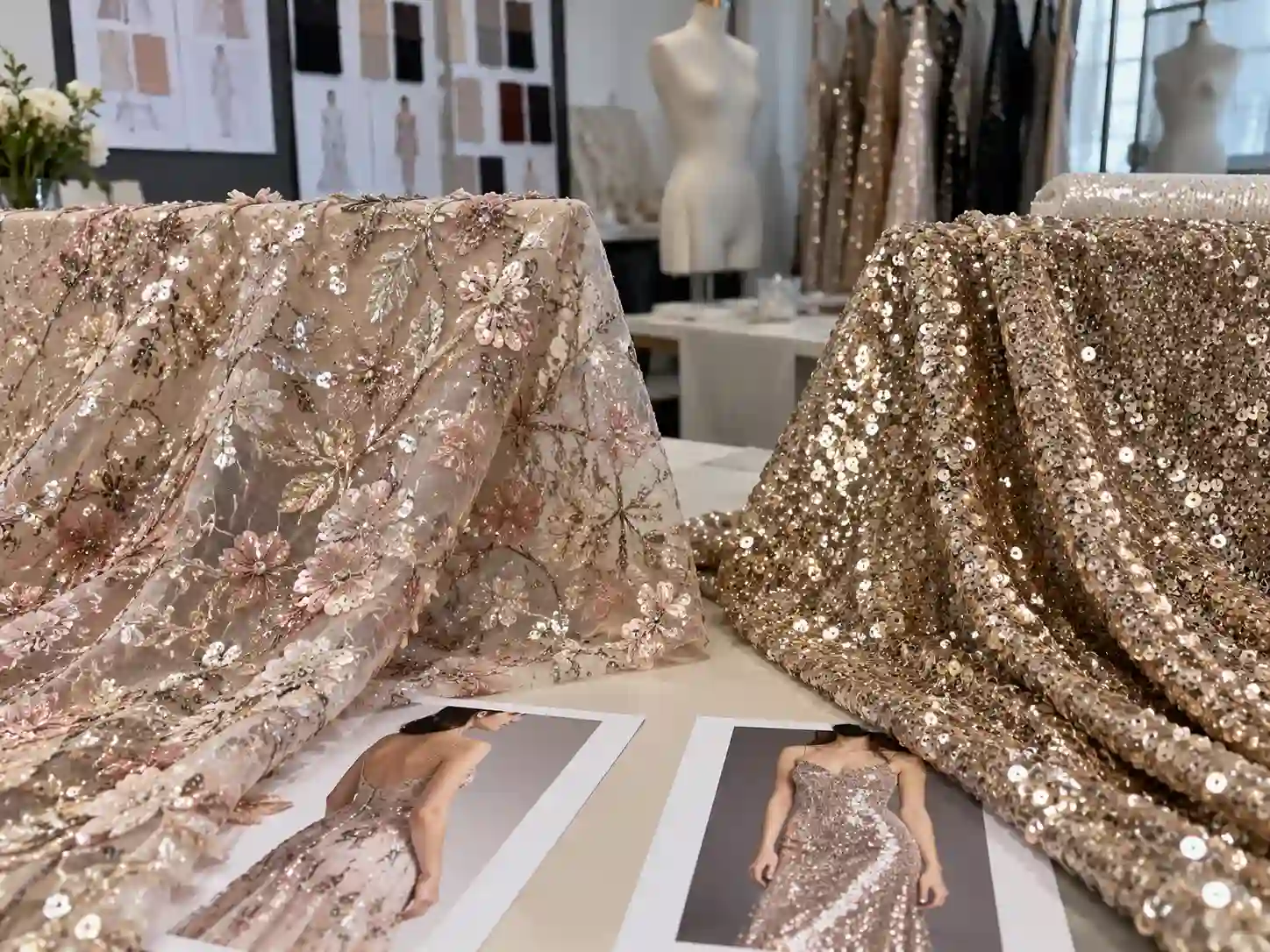
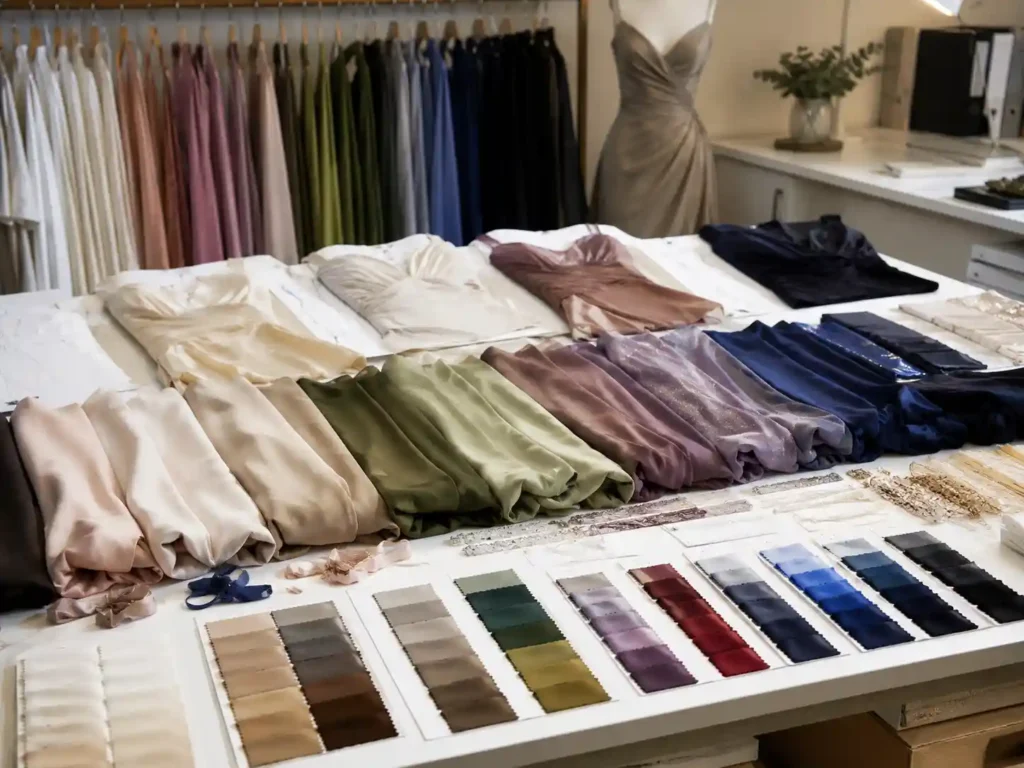
The best fabric depends on the required flare, comfort, structure, opacity, and retail position. Jersey and lightweight knits create softer movement, while ponte, Roma knit, and scuba hold a stronger shape. Satin, crepe, cotton blends, lace, chiffon, and organza can also work when the pattern, lining, closure, and hem method are adapted correctly.
Which Knit Fabrics Are Suitable?
Knitted fabrics are popular because they stretch around the bust and waist, provide comfortable movement, and can reduce the need for darts or a zipper. Stretch percentage alone, however, does not determine suitability. Recovery, weight, thickness, opacity, shrinkage, pilling, and dimensional stability are equally important. A fabric may stretch easily during a hand test yet fail to return to its original width after several hours of wear, allowing the waist seam or neckline to grow.
Lightweight jersey creates a fluid, casual silhouette and works well for easy daywear. Cotton-spandex can feel natural and comfortable but often needs careful shrinkage control. Polyester-spandex is commonly chosen for stable color and repeatable recovery, although heat exposure during pressing must be managed. Ponte and Roma knit provide cleaner structure and a more controlled flare, while scuba can create strong volume with fewer layers. Dense fabrics also add seam bulk and skirt weight, so the bodice and waist seam must be engineered to carry them.
Fabric should be judged in garment form rather than from a small cutting alone. A swatch that appears opaque while relaxed may become transparent over the bust or seat. A knit that looks stable on a table may spiral after washing or pull the skirt downward after several hours on a hanger. Sampling the actual silhouette provides more useful information than relying only on supplier specifications.
| Fabric | Common Working Weight | Stretch or Structure | Likely Silhouette | Key Production Check |
| Lightweight jersey | 140-200 gsm | Moderate width stretch | Soft and flowing | Recovery and transparency |
| Cotton-spandex | 170-240 gsm | Comfortable stretch | Casual and natural | Wash shrinkage |
| Polyester-spandex | 160-240 gsm | Stable stretch | Smooth and repeatable | Heat sensitivity |
| Ponte or Roma | 250-360 gsm | Firm controlled stretch | Structured flare | Seam bulk and skirt weight |
| Scuba knit | 220-320 gsm | Moderate stretch, high body | Pronounced volume | Needle marks and pressing |
| Satin or crepe | 90-220 gsm | Woven drape varies widely | Fluid to polished | Bias growth and puckering |
Which Woven Fabrics Can Be Used?
Woven fabrics offer less natural stretch, so shaping is created through darts, princess seams, curved panels, gathers, or carefully controlled ease. Fitted woven bodices normally need a zipper, button opening, elasticated section, or neckline wide enough for dressing. Satin is popular for party and occasion collections because of its polish and movement, but its reflective surface makes puckering, inconsistent cutting direction, and pressing marks easy to see.
Crepe usually gives a softer, more forgiving surface, while cotton blends can produce a crisp casual silhouette. Viscose and rayon provide attractive drape but may lengthen on bias sections. Chiffon and lace usually need lining and narrow seam finishing. Organza provides volume with limited material weight, although excessive stiffness can make the dress feel costume-like. Fabric width also matters: narrow goods may force additional skirt seams, while wider goods may allow larger circular sections with fewer joins.
Before approval, the production team should review shrinkage, bow and skew, seam slippage, fraying, surface direction, print repeat, color consistency, pressing temperature, and lining compatibility. Two woven fabrics with similar fiber content can behave very differently because yarn size, weave density, finishing, and coating affect the final garment as much as the fiber name printed on the header card.
How Does Fabric Affect the Flare?
Skirt flare comes from the interaction between pattern geometry and material behavior. A full-circle pattern does not guarantee a dramatic outline, and a smaller panelled skirt does not automatically look flat. Lightweight viscose tends to fall closer to the body, while ponte opens away from the hips and holds a more stable shape. Satin moves elegantly but exposes uneven cutting and pressing, whereas organza creates volume quickly but can feel rigid in casual collections.
The most influential properties are drape, bending stiffness, weight, thickness, stretch, recovery, surface friction, and bias growth. Circle and half-circle skirts contain areas cut close to the bias direction. Soft woven fabric can lengthen in those areas after hanging, which is why a hem levelled immediately after assembly may later appear uneven. Allowing the unfinished garment to settle before final hemming is often more reliable than trying to press an unstable hem into place.
Development comments should describe movement in practical terms: soft and close to the body, visible flare while walking, strong shape for product photography, full rotation, minimal waist bulk, or consistent volume through extended sizes. These descriptions help the pattern and fabric teams work toward the same result. Simply requesting a ‘full skirt’ leaves too much room for interpretation and may produce a garment that is visually impressive but too costly, heavy, or unstable for the intended program.
- Soft movement close to the body
- Visible flare while walking
- Strong shape for product photography
- Full rotation without excessive waist bulk
- Consistent volume through the complete size range
When Are Linings or Zippers Needed?
A lining is appropriate when the shell is transparent, scratchy, unstable, or likely to cling. It can also create a cleaner interior and support a structured bodice. The lining must be compatible with the outer fabric, because a stiff lining can restrict a fluid skirt and a heavy lining can pull down a lightweight bodice. The lining hem normally sits safely above the shell so it remains concealed during walking, sitting, and inspection.
Zippers are common in fitted woven styles because the waist opening may not pass comfortably over the shoulders or hips. Invisible zippers create a clean appearance but require accurate seam length, balanced tension, and careful pressing to avoid waves. Stretch styles may pull over the head without a zipper when the neckline and fabric recovery allow it. Supporting components can include lightweight interfacing, clear elastic, stay tape, bra cups, boning, anti-slip elastic, shoulder tape, or waist stabilizers.
Removing a zipper, lining, or stabilizing component can lower unit cost, but it may also reduce opacity, support, dressing comfort, or durability. Sound cost engineering removes unnecessary complexity while protecting the functions that make the dress wearable. A lower component count is useful only when the revised construction still delivers the approved fit and appearance.
How Is the Pattern Developed?
Pattern development converts a sketch, reference garment, image, tech pack, or measurement chart into accurate bodice and skirt components. The pattern maker defines bust shaping, neckline, armhole, waist position, skirt volume, length, seam allowance, closure, lining, and grading rules before the style can be sampled and reproduced reliably in bulk.
How Is the Bodice Created?
The bodice determines how the dress sits around the shoulders, bust, neckline, armholes, and waist. It must also remain stable under the weight of the skirt. A stretch bodice may use reduced finished measurements so the fabric fits closely after extension, while a woven bodice needs positive ease and three-dimensional shaping through darts, princess seams, gathers, panels, or curved side seams.
Pattern development begins by reviewing the bust, high bust, underbust, shoulder width, shoulder slope, front and back body lengths, neckline dimensions, armhole shape, sleeve cap, side-seam position, waist circumference, closure length, and lining structure. Reference images are valuable for visual direction, but they cannot reveal the true garment measurements, fabric stretch, internal support, or back coverage. A measurement chart or an approved proposed specification is still required for controlled development.
The target market must be clear because fit expectations differ among US, UK, EU, Australian, alpha, petite, tall, and extended-size systems. A useful first pattern does not simply copy the tightest possible interpretation of a photograph. It preserves the design while allowing breathing, sitting, dressing, and arm movement. When those functions are ignored, a photogenic sample can become a high-return production style.
How Are the Waist and Skirt Drafted?
Waist placement changes the entire visual proportion. A seam shifted by one centimeter can make a short dress look noticeably higher or lower, especially on a fitted bodice. The waist may follow the natural body level, sit slightly above it, drop below it, or curve to create a shaped front. The selected position must be measured consistently from stable reference points such as the high shoulder point rather than judged only by eye.
Once the waist is established, the skirt can be drafted as a two-piece A-line, a four-, six-, or eight-panel flare, a gathered rectangle, a half circle, a three-quarter circle, or a full circle. Panelled skirts give controlled flare and often improve marker efficiency. Half-circle skirts create stronger movement with moderate consumption. Full circles provide the largest sweep but introduce more bias growth, wider cutting requirements, and longer hemming operations.
The upper skirt seam must match the finished bodice waist after accounting for gathers, pleats, stretch reduction, or elastic. Notches and balance marks help align side seams, center fronts, center backs, and decorative panels. Before sample approval, the development record should identify the finished waist position, panel count, skirt length, approximate hem circumference, seam placement, and desired movement.
| Pattern Area | Working Check | Common Development Adjustment | Reason for Control |
| Waist-seam matching | Bodice and skirt seam lengths | Correct within a few millimeters before sewing | Prevents puckering and uneven feeding |
| Side-seam alignment | Front and back balance | Rebalance length or grain when seams twist | Keeps skirt distribution symmetrical |
| Finished skirt length | Waist seam to hem | Often adjusted in 0.5-1.0 cm steps during sampling | Protects proportion and coverage |
| Neckline depth | High shoulder point to edge | Often adjusted in 0.5-1.5 cm steps | Controls coverage and gaping |
| Waist position | High shoulder point to seam | Often adjusted in 0.5-1.0 cm steps | Changes the entire silhouette |
| Hem balance | Front, back, and side level | Level after fabric has settled | Controls bias growth |
How Is the First Sample Fitted?
The first sample tests the pattern, fabric, construction, and wearing experience together. It should be reviewed on an approved fit model or a dress form representing the base size. The fitting checks whether the neckline lies flat, bust coverage is appropriate, armholes remain closed, the waist seam is level, side seams hang vertically, and the skirt distributes its volume evenly around the body.
The dress should also be evaluated while walking, sitting, raising the arms, and dressing. Short skater dresses can appear acceptable when standing still but become uncomfortable or expose too much during movement. The team should examine zipper strain, lining visibility, skirt lift, fabric recovery, and whether the bodice shifts under the skirt weight. Product photography can be considered, but camera-ready shaping should not replace realistic comfort and sizing.
Comments need measurable language. ‘Raise the underarm by 1 cm, reduce the front neckline depth by 0.8 cm, and remove 1.5 cm from the total waist’ can be applied to the pattern and checked in the next sample. Comments such as ‘make it fit better’ create uncertainty and make version control difficult. Photographs marked with measurement points are especially helpful when the fitting team and factory are in different countries.
- Neckline flatness and bust coverage
- Armhole closure and shoulder comfort
- Level waist seam and vertical side seams
- Skirt balance during walking and sitting
- Zipper strain, lining visibility, and fabric recovery
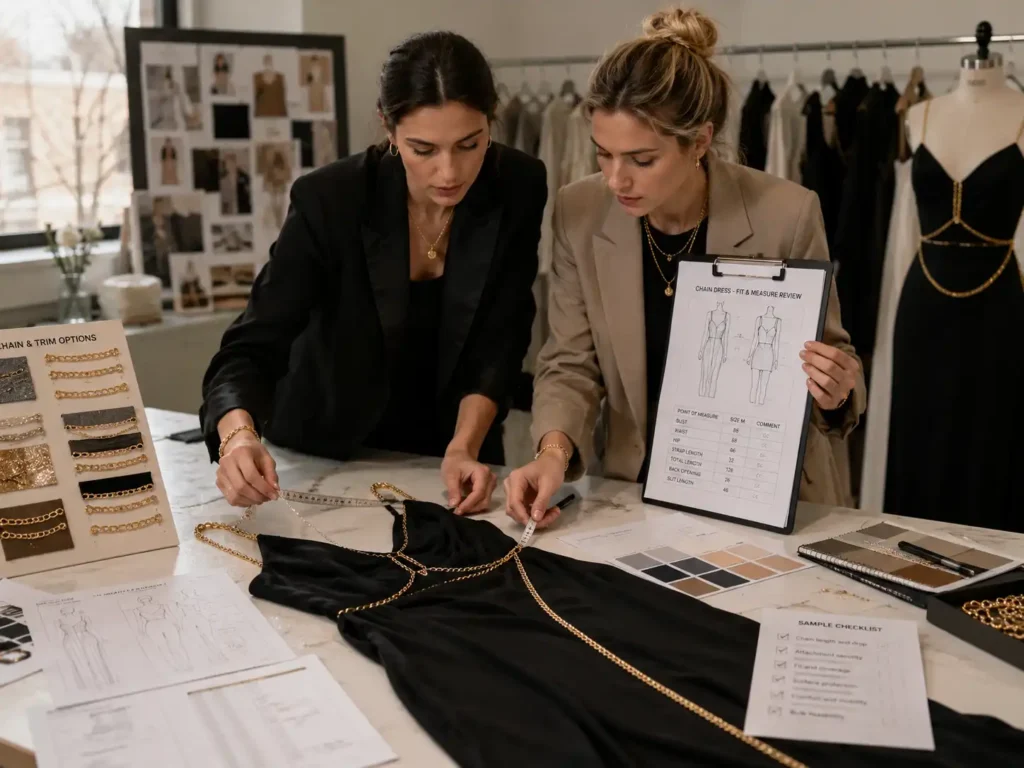
How Are Sizes Graded?
After the base size is approved, the pattern is graded into the required range. Grading does not mean enlarging every area by the same amount. Bust, waist, shoulder, armhole, sleeve width, body length, skirt length, and hem circumference may use different increments. Curves must remain smooth, corresponding seams must continue to match, and the characteristic silhouette should remain recognizable in every size.
The brand should confirm the base size, target market, numeric or alpha system, size range, measurement increments, petite or tall adjustments, extended-size rules, finished tolerances, and order ratio. Skirt sweep deserves specific attention. Keeping exactly the same hem circumference across all sizes can make larger sizes look straighter, while increasing it too quickly adds material, weight, and waist bulk. The grading plan should preserve visual proportion without creating unnecessary consumption.
A graded pattern nest should be reviewed for unexpected jumps, distorted armholes, sharp waist curves, mismatched seam lengths, and irregular grading around straps or necklines. An additional fit sample in a larger or smaller size is valuable when the range is broad, the bodice is highly fitted, or the fabric has limited stretch. This extra check costs less than correcting an entire size group after production begins.
How Are Skater Dresses Produced?
Skater dresses move through material inspection, fabric relaxation, marker planning, spreading, cutting, bundling, sewing, in-line inspection, finishing, measurement, final inspection, labeling, and packing. The production route changes according to fabric type, lining, sleeves, zipper construction, skirt volume, print direction, and embellishment, so the approved sample must guide every major operation.
How Are Fabrics Prepared?
Production begins with material control rather than cutting. Fabric rolls are checked against the approved quality, color, width, weight, handle, stretch, and surface. Typical incoming checks include roll width, shade consistency, holes, stains, bow, skew, print direction, stretch percentage, recovery, shrinkage, colorfastness, and visible surface marks. The inspection depth depends on the fabric and client standard, but obvious risks should be identified before the cutting room creates hundreds of irreversible panels.
Knitted fabric may need relaxation because tension from rolling can temporarily change its width and length. Cutting a high-stretch knit immediately after unrolling can produce panels that change dimension before sewing. Woven fabrics may require shrinkage testing or controlled pre-treatment. Satin, velvet, and brushed fabrics need consistent cutting direction because reflected light or pile direction can make adjacent panels appear to be different colors even when they came from the same roll.
Shade grouping is particularly important when the bodice and skirt form large uninterrupted color areas. Panels from different dye lots should not be mixed carelessly within one garment. A difference that is difficult to see under factory lighting may become obvious in a store, photography studio, or daylight. Clear roll identification and bundle control are therefore part of appearance management, not merely warehouse administration.
How Are Patterns Cut?
Marker planning determines how pattern pieces are arranged across the fabric width. Efficient markers reduce waste, but grain direction, stretch direction, nap, shine, print placement, stripe matching, and quality zones take priority over the lowest possible consumption. Circle skirts can use substantial width, and narrow fabric may require several skirt seams. A panelled alternative may improve usage while maintaining a similar visual effect.
The cutting team controls grain-line alignment, layer height, cutting accuracy, notches, drill marks, panel numbering, shade grouping, and bundle identification. Slippery satin and chiffon can shift in high lays, so excessive layer height may create more recutting and sewing problems than it saves in cutting time. Sharp tools, controlled spreading tension, and clean tables matter because distorted pieces cannot be corrected reliably at the sewing machine.
After cutting, components are counted and bundled by color, size, shade group, and production batch. Bundle tickets help prevent small and medium panels from being mixed or shell pieces from being joined to the wrong lining size. A skater dress contains visually large skirt sections, so even small cutting inconsistencies can become obvious at the waist seam or hem. Accurate cutting is one of the least visible but most decisive stages in the final appearance.
How Are the Parts Sewn?
The sewing sequence varies with construction, but most styles begin by preparing bodice panels, darts, princess seams, cups, or facings before shoulder and side seams are closed. Skirt panels are assembled separately, then joined to the bodice at the waist. Sleeves, lining, and zipper operations may be inserted earlier or later depending on access and seam finish. A planned sequence reduces handling damage and avoids closing an area before the next operation can be completed cleanly.
The waist seam is especially sensitive because the skirt can stretch or distort the lower edge of the bodice. Depending on the material, the line may use clear elastic, stay tape, controlled feeding, or another stabilizing method. Operators must avoid stretching one layer more than the other. Unequal feeding creates ripples, shifts side seams, and concentrates flare in the wrong area. The first finished units should be checked before the full line repeats the operation.
Seam and needle choices follow fabric behavior. Jersey may use overlock and coverstitch construction with stretch-compatible thread and tension. Satin may require a fine lockstitch needle and careful pressure control to avoid puckering. Chiffon may use narrow seams or clean enclosed finishes, while lace edges and sequin fabrics need specialized handling. The approved sample should define the visible seam quality, internal finish, stitch density, and acceptable bulk.
- Prepare bodice shaping and internal support
- Assemble shoulders, neckline, sleeves, and side seams
- Join and balance the skirt panels
- Stabilize and attach the bodice-to-skirt waist seam
- Insert closures, attach lining, finish hems, and press
How Are Finishing and Packing Handled?
Finishing includes thread trimming, stain removal, pressing, measurement, label verification, metal detection when required, folding, and packing. Pressing must suit the fabric. Excessive heat can mark satin, flatten velvet, distort stretch material, or change a synthetic fabric’s surface. The goal is to shape and smooth the dress without hiding defects temporarily or changing its approved dimensions.
Hemming methods include twin-needle coverstitch, narrow rolled hem, baby hem, blind hem, clean-turn hem, binding, and overlock with turn-back. Circular hems require particular care because sections cut near the bias may have lengthened. The skirt should be allowed to reach a stable hanging condition before it is levelled and finished. Trying to force an unstable hem into line with pressing often creates a short-lived correction rather than a durable result.
Private-label packing can include the main label, size label, care label, hangtag, barcode, polybag, size sticker, tissue, and carton marks. Packing must protect the silhouette without adding unnecessary volume. Embellished or structured dresses may need tissue, protective film, or individual placement, while simple knit styles can be folded more compactly. Final packing checks confirm that the correct size, color, labels, barcode, folding method, and carton assortment travel together.
How Is Quality Controlled?
Quality control verifies that bulk garments match the approved sample, measurement chart, fabric standard, construction details, color, labels, and packaging. For skater dresses, inspectors focus on waist-seam stability, skirt balance, hem level, side-seam twisting, neckline shape, zipper appearance, fabric recovery, lining coverage, and consistency across colors and sizes.
What Measurements Matter?
Measurements must be taken using an agreed method. Two inspectors can obtain different results when one stretches the garment, measures along a curve, or chooses a different point at the waist seam. Important points commonly include bust, waist, shoulder width, front and back body lengths, armhole, sleeve length, waist-seam position, skirt length, total garment length, hem circumference, zipper length, and lining length.
Finished tolerances vary by product, measurement point, fabric, size, and client standard. Smaller areas such as straps, necklines, and waist placement normally need tighter control than long skirt measurements. Stretch garments also require a defined measuring condition because aggressive tension can make almost any piece appear to meet the chart. Measurement results should be recorded by size and compared with both the approved specification and the visual fit of the sample.
Measurement alone cannot confirm appearance. A dress may fall within the numeric tolerance yet hang unevenly because the back bodice is too long or one skirt panel has grown on the bias. Inspectors therefore combine table measurement with visual checks on a hanger, mannequin, or fit model. The purpose is to confirm that the numbers produce the intended silhouette rather than treating the chart as an isolated pass-or-fail exercise.
| Quality Point | Practical Check | Frequent Risk | Production Response |
| Waist seam | Measure and inspect level around body | Stretching, ripples, uneven flare | Stabilize seam and control feeding |
| Skirt length | Compare front, back, and sides after settling | Bias growth and uneven hem | Rest, level, and recheck before hemming |
| Bust and waist | Compare with approved size chart | Incorrect fit or strain | Correct pattern, seam allowance, or process |
| Side seams | Check vertically on form | Twisting or pull | Review grain, panel balance, and matching |
| Neckline | Inspect flatness and symmetry | Gaping or stretching | Adjust pattern and stabilization |
| Zipper | Close and inspect from both sides | Waves or distortion | Correct insertion tension and seam length |
| Lining | Check while standing and moving | Exposure or restriction | Adjust length, width, and attachment |
| Labels and packing | Verify size, care data, barcode, and assortment | Wrong SKU or presentation | Audit before carton sealing |
How Is Skirt Balance Checked?
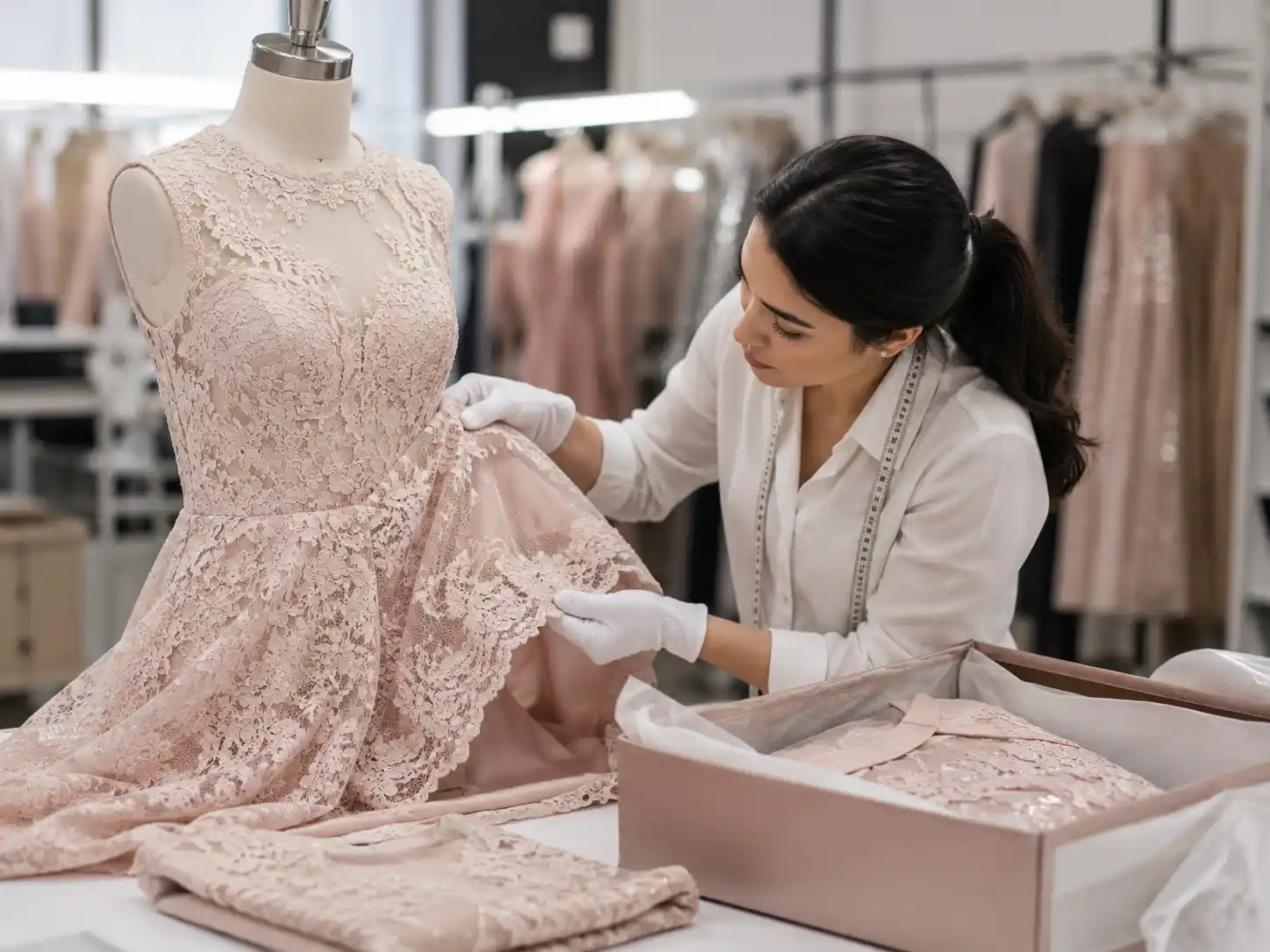
Skirt balance is one of the most important quality points in a skater dress. The garment is reviewed for front and back hem level, left and right symmetry, even flare distribution, side-seam position, panel alignment, waist-seam level, lining concealment, print direction, and movement. A dress can look level on a table yet drop differently once the skirt hangs from the body, so more than one inspection position is useful.
Circular and strongly flared skirts contain bias areas that may lengthen naturally. This response does not always mean the material is defective or the cutting is inaccurate. The production process must allow the fabric to settle before the final hem is levelled. If one side continues to grow after repeated resting, the team may need to review grain alignment, panel shape, material consistency, or the way the garment is supported during production.
Printed styles add another layer of control. Large motifs can make the skirt look unbalanced when placement changes significantly between garments. Perfect matching is not always possible or economical, especially in circular cuts, but an acceptable placement zone should be approved before cutting. Clear standards prevent one inspector from rejecting natural print variation that another inspector would accept.
Which Defects Are Common?
Frequent defects include wavy waist seams, uneven hems, twisted side seams, gaping necklines, loose armholes, zipper waves, seam puckering, exposed lining, weak stretch recovery, skipped stitches, needle damage, shade variation, misaligned labels, and inconsistent skirt volume. The visible symptom often begins earlier in the process. An uneven hem may come from bias growth, while a twisted side seam may begin with poor grain alignment or mismatched panel lengths.
Corrective action should address the source rather than hide the symptom. Pressing a stretched waist seam may make it look acceptable for a short time, but the wave can return after hanging or wear. Reworking the feeding method, stabilization, or pattern relationship is more dependable. Likewise, trimming one visibly long hem section without allowing the entire skirt to settle can create a new imbalance later.
Defect review is most useful when it records the cause, correction, and prevention. A line supervisor needs to know whether a problem came from a fabric roll, cutting bundle, machine setting, operator method, pattern, or pressing step. That information allows the team to isolate affected units and stop the same defect from spreading through the remaining order.
How Is Bulk Consistency Maintained?
Consistency begins before bulk production with an approved pattern, measurement chart, construction sheet, fabric standard, trim card, color reference, label file, packaging instruction, and pre-production sample. The first completed garments from the line should be compared with that approved reference before the full order proceeds. Early confirmation makes it possible to correct seam tension, waist placement, zipper insertion, or hem treatment while the affected quantity is still limited.
A practical control sequence covers incoming fabric inspection, shade grouping, pattern and marker verification, cutting-panel audit, first-piece sewing approval, in-line inspection, measurement sampling, end-line review, final inspection, and packing audit. The sampling level and acceptance method should follow the client’s quality agreement and the risk of the style. High-risk areas such as white opacity, short length, delicate satin, or wide circular hems may justify additional checkpoints.
Before bulk cutting, the brand should approve the fabric, color, trims, main and care labels, size chart, graded measurements, construction details, print placement, packaging, and pre-production sample. For custom development, a useful inquiry includes a tech pack or reference images, estimated quantity, size range, fabric direction, target market, delivery window, and private-label requirements. Clear project information allows the manufacturing team to assess material availability, pattern complexity, sampling needs, production risk, and realistic costing before work begins.
- Approved pattern and graded measurement chart
- Fabric, color, trim, and label references
- Pre-production sample and construction record
- First-piece and in-line production checks
- Final measurement, appearance, and packing audit
Start a Custom Skater Dress Project
A well-manufactured skater dress is the result of many controlled decisions rather than one clever sewing operation. The fabric must support the intended movement, the bodice and waist must remain stable, the skirt geometry must suit the target price and appearance, and the hem must be finished only after the material has behaved as expected. When development records are clear, the approved silhouette can be repeated across colors, sizes, and later production runs with far fewer surprises.
Jinfeng Apparel supports custom skater dress development for fashion collections through pattern making, fabric sourcing, sampling, size grading, bulk production, quality control, private-label packing, and export coordination. The company has worked in women’s fashion manufacturing since 2008 and operates a Guangdong-based system of 6 owned factories and 10+ long-term satellite production partners. Standard MOQ starts from 200 pieces per style and color, subject to fabric, trim, construction, and scheduling requirements.
To request a development review, send the tech pack or reference images, preferred fabric, target market, size range, color plan, estimated quantity, packaging requirements, and required delivery window. Contact Kelly at info@jinfengapparel.com or WhatsApp +86 18929465598. The team can then evaluate pattern complexity, material options, sampling requirements, production feasibility, and quotation details for the proposed skater dress collection.