Skip to content

The gap between a sketch and a finished maxi dress often decides whether a collection succeeds or fails in the market. Many brands assume that a strong design is enough, yet factories interpret design intent through structured technical documentation. A tech pack becomes the bridge that translates visual creativity into measurable, repeatable production instructions. Without it, even experienced manufacturers may produce inconsistent sizing, fabric drape issues, or incorrect construction logic.
A production-ready maxi dress tech pack is not just a document—it is a control system. It defines how fabric behaves, how seams are constructed, how sizing scales across grades, and how quality is verified before shipment. In real manufacturing environments, this document reduces sampling rounds, prevents costly rework, and ensures that bulk production matches the approved sample with precision.
A maxi dress tech pack is a structured production document that includes technical sketches, measurements, fabric details, construction methods, and packaging instructions. It ensures manufacturers can accurately convert design intent into physical garments with consistent sizing, fabric behavior, and quality control across sampling and bulk production.
In real factory communication, missing or unclear tech packs often lead to a chain reaction of delays, sample revisions, and unexpected production costs. Many brands only realize this after the first sample arrives. The following sections break down how a strong tech pack is built and why it determines the success of maxi dress manufacturing.
What Is a Maxi Dress Tech Pack?
A maxi dress tech pack is a structured production document that translates a visual dress concept into precise manufacturing instructions, covering measurements, fabrics, construction details, and quality requirements. In real garment development, especially for long silhouettes like maxi dresses, the tech pack becomes the only reliable reference point that ensures design intent is executed consistently across sampling and bulk production. Without it, factories rely on interpretation, which increases the risk of fit distortion, incorrect drape behavior, and inconsistent sizing across batches.
In practical production workflows, a maxi dress tech pack is not a “design explanation file” but a control document used by pattern makers, sample makers, and production line supervisors. It defines how the garment should be built, how each component interacts, and what tolerances are acceptable during scaling. The more complete the tech pack, the fewer sampling rounds are required, often reducing revisions from 3–4 rounds down to 1–2 in well-prepared projects.
Key Components of a Maxi Dress Tech Pack
A complete maxi dress tech pack is built around several core technical sections. Each section directly impacts production accuracy and cost control.
| Component | Function in Production | Common Risk if Missing |
|---|---|---|
| Flat Sketch | Visual technical blueprint for pattern making | Misinterpreted silhouette |
| Measurement Chart | Defines size accuracy and grading rules | Fit inconsistency across sizes |
| Fabric Specification | Controls drape, weight, and stretch behavior | Wrong fabric substitution |
| Construction Details | Defines sewing method and structure | Weak seams or wrong finishing |
| BOM (Bill of Materials) | Lists all raw materials and trims | Missing or incorrect components |
| Label & Packing | Ensures retail-ready finishing standards | Incorrect branding or packaging |
Each section works as a dependency layer. If one layer is incomplete, downstream production accuracy decreases significantly.

Why Maxi Dress Tech Packs Are Structurally Sensitive
Maxi dresses require more precision than shorter garments because vertical length amplifies small technical errors. A deviation of 1–2 cm in waist positioning or hem drop can visually distort proportion, especially in flowy fabrics like chiffon or satin. Unlike structured garments such as blazers, maxi dresses depend heavily on fabric behavior and gravity, making technical clarity even more important.
In production reality, factories evaluate three main sensitivity factors when reading a maxi dress tech pack:
- Length control: floor-length or ankle-length variation must be clearly defined with tolerance (commonly ±0.5–1.5 cm)
- Fabric drape behavior: weight and GSM determine silhouette flow and swing effect
- Seam balance: side seams, princess seams, or bias cuts must align with pattern logic
When these elements are missing or vague, sampling teams often make assumptions, which leads to inconsistent first samples and repeated revisions.
What Information Must Be Clearly Defined
A production-ready maxi dress tech pack must eliminate ambiguity in all critical garment zones. The following elements are essential for factory execution:
- Silhouette definition: A-line, bodycon, slip, empire waist, or bias-cut structure must be clearly specified
- Exact length positioning: measured from HPS (high point shoulder) or CB (center back)
- Fabric behavior notes: drape level (soft, medium, structured), opacity level, stretch percentage
- Seam logic: placement of darts, panels, gathers, or pleats
- Closure system: zipper type (invisible, coil, metal), placement position, length specification
- Finishing standard: hem type (rolled hem, double-fold, raw edge with overlock)
Factories do not interpret aesthetic intent; they execute technical instructions. Missing clarity in any of these areas usually shifts decision-making to the sampling stage, which increases both time and cost.
Measurement Structure in Real Production
For maxi dresses, measurement accuracy is one of the most critical parts of the tech pack. A typical professional measurement sheet includes:
- Bust circumference (with tolerance ±1 cm)
- Waist position and width
- Hip width at defined drop point
- Total length (front and back if asymmetrical)
- Sweep width at hem
- Strap width or sleeve length (if applicable)
In real production, grading rules are equally important. For example:
- XS → S → M grading increments: bust +2 cm, waist +2 cm, hip +2–3 cm
- Length grading often increases only 0.5–1 cm per size to maintain proportion
Without grading rules, factories may apply inconsistent scaling logic, leading to distorted silhouettes in larger sizes.
Fabric Definition as a Production Control Point
Fabric selection is not only aesthetic—it directly controls production stability. A maxi dress tech pack must include:
- Fiber composition (e.g., 100% viscose, polyester chiffon, satin blend)
- GSM weight range (e.g., 90–120 GSM for lightweight flowy dresses)
- Stretch ratio (0%, 2-way, 4-way stretch)
- Shrinkage tolerance (commonly 2–5%)
- Color standard reference (Pantone or lab dip approval)
In real sampling workflows, fabric uncertainty is one of the top causes of re-sampling. Even small differences in fabric density can change drape behavior significantly, especially in long garments where gravity amplifies fabric response.
Construction Logic and Factory Interpretation
Construction details determine how the garment physically behaves after production. A strong tech pack specifies:
- Stitch types per seam area (overlock, flatlock, coverstitch)
- Seam allowance (commonly 0.7–1.2 cm depending on structure)
- Lining structure (full lining, partial lining, unlined)
- Dart placement and direction
- Hem finishing method
Factories rely heavily on this section during sample construction. If omitted, production teams default to standard internal methods, which may not match the original design intention.
BOM and Production Cost Transparency
The Bill of Materials consolidates all physical inputs required for production. A typical maxi dress BOM includes:
- Main fabric (yardage per size)
- Lining fabric
- Zipper specification
- Thread type and color code
- Labels (main label, size label, care label)
- Packaging materials (polybag size, carton configuration)
A complete BOM helps factories calculate accurate costing and avoids missing components during bulk production. In practice, incomplete BOMs often cause last-minute substitutions that affect garment consistency.
What Should Be Included in a Maxi Dress Tech Pack?
A maxi dress tech pack must contain a complete set of structured production data that allows a factory to recreate the garment without assumptions. In real manufacturing workflows, missing or vague information is the main reason for sample revisions, cost overruns, and inconsistent bulk production. A well-prepared tech pack reduces sampling cycles from multiple rounds to a controlled 1–2 round approval process, especially for flow-sensitive garments like maxi dresses.
The content must cover visual structure, measurement precision, fabric behavior, construction logic, and finishing standards. Each section plays a direct role in how the final garment behaves when worn, especially in long silhouettes where small deviations become visually amplified.
Core Tech Pack Components Overview
| Section | Purpose in Production | Key Risk if Missing |
|---|---|---|
| Technical Sketch | Defines garment structure visually | Misinterpreted silhouette |
| Measurement Sheet | Controls size accuracy & grading | Inconsistent fit across sizes |
| Fabric Specification | Defines drape, weight, and stability | Wrong fabric substitution |
| Trim & Accessory List | Ensures component consistency | Missing or incorrect trims |
| Construction Details | Defines sewing execution method | Weak or incorrect garment structure |
| BOM (Material List) | Controls costing & material usage | Cost deviation & missing inputs |
| Label & Packing | Ensures retail readiness | Incorrect branding or packaging |
Technical Sketch Requirements
Technical sketches convert design intent into a production-readable structure. For maxi dresses, sketches must include front and back views with clearly marked seam lines, darts, pleats, gathers, and panel divisions.
Key elements required:
- Front + back flat sketch (mandatory)
- Optional side view for asymmetric or slit designs
- Neckline shape definition (square, V-neck, sweetheart, halter)
- Strap width or sleeve construction
- Hem structure (straight, curved, flared, layered)
In production reality, unclear sketches are one of the top causes of pattern misinterpretation. Even a missing seam line can change the entire garment silhouette during sampling.
Measurement Specification Sheet
Measurement accuracy determines how the garment fits across different sizes. Maxi dresses require more vertical control compared to short dresses.
Standard measurement points include:
- Bust circumference (±1 cm tolerance)
- Waist circumference and placement point
- Hip circumference (usually 18–22 cm below waist)
- Front length (HPS to hem)
- Back length (CB to hem)
- Sweep width (hem opening control)
- Strap length or sleeve length
Typical grading logic used in production:
| Size Range | Bust Increment | Waist Increment | Hip Increment | Length Adjustment |
|---|---|---|---|---|
| XS–S–M | +2 cm | +2 cm | +2–3 cm | +0.5–1 cm |
| M–L–XL | +2–3 cm | +2–3 cm | +3 cm | +0.5–1.5 cm |
Without structured grading rules, factories may apply internal standards, resulting in inconsistent proportions.
Fabric Specification Requirements
Fabric defines silhouette behavior, especially for maxi dresses where drape is critical.
Required details include:
- Fabric composition (e.g., polyester chiffon, viscose blend, satin stretch)
- GSM range (e.g., 80–120 GSM for flowy dresses)
- Stretch level (none / 2-way / 4-way)
- Shrinkage tolerance (2–5%)
- Opacity level (sheer / semi-sheer / opaque)
- Color standard (Pantone or lab dip reference)

Fabric behavior directly affects:
- Movement flow during walking
- Visual weight of hemline
- Volume control at skirt section
A 10–15 GSM deviation can significantly change drape performance in maxi silhouettes.
Trim and Accessory List
Trims ensure functional and aesthetic consistency across production batches.
Typical required items:
- Zippers (type, length, placement)
- Elastic bands (width and stretch ratio)
- Buttons or hooks (size and finish)
- Labels (main label, size label, care label)
- Threads (color code and strength level)
Example table:
| Trim Item | Specification Example | Risk if Not Defined |
|---|---|---|
| Zipper | Invisible, YKK, 50 cm | Fit issues at closure |
| Elastic | 2 cm width, high stretch | Waist instability |
| Thread | Polyester 40S, color matched | Seam mismatch |
Construction Details
Construction instructions define how the garment is physically assembled.
Key instructions include:
- Seam type (overlock, flatlock, French seam)
- Seam allowance (0.7–1.2 cm standard range)
- Dart placement and direction
- Lining structure (full, partial, none)
- Hem finishing method (rolled hem, folded hem, raw edge finish)
- Slit reinforcement method (if applicable)
Maxi dresses often fail in production when construction logic is incomplete, especially around:
- Side seams (twisting risk)
- Hemline stability (uneven drape)
- Bust shaping (dart misalignment)
BOM (Bill of Materials)
BOM consolidates all material consumption and cost structure.
Includes:
- Main fabric usage per size
- Lining fabric consumption
- Trim quantities per garment
- Packaging materials
- Thread and auxiliary materials
Example BOM structure:
| Component | Quantity | Unit | Notes |
|---|---|---|---|
| Main Fabric | 2.8–3.5 | meters | varies by size |
| Lining | 1.5–2.0 | meters | optional |
| Zipper | 1 | piece | invisible type |
| Labels | 3 | pieces | main + care + size |
Incomplete BOMs often cause production delays due to last-minute sourcing.
Labeling and Packaging Requirements
Final production standards ensure garments are retail-ready.
Required specifications:
- Main label placement (center back neck or side seam)
- Care label content (washing instructions, fiber composition)
- Folding method (flat fold or hanger packing)
- Polybag size and thickness
- Carton loading quantity and ratio
Packaging errors often affect retail presentation and logistics efficiency, especially in e-commerce fulfillment.
Production Reality Insight
In real factory workflows, a maxi dress tech pack is reviewed in three stages:
- Pre-sampling review – checks feasibility and missing data
- Sample execution stage – pattern + sewing based on tech pack
- Bulk production verification – QC checks against tech pack standard
A complete tech pack reduces:
- Sampling revisions by 30–60%
- Production deviation rate by 20–35%
- Cost waste caused by fabric or trim mistakes
What Are the Common Mistakes in Maxi Dress Tech Packs?
A maxi dress tech pack often fails not because of design issues, but because of missing technical precision in communication between design intent and production execution. In real manufacturing environments, even small gaps in documentation can lead to incorrect sampling results, inconsistent bulk production, and unnecessary cost increases. Maxi dresses are especially sensitive because fabric flow, length balance, and silhouette drape amplify every technical error.
Most production problems trace back to unclear measurements, incomplete fabric data, or weak construction logic. Once a tech pack enters the sampling stage with missing details, factories are forced to make assumptions, and those assumptions rarely match original expectations.
Measurement Errors and Inconsistent Grading Rules
One of the most frequent issues comes from incomplete or inconsistent measurement systems. Maxi dresses require precise vertical control, and even a 1–2 cm deviation can change the entire visual proportion.
Common issues:
- Missing reference points (HPS vs CB not defined)
- No clear tolerance range (±1 cm not specified)
- Incorrect grading increments between sizes
- Uneven length scaling across XS–XL
Impact in production:
- Sample fits correctly in one size but fails in others
- Hemline becomes uneven across bulk production
- Waist and hip alignment shifts in larger sizes
Example real deviation effect:
- 2 cm error in waist placement → visible silhouette imbalance
- 1.5 cm hem inconsistency → uneven floor-length appearance

Fabric Specification Gaps
Fabric mistakes are one of the highest-cost issues in maxi dress production because fabric directly controls drape, weight, and movement.
Common missing data:
- GSM not defined (fabric weight range unclear)
- Stretch ratio not specified
- No shrinkage tolerance included
- Color standard missing (Pantone or lab dip reference)
Production impact:
- Wrong fabric substituted by supplier
- Dress drape becomes too stiff or too soft
- Color mismatch across production batches
Real example:
- Intended chiffon 90 GSM replaced with 120 GSM polyester → skirt loses flow and becomes rigid
- No shrinkage allowance → final length reduces after washing
Construction Detail Ambiguity
Construction instructions define how the garment is assembled. When unclear, factories default to internal standards, which may not match design intent.
Typical issues:
- Missing seam type specification
- No seam allowance defined
- Unclear dart positioning
- Lining structure not described
- Hem finishing method not stated
Production consequences:
- Side seams twist after washing
- Bust shaping becomes inconsistent
- Hemline looks uneven or heavy
- Internal structure varies between batches
In maxi dresses, construction clarity is critical because long seams exaggerate small stitching inconsistencies.
Incorrect or Incomplete BOM (Bill of Materials)
BOM errors often appear in accessory and trim definition, which leads to production delays and last-minute sourcing issues.
Common problems:
- Missing zipper specification (type and length not defined)
- Thread color code not included
- Label quantity not listed
- Packaging materials not defined
Impact on production:
- Delayed bulk production start
- Substitution of non-matching trims
- Cost increase due to emergency sourcing
Example:
| Missing Item | Result |
|---|---|
| Zipper type | Wrong closure strength |
| Label spec | Branding inconsistency |
| Thread code | Visible seam mismatch |
Weak Fabric and Construction Alignment
Another frequent issue is disconnect between fabric choice and construction method.
Typical mismatch examples:
- Heavy fabric used with lightweight seam allowance rules
- Stretch fabric treated as non-stretch in grading
- Sheer fabric without lining instructions
Production impact:
- Garment loses structural balance
- Fit behaves differently than expected
- Internal stress causes seam distortion
In maxi dresses, fabric and construction must work as a system; imbalance leads to visible defects in movement and silhouette.
Missing Packaging and Label Standards
Packaging is often ignored during tech pack preparation, but it directly affects retail readiness and logistics efficiency.
Common missing details:
- Folding method not defined
- Polybag size not specified
- Carton loading ratio unclear
- Care label content incomplete
Production consequences:
- Inconsistent folding across batches
- Damage during shipping due to wrong packaging size
- Retail presentation inconsistency
Lack of Pre-Production Review Control
Many tech packs are sent to factories without a final structured review, leading to avoidable errors entering sampling stage.
Missing review checklist:
- Measurement vs sketch consistency not checked
- Fabric vs BOM alignment not verified
- Construction logic not validated
- Trim specifications not cross-checked
Production impact:
- Sampling cycle increases from 1–2 rounds to 3–4 rounds
- Higher rejection rate in first sample
- Increased production lead time by 10–20 days
How Do Factories Use Tech Packs in Maxi Dress Production?
A maxi dress tech pack is the operational blueprint factories rely on to convert design intent into repeatable production output. In real manufacturing environments, it is not treated as a reference file but as a step-by-step execution guide used across sampling, pattern making, cutting, sewing, and quality control. For maxi dresses, where fabric flow, length accuracy, and silhouette balance are highly sensitive, factories depend heavily on tech pack clarity to avoid production deviation.
When a tech pack is complete, factories can reduce sampling iterations, stabilize bulk consistency, and control cost variation. When incomplete, production teams must interpret missing data, which increases error rates and delays.
Tech Pack Review Before Sampling Starts
Before any sample is cut, factories conduct a structured review of the tech pack to identify missing or unclear technical data.
Key review actions:
- Check sketch alignment with measurement sheet
- Validate fabric availability and GSM accuracy
- Confirm construction feasibility for chosen silhouette
- Review trim and accessory completeness
- Identify missing grading rules
Production impact:
- Reduces sample rejection rate by 30–50%
- Prevents wrong fabric cutting at early stage
- Avoids re-sampling caused by missing construction logic
In real workflow, this stage determines whether the design can move directly into sampling or requires clarification.

Pattern Making Based on Technical Data
Once the tech pack is approved for sampling, pattern makers convert flat sketches and measurement sheets into garment patterns.
How factories use tech pack data:
- Flat sketch defines structure and seam placement
- Measurement sheet controls pattern dimensions
- Fabric specification adjusts ease allowance
- Construction notes determine seam type and dart positioning
Key technical adjustments for maxi dresses:
- Length calibration based on HPS or CB reference
- Hem sweep adjustment for fabric drape behavior
- Waist positioning aligned with silhouette balance
Without accurate tech pack data, pattern makers rely on experience, which increases variation between sample and final design intent.
Sampling Execution and First Prototype Build
During sampling, sewing teams follow tech pack instructions to construct the first physical garment.
Factory workflow:
- Fabric cutting based on BOM consumption data
- Stitching guided by construction sheet
- Trim application based on specification list
- Initial fitting evaluation against measurement sheet
Common production checks:
- Bust and waist alignment accuracy
- Hem symmetry and floor-length control
- Seam strength and finishing consistency
- Fabric drape behavior under movement
In maxi dress production, sampling is especially important because long garments exaggerate small structural errors.
Size Grading and Bulk Preparation
Once sample approval is completed, factories use tech pack grading rules to scale the garment across sizes.
How tech pack is used:
- Measurement increments define grading logic
- Pattern adjustments ensure proportional scaling
- Fabric consumption recalculated per size
- BOM updated for bulk quantity planning
Example grading structure:
| Size | Bust Change | Waist Change | Hip Change | Length Adjustment |
|---|---|---|---|---|
| XS | Base | Base | Base | 0 cm |
| S | +2 cm | +2 cm | +2 cm | +0.5 cm |
| M | +4 cm | +4 cm | +4 cm | +1 cm |
| L | +6 cm | +6 cm | +6 cm | +1.5 cm |
Without grading rules, factories apply internal standards, often resulting in inconsistent proportions across size ranges.
Bulk Cutting and Production Line Execution
During bulk production, tech packs serve as the primary reference for cutting and assembly.
Factory usage includes:
- Fabric layout based on BOM efficiency
- Cutting accuracy guided by pattern specifications
- Sewing line instructions from construction sheet
- Real-time QC comparison against tech pack standards
Key control points:
- Fabric shrinkage allowance verification
- Consistency of seam alignment across batches
- Matching thread color and stitch density
- Hemline uniformity across production units
In maxi dress production, even a 1 cm deviation in cutting accuracy can affect final silhouette flow.
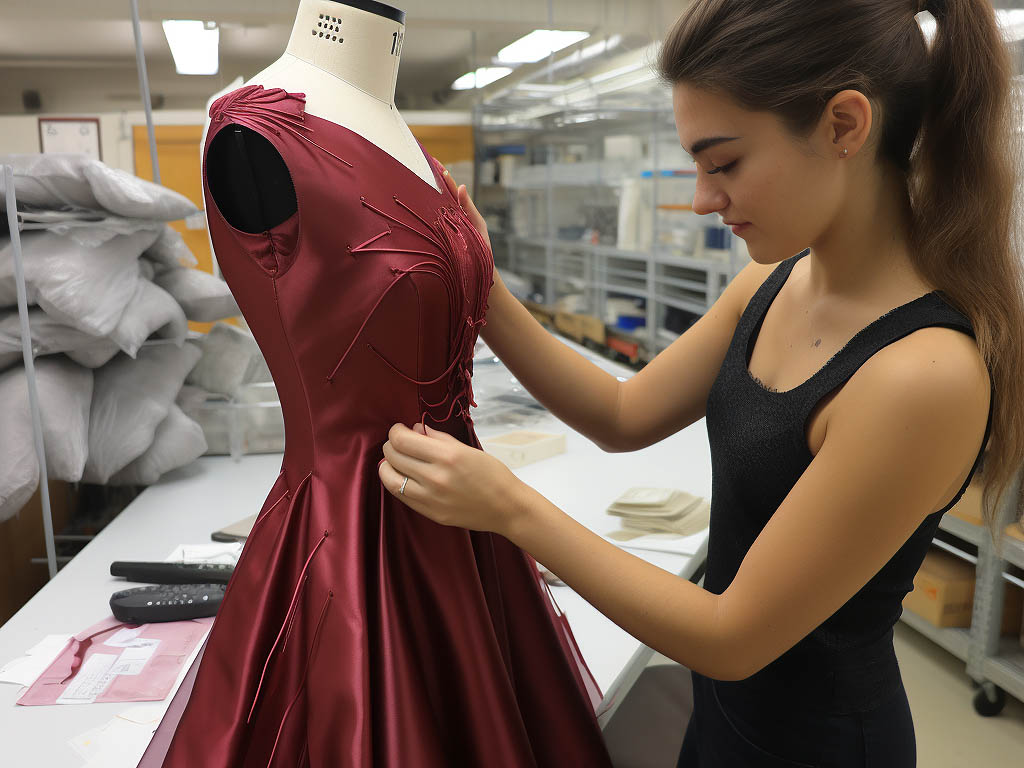
Quality Control and Final Inspection
QC teams rely on tech pack specifications to evaluate final garments before shipment.
Inspection criteria:
- Measurement accuracy vs tech pack sheet
- Fabric quality vs approved swatch standard
- Stitching consistency across all units
- Trim accuracy and placement alignment
- Packaging compliance with defined standards
Common rejection reasons:
- Incorrect hem length variation
- Fabric mismatch in shade or weight
- Uneven seam finishing
- Missing or incorrect labels
QC teams treat the tech pack as the final benchmark for pass/fail decisions.
Production Insight Table
| Production Stage | Tech Pack Function | Key Outcome |
|---|---|---|
| Pre-sampling | Feasibility check | Avoid incorrect sampling |
| Pattern making | Structural guide | Accurate garment shape |
| Sampling | Construction reference | First sample accuracy |
| Grading | Size scaling logic | Consistent size range |
| Bulk production | Execution standard | Stable mass output |
| QC inspection | Final benchmark | Quality consistency |
Conclusion
A strong maxi dress tech pack is not just documentation—it is the foundation of reliable production. When structured correctly, it reduces sampling cycles, stabilizes bulk quality, and protects brand consistency across seasons.
Jinfeng Apparel supports full tech pack development for maxi dress collections, including fabric sourcing, measurement optimization, sampling execution, and bulk production control. Whether starting from a sketch or refining an existing tech pack, our team helps convert design intent into production-ready garments with stable quality and efficient lead times.
For custom maxi dress manufacturing, sampling support, or OEM/ODM production, contact Jinfeng Apparel to start your development process with a structured and reliable production system.