Skip to content

There is a hidden truth in fashion manufacturing that most emerging brands only discover after their first production failure: a corset dress does not fail because of design—it fails because of communication. A corset dress is one of the most structurally complex womenswear categories in modern apparel production. It combines engineering-like internal support systems with delicate aesthetic shaping, requiring precision far beyond standard dress development. Many design concepts look perfect on paper or even in digital mockups, yet collapse during sampling due to missing technical translation.
A tech pack is not just documentation. It is the production “language bridge” between design intention and factory execution. Without it, even experienced factories may interpret structure, tension, or fit differently.
A corset dress tech pack is a structured technical document that defines measurements, materials, construction, and internal support systems such as boning and lining. It ensures factories can accurately convert design intent into production. A complete tech pack reduces sampling errors, improves fit consistency, and minimizes production risks across sizing and bulk manufacturing stages.
Many brands assume that sending a reference image is enough. In reality, corset dresses require engineering-level clarity. A small misunderstanding in waist compression, boning placement, or fabric stretch can change the entire silhouette. This is why tech pack accuracy directly determines whether a corset dress becomes a best-selling product—or a repeated sampling cost trap.
What Is a Corset Dress Tech Pack and Why Is It Critical?
A corset dress tech pack is a structured production document that translates a corset dress design into measurable manufacturing instructions. It defines construction logic, fit control points, materials, internal support systems, and finishing requirements. Unlike standard dress documentation, it must capture structural engineering details such as boning layout, compression zones, and panel shaping. Without it, factories rely on interpretation, which leads to inconsistent fit, repeated sampling, and unstable bulk production outcomes.
In corset dress manufacturing, accuracy is not optional. The garment depends on controlled tension and structural balance. A tech pack becomes the single reference point that aligns design intent with pattern making, sampling, and mass production.

Corset dresses are fundamentally different from loose or semi-fitted garments because they actively reshape the body silhouette. The internal structure behaves more like a support system than a decorative layer. This makes the tech pack not just a communication tool, but a production control system.
In real factory environments, three critical risks appear when a corset tech pack is missing or incomplete:
First, structural misinterpretation. Without defined boning placement diagrams, factories may adjust internal support based on habit rather than design intent. A 2–3 cm deviation in boning positioning can completely change waist shaping effect.
Second, fit instability across sizes. Corset dresses require controlled compression logic. Without defined waist reduction ratios, size M might fit correctly while size L becomes loose or loses shaping structure due to linear grading errors.
Third, sampling cost escalation. Each revision cycle in corset dresses is expensive because changes often require rebuilding internal structure layers, not just stitching adjustments.
A complete corset tech pack eliminates these risks by defining measurable standards for every structural element.
What is included in a corset dress tech pack?
A corset dress tech pack typically includes flat sketches, measurement spec sheets, fabric and trim details, construction breakdown, and internal structure mapping. For production accuracy, it must also include boning layout diagrams, closure system specifications, and tolerance ranges. Each section works together to ensure the factory can replicate the design without subjective interpretation.
Key components:
- Front and back technical flat sketches with seam lines
- Measurement sheet with waist compression targets
- Internal structure map (boning + lining layers)
- Fabric GSM, stretch rate, recovery rate
- Stitching type and seam strength requirements
- Closure positioning and reinforcement details
Why is corset structure more complex than standard dresses?
Corset dresses combine aesthetics with functional shaping. Unlike standard dresses that rely on drape, corset garments rely on engineered compression. This means the internal structure must balance rigidity and flexibility simultaneously.
Typical corset structure includes:
- Vertical boning channels (8–14 per garment depending on style)
- Waist reduction zones (commonly 4–10 cm shaping range)
- Multi-layer lining system for stability
- Reinforced closure zones to handle tension stress
Even a small change in fabric stretch (e.g., 5% vs 12%) can significantly alter fit outcome, making precise documentation essential.
How does a tech pack reduce sampling errors?
A tech pack reduces sampling errors by eliminating interpretation gaps between design and production teams. It defines exact measurement points, material behavior, and construction methods, ensuring the first sample is built closer to final intent.
Typical error reduction outcomes:
- 30–50% fewer sampling revisions when tech pack is complete
- 20–35% reduction in production clarification requests
- Faster approval cycles (1–2 rounds vs 3–5 rounds)
Factories follow documented logic rather than assumptions, which stabilizes output across sampling stages.
What happens when a tech pack is incomplete?
When a corset tech pack lacks detail, production risk increases significantly. The most common issues include:
- Incorrect boning placement leading to weak shaping effect
- Uncontrolled waist compression causing discomfort or poor fit
- Fabric substitution during sampling affecting structure stability
- Inconsistent grading across sizes due to missing scaling rules
| Missing Element | Production Impact | Typical Outcome |
|---|---|---|
| Boning layout | Structural misalignment | Shape distortion |
| Compression ratio | Fit inconsistency | Size instability |
| Fabric specs | Material substitution | Sampling mismatch |
| Seam details | Weak construction | Durability issues |
Incomplete documentation often results in multiple sampling rounds, increased cost, and delayed bulk production timelines.
What Components Should Be Included in a Corset Dress Tech Pack?
A corset dress tech pack must include every detail that affects structure, fit, and production execution. Unlike standard garments, corset dresses depend on internal engineering systems, meaning missing even one component can change silhouette outcome. A complete tech pack covers design sketches, measurement specifications, fabric behavior, internal structure mapping, trims, stitching methods, and tolerance control. Each element works together to ensure factories can reproduce the design consistently across sampling and bulk production without interpretation gaps.
In practical production terms, a corset tech pack functions as a “build instruction file” that removes guesswork from pattern makers and sewing teams.
Corset dresses require a higher level of documentation precision because the garment is constructed through layered structural logic rather than simple stitching. The tech pack must not only show appearance but also explain internal mechanics.
In real production workflows, factories first read the tech pack to break down the garment into engineering sections: outer shell, lining system, boning structure, closure system, and reinforcement zones. If any of these are missing or unclear, production teams make assumptions, which directly leads to sampling variation.
A complete corset dress tech pack also acts as a cost control tool. Each missing detail can trigger additional sampling rounds, typically increasing development cost by 15–30% per revision cycle in structured garments. Therefore, clarity is directly tied to budget efficiency.
Another critical factor is scalability. A corset dress that works in size S may fail in size L if grading logic is not structurally defined. This is why factories rely heavily on documented compression ratios and measurement mapping rather than general size charts.
Finally, internal communication across departments (pattern makers, sample makers, QC teams) depends entirely on how clearly the tech pack defines execution rules. A strong tech pack reduces interpretation layers and improves consistency across production teams.
What are the required technical drawings and flat sketches?
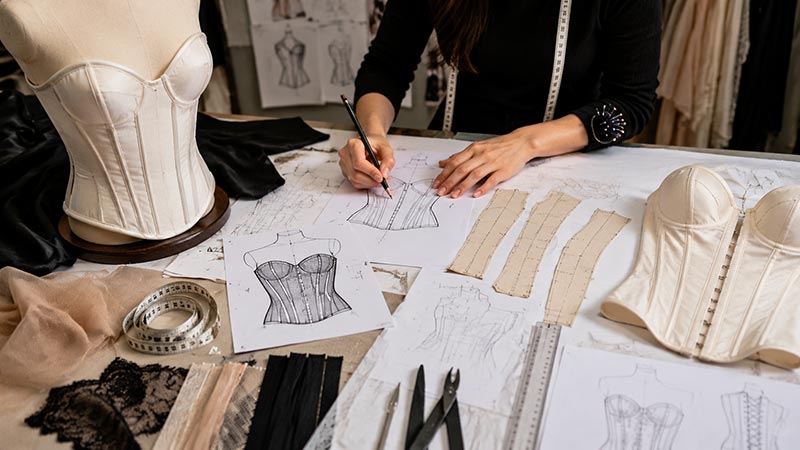
Flat sketches are the visual foundation of a corset dress tech pack. They must clearly define garment structure, not just styling. For corset dresses, sketches should show seam lines, boning channels, panel divisions, neckline structure, and closure placement from both front and back views.
Essential requirements:
- Front and back technical sketches with visible seam mapping
- Panel breakdown indicating corset segmentation
- Boning channel placement lines (vertical + curved where needed)
- Closure positioning (zipper, lace-up, hook system)
- Internal structure indication layers
Without these details, factories often reinterpret structure based on past experience, which leads to inconsistent shaping results.
Which measurements are essential for corset shaping?
Corset dress measurements go beyond standard bust-waist-hip data. They must include structural shaping logic that defines how the garment compresses and supports the body.
Key measurement points:
- Bust circumference + cup depth reference
- Underbust measurement (critical for corset alignment)
- Waist compression target (e.g., -4cm to -10cm reduction range)
- Waist-to-hip transition curve measurement
- Torso length segmentation (top-to-waist ratio control)
- Back center length for closure tension balance
| Measurement Area | Function | Typical Range |
|---|---|---|
| Bust zone | Upper structure balance | ±1.0 cm tolerance |
| Underbust | Corset anchor point | ±0.5 cm tolerance |
| Waist | Compression shaping | 4–10 cm reduction |
| Hip | Lower balance control | ±1.5 cm tolerance |
| Torso length | Fit proportion | ±1.0 cm tolerance |
What fabric and material specifications are needed?
Fabric definition is one of the most critical sections in corset dress tech packs because material behavior directly affects structural performance.
Required specifications:
- Fabric composition (fiber content %)
- GSM weight (fabric density control)
- Stretch percentage (warp/weft direction)
- Recovery rate after tension
- Shrinkage tolerance after washing
- Lining material stability grade
Recommended corset dress materials:
- Heavy satin with controlled stretch (5–8%)
- Structured crepe (low deformation risk)
- Double-layer mesh reinforcement fabric
- Cotton blends with stabilizing weave
| Material Type | Strength | Risk Level | Use Case |
|---|---|---|---|
| Heavy satin | Medium-high | Low | Evening corset dresses |
| Crepe | High | Low | Structured silhouettes |
| Stretch satin | Medium | Medium | Fitted designs |
| Mesh reinforcement | High stability | Low | Internal support |
How should boning, lining, and structure be documented?
Internal structure documentation defines corset performance. Without precise mapping, factories may simplify construction, resulting in reduced shaping effect.
Key documentation requirements:
- Boning type (steel, plastic, spiral steel mix)
- Boning channel width (typically 0.6–1.2 cm)
- Boning quantity per garment (commonly 8–14 pieces)
- Direction mapping (vertical, curved support zones)
- Lining layers (single, double, or fused system)
- Interfacing placement and stiffness grade
Structural breakdown example:
- Outer fabric layer (visual + tension surface)
- Stabilizing interfacing layer (shape retention)
- Boning layer (vertical compression support)
- Inner lining (comfort + skin contact layer)
Missing clarity in this section often leads to the most expensive sampling corrections.
What trim and closure details must be specified?
Trim and closure systems determine both functionality and durability in corset dresses. Because corset garments operate under tension, closure design must be reinforced and clearly defined.
Key elements:
- Closure type (lace-up, invisible zipper, hook-and-eye)
- Closure placement (center back, side seam, front panel)
- Reinforcement stitching type (double stitch, bar tack reinforcement)
- Thread strength specification (high-tension polyester recommended)
- Eyelet spacing for lace-up corsets (usually 2–3 cm intervals)
| Closure Type | Strength Level | Adjustability | Risk Factor |
|---|---|---|---|
| Lace-up | High | Very high | Low |
| Zipper | Medium | Low | Medium |
| Hook & eye | High | Medium | Low |
Poor closure specification is one of the top causes of corset dress returns or fit complaints in bulk production.
How to Build a Factory-Ready Corset Dress Specification Sheet?
A factory-ready corset dress specification sheet is a structured measurement and construction control document that defines how a corset dress should be built, graded, and validated during production. It translates design intent into measurable data that pattern makers and production teams can execute without interpretation. For corset dresses, this document is especially important because fit is controlled through compression logic, not only standard sizing. A strong specification sheet reduces sampling cycles, stabilizes bulk production quality, and ensures consistent shaping performance across all sizes.
In production terms, it is the “fit control system” that prevents structural drift from sample to bulk.
Corset dresses are highly sensitive to measurement logic because every millimeter affects shaping performance. Unlike relaxed garments, where small deviations are acceptable, corset construction amplifies errors due to tension-based design.
A factory-ready specification sheet must do three things simultaneously: define exact body measurements, translate them into garment measurements, and control how those measurements scale across sizes. Without this structure, factories may apply standard grading rules, which are not suitable for compression-based garments.
Another key issue is interpretation variation. Even experienced pattern makers may read measurement points differently unless they are visually and numerically locked. This is why high-precision specification sheets always combine diagrams, numeric tables, and tolerance rules.
From a production efficiency perspective, a well-built spec sheet reduces correction cycles by up to 40% in structured garments because it eliminates ambiguity before sampling begins. It also improves cross-factory consistency when multiple production lines are involved.
How to define bust, waist, and compression ratios?
Corset dresses are not based on static body measurements alone. They require compression logic that defines how much the garment reshapes the body.
Key definition rules:
- Bust measurement = natural bust + shaping allowance (0–2 cm depending on structure)
- Waist measurement = reduced waist target based on compression design
- Compression ratio = difference between body waist and garment waist
Typical corset compression ranges:
- Light structure: 3–5 cm reduction
- Medium structure: 5–8 cm reduction
- Strong structure: 8–12 cm reduction
| Size | Body Waist | Garment Waist | Compression |
|---|---|---|---|
| S | 66 cm | 60 cm | -6 cm |
| M | 72 cm | 64 cm | -8 cm |
| L | 78 cm | 70 cm | -8 cm |
Without defined compression logic, factories may scale waist proportionally, which breaks silhouette consistency in larger sizes.
How to structure size grading for fitted corset styles?
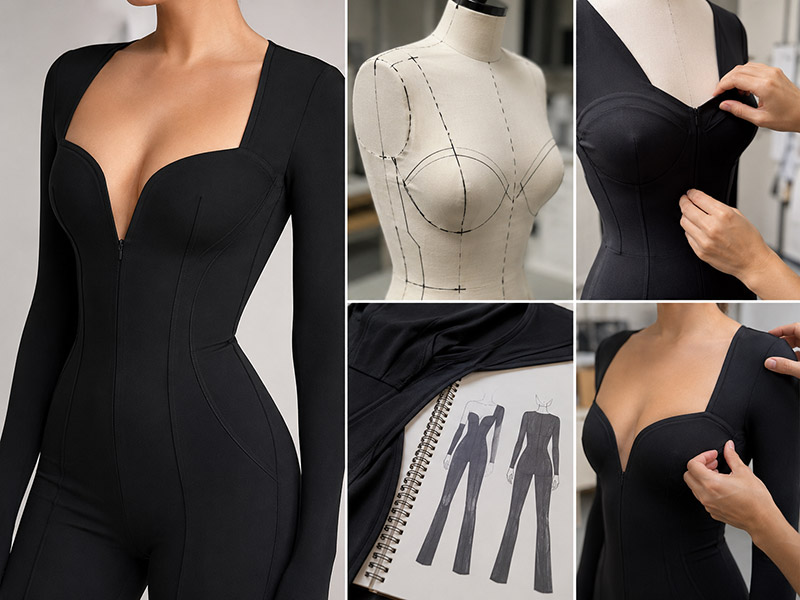
Standard grading systems increase measurements linearly, but corset dresses require controlled grading logic to preserve shaping effect.
Corset grading principles:
- Waist reduction does not increase linearly across sizes
- Bust structure may require cup adjustment instead of scaling
- Boning density must remain stable or slightly adjusted per size
- Torso length may need proportional recalibration
Example grading logic:
- S → M: +6 cm bust, +6 cm waist (controlled compression maintained)
- M → L: +6 cm bust, +6–8 cm waist (adjusted shaping zone)
- L → XL: +6 cm bust, +8 cm waist (increased structural support)
Incorrect grading often results in:
- Loose waist shaping in larger sizes
- Over-compression in smaller sizes
- Distorted side seam balance
What tolerance range is acceptable in production?
Corset dresses require tighter tolerance control than standard womenswear because structural precision directly affects silhouette outcome.
Recommended tolerance system:
| Measurement Zone | Tolerance Range | Reason |
|---|---|---|
| Bust | ±1.0 cm | Upper balance stability |
| Underbust | ±0.5 cm | Corset anchor precision |
| Waist | ±0.5–1.0 cm | Compression accuracy |
| Hip | ±1.5 cm | Lower flexibility |
| Length | ±1.0–1.5 cm | Visual proportion |
Critical zones such as waist and underbust must be tightly controlled because even small deviations change compression feel and visual shaping effect.
Factories often use looser tolerances for efficiency, but corset garments require stricter QC rules to maintain design integrity.
How do factories interpret measurement points?
Measurement interpretation is one of the most common sources of inconsistency in corset production. Without precise diagrams, different teams may measure from slightly different anatomical or garment points.
Standard interpretation system includes:
- Clear measurement diagrams with labeled reference points
- Fixed tape placement rules (horizontal, vertical, curved)
- Defined start/end points for each measurement
- Body vs garment measurement separation
Key examples:
- Waist measurement: must be taken at narrowest point of garment, not body guess
- Bust measurement: must follow seam curvature, not flat width only
- Torso length: measured from neckline center to waist seam line
When measurement points are not standardized, factories may produce variations of 2–3 cm across batches, which is significant for corset dresses.
A factory-ready spec sheet eliminates this risk by locking measurement logic visually and numerically before sampling begins.
What Are Common Mistakes in Corset Dress Tech Packs?
Corset dress tech packs often fail not because of design complexity, but because of missing, unclear, or misaligned technical information. Since corset garments rely on structure, compression, and precise measurement logic, even small documentation gaps can lead to major production deviations. Common mistakes usually appear in three areas: unclear construction details, incomplete measurement systems, and missing material specifications. These issues increase sampling cycles, raise production costs, and create inconsistent fit results across sizes.
In structured dress manufacturing, tech pack errors directly translate into physical garment defects.
Corset dresses amplify every technical mistake because the garment is built on tension balance. Unlike loose-fitting garments, there is almost no tolerance for interpretation errors. A 1 cm deviation in waist or boning placement can significantly change silhouette performance.
In real production environments, most issues do not come from factories lacking skill, but from tech packs failing to provide complete logic. Factories fill missing information using internal standards, which may not match design intent. This creates variation across samples and bulk production.
Another major issue is over-simplification. Many tech packs focus on visual presentation instead of engineering detail. Corset dresses require structured data: compression ratios, boning density, seam reinforcement logic, and fabric behavior under stress. Without these, production becomes assumption-based rather than specification-driven.
Cost impact is also significant. Each correction cycle in corset sampling typically increases development cost by 15–35%, especially when internal structure needs to be rebuilt. Therefore, preventing mistakes at tech pack stage is more efficient than fixing issues during sampling.
Why do unclear sketches lead to sampling failure?
Unclear sketches are one of the most frequent causes of corset sampling failure. When technical drawings do not clearly show seam lines, boning placement, or panel structure, factories interpret construction based on previous experience rather than design intent.
Common problems caused by unclear sketches:
- Misaligned boning channels (shift of 1–3 cm)
- Incorrect panel division affecting shaping accuracy
- Missing reinforcement zones in high-tension areas
- Closure placement errors affecting symmetry
Impact on production:
| Issue Type | Result | Production Effect |
|---|---|---|
| Missing seam lines | Pattern mismatch | Full sample remake |
| Vague structure | Incorrect boning layout | Shape distortion |
| No panel detail | Fit imbalance | Regrading required |
Even experienced pattern makers may produce different interpretations when sketches lack technical clarity.
What missing data causes production delays?
Missing technical data slows down production because factories must pause to confirm missing details before continuing sampling or bulk preparation.
Most common missing data:
- Compression ratio for waist shaping
- Fabric GSM and elasticity range
- Boning type and quantity per section
- Stitching reinforcement instructions
- Size grading logic across XS–XL
Delay impact:
- Each missing key specification can delay sampling by 3–7 working days
- Multiple missing elements may extend sampling cycle by 1–2 weeks
- Back-and-forth clarification increases communication costs and timeline risk
| Missing Information | Delay Impact | Risk Level |
|---|---|---|
| Compression data | Medium delay | High |
| Fabric specs | High delay | High |
| Structure details | High delay | Very high |
| Measurement rules | Medium delay | High |
Incomplete data forces factories to pause decision-making until clarification is provided.
How do inconsistent measurements affect bulk production?
Inconsistent measurement logic creates instability in mass production because factories rely on measurement sheets to scale patterns across sizes. If measurement points or logic are unclear, each production batch may follow slightly different interpretations.
Typical consequences:
- Size M fits correctly, but L and XL lose shaping control
- Waist compression varies across production batches
- Side seam alignment shifts between samples
- Return rate increases due to fit inconsistency
Production variance example:
| Size | Expected Waist | Actual Output (Inconsistent Spec) | Deviation |
|---|---|---|---|
| S | 60 cm | 60–61.5 cm | +1.5 cm |
| M | 66 cm | 65–68 cm | ±2 cm |
| L | 72 cm | 70–74 cm | ±2 cm |
Even small inconsistencies create visible silhouette differences in corset dresses because of high compression design.
What risks come from ignoring construction details?
Ignoring construction details is one of the most critical errors in corset tech packs. Since corset dresses depend on internal structure systems, missing construction logic leads to direct structural failure.
Key risks:
- Boning not aligned with stress points → waist collapse
- Weak seam reinforcement → garment deformation during wear
- Incorrect layering → reduced durability after washing
- Poor closure strength → garment opening under tension
Construction-related failure scenarios:
| Missing Detail | Production Result | Wear Outcome |
|---|---|---|
| Boning mapping | Weak structure | Loss of shaping |
| Stitch reinforcement | Seam breakage | Reduced lifespan |
| Layer definition | Fabric instability | Deformation |
| Closure strength | Opening risk | Fit failure |
Corset dresses are structurally sensitive. Without full construction documentation, even high-quality fabric cannot prevent performance failure during wear or bulk production inconsistencies.
How Do Manufacturers Use Tech Packs in Sampling and Production?
A tech pack is the operational guide used by manufacturers to convert corset dress design into physical samples and final bulk production. It acts as the control document across pattern making, material preparation, sampling execution, fit evaluation, and mass production alignment. In corset dress manufacturing, where structure and compression must remain consistent, the tech pack becomes the central reference point for every production stage. It ensures that sampling decisions are not based on interpretation, but on defined technical standards.
In practical production flow, every corset dress passes through structured checkpoints driven by the tech pack data.
Manufacturers treat tech packs as a production roadmap. Every department—pattern makers, sample sewing teams, fabric sourcing teams, and QC teams—relies on it to execute their specific tasks. For corset dresses, the importance is higher because structure errors cannot be corrected through simple adjustments; they require rebuilding internal layers.
The sampling stage is where most technical validation happens. Factories do not only check appearance but also test structure stability, compression behavior, and fabric response under tension. If the tech pack is clear, sampling becomes a verification process. If unclear, it becomes a discovery process, which increases cost and time.
In bulk production, the tech pack shifts from development tool to consistency control system. It ensures that multiple production lines follow identical standards. Without it, batch variation becomes a common issue, especially in structured garments like corset dresses.
A well-structured tech pack typically reduces production errors by 25–40% and decreases sample revision cycles from 3–5 rounds to 1–2 rounds.
How is a tech pack translated into patterns?
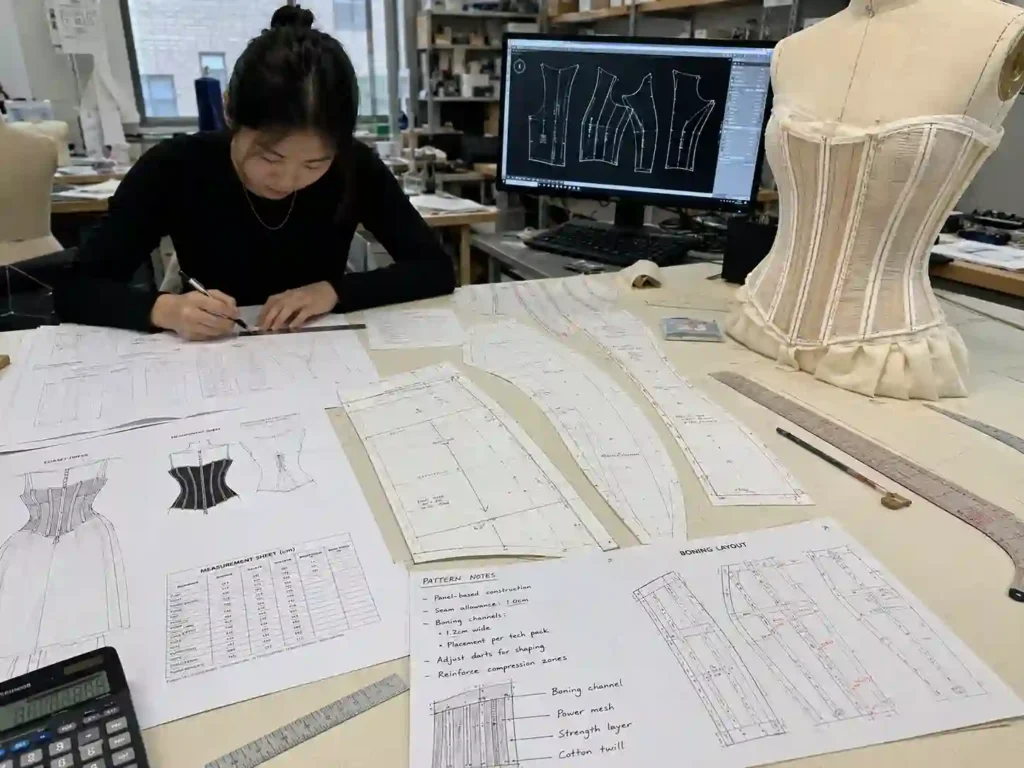
Pattern making is the first transformation stage of a tech pack. Manufacturers convert flat sketches and measurement data into technical patterns using CAD or manual drafting systems.
Key translation steps:
- Convert flat sketches into panel-based construction blocks
- Define seam allowance based on fabric behavior
- Map boning channels directly onto pattern structure
- Adjust dart and shaping lines for compression zones
Critical accuracy points:
| Tech Pack Element | Pattern Output Impact |
|---|---|
| Measurement sheet | Size structure accuracy |
| Flat sketch | Panel segmentation |
| Boning layout | Internal structure design |
| Fabric specs | Seam allowance adjustment |
If measurement points or structure lines are unclear, pattern makers rely on internal templates, which may not match original design intent.
How do factories validate corset structure before sampling?
Before sewing full samples, factories conduct structure validation to ensure corset integrity. This stage focuses on internal reinforcement systems rather than external appearance.
Validation process includes:
- Boning placement test on base fabric
- Compression simulation using fabric tension checks
- Layer alignment verification (outer, interfacing, lining)
- Stress point inspection at waist and closure zones
Typical validation checklist:
- Boning channels aligned within ±0.5 cm tolerance
- Waist compression matches specified reduction range
- Fabric does not deform under moderate tension
- Closure system holds structure without distortion
If structural issues appear at this stage, factories adjust patterns before cutting full samples, reducing material waste.
What checkpoints are used during sample approval?
Sample approval in corset dress production follows structured evaluation points based on the tech pack. The goal is to confirm both aesthetic accuracy and structural performance.
Main checkpoints:
- Fit accuracy across bust, waist, and hip zones
- Compression strength consistency (waist shaping effect)
- Seam durability under tension
- Fabric behavior after wear simulation
- Closure system stability under repeated stress
Sample evaluation table:
| Checkpoint | Standard Requirement | Failure Risk |
|---|---|---|
| Waist fit | ±1 cm tolerance | High |
| Boning alignment | No visible deviation | Very high |
| Seam strength | No opening under stress | High |
| Fabric recovery | ≥90% return rate | Medium |
| Closure stability | No gap under tension | High |
Most corset samples require at least one revision cycle, but clear tech packs can reduce it to a single approval round.
How is tech pack accuracy linked to bulk production stability?
Bulk production stability depends directly on how precise the tech pack is during sampling approval. Once a sample is confirmed, factories replicate the same standards across multiple production lines.
Key stability factors:
- Standardized pattern files derived from approved tech pack
- Locked fabric specifications for all production batches
- Fixed boning and structure parameters
- Controlled measurement tolerance across sizes
Production consistency comparison:
| Tech Pack Quality | Bulk Consistency | Defect Rate |
|---|---|---|
| High precision | Very stable | <2% |
| Medium precision | Moderate variation | 3–5% |
| Low precision | High variation | 8–12% |
In corset dress manufacturing, even small inconsistencies in structure replication can lead to visible fit differences across batches. A complete tech pack ensures production behaves like a controlled system rather than a variable process.

A corset dress is not just a garment—it is a structured product that requires engineering-level precision. Without a complete tech pack, even strong design ideas can fail during sampling or bulk production. With the right manufacturing partner, however, it becomes a repeatable, scalable product with commercial value.
Conclusion
A corset dress is not just a garment—it is a structured product that requires engineering-level precision. Without a complete tech pack, even strong design ideas can fail during sampling or bulk production. With the right manufacturing partner, however, it becomes a repeatable, scalable product with commercial value.
Jinfeng Apparel supports global fashion brands, designers, and procurement teams in building production-ready corset dress collections through accurate tech pack interpretation, structured sampling systems, and stable bulk manufacturing capabilities in Guangdong, China.
If there is already a design concept, sketch, or reference image for a corset dress collection, Jinfeng Apparel can convert it into a production-ready technical package and guide it through sampling to bulk production with controlled risk and stable quality output.
Reach out to begin development discussions and transform corset dress ideas into production-ready collections with factory-level precision.