Skip to content

A fabric supplier tells you a satin is 160 GSM. Another supplier sends a different 160 GSM satin that feels noticeably fuller, looks less transparent, and hangs with more control. Then a third sample arrives at the same stated weight but feels flatter and more fluid. Nothing is necessarily wrong with any of those specifications. The mistake is expecting one number to describe everything that matters when a textile becomes a dress. In real development work, GSM is useful, but it is only one part of the material story.
GSM and fabric thickness measure different physical properties. GSM tells you how much one square meter of fabric weighs, while thickness describes the physical depth of the fabric under defined measurement conditions. A higher GSM fabric is often more substantial within the same fabric family, but GSM alone cannot reliably predict thickness because fiber type, yarn construction, knit or weave structure, finishing, density, loft, and compression all influence the result.
This difference becomes much more important after fabric leaves the swatch card and enters the sample room. A seemingly small change in weight, thickness, stretch, recovery, or surface structure can change how a neckline sits, whether a pale dress needs lining, how much bulk builds around an invisible zipper, and whether a previously approved pattern still behaves correctly. Many expensive production problems begin with a very ordinary sentence: “The replacement fabric is the same GSM, so it should be fine.” The rest of this guide explains why that assumption often fails and what to check instead.
What Is Fabric GSM and What Does It Measure?
Fabric GSM means grams per square meter and measures how much a defined area of fabric weighs. It is useful for comparing similar materials, controlling fabric consistency, and describing whether a textile is relatively light or substantial. GSM does not directly measure thickness, softness, stretch, quality, opacity, or drape, so it should be treated as one specification within a broader fabric approval system.
What GSM Actually Tells You
When a fabric is described as 180 GSM, the specification means that one square meter of that material has a mass of approximately 180 grams under the relevant testing and conditioning method. This gives designers, sourcing teams, mills, and garment manufacturers a common numerical reference that is much more useful than vague descriptions such as “lightweight,” “medium,” or “heavy.” The number is especially helpful when the fabrics being compared belong to the same family and use similar yarn, construction, and finishing.
For example, if a supplier offers three versions of a comparable jersey at 160, 190, and 220 GSM, the heavier options will usually feel more substantial and may provide better coverage. That does not mean every 220 GSM textile is thicker or better than every 160 GSM textile. A compact woven fabric, a stretch jersey, and a lofty knit can all distribute the same amount of mass very differently. GSM tells you how much material is present over a known area; it does not tell you exactly how that material is arranged or how it will behave on the body.
In practice, experienced product teams use GSM as a control variable. It helps answer whether a bulk delivery is broadly consistent with an approved reference, whether a proposed substitute is materially lighter or heavier, and whether a fabric falls within the general weight class expected for the style. It becomes misleading only when the number is asked to do more than it can.
How GSM Is Used in Development
During initial sourcing, GSM helps eliminate obviously unsuitable options before a sample is made. A very light stretch knit may not provide enough body for a fitted dress, while an unnecessarily heavy construction can make a resort style feel dense and warm. During sampling, the approved GSM becomes part of the fabric record. During bulk production, it can be checked again alongside width, shade, hand feel, stretch, shrinkage risk, and visible defects before cutting begins.
The important phrase is “alongside.” Fabric approval becomes much more reliable when weight is connected to the properties that actually affect the garment. For an approved stretch dress fabric, a useful record may include composition, GSM, usable width, crosswise stretch, lengthwise stretch where relevant, recovery, hand feel, drape, transparency, shrinkage behavior, surface finish, and an approved physical swatch. If the style is reordered later, those references help the production team determine whether a new lot still resembles the material on which the original fit and appearance were approved.
This is particularly important for fashion collections that reuse one fabric across several colors or silhouettes. A small fabric variation may be barely noticeable on a loose skirt yet obvious on a bodycon dress. When the material record is complete, the team can separate a true pattern issue from a fabric issue much faster, which reduces unnecessary sample revisions and avoids solving the wrong problem.
Does Higher GSM Mean Better Fabric?
Higher GSM does not automatically mean higher quality. It only tells you that the fabric carries more mass per unit area. A lightweight chiffon can be excellent quality when the yarns are even, the surface is clean, the color is consistent, and the drape suits the intended garment. A much heavier textile can still have weak recovery, unstable dimensions, uneven dyeing, poor pilling resistance, excessive stiffness, or an unattractive hand feel.
Quality is better judged by how well a textile meets the requirements of the product. For a bodycon dress, that might mean controlled stretch, strong recovery, sufficient opacity, smooth surface appearance, and dimensional stability. For a satin slip dress, it may mean clean sheen, fluid drape, limited snagging, controlled wrinkling, and enough substance to avoid a papery appearance. For a structured occasion dress, body, seam behavior, lining compatibility, and shape retention may matter more than achieving the highest possible GSM.
Increasing GSM too far can also work against the design. A heavier fabric can reduce movement in a ruched style, create bulky seam intersections, increase shipping weight, and make a warm-weather garment uncomfortable. The more useful question is not “Is this GSM high enough to be premium?” but “Is this weight appropriate for the fabric construction, silhouette, season, and target wearing experience?”
Is Fabric GSM the Same as Fabric Thickness?
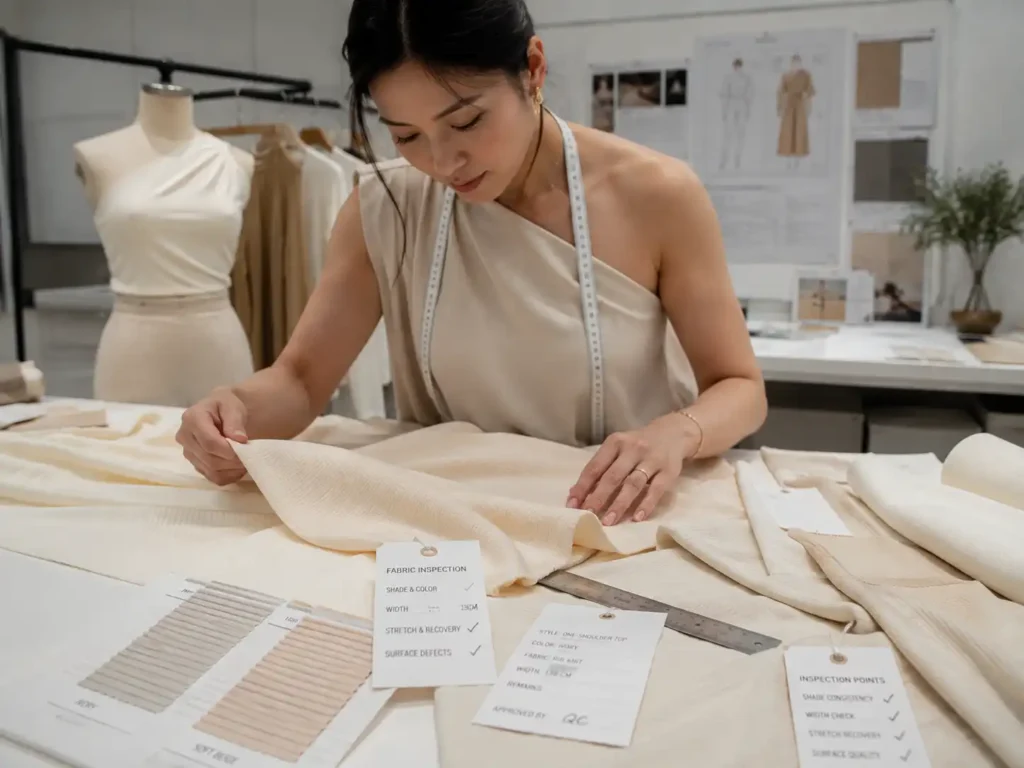
No. Fabric GSM and fabric thickness describe different properties. GSM measures mass per unit area, while thickness measures the physical distance between the two fabric surfaces under defined conditions. Higher GSM can correspond to greater thickness when fabrics are otherwise similar, but there is no universal relationship because yarn bulk, construction, finishing, trapped air, and measurement pressure can change thickness independently of weight.
Weight and Thickness Are Different Measurements
The easiest way to separate GSM from thickness is to think about mass and physical depth as two different questions. GSM asks how much a defined area of fabric weighs. Thickness asks how much space the textile occupies from one surface to the other when it is measured under an agreed level of pressure. Those properties often influence each other, but neither is a substitute for the other.
A dense woven textile can pack a relatively large amount of fiber into a flat structure. It may therefore feel heavy in the hand without appearing bulky. A different fabric can use more open loops, textured yarns, or a raised surface that traps air and creates volume. It may look and feel thicker while weighing less per square meter. This is why the everyday words “heavy” and “thick” should not be treated as synonyms during sourcing conversations.
The distinction becomes especially practical at the sewing stage. GSM affects overall garment weight and can influence drape, while thickness has a more direct relationship with physical bulk where several layers meet. A fabric that works beautifully as one flat layer may become difficult around a folded hem, enclosed seam, waistband, neckline facing, or invisible zipper when four or six layers stack together. If a style includes corset channels, cups, facings, lining, or decorative overlays, thickness can become just as important as area weight.
| Property | GSM | Thickness |
| What it measures | Mass per unit area | Physical fabric depth |
| Common unit | g/m² | mm |
| Useful for | Weight control, fabric comparison, bulk consistency | Seam bulk, layering, compression, structure |
| Strongly influenced by | Fiber quantity, yarn, construction, finishing | Yarn bulk, knit/weave geometry, surface, pressure |
| Can predict the other universally? | No | No |
| Best practice | Compare within similar fabric families | Measure directly when bulk matters |
Does Higher GSM Always Mean Thicker?
Higher GSM often corresponds to greater thickness when most other variables remain similar. If the same mill produces a family of double-knit fabrics from similar fibers, yarns, machine settings, and finishing, a 350 GSM version will commonly be fuller than a 250 GSM version. Within a tightly controlled fabric family, GSM can therefore be a useful proxy for increasing substance.
The relationship becomes unreliable as soon as the construction changes. A 200 GSM satin may be smooth, compact, and relatively flat. A 200 GSM brushed knit may have a raised surface and more trapped air, making it look and feel considerably thicker. A mesh fabric can have noticeable yarn thickness while remaining visually open, and a coated textile can gain mass without becoming proportionally more bulky. Equal GSM does not force equal physical geometry.
This matters when a replacement fabric is proposed for an approved style. A supplier may say, “The GSM is the same,” but the substitute can still differ in compressibility, stiffness, surface texture, stretch, recovery, drape, or transparency. Those differences can alter the fit and appearance even when the area weight matches perfectly. The safest comparison is not specification-to-specification alone; it is specification plus approved swatch plus sewn sample.
Can GSM Be Converted to Millimeters?
There is no universal table that converts fabric GSM directly into millimeters. A theoretical relationship between mass, density, area, and thickness can be calculated for a homogeneous solid, but textile fabric is not a solid sheet. It contains yarn intersections, loops, pores, fiber spaces, surface textures, trapped air, coatings, and finishing effects. Many textiles also compress when pressure is applied, which means even thickness itself depends on how the measurement is performed.
This is why search queries such as “200 GSM in mm” or “300 GSM fabric thickness” do not have one technically correct answer across all textiles. A 200 GSM compact woven can be relatively thin, while a 200 GSM lofty knit can occupy much more depth. Even two knits at the same weight can produce different thickness values if one uses bulked yarn, a double-knit construction, or a brushed finish.
When thickness affects the product, measure thickness directly rather than estimating it from GSM. This is particularly useful for structured knit dresses, multilayer bodices, corset details, bindings, folded hems, and seam intersections where physical bulk can change sewing quality. GSM remains valuable, but it should be used for the question it actually answers: how much the fabric weighs over a known area.
What Thickness Changes in Sewing
Thickness becomes visible quickly once a fabric moves through the sewing line. A style with a concealed zipper may look smooth in a medium-thickness fabric but develop a raised or wavy zipper area when the replacement textile is bulkier. A folded hem can become stiff. A waist seam can form a ridge. A neckline facing can refuse to sit flat. None of these problems is explained completely by GSM because the physical stack of layers is what creates the bulk.
Thickness can also influence the equipment and construction choices used on the factory floor. Needle selection, thread tension, seam allowance, presser-foot pressure, pressing method, edge finishing, and the number of layers captured in a seam may all need adjustment. In stretchy fabrics, a thicker construction can also change how the seam recovers after being stretched during sewing.
For this reason, the most useful thickness check is often not a laboratory number alone. Fold the approved fabric into the same number of layers that will exist at the difficult area of the garment, then compare the substitute in the same way. A simple side-by-side stack around the zipper, waistband, or hem can reveal a production risk before the first full sample is completed.
Why Can the Same GSM Have Different Thickness?
Two fabrics can have identical GSM but different thickness because GSM records how much mass exists in one square meter, not how that mass is arranged. Fiber density, yarn diameter, yarn twist, knit or weave geometry, surface pile, finishing, and trapped air can distribute equal mass into either a compact, flat textile or a thicker, loftier one. Construction is therefore central to understanding thickness.
Fiber and Yarn Change the Volume
Different fibers and yarns occupy space differently, which changes the relationship between GSM and thickness. Fiber density, cross-sectional shape, crimp, filament structure, staple length, and surface characteristics all influence how much physical volume a given mass of material occupies. The yarn-making process adds more variables, including twist, yarn count, filament number, texture, and bulk.
A smooth, tightly twisted yarn can pack efficiently into a compact fabric. A textured or bulked yarn can trap more air and create a fuller surface with less additional mass. Many staple-fiber yarns also create a different tactile surface from smooth continuous-filament yarns, even if the overall weight is similar. This is one reason two fabrics with equal composition and equal GSM can still feel surprisingly different in the hand.
Yarn size matters as well, but it does not operate alone. Many fine yarns can be packed into a dense, relatively flat construction, while larger yarns can create prominent loops or surface depth in a more open construction. When a supplier proposes a “same GSM” substitute, asking about yarn and construction can explain differences that the weight number cannot. If the visual and tactile outcome matters to the brand, a physical swatch is the fastest way to confirm whether those structural differences are acceptable.
Knit and Weave Create Different Geometry
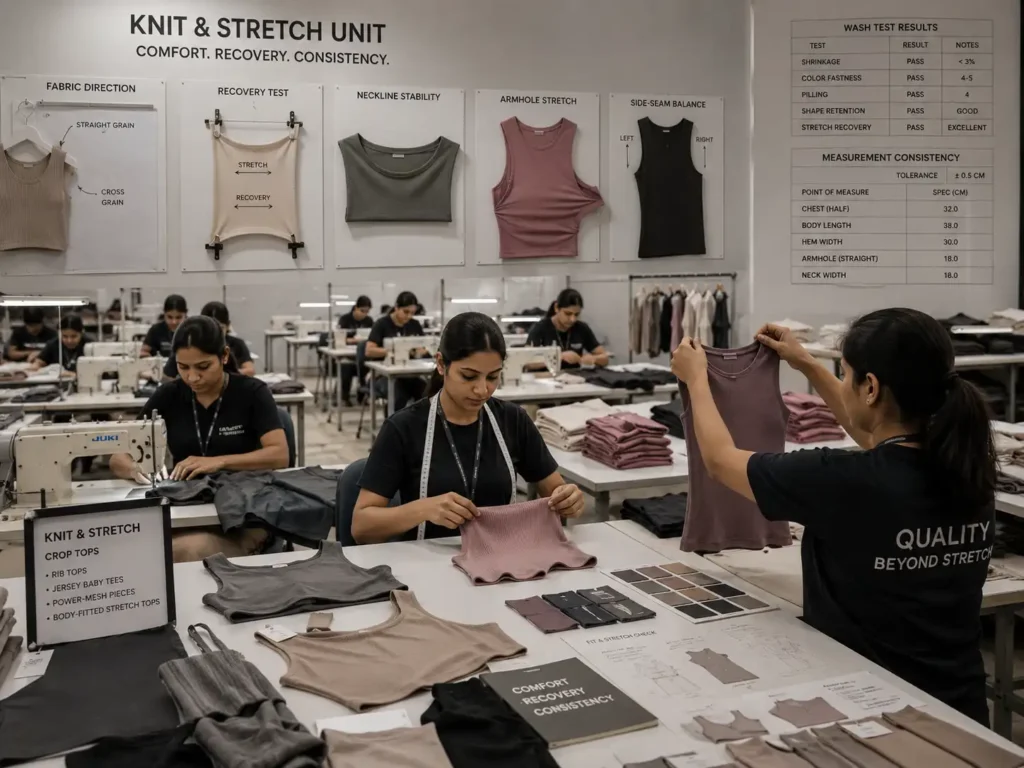
Woven and knitted fabrics arrange yarns in fundamentally different ways. Wovens interlace warp and weft yarns, while knits form loops. Those geometries affect thickness, stretch, air spaces, recovery, and the way the textile bends around the body. Even within one category, construction varies enough that equal-GSM comparisons can be misleading.
Single jersey is typically flexible and relatively fluid. Rib constructions create different vertical geometry and often greater stretch. Double knits such as Ponte use a more substantial structure that can offer greater body and dimensional stability. Satin, by contrast, is a woven structure known for a smooth face and can be relatively compact even when it carries enough weight to drape strongly. Mesh deliberately introduces open spaces, so visual coverage is dominated by construction rather than weight alone.
This is why GSM comparisons work best inside the same fabric family. If a brand is deciding between two similar jerseys, GSM can help distinguish lighter and heavier versions. If it is comparing jersey with Ponte or satin, the number becomes a much weaker predictor of thickness or garment behavior. The first question should be “What structure are we comparing?” before anyone assumes that a matching GSM means a matching feel.
Finishing Can Add or Remove Bulk
Finishing can change a textile’s apparent or measured thickness without producing a proportional change in GSM. Brushing and raising lift fibers away from the base construction and create a softer, loftier surface. Calendaring can flatten and smooth a textile. Compacting can alter density and dimensional stability. Washing, coating, laminating, resin treatment, and mechanical finishing can all change surface behavior and bulk in ways that are immediately noticeable in a garment.
Imagine two fabrics with the same composition, nearly the same GSM, and similar width. One has been mechanically finished for a fuller, softer hand, while the other has a flatter, cleaner surface. On a specification sheet, the difference may appear small. On the body, one may create fuller gathers and more warmth, while the other hangs closer and looks sharper. The finishing process can also change how the fabric reflects light, presses, folds, and packs for shipment.
For fashion development, this is a strong reason to keep an approved swatch rather than relying on a supplier code alone. A mill may update finishing equipment or change processing conditions while keeping the nominal article name. The product team should compare the new lot with the approved material for hand feel, drape, thickness, stretch, surface appearance, and shrinkage before assuming that a matching GSM means the garment will remain unchanged.
Air Is Part of the Structure
A fabric can be thick without containing proportionally more fiber because part of its volume may be air. Knit loops, pile, textured yarns, brushed surfaces, and open structures create spaces that increase physical depth. This is why a lofty textile can feel substantial in the hand yet remain relatively light, while a dense, compact fabric can feel surprisingly heavy even though it looks thin from the side.
The presence of air affects more than thickness. It can influence perceived warmth, compression, packing volume, cushioning, and the way the fabric returns after pressure. In womenswear, a lofty material may create more visual volume in gathers or sleeves, while a compact textile may hang closer to the body and create a cleaner line. Neither behavior can be predicted from GSM alone.
This distinction is useful when reviewing seasonal collections. A winter-oriented knit may need volume and warmth without excessive garment weight. A sleek evening dress may need enough mass for elegant drape but minimal surface bulk. Thinking in terms of mass, thickness, and internal structure as three separate variables makes those choices much easier to communicate between design, sourcing, and production teams.
Which Matters More for Garment Performance?
Neither GSM nor thickness is universally more important for garment performance. GSM helps control overall weight and substance, while thickness helps explain bulk, layering, and physical volume. The right priority depends on the garment. Drape, opacity, fit, stretch, recovery, stiffness, season, lining, and construction method usually need to be considered together before a fabric can be judged suitable.
Drape Needs More Than Weight
Drape is one of the properties most often oversimplified by GSM. Heavier fabric experiences more gravitational force, so mass certainly influences how material hangs. However, bending stiffness, yarn structure, finishing, thickness, and fiber properties determine how easily the textile bends. A heavier satin can still fall in a fluid line, while a lower-GSM organza can remain crisp and stand away from the body.
The best way to evaluate drape is to connect it to a silhouette rather than to a number. A slip dress often needs smooth vertical fall, controlled cling, and enough substance to avoid looking papery. A structured office dress needs more body and shape retention. A ruched party dress may need a fabric that gathers cleanly without becoming bulky. A long skirt may need enough weight to move elegantly without pulling the waistline downward.
In sample development, fabric should be viewed vertically and on the body, not only laid flat on a sourcing table. A swatch that feels promising in the hand can behave differently once several panels, seams, lining, and trims are added. The sewn sample is where the relationship between GSM, stiffness, thickness, and gravity becomes visible, and it is often the only reliable way to confirm whether the intended silhouette has actually been achieved.
Opacity Depends on Construction
Higher GSM often improves coverage within the same fabric family, but opacity is influenced by yarn spacing, fiber type, color, surface finish, stretch, and construction density. A compact 200 GSM knit may provide strong coverage, while a more open construction at the same weight can transmit more light. Stretch complicates the issue because the spaces between yarns can increase when the garment is worn under tension.
This is particularly relevant to light colors and fitted styles. A pale jersey may appear opaque while relaxed on a table and become noticeably more transparent across the bust or hip. Satin can also reveal undergarment lines or seam allowances even when the fabric is not technically sheer. Mesh and lace make the limitation of GSM even clearer because openness is an intentional part of their structure.
A practical opacity review should therefore include relaxed fabric against light, stretched fabric where applicable, the sewn garment under natural light, and the garment under bright retail or studio lighting if that is relevant to the launch. If coverage is insufficient, the solution may be a different construction, a higher weight within the same family, a lining, double layering, a darker color, or a pattern adjustment. Simply asking for “more GSM” is not always the most elegant or cost-effective fix.
Fit Depends on Stretch and Bulk
Fabric weight and thickness can affect fit, but stretch and recovery often determine whether a close-fitting garment performs correctly. Consider an approved bodycon sample made from a 200 GSM stretch jersey. A substitute can match that exact weight but have less stretch and stronger recovery, causing the garment to feel tighter. Another 200 GSM substitute may stretch easily but recover poorly, allowing the waist or hip area to relax after several hours of wear.
Thickness adds another layer to fit because it changes physical bulk around the body and inside seam intersections. A thicker knit can make a fitted waist feel more substantial, alter how a concealed zipper sits, or change the appearance of a neckline binding. In corseted or lined styles, several small differences in material thickness can accumulate across shell, lining, cups, boning channels, and seam allowances.
For fitted womenswear, a useful comparison includes GSM, thickness where relevant, crosswise stretch, lengthwise stretch if used, recovery, shrinkage, hand feel, drape, and opacity under realistic extension. If any of those change materially, the pattern may need to be rechecked. A “same composition, same GSM” replacement should never bypass the fitting stage when the silhouette depends heavily on stretch and body contour.
Comfort Is a Combined Result
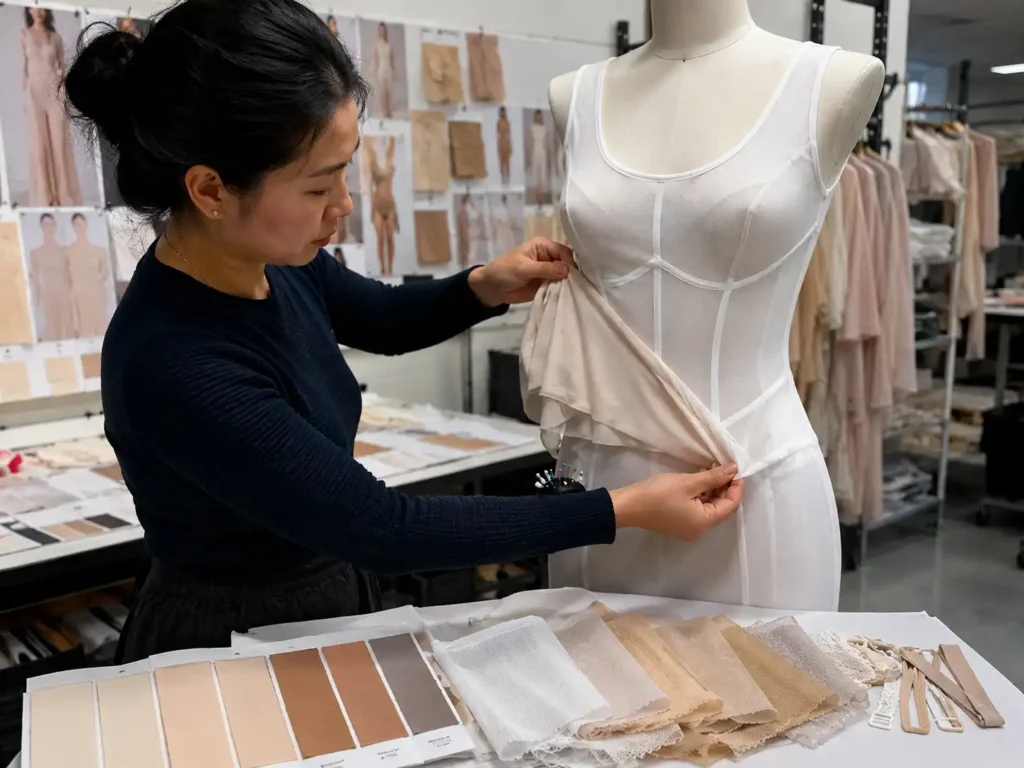
Comfort cannot be reduced to “lighter is better” or “thinner is cooler.” Overall garment weight, air permeability, moisture behavior, surface softness, stretch, recovery, seam bulk, lining, and fit all contribute to the wearing experience. A lightweight textile with a rough surface or poor breathability can feel less comfortable than a somewhat heavier fabric that moves cleanly and feels smooth against the skin.
The correct balance changes by product. Warm-weather resortwear may prioritize low weight, movement, and airflow. A fitted evening dress may accept more weight in exchange for coverage and a smoother silhouette. An office dress may prioritize dimensional stability and low wrinkle appearance. A structured occasion style may need additional body even if that increases thickness at certain seams.
This is also where target market and wear duration matter. A dress designed for a short evening event can tolerate different trade-offs from a garment intended for all-day office use or travel. Product teams get better results when they define the wearing situation first and then select a fabric whose GSM, thickness, stretch, surface, and construction support that experience rather than chasing a single “ideal” number.
How Do GSM and Thickness Vary by Dress Fabric?
GSM and thickness vary widely across dress fabrics because each textile family uses different fibers, yarns, structures, and finishes. Satin may be smooth and relatively flat at a moderate weight, jersey can combine medium weight with significant stretch, and Ponte usually provides greater body and thickness. GSM values are most useful when compared within the same fabric family and against the requirements of a specific silhouette.
Satin and Fluid Wovens
Satin is a strong example of why GSM and thickness should be separated. In the Jinfeng Apparel fabric reference system, common satin used for women’s fashion development spans approximately 80-220 GSM, covering products such as slip dresses, cocktail dresses, evening dresses, bridesmaid dresses, wedding guest styles, and party dresses. Within that broad range, the appearance can change significantly depending on composition, weave density, stretch, finish, and color.
A lighter satin can create beautiful movement but may show seam allowances, underwear lines, or transparency in pale shades. A heavier satin can provide more substance and richer fall, yet it can also add bulk around zippers and enclosed seams. More weight may reduce a papery appearance, but it does not automatically solve wrinkling, snagging, or poor sewing quality. Surface shine and yarn direction can also make shade differences appear more obvious under light.
Chiffon and organza provide a useful contrast. Both can be lightweight, but chiffon is generally selected for fluidity while organza is valued for crispness and volume. Their GSM may fall into a similar broad weight class, yet their silhouettes can be completely different. The practical decision therefore starts with the garment effect, then uses GSM as one way to control the chosen fabric rather than using GSM to choose the entire fabric family.
Jersey and Stretch Knits
Jersey is common in bodycon dresses, casual styles, soft jumpsuits, and other garments that depend on stretch and movement. The Jinfeng Apparel fabric reference places common jersey options around 140-240 GSM, but that range should be treated as a development reference rather than a universal industry limit. Fiber blend, elastane content, knitting density, finishing, and intended fit can all move the practical target higher or lower.
Within the same jersey family, lower weight often creates more fluidity but can increase transparency and reduce support. Higher weight can create better coverage and body, but it may also increase warmth or change how ruching and gathers fall. More importantly, two jerseys with the same GSM can have very different stretch and recovery. One may snap back cleanly after extension, while another can bag at the hip or waist after wear.
For fitted products, stretch should be measured in the directions that matter to the pattern, and recovery should be reviewed after realistic extension. Shrinkage and spirality or skew can also affect dimensions after laundering. GSM is therefore one useful control point among several. The best jersey is not simply the one that hits a target weight; it is the one that maintains the intended opacity, fit, recovery, hand feel, and dimensional stability through sampling and bulk production.
Ponte and Structured Knits
Ponte or Ponte Roma typically sits at the more substantial end of fashion knit fabrics. Jinfeng Apparel’s documented reference range is approximately 250-420 GSM, with common use in bodycon dresses, office dresses, structured knit dresses, pencil skirts, and jumpsuits. These products often rely on the fabric to provide body and shape rather than behaving like a very soft single jersey.
Both GSM and thickness matter here. A Ponte that is too light or thin can lose the clean support expected from the fabric family. A very thick version may feel heavy, create bulky seam intersections, or become uncomfortable for warm-weather collections. Stretch and recovery also need to stay in balance: too little stretch can make fitted garments restrictive, while excessive stretch or weak recovery can reduce structure and cause distortion.
The table below shows useful working references from the documented Jinfeng Apparel fabric system. These are not universal limits for every mill or market; they are practical ranges for understanding how fabric families differ and which secondary checks matter most.
| Fabric family | Documented reference GSM | Typical womenswear use | Checks that matter beyond GSM |
| Satin | 80-220 GSM | Slip, party, cocktail, evening dresses | Drape, shine, transparency, snagging, lining |
| Jersey | 140-240 GSM | Bodycon, casual, soft dresses | Stretch, recovery, opacity, shrinkage, skew |
| Ponte | 250-420 GSM | Bodycon, office, structured knit dresses | Thickness, structure, stretch, seam bulk, stability |
| Mesh / Lace | Varies widely by construction | Overlays, fitted mesh, occasion details | Openness, transparency, stretch, motif or hole stability |
Mesh, Lace, and Open Structures
Mesh and lace make GSM comparisons especially difficult because open space is part of the design. A mesh fabric can use relatively thick yarns while still having low visual coverage because the yarns are separated by large openings. Another mesh with similar GSM can use smaller openings and appear much more opaque. Once the fabric stretches on the body, the opening size can change again, which affects transparency and fit.
For bodycon mesh, useful checks include stretch direction, recovery, relaxed transparency, stretched transparency, edge stability, hole consistency, neckline behavior, lining placement, and seam strength. Printed mesh adds another issue because print placement can shift when the fabric stretches or when cutting direction is inconsistent. A weight number cannot communicate any of those risks by itself.
Lace behaves similarly. The mass may be concentrated in motifs while large spaces remain between them. Two lace fabrics with equal GSM can therefore differ sharply in visual density, softness, motif scale, edge stability, and how much lining is visible underneath. For these open structures, the approved physical swatch and sewn sample are far more informative than a GSM target alone, especially when the finished garment uses multiple layers or strategically placed transparency.
How Should GSM and Thickness Be Specified for Production?

For production, GSM and thickness should be recorded as separate properties and supported by composition, width, stretch, recovery, hand feel, drape, transparency, shrinkage, color, finish, and an approved physical swatch. Bulk fabric should be compared with the approved reference before cutting. If a substitute changes weight, thickness, stretch, or drape materially, the pattern, lining, seam construction, cost, and sample may need to be reviewed again.
Build a Complete Fabric Specification
A strong fabric specification reduces interpretation gaps between the design team, sourcing team, fabric mill, sample room, and bulk-production line. Instead of writing “black stretch fabric, about 200 GSM,” a useful production record should capture the properties that influence the garment. The objective is not to create paperwork for its own sake; it is to make the approved result repeatable when the style moves from one sample to hundreds or thousands of finished pieces.
A practical record should identify the exact fabric code or supplier reference, composition, approved GSM, usable width, stretch direction and percentage, recovery expectation, hand feel, drape, transparency, shrinkage result or risk, color approval, dye lot where relevant, surface finish, and an approved physical swatch. Thickness should be recorded when physical bulk matters to the style, particularly for Ponte, double knits, multilayer bodices, corset structures, heavy bindings, or areas where several seam allowances meet.
The value of this approach becomes clear during repeat orders. If the original article is unavailable, the team can compare a proposed replacement property by property rather than trying to recreate the fabric from memory. It also makes communication faster because everyone can identify whether the issue is weight, stretch, surface, transparency, or construction instead of using broad comments such as “the new fabric feels wrong.”
| Specification | Practical production record | Main reason to control it |
| Fabric code | Approved supplier/internal code | Avoid material confusion |
| Composition | Fiber percentages | Influences hand, care, stretch, cost |
| GSM | Approved target and agreed tolerance | Controls area weight and consistency |
| Thickness | Direct value when relevant | Controls bulk, layering, seam behavior |
| Usable width | Measured width | Affects marker and consumption |
| Stretch / recovery | Direction, percentage, recovery reference | Critical for fitted garments |
| Hand / drape | Approved physical swatch | Protects silhouette and tactile target |
| Transparency | Relaxed and stretched when relevant | Drives lining and coverage decisions |
| Shrinkage | Project-specific result or risk | Protects finished dimensions |
| Color / dye lot | Approved swatch or lab reference | Supports shade consistency |
| Finish | Matte, glossy, brushed, coated, washed, etc. | Affects look, feel, thickness, sewing |
Approve the Physical Fabric
A technical sheet cannot fully communicate how a textile feels, bends, reflects light, stretches, compresses, or behaves when several layers are sewn together. Physical swatch approval therefore remains essential even when the supplier provides detailed laboratory data. The swatch is the bridge between measurable values and the sensory qualities that determine whether a dress actually looks right.
A useful review starts by viewing the material flat, then against light, then hanging vertically. Stretch fabrics should be extended in the directions relevant to the garment and allowed to recover. Several layers should be folded together to simulate a zipper seam, waistband, hem, or facing. The fabric should also be viewed beside the intended lining and, where visual presentation matters, under both natural light and bright studio or retail lighting.
The most important test is still the actual garment sample. A fabric can look excellent as a loose swatch and behave poorly once combined with cups, boning, lining, zippers, ruching, pleats, bindings, or multiple layers. For Jinfeng Apparel projects, fabric swatches form part of the development input because they help confirm weight, hand feel, stretch, and color before the sample and bulk-production decisions are finalized. That workflow is especially valuable for fashion dresses where small fabric changes can alter the visible silhouette.
Control Bulk Before Cutting
The fabric delivered for bulk production should not be assumed to match the approved sample simply because the supplier uses the same article name. Dye lots, finishing conditions, machine settings, raw-material variation, and storage can create differences in shade, weight, width, stretch, hand feel, or shrinkage. These differences are much easier to manage before cutting than after hundreds of garments are assembled.
Incoming inspection should therefore compare the bulk fabric with the approved reference. Depending on the fabric, the review can include color, hand feel, GSM, usable width, batch identification, shade difference, stains, holes, snagging, stretch, recovery, shrinkage risk, print direction, surface shine, and other fabric-specific defects. Satin deserves close attention to snagging, shade, and shine direction. Mesh requires hole, stretch, and transparency checks. Jersey needs stretch, recovery, shrinkage, and skew control. Ponte benefits from checking both GSM and thickness because either can change the structure of the garment.
When a problem appears, isolating the affected rolls before cutting protects the rest of the order and gives the supplier a chance to correct the issue. This is one of the simplest ways to reduce the familiar situation in which the approved sample looks excellent but the bulk garments feel different. Fabric approval has real value only when the production team uses it as a measurable reference, not as a swatch that disappears after the sample meeting.

Recheck the Garment When Fabric Changes
A substitute fabric should not be approved solely because its composition and GSM look similar to the original. The comparison should include weight, thickness where relevant, stretch, recovery, drape, hand feel, transparency, surface appearance, shrinkage behavior, color, cost, availability, and lead time. Once those differences are understood, the next question is whether the garment itself must change.
A heavier or thicker material may need different seam treatment. A lower-stretch substitute can require pattern adjustment. A more transparent fabric may require a lining or double layer. A softer fabric may reduce the support of a corseted bodice. A change in drape can alter skirt volume, hem behavior, or how ruching sits on the body. Even when the change looks small on the fabric card, it can become obvious after the sample is fitted.
This is where an experienced manufacturing partner adds value without turning fabric selection into guesswork. Jinfeng Apparel’s documented approval process compares fabric weight with hand feel, stretch, recovery, drape, transparency, color, cost, and lead-time effects, then reviews whether pattern, lining, costing, or sample revision is necessary. For brands developing seasonal dress collections or repeat programs, that discipline helps keep the approved design closer to the final bulk product while still allowing practical fabric substitutions when supply conditions change.
Conclusion
Fabric GSM and fabric thickness are both useful measurements, but they answer different questions. GSM tells you how much a square meter of fabric weighs. Thickness tells you how much physical depth the textile occupies under defined conditions. Sometimes those values rise together, especially within a closely related fabric family, but they can separate quickly when fiber, yarn, construction, finishing, loft, or compression changes. That is why a “same GSM” replacement is never automatically the same fabric in practical garment terms.
For womenswear, the safest decision is to connect numbers to the garment outcome. A satin slip dress needs the right balance of weight, drape, opacity, and surface behavior. A bodycon jersey needs stretch and recovery as much as it needs an appropriate GSM. Ponte needs structure without excessive bulk. Mesh and lace demand close attention to openness, transparency, and stability. When the specification, physical swatch, sewn sample, and bulk inspection all point in the same direction, fabric selection becomes far more predictable and repeatable. If a brand is struggling to match a reference fabric, stabilize a fitted dress, or control fabric consistency from sampling to repeat production, discussing the complete material profile with an experienced womenswear development team is usually more productive than asking for a GSM number alone.