Skip to content

Satin can look deceptively simple on a fabric hanger. Two swatches may share a similar shine, color, and fiber content yet produce completely different dresses once they are cut and sewn. A lightweight satin can fall beautifully over the body but expose seam allowances, underwear lines, or every small tension problem around a zipper. A heavier satin can create a clean, substantial surface, yet become bulky at gathered seams or feel too rigid for the soft movement a designer originally wanted. The practical question is not which weight sounds more premium. It is which weight gives the intended silhouette enough movement, coverage, stability, and repeatability when the garment moves from swatch to sample and then into bulk production.
Heavy satin is generally better when a dress needs opacity, body, cleaner shaping, broad folds, or support over internal construction. Lightweight satin is generally better when the design depends on fluid drape, soft folds, bias movement, or a body-skimming silhouette. Neither is automatically higher quality. The right choice depends on GSM, fabric construction, color, stretch, lining, fit, seam design, pressing behavior, and the way the finished dress needs to move on the body.
A fabric that looks impressive while hanging from a swatch card may become a different material after it is cut on the bias, attached to a lining, gathered into a waist seam, stitched beside an invisible zipper, pressed around curved seams, packed into a carton, and reproduced across several sizes. That is where fabric knowledge becomes product knowledge. The most useful way to compare heavy and lightweight satin is to follow the fabric through the same decisions a development team makes: weight, drape, silhouette, opacity, construction, sampling, and bulk approval. Those decisions reveal far more than a simple heavy-versus-light label ever can.
What Is Heavy Satin vs Lightweight Satin?
Heavy and lightweight satin are practical descriptions of fabric weight and behavior rather than two fixed textile types. Lightweight satin normally bends more easily, forms smaller folds, and follows body movement more closely. Heavier satin usually offers greater body, coverage, and shape retention. GSM is useful for comparing options, but the final garment also depends on weave density, fiber content, stretch, finishing, color, and construction.
What GSM Is Lightweight Satin?
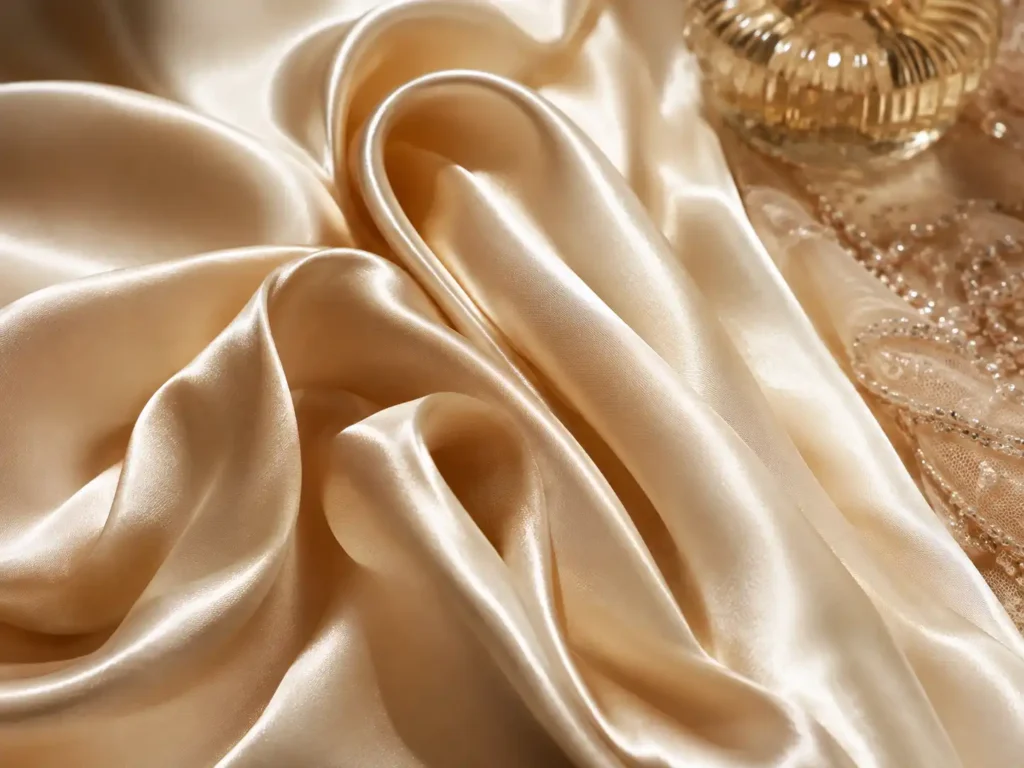
Satin used for fashion dresses covers a wide range of weights. A practical working reference for commonly used satin is roughly 80-220 GSM, broad enough to include very fluid slip-dress materials as well as more substantial occasionwear fabrics. Around the lower end of that range, roughly 80-110 GSM, satin often feels clearly lightweight because it bends readily, forms narrow folds, and responds quickly to movement. Around 110-130 GSM, many fabrics still feel fluid but begin to offer a little more coverage and control. These figures are useful for screening swatches, not for declaring rigid industry categories, because mills can create very different behavior at the same nominal GSM.
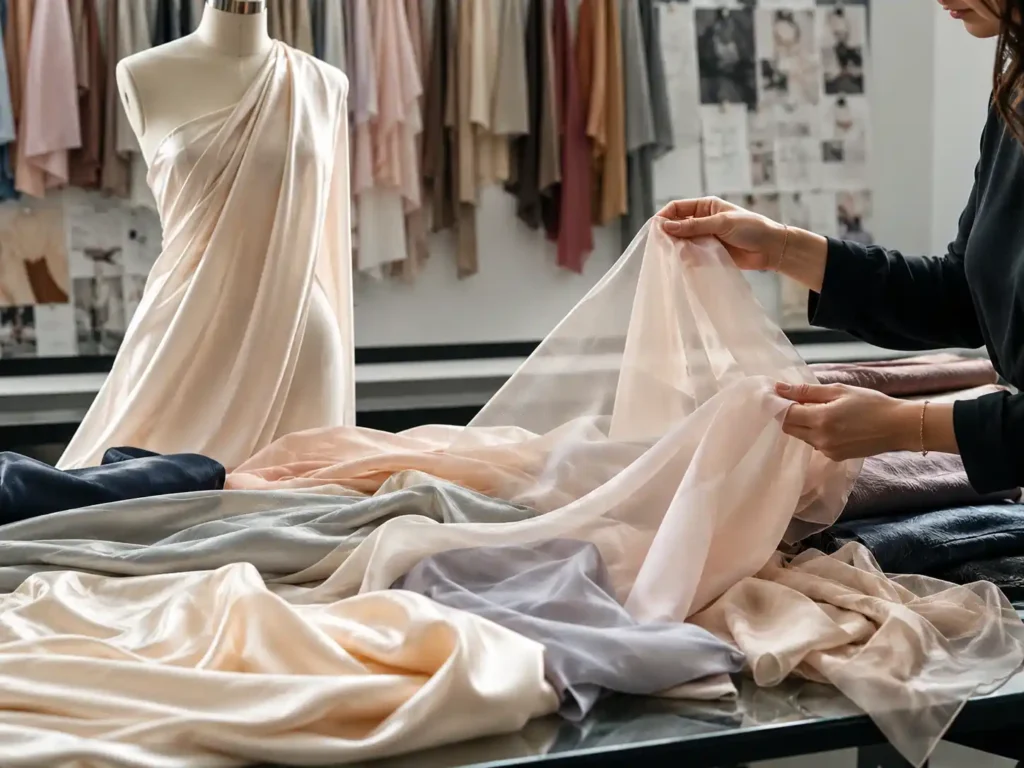
The quickest practical test is to stop looking at the swatch flat on a table. Hang at least half a meter vertically and watch how the material forms folds under its own weight. Lightweight satin often becomes more attractive when hanging because gravity creates long highlights and narrow shadows that a small flat swatch cannot show. Then place the same fabric over a hand, a dark background, and a pale background. The combination of drape and light transmission tells you whether the material is merely light or whether it is too delicate for the intended dress. Lightweight does not mean low quality; it simply means the design needs to make good use of mobility rather than fight it.
What GSM Is Heavy Satin?
Heavy satin generally sits toward the upper end of the dress-satin spectrum and feels more substantial when lifted, folded, or allowed to hang. In practical fashion development, fabrics around 160 GSM and above often begin to provide noticeably more body, while options approaching roughly 180-220 GSM can behave as structured occasionwear satin. The boundary is approximate, because a soft-finished 180 GSM fabric may drape more freely than another 160 GSM satin made with a denser construction. The most useful visual clue is fold width: heavier satin usually creates fewer, broader folds because it resists bending more strongly.
More weight can improve surface coverage and help a fitted or structured silhouette look cleaner, but it also creates problems when several layers meet. Outer satin, lining, interfacing, zipper tape, facings, pleats, and seam allowances can build into a thick stack at the waist or center back. Before approving a heavyweight option, fold the fabric into four, six, and eight layers and press the stack lightly between your fingers. That simple test gives a surprisingly good indication of whether a waist seam, gathered panel, corset junction, or zipper area is likely to become bulky during production. Heavy satin is valuable when its body serves the pattern, not when weight is being used as a substitute for good construction.
| Practical Satin Range | Typical Behavior | Common Dress Applications | Key Risk to Check |
| 80-100 GSM | Very fluid, light, close to body | Slips, cowl necks, soft bias styles | Transparency, seam puckering |
| 100-130 GSM | Fluid with slightly more coverage | Bias midi, draped mini, soft maxi | Cling, zipper rippling |
| 130-160 GSM | Balanced drape and body | Cocktail, bridesmaid, occasion dresses | Construction compatibility |
| 160-190 GSM | More substantial and stable | Structured mini, fitted formal styles | Seam and lining bulk |
| 190-220 GSM | Strong body, broader folds | Sculpted skirts, structured occasionwear | Weight, stiffness, thick seams |
Is GSM Enough to Judge Satin?
GSM answers only one question: how much one square meter of fabric weighs. It does not directly tell you thickness, softness, stretch, surface shine, yarn size, weave density, recovery, or how the fabric behaves when cut on the bias. Two 150 GSM satins can therefore produce very different dresses. One may have a soft finish and fall smoothly around the hips, while another may have a denser, crisper construction that pushes away from the body. If a development team approves both simply because the specification says 150 GSM satin, the final garments can look as though they were made from entirely different material categories.
A more reliable comparison looks at composition, weight, hand feel, drape, stretch, transparency, shrinkage, wrinkling, color consistency, lining requirements, and production risk together. Color can change perception as well: a black satin may look denser and more opaque than an ivory version of the same construction, while stretch satin can become visibly thinner when tension opens the structure across the body. GSM is therefore best treated as a useful reference number that helps narrow options. Approval should still depend on a physical swatch, a sample garment, and the exact construction planned for production.
Are Heavy Satin and Lightweight Satin Different Fabric Types?
Heavy satin and lightweight satin are not standardized fabric identities. Satin describes a weave structure and surface effect, and it can be produced from polyester, acetate, silk-like filament fibers, polyester-spandex blends, and other constructions. Commercial names such as charmeuse, duchess satin, bridal satin, stretch satin, and crepe-back satin may suggest a likely hand or weight, but naming varies between mills. One supplier’s premium satin can be lighter than another supplier’s ordinary satin, which is why replacing fabric by trade name alone is risky when a successful sample already exists.
For repeat production, a physical approved swatch is often more valuable than a descriptive name. Keep the fabric reference together with measurable information such as composition, GSM, width, stretch, color reference, and approved lining. When a repeat order is placed months later, that reference allows the team to compare a new lot against the actual material that created the approved dress rather than against an imprecise label such as heavy satin. This discipline becomes especially important when a style is reordered in several colors, because changes in dye, finish, or raw material can subtly alter drape and opacity even when the supplier uses the same product code.
How Does Satin Weight Change Drape and Structure?
Satin weight changes the balance between movement and shape. Lightweight satin generally falls closer to the body, creates smaller folds, and responds quickly to walking or turning. Heavy satin forms broader folds, covers underlying construction more effectively, and can maintain a cleaner silhouette. The best result comes from matching fabric resistance to the pattern: fluid designs need freedom to fall, while structured designs need enough body to support their intended geometry.
How Does Lightweight Satin Drape?
Lightweight satin creates the liquid appearance that makes many satin dresses visually distinctive. Because the fabric bends with relatively little resistance, gravity draws it into long, narrow folds. As the wearer walks, those folds move continuously and change the direction of reflected light, producing the flowing surface associated with slip dresses, cowl necks, soft maxis, and draped skirts. The effect becomes stronger when the pattern is cut on the bias because woven fabric usually gains additional mechanical give around 45 degrees to the grain, allowing the material to stretch around curves and settle closer to the body.
The same mobility that creates elegance also makes lightweight satin unforgiving. Thick seam allowances can create ridges, a stiff zipper can disturb the fall of the back panel, and a lining with too much body can introduce a visible horizontal break. Even underwear edges may affect the outer surface. That is why a fluid satin should be tested on a body or dress form rather than judged only by how it hangs freely. A material can look beautiful when nothing interrupts it and become much less convincing once it meets the bust, waist, hip, zipper, lining, and hem. Good lightweight-satin design preserves flow through the entire construction system.
How Does Heavy Satin Hold Shape?
Heavy satin resists deformation more strongly, allowing pattern pieces to maintain clearer planes and more deliberate folds. A skirt may stand slightly away from the leg, a shaped neckline can appear cleaner, and a structured mini dress can retain its intended geometry more easily. Under directional lighting, the effect is especially visible: instead of creating many small highlights, the fabric can produce broader reflective areas and deeper, smoother shadows. This gives formal and occasionwear silhouettes a controlled visual presence, particularly when the design depends on structured skirts, fitted bodices, broad pleats, or sculpted shapes rather than continuous fluid movement.
The fabric cannot replace internal engineering, however. A corset dress may still need correct cup shaping, lining, boning, reinforcement, and closure construction, and a heavy shell will not repair a weak foundation. There is also a point where useful structure becomes stiffness. If the fabric is too heavy, a draped neckline can form a rigid pocket, gathers may look bulky instead of soft, and a knot or twist detail can become oversized. The strongest designs use the fabric’s resistance deliberately. The pattern asks the satin to hold specific areas while allowing other areas to move, which is more sophisticated than simply selecting the heaviest option available.
Does Heavier Satin Look More Luxurious?

Heavier satin can feel substantial in the hand, so it is easy to associate weight with a premium product. Yet customers see the finished dress rather than the fabric specification. A heavy satin can still look inexpensive if the surface is overly plastic-looking, seams pucker, the zipper waves, panels reflect light in conflicting directions, or pressing marks remain visible. A lighter satin can look far more refined when its softness suits the silhouette and the construction keeps the surface clean. Perceived quality comes from material suitability and execution rather than from an isolated GSM number.
For satin, the details that most influence appearance are remarkably practical: consistent color, controlled shine, clean seam lines, suitable opacity, flat zipper installation, balanced drape, accurate pressing, limited snagging, and careful packing. The reflective surface magnifies small defects that would disappear on a matte crepe or textured knit. This is also why adding 30 or 40 GSM to solve a quality concern can backfire. Greater weight may hide some underlying construction, but it can introduce bulk, heat, and stiffness. A fabric feels premium when it behaves exactly as the style requires and still looks clean after production handling, not when it is heavy for its own sake.
How Does Weight Affect Satin Shine?
Weight does not create satin shine by itself, but it changes how the shine is perceived on a finished dress. Surface construction controls reflectivity, while fabric weight influences the size and movement of the folds that catch light. Lightweight satin creates many moving highlights because it bends easily, which can make the surface look fluid in motion. Heavier satin tends to produce larger reflective planes and broader shadows, giving a more architectural impression. Neither effect is inherently better; one supports movement, while the other supports shape and visual stability.
Cut direction can matter as much as weight. Adjacent satin panels cut in opposing directions may reflect light differently and appear to be slightly different shades even when they come from the same dye lot. That is why directional control during marker planning and cutting is important, especially on simple dresses where broad uninterrupted panels make reflection differences obvious. Color further intensifies the effect. Black, navy, chocolate, emerald, champagne, ivory, and silver all react differently under flash photography and retail lighting. A fabric should therefore be reviewed in the actual intended color, because approval of a black satin does not guarantee that the ivory version will have the same visual depth or surface uniformity.
Which Satin Weight Is Best for Each Dress?
There is no single satin weight that works for every dress. Slip and bias-cut styles generally need lighter, more fluid satin, while structured minis, fitted corset dresses, and some formal silhouettes benefit from additional body. Medium-weight satin often provides the broadest commercial flexibility because it can retain movement while improving coverage and sewing stability. The correct choice follows the silhouette, construction, color, lining, stretch, and expected fit.
Which Satin Is Best for Slip Dresses?
Slip dresses usually perform best with satin that can fall naturally from the bust and skim rather than rigidly shape the waist and hips. A lightweight or light-to-medium satin is therefore more common than a dense structured option. The fabric needs enough mass to create a long vertical fall but not so much body that the garment begins to stand away from the wearer. A cowl neckline provides an immediate test: if the satin is too stiff, the cowl forms a rigid pocket; if it is extremely light, the neckline can collapse, twist, or expose too much of the facing or lining.
Bias-cut slips add another concern: length growth. Once a long bias panel is assembled and hung, gravity can redistribute the fabric and allow parts of the hem to drop more than others. A hem that looks level immediately after sewing may change after the garment has settled. Seam finishing also becomes unusually visible in this simple silhouette. Large overlocked allowances, heavy zipper tape, thick labels, or bulky lining joins can show through a light satin shell. The minimal appearance customers expect from a slip dress is therefore not minimal from a manufacturing perspective; it requires careful control of fabric, grain, seams, lining, and final hanging behavior.
Which Satin Is Best for Bias-Cut Dresses?
Bias-cut satin needs a balance between mobility and control. Very lightweight satin can create exceptional drape, but it also responds more strongly to body tension and gravity. Light-to-medium satin often gives a commercial collection more margin because it preserves much of the fluidity while improving opacity and sewing stability. Garment length matters as well. A short bias mini and a floor-length gown made from the same satin will not behave identically, because the longer skirt places more fabric weight below the hip and can increase vertical stretch over time.
Fit should be reviewed after the garment has been worn and moved in, not only immediately after dressing. A bias dress can settle differently at the waist, hip, side seam, and hem after several minutes. Side seams that initially appear straight may rotate if grain alignment, cutting, or sewing balance is inconsistent. Panel direction also deserves attention because satin reflects light strongly; adjacent bias panels can show noticeable changes in shine if orientation is inconsistent. In practice, marker efficiency should not override surface continuity on a style that depends on uninterrupted visual flow. A few percentage points of fabric saving are rarely worth a finished garment that appears patchy under retail lighting.
Which Satin Is Best for Mini and Corset Dresses?
Mini dresses cover both ends of the satin spectrum. A softly draped party mini may work beautifully in a light satin, while a fitted strapless or corset mini usually benefits from additional body. Corset construction makes surface coverage especially important because the outer shell may sit over cups, boning channels, seam allowances, reinforcement, lining, elastics, or underwire. If the satin is extremely light, the edges of those internal components can become visible under side lighting. A somewhat more substantial satin can smooth the surface, provided it does not make the entire bodice rigid or uncomfortable.
Layer accumulation is the counter-risk. At the center back, outer satin, lining, zipper tape, reinforcement, seam allowances, and hooks may overlap in a small area. At a waist seam the stack can become even thicker. That is why the fabric should be tested in construction, not simply draped over a mannequin. Stretch satin adds another variable: controlled stretch can improve movement and reduce fit sensitivity, but poor recovery can create horizontal drag lines after sitting or walking. The appropriate fabric is one that covers the internal architecture while recovering cleanly and allowing the wearer to move, rather than simply the thickest satin the supplier can offer.
Which Satin Is Best for Evening and Occasion Dresses?
Evening and occasionwear include fluid bridesmaid dresses, draped cocktail styles, sculpted minis, corseted gowns, wedding guest dresses, and full formal skirts, so the fabric requirement varies widely. The most reliable selection starts with the intended silhouette rather than the occasion label. A soft bridesmaid maxi may need movement and comfort for several hours of wear, while a structured cocktail dress may need enough body to keep the skirt line clean in photographs. Color, lining, and climate also matter; a pale champagne satin can need more coverage than a black version, while an overly heavy fabric may feel uncomfortable in a warm destination setting.
Medium weights often become the practical middle ground because they can preserve some movement while providing better coverage and stability than very light satin. This is not a universal rule, but it explains why development teams often request several neighboring options rather than only one extreme. Looking at the intended dress family together is useful as well. If a collection includes a bias midi, structured mini, and corset gown, forcing all three into one satin may simplify purchasing while weakening the product. Sometimes the better commercial decision is to use two related satins with similar color and surface character but different weights, allowing each silhouette to behave properly.
| Dress Style | Practical Weight Direction | Main Performance Need | Main Risk |
| Slip dress | Light | Fluid body-skimming drape | Transparency, cling |
| Bias midi/maxi | Light-medium | Flow with controlled coverage | Growth, seam distortion |
| Draped cocktail dress | Light-medium | Defined folds without stiffness | Puckering, uneven drape |
| Fitted mini | Medium | Smooth surface and shape | Wrinkling, zipper waves |
| Corset dress | Medium-heavy | Coverage over structure | Layer bulk |
| Structured evening dress | Medium-heavy | Controlled silhouette | Excess stiffness |
| Full formal skirt | Medium-heavy | Broad folds and volume | Weight at waist |
| Soft bridesmaid dress | Light-medium | Movement and comfort | Lining compatibility |
How Do Weight and Color Affect Satin Opacity?
Lightweight satin is more likely to reveal body contours, seam allowances, or undergarments, especially in white, ivory, champagne, blush, and other pale colors. Heavier satin usually improves coverage, but GSM alone does not guarantee opacity. Fabric density, stretch, finishing, lighting, and garment fit also matter. Lining should therefore be selected after evaluating the actual satin color under realistic lighting and tension rather than by weight alone.
Is Lightweight Satin See-Through?
Some lightweight satin is clearly translucent, while other low-GSM satin offers surprisingly good coverage. The difference comes from more than weight. Yarn density, fiber type, weave construction, finishing, color, and stretch all influence how much light passes through the cloth. Pale lightweight satin deserves the most careful evaluation because a fabric can appear acceptable on a hanger and become transparent once it is stretched slightly across the bust or hip. The useful question is not whether lightweight satin is always see-through, but under which conditions the specific fabric loses enough coverage to affect wearability.
Opacity testing should imitate real use. Lay the satin over both light and dark backgrounds, examine it under front lighting and backlighting, and stretch it gently if the finished garment will be fitted. Include a seam allowance in the test because the doubled layer at a seam can create a darker stripe beside a single-layer area, especially in ivory, champagne, or pale blush. Then repeat the check with the intended lining. These simple comparisons reveal far more than holding a small swatch against a white desk. A commercially successful dress should not depend on the customer finding one perfect type of underwear or avoiding bright daylight to make the fabric look appropriate.
Do Light Colors Need More Lining?

Pale satin deserves closer lining evaluation because light colors reveal changes underneath more easily than dark shades. White, ivory, nude, champagne, blush, pale blue, and silver can all expose seam construction or underwear depending on fabric density. However, automatically adding a heavy lining is not the best solution. The lining has its own weight, color, friction, and drape, and those properties change the appearance and movement of the shell. A white lining behind warm ivory can make the dress look cooler, while a beige lining may improve coverage but deepen the tone slightly.
The most useful approach is to choose lining and shell together. Compare several lining colors under the actual satin and check opacity, color shift, static cling, movement between layers, seam visibility, heat, and bulk. For a fluid dress, the lining should not behave like a stiff foundation unless that is intentional. For body-skimming styles, a smooth lining can help the shell move over the body rather than catch on underwear, which reduces local wrinkles. Lining is therefore not simply a privacy layer. It is part of the garment’s mechanical system, and a good combination preserves the outer satin’s intended drape instead of cancelling it.
Does Heavy Satin Need Lining?
Heavy satin may provide enough opacity without lining, but dresses are lined for more than coverage. Lining can protect internal construction, improve skin comfort, conceal seam allowances, stabilize a bodice, support a neckline, reduce friction, or create a cleaner interior. The practical question is therefore what job the lining needs to perform. If the shell already provides excellent coverage and the silhouette is simple, an unnecessary heavy lining can increase heat and restrict movement. In a structured dress, the same lining may be essential because it contributes to the internal architecture even though the shell is completely opaque.
Layer accumulation needs special attention with heavier materials. A 180-200 GSM outer fabric combined with a substantial lining can create considerable thickness around waist seams, zipper ends, pleats, facings, strap attachment points, and bodice-to-skirt joins. An experienced sample room looks at those junctions rather than evaluating each material in isolation. Seam allowances may need grading, reinforcement may need to be localized, and the lining construction may need adjustment so the exterior remains smooth. Lining should solve a defined problem, whether that is coverage, stability, comfort, or finishing. Adding a layer simply because a garment is supposed to feel premium can create more problems than it solves.
How Does Satin Weight Affect Cling?
Lightweight satin follows the contours beneath it more closely because it has less resistance to bending. That creates elegant drape, but it also means underwear lines, pocket edges, lining seams, and body contours can become visible. Heavier satin usually bridges small irregularities more effectively and can stand slightly away from the body, although it may still cling through static or fit tension. Stretch changes the picture again: a stretch satin may look opaque and stable when relaxed but become visibly thinner and more reflective once it is pulled across the hip or bust.
Fit is just as important as weight. Even a substantial satin can show horizontal stress lines when the garment is too tight, and moving to a heavier fabric will not correct the underlying pattern problem. The most reliable assessment is a full sample in the correct size range, worn long enough to reveal how the material behaves after sitting, walking, and turning. Larger sizes can place different tension on key areas, so opacity and cling should be reviewed through grading rather than only on one fit model. In practice, the cleanest satin surface comes from matching fabric, ease, stretch, lining, and pattern shape instead of expecting any one of those elements to compensate for the others.
How Does Satin Weight Affect Garment Production?
Lightweight satin tends to create challenges with shifting, grain distortion, seam puckering, zipper rippling, and handling, while heavy satin is usually more stable but can create thick seam junctions, pressing impressions, and excessive bulk when layered. Both require careful control of shine direction, surface protection, pressing, and packing. Production succeeds when cutting and sewing methods are adjusted to the actual fabric rather than copied from another satin style.
How Does Lightweight Satin Behave During Cutting?
Cutting errors are easy to underestimate because their effects may not appear until sewing or fitting. Lightweight satin has a smooth surface with relatively low friction, so layers can shift during spreading and fluid panels can distort when lifted from the table. Grain control is the first concern. A long skirt panel cut slightly off grain can twist after sewing, particularly when bias sections are involved. Shine direction is the second concern because panels cut in opposing directions may reflect light differently and appear to be different shades even when they came from the same roll.
For bulk cutting, layer height should match the stability of the fabric. Increasing the stack simply to cut more garments at once can allow lower layers to move relative to upper layers, especially with slippery satin. Pattern placement also needs to respect directional appearance. The most fabric-efficient marker is not always the visually safest marker, and saving a small amount of theoretical consumption is rarely worthwhile if finished panels look mismatched under store lighting. After cutting, bias components should be handled without unnecessary hanging or pulling because they can change shape before sewing. Good satin production starts at the cutting table; the sewing room cannot reliably repair every problem introduced during spreading and cutting.
How Does Weight Affect Satin Seams?
Lightweight satin exposes small differences in sewing tension. Excessive thread tension, unsuitable needle choice, feed imbalance, or stretching by the operator can create puckering, and the reflective surface turns each small wave into a visible highlight and shadow. Heavy satin usually offers more stability under the sewing foot, but thickness can become a problem where several seam allowances intersect. Those junctions may create ridges that remain visible from the outside even after pressing. Seam quality therefore needs to be judged under side lighting, which reveals puckering and thickness much more clearly than a direct overhead view.
Machine settings should be established on the actual production fabric rather than copied from a previous style because two polyester satins can require very different handling. Needle type and size, thread, stitch density, upper and bobbin tension, presser-foot pressure, feed balance, seam allowance width, and reinforcement placement all affect the final surface. The approved sample should preserve an appearance standard as well as measurements. If bulk garments technically meet measurements but show more seam ripple than the approved sample, the product is not truly consistent. Satin makes that difference obvious, which is why in-line checks should focus on the visual line of seams instead of waiting until finished garments reach final inspection.
How Does Satin Weight Affect Zippers?
Invisible zippers reveal the difference between fabric and trim stability very quickly. The zipper tape has its own structure, and when a very soft satin is sewn directly to it the shell can ripple while the zipper remains straight. Some localized stabilization can help, but excessive reinforcement creates a rigid strip that is equally visible. The goal is enough support to keep the zipper area flat without changing the movement of the entire back panel. This balance should be tested before the full sample is completed because a simple zipper mock-up can expose whether the shell, lining, and reinforcement are mechanically compatible.
Heavy satin presents the opposite problem. The shell may sit flat beside the zipper, but several layers can become bulky where the zipper crosses a waist seam or bodice join. Outer satin, lining, reinforcement, seam allowances, facing, and zipper tape can all occupy a small area. If the dress also contains boning or hooks, the stack grows further. Seam allowances may need grading and the sequence of construction may need refinement. A clean zipper is therefore not merely a sewing skill; it is the result of matching fabric weight, reinforcement, layer management, and pressing. On satin, even a small ridge catches the light and becomes part of the visible design.
How Should Satin Be Pressed and Packed?
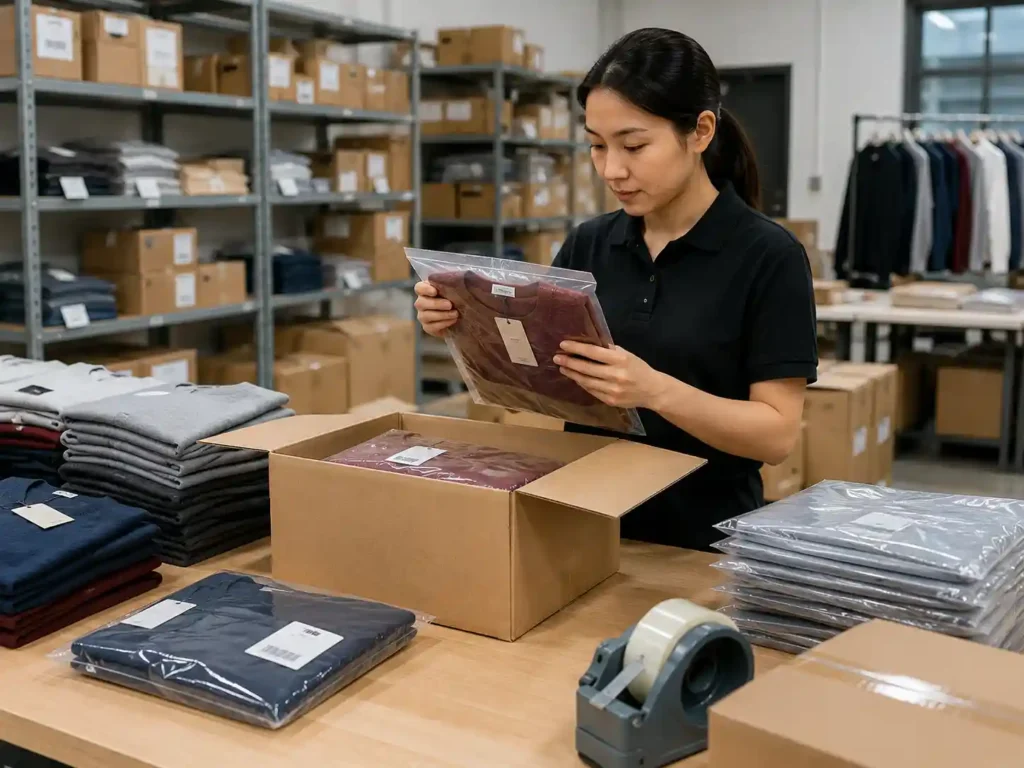
Satin can look excellent when it leaves sewing and still lose its presentation during finishing or packing. Because the surface reflects light strongly, seam impressions, pressure marks, shine changes, and fold lines can be more visible than they would be on matte fabric. Pressing conditions should therefore be tested on offcuts before bulk finishing begins. Heat, pressure, steam, contact time, and protective cloth can all affect the surface. Some heavyweight satin holds seam impressions strongly, while very light satin can distort or become glossy in spots when too much pressure is applied.
Packing deserves its own trial. Fold a finished sample exactly as planned for shipment, leave it compressed, then reopen the garment and evaluate crease recovery, hardware impressions, abrasion, and the way the skirt falls after unpacking. If a deep horizontal fold remains across the front, changing the folding method, adding tissue at critical areas, adjusting garment orientation, or reducing carton compression can be more effective than trying to steam every piece again at destination. Satin is sold visually, so production control does not end when the final stitch is sewn. The garment needs to survive finishing, handling, folding, and transport without losing the appearance approved at sample stage.
| Production Stage | Lightweight Satin Risk | Heavy Satin Risk | Practical Control |
| Spreading | Layer shifting | Lower shifting risk | Control layer height and tension |
| Cutting | Grain distortion | Direction mismatch | Maintain grain and shine direction |
| Sewing | Puckering | Thick intersections | Set fabric-specific machine parameters |
| Zipper | Rippling or bulging | Excess bulk | Test reinforcement and seam stack |
| Pressing | Distortion and marks | Strong seam impressions | Pre-test heat, steam, and pressure |
| Packing | Creases and abrasion | Deep fold memory | Run a packing trial before bulk |
| Bulk QC | Snags and shade variation | Surface marks | Inspect under strong directional light |
Which Satin Should You Choose for Production?
Choose satin from the finished garment backward. Define the silhouette, movement, opacity, fit, structure, stretch, lining, color, and price position first, then compare physical swatches and make a garment sample. Before bulk cutting, confirm production fabric against the approved reference and check shade, hand feel, weight, shine direction, defects, stretch, and construction compatibility. Heavy and lightweight satin are tools; the right one is the fabric that reproduces the intended dress consistently.
What Should You Check Before Choosing Satin?
A useful fabric brief begins with performance rather than a vague request such as high-quality satin. High quality means different things for different dresses. A slip-dress collection may value fluidity above almost everything else, while a structured occasionwear line may place more emphasis on opacity, surface stability, and clean shape. Before sourcing begins, define whether the silhouette is fluid or structured, whether the garment is loose or fitted, whether it is cut on the bias, what color is planned, whether stretch is required, how much opacity is needed, and what kind of lining or internal structure will sit beneath the shell.
The brief should also include practical construction details: garment length, zipper type, gathering, pleating, cups, boning, seam placement, expected retail hand feel, target fabric cost, and likely packing conditions. This makes the sourcing conversation far more useful than simply asking for light satin or heavy satin. When a manufacturer or fabric supplier understands what the fabric needs to do, they can compare options in terms of drape, recovery, transparency, and risk instead of only price and GSM. The goal is to turn a visual design idea into a material specification that survives sampling, fitting, grading, and bulk production without repeatedly changing direction.
How Should You Compare Satin Swatches?
Compare satin swatches under the same conditions and, where possible, in the same color. Different colors can distort perception because dark fabrics often appear denser and less transparent than pale ones. Hang each option vertically and compare fold size, then check backlighting, stretch, recovery, wrinkle formation, and the bulk created by several folded layers. Place the fabric over the intended lining and over a rounded form so you can see how highlights change around curves. A satin that looks smooth on a flat table may reveal streaks, transparency, or irregular reflection when it is curved over a bust or hip.
Record the results rather than relying on memory. A simple fabric card can contain supplier reference, composition, GSM, usable width, stretch direction and percentage where confirmed, color reference, approved lining, sample style, and any notes on snagging, pressing, or zipper behavior. This becomes especially valuable when several styles are developed at the same time or when a repeat order is placed months later. The physical swatch should stay with the record. Satin performance is difficult to describe completely in words, so the approved material itself remains the most reliable reference for hand feel, surface shine, and fold behavior when the team needs to compare a later bulk lot.
Do You Need a Garment Sample Before Bulk Production?
For satin dresses, a garment sample is one of the most important approval stages because several critical behaviors cannot be predicted from a swatch. A sample shows whether a cowl neckline opens correctly, whether a bias skirt grows, whether a fitted hip area clings, whether the lining interferes with movement, and whether the zipper remains flat. It also exposes manufacturing compatibility. A satin can look perfect as loose fabric and become troublesome once seam tension, pressing, reinforcement, and multiple layers are introduced. These are exactly the problems that are cheapest to solve before bulk fabric is cut.
Fit review should include movement rather than only static photographs. Ask the model to walk, sit, raise the arms, turn, and remain in the garment long enough for the fabric to settle. Then inspect the dress under strong directional lighting, paying special attention to cup edges, boning lines, darts, side seams, zipper areas, waist intersections, and the hem. If the fabric does not perform correctly, changing the material at sample stage is usually less disruptive than adding increasingly complicated construction later. A good sample is not just proof that a dress can be made; it is evidence that the chosen fabric, pattern, and production method work together.
How Should Bulk Satin Be Approved?
A successful sample does not automatically guarantee that bulk satin will behave identically. Before large-scale cutting, compare production fabric against the approved reference for fabric identity, composition where specified, GSM, usable width, hand feel, stretch and recovery, surface shine, shade, directionality, obvious weaving or finishing defects, snags, stains, and creases. Shade control deserves particular attention because satin’s reflective surface magnifies small differences between rolls. Panels from slightly different lots can look acceptable on the cutting table and noticeably mismatched after the garment is assembled and placed under directional lighting.
A disciplined sequence is straightforward: confirm the fabric direction, make or approve the sample, revise the material if necessary, confirm the bulk fabric, inspect incoming rolls, and only then release cutting. If a long-term manufacturing partner keeps approved fabric references, patterns, construction notes, and packing requirements, repeat orders become easier to control because the team has a physical and technical benchmark rather than relying on memory. That is particularly useful for satin collections, where small changes in finish or dye lot can alter visual appearance. The objective is not to eliminate every natural variation in textile production, but to detect meaningful changes before they are multiplied across an entire order.
In practice, neither heavy satin nor lightweight satin wins the comparison on its own. Lightweight satin is the stronger choice when the design depends on fluidity, soft folds, bias movement, and a body-skimming silhouette. Heavier satin is usually more suitable when the garment needs greater opacity, broader folds, structural presence, or better visual coverage over internal construction. Many commercially successful dresses sit between those extremes, using a medium weight that preserves movement while improving coverage and sewing stability. The correct fabric is the one that allows the intended silhouette to look natural rather than forcing the pattern to compensate for the wrong material.
The most dependable decision path is to move from silhouette to fabric behavior, then from swatch review to garment sample, fit review, construction approval, bulk fabric confirmation, incoming inspection, and production. A satin dress is ultimately judged by what the wearer sees and feels: whether the skirt hangs cleanly, the bust and hip remain smooth, the lining disappears beneath the shell, the zipper lies flat, the surface survives handling, and the garment still looks polished after pressing and packing. Weight matters because of what it does to the dress. When that principle guides development, both lightweight and heavyweight satin become useful tools instead of competing labels.
Is heavy satin better than lightweight satin for dresses?
Heavy satin is not universally better. It is usually a stronger choice for structured minis, formal skirts, corset dresses, or styles that need more opacity and broad, controlled folds. Lightweight satin is often better for slips, cowl necks, bias-cut dresses, and soft draped silhouettes. A medium weight can be the most practical option when a design needs movement but also needs enough coverage and sewing stability for repeat production. The better fabric is the one that supports the intended silhouette without creating new problems in lining, seams, fit, or comfort.
What GSM satin is best for a slip dress?
Many slip dresses are developed from lightweight or light-to-medium satin, often somewhere around the lower to middle portion of an 80-220 GSM dress-satin range. A practical starting point may be roughly 80-130 GSM, but the number should not be treated as a fixed rule. The fabric still needs enough opacity, stable bias behavior, an appropriate surface finish, and good compatibility with the lining and zipper. A 100 GSM satin from one mill can behave very differently from another fabric carrying the same weight, so the garment sample remains the final test.
Does lightweight satin always need lining?
No. Lightweight satin does not always require lining, but pale colors, fitted silhouettes, and low-density constructions should be checked carefully for transparency and cling. A dark fluid satin may provide acceptable coverage on its own, while an ivory version of the same fabric may reveal underwear or seam allowances. Lining can also be used for reasons other than opacity, including comfort, reduced friction, cleaner internal finishing, or support. The best decision comes from testing the actual shell and lining together under realistic lighting and on the body rather than applying one lining rule to every lightweight satin.
Can heavyweight satin be used for a bias-cut dress?
It can, but the result will usually be different from a classic liquid bias silhouette. Heavier satin can still drape on the bias, yet its folds are broader and its body can reduce the close, flowing movement associated with lightweight charmeuse-like fabrics. This can work well when the design intentionally combines bias shaping with a more substantial formal appearance. The important test is a full-length sample because long bias panels place more weight below the hip and can settle differently over time. If the fabric feels beautiful as a swatch but produces a rigid neckline or heavy skirt, the weight is working against the pattern.
Does higher GSM make satin more opaque?
Higher GSM often improves opacity because there is generally more material per square meter, but weight alone does not guarantee coverage. Yarn density, weave construction, fiber type, finish, color, stretch, and garment tension all influence transparency. A dense 120 GSM satin may provide better coverage than a more open 150 GSM fabric, and a stretch satin can become more transparent when pulled across the body. Pale colors also reveal underlying layers more readily. For reliable approval, test the actual fabric under backlighting, over contrasting backgrounds, and at the tension expected in the finished garment.
How can brands reduce satin problems before bulk production?
The most effective approach is to treat satin approval as a sequence rather than a single fabric choice. Compare swatches for weight, drape, opacity, stretch, surface direction, and layering; make a full garment sample; review fit and movement; test zipper flatness, pressing, and lining behavior; confirm the bulk fabric against the approved reference; and inspect incoming rolls before cutting. This workflow catches many problems while they are still inexpensive to correct. It also creates a repeatable reference for future colors or reorders, which is especially valuable because satin can magnify small differences in shade, finish, seam quality, and packing condition.