“Cotton feels better, so it must make the better dress” sounds convincing until the first production run is washed and the hem comes back shorter, the side seams begin to twist, or a fitted waist no longer sits where the approved sample did. The opposite shortcut is just as risky. Polyester is often treated as the automatic answer for durability and shape retention, yet a fabric can be technically stable and still feel too warm, too glossy, too thin under stretch, or simply wrong for the style. In women’s fashion, the fiber label is only one part of the decision. Jersey construction, yarn type, finished GSM, knit density, elastane content, finishing, color, opacity, stretch direction, recovery, and garment silhouette all affect what the customer eventually wears. A relaxed cotton T-shirt dress and a sculpted polyester-spandex bodycon dress may both be called jersey dresses, but they ask the fabric to do very different jobs.
Cotton jersey is usually the stronger choice when softness, a natural hand feel, moisture absorption, and casual comfort are the priorities. Polyester jersey is usually stronger when fast drying, dimensional stability, color retention, and repeated-wear shape recovery matter more. For dresses, neither fiber is universally better: the right choice depends on GSM, knit structure, stretch and recovery, opacity, finishing, care expectations, and the silhouette being developed.
A useful fabric decision therefore starts with a simple comparison but should not end there. Imagine two black jersey mini dresses hanging side by side in a sample room. Both look smooth, both stretch comfortably by hand, and both appear suitable for production. After one wash and a short wear trial, one keeps its length, side seams, waist recovery, and opacity; the other grows at the hip, shortens at the hem, and becomes slightly see-through under tension. The difference was never visible in the fiber name alone. The rest of this guide explains how to see those risks before they become thousands of finished garments.
What Is the Difference Between Cotton Jersey and Polyester Jersey?
Cotton jersey and polyester jersey can share the same basic knitted construction, but their fibers behave differently. Cotton jersey is generally softer, more absorbent, and more natural in hand feel, while polyester jersey normally dries faster and offers stronger dimensional stability. Their real garment performance also depends on yarn quality, GSM, knit density, finishing, and whether elastane is included.
Cotton Jersey Basics
Cotton jersey is made by knitting cotton yarn into interlocking loops rather than weaving yarns over and under each other. Those loops give the cloth natural mechanical flexibility, a relatively smooth face, and a softer break over the body than many woven cotton fabrics. For womenswear, cotton jersey is often chosen when the product needs an easy, familiar, skin-friendly character rather than a highly polished or technical surface. That makes it particularly relevant to casual dresses, tank dresses, T-shirt dresses, fitted basics, and softer daywear where touch is part of the product value.
The useful specification goes far beyond “100% cotton.” Product teams normally look at yarn quality, finished weight, knitting density, width, compacting or pre-shrink treatment, surface finish, and wash behavior. Two 180 GSM cotton jerseys can perform quite differently: one may be compact, smooth, and stable, while another may be looser, hairier, and more prone to spirality or length loss after laundering. Cotton also absorbs moisture into the fiber, which contributes to its familiar natural touch, but that same characteristic increases the need to control relaxation, shrinkage, and dimensional change before a pattern is locked for bulk cutting.
Polyester Jersey Basics
Polyester jersey uses polyester yarns in the same broad jersey-knit family, but polyester fibers absorb very little moisture into the fiber itself. This usually gives the material a faster drying profile and can make dimensional control easier, especially after correct heat setting and finishing. In fashion dresses, polyester jersey can range from lightweight and fluid to dense and supportive. Fine filament yarns may create a smooth, drapey surface, while textured yarns and elastane can produce a softer, more compressive fabric suited to fitted or ruched silhouettes.
Polyester should not be treated as automatically premium or automatically cheap. Yarn fineness, texture, knit density, finishing, surface luster, and recovery determine how refined the fabric feels. Poorly specified polyester may look shiny, trap heat, or develop persistent pilling, while a well-developed polyester-spandex jersey can give a clean matte surface, controlled stretch, and strong shape retention. For high-repeat fashion programs, its stability can be valuable, but only if bulk fabric is matched to the approved sample for weight, stretch, recovery, shade, and hand feel rather than accepted on composition alone.
Jersey Is a Knit Structure
One of the most useful distinctions in fabric development is that jersey describes the knit structure, while cotton and polyester describe the fiber content. This is why cotton jersey, polyester jersey, viscose jersey, modal jersey, and blended jersey can all belong to the same broad fabric family and still behave very differently when cut and sewn. The loops in the knit create mechanical stretch, while the fiber changes how those loops respond to moisture, heat, friction, repeated extension, and laundering. Elastane can then add another layer by increasing stretch recovery and fit retention.
| Property | Cotton Jersey | Polyester Jersey | Relevance to Dresses |
| Moisture behavior | Absorbs more moisture | Absorbs little, dries faster | Influences comfort and care |
| Natural hand feel | Usually stronger | Highly finish-dependent | Affects perceived quality |
| Dimensional stability | Needs closer control | Usually stronger | Important for fitted silhouettes |
| Color retention | Good with correct dyeing | Often very strong | Useful for dark and repeated colors |
| Mechanical durability | Moderate to strong | Usually strong | Matters in frequent wear |
| Heat sensitivity | Moderate | Higher under excessive heat | Relevant to pressing and care |
| Stretch recovery | Limited without elastane | Often strong with elastane | Critical for bodycon and fitted styles |
Fiber Changes the Finished Dress
The most important difference appears after the fabric becomes a garment. Cotton jersey often creates a softer, more relaxed surface, while polyester jersey can create a smoother, more controlled or performance-oriented result. A cotton jersey may stretch comfortably across the hip but relax slightly after hours of wear. A polyester-spandex jersey may recover more aggressively and keep a sharper waist-to-hip line. Neither effect is automatically desirable; the correct choice depends on whether the design is meant to feel relaxed, sculpted, fluid, compact, casual, or polished.
Drape shows the same pattern. A lightweight filament polyester jersey can fall more fluidly than a heavier cotton jersey, while a compact cotton jersey can create a clean casual silhouette with more body. This is why development teams compare fabric on a hanger, on a dress form, and on a fitting model whenever the silhouette is sensitive to tension. The useful question is not “Which fiber is better?” but “Which combination of fiber, weight, stretch, recovery, opacity, and finish produces the intended dress after sewing, wearing, washing, and repeat production?”
Which Jersey Feels and Performs Better?
Cotton jersey usually feels softer and more natural against the skin, while polyester jersey generally performs better in quick drying, dimensional stability, and shape retention. Cotton often suits comfort-led garments; polyester often suits fitted or easy-care styles. Drape, airflow, stretch, opacity, and recovery can vary widely, so the best fabric should be judged as a complete construction rather than by fiber name alone.
Softness and Skin Feel
Cotton has a familiar tactile character that works naturally in casual womenswear. Good cotton jersey can feel dry, soft, and comfortable against bare skin without the slick sensation sometimes associated with basic synthetic fabrics. This is one reason cotton-rich jerseys continue to perform well in tank dresses, T-shirt dresses, relaxed minis, casual midis, and fitted basics. The surface also tends to look more matte and understated, which can support a premium-casual position when the product depends on touch rather than shine or compression.
Even so, “cotton is always softer” is not a reliable development rule. Staple length, spinning method, enzyme washing, silicone finishing, brushing, compacting, and knit density all change hand feel. A short-staple, hairy cotton jersey can feel rougher than a finely textured polyester microfiber jersey. Softness should also be checked after laundering because cotton may become more relaxed and pleasant while also showing greater shrinkage or surface fuzz. A useful fitting review considers the fabric face, reverse, seam areas, and how the material feels when stretched across the body rather than judging a loose swatch between two fingers.
Breathability and Moisture
Cotton is commonly described as more breathable, but airflow is strongly influenced by knit density and fabric weight. A dense 260 GSM cotton jersey may allow less air movement than a lighter 160 GSM polyester jersey. Cotton’s clearer advantage is moisture absorption: it takes water into the fiber, which can feel comfortable during ordinary low-to-moderate perspiration. Once the fabric becomes wet, however, it generally holds that moisture longer and takes more time to dry than polyester.
Polyester absorbs very little moisture into the fiber itself, so water remains closer to the surface and usually evaporates faster. Some polyester jerseys are engineered to spread moisture through yarn shape or finishing, but standard polyester should not automatically be called moisture-wicking unless the material has been designed or tested for that function. For a relaxed summer day dress, a light cotton-rich jersey may provide the preferred skin feel. For a travel dress or easy-care style expected to be washed frequently and dried quickly, polyester or a carefully balanced blend may be the more practical choice.
Drape and Body Shape
Drape determines whether a jersey dress falls softly, clings closely, or holds a cleaner structured line. Fiber contributes to this behavior, but GSM, yarn form, knit density, and finishing matter just as much. A lightweight filament polyester jersey can move with an almost liquid quality, while a medium-weight cotton jersey often has a drier, fuller body. Both can work beautifully, but they produce different visual language once the garment is on the body and moving rather than hanging still on a rack.
The mistake is judging drape only from a suspended swatch. A fabric may look elegant when hanging freely but become shiny, transparent, or visually uneven once stretched over the bust and hips. It may also reveal underwear lines or seam allowances that were invisible while relaxed. Fitted womenswear therefore needs drape and opacity checks under realistic tension. A relaxed midi may benefit from soft vertical movement, while a bodycon mini needs controlled stretch and enough substance to support the silhouette without becoming bulky or overly compressive.
Stretch and Recovery
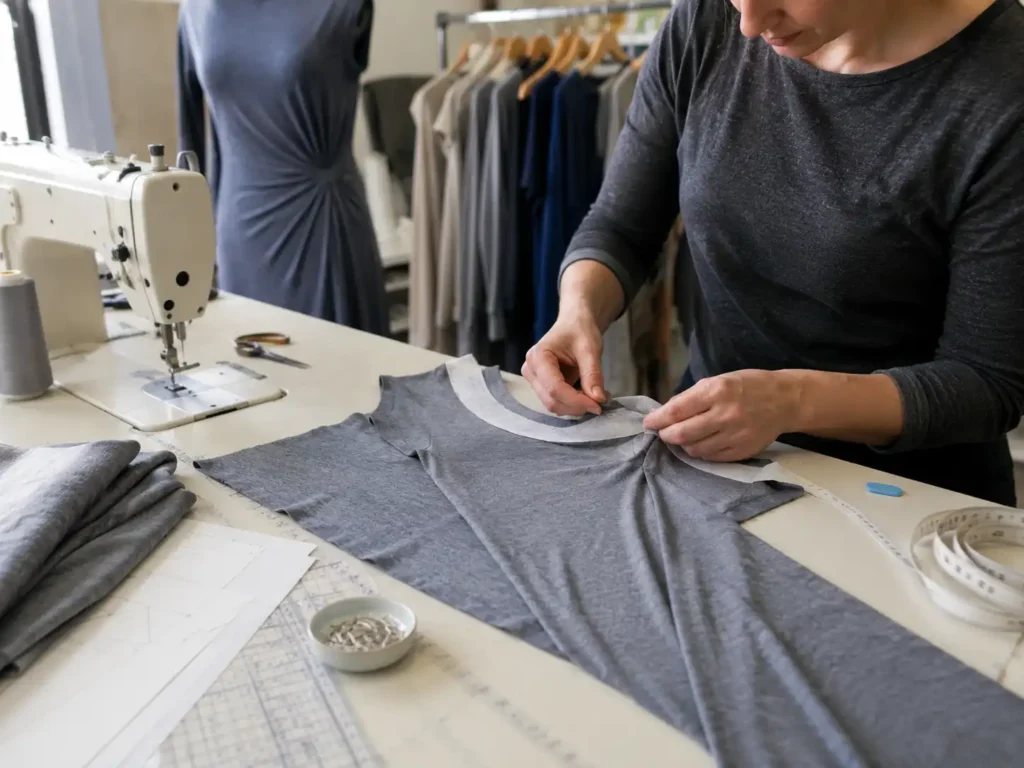
Stretch describes how far a fabric extends; recovery describes how well it returns. Those properties are connected but not interchangeable. A jersey that stretches 40% and remains permanently longer after release can perform worse in a fitted dress than a fabric that stretches 25% but returns closely to its original dimensions. Recovery affects the waist, seat, neckline, sleeve openings, side seams, and hem position, so it often matters more than maximum stretch in close-fitting garments.
A practical evaluation should separate crosswise stretch, lengthwise stretch, recovery after release, and residual growth after repeated extension. Elastane is often introduced when stronger recovery is required, but percentage alone does not guarantee performance because yarn tension, knitting method, finishing, and heat setting also influence the result. Repeated extension gives a more realistic picture than one hand pull. For fitted styles, a short wear trial is especially useful because the hip, seat, bust, and waist place uneven stresses on the garment that a simple swatch test cannot reproduce fully.
How Do Cotton and Polyester Jersey Hold Up Over Time?
Polyester jersey usually offers stronger dimensional stability, quicker drying, and consistent shape retention through repeated wear, while cotton jersey needs closer attention to shrinkage, torque, and surface change. Both can pill, fade, or distort if yarn quality, knitting, dyeing, or finishing is weak. Long-term quality is best judged through realistic wash, recovery, colorfastness, and finished-garment testing rather than appearance alone.
Shrinkage and Dimensional Change
Cotton jersey normally carries the greater shrinkage risk because cotton fibers absorb moisture and the knitted loops can relax from tensions introduced during spinning, knitting, dyeing, compacting, and finishing. Washing can release some of those tensions and change the fabric in length, width, or both. A 2-3% change may look small on a report, yet a 100 cm dress that loses 3% in length becomes roughly 3 cm shorter, which can noticeably alter a mini or fitted midi silhouette.
Polyester is generally more dimensionally stable, particularly after correct heat setting, but it should never be treated as shrink-proof. Excessive dryer temperature, unstable elastane, poor finishing, or unbalanced knitting can still cause distortion. The best review measures garment length, bust, waist, hip, hem opening, and critical seam positions before and after the intended care process. Side seams also deserve attention because a garment can stay close to its original measurements while still rotating visually. Dimensional stability is therefore a fit and appearance issue, not simply a laboratory percentage.
Pilling and Surface Wear
Pilling develops when loose fibers work toward the fabric surface and become entangled through repeated friction. Both cotton and polyester can pill, but the appearance is often different. Cotton fibers are generally weaker, so some pills can eventually break away. Polyester fibers are stronger, which means pills can remain attached for longer once they form. This is why a low-quality polyester jersey may look worn quickly even though the fabric itself remains mechanically strong and has not torn or lost much tensile strength.
The risk depends heavily on yarn and construction. Short fibers, hairy yarn, loose knitting, brushed finishes, and insufficient surface control can all increase fuzz and pilling. In dresses, friction is rarely uniform, so tests should pay attention to underarms, side waist, hips, seat, inner sleeves, and areas repeatedly touched by bags or outerwear. A swatch that stays perfect on a cutting table may show obvious wear after several hours of real use. Laboratory pilling grades are useful, but a sample garment wear trial often reveals whether the appearance fits the intended price and positioning.
Color and Appearance Retention
Polyester has strong potential for color retention because disperse dyes can produce durable shades when dyeing and heat setting are controlled correctly. Deep black, navy, red, and saturated fashion colors can remain visually consistent through repeated washing. Cotton can also achieve good colorfastness, but dye type, depth of shade, washing conditions, and surface friction influence how quickly fading or frosting becomes visible, especially on dark colors where even a small surface change can be obvious under retail lighting.
Appearance retention is broader than colorfastness alone. A garment can keep its shade and still look older because of surface fuzz, pilling, seam puckering, hem distortion, loss of recovery, or localized abrasion. For collections that use the same color across several silhouettes, dye-lot control is important because two black dresses displayed together can look mismatched even if both individually fall within a broad shade tolerance. Bulk lots should be compared against an approved reference before cutting, particularly when repeat orders need to sit beside earlier production in the same selling season.
What Repeated Washing Reveals
The first few washes often expose weaknesses that are difficult to detect during initial fabric inspection. Cotton jersey may relax or shrink, while polyester jersey can reveal pilling, heat sensitivity, elastane instability, or seam behavior that was not obvious in the first sample. The most useful wash review follows the intended care method and records changes in length, width, side-seam position, hem balance, neckline recovery, surface appearance, hand feel, shade, and elastic response after the garment has dried and conditioned.
For brands with repeat programs, consistency across production lots matters almost as much as performance within one lot. A successful dress reordered months later should fit and behave like the earlier delivery, not simply share the same nominal fiber content. Keeping an approved fabric reference, wash result, color standard, and garment measurement record makes that comparison much more reliable. The cost of this discipline is small compared with discovering that the second run has a different hand feel, higher growth, or a visibly different black after garments are already sewn and packed.
Which Jersey Is Better for Different Dresses?
Cotton jersey is often the better match for relaxed casual dresses where softness and a natural hand are central to the style. Polyester or polyester-spandex jersey is often stronger for bodycon, ruched, travel, and high-recovery fitted dresses. The final choice should balance GSM, opacity, stretch direction, recovery, drape, wash stability, and the amount of tension created by the garment pattern.
Bodycon Dresses
Bodycon dresses are among the least forgiving jersey garments because the fabric remains under continuous tension across several body zones. A material may feel flexible at the waist yet behave very differently across the hip, bust, or seat. For these styles, recovery is often more important than maximum extension. If a fabric stretches easily but does not return, the dress may loosen during wear, creating a baggy waist, seat growth, side-seam movement, or a hem that gradually rides upward as the wearer walks and sits.
Polyester-spandex jersey is frequently effective because it can combine dimensional stability with controlled recovery. Cotton-spandex can also perform well when a softer, more natural touch is important, although wash shrinkage and long-term growth usually deserve closer checking. The useful target is a performance profile rather than a fixed fiber ratio: sufficient crosswise stretch for dressing and movement, enough recovery to keep the silhouette, adequate GSM for coverage, stable seams, and a surface that remains attractive under tension. For a fitted style, approval should always include a sewn sample because flat fabric cannot reveal actual ride-up, transparency, or bust-waist-hip balance.
Casual and Summer Dresses
Cotton jersey is a natural candidate for casual dresses because its soft, dry touch works well with T-shirt dresses, tank dresses, relaxed minis, and easy midis. Those silhouettes often require less aggressive recovery than bodycon styles, so comfort can carry more weight in the fabric decision. Summer selection is more nuanced because “cotton is cooler” is not a universal rule. Weight, knit density, garment coverage, and airflow can matter more than the fiber label in a specific product.
| Dress Application | Practical Starting GSM* | Main Priority | Common Fabric Direction |
| Light summer dress | 140-190 GSM | Airflow, softness, drape | Cotton-rich or light blend |
| Casual T-shirt dress | 160-220 GSM | Comfort, opacity, stability | Cotton or cotton-poly blend |
| Fitted midi dress | 200-260 GSM | Coverage and recovery | Polyester-spandex or dense blend |
| Bodycon mini | 220-300 GSM | Shape control and opacity | High-recovery synthetic blend |
| Structured knit dress | 260-340 GSM | Support and clean lines | Ponte or dense double knit |
These figures are practical development starting points rather than universal standards. Yarn size, knitting density, finishing, color, elastane content, and garment construction can shift the most suitable range. The same GSM can also feel noticeably different between mills, so final approval should be based on the actual fabric, sample fit, opacity under stretch, and wash behavior rather than the weight number alone.
A tightly knitted 180 GSM jersey may provide more coverage than a looser 210 GSM fabric, and pale colors often reveal more undergarment lines than black at the same weight. Samples should therefore be checked in the actual color under realistic lighting. A summer dress also needs to be judged as a complete garment: sleeves, lining, body coverage, and fit can have as much effect on comfort as the cotton or polyester percentage printed on the care label.
Ruched and Gathered Styles
Ruching asks jersey to stretch and compress at the same time. The material needs enough drape to form neat folds without becoming bulky, while recovery must remain strong enough to keep those folds controlled after hanging, sitting, or repeated wear. Lightweight polyester-spandex jerseys often work well because they can create compact gathers and maintain elastic response. Cotton-spandex can produce a softer, more casual look, although heavier cotton-rich constructions may build too much thickness where several layers are concentrated at the waist or hip.
The gathering ratio should be tested with the actual fabric because a material that looks elegant at moderate ruching may become heavy or uneven when the pattern uses much deeper gathering. Developers should check fold thickness, transparency between gathers, seam feeding, side-seam stability, drape below the ruched section, and the way the fabric recovers after being stretched. When a prototype looks bulky or collapses after wear, changing the jersey can be more effective than repeatedly altering the pattern because the problem may be coming from fabric mass and recovery rather than the pattern shape itself.
Fitted Womenswear
Fitted womenswear includes slim midi dresses, asymmetric knit dresses, close-fitting tops, jumpsuits, and coordinated sets as well as classic bodycon silhouettes. The first question is where the garment needs to stretch. Some designs require mainly crosswise extension, while others benefit from four-way movement. A one-shoulder or asymmetric style can also place diagonal stress across the knit, making recovery and seam stability important in areas that would not look demanding on a flat technical drawing.
Opacity under extension is another recurring issue. Many jerseys appear completely opaque while relaxed and become noticeably more transparent when stretched 20-40% over the bust, hip, or seat. The fabric should therefore be viewed over both light and dark underlayers at the approximate extension expected in the garment. A short wear test adds another layer of evidence because sitting, walking, and repeated movement reveal growth that a static fitting may miss. When a material changes substantially, pattern ease may also need adjustment; replacing cotton-rich jersey with a high-recovery polyester jersey without refitting can change how the same pattern sits on the body.

How Should You Choose Jersey Weight and Blend?
Choose jersey weight and blend by starting with the finished silhouette rather than a preferred fiber percentage. GSM influences coverage and structure, cotton contributes softness and moisture absorption, polyester improves drying and dimensional stability, and elastane supports recovery. The most reliable specification balances those properties with opacity, drape, wash performance, care expectations, cost, and the actual stretch demand of the dress.
Choosing GSM
GSM means grams per square meter and measures fabric mass, not quality. It is useful for comparing jerseys, but it does not directly tell you thickness, opacity, drape, or durability. A 220 GSM compact cotton jersey and a 220 GSM polyester-spandex jersey can feel completely different because fiber density, yarn size, knit construction, and finishing affect volume and stretch. Likewise, two fabrics with identical weight can provide very different coverage once they are extended over the body.
| Finished GSM | Typical Character | Common Womenswear Use | Main Risk to Check |
| 130-160 | Very light | Layered summer or light gathered styles | Transparency, seam distortion |
| 160-200 | Light to medium | Casual and T-shirt dresses | Opacity, growth, shrinkage |
| 200-240 | Medium | Fitted day dresses and slim midis | Recovery, wash stability |
| 240-300 | Medium-heavy | Bodycon and supportive styles | Heat, bulk, compression |
| 300-360+ | Heavy or structured | Ponte-style and sculpted knit dresses | Stiffness, reduced drape |
These ranges are best treated as development references rather than pass-or-fail standards. Dark colors can appear more opaque than white at the same GSM, and a tightly knitted fabric can outperform a heavier but more open construction. For repeat orders, weight consistency also deserves monitoring because a noticeable GSM shift can change hand feel, stretch, coverage, and even finished measurements while the fiber composition printed on the specification remains exactly the same.
Cotton-Polyester Blends
Cotton-polyester blends are useful when a product needs some of cotton’s natural touch without accepting the full level of moisture retention or dimensional movement associated with pure cotton. A cotton-rich blend can still feel familiar and casual while drying faster and holding shape more consistently. A polyester-rich blend can become softer and less technical in appearance while retaining much of the synthetic fiber’s durability and repeat-wash stability. The blend can therefore be the intended solution rather than simply a compromise between two pure fibers.
Ratios such as 60/40, 65/35, or 50/50 are common reference points, but the percentage alone does not predict quality. A compact 60% cotton / 40% polyester jersey may perform very differently from another fabric with the same composition if yarn quality, knitting tension, dyeing, or finishing changes. Development teams should compare finished GSM, stretch, recovery, shrinkage, pilling, hand feel, drying behavior, and surface appearance together. For repeat programs, consistent fabric sourcing and documented approval standards are especially important because a nominally identical blend from a different mill can produce a noticeably different garment.
Adding Elastane
Elastane changes jersey most visibly through recovery and fit retention. A fabric without elastane can stretch mechanically through its knitted loops but may not return strongly enough for a close-fitting silhouette. Adding a relatively small elastane component can make a substantial difference in bodycon dresses, fitted midis, ruched styles, and close-fitting tops. Even so, a label such as 95% polyester / 5% elastane or 95% cotton / 5% elastane tells only part of the story because the construction determines how effectively that elastane works.
The useful checks include crosswise and lengthwise extension, force required to stretch, recovery after release, residual growth after repeated cycles, heat sensitivity, wash stability, and opacity under tension. Too little recovery can lead to bagging around the waist and seat; too much compression can make a garment uncomfortable or visually smaller than the measurement chart suggests. Pale fitted dresses require particular care because high stretch can reduce opacity dramatically. A successful specification therefore considers elastane percentage together with knit structure, GSM, pattern ease, color, and the intended body fit.
Matching Blend to the Product
Fabric selection affects how the garment is perceived before anyone reads the care label. Cotton-rich jersey often communicates softness, ease, and casual quality. Smooth polyester jersey can create a cleaner, sharper surface, while dense polyester-spandex can support sculpted silhouettes with stronger recovery. A lightweight blend may be the better route for a fluid ruched dress because it keeps the visual softness while improving stability. The correct blend supports the design language as well as technical performance.
Commercial decisions also need to consider total garment cost rather than fabric price per meter alone. A cheaper jersey that requires a second lining layer, creates higher shrinkage, causes fitting revisions, or produces unstable repeat orders can become more expensive by the time the garment reaches shipment. For custom development, it is often more productive to compare two or three fabric options on the same pattern and review fit, touch, opacity, recovery, washing, and estimated production cost together. That gives the design team evidence from the finished dress rather than forcing the choice from swatches alone.
How Can You Test Jersey Before Bulk Production?
Before bulk production, jersey should be checked for composition, GSM, width, shrinkage, stretch, recovery, torque, pilling, colorfastness, opacity, and finished-garment measurements. A fabric swatch alone is not enough. Reliable approval combines measurable material checks with a correctly sewn sample, realistic washing, a short wear evaluation for fitted styles, and comparison of incoming bulk fabric against the approved reference.
Fabric Specifications
The first layer of control is a fabric specification precise enough to be checked again when bulk material arrives. Descriptions such as “soft black cotton jersey” or “stretch polyester jersey” leave too much room for interpretation. A more useful record includes fiber composition, finished GSM, usable width, approved color reference, knit construction, stretch direction, stretch percentage, recovery behavior, shrinkage result, hand feel, surface appearance, opacity, pilling risk, and the intended care method for the finished garment.
Fabric codes are particularly useful when one material is shared across several styles or carried into repeat orders. Instead of relying on memory, each SKU can be linked to an approved reference, sample garment, and test record. When incoming fabric changes in weight or recovery, the same paper pattern can produce a different fit even if cutting measurements stay identical. Bulk approval should therefore compare both appearance and performance. Matching the black shade is not enough if the replacement lot stretches 10 percentage points more, feels noticeably thinner, or grows more after laundering.
Stretch and Recovery Testing
A simple controlled stretch test can provide useful comparative information when the same method is applied consistently. Mark a known distance on the fabric, such as 10 cm, then extend it in the required direction and record the length. Stretch percentage can be expressed as (extended length – original length) / original length x 100. If a 10 cm section reaches 14 cm, the fabric has extended by 40% under that test condition. The important next step is measuring what happens after release.
Recovery should be recorded after a consistent resting period because a fabric may return immediately to 10.3 cm and settle closer to 10.1 cm later. Repeated cycles are more informative than one pull because weak recovery often becomes clearer as the knit is stressed several times. Test both directions when the product requires multi-directional stretch. For fitted dresses, a short wear trial provides additional evidence because the hip, seat, waist, and bust experience uneven forces during real movement. The target is not maximum stretch; it is enough stretch with controlled recovery for the specific silhouette.
Shrinkage, Torque, and Wash Testing
Shrinkage testing starts with accurate measurements before laundering and a care method that matches the intended label. Dimensional change can be calculated as (after-wash measurement – before-wash measurement) / before-wash measurement x 100. If a 100 cm dress measures 97.5 cm after washing, the length change is -2.5%. That figure then needs to be translated into product impact because 2.5 cm can be visually significant on a mini dress while being less critical on a relaxed long style.
Torque or spirality should be checked at the same time. Jersey can twist when the knit is unbalanced or when relaxation and cutting direction are poorly controlled, so side seams may migrate toward the front or back after washing. Review dress length, bust, waist, hip, hem opening, neckline shape, sleeve openings, seam position, surface appearance, and recovery after drying. Finished-garment testing matters because stitching, elastic, lining, and trims can create behavior that is not visible in an isolated fabric square. When a style is especially fit-sensitive, a washed sample should be compared directly with the approved unwashed sample.

Color, Pilling, and Bulk Approval
Colorfastness should match the garment’s target market, color depth, and care method. Wash fastness, dry and wet rubbing, perspiration, and shade consistency may all be relevant depending on the product. Deep black, navy, burgundy, and saturated red deserve extra attention because small shade differences or surface frosting can become obvious under store or studio lighting. If several styles share one color, compare them together rather than approving each garment in isolation because consumers often see the collection side by side.
Pilling should also be considered in relation to actual wear. Laboratory methods provide structured comparisons, while sample garments reveal friction around underarms, waist, hip, seat, and bag-contact areas. Before bulk cutting, the team should be able to answer a few practical questions with evidence: is the fabric the approved composition and weight, does the shade match, is stretch and recovery consistent, are shrinkage and twisting within the agreed standard, and does the washed garment still resemble the approved fit? Once thousands of panels are cut, a fabric problem becomes a much more expensive garment problem.
Conclusion
Cotton jersey and polyester jersey are not competing materials with one permanent winner. Cotton generally brings a softer, more natural hand and stronger moisture absorption, while polyester generally provides faster drying, stronger dimensional control, and more consistent shape retention. The best fabric for a dress depends on what the silhouette asks it to do. Relaxed casual styles may benefit from cotton-rich comfort, while bodycon, ruched, travel, and high-recovery fitted styles often benefit from polyester or polyester-spandex constructions with carefully controlled stretch and opacity.
The safest development process is to move beyond fiber names and approve measurable fabric behavior: GSM, width, stretch, recovery, shrinkage, torque, pilling, colorfastness, opacity, and washed-garment dimensions. For brands developing custom jersey dresses, comparing a few suitable constructions at sample stage can prevent costly changes after bulk fabric arrives. A fabric that looks almost identical on a hanger can behave very differently after a day of wear and one wash; the stronger decision is the one supported by the finished garment, not the label alone.