Skip to content

A chiffon hem looks like a tiny finishing detail, yet it can change the way an entire dress moves. When the edge becomes too heavy, a soft maxi skirt can lose its float. When thread tension is too high, a narrow hem can pull into ripples that become obvious as soon as the garment hangs. When a circular skirt is hemmed before bias sections settle, the sewing may look neat while the finished length still drops unevenly around the body. These are not unusual problems; they are the reason experienced dress teams treat chiffon hemming as part of silhouette engineering rather than as the last routine sewing operation. The choice between a rolled hem and a baby hem therefore needs to be made with the actual fabric, pattern shape, finished appearance, production method, and quality standard in mind. The best-looking sample is only the beginning. A commercial dress also needs a hem that trained operators can reproduce consistently across sizes, colorways, and repeat orders without changing the visual character of the chiffon.
For chiffon dresses, neither a rolled hem nor a baby hem is universally better. A rolled hem is often preferred when the goal is an exceptionally narrow, lightweight edge with minimal visual bulk, while a baby hem can offer more staged control over the fold and finished width. Because sewing rooms do not always use the two terms identically, the safest specification defines the finished width, stitch appearance, edge enclosure, and approved sample rather than relying on the construction name alone.
The distinction becomes especially clear when a dress moves. A hem that seems perfectly acceptable on a flat table can flare, rope, wave, or cast a darker shadow through sheer fabric once the garment is hanging. A sample room may also make one exquisite hem very slowly, while a bulk line needs to repeat the same result hundreds or thousands of times. The useful question is not simply which method is more refined. It is which method lets this particular chiffon, on this particular pattern, keep the drape and visual lightness the designer intended while remaining stable enough for real production. That is where the comparison becomes much more interesting than a sewing glossary definition.
What Are Rolled and Baby Hems?
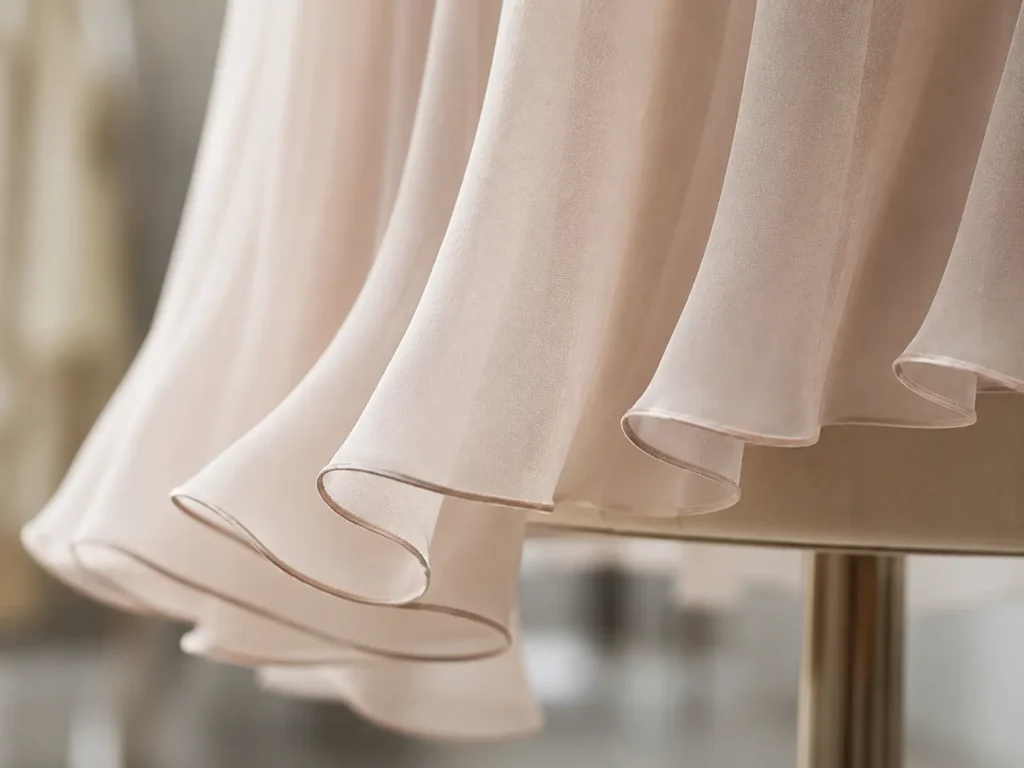
Rolled hems and baby hems are both very narrow finishes used to enclose the raw edge of lightweight fabrics such as chiffon. A rolled hem usually forms the edge into a tiny roll during sewing, while a baby hem is often made through a controlled stitch-trim-fold-stitch sequence. Terminology overlaps, so finished width, construction method, and approved appearance are more reliable than the name alone.
What Is a Rolled Hem?
A rolled hem is designed to keep a garment edge as light and unobtrusive as possible. The raw edge is rolled or tightly folded inward and stitched so that only a small amount of fabric is trapped inside the finish. On fine chiffon, a finished width around 2-4 mm is a useful development range to test, although it should never be treated as a universal rule. The correct width depends on fabric weight, yarn density, surface finish, transparency, pattern geometry, thread choice, and the visual standard of the dress. On a full maxi skirt with several meters of circumference, keeping that edge compact can noticeably preserve swing and softness because unnecessary folded material is not repeated around the entire lower edge.
The method can be produced with a rolled-hem foot, an industrial hemming attachment, or another controlled narrow-hemming setup. Once the fabric feeds cleanly, the operation can be efficient over long edges, but chiffon makes feeding errors visible very quickly. A small change in how the fabric enters the attachment can widen the roll, twist the edge, or pull the hem into a rope-like line. For sample approval, the team should therefore inspect width consistency, thread tension, side-seam intersections, reverse-side cleanliness, and the way the garment hangs after pressing. A rolled hem earns its place not because the edge is tiny, but because it remains tiny, soft, and visually calm over the whole garment.
What Is a Baby Hem?
A baby hem is also an exceptionally narrow enclosed finish, but it is commonly produced with more staged control. One widely used method begins by turning a very small amount of fabric and stitching close to the fold. The remaining raw allowance is then trimmed close to that first line, the edge is folded again, and a final stitch secures the hem. The first line of sewing helps stabilize slippery chiffon before the final turn is formed, which can be useful when a particular fabric refuses to feed consistently through a rolling attachment. The finished result can be almost as narrow as a rolled hem while giving the operator a clearer visual guide during construction.
The trade-off is additional handling. Every extra fold, stitch, and trimming operation is another opportunity to stretch a curved edge or damage a delicate fabric. If trimming leaves too much allowance, the final edge becomes thicker and more visible through sheer chiffon. If trimming is too aggressive, the first stitch line can be weakened or stray fibers may work out of the finish. For that reason, a baby hem should be specified as a physical result rather than as a prestige term. A useful approval might define an approximately 3 mm enclosed edge, clean face-side stitching, no exposed fibers, no visible twisting, and a soft transition through seam intersections, then confirm the exact look on the PP or sealed reference sample.
Are Rolled and Baby Hems the Same?
Sometimes the two terms are used almost interchangeably, and sometimes a sewing room uses them for different operations. That inconsistency explains much of the confusion around rolled hem versus baby hem. One workshop may call a 2-3 mm double-turned edge a baby hem, while another may describe a nearly identical appearance as a narrow rolled hem because the edge is formed with a hemming attachment. Both teams may believe they followed the instruction correctly. For commercial product development, the safest approach is to regard the construction name as a direction and the measurable, photographed, approved result as the actual standard.
A stronger tech-pack instruction records finished width, the number and position of visible stitch lines, whether the raw edge must be completely enclosed, the treatment at side seams, and any special handling required on circular or bias sections. Thread shade, pressing expectations, and an enlarged reference photograph can remove even more ambiguity. This matters when a sample leaves the hands of one highly skilled machinist and moves to a production line, because bulk sewing cannot depend on a shared assumption about vocabulary. In a structured development workflow, approved workmanship changes should be transferred into sewing instructions and QC checkpoints so the construction can be understood by merchandising, production, and inspection teams in the same way.
What Should a Brand Approve?
The most useful approval is not simply a note saying “rolled hem approved” or “baby hem approved.” It is a small package of physical and measurable information that gives the factory a repeatable target. For chiffon, that package should normally include the target finished width in millimeters, face-side appearance, reverse-side appearance, treatment at bulky intersections, and a sealed garment sample. If the fabric is especially sheer, the team should also inspect the hem against the intended lining color or body contrast because a change of only a millimeter in folded depth can alter the visible opacity of the edge.
The garment should then be checked in the conditions that matter to the design. Hang it on a form, photograph it from the front, back, and side, and move the skirt or sleeve so the edge is seen in motion. A narrow finish can pass close inspection yet still form a hard horizontal line around a soft dress. Conversely, tiny local width variation may be nearly invisible at normal wearing distance while the overall drape remains beautiful. The approval should protect the characteristics the customer can actually see: proportion, fluidity, evenness, cleanliness, and consistency. Once those qualities are frozen in a PP or Golden sample, the name of the hem becomes much less important.
How Do Rolled and Baby Hems Differ?
Rolled and baby hems differ mainly in how the edge is formed, how much operator control is available, how quickly the operation can be repeated, and how the finished hem behaves on the chosen chiffon. Rolled hems can be extremely light and efficient; baby hems often provide more staged control. Neither method is automatically superior because fabric behavior and pattern geometry can change the result.
How Do Their Construction Methods Differ?
The construction difference is easiest to understand by following the fabric through the operation. With a rolled hem, the operator commonly guides the raw edge into a narrow fold or roll as it travels through the machine. When the attachment, machine settings, and fabric all cooperate, the edge can be formed and secured continuously. A baby hem is often more sequential: establish a small fold, stitch it, trim the remaining allowance close to that stitch line, fold again, and sew the final edge. The first method concentrates control at the feed point; the second distributes control over several stages. That difference affects labor, handling, and the kinds of errors most likely to appear.
Neither sequence is inherently more premium. A perfectly fed rolled hem can be cleaner than a baby hem with rough trimming, while a carefully controlled baby hem can outperform a rolled edge that wanders in width or stretches a curve. The practical production question is therefore whether the chosen method can be repeated on the approved bulk fabric at the speed and skill level available on the line. If the sample result depends on constant hand correction, extremely slow sewing, or one unusually experienced operator, the construction may still need refinement before it is production-ready. A beautiful sample is valuable, but the manufacturing standard must also survive repetition.
Which Hem Is Narrower?
Either method can create an extremely narrow edge, so there is no universal answer. On fine chiffon, development teams often test finished widths in the 2-4 mm range, then select the smallest width that remains visually clean and realistically repeatable. A 2 mm edge can look exquisite on one stable polyester chiffon and inconsistent on another softer, more mobile quality. Moving to 3 mm may actually improve the garment because the width remains consistent around the whole circumference instead of widening and narrowing unpredictably through curves and seam intersections.
Transparency makes this decision more visible than the ruler suggests. Pale chiffon builds opacity wherever layers are folded, so a section that grows from 2 mm to 4 mm can create a darker band along the lower edge. On black or heavily printed chiffon, the same variation may be far less obvious. For approval, measure several locations rather than only center front. Check straight-grain areas, side seams, curves, and regions approaching the bias. A hem that measures slightly wider but stays uniform usually looks more refined than an ultra-tiny edge that changes width every few centimeters. In dress manufacturing, consistency is part of delicacy.
Do They Need Different Equipment?
Rolled hems are often associated with rolled-hem feet or industrial hemming attachments because these devices guide the edge into a narrow fold during sewing. Baby hems can frequently be made on a standard lockstitch setup, since the staged stitching and trimming process provides much of the control. Equipment, however, does not determine quality by itself. Fine chiffon still depends on the relationship between needle, thread, presser-foot pressure, feed, stitch length, speed, and operator handling. A well-maintained standard machine in skilled hands can outperform a specialized attachment that has not been adjusted for the actual fabric.
For lightweight chiffon, sewing trials commonly start with fine needles around Nm 60/8 or 70/10, depending on yarn density, finish, and thread. A stitch length around 2.0-2.5 mm is also a practical starting range for testing rather than a fixed rule. The team should then look for visible needle holes, yarn displacement, skipped stitches, puckering, and edge stiffness before changing settings. Machine speed deserves attention as well: once the operation is stable, production can run efficiently, but difficult curves and seam intersections may still need controlled feeding. The best setup is the one documented during sampling and verified again on the actual bulk fabric.
How Does the Finished Edge Differ?
A successful rolled hem often appears almost weightless. The line is tiny, the edge remains flexible, and the finish can disappear visually into a flowing skirt or flounce. A baby hem can create an equally refined result, but depending on the method it may look a little more deliberate because the fold is established in stages. That extra definition is not necessarily heavier or worse; on some styles it creates a cleaner visual boundary. The correct choice depends on whether the design wants the hem to disappear into movement or read as a precise, narrow line.
The finished garment should be viewed from two distances. From one or two meters away, look at silhouette, movement, and whether the hem creates an unwanted horizontal band. Up close, inspect stitch balance, fold width, seam junctions, stray fibers, and transparency. Both views are important because a technically perfect edge can still harm the dress from across the room, while a microscopic variation that bothers a technician may be invisible in real use. In commercial fashion, the better finish is the one that supports the whole garment and remains repeatable, not the one that looks most impressive only under magnification.
| Comparison Point | Rolled Hem | Baby Hem |
| Common development width on fine chiffon | About 2-4 mm | About 2-4 mm |
| Edge formation | Rolled/folded during sewing | Often staged stitch-trim-fold-stitch |
| Operation count | Often fewer | Often more |
| Main control challenge | Consistent feeding | Precise trimming and refolding |
| Typical advantage | Minimal bulk and efficient long runs | Controlled width and staged stability |
| Typical defect risk | Roping, uneven roll, stretched curve | Thick spots, trimming variation, extra handling |
| Bulk decision | Validate on actual fabric and pattern | Validate on actual fabric and pattern |
Which Hem Is Better for Chiffon?
Neither hem is universally better for chiffon. Rolled hems often perform well when minimal weight, fluid movement, and efficient long-edge sewing are priorities, while baby hems are useful when precise fold control matters. Fabric weight, surface friction, transparency, pattern shape, and the approved silhouette should decide the method. The better hem is the one that stays light, flat, and repeatable on the actual dress.
Which Hem Preserves Chiffon Drape?
The hem that preserves drape is normally the one that adds the least unnecessary resistance to the lower edge. Chiffon moves easily because it is thin and flexible, so several layers folded into an overly wide or tightly stitched finish can behave like a stiffer band. On a straight mini dress, that difference may be subtle. On a full maxi skirt with several meters of circumference, the added structure is repeated around the entire garment and can noticeably change how the skirt swings, collapses into folds, and recovers after movement. A compact rolled hem is therefore often a strong first trial for very fluid designs.
A baby hem can preserve drape just as successfully when the final width remains narrow and thread tension stays balanced. Width alone does not decide softness; stitch density, compression, seam intersections, and pressing all contribute. A simple comparison test is useful: finish two panels from the approved chiffon with the proposed methods, hang them side by side, and observe edge stiffness, ripple, curl, and movement. For circular skirts, use a curved test rather than a straight strip because grain direction changes around the hem. The method that looks best while hanging and moving should carry more weight than whichever technique sounds more delicate in theory.
Which Works Better on Silk and Polyester Chiffon?
Silk chiffon and polyester chiffon can both accept narrow hems, but they do not behave identically. Fine silk chiffon is often very light, delicate, and unforgiving of repeated needle penetration. Unpicking can leave visible holes or displaced yarns, so construction trials should happen before the final sample becomes the experiment. A rolled hem can look exceptionally elegant when the fabric feeds smoothly, while a staged baby hem can provide useful control when the edge needs more deliberate stabilization. The priority is minimal handling, balanced stitching, and preservation of the fabric’s natural softness rather than forcing one method onto every silk quality.
Polyester chiffon is common in commercial dress production and may tolerate a broader range of machine setups, yet one 100% polyester chiffon can feel completely different from another. Some qualities are dry and crisp; others are silky, textured, or highly slippery. Surface finish and density influence feeding almost as much as fiber content. Heat must also be controlled because aggressive pressing can create shine, flatten texture, or distort synthetic chiffon. For production, the hem should be rechecked on approved bulk fabric or a confirmed equivalent. Switching from sample-yardage chiffon to a different bulk quality without validating the edge can turn a previously stable operation into a consistency problem.
Which Is Better for Curved Hems?
Curved hems expose weaknesses that remain hidden on straight test strips. A full circular chiffon skirt passes continuously through straight grain, cross grain, and many degrees of bias, so the stretch characteristics of the edge keep changing as the operator works around the circumference. A rolled hem can remain exceptionally light, but the operator must avoid pulling bias sections into the attachment. A baby hem gives more staged opportunities to control the fold, yet the extra handling can also stretch the edge if the garment is repeatedly manipulated without support.
For skirts with meaningful bias growth, the garment may need to settle before final leveling and hemming. The exact time depends on fabric and pattern rather than a single rule, but the principle is important: let the shape stabilize before the narrow edge locks it in place. Evaluate the finished hem in three conditions – flat for stitch quality, hanging for balance, and moving for drape. If only one condition is checked, the team may miss a problem that becomes obvious in real wear. A beautifully sewn 3 mm edge is still the wrong result if the skirt rises and drops unpredictably around the body.
Which Hem Should a Brand Choose?
A practical choice can be made by asking four questions. First, how important is absolute lightness at the edge? Second, how difficult is the pattern geometry? Third, does the design want an almost invisible finish or a slightly more defined narrow line? Fourth, can the method be repeated at the expected order quantity without depending on one unusually slow or highly specialized operation? These questions connect aesthetics with manufacturing reality and prevent the team from selecting a technique based only on sewing-room habit.
The decision should balance visual refinement, fabric behavior, operator repeatability, QC measurability, labor time, target price, order volume, and repeat-order consistency. If two methods look equally good, the more stable process may be the better commercial choice. If one method clearly improves drape or transparency on an important hero style, additional sewing time may be justified. The key is to test the actual fabric and full garment before locking the construction. Good dress development rarely ends with a rule such as “always use rolled hems.” It ends with a documented method that makes this particular chiffon style look right and remain right in production.
Which Chiffon Dress Details Suit Each Hem?
Rolled hems are especially useful for fluid maxi skirts, flounces, ruffles, and sheer layers where edge weight must remain minimal. Baby hems can be advantageous on visible sleeves, overlays, and controlled openings where precise width matters. Pleated and bias-cut chiffon need separate testing because their geometry, gravity, and grain direction can change how a narrow hem behaves after the garment is hanging.
Which Hem Suits Maxi Skirts?
Maxi skirts are one of the clearest reasons to keep chiffon hems light. A moderately full dress can carry several meters of lower-edge circumference, which means every extra millimeter of folded fabric is repeated around a long perimeter. For soft, flowing chiffon, a narrow rolled hem is often the first method worth testing because it adds very little mass and allows the skirt to retain its natural swing. The production challenge is not creating one beautiful section; it is keeping the same width and tension through center front, side seams, curved zones, and bias areas over the entire run.
Hem balance must be evaluated at the same time. Circular and bias-heavy maxi skirts can change length as the fabric settles, so leveling belongs before final hemming in any development process that requires it. During approval, inspect the dress hanging on a form and then move it. Watch whether the edge flips outward, curls under, or develops regular waves that were not visible on the table. A maxi dress is bought partly for movement, so movement is a legitimate QC condition. A neat stitch line cannot compensate for an uneven lower silhouette, and a perfectly balanced skirt should not be spoiled by a hem that adds unnecessary stiffness.
Which Hem Suits Ruffles and Flounces?
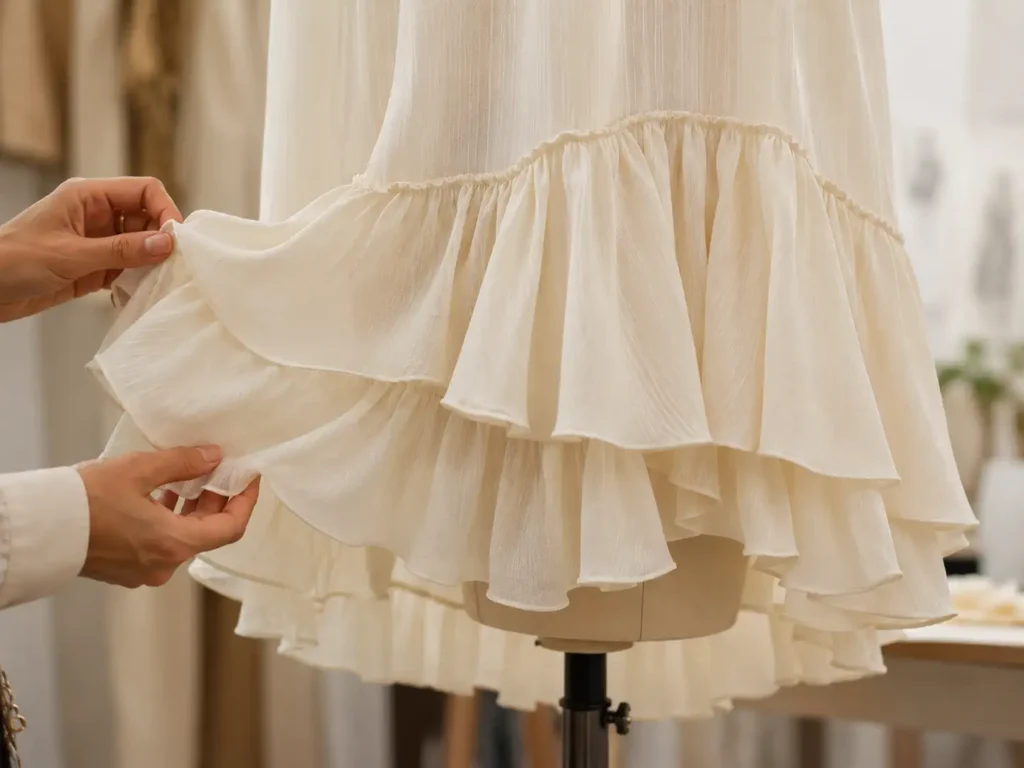
Ruffles and flounces put more curve into the edge than many other dress details. A circular flounce can contain a high proportion of bias along its outer circumference, and the edge may be several times longer than the seam that attaches the piece to the garment. A compact rolled hem often works beautifully because it keeps the outer line flexible enough to flutter. The risk is stretching: if the operator pulls the chiffon as it enters the hemming attachment, the outer edge can grow and create stronger waves than the pattern intended.
A baby hem can be useful when the designer wants a cleaner, more controlled outline, provided the extra stitching and trimming stages do not distort the curve. The final decision should consider the entire ruffle rather than the stitch line in isolation. A little added wave might enhance a romantic dress but look uncontrolled on a cleaner occasionwear style. During sample review, compare ruffle depth, arc, attachment line, edge weight, and movement together. If the hem changes the ruffle’s apparent proportion, the issue is not only workmanship; it is a design-development issue that should be corrected before the construction is frozen for bulk.
Which Hem Suits Sleeves and Overlays?
Sleeve edges sit closer to the wearer’s face and upper body, so small variations can attract more attention than they would at the bottom of a long skirt. Flutter and bell sleeves often benefit from an extremely light rolled edge because movement is central to their appearance. A straighter sheer sleeve can sometimes look cleaner with a controlled baby hem. Comfort also matters: when the edge touches skin, excessive thread tension or a dense rolled finish can feel noticeably harder than the surrounding chiffon even if it looks acceptable on a hanger.
Sheer overlays introduce a different problem – contrast. If pale chiffon sits over a darker lining, every folded layer changes opacity, and an inconsistent hem width can create a visible shadow band. Overlay samples should therefore be inspected over the intended lining or body contrast, not only on a white cutting table. Photography is useful as well because strong e-commerce lighting can reveal fold thickness, stray fibers, and edge shadows that seem subtle in the workroom. For photo-driven dresses, approval under realistic lighting often tells the technical team more than a close inspection under a sewing-machine lamp.
Which Hem Works for Pleated and Bias-Cut Styles?
Pleated chiffon needs a hem that does not fight the vertical rhythm of the pleats. Too much thickness can push the lower edge outward and make the skirt bell unexpectedly, while inconsistent sewing can cause individual pleats to fall at different angles. The production sequence matters because heat-set polyester pleats, stitched pleats, and softer pressed effects do not all behave the same way. The technical team should confirm whether hemming occurs before or after pleating and then inspect whether the chosen method changes the finished length, pleat memory, or visual continuity at the bottom edge.
Bias-cut chiffon introduces gravity into the decision. Diagonal grain can lengthen after hanging, so a dress may look level immediately after sewing but change later. The garment should stabilize according to the validated sample process before the final hem is locked. Neither rolled nor baby hemming should be expected to correct an unstable bias edge. For bias slips, asymmetric dresses, handkerchief hems, and layered skirts, a full garment sample is far more informative than a rectangular test strip. Approval should consider left-right balance, movement, seam position, finished length, hem width, and appearance after hanging because those variables work together in the final silhouette.
| Chiffon Detail | Main Risk | Useful First Trial | Key Approval Point |
| Full maxi skirt | Bias growth and long-edge variation | Rolled hem | Drape and overall balance |
| Circular flounce | Edge stretching | Rolled or controlled baby hem | Wave consistency |
| Small ruffle | Distortion on tight curves | Narrow rolled hem | Flexible edge |
| Flutter sleeve | Visible width variation | Test both methods | Softness and width consistency |
| Sheer overlay | Hem shadow through fabric | Very narrow controlled finish | Low visual bulk |
| Pleated panel | Hem disturbing pleat fall | Narrow lightweight hem | Pleat continuity |
| Bias slip layer | Growth after hanging | Test both on full garment | Stability after settling |
How Do You Prevent Chiffon Hem Problems?
Most chiffon hem problems are prevented through controlled fabric handling, appropriate machine setup, realistic finished width, and early inspection. Puckering usually points to tension or feeding problems, while rippling often comes from stretched curved or bias edges. Uneven width commonly results from inconsistent folding or feeding. Pressing can refine a stable hem, but it should not be used to disguise an unstable sewing process.
How Do You Prevent Puckering?
Puckering appears when the stitching compresses or distorts the chiffon instead of letting the fabric remain flat. Because chiffon has little body, thread tension that would look harmless on a medium-weight woven can immediately pull a narrow edge into visible ripples. Start with the actual approved fabric, not a substitute. Fine chiffon is commonly tested with needles around Nm 60/8 or 70/10, depending on yarn density, finish, and thread. A stitch length around 2.0-2.5 mm can be a sensible first trial, then adjusted after checking needle holes, yarn displacement, skipped stitches, edge stiffness, and stitch balance.
Troubleshooting works best when variables are changed one at a time. Replace a worn needle, confirm needle size, review upper and bobbin tension, check presser-foot pressure, and reduce unnecessary sewing speed before assuming the entire hemming method is wrong. The operator should guide the chiffon rather than pull it. Pressing comes later: light heat can settle a correctly sewn edge, but if a hem looks flat only while it is hot and returns to puckers after cooling, the sewing problem is still present. Correcting the process at the machine is more reliable than trying to iron a distorted edge into temporary compliance.
How Do You Avoid Rippling and Stretching?
Rippling and stretching are closely related on chiffon, especially around circular or bias edges. The most common mechanical cause is tension on the fabric while it is being fed. A long maxi skirt can also create its own pulling force if most of the garment hangs off the machine bed and only a small section is supported near the needle. Supporting the garment, keeping bundles from hanging by one edge, and letting difficult bias sections settle before final leveling all reduce the chance that extra length is introduced before or during hemming.
Inspectors should also distinguish natural chiffon movement from structured waves created by sewing. A soft skirt is not supposed to hang like a rigid straight sheet. The warning sign is a repeated ripple pattern that follows the stitch line and remains even when the garment hangs naturally without being stretched. Compare the suspect garment with the approved sample under the same conditions. If the edge becomes smooth only when pulled taut, excess length was probably introduced during handling or sewing. If the hem relaxes into soft, irregular movement without a repeated wave pattern, the appearance may simply reflect the fabric’s intended fluidity.
How Do You Keep Hem Width Even?
An even hem begins with a width the fabric can realistically support. Teams sometimes request the narrowest possible finish because a tiny edge is associated with refinement, but an ultra-narrow hem that changes every few centimeters looks less controlled than a slightly wider edge that remains uniform. On lightweight chiffon, a 2-4 mm development range is a useful place to test. Once the preferred width is approved, a project-specific tolerance can be established according to the garment’s transparency, price position, curve complexity, and visual sensitivity rather than applying one number to every style.
Measurements should be taken at several points: a stable straight-grain zone, a curved section, a bias zone, center front or back, and at least one seam intersection. Side seams deserve particular attention because folded seam allowances create extra thickness and can interrupt the way a hemming attachment feeds. Operators need a defined method for those junctions rather than improvising from piece to piece. Transparency also changes the visual tolerance. A one-millimeter difference may disappear on dark printed chiffon but show clearly as an opacity change on ivory sheer fabric. Measurement and visual judgment therefore have to work together.
How Do Needle, Thread, and Pressing Matter?
Needle, thread, and pressing choices can determine whether a technically narrow hem still looks soft. A fine needle reduces the size of penetration holes, but the smallest needle available is not automatically correct; it must still form reliable stitches with the selected thread at production speed. Thread should be fine enough to avoid creating a hard cord at the edge while remaining strong enough for wear. Color matching is particularly important on sheer chiffon because both upper and bobbin thread may remain visible from different angles or against a contrasting lining.
Pressing should refine the result rather than repair poor sewing. Polyester chiffon can develop shine, flattening, or distortion under excessive heat, while delicate silk qualities can react badly to aggressive pressure or moisture. Test temperature on scrap fabric, use minimal pressure, avoid dragging the iron along the edge, and let the hem cool before making the final judgment. If a hem becomes glossy or rigid after pressing, the finishing process has changed the fabric even if the stitch line itself is technically correct. On chiffon, a successful hem should still feel like part of the fabric rather than an added strip.

How Are Chiffon Hems Controlled in Production?
Reliable chiffon hems are controlled through sample approval, measurable sewing specifications, sealed reference garments, in-line inspection, and finished-garment review. The PP sample should confirm the final construction before bulk sewing, while sewing instructions, QC checkpoints, and a Golden sample help production teams reproduce the same width, softness, stitch appearance, and hem balance instead of interpreting terms such as “baby hem” differently.
How Is the Hem Approved During Sampling?
Sampling is where the hem has to prove both appearance and production feasibility. A small fabric test can compare stitch settings, but the final decision should be made on an actual garment because a full dress introduces long circumference, bias growth, side seams, lining, pleats, ruffles, and gravity. The first sample establishes direction. If the edge is too heavy, wavy, or inconsistent, the team should identify the cause and record a specific correction such as changing finished width, adjusting machine setup, altering seam allowance, revising handling at curves, or testing a different narrow-hemming method.
Major construction changes may justify a revised sample rather than being left for the production line to interpret. Before bulk, the PP sample should lock the final fabric, dimensions, trims, lining, construction, labels, and finishing requirements. A sealed Golden sample can then serve as the physical reference for production, QC, repeat orders, and disagreements about appearance. In Jinfeng Apparel’s documented development workflow, sample comments are converted into updated patterns, measurement charts, BOM information, sewing instructions, and QC checklists rather than remaining only in messages. Simple samples are generally planned around 7-10 days, standard dresses around 10-15 days, and more complex styles around 15-25 days, with special materials potentially extending the timeline.
What Should a Hem Specification Include?
A production-ready hem specification should make the physical result difficult to misunderstand. “Baby hem” alone is too vague for a sheer material where tiny differences in folded depth affect appearance. A stronger instruction identifies the target finished width in millimeters, seam allowance before hemming, stitch type, thread shade, raw-edge enclosure, expected face and reverse appearance, treatment at seam junctions, and any special handling for curved or bias areas. If a particular machine or attachment is essential to the design, that requirement should be recorded; if only the visual result matters, the factory can retain some freedom to choose the most stable operation.
Photographs are extremely useful because terms such as “flat,” “soft,” “clean,” and “narrow” can be interpreted differently. An enlarged close-up can show the acceptable stitch line, while a full hanging photograph records hem balance and silhouette. The specification should also separate measurable defects from visual defects. Finished width can be checked numerically, whereas excessive roping, heat shine, or edge twisting may be better controlled with approved and rejected reference images. The goal is not to turn the tech pack into a laboratory manual. It is to provide enough information that the sewing operator, line supervisor, merchandiser, and QC inspector are all judging the same finish.
How Is Bulk Consistency Checked?
Bulk chiffon hemming should be inspected while production is running rather than waiting until every garment is finished. The first units are particularly valuable because they reveal whether the sample-room method transferred successfully to the line and whether the bulk fabric behaves like the approved sample fabric. Inspectors should compare those early pieces with the sealed reference and check finished width at several locations, stitch formation, raw-edge enclosure, puckering, curve stretching, seam intersections, thread shade, pressing, and overall hem balance. A long skirt should be inspected around the circumference rather than at one convenient point.
When a repeated defect appears, the useful response is to correct the process rather than repair garments one by one. If multiple dresses develop the same ripple at a side seam, for example, the cause may be seam thickness, attachment feeding, operator handling, or machine tension at that junction. Correcting the operation prevents the next batch from inheriting the same defect. A structured QC system therefore uses early in-line inspection to protect the rest of production, followed by finished-garment review to confirm that the hem works as part of the whole dress. The goal is consistency with the approved sample, not simply the absence of broken stitches.
How Is the Standard Maintained in Bulk?
The greatest production risk is often gradual drift rather than an obvious first-piece failure. At the beginning of a run, operators may work carefully against the sealed sample. Several hours later, machine settings can move, needles wear, speed increases, or shortcuts appear. A 3 mm hem may slowly widen, thread tension can tighten, and seam intersections may be handled differently. Periodic checks are therefore necessary even after first-piece approval. Needle replacement, machine verification, random width measurements, comparison with the Golden sample, pressing review, and final inspection all help keep the edge from changing over the course of the order.
Repeat orders need the same discipline because the style may return months later with a new fabric lot, another operator, or a different production line. Preserving the pattern, BOM, fabric reference, color record, sewing instruction, QC checklist, and Golden sample reduces the need to reconstruct the standard from memory. For brands developing chiffon collections, that documentation is one of the clearest signs that a manufacturer understands repeatable product development rather than one-off sample making. When the correct edge has been developed, the real objective is to reproduce the same width, softness, movement, and appearance on every garment that follows.
| QC Point | Practical Check | Common Failure |
| Finished width | Measure several points around garment | Width wandering |
| Stitch formation | Inspect face and reverse | Skipped, loose, or tight stitches |
| Edge tension | Hang garment without pulling | Roping or puckering |
| Curved areas | Compare with sealed sample | Stretch waves |
| Raw edge | Inspect inside fold | Exposed fibers |
| Seam intersections | Check thickness and twist | Bulky or distorted junction |
| Fabric surface | View under angled light | Needle damage or press shine |
| Hem balance | Inspect on form or hanger | Uneven lower edge |
| Movement | Light walk or swing test | Stiff, flipping, or irregular edge |
Conclusion. A rolled hem and a baby hem can both produce an elegant chiffon dress, but the best choice comes from the fabric and garment rather than from terminology. Start with the visual result the design needs, test a realistic finished width, evaluate the actual chiffon on the real pattern shape, and approve the edge while the garment is hanging and moving. Then translate that approval into measurable instructions, a PP or sealed reference sample, and QC checkpoints that survive bulk production. For a fashion brand, that process is more valuable than chasing the smallest possible hem or insisting on one construction for every chiffon style. When the edge remains light, even, soft, and consistent from sample through repeat order, the hem has done its job: it supports the dress without asking the wearer to notice it. Teams developing chiffon dresses, overlays, ruffles, or bias-cut styles can use the approved sample stage to compare both methods before committing to bulk, especially when the design depends heavily on movement and transparency.