Skip to content

The global fashion supply chain has shifted dramatically in the last decade. Brands no longer choose manufacturing locations based only on labor cost. Instead, production decisions now depend on a combination of speed, fabric capability, sampling precision, and long-term scalability. China and Vietnam are often compared side by side, but the reality is more nuanced than “cheap vs expensive” or “old vs new manufacturing hub.”
In China, decades of industrial clustering have created a highly integrated system covering fabric mills, trims, pattern development, embroidery, printing, and finishing—all within short distances. Vietnam, on the other hand, has rapidly expanded its garment capacity by attracting export-driven factories focused on cost efficiency and large-volume basic apparel.
China offers a highly integrated and technically advanced garment manufacturing ecosystem suitable for complex dress designs, fast sampling, and premium quality control. Vietnam provides cost advantages and competitive bulk production for simpler styles but has limited flexibility in fabric development and complex construction. The best choice depends on design complexity, MOQ strategy, and long-term supply chain stability.
A simple decision on paper often becomes a complex reality during sampling, fabric sourcing, and bulk production. Many brands discover that the “cheaper option” can create hidden costs later—such as re-sampling, inconsistent fit, or delayed shipment windows.
To understand the real difference, it is useful to break down production not as a country comparison, but as a system comparison. That is where the real gap becomes visible.
What Does a Dress Factory Need Before Reviewing a Collection?
Before a dress factory starts reviewing a collection, the most important requirement is not production capacity—it is clarity of input. Many delays, sampling errors, and cost overruns happen because the initial collection data is incomplete or too visual without technical structure. A factory cannot evaluate feasibility, cost, or production risk if key information such as fabric behavior, construction intent, and size logic is missing.
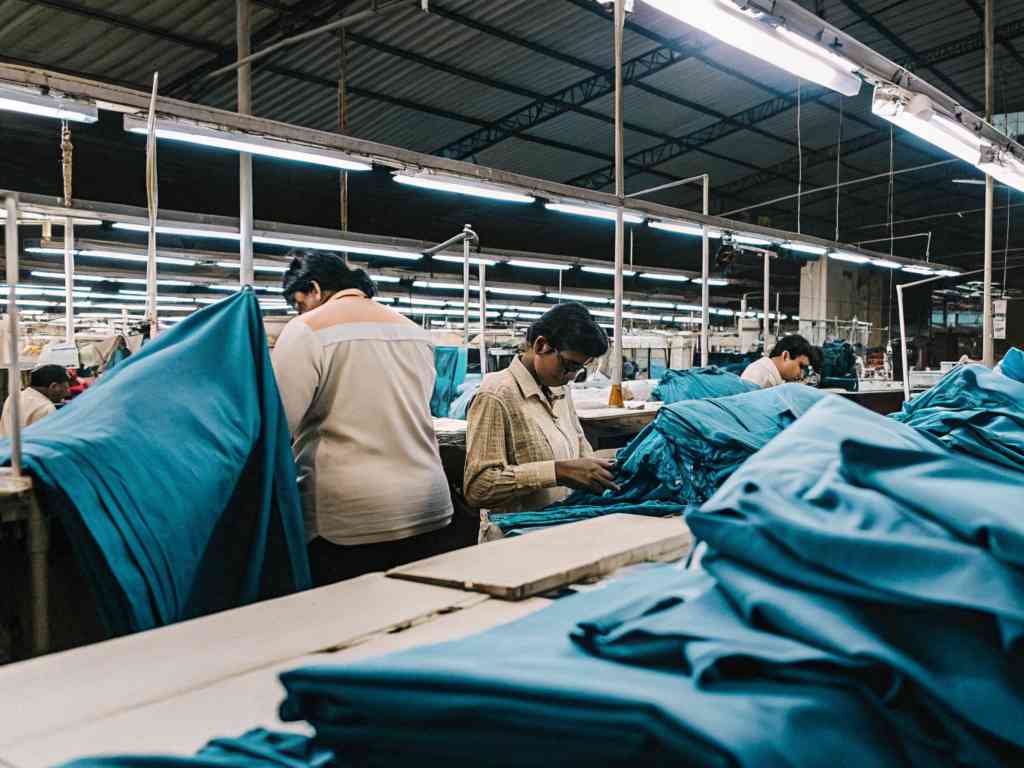
In real manufacturing practice, collection review is a technical validation stage. It determines whether a design can move into sampling with controlled risk. The stronger the input package, the faster the review decision, and the fewer sampling rounds required later.
Typical review preparation time impact:
| Input completeness level | Factory review time | Sampling risk level |
|---|---|---|
| Fully structured tech pack | 24–72 hours | Low |
| Partial sketch + notes | 3–7 days | Medium |
| Image only reference | 5–10+ days | High |
| Mixed unclear inputs | Unpredictable | Very high |
Design Input Clarity and Style Breakdown
A factory first evaluates whether the design can be translated into measurable construction. A reference image alone is not enough. The design must include clear breakdown of silhouette, seam logic, and key construction points.
Key requirements include:
- Front and back flat sketches or clear multi-angle references
- Defined silhouette category (bodycon, A-line, corset, slip, etc.)
- Structural intent such as boning, lining, padding, or shaping zones
- Design variation details (cut-outs, draping, asymmetry, layering)
Without these elements, pattern teams cannot estimate complexity or risk level. In many cases, missing structural clarity leads to over-simplified samples that fail to match the original design intent.
Fabric and Material Confirmation
Fabric selection is one of the highest-impact factors in production feasibility. A factory needs to confirm not only fabric type but also behavior under sewing, tension, and washing conditions.
Required information includes:
- Fabric composition (polyester, nylon, viscose, silk blends, etc.)
- Stretch level (none, 2-way, 4-way, mechanical stretch)
- Weight range (GSM or oz/yd²)
- Surface behavior (shiny, matte, textured, soft drape, rigid structure)
- Color direction or Pantone reference if available
| Fabric Type | Production Risk | Common Issue |
|---|---|---|
| Satin | Medium–High | Slippage, seam puckering |
| Chiffon | High | Layer distortion |
| Knit jersey | Low–Medium | Stretch inconsistency |
| Structured crepe | Low | Minimal risk |
If fabric is not confirmed early, sampling may need to be repeated multiple times due to mismatch in drape or elasticity.
Measurement Standards and Fit Logic
Size structure determines whether a design can be scaled into production. Factories need a clear size framework, not only a single measurement chart.
Key requirements:
- Base size reference (S/M or US4/UK8 equivalent)
- Key body points: bust, waist, hip, length, sleeve, shoulder
- Fit intent: tight fit, relaxed fit, body contouring, oversized
- Grading rule logic across sizes
Common issue in early-stage collections is inconsistent fit expectation across different styles. Without standardized grading rules, bulk production may vary significantly between sizes.
Construction and Technical Detailing
Construction defines production difficulty more than visual design. Two dresses with similar appearance can have completely different manufacturing complexity.
Factories require:
- Stitch type references (single needle, overlock, coverstitch)
- Seam structure details (princess seams, panel seams, invisible seams)
- Closure method (zipper, lace-up, buttons, invisible hook)
- Internal structure (lining layers, interfacing, boning, cups)
- Special construction zones (gathering, pleats, ruching, draping)
The absence of construction clarity is one of the main reasons sampling cycles increase from 1 round to 3–4 rounds.
Quantity Planning and Production Forecast

Even before sampling, factories evaluate whether a style is commercially scalable. This helps determine fabric allocation and production line planning.
Key inputs:
- Expected order quantity per style
- Color variations per design
- Size ratio distribution (S–XL or custom curve)
- Launch timeline and seasonal planning
| Order Scale | Production Strategy | Risk Level |
|---|---|---|
| <300 pcs | Small batch flexible | Medium |
| 300–1000 pcs | Standard production | Low |
| 1000–5000 pcs | Line allocation needed | Low |
| 5000+ pcs | Full production scheduling | Very low |
Without quantity visibility, factories cannot optimize fabric sourcing or production planning, which often leads to higher cost per unit.
Visual References and Detail Accuracy
Visual references help align expectations, but they must be structured, not random inspiration images.
Factories need:
- Full-body reference images (front/back/side if possible)
- Close-up detail images for neckline, waist, and embellishment
- Fabric drape reference images
- Similar garment benchmarks if available
However, visual-only input is insufficient. Images must always be supported with technical clarification to avoid interpretation gaps between design intent and production execution.
How Do China and Vietnam Differ in Dress Manufacturing Capability?
China and Vietnam both play important roles in global dress production, but their capabilities are built on very different industrial foundations. China operates as a full-system manufacturing ecosystem, while Vietnam functions more as a production execution hub focused on efficiency and standardized garment output.
In real production scenarios, the difference is not simply “better or cheaper.” It is about whether a factory can support design complexity, sampling accuracy, fabric flexibility, and fast iteration cycles. These four factors directly affect how fast a fashion collection can move from idea to market.
| Capability Area | China | Vietnam |
|---|---|---|
| Fabric sourcing | Local + integrated | Mostly imported |
| Sampling speed | Fast (3–7 days typical) | Moderate (5–12 days) |
| Design complexity handling | High | Medium |
| Bulk consistency | High | Medium–stable |
| Small batch flexibility | Strong | Limited |
| Cost efficiency | Medium | High |
Fabric Ecosystem and Material Availability
China has one of the most complete textile ecosystems in the world. Fabric mills, dyeing houses, printing facilities, and trim suppliers are concentrated in major industrial clusters such as Guangzhou, Dongguan, and Zhejiang. This structure allows fabric development and garment production to operate almost simultaneously.
Key advantages in China:
- On-demand fabric development for custom designs
- Fast sampling of new textures, prints, and blends
- Immediate access to trims like lace, boning, sequins, and hardware
- Shorter lead time between fabric approval and cutting stage
Vietnam relies heavily on imported fabrics from China, Korea, and Taiwan. While this supports stable production for basic garments, it reduces flexibility when a design requires specific texture, elasticity, or surface finishing. If fabric is delayed or unavailable, sampling timelines often extend significantly.
Sample Development and Technical Accuracy
Sampling is where capability differences become most visible. Dress production requires precise interpretation of design intent—especially for structured silhouettes, corset dresses, draped gowns, or multi-layer designs.
China’s sampling system is typically integrated:
- Pattern makers work closely with fabric teams
- Adjustments can be made within 24–48 hours
- Multiple revisions are possible within one sampling cycle
- Technical teams handle complex construction internally
Vietnam sampling is more linear:
- Pattern making and production often separated
- External fabric dependency slows iteration
- Complex adjustments may require re-sourcing materials
- Revision cycles tend to be longer for technical designs
In practical terms:
- China: 1–2 sampling rounds for most mid-complexity dresses
- Vietnam: 2–4 rounds depending on structure complexity
Handling of Design Complexity

Dress manufacturing is highly sensitive to structure. Small details like seam placement, lining thickness, or boning structure can significantly affect final fit.
China is stronger in:
- Corset construction with boning and shaping layers
- Mixed-material dresses (lace + satin + mesh combinations)
- Asymmetrical and draped designs
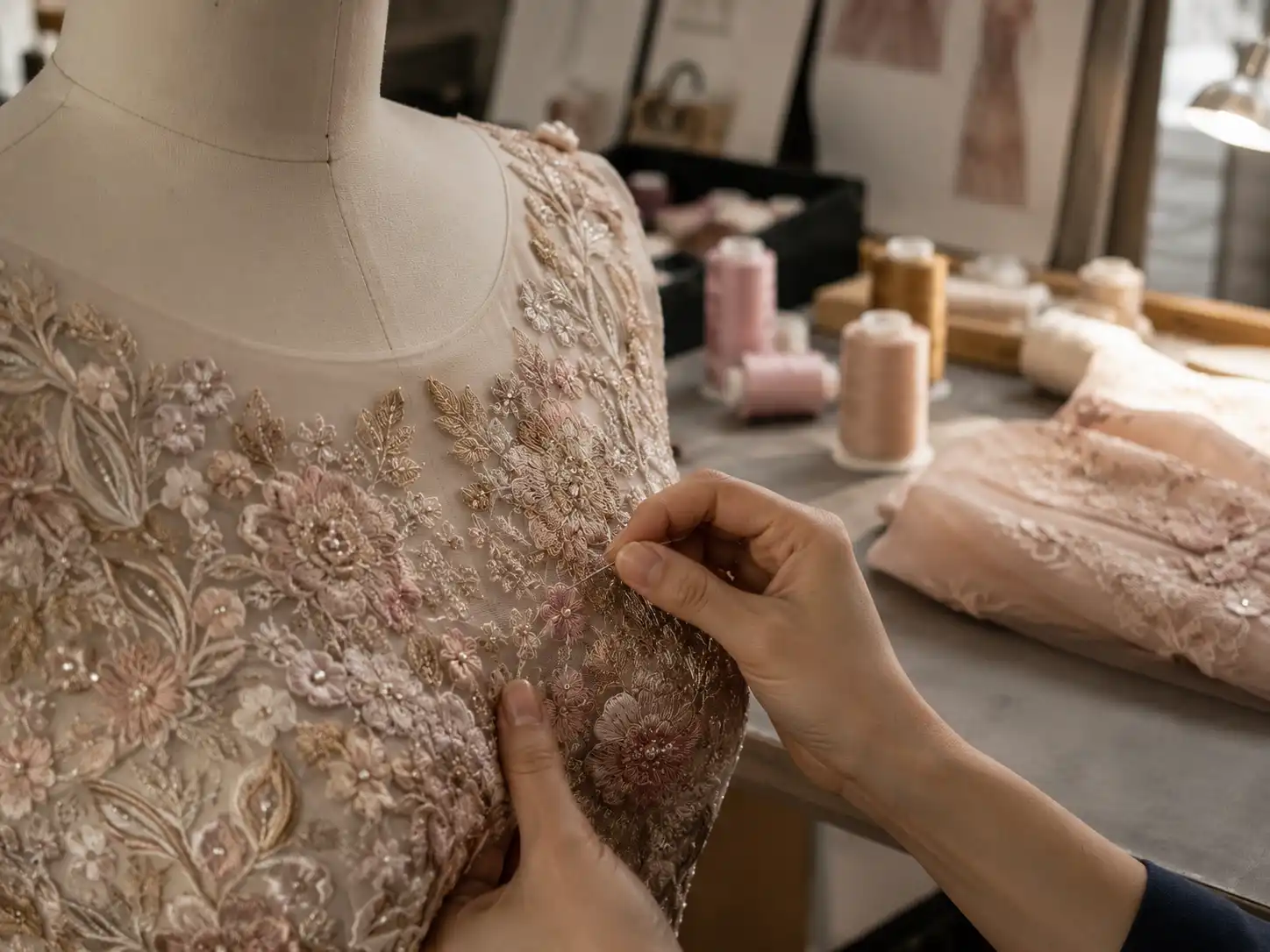
- Embellished or embroidered occasionwear
- Multi-panel pattern engineering
Vietnam performs better in:
- Simple slip dresses
- Basic knit or jersey dresses
- Standard A-line or straight silhouettes
- Repeat production of stable styles
When design complexity increases, China’s advantage becomes more visible due to technical depth and material accessibility.
Production Stability and Bulk Consistency
Bulk consistency refers to how closely production units match approved samples. This is one of the most critical factors for brand-level fashion collections.
China’s system:
- Multi-stage QC (cutting, sewing, finishing, packing)
- Dedicated technical supervisors for production lines
- Faster correction loop during production
- Lower deviation rate in complex styles
Vietnam’s system:
- Strong performance in standardized bulk orders
- Higher reliance on final inspection stage
- Potential variation in complex seam or fabric combinations
- Stable output for repeat basic styles
| Risk Factor | China | Vietnam |
|---|---|---|
| Size deviation | Low | Medium |
| Stitch inconsistency | Low | Medium |
| Fabric mismatch | Low | Medium–High |
| Embellishment error | Low | Medium |
Speed, Flexibility, and Response Cycle
Speed in manufacturing is not only about sewing time. It includes communication, sampling revision, fabric sourcing, and production adjustment.
China:
- Faster response cycle due to integrated supply chain
- Immediate access to development teams
- Flexible adjustments during sampling stage
- Suitable for fast-fashion and trend-driven collections
Vietnam:
- Efficient once production is locked
- Slower during early development stage
- Better suited for stable repeat orders
- Less flexible for rapid design changes
Typical timeline comparison:
- China sampling: 3–7 days
- Vietnam sampling: 5–12 days
- China bulk production: 15–30 days
- Vietnam bulk production: 18–35 days (stable styles may be faster)
Strategic Role in Fashion Supply Chains
China and Vietnam are often not direct competitors but complementary nodes in global sourcing strategies.
China typically functions as:
- Product development center
- Complex sample creation hub
- Innovation and trend testing base
Vietnam typically functions as:
- Cost optimization production base
- Large-volume manufacturing hub
- Stable repeat-order execution center
Many fashion programs use a hybrid structure:
- China for first samples and design validation
- Vietnam for scaling stable, simplified styles
This structure balances speed, cost, and risk control across different product categories.
Which Country Offers Better Cost Efficiency for Dress Production?
Cost efficiency in dress manufacturing is often misunderstood as simple labor cost comparison between two countries. In real production practice, total cost is shaped by multiple layers: sampling cycles, fabric sourcing efficiency, defect rate, communication delay, rework frequency, and lead time stability. China and Vietnam sit at different positions in this cost structure, which leads to very different final landed costs depending on product complexity.
China usually shows higher unit labor cost but lower “hidden production cost” due to faster development cycles and stronger technical control. Vietnam shows lower base labor cost but may introduce additional costs when designs require revisions, imported materials, or complex construction handling.
| Cost Factor | China | Vietnam |
|---|---|---|
| Labor cost per garment | Medium–High | Low |
| Sampling cost efficiency | High | Medium |
| Fabric sourcing cost | Stable (local supply) | Higher (import dependency) |
| Rework / correction rate | Low | Medium |
| Total landed cost (complex styles) | Often lower | Often higher |
Labor Cost vs Total Production Cost Reality
Labor cost is the most visible difference between China and Vietnam, but it rarely determines final profitability in fashion production.
Vietnam’s labor cost advantage:
- 20%–40% lower sewing labor cost compared to China
- Competitive for simple garment structures
- Effective for high-volume standardized production
China’s cost structure:
- Higher hourly labor cost
- Faster production cycles reduce labor hours per finished style
- Strong technical teams reduce inefficient labor repetition
In dress manufacturing, especially for structured or multi-layer garments, labor efficiency matters more than labor price. A complex dress that requires multiple revisions in Vietnam may eventually cost more than a faster, stable production process in China.
Sampling Efficiency and Its Hidden Cost Impact
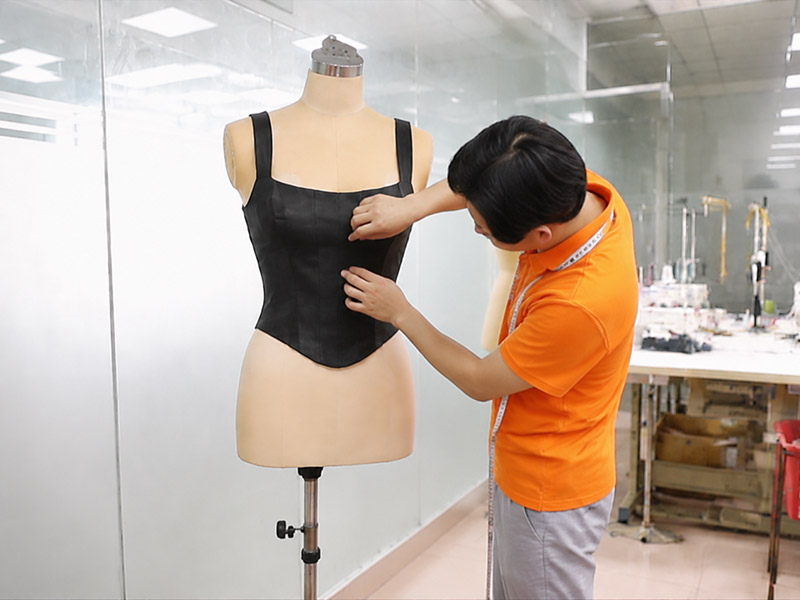
Sampling is one of the most underestimated cost drivers in dress manufacturing. Each sampling round includes fabric consumption, labor time, courier cost, and time-to-market delay.
China sampling structure:
- Average 1–2 rounds for mid-complex dresses
- Fast pattern correction within 24–48 hours
- Local fabric sourcing reduces waiting time
- Lower cumulative sampling cost per style
Vietnam sampling structure:
- Often 2–4 rounds for complex designs
- Fabric sourcing delays due to imports
- Longer revision cycles between stages
- Higher cumulative cost for development-heavy styles
Estimated sampling cost impact:
| Style Complexity | China Total Sampling Cost | Vietnam Total Sampling Cost |
|---|---|---|
| Basic dress | $50–$120 | $60–$140 |
| Mid complexity | $120–$250 | $180–$350 |
| High complexity | $250–$500 | $400–$800 |
The difference becomes significant when a collection contains multiple styles or requires seasonal updates.
Fabric Sourcing and Material Cost Stability
Fabric cost is not only about unit price. It includes availability, lead time, and consistency. Dress production is highly sensitive to fabric behavior, making sourcing efficiency a critical cost factor.
China advantages:
- Integrated textile clusters (Guangzhou, Zhejiang, Jiangsu)
- Immediate access to satin, chiffon, lace, knit, mesh, and specialty fabrics
- Lower logistics cost between mills and factories
- Faster fabric sampling and approval cycles
Vietnam structure:
- High dependency on imported fabrics
- Additional freight and customs cost for materials
- Longer procurement timelines
- Limited flexibility for last-minute fabric changes
In practice, fabric-related delays in Vietnam often increase indirect costs such as:
- Air shipping urgency fees
- Production rescheduling
- Style postponement across collections
Quality Loss Rate and Rework Cost
Rework cost is one of the most overlooked cost elements in dress manufacturing. It includes fixing defective pieces, adjusting sizing issues, or correcting construction errors.
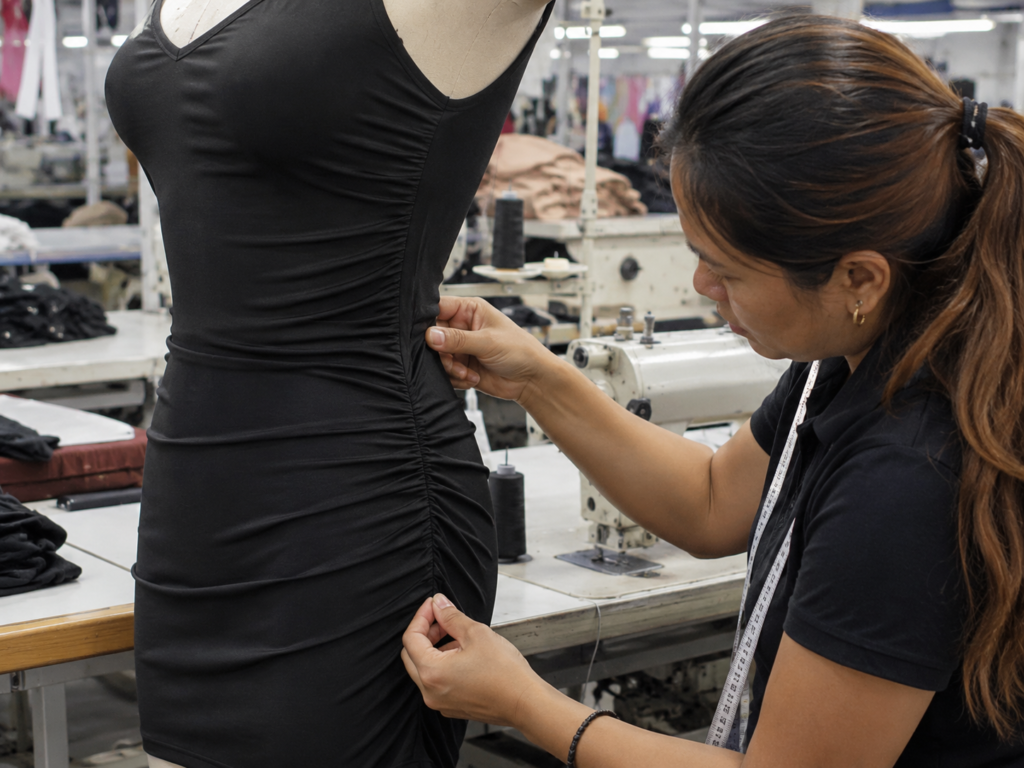
China system characteristics:
- Lower defect rate due to experienced technical teams
- Multi-stage QC reduces batch-level errors
- Faster correction loop during production
- Typical rework rate: 2%–5%
Vietnam system characteristics:
- Good performance in basic garments
- Higher variability in complex construction styles
- Greater reliance on final inspection stage
- Typical rework rate: 5%–10% for complex dresses
Even a 3%–5% difference in defect rate can significantly affect profitability when producing thousands of units.
MOQ, Scale Efficiency, and Unit Cost Behavior
MOQ (Minimum Order Quantity) directly influences per-unit cost structure. Lower MOQ often increases per-unit cost but reduces inventory risk.
China:
- Flexible MOQ for sampling and small batch testing
- Better cost scaling from 300 → 5000+ units
- Stable pricing across repeated production cycles
- Efficient for multi-style collections
Vietnam:
- More competitive in higher-volume stable orders
- MOQ advantages appear in standardized production
- Less efficient for multi-style small batch collections
- Cost advantage increases with scale stability
Cost scaling behavior:
| Production Scale | China Unit Cost Trend | Vietnam Unit Cost Trend |
|---|---|---|
| 100–300 pcs | Stable | Higher efficiency gap |
| 300–1000 pcs | Balanced | Competitive |
| 1000–5000 pcs | Strong efficiency | Strong efficiency |
| 5000+ pcs | Highly optimized | Very competitive |
Hidden Cost Factors That Change Final Pricing
Beyond visible cost structures, several hidden elements significantly affect final production cost:
China tends to reduce:
- Sampling repetition cost
- Communication delay cost
- Fabric mismatch risk
- Production rescheduling loss
Vietnam may introduce:
- Longer material lead time cost
- Additional freight/import cost
- Higher revision cycles in complex styles
- Delay-related opportunity cost
In fashion, timing often has direct financial impact. A delayed collection launch can reduce seasonal sales performance more than any per-unit cost saving.
How Do Quality and Consistency Differ Between China and Vietnam?
Quality and consistency in dress manufacturing are not determined only by final inspection results. They are shaped throughout the entire production chain—pattern making accuracy, fabric stability, sewing discipline, in-line QC systems, and the speed of correction during production. China and Vietnam both produce export-level garments, but their consistency systems operate at different levels of maturity and control depth.
China’s strength lies in systemized multi-stage production control combined with strong technical teams embedded in manufacturing clusters. Vietnam’s strength lies in stable mass production for standardized garments, where repeat styles can maintain acceptable consistency once processes are locked.
| Quality Factor | China | Vietnam |
|---|---|---|
| Sample-to-bulk accuracy | High | Medium |
| Complex structure consistency | High | Medium–Low |
| Basic garment stability | High | High |
| In-line QC depth | Multi-stage | Mid-stage focus |
| Defect correction speed | Fast | Moderate |
| Fabric handling precision | High | Medium |
Sample-to-Bulk Matching Accuracy
Sample-to-bulk consistency is one of the most critical indicators in dress manufacturing. It reflects whether production can replicate approved samples without deviation in fit, structure, or finishing.
China:
- Strong alignment between sample and bulk production
- Pattern makers and production lines often work in the same facility
- Real-time adjustments during early production runs
- Lower deviation in seam placement, fit grading, and construction details
Vietnam:
- Good consistency for basic repeat styles
- Higher deviation risk in complex or multi-layer designs
- Sample often made under ideal conditions, bulk may differ due to material or labor variance
- Revisions may be required after initial bulk inspection
Typical deviation rate comparison:
| Garment Type | China Deviation Rate | Vietnam Deviation Rate |
|---|---|---|
| Basic knit dress | 1%–3% | 2%–4% |
| Mid complexity dress | 2%–5% | 5%–8% |
| Structured/corset dress | 3%–6% | 6%–12% |
Construction Stability in Complex Dresses
Dress construction determines long-term consistency more than fabric or color. Elements such as boning, lining layers, pleats, draping, and asymmetric cuts increase production risk.
China advantages:
- Strong technical pattern teams for structural garments
- Internal coordination between sampling and production units
- Ability to refine construction during pilot runs
- Stable execution of multi-material designs
Vietnam characteristics:
- Efficient for single-layer or simple construction
- Limited flexibility when design requires structural engineering
- Dependence on external technical input for complex adjustments
- More stable when designs remain unchanged across seasons
In practice, structured occasionwear, corset dresses, and embellished styles show significantly higher consistency performance in China compared to Vietnam.
Fabric Behavior Control and Material Consistency
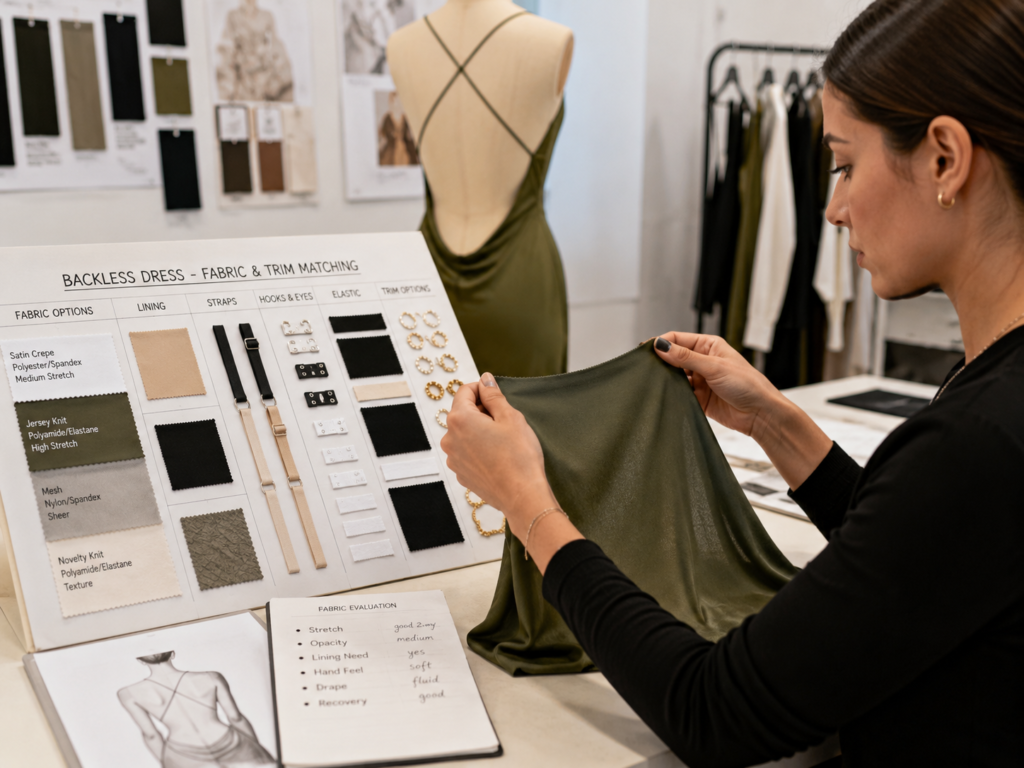
Fabric behavior is one of the most unpredictable factors in dress production. Even identical fabrics can behave differently depending on cutting, stitching tension, and storage conditions.
China system advantages:
- Immediate fabric testing within production clusters
- Strong control over shrinkage, stretch, and dye consistency
- Access to local mills for rapid replacement or adjustment
- Lower risk of batch-to-batch variation
Vietnam structure:
- Higher dependency on imported fabric batches
- Longer feedback loop when fabric issues occur
- Limited on-site fabric development capability
- Higher risk of variation between sample and bulk fabric lots
Fabric-sensitive designs such as satin slip dresses, chiffon layers, and stretch-bodycon styles show clearer consistency advantage in China due to tighter material control loops.
In-Line Quality Control Systems
Quality control structure determines how early defects are detected and corrected. The earlier the detection, the lower the production cost impact.
China QC structure:
- Cutting inspection before sewing
- In-line sewing checkpoints per operation stage
- Mid-production sampling checks
- Final inspection before packing
- Dedicated QC teams per production line
Vietnam QC structure:
- Strong final inspection system
- In-line QC exists but less segmented
- Greater reliance on end-stage correction
- Slower correction loop for systemic issues
| QC Stage | China | Vietnam |
|---|---|---|
| Cutting QC | Standard | Limited |
| In-line QC | Multi-point | Basic |
| Mid-stage audit | Frequent | Occasional |
| Final inspection | Strict | Strict |
Multi-stage QC reduces cumulative defect rates, especially in complex dress categories.
Defect Rate and Production Correction Speed
Defect rate alone does not determine quality—correction speed defines final production outcome.
China:
- Faster feedback between QC and production teams
- Defects corrected during ongoing production runs
- Lower accumulation of systemic errors
- Typical overall defect rate: 2%–5%
Vietnam:
- Effective correction after final inspection stage
- Slower feedback loop during production
- Higher risk of batch-level correction requirements
- Typical overall defect rate: 4%–10% depending on complexity
In fashion cycles with tight launch deadlines, slower correction cycles can affect delivery timing and increase logistical cost.
Consistency in Scaling Production Volume
Scaling production from small batches to large volumes often exposes weaknesses in consistency systems.
China:
- Strong scalability across 100 → 10,000+ pcs
- Stable replication of approved samples
- Factory clusters allow parallel production expansion
- Lower quality fluctuation during scaling
Vietnam:
- Strong performance in stable high-volume repeat styles
- Consistency may decrease when scaling complex designs
- Better suited for standardized collections rather than frequent design changes
Scaling consistency comparison:
| Volume Scale | China Consistency | Vietnam Consistency |
|---|---|---|
| 100–500 pcs | High | High |
| 500–2000 pcs | High | Medium–High |
| 2000–5000 pcs | High | Medium |
| 5000+ pcs | Very High | Medium |
Which Country Is Better for Speed, Flexibility, and Scaling?
Speed, flexibility, and scaling capacity in dress manufacturing are not determined by sewing efficiency alone. They depend on how quickly a factory can move from design confirmation to sample approval, how easily adjustments can be made during production, and how smoothly output can expand when demand increases.
China and Vietnam both support export-oriented fashion production, but their operational logic is different. China operates as a fast iteration system supported by integrated supply chains, while Vietnam operates as a stable production execution base optimized for repeat manufacturing.
| Performance Factor | China | Vietnam |
|---|---|---|
| Sampling speed | Fast | Moderate |
| Design change flexibility | High | Medium–Low |
| Production scaling speed | Very fast | Medium |
| Fabric sourcing speed | Immediate | Delayed (import-dependent) |
| Style switching capability | Strong | Limited |
| Small batch responsiveness | High | Medium |
Sampling Speed and Development Cycle Time
Sampling speed directly impacts how fast a collection can enter the market. In fashion, even a 7–10 day delay can affect seasonal positioning.
China:
- Average sampling cycle: 3–7 days for standard dresses
- In-house pattern correction within 24–48 hours
- Fabric sourcing often completed within the same industrial zone
- Multiple revisions possible without restarting full sampling flow
Vietnam:
- Average sampling cycle: 5–12 days depending on fabric availability
- External fabric sourcing can extend timeline
- Pattern adjustments may require additional coordination steps
- Longer gap between revision and resampling
For trend-driven collections, China’s compressed sampling cycle supports faster market entry.
Flexibility in Design Changes and Adjustments
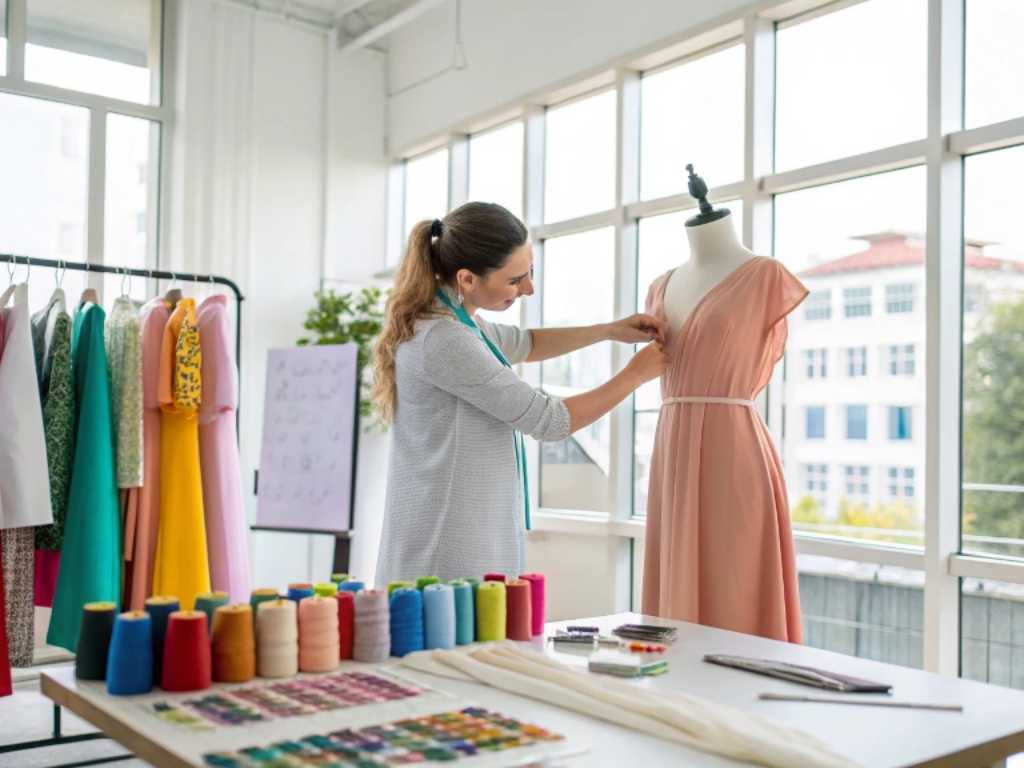
Flexibility refers to how easily a factory can adjust design details without restarting the entire production process.
China flexibility structure:
- Immediate access to technical teams (pattern + sewing + fabric)
- On-site modification of construction details
- Fast iteration for neckline, sleeve, or silhouette changes
- Lower cost impact for mid-stage adjustments
Vietnam flexibility structure:
- Adjustments often require separate coordination steps
- Fabric or trim changes may require reordering
- Less agile when design changes occur after sampling approval
- Better suited for fixed designs without modifications
In real production, frequent design updates favor China due to its integrated response system.
Scaling Capacity from Small Batch to Mass Production
Scaling determines how quickly a style can move from test orders to full-scale production without quality loss or delay.
China scaling system:
- Industrial clusters allow parallel production expansion
- Multiple production lines can be activated quickly
- Strong workforce flexibility for peak season demand
- Capacity scaling from 200 pcs → 10,000+ pcs with minimal disruption
Vietnam scaling system:
- Efficient for stable high-volume production runs
- Scaling works best when design is fixed and repeated
- Limited flexibility when multiple styles need simultaneous expansion
- Strong performance for long-term basic collections
| Scale Stage | China Capability | Vietnam Capability |
|---|---|---|
| 100–500 pcs | Fast & flexible | Stable |
| 500–2000 pcs | Highly efficient | Efficient |
| 2000–5000 pcs | Very strong | Stable |
| 5000+ pcs | Highly scalable | Strong but less flexible |
Style Switching Speed Across Multiple Designs
Fashion collections often require switching between multiple styles within a short production window.
China:
- Rapid switching between different dress styles
- Shared fabric and trim ecosystem reduces transition time
- Production lines can be reconfigured quickly
- Suitable for multi-style seasonal drops
Vietnam:
- Style switching is slower due to more fixed production setup
- Better efficiency when producing one or two stable styles
- Less flexible for frequent collection updates
In fast fashion cycles, switching speed directly influences how many styles can be launched per season.
Production Stability Under Time Pressure
Speed is only effective when stability is maintained under tight deadlines. Rush orders often expose system weaknesses.
China:
- Strong emergency production capability
- Parallel sourcing reduces delay risk
- QC systems maintain stability even under compressed timelines
- Better handling of urgent replenishment orders
Vietnam:
- Stable under normal production schedules
- Rush orders may affect consistency due to external dependencies
- Longer response time for material adjustments
- Better suited for planned production cycles
Real-World Production Scenario Comparison
A typical fashion launch scenario highlights the difference clearly:
Scenario: 10 dress styles, 500 pcs per style, 30-day launch window
China outcome:
- Sampling completed within 1–2 weeks
- Bulk production overlaps with final sample approval
- Style switching handled in parallel
- Full launch achievable within timeline
Vietnam outcome:
- Sampling may take longer due to fabric sourcing
- Some styles may enter production later in cycle
- Higher risk of staggered delivery
- Full synchronization more difficult
How Should Brands Decide Between China and Vietnam?
Choosing between China and Vietnam for dress manufacturing is not a fixed geographic decision, but a structured production strategy decision. The right choice depends on product complexity, speed requirement, cost sensitivity, and how frequently design changes occur within a collection cycle.
In real production planning, the decision is rarely “either/or.” Instead, it is about matching the right manufacturing system to the right product type. China provides a development-driven system with strong technical control, while Vietnam offers a cost-optimized production system focused on stable execution.
| Decision Factor | China Advantage | Vietnam Advantage |
|---|---|---|
| Design complexity | High capability | Limited |
| Cost control | Medium | Strong |
| Sampling speed | Fast | Moderate |
| Production stability | High | High (basic styles) |
| Flexibility for changes | Strong | Limited |
| Scaling efficiency | Very strong | Strong |
Product Complexity Level and Design Structure
The first decision factor is how complex the dress design is. Complexity directly determines production risk, sampling cycles, and fabric requirements.
China performs better when:
- Dresses include corset structures, boning, or shaping panels
- Multi-fabric combinations (lace + satin + mesh) are required
- Embellishment, embroidery, or handwork is involved
- Draping, asymmetry, or advanced pattern engineering is needed
Vietnam performs better when:
- Designs are simple silhouettes (slip dress, jersey dress, basic A-line)
- Construction is single-layer or low complexity
- Styles are repeat production from previous seasons
- Minimal structural engineering is required
As complexity increases, China’s technical ecosystem reduces sampling risk and correction cycles.
Budget Structure and Total Production Cost
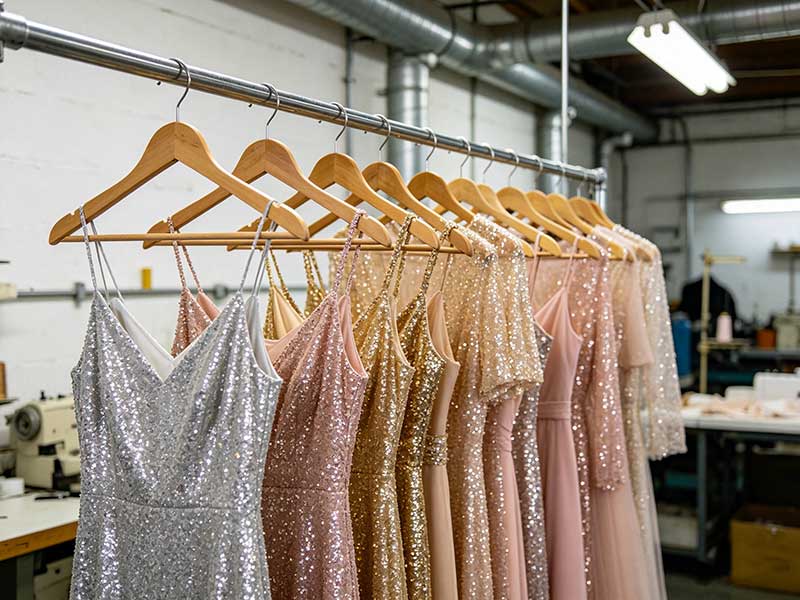
Cost should be evaluated at total landed cost level, not only unit price.
China cost structure:
- Higher labor cost per unit
- Lower hidden cost due to faster sampling
- Reduced rework rate
- Lower risk of production delay penalties
Vietnam cost structure:
- Lower labor cost per unit
- Higher dependency on imported fabrics
- Potential additional cost from sampling revisions
- Longer development cycle may increase indirect cost
| Cost Component | China | Vietnam |
|---|---|---|
| Labor cost | Medium–High | Low |
| Sampling cost | Low–Medium | Medium |
| Fabric cost stability | High | Medium |
| Rework cost | Low | Medium |
| Delay-related cost | Low | Medium–High |
When full cycle cost is calculated, China often becomes more efficient for complex collections.
Speed Requirement and Market Timing Pressure
Time-to-market is critical in fashion, especially for seasonal or trend-driven collections.
China is suitable when:
- Launch timelines are tight (30–45 day cycles)
- Multiple styles need parallel development
- Fast sampling and revision cycles are required
- Seasonal drops depend on rapid response
Vietnam is suitable when:
- Production schedules are stable and long-term planned
- Fewer design changes occur during development
- Focus is on cost efficiency rather than speed
- Styles are repeated across seasons
Speed difference becomes more visible during sampling stage rather than bulk production.
Risk Tolerance and Production Stability
Risk tolerance defines how much deviation a brand can accept in sampling, bulk consistency, and delivery timing.
China:
- Lower technical risk due to integrated supply chain
- Strong QC system across multiple production stages
- Faster correction of defects during production
- Better control for complex garments
Vietnam:
- Stable for standardized production
- Higher risk in complex construction or fabric-sensitive designs
- Dependence on imported materials increases supply risk
- Better suited for predictable, repeat orders
| Risk Area | China | Vietnam |
|---|---|---|
| Sampling deviation | Low | Medium |
| Bulk inconsistency | Low | Medium |
| Fabric delay risk | Low | Medium |
| Complex design failure | Low | High |
Order Strategy and Scaling Direction
Scaling strategy determines long-term manufacturing alignment.
China is stronger for:
- Multi-style collections with frequent updates
- Small batch testing followed by fast scaling
- Seasonal fashion cycles requiring rapid expansion
- Mixed product categories within one season
Vietnam is stronger for:
- Large volume stable production runs
- Long-term repeat orders with minimal design changes
- Cost-focused mass production programs
- Simplified product portfolios
Scaling behavior comparison:
| Scale Stage | China Performance | Vietnam Performance |
|---|---|---|
| 100–500 pcs | Flexible & fast | Stable |
| 500–2000 pcs | Highly efficient | Efficient |
| 2000–5000 pcs | Strong scaling | Stable |
| 5000+ pcs | Very strong | Strong but less flexible |
Hybrid Strategy for Real Production Planning
In actual fashion supply chain operations, many brands do not rely on a single country. A hybrid model is often used to balance risk, cost, and speed.
Common hybrid structure:
- China for sampling, design development, and complex styles
- Vietnam for repeat production and simplified SKUs
Benefits of hybrid model:
- Faster product development cycles
- Lower overall production cost for scale items
- Reduced risk in design experimentation
- More stable long-term supply chain structure
What Questions Do Buyers Usually Ask Before Choosing China or Vietnam?
Choosing between China and Vietnam is rarely based on a single factor. In real dress manufacturing decisions, the evaluation happens through a set of practical, risk-focused questions. These questions reflect concerns around cost stability, sampling reliability, production speed, and long-term scalability.
Most decision-makers are not comparing countries in theory—they are trying to avoid production failure, delay risk, and inconsistent bulk results. The questions below represent the most common decision checkpoints before committing to a production base.
What Is the Real Total Cost Per Dress After All Production Stages?
Unit price is only the starting point. Real cost includes sampling, fabric loss, rework rate, shipping method, and production delay impact.
Typical evaluation breakdown:
| Cost Layer | China | Vietnam |
|---|---|---|
| Unit production cost | Medium–High | Low |
| Sampling iteration cost | Low | Medium |
| Fabric sourcing cost | Stable | Variable |
| Delay cost impact | Low | Medium–High |
Key concern behind the question:
- Whether low unit price actually leads to lower final landed cost
- Whether sampling cycles increase total project budget
How Many Sampling Rounds Are Usually Needed Before Bulk Approval?
Sampling rounds directly affect time-to-market and development cost.
China typical pattern:
- 1st sample: 70–85% accuracy
- 1–2 rounds for most mid-complex dresses
- Faster correction within 24–48 hours
Vietnam typical pattern:
- 1st sample: 60–80% accuracy depending on design complexity
- 2–4 rounds for structured or mixed-material dresses
- Longer revision cycles due to external material sourcing
Key concern:
- Whether sampling delays will affect seasonal launch timing
Which Country Handles Complex Dress Designs More Reliably?
Complexity is a major decision factor for fashion collections involving structured silhouettes.
China performs stronger in:
- Corset dresses with boning structure
- Multi-layer chiffon or satin combinations
- Embellished or embroidered occasionwear
- Asymmetrical and draped construction
Vietnam performs better in:
- Simple slip dresses
- Basic jersey or knit dresses
- Standard A-line or straight silhouettes
Key concern:
- Risk of design deviation during bulk production
What Is the Risk of Sample and Bulk Mismatch?
Sample-to-bulk consistency is one of the most critical production risks.
| Risk Area | China | Vietnam |
|---|---|---|
| Fit consistency | High | Medium |
| Stitch accuracy | High | Medium |
| Fabric substitution risk | Low | Medium |
| Embellishment accuracy | High | Medium–Low |
Key concern:
- Whether final production matches approved sample without repeated correction cycles
Which Country Is Faster for Launching New Collections?
Speed includes sampling, approval cycles, and production readiness.
China:
- Sampling: 3–7 days
- Bulk production: 15–30 days
- Faster revision loops
- Better for trend-driven launches
Vietnam:
- Sampling: 5–12 days
- Bulk production: 18–35 days
- More stable but slower adjustment cycle
Key concern:
- Whether production speed supports seasonal or trend-sensitive launches
What Is the Minimum Order Quantity and Its Impact on Cost?
MOQ affects pricing structure, inventory risk, and flexibility for testing new designs.
China:
- Flexible MOQ for sampling and small batches
- Better for multi-style collections
- Easier to test market response
Vietnam:
- More efficient at higher volume stable orders
- Less flexible for frequent style changes
- Better for repeat production programs
Key concern:
- Whether initial launch strategy requires low-risk testing or bulk scaling
How Stable Is Production Quality at Scale?
Scaling often exposes hidden production weaknesses.
China:
- Strong scalability from 100 → 10,000+ pcs
- Stable QC system across production stages
- Lower deviation rate during expansion
Vietnam:
- Stable for repeat styles
- Higher variability when scaling complex designs
- Better suited for consistent, long-term SKUs
Key concern:
- Whether quality remains stable when order volume increases
What Happens If Design Changes After Sampling?
Design iteration speed affects flexibility in fashion development cycles.
China:
- Fast modification cycles (pattern + fabric + production aligned)
- Low disruption cost during adjustments
- Suitable for evolving design directions
Vietnam:
- Changes may require new material sourcing
- Longer revision cycle between stages
- Higher adjustment cost for late-stage changes
Key concern:
- Whether design flexibility is required during development phase
Custom Dress Manufacturing with Jinfeng Apparel
Production decisions between China and Vietnam ultimately come down to balancing cost, speed, and design complexity. Many brands find that the most effective approach is not choosing one country permanently, but selecting the right production system for each collection stage.
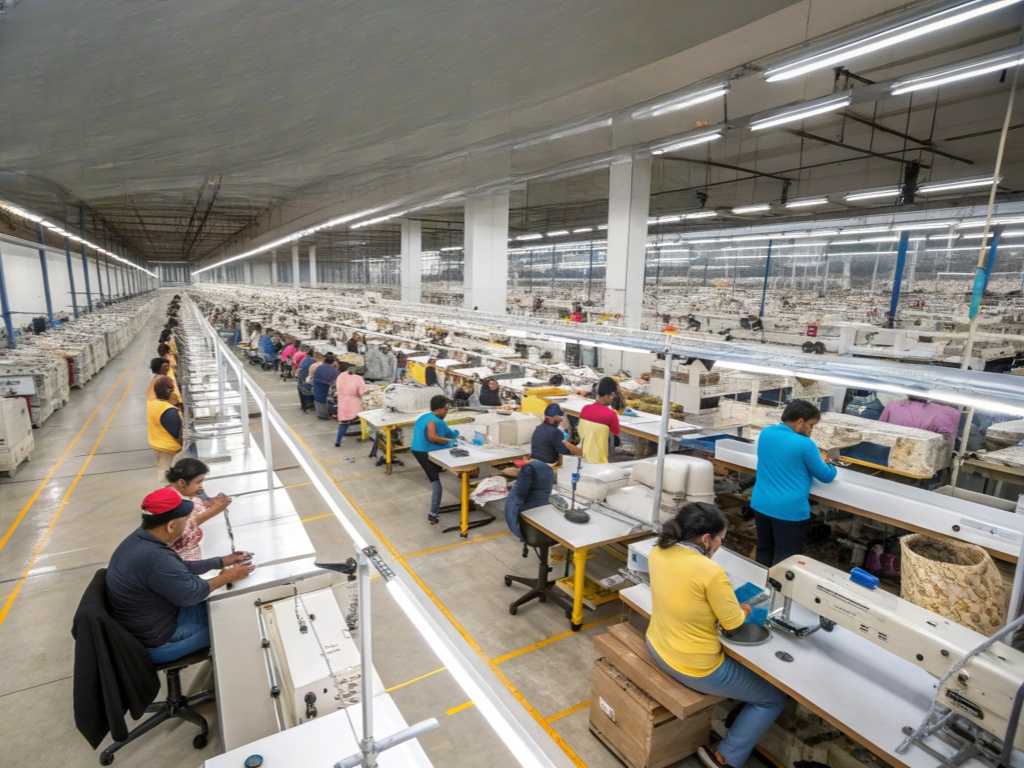
Jinfeng Apparel supports structured custom dress development in China, covering sampling, fabric sourcing, technical construction, and bulk production for a wide range of fashion categories—from structured occasionwear to trend-driven daily styles.
If there is a current collection in development, technical sketches, or reference designs ready for sampling, Jinfeng Apparel can provide development guidance, fabric suggestions, and production planning based on real manufacturing conditions.
Direct inquiries are welcome for custom dress OEM/ODM development, sampling evaluation, and production scaling strategies.