Skip to content

In custom dress manufacturing, one of the earliest questions from a factory is often misunderstood by many fashion brands: “What is your target quantity?” At first glance, it may seem like a simple procurement formality. However, in real production environments, this single number determines almost every downstream decision—fabric sourcing strategy, labor allocation, production line planning, risk buffering, and even whether a style is commercially viable for production at all.
In practice, quotation without quantity is not truly a quotation—it is only a rough estimate. The cost of a dress is not fixed like a retail product. It changes dynamically based on scale, efficiency, and material structure. A 100-piece order and a 5,000-piece order can have completely different unit economics, even if the design is identical.
Factories ask for target quantity before quoting because production cost depends on scale. Quantity affects fabric pricing, labor efficiency, setup cost distribution, and risk planning. Without it, accurate costing is impossible. A clear order volume ensures realistic quotation, stable production planning, and aligned expectations between design intent and manufacturing feasibility.
To understand this deeper, imagine two brands sending the same satin mini dress design to a factory. One says “maybe 120 pieces,” another says “5,000 pieces across three colors.” The factory does not just calculate cost—it evaluates whether the production system should be structured as a sampling-driven small batch or a semi-industrial production run. This is where most quotation misunderstandings begin.
What Does Target Quantity Mean in Custom Dress Manufacturing?
Target quantity refers to the planned production volume for a specific dress style before sampling and bulk pricing are finalized. It includes total units across all colors and sizes, and it acts as the core input for calculating fabric demand, labor allocation, and cost structure. In custom dress manufacturing, this number directly determines whether a style is treated as a small-batch development project or a scalable production order. Even when the design is identical, a 200-piece order and a 2,000-piece order follow completely different cost logic because material sourcing, cutting efficiency, and production line setup change with scale.
Key impact overview:
| Production Scale | Typical Quantity | Factory Approach | Cost Behavior |
|---|---|---|---|
| Sample Stage | 1–50 pcs | Manual development | High unit cost |
| Small Batch | 50–300 pcs | Mixed production | Moderate efficiency |
| Mid Volume | 300–1,000 pcs | Semi-line production | Balanced cost |
| Bulk Production | 1,000–5,000+ pcs | Full line optimization | Lowest unit cost |
Target quantity is not only a forecasting number but also a production trigger that determines how fabric is sourced, how sewing lines are arranged, and how risk is distributed across the manufacturing process.
What is target quantity in production planning?
In production planning, target quantity is the expected number of finished units for a single style, usually confirmed before final quotation. It includes breakdowns by size (S–XL or extended sizing) and color allocation. This information allows factories to calculate fabric consumption, cutting efficiency, and workload distribution across sewing lines.
For example, a 1,000-piece dress order with three colors may require:
- 400 pcs black
- 300 pcs white
- 300 pcs red
Each color affects dyeing cost, fabric procurement method, and production scheduling. Without this breakdown, factories cannot accurately calculate material needs or production flow efficiency.
Target quantity also connects directly to fabric ordering logic. Below certain thresholds, fabric is purchased from stock rolls; above certain thresholds, mills may require custom dyeing orders, which changes lead time and cost structure significantly.
How is target quantity different from MOQ?
MOQ (Minimum Order Quantity) is the minimum threshold set by the factory to make production viable. Target quantity is the planned order volume provided by the brand. One defines feasibility, the other defines demand scale.
| Factor | MOQ | Target Quantity |
|---|---|---|
| Definition | Factory minimum requirement | Brand expected volume |
| Control | Factory-side | Brand-side |
| Purpose | Ensure production efficiency | Guide pricing and planning |
| Flexibility | Fixed or limited | Adjustable before confirmation |
For example, a factory may set MOQ at 100 pcs per style per color due to fabric dyeing constraints. However, a brand might plan 800 pcs across multiple colors. If target quantity is close to MOQ, pricing tends to be higher due to limited efficiency. If it is significantly higher, pricing becomes more competitive due to scale optimization.
In practice, MOQ answers “can this be produced?”, while target quantity answers “how should this be priced and organized?”
Why does quantity directly affect quotation structure?
Quotation structure in dress manufacturing is built on cost distribution logic rather than fixed pricing. Target quantity determines how fixed and variable costs are allocated across each unit.
A typical dress cost structure includes:
- Fabric cost
- Trims and accessories
- Labor cost
- Sampling amortization
- Cutting and wastage
- Factory overhead
Fixed costs such as pattern development and machine setup remain constant regardless of order size. When quantity increases, these costs are spread across more units, reducing per-piece cost.
For example:
| Cost Item | 100 pcs Order | 1,000 pcs Order |
|---|---|---|
| Setup cost | $300 ($3/unit) | $300 ($0.30/unit) |
| Fabric cost | Higher rate | Bulk discounted rate |
| Labor efficiency | Low | High |
| Final unit price | High | Lower |
Why Do Factories Ask for Target Quantity Before Quoting?
Target quantity is required before quotation because dress pricing is directly tied to production scale, material purchasing conditions, and factory capacity allocation. Without a clear quantity, cost calculation becomes unstable and inaccurate, especially in custom dress manufacturing where every style may involve different fabrics, trims, and construction complexity. Quantity determines whether production runs under small-batch sampling logic or optimized bulk production logic, which leads to completely different unit pricing structures. Factories use this number to calculate fabric procurement strategy, labor efficiency, and production scheduling before confirming any price.
Core impact summary:
| Factor | Without Quantity | With Confirmed Quantity |
|---|---|---|
| Fabric pricing | Estimated retail or stock price | Negotiated bulk pricing |
| Labor planning | Unstable | Scheduled line allocation |
| Production method | Sample-level assumption | Defined workflow |
| Quotation accuracy | Low | High |
In real production practice, quotation is not a fixed list—it is a calculation model. Target quantity is the first variable that activates this model.
Do production costs change based on order size?
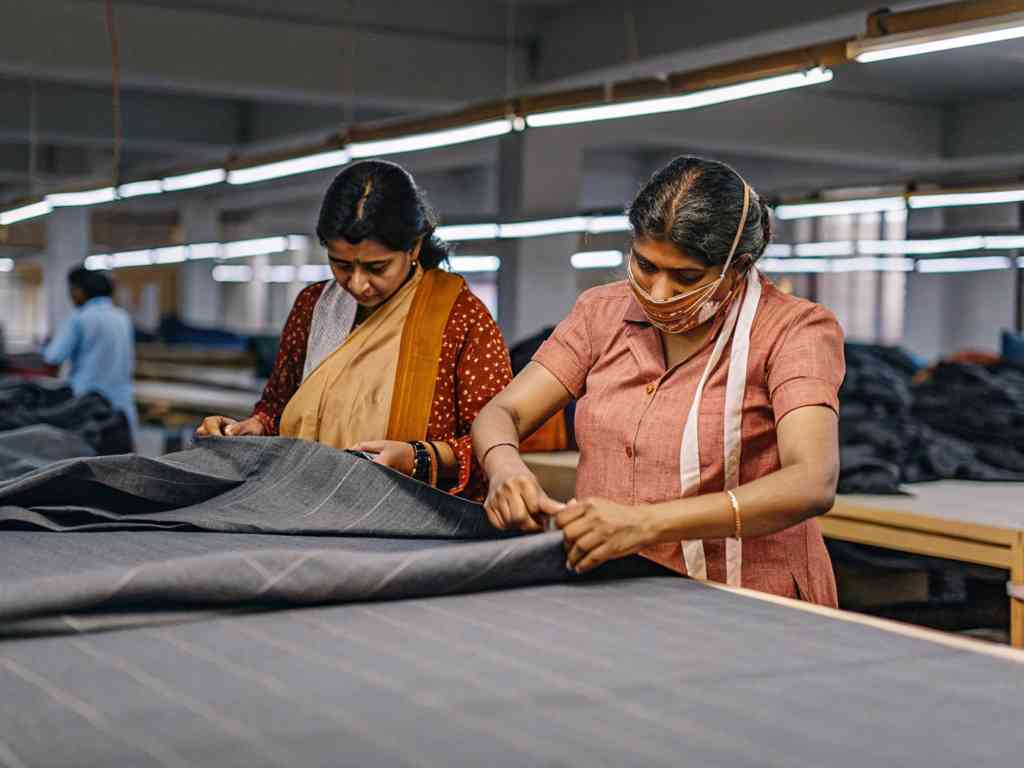
Production cost changes significantly depending on order volume because fixed costs and variable costs behave differently at different scales. Fixed costs such as pattern making, machine setup, and initial sampling adjustments remain constant regardless of whether the order is 100 pieces or 5,000 pieces. When volume increases, these fixed costs are distributed across more units, reducing the cost per piece.
For example:
| Cost Component | 100 pcs Order | 1,000 pcs Order |
|---|---|---|
| Pattern setup | $200 ($2/unit) | $200 ($0.20/unit) |
| Machine setup | $150 ($1.5/unit) | $150 ($0.15/unit) |
| Labor efficiency | Low output/hour | Stable production flow |
| Unit price trend | High | Significantly lower |
Variable costs such as fabric and trims also improve with scale. Larger orders allow mills to offer bulk pricing, which can reduce fabric cost by 10–30%. At the same time, production lines operate more efficiently because workers repeat the same process continuously instead of switching between styles.
How does quantity affect fabric sourcing and trim cost?
Fabric sourcing is one of the most quantity-sensitive elements in dress production. Mills and trim suppliers operate on tiered pricing systems, meaning cost per meter decreases as order volume increases. Without target quantity, factories cannot decide whether to purchase from stock or place a bulk order directly with mills.
Typical sourcing differences:
| Quantity Level | Fabric Source Type | Cost Behavior | Lead Time |
|---|---|---|---|
| <300 pcs | Stock fabric | Higher cost | Fast |
| 300–1,000 pcs | Mixed sourcing | Medium cost | Medium |
| 1,000+ pcs | Mill bulk order | Lower cost | Longer |
Trim components such as zippers, buttons, lace, and elastic also follow MOQ rules. For example, custom metal zippers may require a minimum order of 1,000–3,000 units, while lace trims often require minimum dye lots. Target quantity determines whether these costs can be optimized or must be absorbed at higher per-unit rates.
Why does labor efficiency depend on batch size?
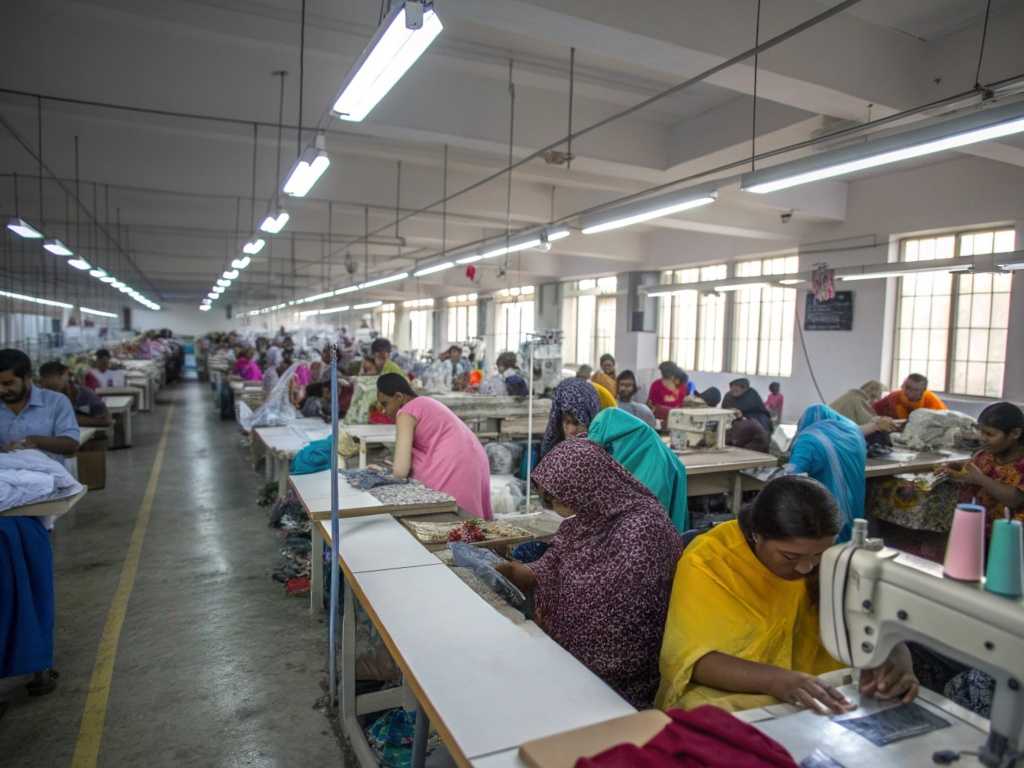
Labor efficiency increases with larger batch sizes because production lines become more stable and repetitive. In small orders, workers frequently switch between styles, which increases setup time, reduces output per hour, and increases error rates. In larger orders, the same operation is repeated continuously, allowing smoother workflow and higher efficiency.
Comparison of efficiency factors:
| Production Factor | Small Batch | Large Batch |
|---|---|---|
| Machine setup changes | Frequent | Rare |
| Operator learning curve | Repeated | Stable |
| Output per hour | Lower | Higher |
| Error rate | Higher | Lower |
In real factory operations, even a 20–30% improvement in line efficiency can significantly reduce labor cost per garment. This is why quantity directly influences final quotation—not only through material cost but also through production speed and stability.
How does risk allocation influence pricing?
Every production order carries operational risk, including fabric defects, cutting waste, stitching errors, and potential rework. When order quantity is small, these risks are concentrated into fewer units, increasing cost pressure per garment. When quantity increases, risk is distributed across a larger number of units, making cost more stable and predictable.
Risk impact comparison:
| Risk Type | Small Order Impact | Large Order Impact |
|---|---|---|
| Fabric waste | High per unit impact | Diluted |
| Rework cost | Significant | Minimal per unit |
| Quality fluctuation | More visible | Stabilized |
| Production disruption | High sensitivity | Lower sensitivity |
Factories also include a risk buffer in quotation models. This buffer is higher for small orders because any defect or delay has a stronger financial impact. For larger orders, risk is absorbed more efficiently through scale.
How do factories protect capacity and scheduling?
Production capacity is limited and scheduled in advance. Each sewing line operates under a weekly or monthly plan. Target quantity helps factories decide whether to reserve full line capacity, partial capacity, or schedule production between existing orders.
Capacity planning logic:
| Quantity Range | Production Allocation |
|---|---|
| 100–300 pcs | Shared line slot |
| 300–1,000 pcs | Partial dedicated line |
| 1,000–5,000+ pcs | Full line reservation |
Without confirmed quantity, factories cannot commit production time. Overbooking leads to delays, while underutilization reduces efficiency. Therefore, quantity acts as a scheduling lock that aligns production timing, material arrival, and delivery planning.
How Does Target Quantity Affect Dress Pricing?
Target quantity directly determines how dress pricing is structured because every cost element in garment manufacturing is scale-sensitive. The same design can have significantly different unit prices depending on whether the order is 100 pieces, 500 pieces, or 5,000 pieces. Pricing is not calculated as a fixed value; it is built from fabric cost, labor efficiency, production setup cost, and wastage rate, all of which change with volume. Lower quantities concentrate fixed costs into fewer units, while higher quantities distribute these costs across a larger production base, reducing unit price. This is why factories always link quotation levels to target quantity before confirming final pricing.

Cost behavior overview:
| Production Scale | Cost Structure | Price Behavior |
|---|---|---|
| 50–200 pcs | High fixed cost impact | Highest unit price |
| 200–1,000 pcs | Balanced cost split | Moderate pricing |
| 1,000–3,000 pcs | Optimized efficiency | Lower unit price |
| 3,000+ pcs | Full scale production | Lowest unit price |
How is cost per piece calculated in small vs large orders?
Cost per piece is calculated by dividing total production cost by total output, but the structure of that cost changes significantly with volume. In small orders, fixed costs such as pattern making, sample correction, and machine setup occupy a large portion of each unit cost. In large orders, these fixed costs are spread across many units, making each garment cheaper to produce.
Example comparison:
| Cost Component | 100 pcs Order | 1,000 pcs Order |
|---|---|---|
| Fabric cost | Higher per meter | Bulk discounted |
| Labor cost | High due to inefficiency | Lower due to repetition |
| Setup cost | $300 = $3/unit | $300 = $0.30/unit |
| Total unit price | High | 20–40% lower |
In real production, even identical dresses can show 30–60% price differences purely based on scale.
What role does setup cost play in pricing?
Setup cost includes all pre-production actions required before sewing starts. It does not depend on quantity but must be completed for every style. These include pattern development, sample correction, cutting layout preparation, and machine configuration.
Setup cost impact:
| Setup Item | Fixed Cost Example | Impact on Small Order | Impact on Large Order |
|---|---|---|---|
| Pattern making | $150–$300 | High per unit impact | Low per unit impact |
| Cutting setup | $80–$200 | Noticeable cost driver | Minimal impact |
| Machine adjustment | $50–$150 | Cost-heavy | Diluted |
When order quantity is low, setup cost becomes one of the most expensive components per garment. When quantity increases, it becomes almost negligible in unit pricing.
How does cutting, sampling, and wastage impact unit cost?
Fabric cutting and sampling loss are hidden but significant cost drivers in dress manufacturing. Every layout requires fabric positioning optimization, and small inefficiencies lead to material waste. Sampling adjustments before bulk production also add cost.
Typical wastage comparison:
| Production Scale | Fabric Waste Rate | Cost Impact |
|---|---|---|
| Small batch | 12–18% | High cost pressure |
| Medium batch | 8–12% | Moderate impact |
| Bulk production | 5–8% | Optimized cost |
Sampling also affects pricing. If multiple fitting adjustments are required before bulk approval, additional labor and material costs are added into final quotation, especially in small orders where correction cost cannot be distributed.
Why do price tiers exist in custom dress production?
Price tiers exist because production efficiency changes at different volume levels. Each tier reflects a different operational model inside the factory, from sample-driven production to fully optimized assembly line production.
Typical pricing tiers:
| Tier Level | Quantity Range | Production Mode | Price Behavior |
|---|---|---|---|
| Tier 1 | 50–200 pcs | Sample-based | Highest price |
| Tier 2 | 200–800 pcs | Semi-production | Medium price |
| Tier 3 | 800–2,000 pcs | Line production | Lower price |
| Tier 4 | 2,000+ pcs | Full optimization | Lowest price |
These tiers are not arbitrary—they reflect real changes in fabric sourcing strategy, labor efficiency, and production scheduling. Each tier represents a different level of industrial efficiency, which is why pricing steps down as quantity increases.
What Risks Do Factories Manage Through Quantity Confirmation?
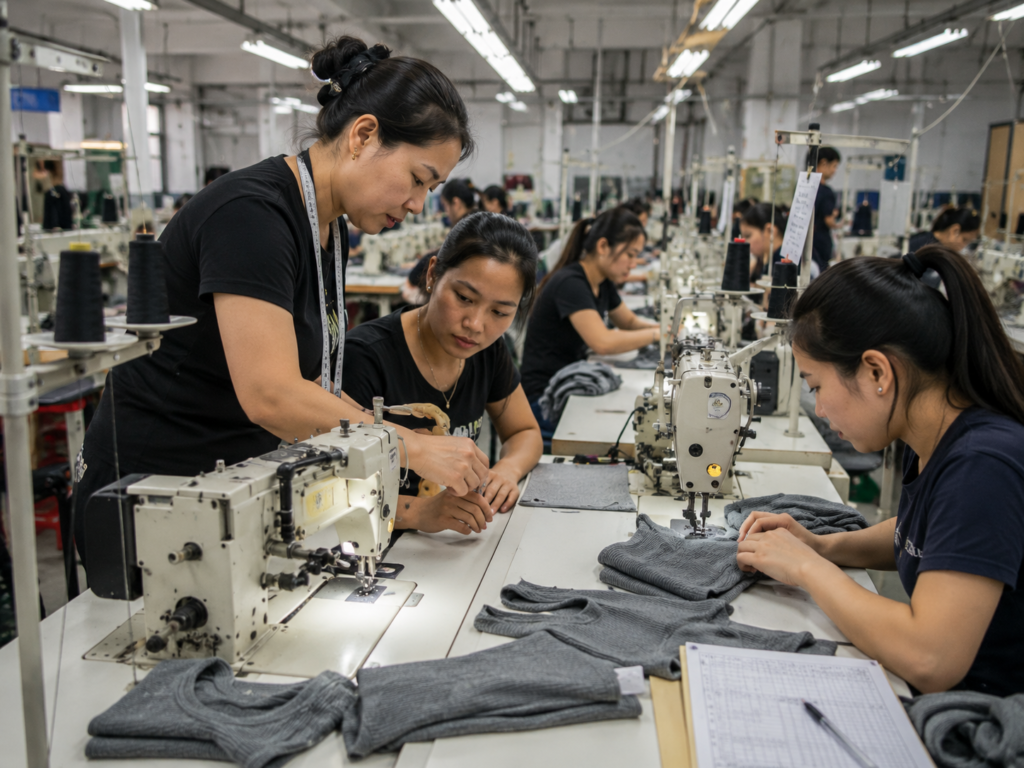
Quantity confirmation is one of the most important risk-control steps in custom dress manufacturing because it stabilizes planning across materials, production lines, and delivery schedules. Without a confirmed quantity, factories face uncertainty in fabric procurement, capacity allocation, and cost control, which can directly affect pricing accuracy and production reliability. In practice, quantity acts as a “risk boundary” that allows factories to decide how much material to purchase, how many lines to reserve, and how to balance efficiency versus flexibility. Even small changes in quantity can shift production from stable to unstable planning conditions.
Risk control overview:
| Risk Area | Without Confirmed Quantity | With Confirmed Quantity |
|---|---|---|
| Fabric procurement | Over/under ordering risk | Accurate bulk planning |
| Production capacity | Unstable scheduling | Locked production slots |
| Cost control | High fluctuation | Predictable structure |
| Delivery timeline | Delay risk | Controlled timeline |
What happens if production quantity is too low?
When production quantity is too low, factories face disproportionate fixed costs per unit and inefficient use of production capacity. A small order still requires full setup: pattern creation, cutting preparation, machine adjustment, and quality calibration. If the total volume cannot absorb these costs, unit price increases sharply and production efficiency drops.
Typical impact:
| Cost Element | Effect in Low Quantity Orders |
|---|---|
| Setup cost | Becomes dominant per unit |
| Labor efficiency | Underutilized production time |
| Fabric utilization | Less optimized cutting layout |
| Factory decision | May reject or increase pricing |
In many cases, orders below a certain threshold (for example 100–200 pieces per style) may be considered operationally inefficient unless higher pricing is accepted.
How does inaccurate quantity affect fabric procurement?
Fabric procurement depends heavily on exact quantity because mills operate with strict minimum order requirements and pricing tiers. When quantity is inaccurate, two major risks appear: over-purchasing or shortage.
Impact comparison:
| Scenario | Result | Business Impact |
|---|---|---|
| Overestimated quantity | Excess fabric inventory | Capital waste |
| Underestimated quantity | Fabric shortage | Production delay |
| Quantity changes mid-process | Batch inconsistency | Color shade variation risk |
In dress production, fabric is not just a material cost—it also determines lead time. Many custom fabrics require 2–4 weeks production time. If quantity is wrong, procurement must restart, which directly affects delivery schedules.
Why does unstable quantity increase production risk?
Unstable quantity disrupts every stage of production planning. Factories schedule sewing lines weeks in advance based on confirmed workloads. When quantity changes frequently, production must be reorganized, which leads to inefficiency and operational instability.
Key risk areas:
| Production Stage | Risk Caused by Instability |
|---|---|
| Scheduling | Line rescheduling conflicts |
| Material planning | Recalculation of fabric needs |
| Workforce allocation | Idle or overloaded lines |
| Quality consistency | Variation due to rushed adjustments |
In real operations, even a 10–15% change in quantity after confirmation can require full re-planning of production slots, especially during peak seasonal cycles.
How do factories protect capacity and scheduling?
Factories use confirmed quantity as a locking mechanism for production planning. Once quantity is confirmed, production slots, material orders, and labor allocation are fixed into a structured schedule. This ensures that each style fits into the factory’s overall capacity plan without disrupting other orders.
Capacity planning model:
| Quantity Range | Production Allocation Strategy |
|---|---|
| 100–300 pcs | Shared production window |
| 300–1,000 pcs | Partial line reservation |
| 1,000–3,000 pcs | Dedicated line scheduling |
| 3,000+ pcs | Full production block |
This structure helps factories avoid overbooking, maintain delivery consistency, and reduce idle capacity. Confirmed quantity essentially transforms a concept into a scheduled production commitment, ensuring stability across materials, labor, and delivery timelines.
How Should Brands Provide Quantity to Get Accurate Quotes?
Accurate quotation in custom dress manufacturing depends heavily on how quantity information is structured and communicated. A single total number is not enough for factories to calculate real production cost. Quantity needs to reflect size ratio, color distribution, and production intent (trial order or confirmed bulk order). When this information is incomplete, factories must assume fabric usage, labor allocation, and production efficiency, which leads to pricing deviations. A well-structured quantity breakdown allows factories to calculate fabric consumption precisely, optimize cutting plans, and allocate production lines efficiently, resulting in faster and more stable quotation output.

Quotation accuracy impact:
| Input Quality | Pricing Accuracy | Production Planning |
|---|---|---|
| Only total quantity | Low | Estimated |
| Partial breakdown | Medium | Semi-accurate |
| Full structured data | High | Fully aligned |
What is the difference between estimated and confirmed quantity?
Estimated quantity represents a planning forecast, often used in early development or design evaluation stages. Confirmed quantity represents a committed production volume used for final pricing, fabric booking, and production scheduling. Mixing these two leads to pricing instability and repeated quotation revisions.
Comparison:
| Type | Purpose | Risk Level | Factory Action |
|---|---|---|---|
| Estimated Quantity | Early planning | High uncertainty | Rough costing only |
| Confirmed Quantity | Production execution | Low uncertainty | Final quotation & booking |
Estimated numbers help evaluate feasibility, but confirmed numbers are required to lock material purchasing and production schedules.
How to define size ratio and color breakdown?
Size ratio and color distribution directly affect fabric consumption, cutting efficiency, and production layout. Without these details, factories cannot calculate accurate fabric usage or optimize cutting markers.
Recommended structure:
| Element | Example | Impact on Production |
|---|---|---|
| Total quantity | 1,000 pcs | Overall capacity planning |
| Color split | Black 500 / White 300 / Red 200 | Fabric sourcing decisions |
| Size ratio | S:20%, M:40%, L:30%, XL:10% | Cutting efficiency |
For example, a balanced size curve reduces fabric waste, while uneven ratios may increase leftover fabric or require re-adjustment of cutting layouts. Color breakdown also determines whether fabric must be dyed in batches or sourced from stock, which affects lead time and cost.
What production information improves quotation accuracy?
Quantity alone is not enough to generate precise pricing. Factories also require supporting production inputs that define how the garment will be constructed and processed.
Key inputs:
| Information Type | Why It Matters |
|---|---|
| Fabric type | Determines cost per meter and MOQ |
| Style complexity | Affects labor time per unit |
| Trim details | Impacts sourcing and minimum order requirements |
| Construction method | Influences production speed |
For example, a satin slip dress with minimal seams has a very different labor cost compared to a corset dress with boning, lining, and structured panels—even at the same quantity. Providing full production context reduces quotation assumptions and improves cost accuracy.
What mistakes cause quotation delays or revisions?
Most quotation delays are not caused by production complexity but by incomplete or unclear quantity input. When factories cannot clearly understand volume structure, they must request clarification before pricing.
Common issues:
| Mistake | Impact |
|---|---|
| Only total quantity provided | Requires assumptions for fabric usage |
| Missing size breakdown | Incorrect cutting estimation |
| Unclear color allocation | Fabric sourcing uncertainty |
| Frequent quantity changes | Repeated recalculation |
In practice, even small missing details can add 24–72 hours to quotation time because factories must re-evaluate fabric planning, labor allocation, and production scheduling before confirming pricing.
What Happens After Quantity Is Confirmed?
Once quantity is confirmed, custom dress manufacturing moves from estimation into execution planning. At this stage, factories stop relying on assumptions and begin locking real production decisions, including fabric procurement, production line allocation, cost finalization, and delivery scheduling. Quantity becomes the trigger that activates the full production workflow. Every downstream step depends on this number because it defines how materials are purchased, how sewing capacity is reserved, and how timelines are structured. Without changes in quantity, the entire system becomes stable and predictable, allowing factories to commit resources with controlled risk.
Post-confirmation workflow overview:
| Stage | Action | Outcome |
|---|---|---|
| Cost finalization | Convert estimate into firm quotation | Stable pricing |
| Fabric booking | Place bulk or stock orders | Material secured |
| Production planning | Allocate sewing lines | Capacity reserved |
| Sampling alignment | Adjust pre-production sample if needed | Production-ready sample |
| Scheduling | Lock delivery timeline | Fixed shipment plan |
How is the final quotation structured?
After quantity confirmation, quotation moves from a flexible estimate to a fixed cost breakdown based on real production conditions. Factories calculate pricing using confirmed fabric consumption, labor allocation, trim sourcing, and overhead distribution. At this stage, assumptions are removed and replaced with actual production data.

Typical structure:
| Cost Component | What It Includes | Pricing Behavior |
|---|---|---|
| Fabric cost | Based on confirmed meter usage | Bulk negotiated |
| Labor cost | Sewing time per unit | Based on efficiency |
| Trims | Zippers, lace, buttons | MOQ-driven pricing |
| Setup cost | Pattern + machine setup | Fixed and amortized |
| Overhead | QC, logistics prep | Distributed per unit |
Once structured, the final quotation becomes stable unless quantity or fabric specifications change. Even small adjustments in confirmed quantity can trigger recalculation of fabric cost tiers or labor efficiency assumptions.
What steps follow before sampling and bulk production?
After quantity is locked, factories align sampling and production to ensure the sample reflects real bulk conditions. This avoids mismatch between sample quality and final production output.
Key steps:
| Step | Purpose | Output |
|---|---|---|
| Fabric sourcing | Secure correct material | Bulk-ready fabric |
| Pattern finalization | Adjust for production efficiency | Production pattern |
| Sample confirmation | Validate fit and construction | Approved sample |
| Pre-production check | Confirm trims and specs | Locked BOM |
At this stage, some minor adjustments may be made to improve manufacturability. For example, seam reinforcement or lining adjustments may be optimized to ensure consistency in bulk production without affecting design intent.
How does quantity lock production scheduling?
Confirmed quantity directly determines how factories allocate sewing lines and production time. Each order is placed into a production calendar based on volume, complexity, and delivery timeline. Once locked, the order is assigned a specific production window.
Capacity allocation logic:
| Quantity Range | Scheduling Method | Production Impact |
|---|---|---|
| 100–300 pcs | Shared production slot | Flexible timing |
| 300–1,000 pcs | Partial line allocation | Moderate priority |
| 1,000–3,000 pcs | Dedicated line | Fixed schedule |
| 3,000+ pcs | Multi-line production | High priority block |
This structure ensures that multiple orders can run simultaneously without disrupting efficiency. Quantity acts as the key variable that prevents overbooking and ensures delivery stability across all active production lines.
What signals readiness for factory commitment?
Factories consider production fully committed only when quantity, sample approval, and technical specifications are all aligned. These three elements create a stable production baseline.
Readiness indicators:
| Condition | Requirement | Result |
|---|---|---|
| Confirmed quantity | Final production volume locked | Pricing stabilized |
| Approved sample | Fit and construction validated | Production approved |
| Final tech details | Fabric + trims + BOM confirmed | Full execution ready |
Once these conditions are met, factories proceed with material procurement and production execution without further assumption-based decisions. At this point, production risk is minimized, and the order moves into a controlled manufacturing cycle with defined cost, timeline, and output expectations.
Conclusion
In custom dress manufacturing, target quantity is not a formality—it is the foundation of cost logic, production feasibility, and delivery stability. Without it, pricing remains speculative and production planning becomes unstable. With it, factories can align fabric sourcing, labor efficiency, and capacity scheduling into a predictable system.
For fashion brands planning new collections, especially in mini dresses, bodycon dresses, satin dresses, or eveningwear lines, providing clear target quantity upfront significantly improves quotation accuracy and reduces sampling delays.
Jinfeng Apparel supports structured OEM/ODM development for custom dresses with scalable production planning, consistent quality control, and flexible order quantities across different fashion categories. If a new collection is under development and accurate pricing or sampling support is required, direct consultation can be initiated with our development team to review fabric options, construction details, and production feasibility.
We are ready to evaluate your design concept and translate it into a production-ready custom dress program with optimized cost structure and stable manufacturing execution.