Skip to content

When a dress moves from design idea into physical sampling, the most expensive mistakes are not caused by sewing quality—they are caused by missing or incomplete technical information. In real production environments, a sample is often produced within 5 to 10 days. During this short window, every missing detail in the tech pack forces assumptions. And every assumption creates deviation.
A structured dress tech pack is the only document that turns a visual concept into measurable production instructions. Without it, even experienced factories must interpret fabric behavior, silhouette proportions, and construction logic based on prior experience rather than confirmed data.
A dress tech pack before sampling is a structured production document containing design drawings, garment measurements, fabric specifications, trims, stitching methods, and quality requirements. It eliminates interpretation gaps between design intent and factory execution, ensuring the first sample closely matches expected fit, silhouette, and construction standards while reducing revision cycles and material waste.
In actual dress development workflows, a single unclear measurement or missing fabric specification can lead to 2–3 additional sample rounds. Each round adds 3–7 production days and increases material cost by 8–15%. This is why professional brands treat the tech pack as a production contract rather than a design reference.
A common situation: a satin midi dress is requested with “soft drape.” One factory uses lightweight polyester satin (90–110 GSM), another uses heavy satin (140–160 GSM). The silhouette outcome changes completely. The only way to prevent this variation is a precise, structured tech pack with measurable parameters.
What Is a Dress Tech Pack Before Sampling?
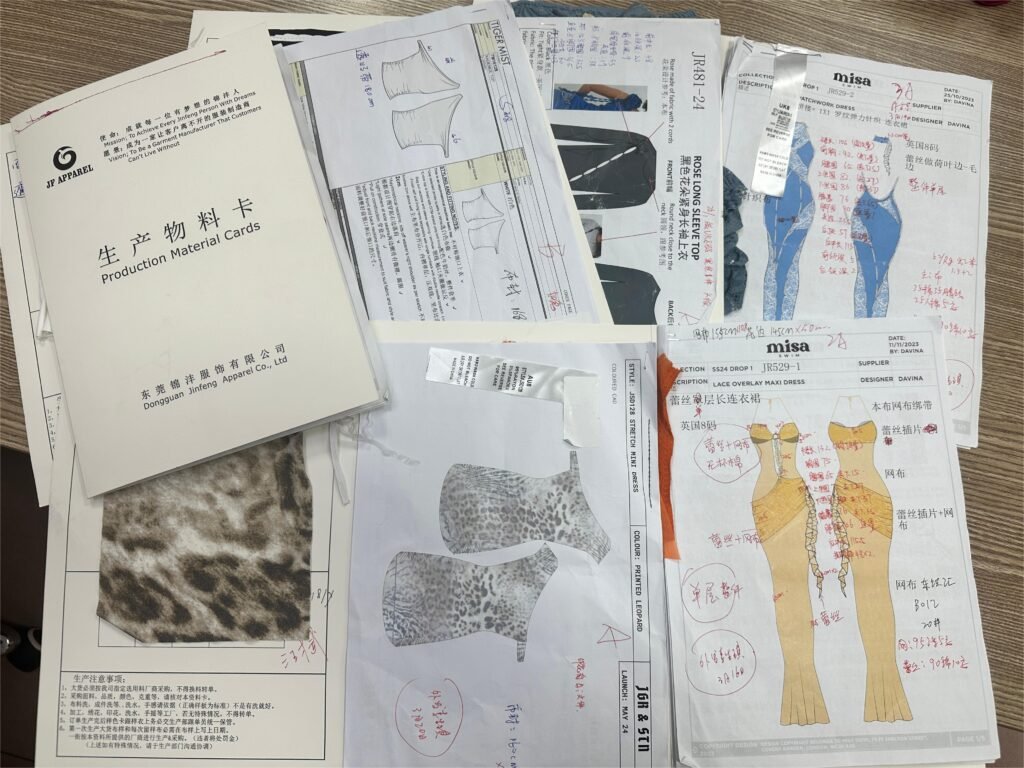
A dress tech pack before sampling is a standardized manufacturing document that converts a fashion design into precise production instructions. It defines measurements, materials, construction details, trims, and quality standards so factories can produce an accurate sample without interpretation. It ensures consistency across design, sampling, and bulk production stages.
Why is a tech pack essential for sample accuracy?
A dress tech pack acts as the single reference point for all production decisions during sampling. In garment manufacturing, ambiguity is the primary cause of sample failure. When only sketches or inspiration images are provided, factories must interpret:
- Fabric weight and elasticity
- Seam construction method
- Dress length positioning
- Fit intention (tight, semi-fitted, relaxed)
- Internal finishing standards
Each interpretation varies based on factory experience, which leads to inconsistent results.
In structured production systems, a tech pack reduces first-sample rejection rates from an estimated 40–60% (without documentation) to 10–15% (with complete specification). This is achieved by removing subjective decision-making from early production stages.
A complete tech pack also stabilizes communication between design and production teams. Instead of long explanation cycles, factories rely on measurable data such as:
- Bust circumference: 88 cm (size M)
- Waist: 70 cm ± 1 cm tolerance
- Fabric stretch: 15–20%
- Seam allowance: 1 cm flat-felled construction
This level of precision eliminates guesswork and ensures reproducibility across multiple production runs.
What role does it play in reducing sampling errors?
Sampling Error Breakdown in Dress Development
| Sampling Error Category | Typical Impact Range | Root Cause | Effect on Development |
|---|---|---|---|
| Measurement Deviation | 35% – 45% | Missing POM definitions or unclear grading rules | Leads to inconsistent fit across sizes, repeated fit revisions |
| Fabric Mismatch | 25% – 35% | Unspecified GSM, composition, or stretch ratio | Causes visual and handfeel differences vs. design intent |
| Construction Inconsistency | 15% – 25% | Undefined stitching, finishing, or internal structure methods | Affects durability, shape stability, and production repeatability |
| Design Misinterpretation | 10% – 20% | Unclear sketches or missing technical breakdowns | Results in incorrect silhouette, proportion or detailing |
Production Efficiency Impact (With Complete Tech Pack)
| KPI | Improvement Range |
|---|---|
| Sampling Iterations | Reduced from 2.8 rounds → 1–3 rounds |
| Sampling Speed | 30% – 50% faster cycle |
| Development Cost | 20% – 35% reduction |
| First-Sample Approval Rate | Significantly higher due to reduced ambiguity |
What Design Details Should Be Included?
A dress tech pack must include technical sketches, garment construction breakdown, design references, style coding, and structural annotations. These elements translate visual design into manufacturing logic, ensuring consistent interpretation across pattern making, sampling, and production. Clear design details reduce misalignment in silhouette, proportions, and construction methods during the first sample stage.

Is a technical sketch or CAD drawing required?
Technical sketches are one of the most critical elements in dress development because they define structure, not aesthetics. A real production-ready CAD drawing is not a fashion illustration—it is an engineering map of the garment.
A complete dress tech sketch should include:
- Front view, back view, and optional side view
- Seam lines clearly marked (princess seams, panel lines, darts)
- Neckline shape with measured depth and width
- Sleeve construction type and attachment method
- Hem structure and finishing style
- Closure positioning (zipper, buttons, invisible seam)
In real sampling practice, absence of technical sketches increases first-sample revision probability by 40–60%. For example, without seam placement indication, a bodycon dress may shift from a 6-panel structure to a 4-panel structure depending on factory habits, directly affecting fit compression and body contouring effect.
A production-grade sketch should also include proportional scaling references. For dresses, standard industry scaling uses:
- Shoulder-to-waist ratio: 38–42% of total body length
- Waist-to-hem ratio: 58–62% depending on silhouette
- Dart intake: 2–4 cm per bust shaping zone for fitted styles
These numerical indicators ensure pattern makers do not rely on subjective interpretation.
What construction details must be clearly defined?
Construction details determine how a dress behaves in real wear conditions. Two dresses with identical fabric can feel completely different depending on internal construction.
Key construction specifications should include:
1. Seam type definition
- Overlock seam (standard knit construction)
- French seam (lightweight woven, premium finish)
- Flat-felled seam (durability-focused structure)
- Bound seam (luxury interior finishing)
For example:
A satin slip dress using overlock seams may reduce production cost by 8–12%, but French seams increase durability by 20–30% and significantly improve interior aesthetics.
2. Internal structure design
- Lining presence (full, partial, or none)
- Interlining usage for shaping support
- Boning placement for structured bodices
In structured dresses like corset-style or evening dresses, boning typically follows:
- Side seams: 2–4 channels per side
- Front panel: 1–2 shaping channels
- Back panel: optional reinforcement depending on zipper type
Without this specification, factories may eliminate internal structure to reduce cost, resulting in poor silhouette control.
3. Closure system specification
Closure systems directly impact fit accuracy and durability:
- Invisible zipper (standard for dresses 18–60 cm opening)
- Metal zipper (decorative or heavy-duty use)
- Button closure (spacing usually 6–9 cm intervals)
- Hook-and-eye reinforcement for neckline stability
A missing closure specification often leads to incorrect zipper placement deviation of 2–4 cm, which is enough to distort waist alignment in fitted dresses.
How should style codes and reference images be structured?
Style coding is essential for managing multiple dress variations during development. Without standardized coding, production errors increase significantly when multiple samples run in parallel.
A professional structure typically includes:
- Style ID (e.g., JD-2025-015)
- Color code reference (Pantone or fabric code)
- Fabric code (linked to supplier or swatch system)
- Version number (V1, V2, V3 for revisions)
This system reduces sample confusion rates by up to 35–50% in multi-style development cycles.
Reference images must also follow strict hierarchy instead of being collected randomly. Effective structure includes:
Primary reference (70% importance)
Defines overall silhouette and proportion
Secondary reference (20% importance)
Defines details such as neckline, sleeve shape, or waist position
Detail reference (10% importance)
Focuses on trims, stitching, or decoration elements
A common mistake is using too many mixed references, which leads to conflicting design directions. When more than 5 reference images are used without annotation, interpretation deviation increases by approximately 25–30%.
Best practice is to annotate images with directional notes:
- “neckline depth similar to image A”
- “sleeve volume similar to image B”
- “waist shaping reference from image C”
This converts visual inspiration into measurable production intent.
What design consistency rules improve sampling success?
Design consistency is often overlooked but plays a major role in sampling accuracy. Three key consistency rules apply:
1. Proportion locking
Once silhouette ratios are defined in the tech pack, they should remain fixed across all sizes unless grading rules explicitly adjust them.
2. Detail hierarchy control
Critical design elements (silhouette, neckline, waist structure) must never be secondary to decorative elements (embroidery, prints).
3. Fabric–design alignment
Certain designs require specific fabric behavior:
- Ruched dresses require ≥20% stretch ratio
- Structured A-line dresses require ≤5% elasticity
- Bias-cut satin requires controlled GSM range (120–160 GSM)
When fabric and design intent are misaligned, even perfect construction cannot correct silhouette distortion.
Which Measurements and Size Specs Are Needed?
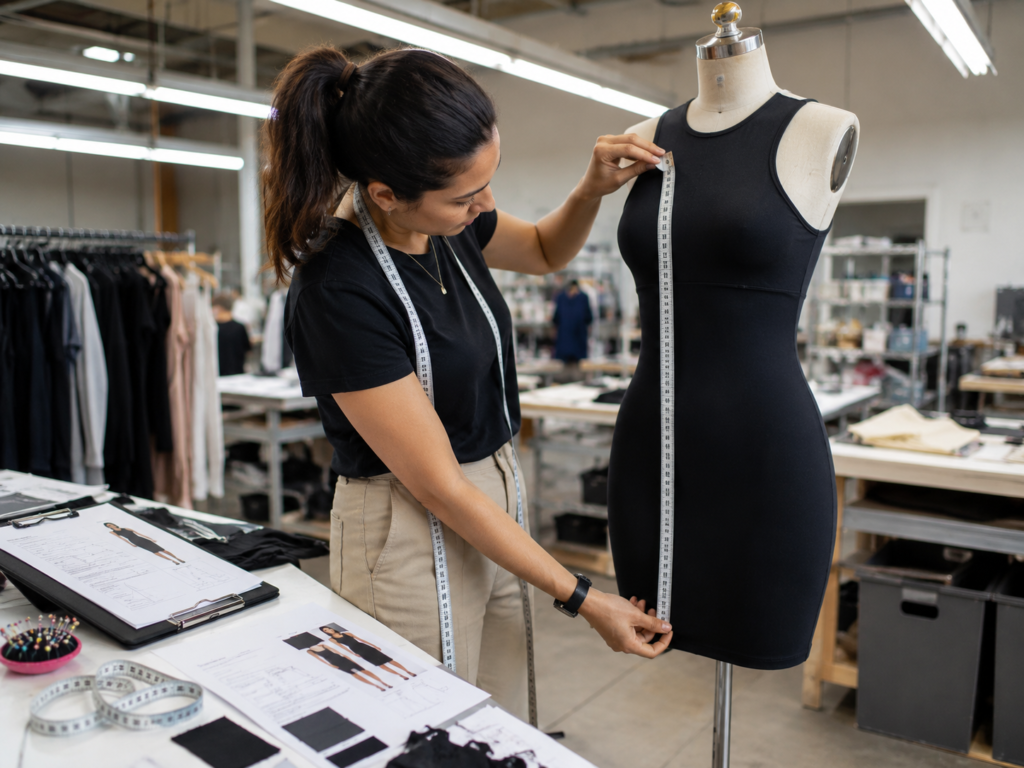
A dress tech pack must include a full POM (Point of Measurement) sheet, size grading rules, and tolerance ranges for each measurement. These ensure consistent fit across sizes, reduce sampling deviations, and prevent production inconsistencies. Without structured measurement standards, even accurate samples cannot scale reliably into bulk production.
What is a standard POM (Point of Measurement) sheet?
A POM sheet is the most critical element for controlling garment fit. It defines exactly where and how each measurement is taken, ensuring every factory follows identical rules.
For dresses, a standard POM sheet typically includes:
Core body measurements
- Bust (full circumference at apex point)
- Waist (natural waist or design waistline)
- Hip (fullest point, usually 18–22 cm below waist)
- Shoulder width (edge to edge across back)
- Back length (neck point to waist or hem)
- Front length (shoulder to hem)
Garment-specific measurements
- Dress length (center back to hem or shoulder to hem)
- Strap length (if applicable)
- Sleeve length (shoulder point to cuff or hem)
- Armhole circumference
- Hem opening width (A-line or flare dresses)
In production practice, measurement definition errors account for nearly 30–40% of first-sample revisions. A common example is dress length confusion: some factories measure from shoulder point, others from center back neck. A deviation of just 2 cm can significantly change silhouette balance in mini or midi dresses.
A professional POM sheet must also include a measurement diagram. Without visual marking, even correctly written values can be interpreted differently by different pattern makers.
How should grading rules and size charts be defined?
Grading rules define how a base size expands or reduces across the size range. Without clear grading logic, size inconsistency becomes one of the most common production issues.
A structured grading system typically includes:
Standard grading increments (example for woven dresses):
- Bust: +2 cm per size step
- Waist: +2 cm per size step
- Hip: +2.5 cm per size step
- Shoulder: +0.5 cm per size step
- Length: +1–1.5 cm per size step (depending on design)
For stretch dresses, grading is adjusted differently:
- Bust: +1.5–2 cm
- Waist: +1.5–2 cm
- Hip: +2 cm
- Reduced tolerance on length to maintain proportion
In real production environments, inconsistent grading rules can lead to fit drift across sizes. For example, a size M dress may fit correctly, but size XL may become disproportionally tight in hip or overly loose in waist due to non-linear grading.
A proper tech pack should also define size range coverage:
- Standard fashion range: XS–XL (5 sizes)
- Extended range: XXS–3XL (7–9 sizes)
Each range requires different grading logic depending on target market body proportions.
Are tolerance ranges necessary before sampling?
Tolerance ranges are essential to define acceptable deviation limits in both sampling and bulk production. Without tolerance standards, even minor measurement differences can cause unnecessary rejection of otherwise acceptable samples.
Common industry tolerance benchmarks:
Woven dresses
- Bust: ±1 cm
- Waist: ±1 cm
- Hip: ±1.5 cm
- Length: ±1–2 cm
Stretch dresses
- Bust: ±1.5 cm
- Waist: ±1.5 cm
- Hip: ±2 cm
- Length: ±2 cm
Tolerance must reflect fabric behavior. Stretch fabrics naturally absorb measurement variation, while woven fabrics require stricter control.
In production practice, unclear tolerance definition increases sample rejection rates by approximately 20–35%, not due to actual quality issues, but due to expectation mismatch.
Tolerance ranges also play a key role in bulk inspection. During final QC, garments are randomly checked. Without defined tolerance, inspection becomes subjective, leading to inconsistent acceptance decisions across batches.
How do measurement errors impact fit consistency?
Measurement errors rarely appear in isolation. They accumulate across multiple points, creating compound fit distortion.
For example:
- Waist deviation: +1.5 cm
- Hip deviation: +2 cm
- Length deviation: +2 cm
Individually acceptable, but together they change silhouette perception significantly.
In fitted dresses, even a 2 cm waist shift can:
- Alter body contour alignment
- Change tension distribution across seams
- Affect drape balance at hem
In structured garments like corset dresses, measurement drift can also impact:
- Boning placement alignment
- Bust support effectiveness
- Closure stress points
This is why measurement precision is treated as a structural requirement rather than a reference guideline.
What measurement system improves production stability?
A stable measurement system is built on three layers:
1. Base size definition
One standardized sample size (usually size S or M) used as the reference point for all grading.
2. Controlled POM mapping
Every measurement tied to a visual diagram, not just text.
3. Locked grading logic
No free interpretation allowed during production stage.
When these three layers are applied, sampling deviation rates typically drop by 30–50%, and size consistency across bulk production improves significantly.
In practical production environments, this system is what separates experimental sampling from scalable manufacturing.
How Should Fabric and Trim Information Be Specified?
A dress tech pack must specify fabric composition, weight (GSM), stretch level, weave type, and approved color standards, along with detailed trim information such as zippers, buttons, linings, and labels. Clear material specification ensures consistent garment handfeel, structure, durability, and color accuracy across sampling and bulk production stages.

What fabric details must be included?
Fabric specification is one of the most decisive factors in dress development because it directly determines silhouette, drape, comfort, and cost stability.
A complete fabric specification should include:
1. Fabric composition
- Polyester / cotton / viscose / nylon / spandex ratio
- Example: 95% polyester + 5% elastane
- Natural fiber blends must specify origin when relevant (cotton combed, viscose rayon, etc.)
2. Fabric weight (GSM)
GSM determines thickness, structure, and seasonal suitability:
| Fabric Weight Level | GSM Range | Typical Fabrics | Effect on Garment |
|---|---|---|---|
| Lightweight | 80–130 GSM | Chiffon, georgette | Creates soft drape and fluid movement |
| Mid-weight | 130–180 GSM | Satin, crepe | Balanced structure with soft flow |
| Heavy Structured | 180–260 GSM | Jacquard, bonded fabrics | Strong silhouette and defined shape |
A variation of 20–30 GSM can significantly change drape behavior.
For example, satin at 120 GSM creates fluid movement, while 160 GSM produces a more structured and controlled silhouette.
3. Fabric stretch ratio
Stretch level must be clearly defined:
| Stretch Level | Stretch Range | Fabric Behavior | Application Result |
|---|---|---|---|
| No Stretch | 0–3% | Stable woven structure | Sharp silhouette, minimal flexibility |
| Low Stretch | 5–10% | Slight flexibility | Comfortable fit with stable shape |
| Medium Stretch | 10–25% | Balanced elasticity | Common for fitted dresses |
| High Stretch | 25–40% | Strong elasticity | Bodycon and performance wear fit |
4. Fabric structure type
- Woven (structured dresses, formalwear)
- Knit (bodycon, stretch dresses)
- Mixed construction (woven + stretch panels)
Fabric structure affects seam choice, fit behavior, and production method.
5. Fabric finishing
- Brushed / sand-washed / mercerized / coated / pleated
- Finishing affects softness, shine level, and durability
Without finishing definition, factories may deliver inconsistent texture results even with identical fabric composition.
Which trims and accessories should be listed clearly?
Trim specification is often underestimated, yet it directly influences garment function, durability, and perceived quality.
A complete trim list should include:

1. Zippers
- Type: invisible / metal / nylon coil
- Length: precise measurement (e.g., 22 cm center back)
- Brand: YKK / SBS / generic
- Color match standard: fabric-matched or contrast
In production practice, incorrect zipper specification is responsible for approximately 10–15% of sampling revisions in fitted dresses.
2. Buttons and fasteners
- Size (e.g., 10 mm, 15 mm)
- Material (resin, metal, shell)
- Placement spacing (typically 6–9 cm intervals)
- Quantity per garment
Even small button size variations change garment visual balance significantly, especially in front-opening dresses.
3. Lining materials
- Composition (polyester, viscose, stretch knit)
- GSM range (60–120 GSM typical)
- Coverage (full lining / partial lining / bust-only lining)
Lining directly affects comfort and opacity. For lightweight chiffon dresses, lining GSM must be carefully controlled to avoid heaviness or transparency issues.
4. Elastic components
- Width (e.g., 1 cm, 2 cm, 3 cm)
- Stretch recovery rate (≥85% recovery standard in premium garments)
- Placement zones (waist, shoulder straps, back smocking)
Poor elastic specification leads to shape distortion after repeated wear.
5. Labels and branding elements
- Main label (woven or printed)
- Care label (fabric content + washing instruction)
- Size label (S/M/L or numeric sizing)
- Placement position (center back neckline, side seam, etc.)
Label positioning affects wearer comfort and brand presentation. Misplacement often results in customer dissatisfaction even if garment quality is high.
How do color standards and lab dips control production accuracy?
Color consistency is one of the most sensitive elements in dress manufacturing. Without strict standards, fabric batches may vary significantly across production runs.
Key color control systems include:
1. Pantone reference system
- Standard color code must be provided (e.g., Pantone 19-4052 TCX)
- Separate codes required for fabric, trims, and lining if needed
2. Lab dip approval process
Lab dips are small dyed fabric samples used to confirm:
- Color accuracy under natural and artificial light
- Fabric absorption behavior
- Color fastness compatibility
Typical lab dip approval tolerance:
- ΔE ≤ 1.0–1.5 (industry acceptable range for fashion garments)
3. Fabric batch consistency control
Even approved colors can vary between production batches. A professional system requires:
- Batch dyeing control records
- Fabric roll matching system
- Color continuity checks during cutting stage
Without these controls, bulk production may result in visible shade differences between garments.
Why does fabric-trim mismatch cause production failure?
Fabric and trim compatibility directly impacts garment stability and visual coherence.
Common mismatch cases include:
- Heavy metal zipper used on lightweight chiffon dress → causes drape distortion
- Thick elastic in thin fabric → creates visible bulking
- Glossy trim on matte fabric → visual inconsistency
In production environments, approximately 25–35% of early sampling issues are linked to incorrect material pairing rather than sewing quality.
A well-structured tech pack eliminates this risk by locking material combinations before sampling begins.

What material specification system improves production stability?
A stable material system relies on three locked layers:
1. Approved fabric code system
Each fabric linked to:
- GSM
- composition
- supplier reference
- color standard
2. Trim master list
Each trim pre-approved with:
- exact specification
- supplier source
- compatibility rule
3. Substitution restriction rule
No material substitution allowed without written revision approval
When this system is applied, sampling deviation caused by materials can drop by 40–60%, and first-sample accuracy improves significantly.
Do Production and Quality Instructions Need to Be Included?
Production and quality instructions are essential in a dress tech pack because they define how garments must be sewn, finished, inspected, and packaged. These instructions remove ambiguity during manufacturing, ensure consistent quality across batches, and align factory output with expected construction standards and retail presentation requirements.
What stitching and construction requirements should be clarified?
Stitching specifications directly determine garment durability, elasticity, and appearance. Without clear instructions, factories may default to cost-saving methods that reduce product quality.
Key stitching parameters should include:
1. Stitch type definition
- Single needle stitch: used for lightweight woven dresses
- Double needle stitch: used for reinforcement areas such as hems and armholes
- Overlock stitch: standard for knit and stretch fabrics
- Flatlock stitch: used for sportswear or high-comfort seams
For example, bodycon dresses typically require 4-thread overlock with reinforced side seams to maintain stretch recovery above 85%.
2. Stitch density control
| Fabric Type | Stitch Density (SPI) | Performance Impact |
|---|---|---|
| Lightweight fabrics | 12–14 stitches per inch | Fine appearance, smooth seam finish |
| Medium fabrics | 10–12 stitches per inch | Balanced strength and flexibility |
| Heavy fabrics | 8–10 stitches per inch | Strong seam structure for durability |
Lower stitch density can reduce durability by up to 20–30% in high-stress areas such as waist seams and armholes.
3. Seam allowance specification
| Garment Type | Seam Allowance Range | Functional Purpose |
|---|---|---|
| Basic woven dresses | 1.0–1.5 cm | Standard construction balance for shaping and assembly |
| Structured garments | 1.5–2.0 cm | Extra allowance for shaping, pressing, and reinforcement |
| Stretch garments | 0.6–1.0 cm | Prevents bulk while maintaining elasticity and recovery |
Incorrect seam allowance is one of the main causes of fit deviation during first sampling, especially in fitted waist areas where a 1 cm difference can significantly affect silhouette balance.
How are washing, finishing, and labeling instructions defined?
Finishing instructions determine final garment appearance and stability after production.
1. Washing treatment requirements
Common finishing processes include:
- Pre-washing (to stabilize shrinkage before cutting)
- Enzyme wash (softening surface texture)
- Stone wash (vintage effect for denim or textured fabrics)
- Steam pressing (final shape stabilization)
Shrinkage control is critical. Standard tolerance after washing should be:
- Woven dresses: ≤3% shrinkage
- Knit dresses: ≤5% shrinkage
Without pre-defined washing standards, garment dimensions may shift significantly after first wash, affecting fit consistency.
2. Ironing and shaping standards
Final pressing defines garment presentation quality:
- Flat press for structured dresses
- Mold pressing for curved seams
- Steam finishing for delicate fabrics like chiffon or silk blends
Incorrect pressing temperature can cause fabric damage or unwanted shine marks, especially on synthetic satin fabrics above 120°C.
3. Label placement and specification
Labeling must be precisely defined to avoid production inconsistency:
- Main label position: center back neckline or inner side seam
- Care label: left side seam, 10–15 cm from hem
- Size label: adjacent to main label or care label stack
Label material types:
- Woven label (premium positioning)
- Printed satin label (comfort-focused)
- Heat transfer label (minimal irritation)
Label errors account for approximately 8–12% of production rejection cases in bulk inspection due to regulatory compliance issues in US and EU markets.
What packaging and QC expectations should be set before sampling?
Packaging and QC instructions define how garments are handled after production and how quality is evaluated before shipment.
1. Packaging standards
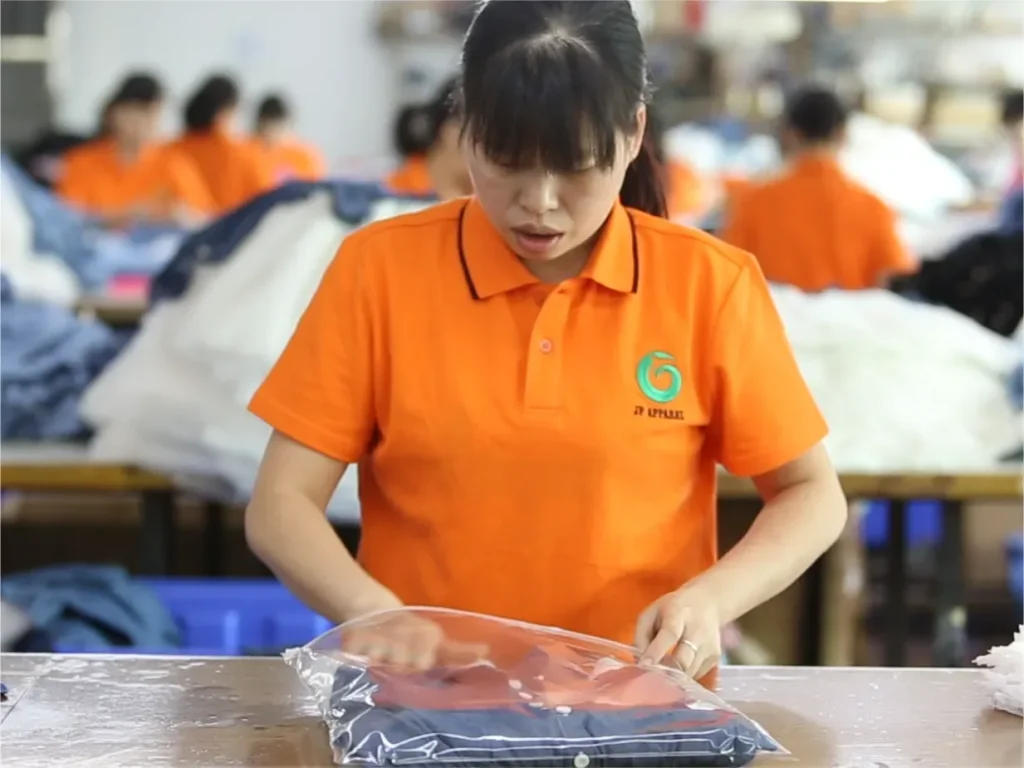
Packaging must be defined at both unit and carton level:
Individual packaging
- Polybag thickness: 0.03–0.05 mm standard
- Folding method: flat fold or hanger fold
- Moisture protection: silica gel inclusion for humid regions
Carton packaging
- Carton strength: 5-layer corrugated standard
- Weight limit: 15–20 kg per carton
- Size ratio control to prevent deformation during transport
Incorrect packaging increases return rates by 5–10% in ecommerce fulfillment due to wrinkling or damage during transit.
2. Quality inspection standards (AQL system)
AQL standards define acceptable defect levels:
- Critical defects: 0% tolerance
- Major defects: 2.5% standard acceptance level
- Minor defects: 4.0% acceptable threshold
Inspection typically includes:
- Measurement accuracy check
- Stitching quality review
- Fabric defect inspection (holes, stains, weaving issues)
- Color consistency under D65 lighting
Without AQL definition, inspection results vary significantly between teams, leading to inconsistent approval decisions.
3. Defect classification system
Clear defect classification improves production control:
- Critical: safety or usability failure (broken zipper, incorrect size labeling)
- Major: visible defect affecting appearance (misaligned seams, uneven hem)
- Minor: small aesthetic issue (loose thread, slight shading variation)
A structured classification system reduces dispute rate during final inspection by approximately 30–40%.
Why do production and QC instructions directly impact scalability?
Sampling is only the first stage. Without production and QC standards, consistency breaks during bulk manufacturing.

Key scalability risks include:
- Variation in stitching quality across different production lines
- Fabric inconsistency between dye batches
- Packaging differences affecting retail presentation
- Size drift across repeated production runs
When production instructions are fully standardized, batch-to-batch deviation can be reduced by 35–60%, making scaling from sample to thousands of units predictable and stable.
conclusion
If a brand is preparing to move from concept to sampling, the quality of the tech pack will directly determine the success of the first sample and the speed of production rollout.
Jinfeng Apparel supports global fashion brands with full OEM/ODM dress development, from tech pack refinement to sampling and bulk production. With over 28 years of manufacturing experience and a complete in-house development system, technical gaps can be minimized before sampling begins.
For brands preparing new dress collections, submit your sketches, reference images, or draft tech packs to Jinfeng Apparel to begin structured sampling development with production-ready accuracy.