Skip to content

Two rolls of sequin fabric can look almost identical in a sourcing photo and behave completely differently once they become dresses. One may create a light floral surface with visible mesh between motifs; another may cover almost every part of the cloth with reflective discs, adding weight, stiffness, seam bulk, and a very different kind of movement. That is why choosing between embroidered sequin fabric and all-over sequin fabric cannot be reduced to deciding which swatch looks more luxurious on a hanger. The better choice depends on how the material behaves after cutting, sewing, lining, fitting, pressing, packing, and repeated wear.
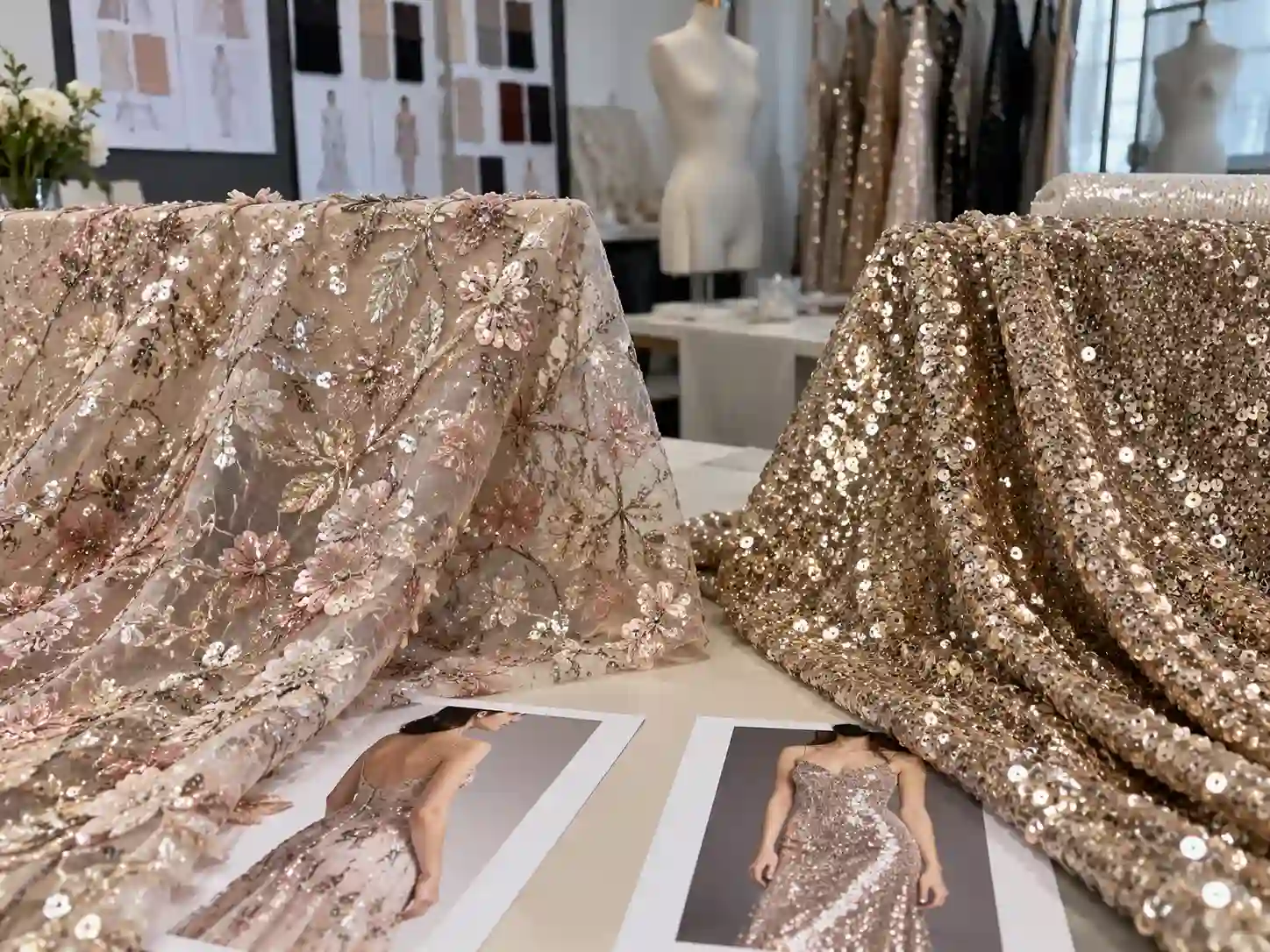
Embroidered sequin fabric is usually the stronger option when a dress needs visible motifs, controlled sparkle, negative space, or deliberate decorative placement, while all-over sequin fabric is often better when the design depends on continuous shine and strong visual coverage. The final choice still depends on backing fabric, sequin density, stretch, garment weight, lining, seam treatment, target cost, and whether the material can be reproduced consistently in bulk production.
The difference often becomes obvious only during sampling. A fabric that looks spectacular as a small swatch can pull a strapless neckline downward, make an invisible zipper bulky, scratch the underarm, or distort a bodycon pattern once the full garment is assembled. Experienced dress development therefore starts with the finished silhouette and works backward to the fabric. The following comparison looks at sequin material the way a product developer, pattern maker, sewing technician, sourcing team, quality inspector, and brand team need to see it before committing to production.
What Is the Difference Between Embroidered and All-Over Sequin Fabric?
Embroidered sequin fabric usually uses sequins to create defined motifs, lines, florals, or controlled decorative areas, while all-over sequin fabric emphasizes continuous or very dense surface coverage. The terms are not always mutually exclusive because an all-over design can also be embroidered. For dress development, sequin density, backing fabric, repeat, direction, stretch, weight, and attachment method are more useful specifications than the fabric name alone.
What Is Embroidered Sequin Fabric?
Embroidered sequin fabric is built around a planned decorative structure. Sequins may follow floral vines, geometric lines, waves, abstract motifs, borders, gradients, or scattered arrangements instead of covering every part of the ground fabric equally. Mesh and tulle are common bases because the open background allows the embroidery to stand out, although sequins can also be applied to knitted, woven, velvet, lace, or stretch foundations. The important point is that the embellishment has a deliberate relationship to the pattern rather than functioning as a uniform reflective surface.
Its biggest advantage is visual control. A designer can use embellishment to frame the bust, emphasize the waist, create vertical movement through a gown, or leave transparent spaces between decorative motifs. That makes embroidered sequin fabric especially useful when the surface design contributes directly to the silhouette. The trade-off is placement sensitivity. Once a recognizable motif exists, cutting can no longer be treated as though the cloth were visually uniform, because poor placement can make a technically well-sewn garment look unbalanced.
Before production, the fabric should be reviewed for horizontal repeat, vertical repeat, border position, motif direction, usable width, embroidery density, and whether the design needs left-right symmetry. A large flower centered poorly across the bust, a curved embroidery line cut off at the neckline, or a repeated motif that breaks abruptly at a side seam can be obvious in finished photography. Those decisions affect marker making, cutting efficiency, and fabric consumption before the sewing line is even considered.
What Is All-Over Sequin Fabric?
All-over sequin fabric is defined primarily by coverage. Sequins are distributed across most or nearly all of the usable surface, creating a continuous reflective appearance. The layout can still contain rows, waves, geometric patterns, overlaps, reversible sequins, gradients, or directional effects, but the garment is visually read as a full sequin surface rather than a base fabric decorated with isolated motifs. This construction is common in party dresses, holiday capsules, evening styles, fitted minis, performance-inspired fashion, and statement jumpsuits where shine is one of the main selling features.
The technical behavior still depends heavily on what sits underneath the sequins. An all-over sequin mesh may be relatively open and flexible, while an all-over sequin jersey can provide greater body stretch. A densely stitched construction can reduce the stretch of an otherwise elastic base because the embroidery thread network restricts extension. Two materials that suppliers both call “all-over sequin” can therefore behave very differently once the pattern is cut and put under tension on the body.
A sourcing description such as “black all-over sequin fabric” is not precise enough for production. A useful specification should also identify the backing, usable width, stretch direction, surface direction, sequin size or shape when relevant, approximate fabric weight, transparency, repeat, color effect, and intended garment. These details reduce the chance of approving a visually attractive fabric that later proves too heavy, too rigid, too transparent, or too difficult to sew into the planned dress.
Are Embroidered and All-Over Sequins Mutually Exclusive?
They are not necessarily mutually exclusive. “Embroidered” usually describes the application or decorative construction, while “all-over” describes how much of the surface is covered. An all-over surface can therefore be created through embroidery, which means the same fabric may reasonably fit both descriptions. Commercial fabric names are often merchandising shorthand rather than technical standards, so development teams should compare measurable characteristics instead of assuming that supplier terminology is consistent from one mill or market to another.
For practical dress development, it is often more useful to compare pattern-led sequin fabric with dense continuous sequin fabric. The first usually places more importance on motif position, open ground, visual balance, and repeat matching. The second usually places more importance on coverage, total weight, seam thickness, surface direction, and continuous reflection. Both categories can create excellent garments, and both can create expensive production problems when the backing and the dress structure are poorly matched.
| Development Point | Patterned Embroidered Sequin | Dense All-Over Sequin |
| Surface coverage | Partial to high | High to nearly continuous |
| Ground fabric visibility | Usually more visible | Usually less visible |
| Motif repeat | Often critical | May be minor or critical |
| Placement control | High | Medium to high |
| Visual effect | Detailed and dimensional | Strong, continuous shine |
| Direction sensitivity | Common | Common |
| Seam-bulk risk | Localized or variable | Often more consistent and higher |
| Cutting flexibility | Reduced by motif placement | Reduced by direction or density |
| Main development question | Where should motifs sit? | Can the garment handle the coverage? |
How Does Coverage Change the Fabric?
Adding more sequins changes much more than appearance. Coverage can affect weight, flexibility, air permeability, surface friction, seam thickness, cutting loss, needle contact, packing behavior, and total garment cost. A design team should therefore treat coverage as an engineering variable as well as a decorative choice. The effect becomes more obvious as garment area increases, because a dense material that feels manageable in a small swatch may become demanding when used for long sleeves, a full-length skirt, a train, or a heavily fitted bodycon shape.
Coverage also changes the way other design details read. Fine ruching may disappear visually under a highly reflective surface, while small darts or multiple style lines can create bulky joins without adding much visible value. On a motif fabric, open areas may fold easily while heavily embroidered zones resist compression, producing uneven drape. The most successful material is therefore not automatically the one with the greatest sparkle; it is the one whose surface effect, silhouette, construction, comfort, and production repeatability work together.
How Do They Differ in Look, Weight, Drape, and Stretch?
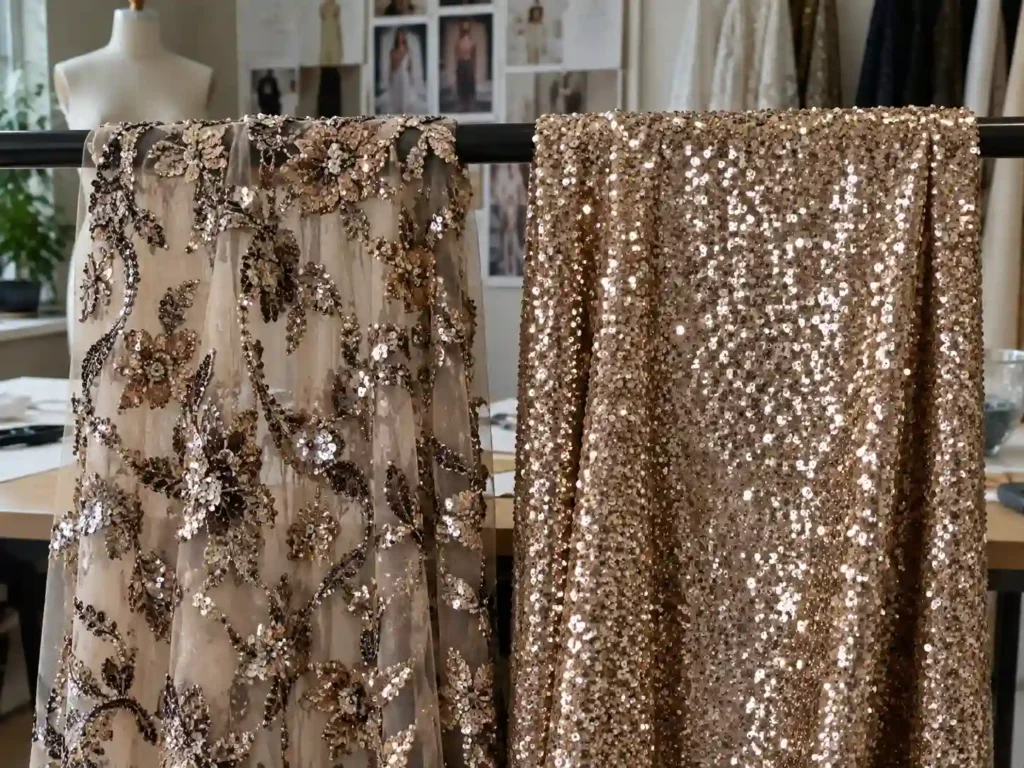
Embroidered sequin fabric usually offers more visible pattern and negative space, while dense all-over sequins create stronger continuous reflection. Weight and drape depend on sequin density and the backing, not the category name alone. Stretch must be measured on the finished embellished fabric because embroidery threads and dense sequin coverage can significantly reduce the extension available in the original mesh or knit base.
How Does Each Fabric Reflect Light?
Patterned embroidered sequins create variation between reflective areas and exposed ground fabric. This contrast gives the surface more depth because the eye reads both the motif and the sparkle. A floral embroidery on fine mesh may flash strongly along the stitched areas while the transparent spaces remain quieter. As the wearer moves, individual motifs catch light at different moments, which can make the dress feel more dimensional and visually detailed than a uniformly reflective surface.
All-over sequins create a broader field of light. Instead of directing attention toward individual motifs, they turn most of the garment into a reflective surface. This is particularly effective for evening photography, party settings, stage-oriented fashion, and short-form social media where the product needs to register immediately. However, stronger reflection is not always better. Dense shine can visually flatten small pleats, subtle ruching, narrow panel lines, or other construction details that would normally add depth to a plain fabric.
Sequin size and finish further change the result. Smaller sequins usually create a finer texture, while larger discs produce more obvious flashes and stronger movement. Matte, metallic, transparent, iridescent, holographic, and two-tone finishes respond differently under the same light. Direction should also be checked carefully because aligned sequins can reflect differently when a panel is reversed. A useful sample review therefore includes front light, side light, movement, camera flash, and the actual lining color planned for the garment.
Which Sequin Fabric Is Heavier?
Dense all-over constructions often feel heavier because more decorative material is attached to every square meter, but exact weight varies too much to judge from category names alone. The safer approach is to request or measure finished fabric weight and then estimate how much embellished area the garment actually uses. This turns a vague statement such as “the second fabric feels heavier” into a measurable development issue that can be compared with strap width, neckline structure, zipper construction, and total garment length.
Consider an illustrative calculation. If a finished embellished fabric measures 250 g/m² and the outer shell uses approximately 2.1 m² of cloth, the shell contributes about 525 g before lining, zipper, thread, pads, boning, labels, or other trims are added. If another fabric measures 350 g/m² at the same area, the shell rises to about 735 g. Those figures are examples rather than universal sequin standards, but they show how a difference that feels modest on a swatch becomes more important across a complete dress.
Weight should always be considered together with support points. Shoulder seams, narrow straps, bust edges, waist seams, and zipper tape may carry substantial load in a long or densely embellished garment. A strapless design is particularly sensitive because the garment cannot transfer weight through shoulder straps. A full-length evening dress made from the same material as a successful mini may therefore need a completely different internal structure, even when both garments share the same visual concept.
How Does the Backing Affect Drape?
The backing determines much of the fabric’s fundamental behavior. Soft mesh can allow embroidered areas to move independently and create a lighter, more fluid drape. A stable woven ground can hold a sharper shape. Jersey can provide softer fall and easier body movement, while power mesh can offer firm stretch and recovery. Once sequins and embroidery threads are added, these base characteristics remain important, but the embellishment may stiffen specific zones or change how evenly the fabric responds to folding and tension.
This matters for ruching, gathering, pleating, knots, twists, and draped necklines. A pattern developed in plain stretch mesh may form fine, smooth folds, while the same pattern cut from densely embroidered sequin mesh can bunch unevenly because the embellished zones resist compression. Patterned fabrics can be especially unpredictable when a seam crosses repeatedly between open mesh and heavily stitched motifs, since the thickness and flexibility change along the same sewing line.
A useful sample review separates three observations: how the fabric hangs freely, how it behaves when folded or gathered, and how it reacts when stretched over the body. Those tests often reveal more than simply touching the cloth on a sourcing table. Drape should also be checked over the intended lining, because a soft lining, firm lining, or double-layer construction can change the final movement of the dress considerably.
How Does Stretch Change After Embellishment?
Never rely only on the stretch specification of the unembellished backing. Once sequins are stitched to mesh or knit, the embroidery thread network can restrict extension and change recovery. Two fabrics built on similar stretch bases may therefore perform very differently. This becomes critical in bodycon dresses, fitted sleeves, jumpsuits, or narrow skirts where the garment depends on controlled extension through the bust, hip, seat, and movement areas.
A simple development measurement can be calculated as: Stretch % = (extended length – original length) ÷ original length × 100. If a marked 10 cm section extends comfortably to 12 cm without damaging the embellishment, the measured extension is 20%. The sample should then be released and checked for recovery. If it remains noticeably longer or the sequin rows distort after repeated extension, the material may not be suitable for a style that depends on close fit and repeated movement.
Record crosswise stretch, lengthwise stretch, bias behavior, recovery, visible spacing between sequins, puckering after release, and whether embellishments catch each other during movement. A supplier may call a fabric “stretch sequin,” but the garment experiences the finished embellished construction, not the original backing before embroidery. The most useful specification is therefore measured on the exact fabric lot being considered for sampling rather than borrowed from a generic material description.
Which Sequin Fabric Is Best for Different Dress Styles?
Patterned embroidered sequin fabric is usually a stronger starting point when motif placement, transparency, layered detail, or controlled embellishment is central to the design. Dense all-over sequins are often better when continuous sparkle defines the garment. The final choice should account for silhouette, stretch, garment length, support structure, lining, zipper placement, comfort, target price, and how consistently the fabric can be reproduced.
Which Is Better for Bodycon Dresses?
A bodycon dress places the fabric under continuous tension, particularly across the bust, waist, seat, and hip. This makes stretch recovery more important than surface appearance. A dense all-over sequin construction can work very well when the backing provides adequate crosswise extension and the embroidery does not lock the fabric. The garment should be fitted at realistic body measurements because a fabric that looks uniform while relaxed may open into visible gaps or distort its rows once stretched across the body.
Patterned embroidered mesh can also work effectively over a stretch lining or support layer. This arrangement allows the outer layer to carry the decorative effect while the inner construction provides opacity, recovery, and some fit control. The two layers must be compatible, however. A rigid outer layer over a highly elastic lining can restrict movement, while an excessively loose outer layer can shift independently and create rippling, twisting, or uneven motif placement after wear.
For fitted styles, attention should go to side seams, center-back zipper areas, armholes, neckline edges, underarms, and hems. These are the points where sequin thickness and exposed edges are most likely to affect comfort. The dress should also be tested after sitting and moving, not only during the first standing fit, because recovery problems often become visible after the fabric has remained extended for several minutes.
Which Is Better for Mini and Party Dresses?
Dense all-over sequin fabric is a natural choice for many party minis because it creates a clear visual message without requiring complicated pattern work. Straight minis, fitted tanks, halter dresses, one-shoulder styles, and simple long-sleeve silhouettes can rely on the surface itself to create impact. This can be commercially useful when the collection needs a strong evening look but the garment should remain visually clean and easy to understand in ecommerce photography.
Patterned embroidered sequins become especially useful when a mini dress includes transparent zones, corset panels, shaped cups, asymmetric motifs, or decorative placement. Leaving parts of the mesh visible can create more visual depth than covering the entire garment uniformly. It can also make the embellishment feel more intentional because the eye sees a pattern rather than a solid block of shine. The trade-off is that pattern placement and symmetry require more control during cutting.
| Dress Type | Useful Starting Construction | Key Technical Check | Main Risk |
| Stretch bodycon mini | Stretch all-over sequin | Crosswise stretch and recovery | Restricted movement |
| Corset mini | Embroidered mesh or controlled sequin | Bodice support and seam bulk | Thick shaped seams |
| Holiday party mini | Dense all-over sequin | Weight and edge comfort | Scratchy neckline or armhole |
| One-shoulder dress | Either construction | Load on single shoulder | Garment pulling |
| Long-sleeve mini | Stretch sequin | Elbow and arm movement | Sleeve restriction |
| Sheer-panel party dress | Embroidered mesh | Motif placement and lining | Misaligned transparency |
The table is a useful starting point rather than a fixed formula. A stretch all-over fabric can still fail in a bodycon dress if its recovery is weak, while an embroidered mesh can work beautifully in a corset mini if the motif is planned around the shaped seams. The design team should always confirm the material through an actual garment sample rather than approving from swatches or supplier photographs alone.
Which Is Better for Evening and Prom Dresses?
Long evening and prom dresses magnify every property of the fabric. More garment area means more total decorative weight, greater cumulative material cost, more opportunities for motif mismatch, and more surface that can be damaged during sewing, finishing, or packing. Embroidered sequin fabric often suits gowns where the pattern contributes to the visual line, while all-over sequins are effective when the design is based on a continuous metallic or reflective surface.
Large embroidered motifs can create vertical movement and help guide the eye through a long silhouette. Concentrated embellishment can also highlight a bodice while allowing a softer or more transparent skirt below. Dense all-over fabric suits cleaner gown patterns because the material already provides strong visual information. Adding too many seams, pleats, or tiny design details under continuous reflection can increase construction difficulty without improving the finished appearance enough to justify the extra labor.
Total garment weight should be checked early. A material that works beautifully for a short mini may feel very different when used in a 140-150 cm long gown with sleeves or a fuller skirt. Narrow straps, off-shoulder edges, and strapless bodices should not be expected to support that weight without appropriate internal structure. Hem behavior also matters because dense sequins can make a skirt fall more vertically, while open embroidered mesh may move more softly.
How Should You Choose for a New Design?
Start with the garment requirements rather than a favorite fabric photograph. Define whether the style is fitted, semi-fitted, or loose; whether it depends on stretch; whether transparent areas are intentional; whether motifs need controlled placement; how long the garment is; whether sleeves are fitted; how the neckline is supported; and where the zipper will sit. These questions quickly separate visually attractive fabrics from materials that are technically appropriate for the intended silhouette.
The same reasoning should include the commercial plan. A heavily embroidered material may be perfect for a premium occasion dress but too inefficient for a price-sensitive mini if every panel requires precise motif matching. A dense all-over construction may create excellent impact for a holiday capsule but become uncomfortable or unnecessarily heavy if the style has long sleeves and extensive ruching. Fabric choice becomes easier when appearance, fit, construction, target cost, and expected production quantity are evaluated together.
For custom development, a useful starting package includes a tech pack or clear reference, target silhouette, size range, intended market, preferred color direction, target surface effect, approximate order plan, and any fabric limitations already known. When those inputs are clear, a manufacturer can compare actual fabric options against the garment rather than sending random sequin swatches. This usually shortens the path from attractive idea to a sample that can realistically move toward bulk production.

How Do Cutting, Sewing, and Lining Requirements Differ?
Both constructions need more preparation than ordinary dress fabrics. Pattern direction, sequin placement, seam allowances, cutting damage, needle contact, zipper zones, lining, and skin-contact edges must be reviewed before bulk cutting. Patterned embroidery adds motif-matching work, while dense all-over sequins often create more seam thickness. The sewing method should be developed around the sequin size, backing, attachment structure, and garment design.
How Should Sequin Fabric Be Cut?
Direction is one of the first controls. Many sequin surfaces reflect light differently depending on their orientation. If one front panel is reversed, it may appear lighter or darker even though all pieces came from the same roll. The approved direction should therefore be marked on the pattern, marker, and production documentation. This matters not only for obvious reversible sequins but also for small aligned discs whose angle changes the way light travels across the garment.
Patterned embroidered fabrics add motif placement. If the cloth contains noticeable flowers, geometric motifs, borders, or directional lines, important garment areas need planned positioning. Center front, bust, waistline, neckline, sleeve head, and symmetrical left-right panels are common areas where poor placement becomes immediately visible. Marker efficiency cannot be the only objective, because rotating or shifting a panel to save fabric may destroy the visual balance that made the material attractive in the first place.
A production-ready cutting record should include usable width, surface direction, crosswise and lengthwise stretch, repeat dimensions, border position when present, center-front placement, symmetry requirements, approved marker version, and defective-area handling. Dense all-over materials may require fewer motif decisions, but they still need careful layer control because slippery embellished surfaces can shift when stacked too high. Cutting tools also require appropriate maintenance because repeated contact with hard decorative elements can accelerate wear.
How Should Seams Be Sewn?
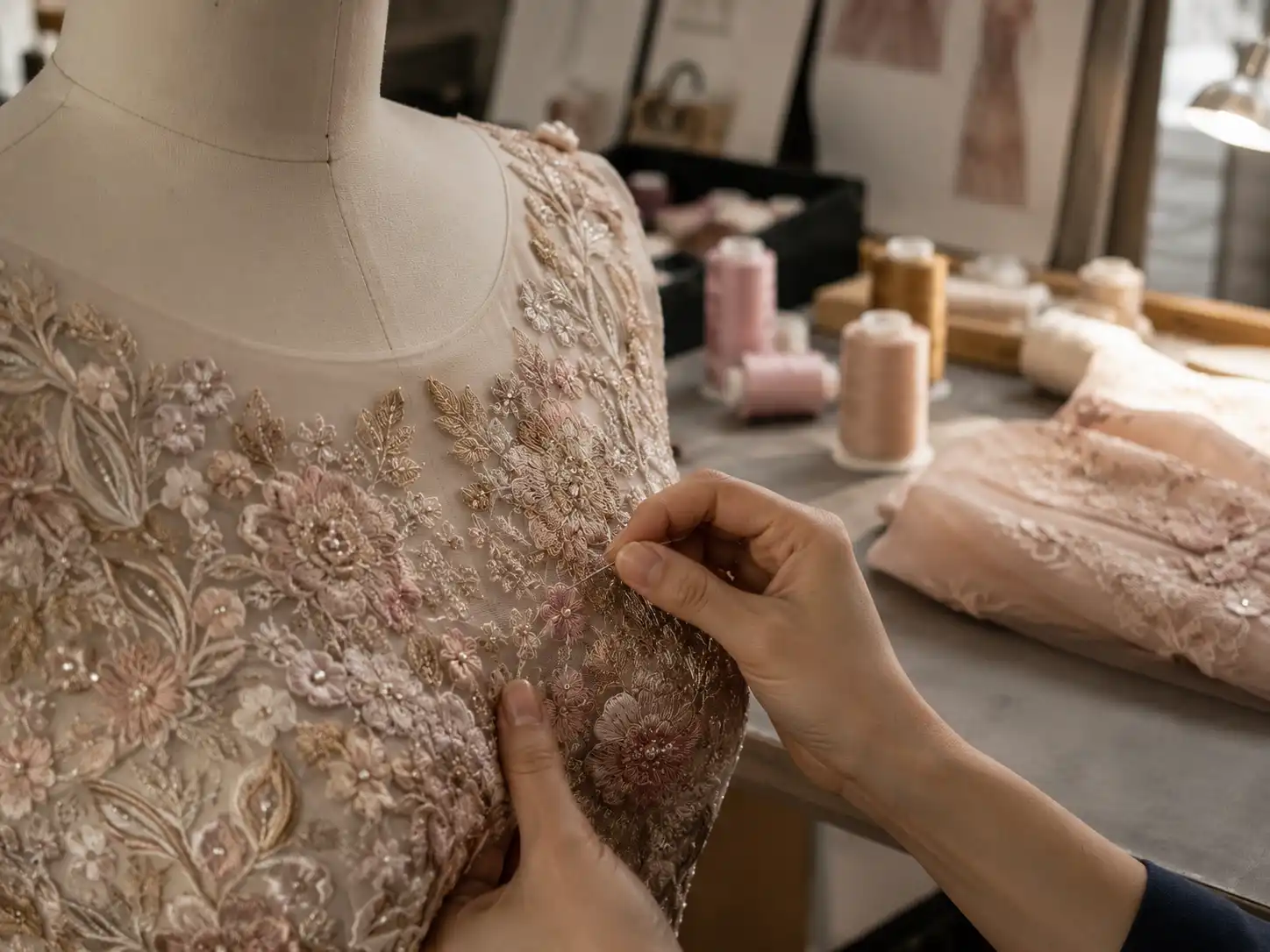
Sequins that fall directly into a stitching path often need special handling. Depending on the construction, they may be moved, trimmed, or removed from the seam allowance so the machine can form a cleaner seam without repeatedly striking hard decorative pieces. The goal is not simply to prevent needle damage. Excess embellishment trapped inside the seam can create ridges, uneven pressing, or a visibly bulky line on fitted garments where the surface is expected to lie smoothly against the body.
High-risk areas include side seams, princess seams, darts, waist joins, shoulder seams, sleeve seams, narrow straps, zipper seams, and shaped bodice panels. Corset-inspired sequin dresses can be particularly demanding because several curved seams may converge within a small area. If each seam carries dense sequin coverage, the finished bodice can become much thicker than the pattern maker expected, changing both fit and the ability to install boning, cups, binding, or internal support cleanly.
Removing sequins must also be controlled. Cutting the wrong embroidery thread can loosen neighboring sequins beyond the intended seam allowance. For that reason, seam preparation should be standardized during sample development rather than improvised by individual operators during bulk production. If visible gaps remain after joining, controlled replacement may be needed in selected areas. That extra work should be recognized during costing instead of being treated as unexpected repair after production has started.
How Should Zippers and Edges Be Handled?
Invisible zippers are common in fitted dresses, but dense sequin fabric can make them difficult. If too much embellishment remains beside the zipper teeth, the slider can catch, the seam can bulge, or the closure may become visibly uneven. The development team should inspect the complete zipper area from both inside and outside, confirming that the zipper moves smoothly, the seam lies flat on the body, nearby embroidery remains secure, and any cleared sequin area does not create an obvious bare stripe.
Edges deserve equal attention because the wearer feels them immediately. Necklines, armholes, shoulder straps, sleeve openings, high slits, and short hems can place hard sequin edges directly against the skin. A dress may photograph beautifully and still become uncomfortable within minutes if the underarm repeatedly rubs against exposed sequins. This is one of the most common differences between a fabric sample that looks premium and a finished garment that actually feels premium.
Possible solutions include removing sequins from the turn line, using a facing, bringing the lining cleanly to the edge, applying a suitable binding, or planning an unembellished margin into the fabric or embroidery design. The correct treatment depends on the garment. A heavy binding may solve abrasion but ruin the appearance of a delicate sheer evening dress, so comfort and visual finish must be developed together rather than treated as separate problems.
Do Sequin Dresses Need Lining?
Many sequin dresses benefit from lining, but the lining should be specified as part of the garment rather than added generically at the end. It provides opacity, separates embroidery threads and sequin backs from the body, improves comfort, and can stabilize the shell. The lining’s stretch, weight, color, length, and attachment method all influence the finished result, especially when the outer fabric is transparent or relies on stretch for fit.
Stretch compatibility is crucial. If the embellished shell can extend by around 20% but the lining is nearly rigid, the wearer experiences the restriction of the lining, not the capability of the shell. Conversely, a very soft or loose lining can crawl upward while the outer layer remains in place. The two layers should therefore be tested together on the body, particularly through the bust, hip, seat, and sleeve areas where movement is greatest.
Color changes the visual effect as well. A nude lining under black embroidered mesh creates a different product from black lining under the same fabric. White, champagne, skin-tone, metallic, and contrast linings can all alter how the sequins and open ground appear. Length must also be checked physically because a short mini lining can ride upward while an overly long gown lining can interfere with walking or show below the shell. A proper fitting should review opacity, stretch, attachment, length, hem movement, neckline coverage, and zipper interaction as one system.
Which Sequin Fabric Is More Cost-Effective for Production?
The more cost-effective fabric is the one that produces the required dress at the lowest reliable finished-garment cost, not necessarily the lowest fabric price per meter. Sequin density, usable width, repeat matching, cutting loss, seam preparation, lining, sewing speed, repair work, QC, and packing can all change the final cost. Patterned embroidery and dense all-over sequins create different cost pressures.
What Drives Sequin Fabric Cost?
Material price begins with the base fabric and the embellishment construction. Sequin size, shape, density, color effect, embroidery complexity, stretch requirement, custom pattern development, backing quality, order quantity, and color quantity can all influence sourcing cost. Usable width is equally important because two fabrics with similar quoted prices per meter may deliver different cutting yield once decorative selvedges, borders, damaged edge areas, or unusable motif zones are removed from the calculation.
A useful first calculation is outer-shell material cost = actual usable consumption × purchase price per meter or yard. That figure is only the starting point. The finished dress also carries lining, trims, special seam preparation, extra cutting care, slower handling, inspection, finishing, packing protection, and possible decorative repair. When these elements are ignored, a cheaper roll can appear attractive during sourcing and then produce a more expensive garment after the sample room exposes the real construction requirements.
A simplified prototype in plain fabric can confirm general proportions, but it cannot reliably prove sequin weight, stretch restriction, seam bulk, surface friction, or zipper behavior. For meaningful costing, the intended sequin fabric or a technically comparable substitute should be introduced before the price is treated as final. This is particularly important for corset dresses, fitted minis, long sleeves, jumpsuits, and gowns where the decorative surface directly affects sewing time and support structure.
How Does Pattern Repeat Affect Consumption?
Large repeats reduce marker freedom because pattern pieces cannot always move to the most fabric-efficient position. If a floral motif repeats every 40 cm vertically, for example, the cutter may be unable to shift the front bodice by 10 or 15 cm if that change places the main flower poorly across the neckline or bust. When left and right panels also need balance, the restriction becomes greater, and the theoretical marker efficiency may no longer reflect what is visually acceptable in the finished garment.
Direction creates another constraint. If all major pieces must face one way, they cannot simply be rotated 180 degrees to fill unused spaces in the marker. This occurs with aligned sequins, gradient layouts, nap-like reflective effects, and obvious embroidered motifs. A small mini with simple panels may still cut efficiently, while a long asymmetric gown from the same material may consume noticeably more cloth because its large pieces and visual placement rules leave fewer options.
A sensible consumption review separates normal marker loss, direction-related loss, motif-matching loss, unusable border or selvedge loss, defective-area allowance, and replacement needs for damaged panels. These should not be assigned an arbitrary percentage across every style. The correct allowance comes from the actual approved fabric, pattern set, size ratio, and marker. Good cost control starts with a realistic cutting plan, not a generic “sequin surcharge” applied to every embellished dress.
How Does Sewing Complexity Affect Cost?
Sequin garments are usually slower to handle than comparable plain-fabric garments because operators may need to clear seam lines, protect machine components, sew through changing thickness, check for loosened sequins, repair decorative gaps, and handle finished panels without scratching or tangling the surface. The difference becomes larger when the pattern contains many seams. A simple slip-style dress uses decorative fabric very differently from a corset dress with shaped cups, princess seams, boning channels, waist panels, and a center-back zipper.
Instead of assuming all sequin garments carry the same sewing difficulty, count the number of high-risk operations. Curved bust seams, narrow straps, invisible zippers, shaped waist joins, lined slits, fitted sleeves, heavily curved necklines, corset panels, hand replacement of missing sequins, and clean finishing around exposed edges all add handling steps. When several of these occur in the same style, the fabric choice and pattern construction need to be reviewed together rather than priced independently.
A patterned fabric may reduce seam clearing in areas where the motif leaves open mesh but require careful placement elsewhere. A dense all-over fabric may reduce motif-matching work but create consistent thickness at almost every seam. Neither construction is automatically cheaper. The more useful question is which option delivers the target appearance with a stable sewing method, acceptable consumption, and a manageable level of rework across the planned production quantity.
How Should Total Production Cost Be Compared?
For larger programs, compare fabrics through the finished garment rather than through isolated meter prices. Start with actual marker consumption and then add style-specific lining, trims, seam preparation, sewing complexity, finishing, inspection, and packing. Color planning also matters because special sequin fabrics can carry their own mill or supplier minimums. Splitting one style into many small colors can make an otherwise sensible material inefficient, even when the garment pattern itself is simple.
Cost reduction is most effective when it removes unnecessary complexity without weakening the intended appearance. Better marker layout, a technically equivalent backing, simplified internal construction, adjusted embellishment density in low-visibility areas, more efficient color consolidation, or a cleaner seam plan can sometimes save more than switching to the cheapest fabric. For established collections, repeatability also has financial value because a fabric that cannot be reproduced reliably can create expensive delays and redevelopment when a successful style needs replenishment.
When discussing a new sequin style with a manufacturer, provide the intended quantity by color, size range, target market, target price position, and the details that cannot change visually. That allows the team to identify where cost can move without damaging the design. A fabric quote becomes much more meaningful once it is connected to actual consumption, pattern complexity, lining, sewing operations, QC needs, and the expected order structure rather than treated as a standalone number.

How Do You Evaluate Sequin Fabric Before Bulk Production?
Approval should happen in stages: inspect the fabric, measure its behavior, make the garment, wear-test the sample, confirm construction, and then define bulk QC standards. Check width, weight, stretch, recovery, repeat, direction, color, transparency, attachment stability, shedding, lining compatibility, seam bulk, zipper performance, comfort, and packing. Bulk production should reference an approved PP or equivalent sealed sample rather than memory or photographs alone.
What Should You Check on a Fabric Swatch?
A swatch is useful only when it is treated as a technical sample rather than a color chip. Record the supplier reference, color code, backing type, composition where confirmed, usable width, surface direction, repeat, sequin type, and stretch direction. Photograph the face and reverse because the back often reveals embroidery density, loose threads, knots, or rough areas that the shiny surface hides. If the fabric is transparent, evaluate it over the intended lining colors instead of against a white table.
For stretch material, mark a known length and measure controlled extension. If a 10 cm section reaches 12 cm comfortably, the measured extension is 20%. Then release it and check whether it returns close to the original length. Repeat the test in the other direction because crosswise and lengthwise behavior can differ substantially. Patterned fabrics should have both horizontal and vertical repeats recorded so the dimensions can enter the marker and consumption discussion before the style is costed.
A larger hanging sample is useful for heavier constructions because a small swatch cannot reveal cumulative drape. It is also sensible to compare the material after gentle folding, repeated handling, and limited controlled stretching to see whether sequins catch, threads loosen, or the backing puckers. The objective is not to create an artificial laboratory threshold but to identify obvious risks early enough that the design can still change without wasting a full garment sample.
How Should Attachment and Surface Stability Be Tested?
Begin with visual examination for missing sequins, loose thread ends, irregular spacing, inconsistent orientation, damaged discs, puckered backing, and areas where the embroidery tension looks different from the surrounding cloth. Then handle the material in ways that resemble actual garment use. Fold it, flex it, rub embellished surfaces lightly against each other, and repeatedly extend stretch constructions within a realistic range. Afterward, inspect whether attachment threads remain secure and whether new gaps or distortions have appeared.
Any formal pull, abrasion, wash, colorfastness, or durability requirement should follow an applicable customer specification or an agreed test method rather than an invented universal threshold. Different sequin structures behave differently, and a test appropriate for a large sewn disc may not suit a fine embroidered paillette. The sample should also be checked after sewing because a material can look stable on the roll but become vulnerable when embroidery threads are cut during seam preparation.
High-contact areas deserve additional attention. Underarms, side seams, sleeve interiors, waist areas, the seat of fitted dresses, the inner thigh of jumpsuits, and high slits experience repeated friction. A surface that begins shedding or catching in those areas can quickly create complaints even when the rest of the garment remains visually perfect. Stability testing therefore needs to reflect where the material will sit on the body, not only how it behaves as an isolated piece of cloth.
How Should the Dress Sample Be Reviewed?
The garment must be worn and moved in. Static mannequin approval misses too many problems because sequin dresses change under body tension and friction. For a fitted style, review bust, waist, hip, neckline, armhole, strap length, garment length, zipper behavior, lining position, and the amount of stretch used at the largest body points. Ask the fitting model to sit, walk, raise the arms, rotate the torso, and operate the zipper several times rather than standing still for a quick visual check.
For a long gown, inspect total weight and hem balance after the garment has hung for a period of time. A heavy embellished skirt may pull differently after gravity acts on it, and narrow straps or bodice edges can settle lower than they did immediately after sewing. Stretch styles should also be checked after wear to see whether the waist, seat, elbows, or sleeves recover. These observations are more useful than approving fit only at the first moment the sample is put on.
The review should ask whether sequin rows open excessively at the hip, whether the backing becomes more visible than intended, whether the lining rides upward, whether sequins catch against each other, whether the neckline remains stable, whether the underarm feels comfortable, and whether important motifs remain balanced from left to right. A plain-fabric prototype can confirm basic proportions, but only the embellished sample can prove the final weight, friction, stretch restriction, seam bulk, and surface behavior.
What Should QC Check Before Bulk Approval?
Sequin quality control begins with incoming fabric and continues through cutting, sewing, finishing, and packing. Waiting until final inspection is inefficient because many problems cannot be repaired economically once the garment is complete. Incoming material should be checked for color, usable width, direction, repeat, agreed weight or stretch requirements, obvious defects, missing sequins, loose embellishment, backing damage, and consistency with the approved sample before large quantities are released to cutting.
| QC Stage | Key Checks | Practical Record |
| Incoming fabric | Color, usable width, weight if specified, repeat, direction, stretch, defects, missing or loose sequins | Roll or batch reference plus approved swatch |
| Cutting | Correct pattern version, motif position, surface direction, stretch direction, panel quantity | Marker and cut-panel check |
| Sewing | Seam flatness, stitch quality, cleared seam areas, zipper, symmetry, lining attachment | In-line inspection record |
| Finished garment | Measurements, appearance, missing sequins, scratch points, lining length, zipper function, fit | Approved measurement sheet or sealed sample |
| Packing | Surface protection, folding, abrasion risk, labels and size identification | Approved packing method |
Bulk approval should also answer a broader question: can the material supplier reproduce the approved fabric consistently? A beautiful development sample has limited value if the next batch changes in backing tension, sequin shade, embroidery density, repeat, or stretch. For repeat-order programs, retain the approved fabric swatch, material code, color reference, pattern information, trim details, construction notes, and sealed garment sample where appropriate. These records reduce the need to rebuild a successful style from incomplete photographs months later.
The final choice between embroidered and all-over sequin fabric should therefore be made only after four things agree: the intended appearance, garment structure, commercial cost, and bulk-control plan. When those four align, either construction can produce a strong dress. When one of them is ignored, even an expensive sequin material can become a production problem that is difficult to solve after bulk cutting has begun.
Choosing the right sequin fabric is less about declaring one construction superior and more about matching the material to the dress. Pattern-led embroidered sequins usually offer greater control over motifs, transparency, and decorative placement, while dense all-over sequins deliver continuous shine and a strong surface statement. Both require careful attention to backing, stretch, weight, edge comfort, lining, seam preparation, cutting direction, cost, and repeatability. The earlier these questions are resolved during development, the easier it becomes to protect the intended look through sampling and bulk production.
For brands developing sequin dresses, the most productive starting point is a clear tech pack or reference, target silhouette, size range, expected quantity, desired color and surface effect, lining direction, and target price position. Jinfeng Apparel can use that information as the basis for a practical custom-development discussion rather than treating fabric selection as a separate sourcing exercise. The goal is to confirm a sequin construction that looks right on the finished garment, can be sewn and inspected consistently, and remains commercially sensible when the design moves from sample to production.