Skip to content

A dress can measure perfectly on a specification sheet and still feel wrong after an hour on the body. That is one of the most important lessons in stretch-dress development. A waist can meet tolerance, the hip can match the approved sample, and the side seams can look balanced during the first fitting, yet the silhouette may soften after sitting, walking, bending, or dancing. When that happens, the problem is not always the size chart. The fabric itself may be changing how the size behaves under real wear.
Fabric recovery affects dress sizing because stretch fabrics must do two jobs: extend enough to fit and move with the body, then return toward their original dimensions when tension is reduced. Poor recovery can make a correctly measured dress feel progressively looser, while controlled recovery helps maintain the intended bust, waist, hip, neckline, hem, and overall fit through wear.
This is especially important in bodycon, jersey, rib-knit, ponte, and other close-fitting dresses, where the pattern often relies on fabric tension rather than loose garment volume. Picture a fit sample that looks excellent when the model first steps out of the fitting room. Twenty minutes later, after she has sat down twice and walked the floor, the waist has relaxed and the seat has begun to bag. The measurement sheet did not suddenly become wrong. The fabric revealed a part of the sizing equation that flat measurements alone could not show.
What Is Fabric Recovery?
Fabric recovery is the ability of a fabric to return toward its original dimensions after it has been stretched and the force is removed. It is different from stretch percentage. A material may extend easily yet retain noticeable growth afterward, which can change how a fitted dress holds the bust, waist, hip, neckline, and overall silhouette during real wear.
What Is Fabric Stretch?
Fabric stretch describes how much a material can extend from its relaxed dimension when force is applied. If a marked 100 mm section reaches 130 mm under a defined test condition, the observed extension is 30%. That number is useful, but it does not mean a dress pattern should automatically be reduced by 30%. Stretch percentage does not tell you how much force was required, whether the extension feels comfortable on the body, how the fabric behaves in another direction, or how much shape it retains afterward. A soft rib knit and a firm ponte can show similar extension yet create very different wearing pressure. In practical dress development, widthwise behavior matters most around the bust, waist, and hip, while lengthwise elasticity can affect shoulder position, garment length, and hem stability. Composition also cannot predict stretch by itself. Yarn structure, knit density, finishing, elastomer distribution, fabric weight, and cut direction all influence how a material actually extends in a finished garment.
What Is Fabric Recovery?
Recovery answers the question that stretch percentage cannot: after the fabric has been extended, how closely does it return toward its starting dimension? Imagine two 100 mm fabric strips that both extend to 130 mm. After release and a defined recovery period, one returns to 100.5 mm while the other settles at 105 mm. Their maximum extension looked identical, but their likely dress performance is very different. The first material retains little residual growth and is more likely to keep a fitted waist or hip stable. The second retains much more extension and may feel progressively looser during wear. The body repeatedly loads a close-fitting dress through sitting, walking, breathing, bending, and arm movement, so recovery becomes a fit variable rather than an abstract textile property. Stronger recovery is not automatically better, either. If the pattern uses too much negative ease, a high-power fabric can feel restrictive. The useful goal is balanced extension, return, comfort, and shape retention for the intended silhouette.
What Is Fabric Growth?
Fabric growth is the residual dimensional increase that remains after a material has been stretched and the load is removed. In everyday language, customers often describe the result as a dress that has ‘stretched out,’ ‘gone baggy,’ or ‘lost its shape.’ The change rarely appears evenly across the garment. The seat can remain enlarged after prolonged sitting, the hip can soften after repeated movement, and a neckline may open if it no longer retains enough tension. Long knit dresses can also experience vertical change because the garment’s own weight adds sustained load. This is why technicians should not judge a stretch dress only during the first minute of a fitting. A sample can look excellent while standing still and reveal very different behavior after movement and recovery. Growth also needs to be separated from sewing or pattern errors: a side seam that shifts after wear, for example, can involve fabric torque, cutting direction, unequal tension, or residual growth, not simply an incorrect seam allowance.
Do Stretch and Recovery Mean the Same Thing?
No. Stretch describes extension under force, while recovery describes the return after that extension. Treating them as the same property is one of the easiest ways to create inconsistent sizing in fitted dresses. The comparison below uses illustrative numbers, not universal pass-fail limits. Its purpose is to show that two fabrics can share the same apparent stretch and still leave very different amounts of residual growth. For sourcing teams, the practical lesson is to compare fabrics under the same test conditions and to review the results alongside fabric weight, hand feel, opacity under tension, dimensional stability, and garment fit. A replacement fabric should not be approved solely because its fiber content or headline stretch percentage resembles the original. If recovery changes meaningfully, the pattern and fit should be reviewed before the fabric is released for bulk cutting.
| Example | Original Mark | Extended Mark | Observed Stretch | After Recovery | Residual Growth | Interpretation |
| Fabric A | 100 mm | 125 mm | 25% | 100.5 mm | 0.5% | Moderate stretch, little retained growth |
| Fabric B | 100 mm | 135 mm | 35% | 101.5 mm | 1.5% | High stretch, relatively good return |
| Fabric C | 100 mm | 135 mm | 35% | 105 mm | 5.0% | Same stretch as B, much more growth |
| Fabric D | 100 mm | 120 mm | 20% | 104 mm | 4.0% | Lower stretch does not guarantee better recovery |
Note: These figures are illustrative examples, not universal acceptance limits. Test method, load, direction, conditioning, and recovery period must be defined before comparing fabrics.
How Does Recovery Affect Dress Sizing?
Recovery changes how a nominal dress size behaves once the garment is under body tension. Stronger, well-balanced recovery can help maintain the intended bust, waist, and hip relationship, while excessive fabric growth can make a technically correct size feel progressively looser. Dress sizing therefore depends on both static measurements and the fabric’s behavior during and after wear.
How Does Recovery Change Body Fit?
A size chart describes dimensions, but the body experiences tension. Suppose a fitted dress has a 64 cm relaxed waist and is intended for a 70 cm body waist. The garment must expand by about 6 cm at that level once worn. If the fabric extends smoothly and then maintains useful return force, the dress can remain close to the body while allowing movement. If the material retains part of that extension, the same 64 cm garment may feel softer and larger after an hour. This is why a measurement report and a fitting comment can appear to disagree without either being wrong. The garment may measure inside tolerance before wear while behaving differently under sustained load. It also explains why replacing a fabric can disturb a previously stable pattern. The paper dimensions may be unchanged, but the relationship among stretch, power, recovery, weight, drape, and body tension has changed. In fit-sensitive styles, fabric approval and sizing approval should therefore be treated as connected decisions.
How Does Recovery Affect Bust, Waist and Hip Fit?
The bust, waist, and hip do not load a dress in the same way. The bust combines circumference, contour, neckline tension, and upper-body movement. The waist often carries the visual definition of a bodycon silhouette, so a small loss of tension can make the whole style appear less shaped. The hip and seat usually face the longest periods of sustained extension, especially when the wearer sits, bends, or walks. When recovery is weak, residual growth around the seat can redistribute fabric vertically and make a hem, waistline, or side seam appear to move even when the original flat measurements were correct. In one anonymous European bodycon program recorded by Jinfeng Apparel, the development team tracked recovery together with bust-waist-hip proportion, side-seam twisting, dress length riding up, and post-wash dimensional stability. The corrective work combined fabric assessment, fabric relaxing, cutting-direction control, pattern correction, and finished-garment measurement checks rather than treating each symptom as an unrelated problem.

How Does Poor Recovery Make Dresses Feel Larger?
Poor recovery changes perceived size because the garment retains some of the extension created during wear. The label stays the same and the approved pattern has not changed, yet the pressure holding the dress close to the body becomes lower. A fitted dress can therefore pass through three useful observation stages: initial fit when it is first put on, active fit while the wearer sits and moves, and post-load fit after those movements stop. A waist that becomes only slightly more relaxed can noticeably soften a sculpted silhouette. Small growth at the seat can create bagging or horizontal folds, while reduced tension at a strapless edge can become a functional fit issue rather than merely a visual one. When customers say a dress feels tight at first but loose later, reducing the pattern immediately can make the first-wear problem worse. A better investigation separates pattern dimensions, fabric recovery, lining restriction, sewing tension, finishing, and wear conditions before deciding what should change.
Do Identical Measurements Always Create the Same Fit?
Identical flat measurements do not guarantee identical fit because the wearer’s experience depends on how the garment reaches those measurements on the body. A dense ponte and a soft rib knit can both measure 80 cm at the bust, 64 cm at the waist, and 86 cm at the hip, yet one may feel firm and structured while the other feels flexible and gradually more relaxed. Fabric weight adds another variable: a heavier knit can create more vertical load, particularly in midi and maxi lengths. Linings, zippers, boning, elastic, binding, sequins, embroidery, and multi-layer mesh can also reduce or redistribute the base fabric’s usable stretch. This is why technical fittings should check more than flat dimensions. Teams need to observe waist position, hip tension, side-seam balance, neckline stability, hem level, mobility, and the garment’s return after sitting and movement. In practical terms, body measurement, garment measurement, and desired fit character are related, but they are not interchangeable.
How Do Stretch and Recovery Affect Negative Ease?
Negative ease means a stretch garment is intentionally smaller than the body dimensions it is designed to fit. Stretch allows the dress to expand around the wearer, while recovery helps maintain the intended tension afterward. The correct reduction cannot be chosen from stretch percentage alone; fabric power, recovery, construction, comfort, opacity, and design intent must also be evaluated.
What Is Negative Ease?
Negative ease is the dimensional reduction used when a garment is intentionally made smaller than the body and relies on fabric extension to create the final fit. If the target body waist is 70 cm and the relaxed garment waist is 63 cm, the dress is 7 cm smaller at that point, or 10% smaller relative to the body measurement. The arithmetic is straightforward; the product decision is not. A sculpting bodycon dress, a soft rib-knit midi, and a jersey slip dress may all look fitted, yet each can require a different amount of reduction because the desired pressure and silhouette are different. Lining and construction matter too. A stretch shell paired with a less elastic lining may have much less usable garment stretch than the shell fabric suggests. Technical teams should therefore keep three numbers separate: target body measurement, relaxed garment measurement, and the amount of extension the completed garment experiences on the body. Negative ease works only when those three values remain compatible with comfort and recovery.
How Does Recovery Determine Negative Ease?
Recovery determines whether the tension created by negative ease remains useful after repeated movement. A pattern reduction that works well in a high-recovery fabric can become unstable in a material that retains more growth. The table below illustrates how quickly a pattern asks more of the fabric as the relaxed garment measurement becomes smaller. These figures are not recommended industry limits; they simply show the mathematical relationship for the same 70 cm target waist. As reduction increases, the fabric must extend farther, seams and linings must tolerate more movement, and the wearer usually experiences more pressure. If the fabric then retains part of that extension, the waist can become progressively softer. The opposite problem also matters: a strong, high-power fabric combined with aggressive negative ease may technically fit but feel restrictive or difficult to put on. This is why experienced pattern teams use calculations to establish a starting point, then rely on real samples, movement, wear observation, and recovery behavior to decide whether the reduction is actually appropriate.
| Target Body Waist | Relaxed Garment Waist | Reduction | Reduction vs. Body | What to Verify |
| 70 cm | 67 cm | 3 cm | 4.3% | Light tension, comfort, neckline and hip balance |
| 70 cm | 65 cm | 5 cm | 7.1% | Stretch force, recovery, movement, seam behavior |
| 70 cm | 63 cm | 7 cm | 10.0% | Recovery after wear, body pressure, opacity |
| 70 cm | 60 cm | 10 cm | 14.3% | High fit risk unless fabric and construction support it |
Note: The table demonstrates the mathematics of negative ease only. It is not a recommended sizing specification; actual reductions require fabric-specific fitting and comfort validation.
Do High-Stretch Fabrics Need Smaller Patterns?
Not automatically. Maximum extension is not the same as comfortable or usable extension. A fabric that can be forced to stretch 50% by hand may require far too much force to reach that level comfortably in a dress. Another fabric may extend 35% with very little resistance and therefore feel much looser at the same pattern dimensions. Opacity can also become the limiting factor: some materials technically stretch enough for a highly reduced bodycon pattern but become thin, shiny, or transparent long before the mechanical limit is reached. The completed garment may have even less usable stretch because zippers, bindings, linings, dense seams, boning, embroidery, or decorative applications restrict specific areas. When a sourcing team proposes a new ‘higher-stretch’ fabric, the pattern should not simply be reduced. The more useful comparison is extension under consistent conditions, recovery after loading, fabric power, weight, hand feel, appearance under tension, and the fit of the finished sample. High stretch gives options; it does not determine the correct size by itself.
How Does Fabric Tension Change Size Perception?
Customers experience size through pressure, movement, and confidence as much as through centimeters. Two dresses with the same relaxed waist can receive opposite fit comments if one requires much more force to extend around the body. A firm fabric with controlled recovery may feel sculpted and supportive, while a low-power fabric with similar measurements can feel softer. The most troublesome combination is often high initial resistance followed by weak recovery: the dress feels small when first put on, then becomes loose after wear. That can tempt a team to enlarge the pattern based on the first fitting or reduce it based on the later fitting, creating a cycle of corrections that never addresses the fabric behavior. Fit comments are more useful when they record sensation as well as dimension. Notes such as ‘firm but comfortable,’ ‘waist loses shape after sitting,’ ‘hip pressure too high,’ or ‘neckline relaxes after movement’ provide a much clearer basis for separating pattern, fabric, and construction causes before revising a size chart.
Which Dresses Are Most Sensitive to Recovery?
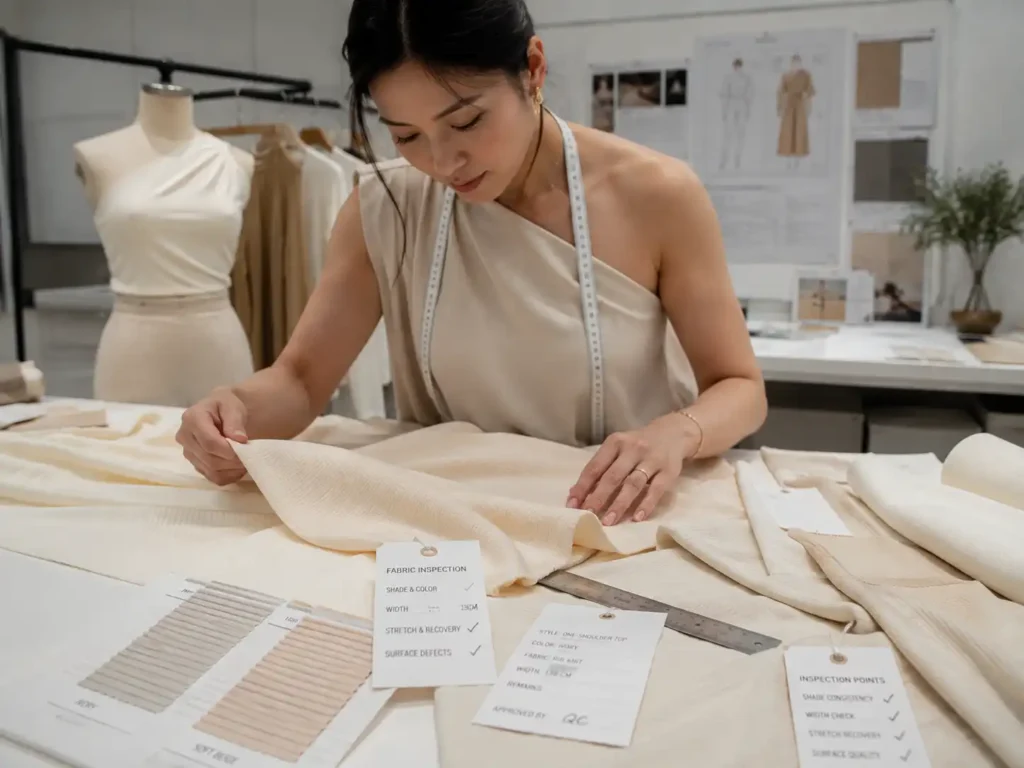
Bodycon, jersey, rib-knit, and other close-fitting stretch dresses are especially sensitive to recovery because their silhouette depends on continuous fabric tension. Problems usually become visible first around the waist, hip, seat, neckline, side seams, and hem. Ponte and other structured stretch fabrics also depend on recovery, while looser silhouettes generally tolerate more dimensional change before it becomes noticeable.
How Does Recovery Affect Bodycon Dresses?
Bodycon dresses reveal recovery problems quickly because the fabric is expected to maintain contact with the body across most of the silhouette. The seat is particularly revealing. When the wearer sits, the back hip and seat panels can remain under load for much longer than during a standing fit, and a weak-recovery fabric may not fully return when she stands. Horizontal folds, soft bagging, or a less defined hip line can appear even though the garment looked correct at first. Recovery also interacts with vertical balance. When crosswise tension changes around the hip, the skirt can migrate toward a lower-tension position, contributing to hem ride-up or side-seam movement. In one recorded 10-style bodycon program using jersey, rib knit, and ponte, approximately 16,000 pieces were developed with particular attention to recovery, bust-waist-hip balance, seam twisting, hem movement, and post-wash dimensions. The useful lesson is that several visible fit symptoms can share one root cause, so changing a single circumference measurement is not always the right correction.
How Do Jersey and Rib Dresses Behave?
Jersey and rib fabrics are popular because they can feel soft, flexible, and easy to wear, but those same qualities make recovery especially important in fitted silhouettes. Rib construction often allows generous widthwise extension, which can create excellent comfort around the bust and hip. If return is weak, however, the waist may lose definition and the hip may remain enlarged after sitting. Jersey is an even broader category: a lightweight rayon-blend jersey intended for a fluid slip dress should not be judged by the same fit expectations as a denser polyester-elastane jersey used for a mini bodycon style. Internal manufacturing records for knit, jersey, and rib-knit dresses commonly flag loosening after wear, wash distortion, side-seam twisting, hem ride-up, and unstable bust-waist-hip measurements as connected risks. Useful controls include fabric weight, stretch, recovery, shrinkage, relaxing, cutting direction, seam stability, finished-garment tolerance, and post-care behavior. A hand-feel approval alone is therefore not enough for a fit-sensitive knit dress.
How Does Ponte Affect Structured Fit?
Ponte is often chosen when a dress needs more structure and surface coverage than lightweight jersey while still allowing body movement. Its value comes from the balance of thickness, weight, stretch, recovery, knit density, and hand feel rather than from the name ‘ponte’ itself. A heavier ponte can create smoother body lines and stronger waist definition, but it can feel restrictive if the pattern uses too much negative ease. A lighter version may be comfortable but provide less support around the hip or abdomen. Two fabrics sold under the same category can therefore demand different patterns or fit expectations. In practical development, ponte is reviewed for thickness, fabric weight, extension, return, structural feel, intended season, seam appearance, and dimensional behavior after care. A fabric can pass one criterion and still fail the garment: it may recover well but be too heavy for a summer mini, or it may stretch comfortably but lack the firmness required for a clean, structured bodycon silhouette.
Are Loose Dresses Affected the Same Way?
Loose dresses are generally less dependent on recovery because positive ease provides space between the body and the garment. A small dimensional change around the hip of an A-line woven dress may have little effect on the perceived size, while the same change can be obvious in a compression-style bodycon garment. Recovery still matters in local areas, however. A loose knit maxi can lengthen under its own weight, a stretch neckline can open, and a fitted bodice attached to a full skirt can experience vertical pull from the skirt mass. Mixed-material designs require even more attention because a stretch mesh panel, non-stretch lining, elasticized waist, or structured bodice can each carry load differently. The useful question is not whether a loose dress ‘needs recovery’ but how much of its intended shape depends on elastic tension. The more a silhouette relies on fabric tension instead of pattern volume, the more sensitive its sizing and appearance become to recovery behavior.
How Is Fabric Recovery Tested for Sizing?
Fabric recovery is assessed by extending a conditioned specimen under defined conditions, removing the force, allowing the material to recover, and measuring the remaining dimensional change. For dress sizing, useful testing should consider direction, load, recovery period, residual growth, laundering, and the actual stresses expected in the finished garment rather than relying on hand stretch alone.
How Are Stretch and Growth Measured?
The basic measurement logic is easy to understand even though formal laboratory methods control the details more carefully. A specimen starts with a known gauge length, is extended according to a defined method, and is then measured during or after loading. If a 100 mm reference length reaches 130 mm, the observed extension is 30%. If the material later settles at 103 mm after the specified recovery period, it retains 3% growth relative to the original mark. Those two figures answer different questions: one describes how far the material extended, while the other describes how much enlargement remained. The test conditions are critical. Different loads, hold times, conditioning, directions, recovery periods, and specimen dimensions can produce different numbers, so results from two suppliers should not be compared as though they were identical unless the methods are comparable. For technical sourcing, ‘40% stretch’ should always prompt follow-up questions about direction, test condition, force, and residual growth before it is used to make pattern decisions.
Why Does Relaxation Matter?
Stretch fabric may not arrive at the cutting table in its most stable state. Rolling, transport, storage, and handling can leave material under tension or compression, and cutting while that condition is still changing can turn a perfectly accurate marker into inconsistent panels. The result may appear later as garment-width variation, length changes, mismatched pieces, seam distortion, or size differences that are incorrectly blamed on sewing. Fabric relaxing is therefore a dimensional-control step, not a ritual with one universal number of hours. Different constructions, weights, elastomer contents, roll tensions, and storage conditions can settle differently. A more useful approach is to verify stability through the actual production process: fabric on receipt, fabric after relaxation, cut-panel dimensions, sewn-garment dimensions, finished measurements, and post-care measurements where relevant. The point at which movement appears helps the team identify whether the root cause lies in fabric condition, cutting, sewing tension, finishing, or the pattern itself. That is far more informative than simply tightening the final garment tolerance.
Do Direction and Construction Matter?
Yes. Stretch and recovery can differ sharply by direction, so a fabric that performs well around the body may behave very differently along the garment length. A four-way-stretch material can still show unequal power or residual growth widthwise and lengthwise. Cutting direction therefore affects more than fabric usage; it can influence side-seam balance, garment length, waist position, and how evenly tension is distributed across panels. The completed dress also behaves differently from an isolated swatch. A non-stretch zipper can restrict the center back, a stable lining can reduce shell extension, binding can control a neckline, and boning can prevent a bodice section from stretching at all. Dense embroidery, sequins, heat-applied decoration, and multiple layers of mesh can further alter local behavior. Technical teams should distinguish fabric elasticity from garment elasticity. Material testing establishes the base characteristics, but only a finished sample reveals how those properties survive real construction. That is why fabric tests and fit samples should support each other rather than competing as separate approval systems.
Which Test Methods Apply?
There is no single test method that automatically suits every stretch dress. ASTM D2594/D2594M is commonly referenced for stretch and growth evaluation of certain knitted fabrics, while ASTM D3107 is used for stretch, growth, and recovery properties of woven fabrics made with stretch yarns. ISO 20932-1 provides strip-test methods for fabric elasticity and related properties. These standards are useful because they replace casual hand pulling with defined procedures, but a brand should still select methods according to fabric construction, product specification, intended use, and laboratory capability. A numerical result does not replace a fit sample. The strongest development sequence is controlled fabric assessment, pattern assumptions, sample fitting, realistic movement or wear observation, revision where necessary, and pre-production approval. A fabric can show technically good return and still be wrong for a dress because it feels too firm, becomes transparent when extended, is too heavy for the season, or behaves poorly once lining and seams are added. Testing narrows uncertainty; garment approval decides suitability.
How Do Manufacturers Keep Dress Sizing Stable?
Stable sizing comes from controlling the whole development and production chain rather than relying on final inspection alone. Fabric approval, relaxation, pattern version control, grading, cutting, fit samples, PP approval, in-line measurements, finished-garment tolerances, and sealed reference samples all contribute to consistency. Stretch-sensitive dresses need these controls to stay connected from sample development through bulk production.
How Should Recovery Affect Pattern Development?
A pattern developed in one stretch fabric should not automatically be treated as universal. If extension, recovery, fabric power, weight, drape, or usable garment stretch changes significantly, the same paper dimensions can create a different fit. This becomes especially important when a brand asks for ‘the same dress in another fabric.’ Commercially, it sounds like a material substitution; technically, it can change bust pressure, waist shaping, hip extension, neckline stability, and hem behavior. A sensible development review compares the proposed fabric with the approved one and then checks whether the existing negative ease still makes sense. Major fabric replacement or a clear change in elasticity commonly justifies another fit or revised sample before bulk cutting. Pattern revisions should be documented at specific points such as bust, waist, hip, length, straps, neckline, armholes, and slit position. The purpose is not to create more sampling for its own sake. It is to make sure the fit approved by the brand exists in an updated pattern and measurement record that the production floor can actually follow.
How Does Recovery Affect Size Grading?
Grading expands or reduces an approved base pattern into a size range, but it does not eliminate the effect of fabric behavior. A mathematically clean grade can still create inconsistent perceived fit if the material carries tension differently as body circumference increases. In a larger size, the absolute extension around the bust or hip can be greater, exposing more growth if recovery is weak. In smaller sizes, aggressive reduction can make a high-power fabric feel disproportionately tight. This does not mean every size needs a different fabric or a separate development process. It means representative size checks are valuable when a silhouette relies heavily on negative ease. Practical controls include grade-rule review, pattern-version control, bust-waist-hip balance, garment length, strap or neckline position, and observation of the fabric after fitting. The objective is not merely to preserve numeric increments between XS, S, M, L, and XL. It is to preserve the intended fit character – whether soft, close, structured, or sculpting – as consistently as practical across the size range.
How Do Fit Samples Confirm Sizing?
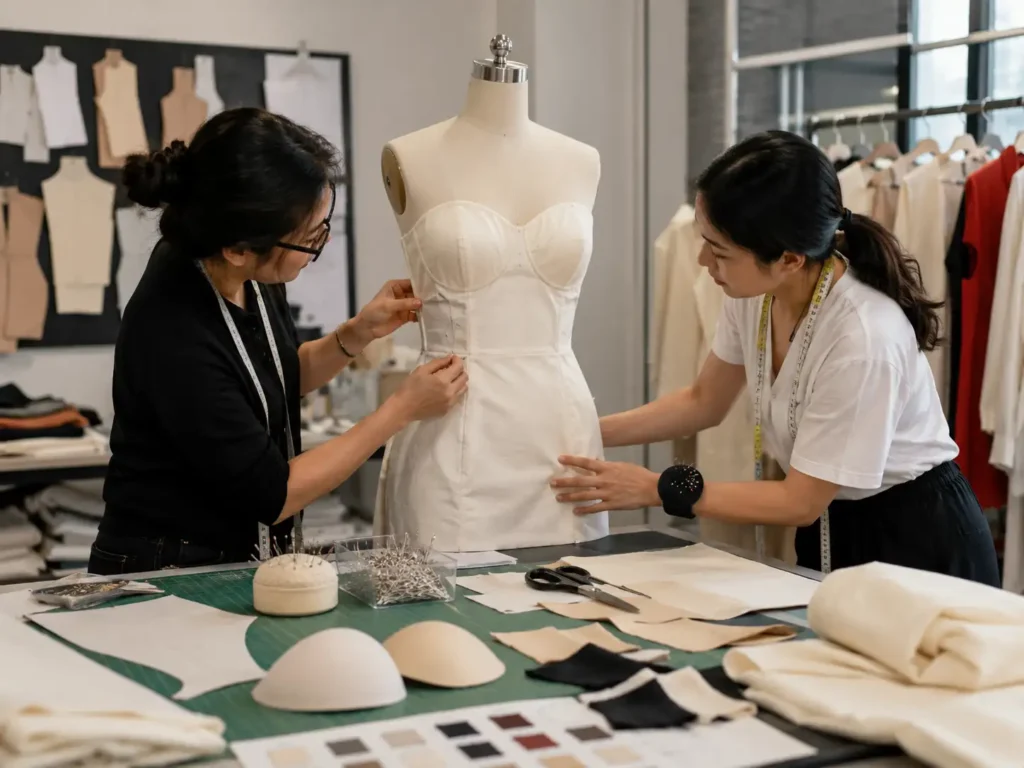
A fit sample is where body measurements, garment measurements, fabric mechanics, and design intent finally meet. A useful fitting does more than photograph a model standing straight. The wearer should sit, walk, raise her arms, turn, and return to a neutral position so the team can observe hip loading, garment lift, neckline movement, side-seam balance, and recovery after motion. Comments should be specific enough to drive a technical correction. ‘Fit is wrong’ is vague; ‘waist is correct initially but relaxes after sitting’ or ‘side seam moves forward at the hip after walking’ tells the team where to investigate. Jinfeng Apparel’s documented sample process uses first samples, fit samples, revised samples, PP samples, and Golden samples, with major comments transferred into updated patterns, measurement charts, BOM information, sewing instructions, and QC requirements. That transfer is important because a correction has little value if it exists only in a message thread and never reaches the files used for bulk production.
How Is Recovery Controlled in Bulk Production?
Bulk consistency depends on preserving the approved relationship among fabric, pattern, construction, and measurements across hundreds or thousands of garments. Recovery cannot be ‘fixed’ at final inspection if the wrong fabric batch was cut, the fabric was unstable before cutting, or the production line used an outdated pattern version. The control chain below shows how sizing risk can be managed earlier. Jinfeng Apparel’s documented size-control process includes size-chart confirmation, grade-rule review, pattern-version control, fabric relaxing, cutting QC, in-line measurement, finished-garment measurement, tolerance control, and comparison with approved PP and Golden samples. The goal is not to promise zero variation, because textile and apparel production operates within defined tolerances. The stronger approach is to identify what was approved, monitor the variables most likely to move the fit, catch drift before it spreads through the order, and keep development, cutting, sewing, finishing, and final QC working from the same approved reference.
| Stage | What Is Controlled | Typical Record | Main Fit Risk |
| Fabric approval | Stretch, recovery, weight, shrinkage risk | Approved fabric record | Wrong bulk fabric behavior |
| Fabric relaxing | Dimensional stability before cutting | Relaxation / batch record | Panels changing after cutting |
| Pattern release | Approved version and grade rules | Pattern version + size chart | Old or incorrect fit data |
| Cutting | Direction and panel accuracy | Cutting QC record | Unequal stretch or dimensions |
| Sewing | Seam construction and local tension | Sewing instruction + in-line QC | Restricted stretch or distortion |
| In-line measuring | Bust, waist, hip, length | Measurement report | Size drift detected too late |
| Final measuring | Finished dimensions vs. tolerance | Final QC report | Off-spec garments |
| PP / Golden comparison | Approved fit and construction | Sealed reference sample | Bulk drifting from approval |
Conclusion
Fabric recovery is easy to underestimate because it is rarely printed on a consumer size label, yet it can determine whether a fitted dress still feels like the same size after real wear. Stretch tells us how far a material can extend; recovery and growth tell us what happens afterward. Those properties interact with negative ease, fabric power, pattern balance, grading, cutting direction, lining, seam construction, garment weight, and care conditions. For fashion brands, the most reliable approach is to review recovery before locking the pattern, observe the sample after movement rather than only in a static fitting, and carry the approved fabric-pattern relationship into bulk production through controlled measurements and reference samples. When a stretch dress fits well at first and remains stable through wear, that result is rarely accidental. It usually comes from treating fabric behavior and sizing as one connected product-development problem.