A knit dress can look perfectly opaque on a hanger and become noticeably more revealing the moment it is pulled over the body. That difference is one reason fabric weight matters so much in fitted womenswear. GSM gives designers and product teams a useful numerical reference, but the number never works alone. Yarn size, loop density, stretch, recovery, color, negative ease, finishing and lining all influence what the wearer actually sees once the fabric is under tension. A good fabric decision therefore starts with more than asking whether a knit feels thick enough in the hand.
Knit fabric weight affects body coverage because increasing GSM generally places more material between the body and incoming light, improving opacity and often adding structural support. However, higher GSM does not automatically guarantee better coverage. Knit construction, color, fiber composition, stretch percentage, negative ease and lining can change how much skin or body contour remains visible. The right weight is the one that stays stable and appropriately opaque at real wearing stretch.
The most common development mistake is approving a swatch as though it were the finished garment. A fabric may look dense on the cutting table, pass a quick hand-behind-the-swatch test and still open across the seat, bust or upper thigh once the pattern stretches it. Experienced dress development teams therefore judge fabric weight in motion and on the body. The difference between a confident fitted dress and an unexpectedly sheer one is often discovered only after the sample is worn, walked in and viewed from several angles under realistic light.
What Does Knit Fabric Weight Mean?
Knit fabric weight is normally expressed in grams per square meter, or GSM. It describes how much material exists in a defined area, but it does not directly measure thickness, opacity, stretch, softness or quality. For dress development, GSM becomes useful only when it is considered together with knit structure, yarn composition, density, recovery, drape, color and the amount of stretch the finished garment places on the fabric.
What Is Fabric GSM?
GSM means grams per square meter. A 180 GSM knit weighs 180 grams for every square meter of fabric, while a 300 GSM knit carries substantially more material in the same area. When two fabrics use similar yarns and similar knit construction, the heavier option will often feel more substantial, transmit less light and resist becoming transparent when moderately stretched. That makes GSM a useful control point when comparing one jersey with another jersey or one rib knit with another rib knit.
The number becomes less predictive when the constructions change. A 220 GSM single jersey should not be expected to behave like a 220 GSM rib knit, and neither should be treated as equivalent to a 220 GSM double knit. Yarn thickness, stitch length, machine gauge, loop shape and finishing determine how the mass is distributed across the fabric surface. In Jinfeng Apparel’s current fabric knowledge base, jersey is commonly referenced around 140-240 GSM, rib knit around 180-320 GSM and ponte around 250-420 GSM. These are working development ranges, not universal industry grades.
Is GSM the Same as Thickness?
GSM and thickness often move in the same direction, but they measure different things. GSM measures mass per area; thickness measures the physical distance between the two surfaces of the material. A lofty knit made with bulky yarn may feel thick without being particularly heavy, while a compact fabric made from finer yarn can feel flatter yet contain more mass. Brushing, raising, coating and surface texture can widen the difference further, which is why hand feel alone is unreliable when body coverage is important.
Coverage depends on how much open space exists between yarns and how that space changes during stretch. A thick-looking rib can become visually more open when the ribs separate across the hip, while a flatter ponte can remain comparatively closed because its construction is more stable. During fabric development, it is therefore better to record GSM together with physical thickness, width, stretch percentage, recovery, drape, transparency and shrinkage. Treating one number as a substitute for these properties often leads to a sample that looks very different from what the specification sheet suggested.
What Else Affects Body Coverage?
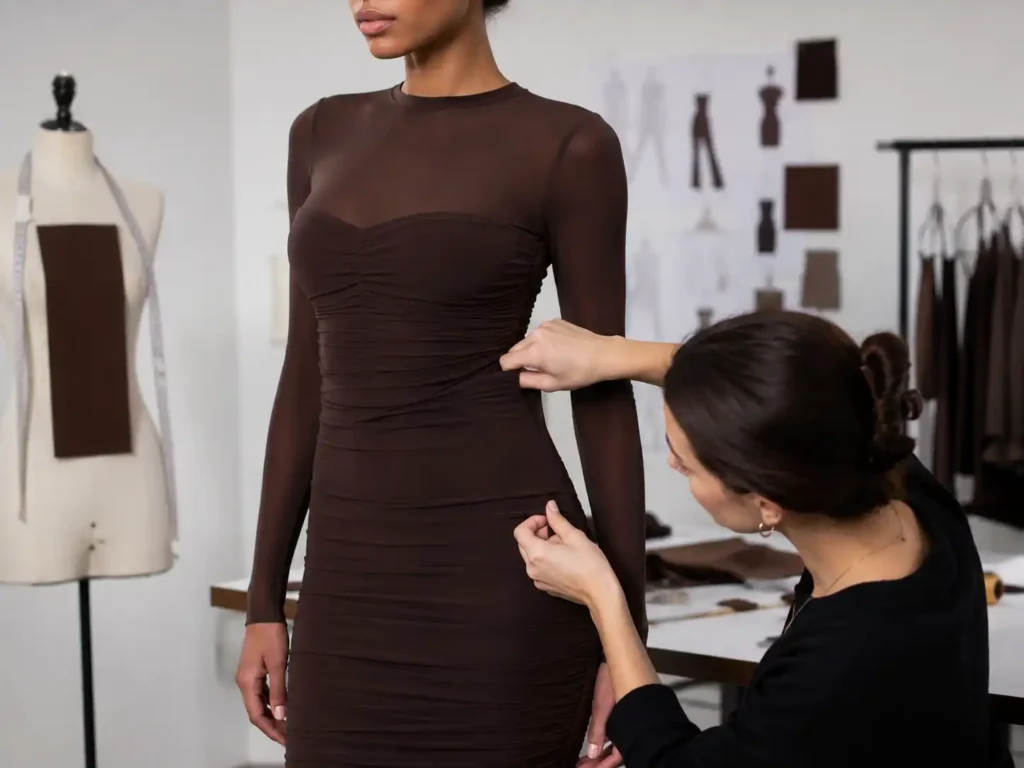
Body coverage has two separate visual components. The first is opacity: whether skin, underwear or an internal layer can be seen through the fabric. The second is contour masking: how clearly the fabric traces the navel, underwear edges, hip transitions or other surface details. A dress can be completely opaque and still feel more revealing than intended because a soft, smooth knit follows the body extremely closely. Weight influences both effects, but construction and fit determine how strongly they appear.
Color, fiber content and garment ease also matter. White, ivory, nude and pale pastels normally reveal contrast underneath more easily than black, navy or deep saturated colors. Viscose-rich jersey can drape more fluidly than some polyester-spandex constructions, while rib texture may visually break up body contours even as its channels open under stretch. A compatible lining or double layer can improve coverage, but it may also change stretch and drape. The safest approach is to evaluate weight, structure, color and fit as one system rather than approving them separately.
| Knit Type | Working Weight Range | Typical Stretch | Coverage Tendency | Common Dress Direction |
| Jersey | 140-240 GSM | Medium-high | Lower weights and pale shades need closer opacity checks | Bodycon, casual, date-night and soft fitted dresses |
| Rib Knit | 180-320 GSM | High | Usually substantial, but ribs can open across curved areas | Knit dresses, tank dresses, fitted sets and bodycon styles |
| Ponte / Roma | 250-420 GSM | Medium-high | Usually low transparency with stronger contour control | Structured bodycon, office and fitted midi dresses |
How Does GSM Affect Body Coverage?
Within the same knit family, increasing GSM generally improves opacity because more material is present across each square meter. It can also add body and reduce how strongly minor contours show through. The relationship is useful but not perfectly linear: a dense lower-weight knit can sometimes provide better stretched coverage than a heavier open construction. GSM is best used as one measurable part of a wider coverage and fit assessment.
How Do Lightweight Knits Cover the Body?
Lightweight knits are chosen because they feel soft, fluid and easy to wear. They can be excellent for summer dresses, relaxed jersey silhouettes, layering pieces and styles where movement matters more than firm shaping. Problems usually appear when the same light construction is asked to perform in a close bodycon pattern. As the garment stretches over the bust, hips and seat, the loop structure may open and the same yarn mass is spread across a larger surface area.
The result is not always obvious transparency. A lightweight fabric can remain technically opaque while showing underwear lines, the navel or small body transitions more clearly than a firmer fabric. The risk is higher in pale shades and on smooth surfaces that reflect light cleanly. Several development choices can preserve a lightweight look without accepting unwanted exposure: reducing negative ease, selecting a denser knit, lining only high-risk zones, using a compatible double layer, introducing ruching or choosing a silhouette with enough ease for the fabric to hang rather than remain under constant tension. Lightweight does not mean poor coverage, but it leaves less room for error.
How Do Midweight Knits Perform?
Midweight knits often provide the most flexible balance for fitted dresses because they can retain softness while offering enough substance to improve opacity, seam stability and surface smoothness. They are particularly useful when a style should follow the body without feeling overly compressive. A well-selected midweight jersey or rib can move naturally while giving the pattern maker more tolerance around the hip, seat and bust, where lighter fabrics may begin to look stretched or visually thin.
The term “midweight” should always be interpreted within a fabric family. A 220 GSM jersey may sit near the upper end of a common jersey working range, while 220 GSM sits comfortably inside many rib-knit ranges and below the usual working range of ponte used for structured dresses. Comparing raw GSM across unrelated structures therefore creates false confidence. A more useful development method is to compare fabrics with similar construction, then judge the garment at realistic extension. The best midweight option is the one that balances opacity, recovery, drape, surface quality and seasonal comfort rather than simply landing in the middle of a numerical range.
How Do Heavyweight Knits Change Coverage?
Heavyweight knits generally provide more physical substance, which can improve both opacity and contour control. They are useful when a dress needs a clean surface, controlled shaping or a more polished silhouette. Ponte is a good example: Jinfeng Apparel’s current working reference places ponte around 250-420 GSM, with low transparency and a more stable, structured hand. That is one reason it is commonly considered for fitted midi dresses, office silhouettes, pencil shapes and structured bodycon garments.
More weight changes more than coverage. Thick knits can create bulk at seam intersections, folded hems, zippers and ruching. They may feel warmer, place more load on straps and necklines, and reduce the airy movement expected from a summer dress. In very fitted styles, stronger fabric can also increase body pressure if negative ease is not adjusted. The aim is therefore not maximum GSM. The aim is enough weight and density to give the intended coverage while keeping the original silhouette, comfort and movement. Past that point, extra mass can solve transparency while creating fit and construction problems elsewhere.
Does Higher GSM Reduce See-Through Risk?
Higher GSM usually reduces see-through risk when yarn, color, knit structure and stretch behavior are otherwise similar. More material generally blocks more light, but the comparison becomes unreliable when construction changes. A compact 210 GSM jersey can outperform a looser 240 GSM fabric for stretched opacity. Likewise, a substantial rib can look dense while relaxed and become more open when its vertical channels separate across the body.
Coverage testing should therefore reproduce the garment’s real use. A useful sequence is to observe the fabric relaxed, moderately stretched and stretched to the approximate extension expected in the garment. The sample should then be checked under normal front lighting and stronger backlighting, ideally over both skin and a contrasting underlayer. If a fabric passes only in the relaxed condition, it has not passed the test that matters for a fitted dress. The final approval should reflect the stretch state at which the consumer will actually wear the garment, not only the appearance of an unstressed swatch.
Which Knit Structures Give More Coverage?
Knit structure controls how yarn is arranged and how widely the loops open under tension, so two fabrics with similar GSM can provide very different coverage. Jersey generally gives softer drape, rib knit gives stronger body conformity, and ponte provides greater structural stability. Choosing the right structure first and then fine-tuning weight is usually more reliable than selecting a dress fabric by GSM alone.
How Does Jersey Affect Coverage?
Jersey is popular in women’s dresses because it feels familiar, soft and comfortable, and it adapts easily to casual, date-night and bodycon silhouettes. In Jinfeng Apparel’s fabric reference, common jersey constructions sit around 140-240 GSM with medium-to-high stretch and medium-to-high drape depending on composition. The same reference notes that pale colors or lower weights may become more transparent, which is particularly important when the fabric is used in a close-fitting pattern.
Jersey’s softness is both its advantage and its main coverage challenge. It does not always hold itself away from the body, so even an opaque version can reveal more contour than a firmer double knit. A light jersey that looks polished in a relaxed midi may look overly thin in a tight mini because the pattern demands more extension. Developers should also consider recovery, side-seam twisting, neckline stability and wash behavior. A sample that looks good for five minutes can change after sitting, walking or laundering if the fabric grows or loses recovery. Coverage therefore needs to remain stable over wear, not just during the first fitting.
Is Rib Knit More Body-Conscious?
Rib knit is naturally suited to close-fitting garments because the vertical rib structure normally allows strong widthwise stretch. It can expand around curves and then recover, making it useful for tank dresses, knit minis, fitted midi dresses, tops and matching sets. In the current internal fabric reference, rib knit is commonly evaluated around 180-320 GSM. Lower-weight pale versions require closer transparency checks because the channels can open as the fabric stretches across the body.
Rib texture creates an interesting trade-off. The raised surface can visually break up small body contours, which sometimes makes the garment look more forgiving than smooth jersey. At the same time, the ribs can separate under high tension, reducing opacity and visibly widening the texture over the bust or hip. That makes realistic extension testing essential. Recovery is equally important: a rib that stretches easily but returns poorly can bag at the seat, neckline or waist after wear. Good coverage in rib knit therefore depends on the relationship between density, stretch, recovery and the pattern’s negative ease rather than on weight alone.
How Does Ponte Improve Structure?
Ponte is frequently selected when the design needs a cleaner, more controlled outer surface without moving into rigid woven construction. Its double-knit character generally provides greater dimensional stability than soft single jersey, helping the fabric bridge over small surface variations rather than falling into every contour. That can make a fitted ponte dress appear smoother even when the silhouette remains close to the body.
The material still needs careful pattern work. A heavy ponte cut too tight can feel restrictive and create pressure around the waist or seat. Thick seam allowances may show as ridges, while bulky zipper areas or folded hems can distort an otherwise clean surface. The internal ponte reference therefore emphasizes thickness, stretch, waist-to-hip proportion, side-seam smoothness and dimensional consistency during sampling and bulk control. Ponte often solves transparency more easily than lighter knits, but opacity does not replace fit engineering. The final result should look smooth, allow movement and maintain the intended body shape without depending on excessive compression.
Do Double Knits Cover Differently?
Double-knit structures generally provide more body and dimensional stability than very light single-knit constructions because the yarn system creates a more substantial fabric architecture. The practical advantage in dresses is not simply greater thickness. A stable double knit can hold a smoother outer line, resist curling and remain less open under moderate stretch, which is useful for office dresses, fitted midi silhouettes, pencil shapes and structured jumpsuits.
The trade-off is reduced fluidity. Moving a design from soft jersey into a dense double knit can make the garment feel more formal, heavier and less draped, even when the pattern dimensions stay the same. Seam bulk may also increase. For this reason, double knit should be selected because its structure matches the design target, not because it seems automatically “better.” The most useful comparison looks at GSM, stretch in both directions, recovery, stretched opacity, seam behavior, drape and wash stability. Good coverage is achieved when these properties support the design together rather than when one specification is maximized.
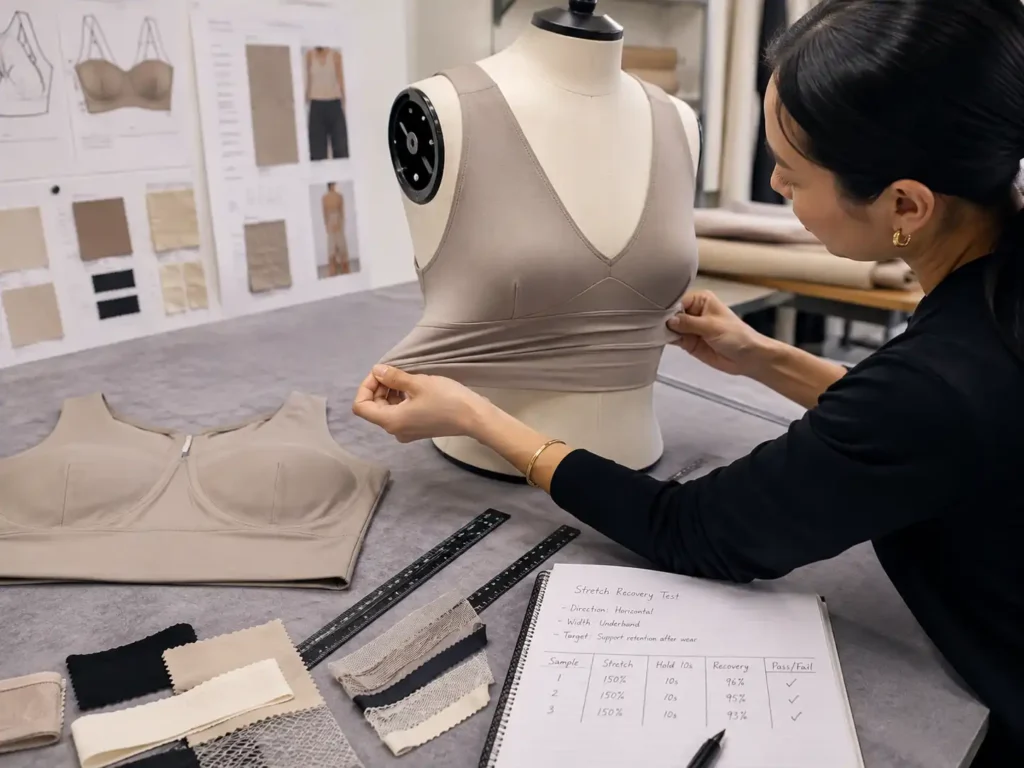
How Do Stretch and Fit Change Opacity?
Stretch changes opacity because knit loops spread as the material expands across the body. The same fabric can appear fully opaque in a relaxed state and become noticeably more transparent over the bust, hip or seat. Negative ease, body shape and movement determine how much local stretch occurs, so coverage should be approved on a fitted garment under realistic movement and lighting rather than from an unstretched swatch.
Why Can Knit Fabric Become Sheer When Stretched?
A knit contains a network of loops that can change shape when tension is applied. As the material stretches, the same amount of yarn must cover a larger area, and the spaces between yarns can become more visible. This is easy to demonstrate with a jersey swatch held over a contrasting background: the swatch may look solid while relaxed and reveal more of the background as it is pulled sideways. On the body, the effect can be stronger because tension is three-dimensional and uneven.
The seat, hip and bust often stretch more than the waist, so one part of a dress may remain opaque while another becomes visibly thinner. Fabric color, loop density and lighting influence how obvious the change looks. For that reason, a hand-behind-the-swatch check should be treated as an early screening method, not a final approval. Fitted garments need to be viewed from the front, side and back under normal light and mild backlighting. A fabric is truly suitable only when the intended body areas remain appropriately covered during realistic movement and extension.
How Does Negative Ease Affect Coverage?
Negative ease means the garment measurement is smaller than the corresponding body measurement, so the knit must stretch to fit. It is fundamental to bodycon construction because controlled tension creates the close silhouette. The percentage needs to be interpreted carefully. If the target hip is 100 cm and the garment measures 90 cm, the dress is 10% smaller than the body at that point, but the 90 cm garment must extend about 11.1% to reach 100 cm before movement is added.
That difference matters because opacity can change quickly as extension increases. A fabric that looks stable at 5% extension may look very different at 15% or 25%. Sitting, stepping forward and bending can temporarily increase local strain even further. Pattern makers should therefore choose negative ease after evaluating the actual fabric, not copy the same percentage from one knit to another. Strong recovery, dense construction and stable opacity can support more aggressive shaping, while a soft open jersey may require more relaxed measurements to maintain both comfort and visual coverage.
| Body Measurement | Garment Measurement | Negative Ease vs. Body | Approx. Extension Needed to Fit* |
| 100 cm | 96 cm | 4% | 4.2% |
| 100 cm | 92 cm | 8% | 8.7% |
| 100 cm | 90 cm | 10% | 11.1% |
| 100 cm | 85 cm | 15% | 17.6% |
| 100 cm | 80 cm | 20% | 25.0% |
Approximate circumferential extension from the garment’s relaxed measurement to the body measurement, before additional movement is considered.
Which Body Areas Need More Coverage?
Coverage risk is rarely distributed evenly across a fitted dress. The hip and seat are among the most demanding zones because they can place high continuous tension on the fabric, particularly in bodycon minis and fitted midis. The upper thigh becomes important during walking, when one leg moves forward and temporarily increases strain. The bust can also show more contrast in pale colors because bras, cups, seams and internal support structures create different layers beneath the outer fabric.
The stomach presents a slightly different issue. The material may remain fully opaque but reveal underwear construction or body contour more clearly than intended. A useful fitting should therefore include front, side and rear observation while the wearer stands, walks, sits, bends and raises the arms. Each movement changes local stretch. The intended occasion also matters: a club dress may deliberately create close body definition, while a polished office knit dress usually needs more smoothing. “Enough coverage” is a design and performance target, not a single GSM threshold that applies to every silhouette.
Do Color and Fiber Content Matter?
Color can materially change perceived opacity even when the knit construction and GSM remain identical. White, ivory, nude and light pastels usually show differences between skin, underwear and fabric more readily than dark colors. A black sample can therefore perform well while an ivory colorway in the same fabric reveals more contrast. Approving one color should not automatically validate every shade when body coverage is an important part of the design brief.
Fiber composition also changes drape, recovery, moisture behavior and surface appearance. Viscose-rich jersey may fall closely around the body, while polyester-spandex or nylon-spandex constructions can behave differently in recovery and tension. Cotton-rich fabrics may require additional attention to shrinkage depending on construction and finishing. Surface character matters as well: matte or textured knits tend to break up reflected light, whereas very smooth surfaces can emphasize curves through highlights and shadows. When composition or color changes, weight should be rechecked together with stretch, drape, transparency and the fit of the sample.
Is Heavier Knit Fabric Always Better?
Heavier knit fabric is not automatically better. Extra weight can improve opacity and surface smoothness, but it can also make a dress warmer, more restrictive, bulkier at seams and less fluid. A successful fabric provides enough density to achieve the intended coverage while preserving the correct drape, stretch, recovery, comfort and seasonality. Weight should solve a garment problem rather than serve as a stand-alone quality score.
Does More Weight Always Mean More Coverage?
More weight generally helps when two fabrics are genuinely similar in yarn, construction, color and stretch. Real sourcing rarely produces such a controlled comparison. One supplier may offer a compact 210 GSM jersey while another offers a looser 240 GSM jersey. The heavier fabric may look more substantial in the hand yet still open more under stretch because its loop structure is less compact. Comparing unrelated constructions by GSM alone therefore creates false confidence.
The same distinction applies to body contour. A dense heavy knit may prevent skin from being visible through the material while still fitting so closely that underwear edges or small surface transitions remain obvious. That is why opacity and contour masking should be evaluated separately. A useful rule is that GSM predicts material quantity more reliably than it predicts finished-garment modesty. Coverage belongs to the finished garment, not just the fabric specification. The most reliable selection method compares real samples at the same extension, under the same lighting and in the intended color.
How Does Weight Affect Drape?
Fabric weight influences drape because gravity acts on the material’s mass, but stiffness and knit structure determine what that extra mass actually looks like. A heavier soft jersey may produce deeper, fluid folds, while a heavy ponte may become more controlled and architectural. Both carry more GSM, yet their visual effect is completely different. This distinction matters when a developer increases weight to correct transparency after the first sample.
Consider a ruched bodycon dress that looks too thin in a light jersey. Replacing it with a much heavier fabric may improve opacity but make the ruching bulky because several layers accumulate at the gathered area. The waist can look wider, the side seam can become thicker and the skirt may lose the fluidity that made the original design attractive. A similar issue appears when a soft dress is moved into ponte: the garment can suddenly look more formal and structured. Increasing GSM is useful only when the resulting drape still matches the intended silhouette.
Can Heavy Knits Show Body Lines?
Yes. A heavy knit can be completely opaque and still reveal the shape beneath it. Smooth stretch fabrics under strong tension can trace underwear seams, the navel, hip transitions or bra edges even when no skin is visible through the fabric. Surface texture makes a difference because ribbing, mélange effects or matte finishes can break up light and reduce the visibility of minor contours, while a smooth uniform surface can make those same contours easier to read.
Construction details also become important as weight increases. Thick seam allowances, folded hems, zippers and lining joins create ridges beneath a tight surface. If the outer fabric is under tension, these internal thickness changes can become visible. Solutions can include slightly increasing ease, moving seam positions, reducing seam bulk, using a softer compatible lining, changing underwear or internal support construction, or selecting a material with a more forgiving surface. Coverage should therefore answer two questions: what can be seen through the fabric, and what can be seen through the shape of the fabric.
Does More Weight Affect Comfort?
Heavier knits can feel reassuring and substantial, but the same qualities may reduce comfort when the style or season does not justify them. A 300+ GSM structured knit can work beautifully in a fitted autumn midi or office dress, while a similar weight may feel unnecessarily dense in a sleeveless summer tank dress. More mass can also place extra load on narrow straps and halter necklines, and a large heavy skirt can pull downward on the bodice during extended wear.
Stretch resistance and recovery influence comfort just as strongly as weight. Two fabrics can share the same GSM yet produce very different body pressure. One may stretch easily and recover firmly, creating support, while another may resist extension and feel restrictive. Comfort should therefore be assessed over time rather than during a brief fitting. The wearer should be able to walk, sit and move naturally without excessive compression or heat. The correct weight delivers enough coverage for the occasion while still feeling believable for the season, silhouette and expected wear duration.
How Do You Choose the Right Knit Weight?
Choose knit weight by starting with the dress silhouette, required opacity and intended level of body conformity. Then compare candidate fabrics for GSM, knit construction, stretch, recovery, color, drape and transparency at realistic extension. Make a fitted sample before bulk approval and decide on lining after evaluating the garment on the body. The correct fabric is the one that performs consistently, not simply the one with the highest GSM.
Which Weight Works for Bodycon Dresses?
Bodycon dresses require particularly close coordination between fabric and pattern because the garment relies on stretch to create its shape. Within Jinfeng Apparel’s current development references, jersey commonly sits around 140-240 GSM, rib knit around 180-320 GSM and ponte around 250-420 GSM. These ranges describe different fabric families, not three quality levels. A substantial jersey may create a soft sensual fit, rib can add texture and strong conformity, while ponte produces a smoother, more structured outer line.
The intended occasion should guide the selection. A date-night mini may benefit from the movement of jersey or rib, while a polished fitted midi may work better in ponte. Opacity should be checked in the intended color and across the planned size range because grading changes the way tension is distributed. Recovery, shrinkage and side-seam stability also deserve attention. A bodycon fabric that looks excellent during the first fitting but grows at the hip after wear can lose both shape and coverage. The correct weight supports the look throughout movement and repeated use.
Which Weight Works for Softer Dresses?
Softer dresses usually need less structural control, which allows lighter or medium-weight knits to work successfully when the pattern includes enough ease. A relaxed jersey midi, for example, may remain visually opaque at a lower GSM because the material hangs from the body instead of being stretched continuously across it. Drape becomes the more important concern: the fabric should form natural folds, move easily and feel proportionate to the season and silhouette.
Adding weight can sometimes make a soft design look more premium, but only up to the point where movement begins to suffer. Excessive GSM can make a casual or resort-inspired knit dress look visually heavy and can cause the skirt to pull downward. Color provides another variable. Darker shades often allow slightly more flexibility than white or ivory because they conceal underlying contrast more effectively. The most useful target is the lightest fabric that still provides acceptable opacity, recovery and garment substance while preserving the intended flow and hand feel.
When Is a Lining Needed?
A lining is appropriate when the outer knit cannot deliver the required opacity, comfort or internal finish by itself. Pale fitted jersey is a common example. The same fabric may work unlined in black and need additional coverage in ivory. Full lining is not always necessary: some styles need only the skirt, bust or specific cut-out zones supported, while others use a self-fabric double layer to keep stretch and hand feel consistent across the garment.
The lining must be compatible with the shell. A low-stretch lining under a highly elastic knit can restrict movement, pull the outer layer out of shape or change the intended negative ease. A lining that is too heavy can also increase seam bulk and alter drape. The decision should therefore be made during sampling, not added as a late production fix. If transparency is discovered after the sample is made, the development team should compare a denser shell, adjusted fit, partial lining, full lining and double-layer construction before deciding which solution preserves the original design most successfully.

How Should Fabric Be Tested on the Body?
Flat swatches are useful for initial screening, but the most meaningful coverage test is a fitted sample made in the intended material or a technically comparable substitute. Start by observing the garment standing under normal front lighting, then check side and rear views because curved areas can show different levels of tension. Mild backlighting can reveal hidden transparency that is not obvious under evenly lit fitting-room conditions.
Movement should follow immediately. The wearer should walk, sit, bend, step forward, raise the arms and turn the torso. These actions change local extension around the bust, hip, seat and upper thigh. Fit comments should also be precise. “Too thin” can describe actual sheerness, excessive contour visibility, insufficient structure or simply a hand feel that does not match the intended price position, and each problem requires a different correction. Rechecking measurements after wear is useful when recovery is important. A fitted dress must maintain both opacity and shape after movement, not merely look correct in a static fitting pose.
What Should Be Approved Before Bulk Production?
Bulk production should begin only after the fabric specification and finished-garment behavior have both been confirmed. A material name is not enough because different lots or substitute fabrics can change weight, stretch, drape and transparency. The approval record should define the exact fabric composition, GSM or acceptable weight range, usable width, stretch direction, stretch behavior, recovery, color, hand feel, drape and opacity in both relaxed and stretched states.
Pattern and lining information should be tied to the same approval. If fabric weight or stretch changes, the existing pattern may no longer produce the same fit, and a new sample may be needed before bulk cutting. Repeat-order records should also retain swatch references, shrinkage notes and lot information so later production can be compared with the approved original. This matters especially for fitted knit programs where small changes in material behavior can alter tension across several sizes. A disciplined approval system turns coverage from a subjective fitting comment into a reproducible production requirement.
| Approval Point | What to Confirm | Main Coverage Risk if It Changes |
| GSM / Weight | Approved value or working tolerance | Opacity, drape and garment substance can shift |
| Knit Structure | Jersey, rib, ponte or other construction | Loop opening and contour behavior can change |
| Stretch & Recovery | Direction, extension and return | Fit tension and transparency may change |
| Color | Bulk shade against approved sample | Pale shades can reveal more contrast |
| Stretched Opacity | Check at realistic garment extension | Skin or underlayers may become visible |
| Lining | Material, stretch and coverage zone | Shell fit, comfort and movement can change |
| Pattern / Ease | Approved measurements and size grading | Excess tension can reduce opacity |
| Shrinkage | Fabric and garment behavior | Post-wash fit and tension can change |
| Bulk Lot | Compare with approved swatch and sample | Production may behave differently from sampling |
For a custom knit dress program, the most useful development information is not a single GSM target. A team can make a much better fabric decision when it has the silhouette, target color, intended fit, size range, seasonal use, reference sample and expected hand feel at the same time. Jinfeng Apparel’s fabric-development work covers jersey, rib knit, ponte and other stretch materials, with weight considered together with drape, stretch, transparency, lining and bulk-production risk rather than as an isolated specification.
Conclusion
Knit fabric weight matters because it changes how much material sits between the body and light, but the best dress development decisions are never made from GSM alone. Coverage emerges from the interaction between weight, knit structure, color, stretch, recovery, negative ease, lining and the three-dimensional shape of the garment. A fabric should therefore be judged at realistic extension, in the intended color and on a fitted sample that is actually moved in, not only inspected while flat.
The most reliable approach is to define the look first and then choose the lightest, softest or most structured knit that can deliver that look without compromising opacity or comfort. Jersey, rib and ponte can all produce excellent fitted dresses when their strengths are matched to the silhouette. Recording the approved fabric and pattern details before bulk production then turns a successful sample into something that can be reproduced consistently across colors, sizes and repeat orders.