Skip to content

Two satin fabrics can look almost identical when they are folded on a showroom table, yet behave like completely different materials once they become dresses. The difference shows up when the fabric is cut on the bias, pulled around the bust and hip, sewn beside a zipper, photographed under hard light, packed into a carton, worn for several hours, and cleaned after an event. That is why choosing between polyester satin and silk satin should never be reduced to “synthetic versus natural.” The real question is whether a particular satin can deliver the look, comfort, construction, price point, and production consistency that the finished dress requires.
Polyester satin is usually the more practical choice for scalable fashion dresses because it offers broad color availability, easier care, strong durability, and more controllable material cost. Silk satin is usually the stronger choice when natural fiber content, breathability, nuanced luster, soft hand feel, and premium positioning are central to the product. Neither is universally better; silhouette, GSM, lining, construction, target retail price, wear occasion, and production volume should decide the material.
A sample room makes this clear very quickly. One satin may look perfect on the roll but ripple as soon as a concealed zipper is inserted. Another may feel luxurious in a small swatch yet become too transparent when stretched across the body. A third may photograph beautifully but develop obvious fold marks after packing. The useful comparison therefore starts with fiber, but it ends with the finished garment. That is where polyester satin and silk satin stop being abstract textile categories and become real product decisions.
What Is the Difference Between Polyester Satin and Silk Satin?
Polyester satin and silk satin can use the same satin weave, but they are made from different fibers. Polyester satin uses manufactured polyester filaments, while silk satin uses natural silk fibers. This changes moisture behavior, hand feel, luster, durability, care, cost, and bulk consistency. Satin describes the fabric structure; polyester and silk describe what the yarns are made from.
Is Satin a Fiber or a Weave?
Satin is primarily a weave structure rather than a fiber, and this distinction removes much of the confusion around the phrase “silk versus satin.” A satin construction places longer yarn floats on the face of the fabric, creating a smooth surface with fewer visible interlacings than a plain weave. Those floats reflect light strongly, which produces the recognizable satin sheen. Silk can be woven into satin, but polyester, acetate, viscose blends, and other filament yarns can also be used to create satin fabrics.
For dress development, the word “satin” by itself is therefore an incomplete specification. Two fabrics sold under that name may differ in composition, yarn size, fabric density, weight, stretch, finish, opacity, and surface friction. A lightweight polyester charmeuse-style satin may behave more like a fluid silk satin than it does a heavy polyester bridal satin. Likewise, two silk satins can feel and drape differently if their yarns, density, or finishing are different. A practical specification should identify composition, GSM, width, stretch, hand feel, luster, opacity, color, finish, and intended garment use before a sample is approved.
What Is Polyester Satin Made From?
Polyester satin is normally produced from polyester filament yarns woven in a satin construction. Because polyester filaments can be engineered in different thicknesses, twists, cross-sections, densities, and finishes, the category covers far more than the very bright, inexpensive satin sometimes associated with costumes. Good polyester satin can be matte, softly reflective, crisp, fluid, lightweight, heavy, non-stretch, or blended with elastane for body-conscious styles. That range is one reason it appears across partywear, occasionwear, bridesmaid collections, slip dresses, cocktail dresses, corset styles, and eveningwear.
In Jinfeng Apparel’s satin dress development, approximately 80-220 GSM is a common working range for satin fabrics, although the correct weight depends on construction and silhouette. Lightweight qualities are often explored for slips, summer dresses, and fluid draping, while heavier satins can support structured evening dresses or smoother body coverage. The commercial advantage is not simply lower cost. Polyester satin is often easier to source in multiple colors, repeat across production runs, care for after purchase, and adapt to stretch or finishing requirements. The risk is choosing a low-grade quality that is overly shiny, stiff, thin, or visually flat.
What Is Silk Satin Made From?

Silk satin uses natural silk yarns in a satin weave. Its appeal comes from the combination of fine fibers, a smooth face, fluid movement, and a more complex way of interacting with light. Rather than producing one hard, uniform reflection, good silk satin often shifts more gradually between highlights and shadows as the wearer moves. This is especially noticeable on long, uninterrupted surfaces such as bias-cut gowns, cowl-neck slips, fluid skirts, and minimalist evening dresses, where the fabric itself becomes a major part of the design.
Silk also manages moisture differently from polyester, which can improve comfort when the dress sits directly against the skin for several hours. The trade-off is that silk satin normally costs more and requires more careful handling through cutting, sewing, pressing, packing, cleaning, and storage. Water spots, abrasion, needle marks, and excessive heat can be more consequential because both the material and mistakes are more expensive. Silk therefore makes the strongest commercial sense when natural fiber content, tactile quality, movement, and premium storytelling genuinely support the retail positioning of the garment.
| Comparison Point | Polyester Satin | Silk Satin | Practical Meaning for Dresses |
| Fiber source | Synthetic polyester | Natural silk | Changes comfort, care, cost, and positioning |
| Surface character | Often clean and consistent | Often softer and more dimensional | Most visible on simple silhouettes |
| Moisture behavior | Relatively low absorption | Higher moisture management | Relevant for close-to-skin and long-wear styles |
| Durability | Generally strong | More delicate | Matters for travel, returns, and repeated wear |
| Care | Usually easier | Usually more demanding | Affects the ownership experience |
| Bulk consistency | Often easier to manage | Requires closer lot control | Important for repeat and multi-color programs |
| Satin dress weight | Commonly 80-220 GSM in our development records | Varies widely by silk construction | Weight should follow silhouette, not fiber prestige |
| Typical commercial role | Scalable fashion and occasionwear | Premium and luxury programs | The better option depends on the collection |
How Do Polyester Satin and Silk Satin Look and Feel?
Silk satin usually has a softer, more nuanced luster and a naturally refined hand, while polyester satin often gives a cleaner and more uniform reflection. The difference is real, but fiber is only part of the result. GSM, yarn construction, finishing, dye color, lining, garment tension, and lighting can make one polyester satin look more luxurious than another fabric simply labeled silk.
Which Satin Has Better Shine?
“Better shine” does not mean “more shine.” Silk satin is often preferred when the desired impression is subtle luxury because the reflection tends to change more softly across folds and movement. On a bias skirt or cowl neckline, this can create a layered surface where highlights roll gradually into shadow. Polyester satin can produce a stronger, more even reflection, which may be desirable for partywear or dramatic evening styles, but excessive gloss can also make a garment look harder or cheaper than intended.
The problem becomes more obvious under photography. A fabric that looks elegant in ambient showroom lighting may create sharp white highlights under direct flash, especially across the bust, waist, hip, zipper, or any area where the fabric is under tension. Pale champagne, ivory, silver, blush, and bright saturated colors can amplify this effect. Black, navy, chocolate, and burgundy often control reflection more easily because the darker surface absorbs more light. Satin should therefore be approved under daylight, warm indoor light, cool retail light, and camera lighting when ecommerce imagery is important.
Which Satin Feels Softer?
Silk satin generally has a naturally soft, smooth hand, but softness can mean several different things in garment development. A fabric can feel silky between the fingers yet still be relatively stiff when draped. Another may feel extremely fluid but too slippery for the intended construction. Polyester finishing technology can also produce very soft, polished surfaces, so a quick touch test is not enough to judge whether a satin will make a better dress.
The more useful test is to handle a larger piece. Drape it over the forearm, shoulder, hip, and a dress form, then observe how the fabric bends and how quickly folds release. A soft, lightweight satin can be excellent for a cowl-neck slip because it falls into small, fluid folds. The same material may be too weak for a corset-inspired bodice where the designer wants a controlled surface. A heavier satin may feel less delicate in the hand but perform better on a formal midi dress because it skims the body instead of exposing every line beneath it.
How Does Drape Differ?
Silk satin is famous for fluid drape, but fiber alone does not decide how a fabric falls. Yarn size, fabric density, GSM, finishing, and grain direction all contribute to drape. A lightweight polyester satin can be more fluid than a dense silk satin, while a heavier polyester satin can form broader, more controlled folds that are useful for eveningwear. The important question is not which fiber drapes better in theory, but whether the particular fabric creates the intended silhouette on the body.
A useful evaluation looks at three behaviors: how the satin hangs vertically, how it bends over curves, and how it responds after movement. Slip dresses usually need fluidity through the bust and hip. Structured dresses need enough body to keep the skirt from collapsing. Bias-cut gowns need controlled diagonal extension so the garment follows the body without growing excessively. When fabric weight or stretch changes, the existing pattern may also need review because drape, hem level, neckline depth, and overall balance can shift even when the design itself has not changed.
Do They Look Different in Photos?
Yes, but photography can either exaggerate or hide the difference. Strongly reflective polyester satin may look smooth and expensive in soft daylight yet appear harsh under flash because its highlights become concentrated. Silk satin often moves between light and shade more gradually, although a very smooth silk surface can still produce strong highlights. Matte polyester satin can sometimes outperform glossy silk in ecommerce photography simply because its finish was selected to control reflection around seams and body curves.
The most revealing areas are usually the bust, waist, hip, center-back zipper, and side seams. These zones carry more garment tension, so even small puckers or fit imbalances create visible light bands. Before bulk approval, photograph the sample from the front, back, side, and during movement. Use both soft and direct light if possible. For online brands, this is not a minor aesthetic test: customers often judge satin almost entirely through product photographs and short videos, so a fabric that photographs poorly can reduce perceived quality before the customer ever touches the dress.
Which Satin Is More Comfortable and Durable?
Silk satin generally provides better moisture comfort and a softer long-wear feel, while polyester satin usually offers greater durability, easier maintenance, and stronger resistance to routine handling. For scalable occasionwear, polyester often gives a practical balance. For premium garments worn close to the skin, silk can offer a more refined experience when the customer accepts the higher cost and more careful care requirements.
Which Satin Is More Breathable?
Silk satin usually has the comfort advantage because silk can take up and release more moisture than polyester. During warm events or extended wear, this can reduce the sticky sensation that some wearers experience with synthetic satin. The difference is most relevant in slip dresses, resort occasionwear, summer wedding-guest dresses, and other garments that sit directly against large areas of skin for several hours.
That advantage should not be exaggerated, because the outer shell is only one part of the thermal system. Lining, boning, cups, interfacing, shapewear, sleeve coverage, garment ease, and venue temperature can influence comfort as much as the satin itself. A lightweight polyester satin dress with an open back and breathable lining may feel cooler than a heavily lined silk gown with multiple support layers. For eventwear, a useful fit test should include sitting, walking, raising the arms, and staying in the finished garment for a realistic period rather than judging comfort during a five-minute fitting.
Which Satin Is More Durable?
Polyester satin normally offers stronger day-to-day durability because polyester fibers are strong and dimensionally stable. This makes it useful for garments that will be packed, transported, tried on repeatedly, returned through ecommerce, steamed, and worn more than once. Silk satin can perform well, but it usually demands more careful handling and is less forgiving of abrasion, water spotting, and rough treatment.
The satin weave creates a separate vulnerability regardless of fiber: snagging. The longer surface floats can catch on jewelry, rough fingernails, damaged hangers, hook-and-loop fasteners, zipper teeth, metal trims, or sharp packaging edges. A polyester satin may therefore be strong in tensile terms yet still look damaged after one visible pull. In satin dress quality control, surface appearance matters as much as basic fiber strength. Snags, stains, shade variation, zipper distortion, pressing marks, and packing creases are all practical defects that can reduce perceived value even when the fabric remains technically strong.
Which Satin Wrinkles More?
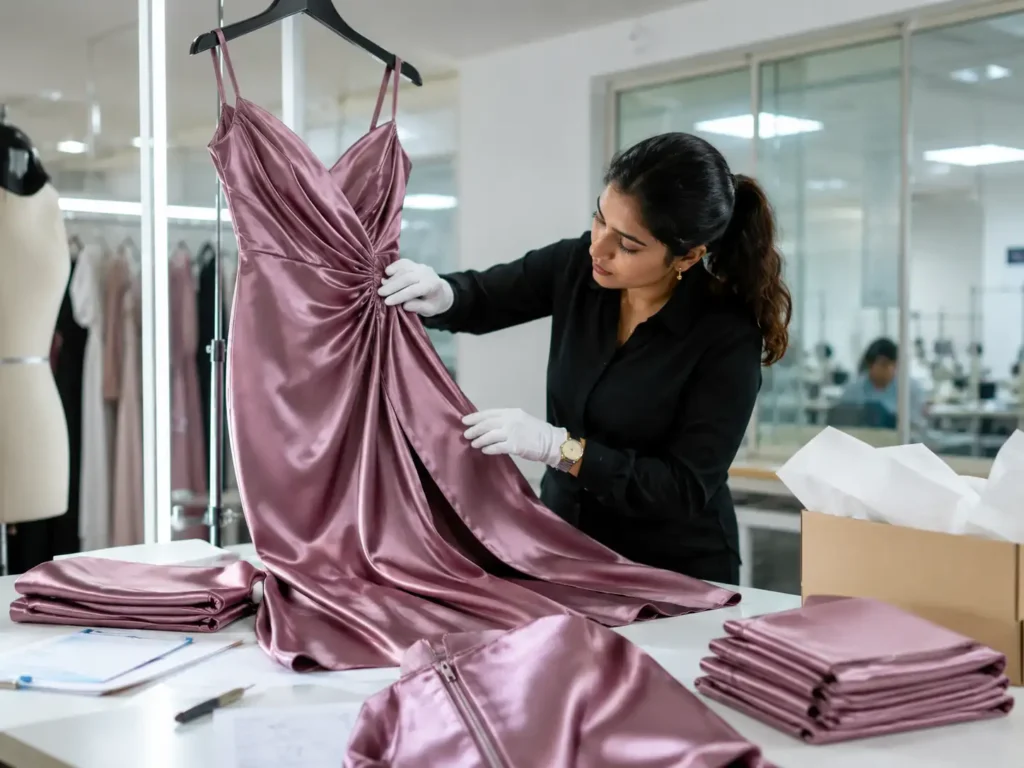
Both fabrics can wrinkle, but the degree and appearance depend on fiber, weight, finish, construction, and packing pressure. Silk satin often shows natural creasing more readily, while polyester usually has better wrinkle recovery. Lightweight polyester satin can still develop stubborn fold lines when garments are packed tightly for long-distance shipping, particularly when cartons are highly compressed or the dress is folded across a highly visible area.
Satin makes creases more obvious because its surface reflects light across every fold. A wrinkle that is barely noticeable on crepe may become a bright or dark stripe on satin. Brands should therefore test the proposed packaging before bulk production. Pack a finished sample using the intended folding method, keep it compressed for a realistic period, then assess how the garment recovers by hanging or steaming. Tissue placement, protective bags, fold position, carton pressure, and the way trims contact the fabric can all affect the condition in which the dress reaches a warehouse or customer.
Which Satin Is Easier to Care For?
Polyester satin is generally easier for consumers to maintain. Many qualities tolerate careful washing, steaming, and routine wardrobe storage better than silk, although the correct care instruction still depends on dye, finishing, lining, embellishment, adhesive components, and garment structure. A simple polyester slip dress and a boned, rhinestone-covered polyester corset dress may require very different care even though the outer shell composition is similar.
Silk satin usually requires more conservative treatment. High heat, aggressive detergents, friction, and water spotting can affect the surface, while structured silk garments may need professional cleaning because the internal materials are more sensitive than the shell itself. Care requirements influence product satisfaction, not just label compliance. A mainstream occasion dress can disappoint customers if maintenance is unexpectedly difficult, while a luxury customer may accept specialist care as part of the product category. The safest approach is to test the complete garment rather than copying a general fabric supplier instruction onto the final care label.
| Performance Factor | Polyester Satin | Silk Satin | What to Check on the Dress |
| Warm-weather comfort | Moderate to good depending on construction | Generally better | Test complete lined garment during extended wear |
| Moisture handling | Lower | Higher | Important for close-fitting or summer styles |
| Surface snag risk | Present | Present | Test trims, jewelry contact, zippers, and packing |
| Wrinkle recovery | Often better | Usually more sensitive | Simulate folding and transport |
| Static tendency | Can be higher | Usually lower | Review lining and dry-weather wear |
| Maintenance | Generally simpler | Generally more delicate | Confirm care on the finished garment |
How Does Satin Choice Affect Dress Production?
Satin influences cutting stability, grain control, seam appearance, zipper flatness, lining behavior, pressing, and bulk consistency. Lightweight satin can shift during cutting, while reflective surfaces make construction defects easy to see. Polyester is often more forgiving, but it still needs careful handling. A reliable production process validates the approved fabric through cutting, sewing, fitting, pressing, inspection, and packing before volume production begins.
How Does Satin Behave During Cutting?
Satin can move significantly during cutting because the smooth face has relatively low friction. When several layers are spread together, lightweight fabrics may shift against one another, causing panels to lose alignment. A small displacement at the cutting stage can later appear as twisted side seams, uneven necklines, mismatched hems, or asymmetric drape. Bias-cut styles are even more sensitive because the pieces are intentionally positioned diagonally to the grain and can distort before sewing begins.
Surface direction matters just as much. Satin reflects light according to yarn orientation, so pattern pieces cut in opposite directions can appear slightly different in shade even when they come from the same roll. Marker efficiency should therefore not be optimized so aggressively that front and back panels reflect differently. Production specifications should define grain and shine direction, control spreading tension, and verify the first cut pieces before a large quantity is released. A few extra centimeters of fabric consumption are often cheaper than correcting hundreds of dresses whose panels look mismatched under retail lighting.
How Does Satin Affect Sewing?
Satin exposes sewing quality because light moves across its smooth surface. Excessive thread tension can create puckering, an unsuitable needle can leave holes or pulls, uneven feeding can distort long seams, and a zipper inserted under tension can wave down the center back. These defects become especially visible on close-fitting dresses because the fabric is already being pulled across the bust, waist, and hip when the garment is worn.
Machine settings should therefore be proven on the actual approved fabric rather than copied from a previous satin order. Needle size, needle condition, thread, stitch density, presser-foot pressure, and tension can all change seam appearance. A short trial should include straight seams, curves, princess lines, zipper insertion, topstitching where used, and pressing. The goal is not to make satin production sound fragile; it is to recognize that reflective fabrics give less visual forgiveness. Several minor sewing errors that would be hidden on textured crepe can combine into a visibly lower-quality satin dress.
Does Satin Need a Lining?
Not every satin dress requires lining, but many benefit from it. The decision depends on color, GSM, opacity, silhouette, skin contact, seam construction, and quality level. Lightweight ivory, champagne, blush, white, and pastel satin can look opaque on a cutting table yet reveal underwear, seam allowances, or body shadows once stretched over the wearer. Close-fitting satin may also cling to skin or undergarments, especially in dry conditions where static is more noticeable.
Lining also supports structure and presentation. In corset, occasion, and evening dresses it can hide cups, boning, facings, interfacing, and reinforcement while helping the outer satin slide more smoothly over the body. The lining must be compatible with the shell rather than selected as an afterthought. If the two layers differ too much in stretch, shrinkage, weight, or drape, they may pull against each other and distort the garment. Light-colored, lightweight, formal, and fitted satin styles are therefore common candidates for lining, but the final decision should be made on a complete sample.
What Should Be Checked Before Bulk Production?
The most important production question is whether the bulk fabric behaves like the material used in the approved sample. Satin is sensitive to small changes because differences in weight, surface finish, stretch, and shade can be easy to see on the finished dress. Before cutting, the bulk lot should be checked for composition, GSM, width, hand feel, drape, stretch, recovery, opacity, color, luster, shrinkage, surface faults, and compatibility with the approved lining and sewing setup.
A fabric change can trigger more than a purchasing update. Heavier material can alter drape, additional stretch can change negative ease, lower opacity may require lining, and different shrinkage can affect finished measurements. Jinfeng Apparel’s fabric approval process therefore rechecks weight, hand feel, stretch, recovery, drape, transparency, shine, color, MOQ, cost, lead time, and whether the pattern or sample needs revision when a material changes. This prevents the common mistake of assuming that two satins with a similar color and composition will behave identically in production.
| Production Check | Practical Checkpoint | Risk if Ignored |
| Fabric weight | Confirm approved GSM; satin commonly spans about 80-220 GSM in our dress development | Drape, opacity, and fit can change |
| Grain and shine direction | Keep visible panels consistently oriented | Panels may appear to be different shades |
| Stretch and recovery | Compare with approved sample | Ease and seam tension may change |
| Lining compatibility | Match opacity, stretch, and drape | Pulling, clinging, or transparency |
| Zipper trial | Check flatness before bulk sewing | Rippling or center-back distortion |
| Pressing test | Confirm temperature, pressure, and protective method | Shine marks or surface damage |
| Packing simulation | Fold and compress a finished sample | Creases, snags, and pressure marks |
| Bulk shade | Compare dye lots under controlled light | Visible panel or order-to-order variation |
Which Satin Is Better for Different Dresses?
Silk satin is especially attractive for premium slip, bias-cut, and minimalist evening dresses where fluid movement and natural luster are easy to see. Polyester satin is often more practical for partywear, bridesmaid programs, multi-color collections, and scalable occasionwear. For corset and bodycon styles, GSM, stretch, recovery, lining, and internal structure can matter more than whether the surface fiber is silk or polyester.
Which Satin Is Better for Slip Dresses?

Slip dresses expose the fabric more clearly than heavily constructed garments because there are fewer design elements to distract from the hand feel, drape, opacity, and surface reflection. Silk satin is a natural fit for premium slips because the fabric sits close to the skin and its movement becomes part of the design. When the retail positioning supports natural fibers, silk can contribute both a tactile advantage and a straightforward premium material story.
Polyester satin is often the stronger commercial choice for larger fashion programs. A well-selected lightweight quality can create excellent movement while offering easier care, broader color availability, and more predictable costing. The biggest mistake is choosing a satin that is too light simply because it feels fluid. Once stretched across the bust and hip, very light satin may expose underwear lines, seam allowances, and fit irregularities. A slip-dress fabric should be evaluated on the body, while walking and sitting, because the right balance is not maximum softness; it is fluidity with enough substance to remain flattering and stable.
Which Satin Is Better for Bias-Cut Dresses?
Bias-cut dresses depend heavily on fabric behavior because the pattern pieces are positioned diagonally to the grain. This allows a non-stretch woven satin to extend and shape around the body, creating the fluid, body-skimming appearance associated with classic bias gowns and slips. Silk satin can produce exceptional results because of its softness and movement, but a lightweight polyester satin can also perform very well if its density and finish allow controlled diagonal extension.
The key issue is growth. Bias panels can lengthen under their own weight after cutting and sewing, which may shift side seams or make the hem uneven. Samples should therefore be allowed to settle before final hem evaluation, and strap length, neckline depth, and balance should be reviewed after the fabric has relaxed. Changing from silk to polyester, or from one polyester satin to another, should not be treated as a simple color substitution. If weight, diagonal stretch, or drape changes, the same pattern can produce a noticeably different silhouette.
Which Satin Is Better for Party and Evening Dresses?
Polyester satin often gives party dresses an effective balance of visual impact, color flexibility, structure, and cost. Many party styles rely on body-conscious fit, ruching, corsetry, asymmetric draping, short hemlines, or bold color rather than natural fiber content. In these products, a well-developed polyester satin can direct more of the garment budget toward fit, construction, trims, lining, or detailing without losing the smooth, reflective character customers expect.
Evening dresses create a broader decision. Long, minimalist gowns can justify silk because large uninterrupted panels make fabric quality highly visible. More structured eveningwear may benefit from a heavier matte or low-luster polyester satin that creates controlled folds and smoother body coverage. Bridesmaid programs often lean toward polyester for another reason: they may need several shades, multiple sizes, repeat orders, and stable pricing over a longer selling period. The better material is therefore the one that supports the entire collection plan, not simply the fabric with the more prestigious fiber name.
Which Satin Is Better for Bodycon or Corset Dresses?
For bodycon and corset styles, the polyester-versus-silk question often becomes secondary because structure and stretch are more important. A non-stretch silk satin can work as the shell of a structured corset dress, but the fit is mainly created by pattern engineering, boning, cups, lining, interfacing, and seam placement. For softer bodycon styles, stretch satin containing elastane may be much more practical because the fabric must follow the bust, waist, and hip while recovering after movement.
Recovery deserves particular attention. A fabric can stretch enough during fitting but still perform badly if it fails to return to its original dimensions, leaving the seat or hip loose after several hours. Heavier satin may also smooth the body better than very lightweight satin, which tends to expose underwear lines and small fit imperfections. For corset dresses, the satin should be tested over the real internal structure. Surface strain around cups, boning channels, waist seams, and zipper areas becomes highly visible under light, so a beautiful swatch can still be the wrong shell fabric.
How Should Fashion Brands Choose the Right Satin?
Fashion brands should choose satin by working backward from the finished dress rather than forward from the prestige of the fiber. Define the silhouette, customer, selling price, color range, comfort expectation, care level, production volume, and visual direction first. Then compare fabrics for composition, GSM, drape, opacity, luster, stretch, sewing behavior, lining compatibility, cost, availability, and repeatability.
Is Silk Satin Worth the Higher Cost?
Silk satin is worth the higher cost when its qualities contribute directly to what the customer sees, feels, and values. A minimalist premium slip gown is a good example because the garment has few distractions: the customer can feel the material against the skin and see its movement across a large uninterrupted surface. Natural fiber content, subtle luster, and comfort can therefore support a higher retail position in a way that is easy to understand.
The calculation changes when the dress already contains expensive construction such as boning, draping, rhinestones, sequins, lace, embroidery, or complex lining. Increasing the shell-fabric cost may produce a smaller visible improvement than investing the same budget in fit, workmanship, lining, hardware, or finishing. Cost should be judged at garment level rather than meter level. A silk label cannot compensate for a rippled zipper, transparent skirt, poor bust fit, or unstable hem. Silk makes commercial sense when the premium is both visible and meaningful to the customer, not merely because the fiber sounds more luxurious in a specification sheet.
When Is Polyester Satin the Better Choice?
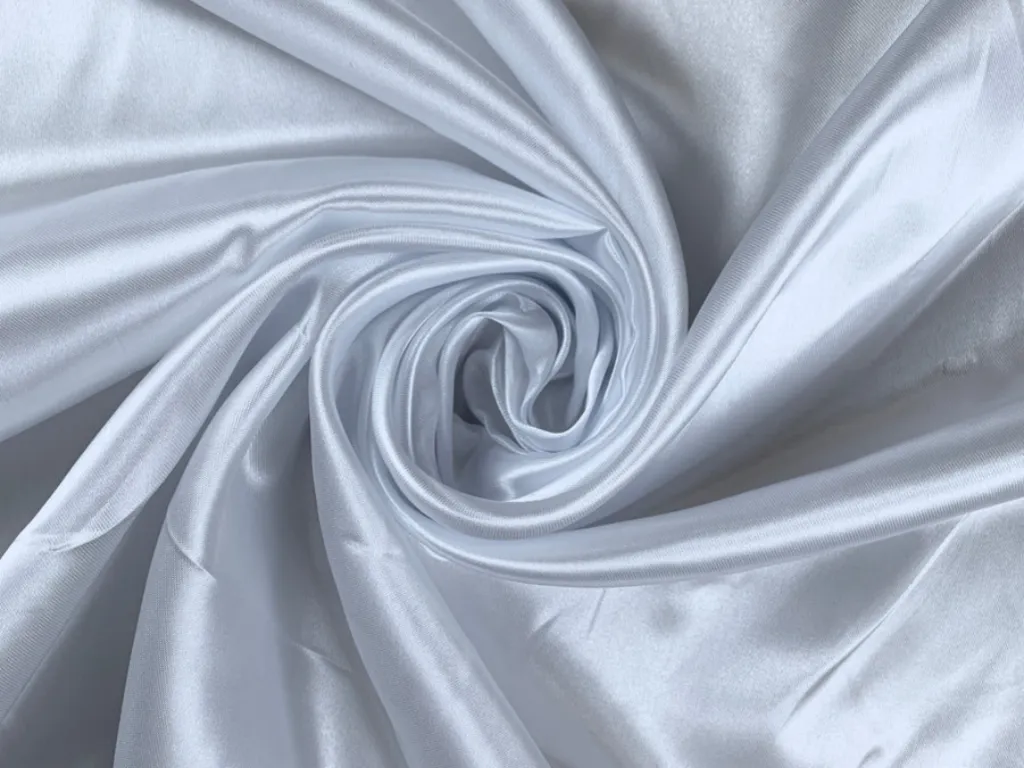
Polyester satin is often the stronger option when a collection needs multiple colors, dependable repeat orders, practical care, competitive retail pricing, or larger production volume. Occasionwear and partywear are good examples because customers may value silhouette, color, fit, and visual impact more than natural fiber content. A high-quality polyester satin can deliver these priorities while allowing more product budget for complex construction or finishing.
Polyester also offers useful engineering flexibility. Stretch satin can support bodycon and corset-inspired styles, heavier qualities can add structure, and matte finishes can reduce the sharp reflection associated with very glossy satin. The key is not to treat polyester satin as one standard fabric. A useful sourcing comparison may include a lightweight fluid option for slips, a medium-weight matte quality for bridesmaid dresses, and a heavier stretch satin for fitted occasionwear. All three can be polyester satin while producing very different garments, so approval must be based on the actual sample rather than the fiber label alone.
When Is Silk Satin the Better Choice?
Silk satin is especially convincing when the dress is deliberately positioned around natural materials, tactile luxury, movement, or premium craftsmanship. Minimalist eveningwear, luxury slip dresses, selected bridal pieces, and elevated occasionwear can benefit because the fabric itself is one of the main design elements. In such garments, there may be little embellishment to create perceived value, so the quality of the surface and hand feel becomes more important.
Silk also makes sense when customers specifically expect natural fiber content as part of the purchase decision. The supply chain, however, has to support that promise. Cutting, sewing, pressing, packing, and care communication may require more attention, while color matching and repeat availability deserve closer management if the style will remain in production across multiple seasons. The strongest case for silk is therefore not that it is automatically better than polyester. It is that the fiber’s comfort, luster, movement, and material story are genuinely useful to the product being developed and valued by the customer who is buying it.
How Should Brands Compare and Approve Satin?
A small swatch can eliminate unsuitable options, but it should not be the final approval method for a satin dress. Satin behaves differently when it is used across a full panel, positioned on straight grain or bias, sewn through shaped seams, lined, pressed, packed, and photographed. A useful evaluation starts with composition and GSM, then moves to hand feel, drape, opacity, luster, stretch, recovery, and color before the fabric is placed into an actual garment sample.
Once the sample is made, inspect the bust, waist, hip, neckline, zipper, side seams, and hem. Photograph the dress under different lighting, sit and walk in it, fold and pack it, then check how it recovers after unpacking and steaming. Before bulk production, compare the production fabric with the approved development material. If weight, stretch, finish, transparency, or color changes, review the pattern and garment again rather than assuming the original sample remains valid. For custom projects, this structured approval process is often more valuable than arguing about whether polyester or silk is superior in the abstract.
Conclusion
Polyester satin and silk satin are not simply inexpensive and expensive versions of the same idea. They solve different product problems. Silk satin is particularly compelling when natural fiber content, skin comfort, subtle luster, and fluid movement are central to the dress. Polyester satin is often the more versatile commercial option when the collection needs strong color choice, repeatability, practical care, durability, stretch options, and controlled production cost. In both cases, fabric weight, finish, lining, pattern, sewing, and quality control can matter as much as fiber content.
The most reliable selection process therefore starts with the dress rather than the fabric label. Define how the garment should look, move, feel, photograph, fit, travel, and be cared for, then compare actual satin qualities against those requirements. A well-selected polyester satin can outperform the wrong silk satin, and a carefully developed silk satin can deliver a level of movement and tactile quality that synthetic alternatives may not fully reproduce. For brands developing satin collections, the strongest results usually come from testing the fabric in the real silhouette before committing to bulk production.