Skip to content

Choosing fabric for a women’s dress looks simple until the first real sample is worn, washed, pressed, zipped, lined, and compared with the original design. A satin swatch can look expensive under showroom lighting yet pucker around an invisible zipper. A soft viscose can drape beautifully on a table yet grow through a long skirt panel. A stretchy jersey can feel comfortable in the hand but become too transparent across the hips. In practical dress development, fabric is not decoration added after the pattern; it is part of the fit system, the visual language, the cost structure, and the production process. That is why experienced teams start with the dress silhouette and the expected wearing experience, then work backward into fabric weight, drape, stretch, recovery, opacity, surface, lining, care, and bulk-production behavior rather than choosing a textile only because its name sounds premium.
The best fabric for a women’s dress is the one that supports the intended silhouette while meeting requirements for drape, weight, stretch, recovery, opacity, comfort, care, cost, and production consistency. Satin and crepe suit many occasion styles; chiffon and viscose create fluid movement; jersey, rib knit, ponte, and power mesh support fitted designs; while lace, velvet, linen, and sequins solve more specific needs.
A useful way to think about fabric selection is to imagine two dresses made from the same pattern but different materials. One falls cleanly from the waist, the zipper stays flat, the hem hangs evenly, and the wearer can move without pulling. The other twists at the side seam, grows after hanging, becomes sheer when stretched, and needs repeated pattern corrections. The pattern may be identical, but the product is not. The sections below look at fabric the way a development and manufacturing team does: not as a list of fashionable names, but as a set of measurable behaviors that must survive sampling and still remain consistent when the order moves into bulk production.
What Makes a Fabric Right for a Dress?
A dress fabric is right when its physical behavior supports the intended silhouette, fit, comfort, appearance, care requirements, and production method at the same time. Fiber name alone is not enough. Weight, construction, drape, stretch, recovery, opacity, surface finish, shrinkage risk, lining needs, and bulk consistency determine whether a fabric will still work after the design moves from swatch to finished garment.
The reference ranges below are practical working ranges used for custom womenswear development, not universal textile standards. Supplier construction, yarn, finishing, and fiber content can shift the behavior of a fabric even when the GSM looks similar, so the final decision should always be validated with the actual swatch, garment sample, intended lining, and real construction details.
| Fabric | Working GSM Range | Stretch | Opacity / Lining | Typical Dress Use |
| Chiffon | 30-90 | Low / none | Sheer; usually lined | Maxi, bridesmaid, layered dresses |
| Satin | 80-220 | Low / none | Low-medium; depends on weight | Slip, cocktail, evening dresses |
| Stretch satin | 120-250 | Medium | Usually low; style dependent | Fitted party, bodycon, corset styles |
| Lace | 60-250 | Low-medium | High transparency; usually lined | Occasion, wedding guest, overlays |
| Mesh | 40-120 | Low-medium | High transparency; usually lined | Party, club, layered dresses |
| Power mesh | 100-250 | High | Medium-high transparency | Bodycon, shaping panels |
| Jersey | 140-240 | Medium-high | Low-medium; test under stretch | Bodycon, casual, ruched dresses |
| Rib knit | 180-320 | High | Usually low; construction dependent | Knit dresses, fitted silhouettes |
What Do Drape, Weight, and Structure Change?
Drape describes how fabric falls under its own weight and follows the body, while weight influences how strongly that fabric pulls downward, holds volume, or reveals what sits underneath. The two characteristics should be read together. A very light chiffon can create airy layers and soft movement, but it will not provide the same support as a medium-weight satin or a dense ponte. A heavier material can make a garment feel substantial, yet it can also overload a halter neckline, pull a bias skirt downward, or turn a fluid design into something visually stiff. In professional development, the question is not whether a fabric is light or heavy; it is whether its weight and drape produce the intended silhouette when the full garment length, lining, trims, and construction are added.
Working GSM ranges are useful for narrowing the search, but they should be treated as references rather than universal rules because yarn, construction, finishing, and fiber content can change behavior at the same weight. A development matrix used for custom womenswear records chiffon around 30-90 gsm, satin around 80-220 gsm, stretch satin around 120-250 gsm, mesh around 40-120 gsm, power mesh around 100-250 gsm, jersey around 140-240 gsm, and rib knit around 180-320 gsm. The practical lesson is that a number helps teams compare options, but a swatch still needs to be hung, stretched, layered, and sampled before anyone can judge whether the fabric is right for the dress.
How Does Stretch and Recovery Affect Fit?

Stretch tells you how far a fabric can extend; recovery tells you how well it returns after that extension. For fitted dresses, recovery is often the more important of the two because poor recovery can make the neckline grow, the waist lose shape, the seat bag out, or the hem become longer during wear. A fabric can feel impressively elastic in the hand and still perform badly after repeated movement. That is why bodycon, ruched, cut-out, fitted jersey, and power-mesh styles should be reviewed for crosswise stretch, lengthwise stretch, recovery, opacity under tension, and seam behavior rather than being approved on the simple description ‘stretch fabric.’
Different stretch materials create different silhouettes even when they cover a similar percentage of extension. Jersey usually follows the body more softly; rib knit adds visible texture and often stronger elasticity; ponte gives a smoother, more structured surface; power mesh combines transparency with controlled stretch; and stretch satin adds sheen while behaving differently from a knit. Pattern dimensions, negative ease, seam type, lining, zipper construction, and grading all need to respect those differences. If a fabric is changed after fit approval, especially between knit structures or between non-stretch and stretch satin, the new material should trigger another fit check because the dress is effectively being built on a new mechanical foundation.
When Do Opacity and Lining Matter?
Opacity is easy to underestimate because fabric looks denser when it is folded or lying flat than when it is stretched over the body. White fabrics, pale colors, chiffon, mesh, lace, lightweight viscose, and fine jersey should be checked under realistic lighting and, where relevant, at the maximum tension they will experience on the bust, waist, or hips. A fabric that looks opaque on the cutting table may become visibly transparent when worn, photographed under strong lighting, or combined with a darker undergarment. For occasion and e-commerce fashion, those details can affect both product presentation and customer confidence.
Lining is not only a solution for modesty. It can improve surface smoothness, reduce irritation from sequins or embroidery, support a bodice, hide internal construction, stabilize an opening, and influence the color seen through lace or mesh. The lining must still match the shell mechanically. A rigid woven lining inside a highly elastic bodycon dress can restrict movement, while a heavy lining under chiffon can destroy the softness that made the fabric attractive in the first place. Color also matters because nude, white, black, or tonal linings can make the same lace or mesh appear completely different. The best lining decision starts with the role it needs to play rather than with a default fabric that is used in every dress.
Which Fabric Specifications Should You Check?
A useful fabric specification should describe the material well enough that design, sourcing, sampling, and production teams are discussing the same thing. Labels such as ‘black satin,’ ‘soft jersey,’ or ‘premium mesh’ leave too much room for interpretation. A more workable record includes fiber composition, woven or knit construction, GSM or another agreed weight measure, usable width, color reference, stretch direction, stretch percentage where relevant, recovery, hand feel, drape, surface texture or shine, transparency, shrinkage risk, wrinkle tendency, snagging risk, lining requirement, print compatibility, supplier MOQ, and lead time. These details do not make fabric selection bureaucratic; they make it repeatable.
The practical value becomes obvious when a collection is reordered several months later. If the team only saved a photograph and the phrase ‘silky satin,’ it may be difficult to reproduce the original result. If the file also contains a physical reference, supplier article, weight, width, stretch notes, color record, lining choice, and known risks, the next production run starts with much less uncertainty. The same discipline also improves material substitution. A proposed alternative can be compared against the properties that actually matter to the dress instead of being accepted because the composition sounds similar. Two fabrics with the same fiber percentages can still differ dramatically in construction, surface, stretch, recovery, and drape, so specification is what turns a subjective preference into a product standard.
- Fiber composition and fabric construction
- GSM or agreed weight, usable width, and color reference
- Stretch direction, stretch percentage, and recovery where relevant
- Hand feel, drape, surface shine or texture, and transparency
- Shrinkage, wrinkle, snagging, and lining risk
- Print suitability, supplier MOQ, lead time, and material cost
Which Fabrics Suit Different Dress Styles?
Different dress silhouettes need different fabric behavior. Bodycon styles usually need controlled stretch and recovery; slip and fluid maxi dresses need clean drape; corset and strapless designs need greater stability; resort dresses favor movement and comfort; and office dresses generally benefit from shape retention. Matching fabric performance to the garment architecture is more reliable than choosing by trend, fiber reputation, or price alone.
The matrix below is useful as a starting point because it connects the dress silhouette with the physical property that matters most. It should not be used as a rigid rule: fabric weight, finish, stretch, lining, season, and brand positioning can move a style into a different material direction once the actual sample is reviewed.
| Dress Style | Strong Fabric Directions | Main Requirement | Typical Risk to Check |
| Bodycon | Jersey, rib knit, ponte, power mesh | Stretch and recovery | Sheerness, growth, side-seam distortion |
| Slip | Satin, crepe, viscose | Fluid drape | Puckering, clinging, bias distortion |
| Party | Stretch satin, mesh, sequin, jersey | Fit and visual impact | Snagging, transparency, comfort |
| Evening | Satin, chiffon, lace, crepe, velvet | Drape and finish | Weight, lining, seam quality |
| Resort | Rayon, viscose, chiffon, linen | Movement and comfort | Shrinkage, wrinkles, transparency |
| Office | Ponte, crepe, suiting | Shape retention | Pressing, creasing, fit balance |
| Corset | Satin, lace, mesh, structured woven | Bodice support | Cup shape, boning, seam tension |
| Strapless | Satin, stretch satin, velvet, lace | Upper-body stability | Slipping, neckline distortion |
Which Fabrics Work for Bodycon and Fitted Dresses?
Bodycon dresses are unforgiving because the fabric becomes part of the fit system. The pattern, material stretch, recovery, thickness, and opacity all work together around the bust, waist, and hips. Jersey is common because it feels soft and moves with the body, but lightweight versions can reveal undergarment lines or become transparent when stretched. Rib knit adds texture and strong elasticity, while ponte usually gives a denser, smoother and more structured silhouette. Power mesh can provide controlled transparency or support, and stretch satin can bring a dressier surface to fitted party styles, although it needs closer control around seams, zippers, and recovery. None of these materials should be considered interchangeable simply because they all stretch.
For a fitted dress, the most revealing test is to review the sample on the body rather than on a hanger. Check whether the side seam stays straight, whether the neckline returns after movement, whether the fabric turns sheer over the fullest points, and whether the garment still measures consistently after fitting. Also look at the interaction between shell and lining because a lining with lower stretch can become the hidden reason a dress feels tight. When a bodycon style is being developed for multiple sizes, consistent stretch and recovery become even more important because grading assumes the material will respond in a predictable way across the range. A fabric that varies significantly between lots can turn an otherwise reliable pattern into a moving target.
Which Fabrics Work for Slip, Maxi, and Fluid Dresses?
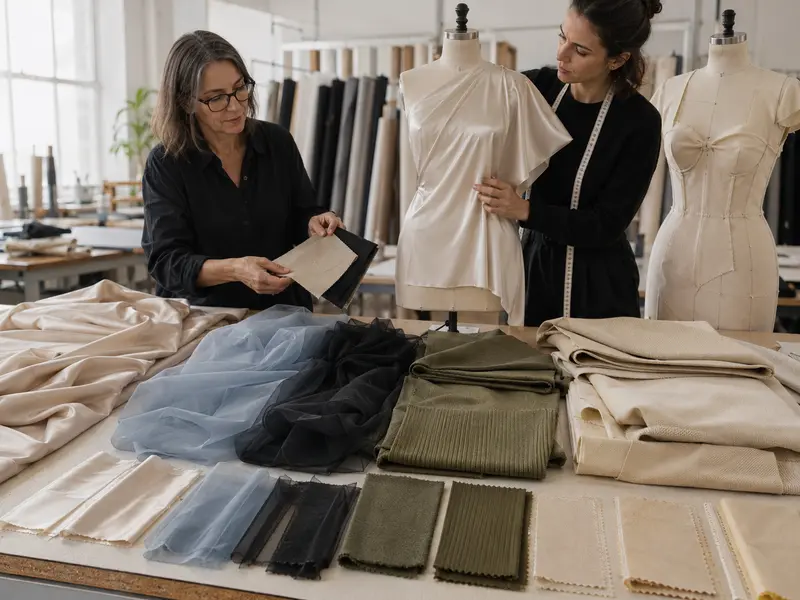
Slip dresses, soft midis, wedding-guest dresses, draped styles, and many resort maxis depend more on movement than on rigid structure. Satin is a familiar choice because its smooth face and light reflection reinforce a clean, elegant silhouette, but satin still needs the right weight and drape. A stiff version can make a slip dress look boxy, while a very thin one may show seam allowances or cling to the body. Chiffon works when transparency, gathering, layering, or floating movement are part of the design. Crepe can provide fluidity with less shine and more visual substance, and viscose or rayon can give resort and casual dresses a soft, easy fall.
Long garments reveal behaviors that small swatches hide. A fabric used in a 130-centimeter skirt panel may lengthen under its own weight, twist if cut off grain, or pull differently once a lining and hem are added. For bias-influenced designs, hanging the sample before final hem correction can expose vertical growth that would otherwise appear only after production. Fluid fabrics also need attention at zippers and side seams because a rigid closure can disrupt the softness of the shell. The best material for a maxi or slip dress is not the fabric that moves the most; it is the one that produces controlled movement while remaining stable enough for the pattern, seam construction, lining, and expected care method.
Which Fabrics Work for Party and Evening Dresses?
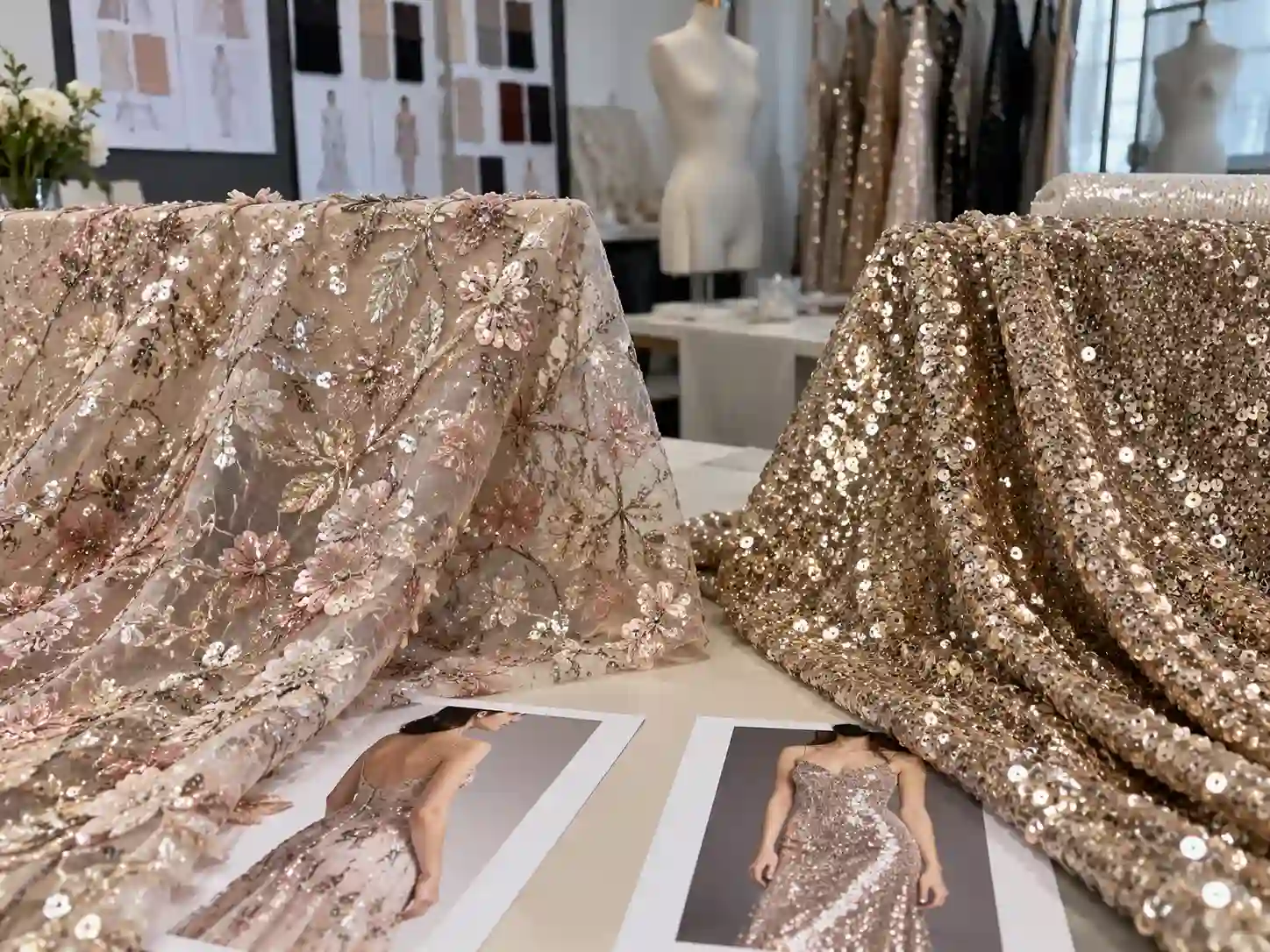
Party and evening dresses can use a wider material palette because the product may depend on shine, transparency, texture, volume, or embellishment. Satin and stretch satin suit polished occasion styles; lace adds decorative depth; mesh and power mesh create sheer panels and fitted effects; sequin fabric delivers immediate visual impact; velvet adds richness and directional nap; organza creates crisp lightweight volume; and tulle can build softer layered volume. Each of these choices changes not only the look of the dress but also the sewing sequence, lining strategy, handling requirements, and inspection points. A visually dramatic fabric usually creates a more specific production risk profile than a plain stable woven.
Sequin fabrics, for example, can increase seam bulk, cause needle breakage, create scratchy edges, and lose embellishment if seam areas are not prepared carefully. Lace quality is strongly affected by motif placement and joining, especially when a symmetrical design crosses center front or important seams. Mesh needs transparency control, stretch-direction management, neckline stability, and hole inspection. Velvet must be cut with consistent nap direction because reversed panels can appear like a different shade under the same light. These are not reasons to avoid statement materials; they are reasons to include their behavior in the design decision from the beginning. The strongest occasionwear products are usually the ones where the fabric effect and the construction method have been developed together rather than separately.
Which Fabrics Fit Resort and Office Dresses?
Resort and office dresses show how strongly use case changes fabric selection. Resort products generally prioritize softness, movement, comfort, print expression, and packability. Chiffon, rayon, viscose, linen, linen blends, and lightweight printed wovens often suit those needs, although shrinkage, wrinkling, transparency, and long-panel stability still need attention. Office dresses usually require cleaner shape retention, more controlled drape, and dependable seam definition, so ponte, crepe, suiting fabrics, and structured knits are more natural directions. A fabric that feels perfect for a breezy vacation maxi can look unfinished in a tailored midi, while a dense suiting may feel too rigid or warm for a resort collection.
The same logic applies within one category. A linen-rich resort dress may intentionally show natural creasing because that texture supports the relaxed aesthetic, while a smooth viscose print may be chosen when the brand wants a softer, more fluid look. In officewear, a ponte dress may offer comfort without losing shape, whereas a woven suiting can produce sharper darts and seams but less stretch. Climate, target market, care expectations, and selling price should all sit beside silhouette when making these choices. Experienced development teams rarely ask which fabric is ‘best’ in the abstract. They ask which material makes the specific dress look convincing in its intended setting and remains practical to produce at the planned quality level.
How Do Popular Dress Fabrics Compare?
Popular dress fabrics are best compared by behavior rather than reputation. Satin gives sheen and elegant drape, chiffon gives light movement, crepe balances fluidity with a quieter surface, jersey provides body-following stretch, and ponte adds structure. Lace, mesh, viscose, rayon, linen, velvet, organza, tulle, and sequins each solve different visual or technical needs, so ‘better’ always depends on the dress.

How Do Satin and Stretch Satin Compare?
Satin is often spoken about as though it were one luxury material, but it is a weave structure and can be produced from different fibers with very different performance. Polyester satin, viscose-rich satin, acetate satin, silk satin, and stretch satin may photograph similarly while behaving differently under a needle, around a zipper, or after pressing. Standard satin works well in slip dresses, cocktail dresses, bridesmaid styles, and many evening garments because its smooth face and directional shine create a polished surface. Stretch satin adds elasticity, which can make fitted party, bodycon, or corset-inspired styles easier to wear, but the pattern and seam construction must account for that movement rather than treating the material like a non-stretch woven.
Satin also makes production flaws visible. Puckered seams, needle marks, press marks, snagging, shade differences, and zipper waviness often stand out more on a smooth reflective surface than on a textured crepe. Stretch satin adds another variable: the shell may move while the zipper tape, lining, or stabilizer does not, creating tension that shows on the outside. When comparing options, review weight, drape, shine level, back-face texture, stretch, recovery, snag sensitivity, wrinkle behavior, and lining compatibility. A brighter or more expensive satin is not automatically the stronger production choice. The best one is the material that gives the desired sheen while still allowing seams, fit, pressing, and bulk reproduction to stay controlled.
How Do Chiffon and Crepe Compare?
Chiffon and crepe can both create elegant movement, yet they communicate very different visual weight. Chiffon is light, airy, and usually transparent, which makes it useful for gathered sleeves, tiered skirts, overlays, bridesmaid dresses, and flowing maxi silhouettes. Its lightness also creates handling challenges: layers can shift during spreading, cut edges can fray, seam allowances remain visible, and hems need clean control. Crepe is a broader family that can range from lightweight and fluid to more structured. Its characteristic surface reduces shine and can make minor wrinkles or seam irregularities less obvious than they would be on a satin face.
The right comparison begins with the silhouette. If the design needs floating layers, visible transparency, and soft volume, chiffon has a natural advantage. If the dress needs more body, cleaner seam definition, and a quieter surface, crepe may be more suitable. The two can also work together, for example a stable crepe body with chiffon sleeves or an overlay. Production teams should still confirm how each material reacts to lining, pressing, narrow hems, and long hanging lengths. Asking whether chiffon is ‘better’ than crepe is not especially useful. Asking whether the dress needs air and layering or controlled fluidity gives the sourcing team a question that can actually be answered with samples and measurable fabric behavior.
How Do Jersey and Ponte Compare?
Jersey and ponte are both knitted fabrics, but the finished dresses they create can be noticeably different. Jersey usually feels softer and follows the body closely, making it useful for ruched styles, date-night dresses, casual fitted products, and relaxed bodycon silhouettes. Lightweight jersey can be comfortable and fluid, but it may also become transparent when stretched, curl at cut edges, grow after wear, or show underwear lines. Ponte is generally denser and more stable, which allows it to support cleaner panel lines, smoother surfaces, and a more structured silhouette while still offering some stretch and comfort.
That extra structure is useful for fitted midi dresses, office styles, clean bodycon products, and panelled silhouettes where the brand wants a smooth look rather than the softer cling of a fine jersey. The trade-off is weight and warmth. A heavy ponte can feel excellent in cooler-season officewear but too dense for a summer party range. Jersey and ponte also react differently to seams and grading, so one should not replace the other without reviewing the sample. Compare opacity, stretch, recovery, weight, surface texture, edge behavior, and how the garment returns after movement. The question is not which knit is more premium; it is which construction gives the silhouette enough softness or enough control for the intended dress.
How Do Lace, Mesh, and Statement Fabrics Compare?
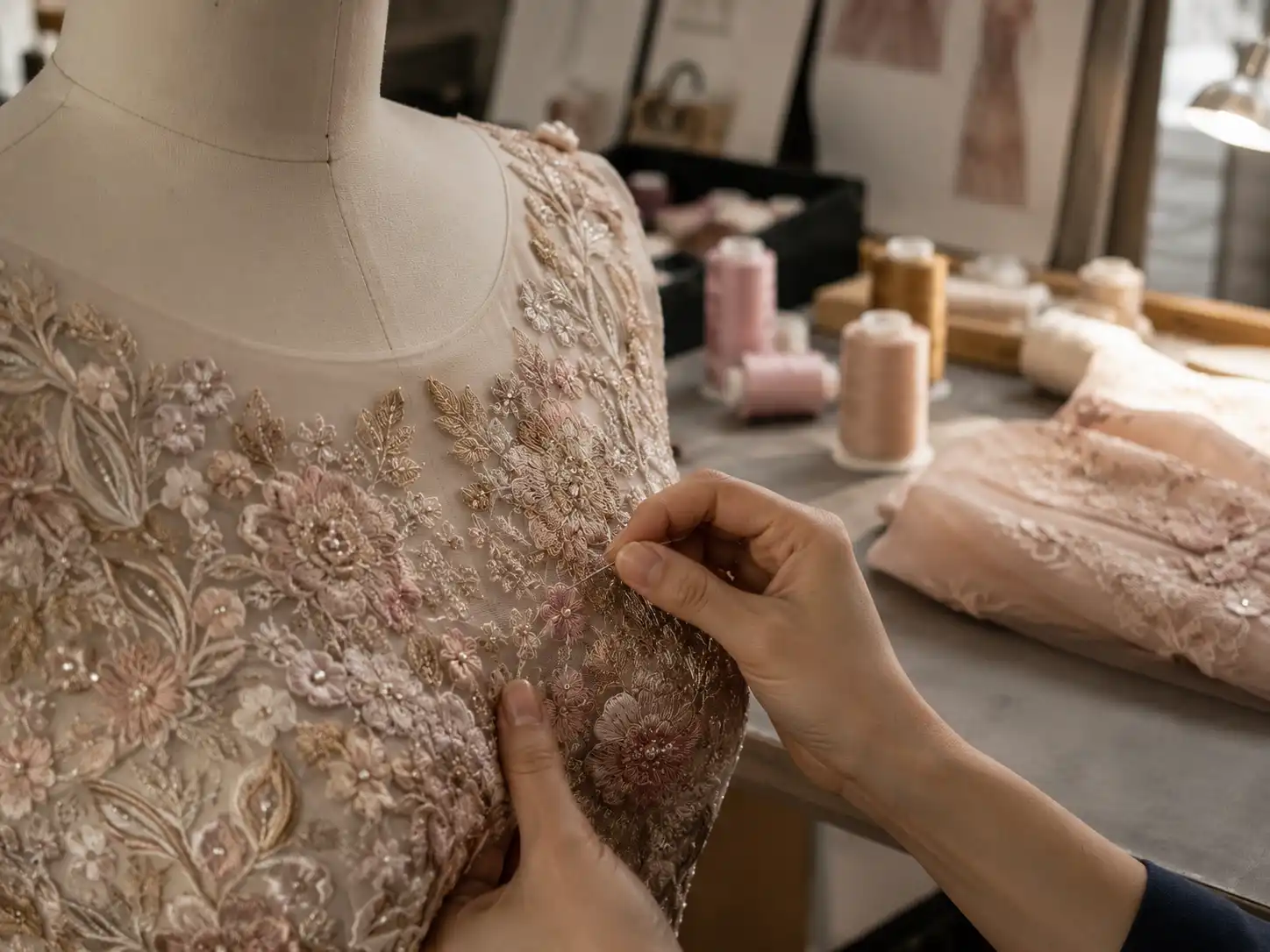
Lace, mesh, velvet, sequins, organza, and tulle often provide the strongest visual identity in a collection, but they are less forgiving than plain stable fabrics. Lace depends on motif scale, edge design, placement, joining, and lining color. Mesh depends on transparency, stretch direction, hole resistance, and edge stability. Velvet adds rich depth but introduces nap direction and pressing sensitivity. Sequin fabric brings immediate sparkle but also creates seam bulk, possible skin irritation, embellishment loss, and needle-management issues. Organza gives crisp lightweight structure, while tulle can range from soft layering to much firmer volume depending on construction.
These materials should therefore be compared by the specific effect they create and by the manufacturing controls that effect requires. A lace overlay and a printed mesh can both create transparency, but they will not be cut, joined, lined, or inspected in the same way. Organza and tulle can both add volume, yet one may produce sharper architectural shape while the other gives softer layers. Velvet and sequins can both feel luxurious in eveningwear, but their weight, comfort, packing, and surface risks differ. Statement fabric selection works best when the product team accepts that the visual feature is also a technical feature. The stronger the surface effect, the more important it becomes to sample the exact seam, edge, closure, and lining solution before bulk approval.
How Does Fabric Affect Dress Manufacturing?
Fabric affects almost every manufacturing stage, including spreading, cutting, sewing, pressing, fitting, lining, inspection, and packing. Slippery materials can shift, stretch fabrics can distort, satin exposes puckering, mesh can tear or grow, lace needs placement control, and embellished fabrics complicate sewing. Manufacturing quality therefore starts with understanding fabric behavior before the first production pieces are cut.
How Does Fabric Affect Cutting?
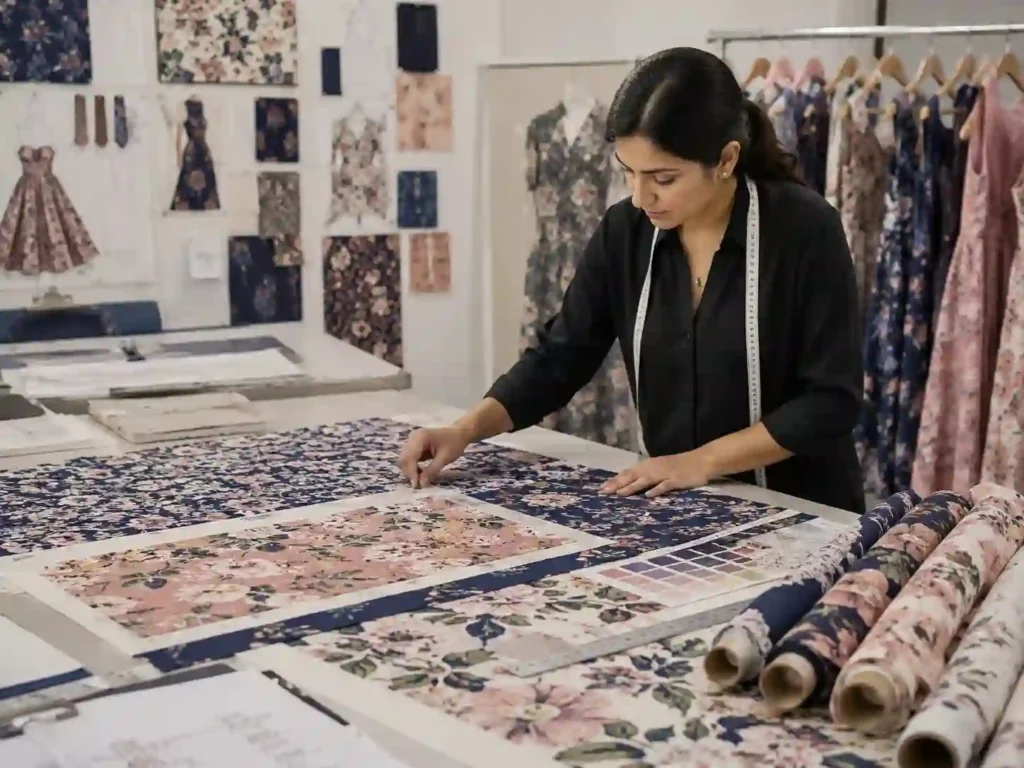
Cutting is the first stage where fabric behavior becomes a production problem rather than a swatch-room observation. Stable woven materials generally stay where they are placed, while chiffon, satin, viscose, mesh, and stretch knits can shift, distort, or lengthen if the spreading process adds too much tension. Directional prints, stripes, checks, velvet nap, lace motifs, and border designs create extra marker restrictions because pattern pieces cannot simply be rotated to improve fabric yield. Stretch fabrics add another risk: if the cloth is pulled during spreading and cut while under tension, the pieces can shrink back afterward and become smaller than the pattern intended.
Before bulk cutting, a production team should confirm the fabric face, grain direction, stretch orientation, nap or print direction, usable width, shade grouping, defect areas, layer stability, and any motif-matching requirement. Those restrictions should be understood before final consumption is calculated because the most efficient marker on a computer may not be practical on the real fabric. A few percentage points of theoretical fabric saving are not useful if the dress later twists, if velvet panels reflect light in different directions, or if a floral print looks unbalanced across the garment. Cutting control is therefore part of product quality, not merely a cost-efficiency exercise, especially in women’s dresses where long panels and visible surface effects make orientation errors easy to notice.
- Fabric face and grain direction
- Stretch, nap, or print orientation
- Usable width and defect areas
- Shade grouping and layer stability
- Pattern or motif matching requirements
How Does Fabric Affect Sewing and Seams?
Every seam asks the textile to accept needle penetration, thread tension, feeding pressure, stretching, and pressing. Different materials expose different weaknesses. Satin can highlight even slight puckering because light travels across a smooth reflective face. Fine mesh can stretch around necklines and armholes if the edge is not controlled. Jersey seams may become wavy when machine feed and tension do not suit the fabric. Lace requires thoughtful joining and edge finishing, while sequin fabric can cause needle breakage and may need embellishment removed from seam allowances before assembly.
Good sewing therefore means different things on different materials. Needle size, stitch type, thread, seam allowance, machine setup, presser-foot pressure, feeding method, stabilizer, and pressing technique may all need to change. The most useful quality system is fabric-specific rather than generic. Satin should be checked for puckering, snagging, needle marks, shade, zipper flatness, and packing creases. Mesh needs hole inspection, stretch consistency, transparency, neckline stability, and seam control. Lace needs motif placement and lining review. Sequin garments need attention to missing embellishment, rough edges, seam bulk, and internal comfort. When those risks are defined before production, operators and inspectors know what matters instead of relying on a vague instruction to ‘sew carefully.’
How Does Fabric Change Fit?
Fit problems are not always pattern problems. A sample can feel tight because the new fabric stretches less than the approved one, a neckline can gape because the material has poor recovery, a long skirt can grow because the cloth elongates under its own weight, and a side seam can twist because the panel was cut off grain. This is why changing fabric after fit approval should be treated as a product change, not merely a sourcing substitution. The same paper pattern cut in a 220 gsm stable ponte and a softer 170 gsm jersey can produce different measurements, body cling, transparency, side-seam behavior, and visual smoothness even if both fabrics look acceptable in a small swatch.
The safest approach is to identify which fit zones depend most strongly on material behavior. In a bodycon dress, review bust, waist, hip, side seam, neckline, and hem recovery. In a strapless or corset style, check upper-bust stability, cup shape, boning interaction, and whether the shell stretches away from the support structure. In a bias or fluid dress, review vertical growth, hem level, and zipper behavior after hanging. A fabric replacement should trigger another fit review whenever stretch, recovery, weight, drape, thickness, or surface friction changes meaningfully. This is one of the simplest ways to avoid repeated pattern corrections that are really attempts to force an unsuitable fabric to behave like the original material.
How Do Lining and Bulk Consistency Affect Production?
Lining introduces another fabric into the engineering of the dress. It has its own weight, stretch, shrinkage, color, friction, and recovery, so it can either support the shell or fight it. A stretch bodycon dress needs lining that allows the intended movement. Chiffon usually needs something light enough to preserve the outer fabric’s softness. Lace and mesh often require careful tonal matching because the final visible color is the combined result of shell and underlayer. Sequin fabrics may need lining mainly for comfort and protection. When the lining role is not defined clearly, fit and appearance problems can emerge even when the shell fabric itself is suitable.
Bulk consistency becomes the next challenge because an approved sample does not guarantee that every production roll will match it perfectly. Production fabric can differ slightly in shade, weight, width, hand feel, stretch, recovery, surface finish, transparency, or shrinkage tendency. The practical response is to treat bulk fabric approval as a separate gate. Compare incoming material with the approved swatch and garment, group shade where necessary, inspect visible defects, and confirm key performance points before cutting. This sequence is especially important for satin, mesh, white dresses, printed fabrics, bodycon styles, and long fluid garments because small differences can become obvious once panels are sewn side by side. Fabric quality is cheapest to correct before cutting, when the material is still a roll rather than hundreds of unfinished dresses.
What Fabric Checks Matter Before Bulk Production?
Before bulk cutting, compare the actual production fabric with the approved reference for weight, width, hand feel, color, stretch, recovery, shrinkage, transparency, surface quality, and lining compatibility. Sample approval alone is not enough because bulk material may come from another lot or dye batch and can behave differently even when the supplier article name has not changed.
Do You Need Both a Swatch and a Garment Sample?
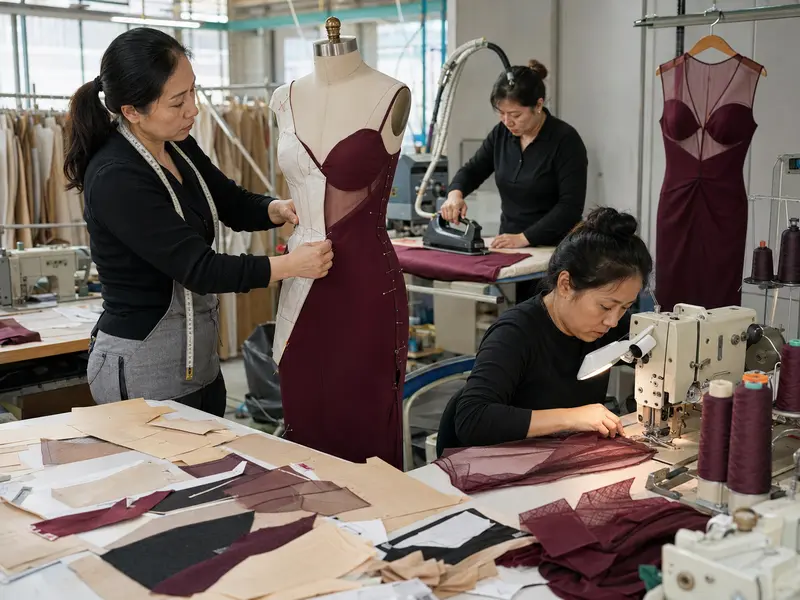
A swatch is useful for initial screening, but it cannot prove how the finished dress will behave. A small card can show color, surface texture, shine, approximate hand feel, basic stretch, and some transparency. It cannot fully show long-panel drape, bias growth, garment weight, bust transparency, zipper behavior, seam puckering, hem movement, or the interaction between shell and lining. That is why the garment sample remains essential. Once the material becomes a dress, the development team can see whether the neckline lies flat, whether the skirt moves as intended, whether the body becomes transparent, whether the zipper is stable, and whether the fabric supports or distorts the silhouette.
A useful approval sequence is swatch, first sample, fit review, revised sample where needed, pre-production reference, and then bulk fabric confirmation. When several rounds of pattern correction fail to solve the same issue, the team should reconsider the material instead of assuming the pattern is always wrong. A waving zipper may partly come from shell stretch; a neckline that keeps growing may indicate poor recovery; persistent transparency may require a heavier fabric, double layer, or different lining. Experienced development is partly about knowing when to stop adjusting the pattern and start asking whether the textile is fighting the dress. The swatch and the sample answer different questions, so using both creates a much stronger approval chain.
How Should Shrinkage, Stretch, and Recovery Be Checked?
Shrinkage can change garment measurements after washing, steaming, pressing, or normal care, so it deserves attention whenever the material or care method creates risk. Rayon, viscose, linen, cotton-rich fabrics, and selected knits are common examples, but no single shrinkage percentage should be treated as universally acceptable because tolerance depends on construction, intended care, garment fit, test method, and the brand’s own standard. The key is to use an agreed method, record the result, and connect that result to the pattern and finished-measurement tolerance rather than relying on a general assumption that a fiber is ‘safe’ or ‘risky.’
Stretch fabrics need the same discipline. Record crosswise and lengthwise extension using a consistent method, then examine how well the fabric returns after repeated stretching. Recovery matters because temporary extension is expected in a fitted dress, while permanent growth changes the garment. Also check transparency at the intended extension, especially in bodycon products and pale colors. The result should be compared with the approved sample fabric, not just with a supplier claim. A nominal composition such as 95% polyester and 5% spandex does not tell you how far the fabric stretches, how quickly it recovers, or how dense it appears on the body. Construction and finishing often matter just as much as fiber percentage.
How Should Color and Surface Quality Be Reviewed?
Color becomes more complicated as fabrics become reflective, transparent, textured, or layered. Satin can exaggerate shade and direction differences because its surface reflects light strongly. Lace and mesh can look different depending on the lining color and the number of layers. Printed fabrics add repeat position, print direction, registration, and panel placement to the inspection list. A practical review should use reasonably consistent lighting, compare shell and lining together where relevant, and keep lot or batch information connected to the material so any visible variation can be traced before different shades are mixed in one garment.
Surface inspection should also match the fabric. Satin needs attention to snags, marks, pulls, and creases. Mesh should be checked for holes, runs, or local distortion. Lace can have damaged motifs or uneven edges. Sequin fabric may show missing or loose embellishment. Printed goods can have streaks, registration problems, stains, or repeat defects. These issues are commercially important because the labor cost is already added once the fabric is sewn. Catching a surface defect on the roll is far less expensive than discovering it during final garment inspection. For visually sensitive dresses, fabric inspection is therefore not a warehouse formality; it is one of the first opportunities to protect the finished appearance.
Is Sample Fabric Approval Enough?
No. The fabric used for the first or fit sample may come from stock, a supplier cutting, an earlier dye lot, or a small development batch. Bulk fabric may be produced later and can differ slightly even when the supplier name and article number remain the same. Before cutting, compare the production material directly with the approved swatch and garment for color, weight, width, drape, stretch, recovery, transparency, surface finish, hand feel, and lining compatibility. When the style is especially sensitive, a pre-production garment made from the actual bulk fabric provides another useful check before the full order is released.
This distinction matters most when fit or visual quality depends heavily on the fabric. Bodycon styles are sensitive to stretch and recovery, white dresses to opacity and contamination, satin to shade and surface damage, mesh to transparency and hole quality, printed resort dresses to direction and color, and long viscose garments to shrinkage and vertical stability. A disciplined approval chain does not assume that a passed sample eliminates future risk. It creates physical references that can be compared at every stage, which is especially valuable for repeat orders and multi-color collections. Production becomes easier to manage when the team can point to an approved material standard instead of debating whether a new roll simply ‘looks close enough.’
The following checklist is designed to make pre-bulk approval more concrete. The exact test method and tolerance should follow the brand, product type, care instruction, and applicable quality requirement, but recording the same fields from sample through bulk gives the team a consistent way to spot material changes before they affect finished dresses, fit, appearance, or production stability.
| Check | What to Record | What It Helps Control |
| Weight | GSM or agreed supplier measure | Drape, opacity, warmth, garment weight |
| Width | Usable width in cm/in | Consumption, marker planning, cut yield |
| Shrinkage | Percentage change under agreed method | Finished measurements and care behavior |
| Cross stretch | Percentage extension | Width fit and negative ease |
| Length stretch | Percentage extension | Vertical fit, growth and hem level |
| Recovery | Return after repeated extension | Bagging, neckline growth, fit stability |
| Shade | Lot / batch reference | Panel consistency and reorders |
| Transparency | Relaxed and stretched condition | Lining and coverage decisions |
| Hand feel | Approved physical reference | Customer-perceived quality |
| Surface defects | Roll inspection record | Snags, holes, stains, print defects |
How Should Brands Source Dress Fabrics?
Dress fabric sourcing should begin with garment requirements rather than supplier catalogs. Define the silhouette, weight, drape, stretch, opacity, color, lining, care, target cost, and production needs first. Then compare swatches, make the garment sample, review fit and construction, evaluate supplier MOQ and lead time, and approve the actual bulk material before production. This turns sourcing into product development rather than textile shopping.
How Do You Start With the Dress Instead of the Fabric?

A fabric search becomes much faster when the sourcing team can describe what the finished dress needs to do. ‘Black fabric for a party dress’ leaves hundreds of possible answers. ‘Black stretch satin for a fitted mini, medium weight, smooth hand, moderate stretch, low transparency, suitable for an invisible zipper and a lined bodice’ gives the supplier a much clearer target. The same applies to a resort maxi: the brief should indicate whether soft drape, print quality, breathability, low weight, packability, or reduced shrinkage risk matters most. The design does not need to arrive as a perfect technical specification, but the team should define enough priorities to separate suitable fabrics from attractive but irrelevant ones.
A practical sourcing brief usually includes product category, reference image or sample, intended silhouette, season, target market, desired hand feel, drape, approximate weight direction, stretch requirement, transparency limit, lining expectation, color, surface finish, target garment cost, and planned order quantity. For custom dress programs, it also helps to indicate whether the material will be used across several styles or colors because that changes fabric MOQ and cost planning. Jinfeng Apparel’s fabric-development system follows this garment-first logic across chiffon, satin, stretch satin, lace, mesh, power mesh, jersey, rib knit, ponte, crepe, velvet, sequins, organza, tulle, rayon, viscose, linen, denim, suiting, and blended fabrics, with the actual recommendation shaped by silhouette, hand feel, drape, stretch, transparency, lining, cost, and production risk.
How Should Cost and MOQ Be Managed?
Fabric cost should be judged in the context of the finished garment rather than only as a price per meter. A cheaper textile can increase total cost if it creates greater cutting waste, needs an extra lining layer, slows sewing, produces more defects, requires repeated sample revisions, or fails to deliver the visual level needed for the selling price. A more expensive fabric can sometimes simplify construction or improve perceived value enough to justify the difference. Good cost engineering looks at the complete dress, including consumption, trims, labor, lining, quality control, packing, and expected reject risk, instead of assuming that the lowest fabric quote is automatically the most commercial choice.
MOQ is equally important because the garment factory and the upstream fabric supplier do not always have the same minimum. Custom weaving, custom dyeing, exclusive prints, specialty lace, special sequin bases, and some recycled or certified material programs can carry separate supplier requirements. Multi-color collections make this more visible because the total garment quantity may be healthy while each color remains below a dye minimum. Common solutions include using available stock fabric, selecting existing supplier colors, consolidating color quantities, choosing a near-equivalent construction, adjusting composition, or finding a supplier whose minimum suits the program. The goal is not to force every design into the cheapest available textile; it is to protect the product’s key appearance and performance while keeping the order commercially workable.
How Should Fabric Alternatives Be Evaluated?
Fabric substitution is normal in commercial development because the original material may be unavailable, too expensive, too slow, or tied to an impractical supplier minimum. The mistake is assuming that an alternative only needs a similar fiber composition. For a satin slip dress, the priorities may be surface appearance, drape, weight, hand feel, opacity, and seam behavior. For a bodycon dress, stretch, recovery, opacity, weight, and surface may matter more. Two fabrics with the same fiber percentages can still differ dramatically in knit or weave construction, finishing, density, recovery, shine, and touch, so the replacement should be judged against the characteristics the wearer and the garment construction actually depend on.
A sensible sequence is candidate swatch, specification comparison, garment sample or relevant panel test, fit review, cost review, and bulk confirmation. Highly sensitive products may need more than one of those steps because the risk is not visible on a small cutting. Changing satin can alter zipper flatness; changing jersey can alter negative ease; changing lining can alter comfort and movement; changing mesh can alter transparency and neckline recovery. This is one area where working with a manufacturer that participates in product development rather than merely purchasing the requested fabric can save time. The useful conversation is not ‘Can you find something cheaper?’ but ‘Which properties must remain unchanged for the dress to keep its intended fit, appearance, and quality level?’
How Do You Approve Fabric for Production?
Fabric sourcing is complete only when the actual production material has been approved. A reliable path is design requirement, fabric specification, supplier search, swatch review, sample development, fit and construction review, alternative evaluation if needed, color confirmation, bulk fabric approval, incoming inspection, and then cutting. This sequence can feel slower than ordering fabric immediately, but it prevents much more expensive delays once production has started. It also creates a chain of references that supports repeat orders, because the team can retain the approved swatch, supplier information, color reference, construction notes, lining decision, and known risks rather than rebuilding the material decision from memory each season.
The same discipline applies to sustainability and certification claims. Recycled polyester, certified viscose, organic cotton, or other preferred materials may be available for suitable projects, but claims should be connected to the actual supplier, fabric, batch, and supporting documents rather than assumed from a generic category. A certified material that produces the wrong drape, poor recovery, or unacceptable transparency is still the wrong fabric for that dress. Strong sourcing therefore balances design intent, measurable performance, documentation, cost, supplier capability, and bulk consistency. When those elements are reviewed together, fabric sourcing becomes one of the most effective tools for protecting the finished collection rather than a last-minute step between design and production.
- Define the dress requirement and measurable fabric properties.
- Search suppliers and compare physical swatches.
- Develop the garment sample and review fit, construction, and lining.
- Evaluate alternatives only against the properties the dress actually needs.
- Confirm color and approve the production fabric lot.
- Inspect incoming fabric before releasing it to cutting.
Conclusion
The best fabric for a women’s dress is not the textile with the most fashionable name, the highest price, or the most impressive swatch card. It is the material that still looks, fits, feels, and performs correctly after pattern development, sampling, fitting, cutting, sewing, pressing, inspection, packing, wear, and repeat production. That is a much more demanding standard, but it is also a more useful one. When brands define the silhouette first, translate that idea into measurable fabric behavior, test the material in a real garment, and confirm the bulk lot before cutting, many common problems become easier to prevent. Satin can stay smooth around a zipper, mesh can remain stable around a neckline, jersey can recover after wear, and a viscose maxi can keep its intended length because those risks were considered before production rather than discovered afterward. For custom dress collections, thoughtful fabric selection is not a separate sourcing task; it is one of the foundations of product quality.