A stretch fabric can look perfect on a swatch card and still become the wrong material once it is cut into a dress. The difference usually appears where customers actually feel it: across the bust when they raise their arms, around the hips when they sit, at the waist after several hours of wear, or along a hem that slowly drops while the garment hangs. Two fabrics may share a similar fiber label and weight, yet behave very differently because the direction of stretch, the amount of usable extension, and the quality of recovery are not the same.
For dresses, neither 2-way nor 4-way stretch is automatically better. Two-way stretch is often useful when a style needs controlled horizontal flexibility with stronger vertical stability, while 4-way stretch is valuable when a close-fitting garment needs meaningful movement both around and along the body. The right choice depends on silhouette, stretch percentage, recovery, garment entry, fabric weight, lining, pattern ease, dress length, and the way the wearer is expected to move.
A useful way to think about the choice is to imagine two fitting-room moments. One dress feels slightly firm when first zipped but still looks clean after dinner, sitting, walking, and standing again. Another feels amazingly soft at the first try-on, yet the waist relaxes, the seat bags, and the hem sits lower by the end of the evening. The second fabric may have had “more stretch,” but the first one had the better performance profile. That difference is what this guide is designed to explain.
What Is the Difference Between 2-Way and 4-Way Stretch?
Two-way stretch usually extends mainly along one fabric axis, while 4-way stretch extends meaningfully in both widthwise and lengthwise directions. For dresses, this affects comfort, body conformity, garment length, pattern reduction, movement, and recovery. The safest specification is not the marketing label alone, but measured stretch percentage, recovery, fabric direction, and the behavior of the material in the actual dress sample.
Stretch Direction
In commercial apparel development, a fabric described as 2-way stretch usually has its useful extension concentrated across the width. When a dress is cut in the conventional grain direction, that movement travels around the bust, waist, and hips while the shoulder-to-hem direction remains more stable. This can be a very efficient balance because most fitted dresses need circumferential comfort without necessarily needing the whole garment to grow vertically. A 4-way stretch fabric adds meaningful lengthwise extension, which allows the material to follow bending, sitting, reaching, and diagonal body movement more naturally. That extra movement is particularly useful in bodycon and close-fitting knit dresses, but it also adds another dimension that the pattern maker and production team need to control.
| Fabric Behavior | Typical 2-Way Stretch | Typical 4-Way Stretch | Dress Development Impact |
| Crosswise extension | Often 15-50%+ | Often 20-70%+ | Influences bust, waist and hip fit |
| Lengthwise extension | Often below 10-15% | Often 15-50%+ | Influences movement and dress length |
| Vertical stability | Usually higher | Depends strongly on recovery | Important for midi and maxi styles |
| Pattern sensitivity | Moderate | Higher | More stretch may require more negative ease |
| Main advantage | Controlled comfort | Multidirectional movement | Must match the silhouette |
| Main risk | Too firm for some pull-on fits | Growth or bagging if recovery is weak | Requires sample validation |
These ranges are practical apparel-development references rather than universal textile standards. Actual values vary with fiber, yarn, knit or weave construction, finishing, fabric weight, and the test method used. A technical team should treat them as comparison points, then approve the final requirement only after testing the selected fabric and evaluating it in the intended dress construction.
Terminology Can Mislead
The phrase “2-way stretch” is not used consistently across every mill, merchant, country, or production team. One supplier may use it for fabric that stretches left and right along a single axis, while another may call that “one-way stretch” and reserve “2-way” for material that stretches both lengthwise and widthwise. That inconsistency is more than a vocabulary problem when a pattern has already been developed around a specific performance requirement. A technical fabric approval should therefore describe what the material actually does. Recording crosswise stretch, lengthwise stretch, recovery, fabric direction, and an approved physical swatch gives the designer, pattern maker, sourcing team, and factory a common reference that is much harder to misunderstand than a short supplier label.
Stretch Percentage Matters
Stretch direction tells you where a fabric moves, while stretch percentage tells you how much usable movement it provides. A simple working calculation is: Stretch % = (extended length – original length) / original length x 100. If a 10 cm section extends comfortably to 13 cm, the measured extension is about 30%. If another fabric reaches 16 cm, the extension is about 60%. Both materials could still be described as 2-way stretch if the movement is concentrated across one axis, but they should not automatically use the same fitted pattern. The 60% fabric may require more negative ease or a different waist and hip balance, assuming recovery is strong enough to support that reduction. Numbers turn “medium stretch” into something a technical team can actually compare.
4-Way Is Not Always Better
More stretch can improve mobility, but it can also introduce more opportunity for the garment to move where the designer did not intend. A structured mini dress may benefit from limited lengthwise stretch because the waistline and hem remain more predictable. A fitted jersey dress may benefit from multidirectional movement because sitting and walking create tension across several axes at once. The critical question is whether the style genuinely needs vertical elasticity. If the answer is no, adding more lengthwise stretch may deliver little practical value while increasing the need to manage growth, neckline stability, and long-term recovery. Fabric selection should therefore be based on the silhouette and wearing conditions rather than an assumption that 4-way stretch is always a premium upgrade.
Which Stretch Is Better for Different Dresses?
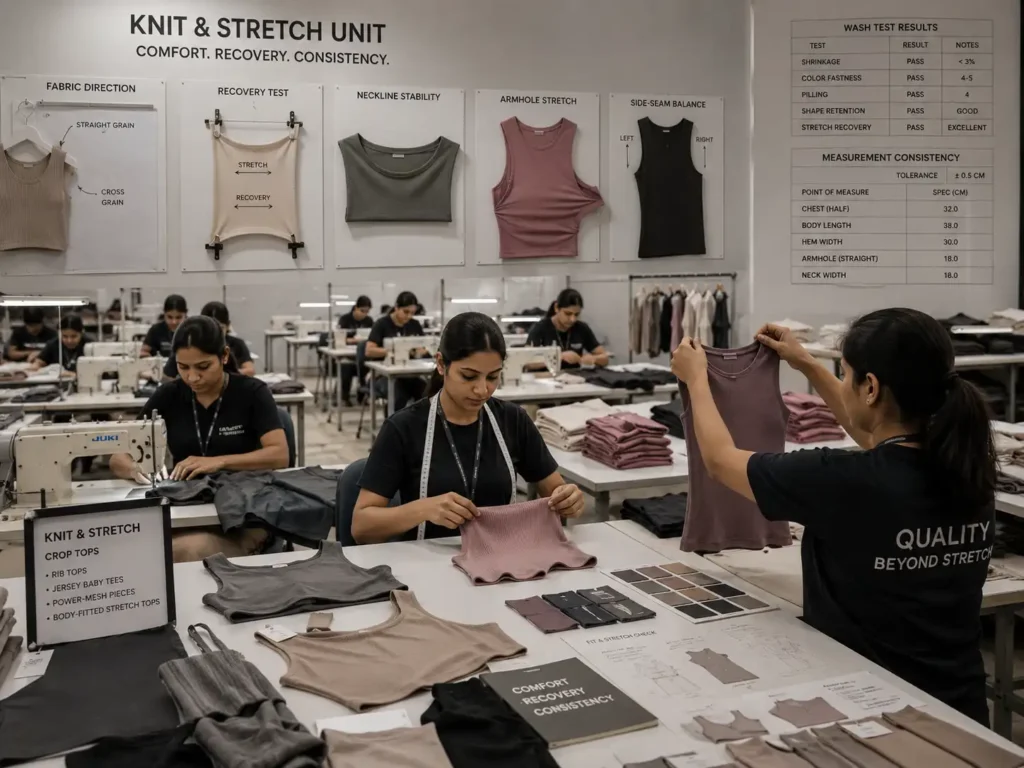
Four-way stretch is often useful for close-fitting bodycon and movement-dependent knit dresses, while controlled 2-way stretch can suit structured, tailored, or vertically stable silhouettes. The right choice depends on garment entry, fit level, skirt shape, lining, closures, fabric weight, recovery, and the amount of real movement expected during wear. A fabric should be selected for the specific silhouette rather than for stretch direction alone.
Bodycon Dresses
Bodycon dresses place some of the highest demands on stretch because the fabric works continuously over the bust, waist, hips, and seat. The garment does not only need to expand when the wearer puts it on; it must repeatedly extend and recover when she walks, sits, bends, and stands again. Four-way stretch can be very effective here because those movements create diagonal and vertical tension in addition to horizontal tension. Yet recovery is just as important as extension. A fabric with very high stretch but weak recovery may feel comfortable during the first fitting and then lose waist definition, develop looseness around the seat, or allow the skirt to creep upward. For many fitted programs, the useful starting point is not “maximum stretch” but enough crosswise extension for entry and movement, supported by recovery strong enough to restore the intended silhouette after repeated wear.
Structured Dresses
Structured and corset-inspired dresses often benefit from controlled stretch rather than maximum elasticity. Their shape may depend on boning, cups, underwire, lining, fusible support, shaped seams, and a zipper. If the shell stretches significantly while the internal construction does not, those layers begin to work against each other. The outer fabric can ripple over the lining, zipper areas can pull, and carefully engineered neckline or waist shapes can become less stable. Moderate 2-way stretch is often useful because it can provide comfort around the torso while keeping the lengthwise direction comparatively firm. Four-way stretch can still work, but the lining and support materials should be selected as part of the same system. A dress should be evaluated as a complete construction, not as an isolated shell fabric.
Knit and Occasion Dresses
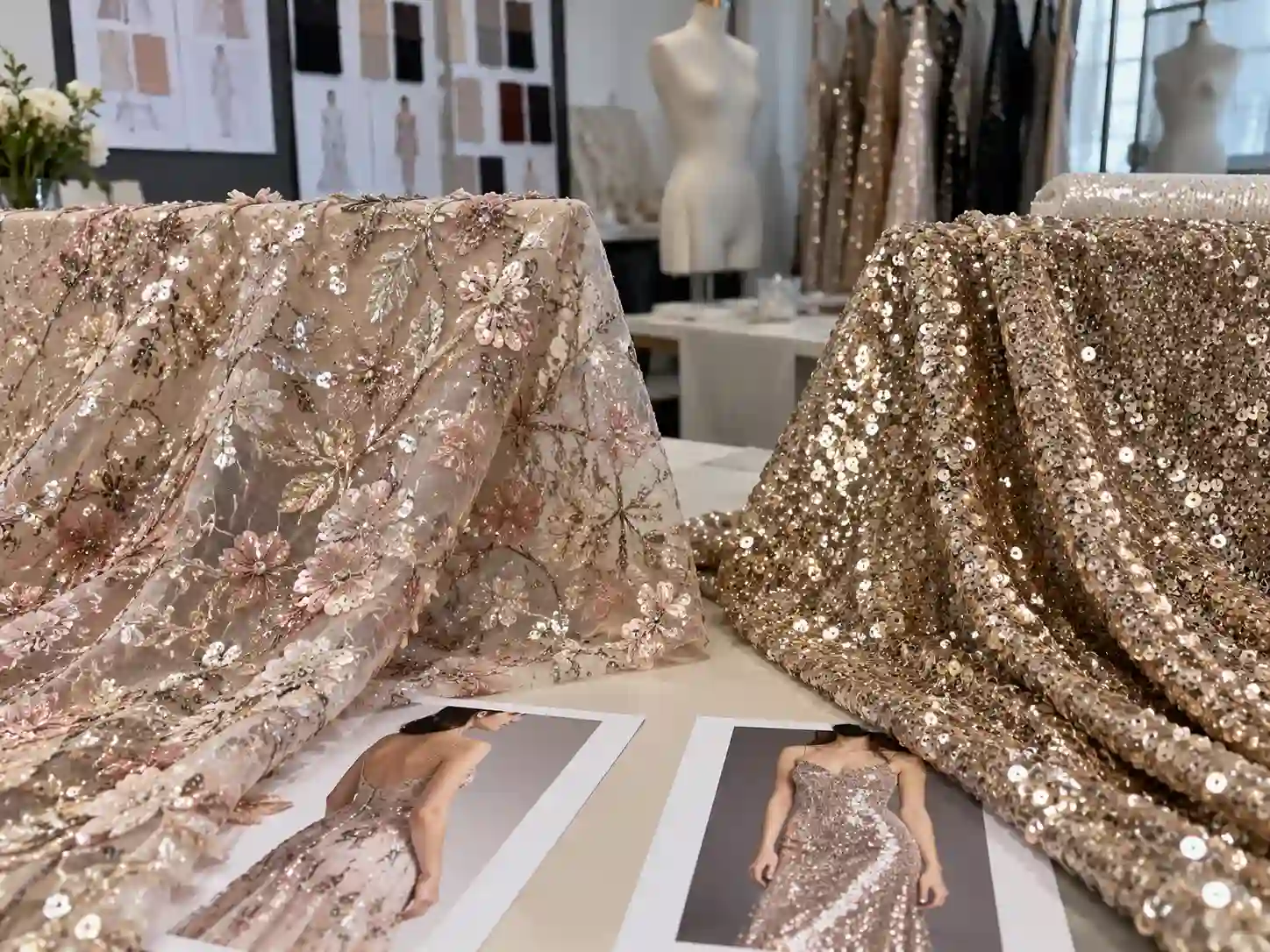
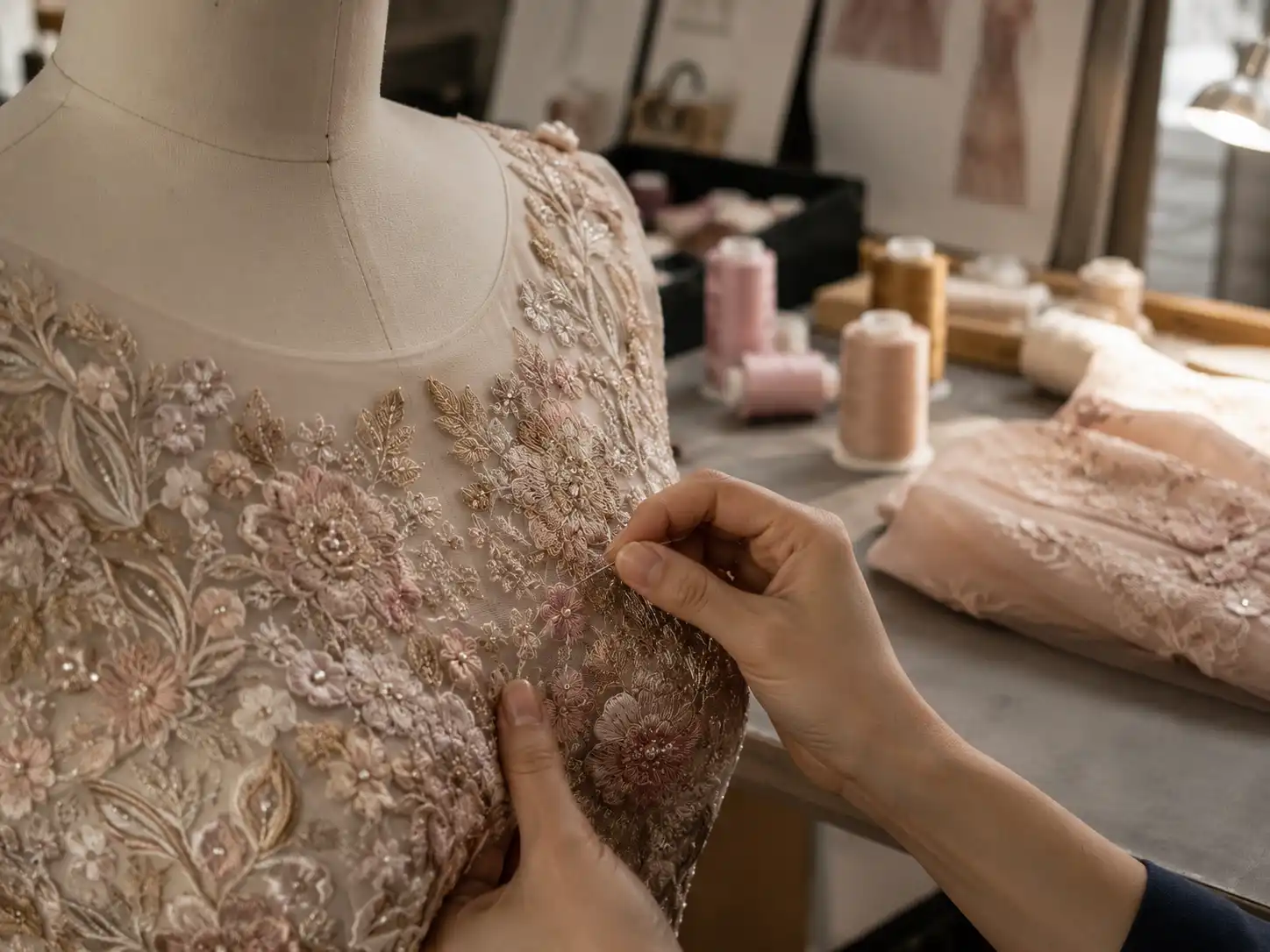
Knit, party, and occasion dresses cover an unusually wide performance range. A relaxed jersey midi dress may need relatively modest controlled stretch, while a narrow rib-knit mini dress without a zipper may depend on high extension simply to pass over the hips. A ruched mesh dress, stretch satin cocktail dress, and sequin party dress can all appear in the same fashion category but place very different demands on the base material. Embellishment can also reduce usable stretch because dense sequins, embroidery, rhinestones, bonding, or appliques restrict the movement of the underlying cloth. The starting point should therefore be the silhouette, garment entry, lining, and construction rather than the marketing category. The more a design relies on the fabric to create fit, the more carefully stretch and recovery need to be quantified.
| Dress Style | Common Stretch Priority | Practical Starting Range | Main Issue to Check |
| Bodycon mini | Strong stretch + recovery | 30-60%+ crosswise | Ride-up and bagging |
| Pull-on knit dress | Entry stretch | 35-60%+ crosswise | Passing over hips or bust |
| Ponte sheath | Controlled stretch | 15-35% | Compression and seam smoothness |
| Stretch satin dress | Moderate comfort stretch | 10-30% | Puckering and zipper stability |
| Structured corset dress | Stability | Low-moderate | Shell and lining tension mismatch |
| Ruched mesh dress | Flexible high stretch | 30-70%+ depending on mesh | Recovery and transparency |
| Long fitted knit dress | Stretch + vertical recovery | Project-specific | Length growth |
| A-line stretch woven dress | Moderate comfort | 10-25% | Shape retention |
*These values are working references for development rather than universal specifications. Final requirements should come from the approved fabric, pattern, sample fit, and brand standard. Fabric weight, lining, garment length, construction, recovery, and the way the dress is entered can move a suitable specification above or below these ranges, so a complete sample remains the final decision point.
When 2-Way Is Enough
Not every fitted dress needs 4-way stretch. Fitted silhouettes have been made for decades through darts, princess seams, shaped panels, zippers, and controlled ease, even in fabrics with little or no stretch. Two-way stretch becomes especially effective when a design mainly needs extra room around the body while vertical stability remains desirable. Consider a fitted midi dress with a center-back zipper and an A-line skirt. Its movement requirement is very different from a pull-on dress that hugs the body from bust to calf. The first may perform beautifully with moderate crosswise stretch, while the second may need greater extension. Lining also changes the answer. A 4-way stretch shell over a rigid woven lining behaves much closer to the lining in areas where the layers are joined. The best question is always where the garment must expand, how much it must expand, and how reliably it must recover.
How Do Stretch and Recovery Affect Dress Fit?
Stretch determines how far a fabric can extend, while recovery determines how effectively it returns afterward. Dress fit depends on both. Insufficient stretch creates restriction and seam stress, while excessive stretch with weak recovery can cause bagging, ride-up, length growth, and unstable necklines. Pattern ease, fabric weight, compression, and recovery must therefore be evaluated together through measurements and realistic fitting rather than through a hand-stretch test alone.
Stretch and Negative Ease
Negative ease means the finished garment is intentionally smaller than the corresponding body measurement so that the fabric must stretch to fit. If a target hip is 100 cm and the dress measures 92 cm at the same level, the garment contains 8 cm of negative ease before considering seam and construction effects. That reduction can be perfectly reasonable in a high-recovery jersey but overly aggressive in a firm stretch woven. The common mistake is reusing the same pattern reduction when a brand changes fabric. A successful bodycon block developed for soft jersey can feel very different in rib knit or compact ponte even when the fiber composition looks similar. Negative ease should also be distributed intelligently. The bust, waist, and hip do not necessarily need identical compression, and a good pattern allows those areas to behave differently rather than applying one percentage everywhere.
Recovery and Shape Retention
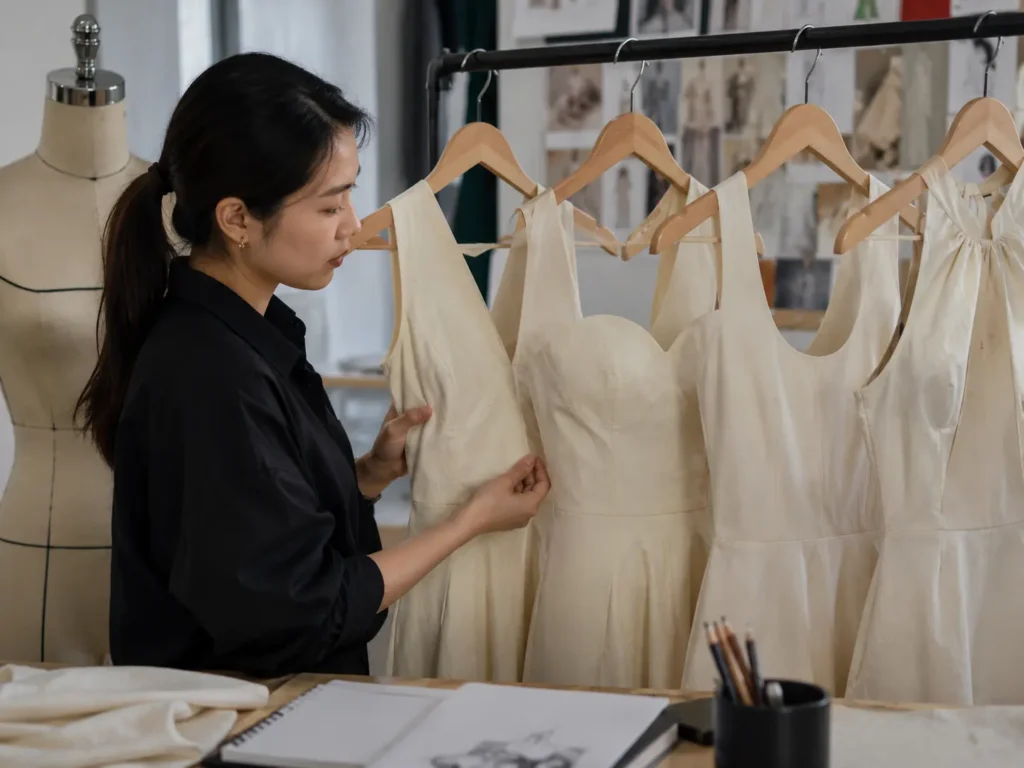
Recovery determines whether the dress returns toward its original dimensions after the fabric has been stretched. Two 10 cm swatches can both extend to 14 cm and therefore show about 40% stretch, yet one may return to 10.1 cm while the other remains at 10.8 cm. On a fitted garment, that difference can become a looser seat, a wider neckline, weaker waist definition, or extra length after prolonged wear. Repeated extension matters too. Some fabrics recover well after one pull but progressively relax after several cycles. Garment weight can magnify the problem because a long, heavy 4-way stretch dress places continuous load on the shoulder-to-hem direction. For close-fitting dresses, recovery is often more commercially important than the maximum stretch number because customers notice whether the garment still looks controlled after hours of movement.
Ride-Up and Bagging
Ride-up and bagging often appear together because both are linked to the balance between fabric behavior and pattern tension. Ride-up commonly occurs when excessive horizontal tension around the hips pulls a narrow skirt upward during walking. High negative ease, insufficient hip circumference, a tight hem, and surface friction can all contribute. Bagging occurs when the fabric remains stretched after sustained pressure, particularly around the seat after sitting. A garment can experience both problems at once: the skirt moves upward while the seat gradually relaxes. Static mannequin inspection will not reveal the full picture. During fitting, the wearer should walk naturally, sit for several minutes, stand again, bend, and raise the arms before the garment is reassessed. Side-seam position, hem level, waist placement, and surface tension should be compared before and after movement.
Bust-Waist-Hip Balance
The bust, waist, and hips create different mechanical demands in a stretch dress. The bust has three-dimensional projection, so excess tension can flatten the shape, pull the neckline downward, or push an armhole outward. The waist usually controls the visual silhouette, and weak recovery can make a sharply fitted design look straighter after wear. The hips generate some of the strongest movement during sitting and walking, so over-compression can rotate side seams, create drag lines, or encourage ride-up. Pattern makers therefore look beyond simple circumference measurements and assess where tension is traveling through the garment. A small pattern change can have a major effect in a firm ponte dress but barely register in a very soft jersey. Fit decisions should therefore be made in the approved production fabric, or in a genuinely comparable material, rather than in a convenient substitute that only looks similar.
How Do Fabric Type and Spandex Affect Stretch?
Spandex content influences elasticity but does not determine stretch performance by itself. Yarn structure, knit or weave construction, fabric density, weight, and finishing also matter. Two fabrics containing the same percentage of spandex can have very different extension, recovery, compression, and drape. For dress development, measured behavior is more useful than fiber content alone, especially when a fitted pattern, lining, or zipper depends on predictable fabric movement.
Spandex Percentage
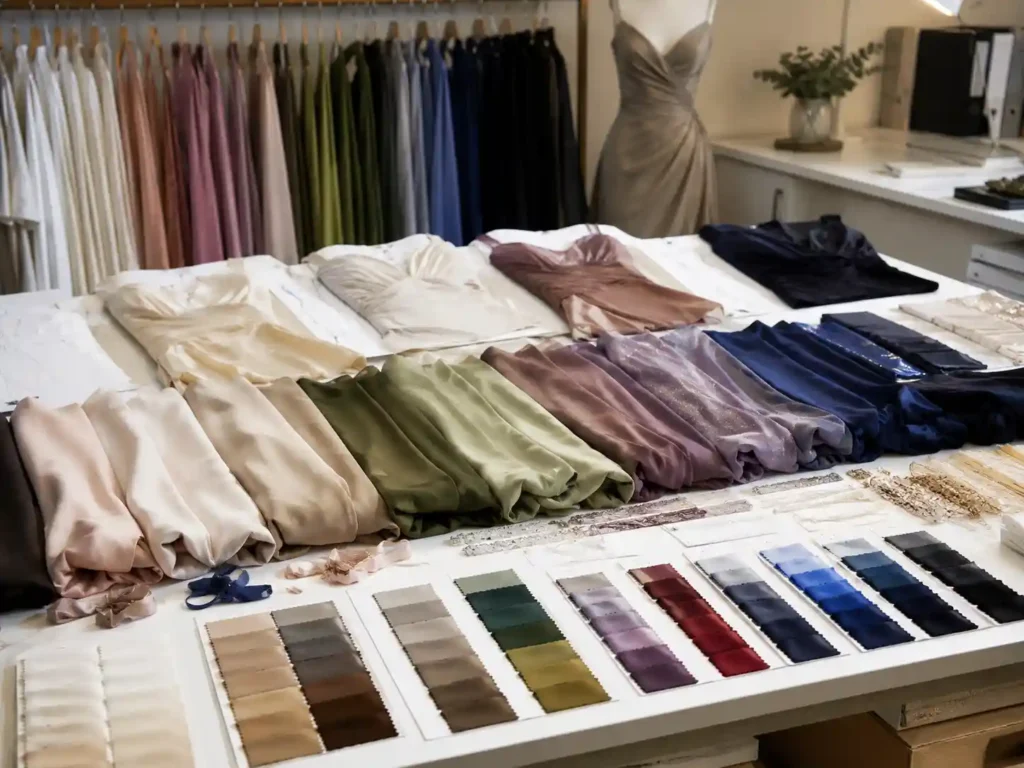
More spandex does not necessarily mean proportionally more stretch. A fabric containing 10% elastane is not automatically twice as stretchy as one containing 5% because elasticity depends on how the elastomeric yarn is integrated into the structure. A dense compact knit with relatively high elastane can feel firm and compressive, while a more open knit containing less elastane may extend farther under light tension. This distinction matters because fiber composition is often the first specification a sourcing team sees, yet it cannot tell them whether the dress will feel supportive, soft, restrictive, or unstable. A more useful fabric record combines composition with weight, usable width, crosswise stretch, lengthwise stretch, recovery, hand feel, drape, and shrinkage. For fitted garments, the force required to reach the measured extension is also important because two fabrics can stretch to the same distance while creating very different levels of body compression.
Jersey, Rib and Ponte
Jersey, rib knit, and ponte are all common dress materials, but they should not be treated as one generic “stretch knit.” Single jersey tends to feel softer and more fluid, with crosswise stretch that can suit bodycon, ruched, and relaxed silhouettes. Lightweight jersey may drape beautifully but can reveal more body contour and may require careful neckline stabilization. Rib knit has a raised structure and often substantial horizontal extension, which makes it useful in close-fitting dresses and matching sets, although some qualities can grow noticeably after wearing or washing. Ponte is generally denser and more structured, giving enough elasticity for comfort while supporting cleaner seams and a smoother silhouette. Dress jerseys frequently sit around 140-240 gsm, while rib and ponte qualities often move into roughly 180-350 gsm or more, depending on construction. The ranges overlap, but their compression, recovery, and visual structure remain different.
Stretch Satin and Wovens
Stretch satin is a good example of a material name that does not tell you the stretch direction. “Satin” refers mainly to weave and surface character, not to a fixed elasticity level. Traditional satin may have little meaningful stretch, while stretch satin often contains elastomeric yarn or a construction that provides moderate crosswise movement. That extra give can improve comfort in cocktail, party, and fitted occasion dresses, but the smooth reflective surface also exposes sewing problems more easily. Seam puckering, zipper bulging, tension marks, and pressing differences can be very visible. Stretch crepe, stretch suiting, and stretch denim follow the same broader principle: woven structure provides greater stability than many knits while added elasticity improves comfort. When reviewing these fabrics, the useful checklist includes extension in both directions, recovery, seam behavior, shrinkage, pressing response, and the effect of lining or zipper tape on actual garment movement.
Power Mesh and Layering
Power mesh is often chosen when a dress needs stretch combined with support, transparency, or internal shaping. Compared with lightweight decorative mesh, it generally offers firmer recovery and can function as a visible design layer, an internal waist panel, a bust-support component, or a shaping lining. Its performance varies widely, so “power mesh” should not be treated as a single specification. Some qualities feel soft and flexible, while others provide noticeable compression. Layering changes the behavior again. A strong power mesh joined to soft jersey can control the stretch of the entire panel, while the same mesh paired with rigid satin can create tension near seams. Transparency should also be tested under realistic extension because mesh that looks sufficiently opaque on a table may become much more transparent over the body. The complete layer system, not the relaxed swatch alone, determines how the finished dress behaves.
How Should Stretch Fabric Be Cut and Sewn?
Stretch fabric should be relaxed when necessary, cut in the approved grain and stretch direction, and sewn without excessive feeding tension. Production teams need to control seam extension, edge stability, and panel alignment. Poor handling can create twisted side seams, wavy stitching, distorted necklines, and measurement inconsistency even when the pattern and fabric are technically correct.
Grain and Cutting Direction
The direction with greater stretch is usually positioned around the body in fitted dresses because the bust, waist, and hips need more circumferential movement than vertical movement. That principle can become complicated when the material also has a directional floral print, satin shine, rib texture, nap, or another visible orientation. Suppose a fabric has about 40% crosswise stretch and only 8% lengthwise stretch. Rotating the front and back bodice pieces by 90 degrees to improve marker efficiency could suddenly leave the garment with only 8% usable extension around the bust. The marker may use less fabric while making the dress substantially harder to wear. Stretch direction should therefore be included in the cutting information, especially for repeat orders or multi-factory production. Fabric utilization matters, but it should never be optimized by quietly changing the direction that established the approved fit.
Fabric Relaxation
Stretch fabrics can arrive on rolls under tension, which means their dimensions immediately after unrolling may not represent their stable dimensions. If material is spread tightly and cut before it has recovered, panels can contract afterward and finished garments may measure smaller than expected. There is no responsible universal rule that every knit needs an identical number of relaxation hours because suitable time depends on construction, roll tension, finishing, elastane content, storage, and production conditions. The practical approach is to compare the fabric before and after resting during development. If meaningful dimensional change appears, the factory can establish a controlled relaxation process for that quality. Operators should also avoid pulling the cloth straight simply to make selvages look neat because this can introduce fresh tension. Repeatability matters more than a fashionable single number, especially when the same style is produced in several colors or batches.
Seam Stability
A stretch seam needs enough flexibility to move with the garment without becoming visually unstable. Wavy seams often develop when the fabric is stretched during sewing and does not fully recover after passing under the presser foot. Excessive pressure, operator pulling, unsuitable thread tension, incorrect feeding, or an inappropriate stitch construction can all contribute. The correct response depends on the function of the seam. A bodycon side seam needs more extension than a stabilized zipper seam, while a neckline may require controlled reinforcement to prevent growth. Sewing trials should use the actual production fabric because seemingly similar substitutes can react differently to feed and heat. After sewing, the seam should be allowed to recover before appearance is judged. Pressing can temporarily flatten waviness, so quality should be checked again after cooling. A good seam stays smooth while retaining the movement that the garment actually needs.
Twist and Length Growth
Side-seam twisting and vertical growth become especially visible in narrow stretch dresses. A side seam that rotates toward the front or back can result from off-grain fabric, marker misalignment, unequal panel feeding, or tension that is not balanced across the body. The investigation should start with fabric and cutting rather than assuming sewing is always responsible. Length growth is a different problem and often becomes more important in 4-way stretch midi and maxi dresses because gravity continuously loads the material. A long skirt places much more vertical force on the same fabric than a mini dress. Useful checks compare garment length immediately after sewing, after an agreed hanging period, after pressing, and after the intended care process when relevant. If the hem drops unevenly, the solution may involve settling before hemming, changing the pattern, stabilizing selected areas, or choosing a more suitable fabric.
How Do You Test Stretch Fabric Before Production?
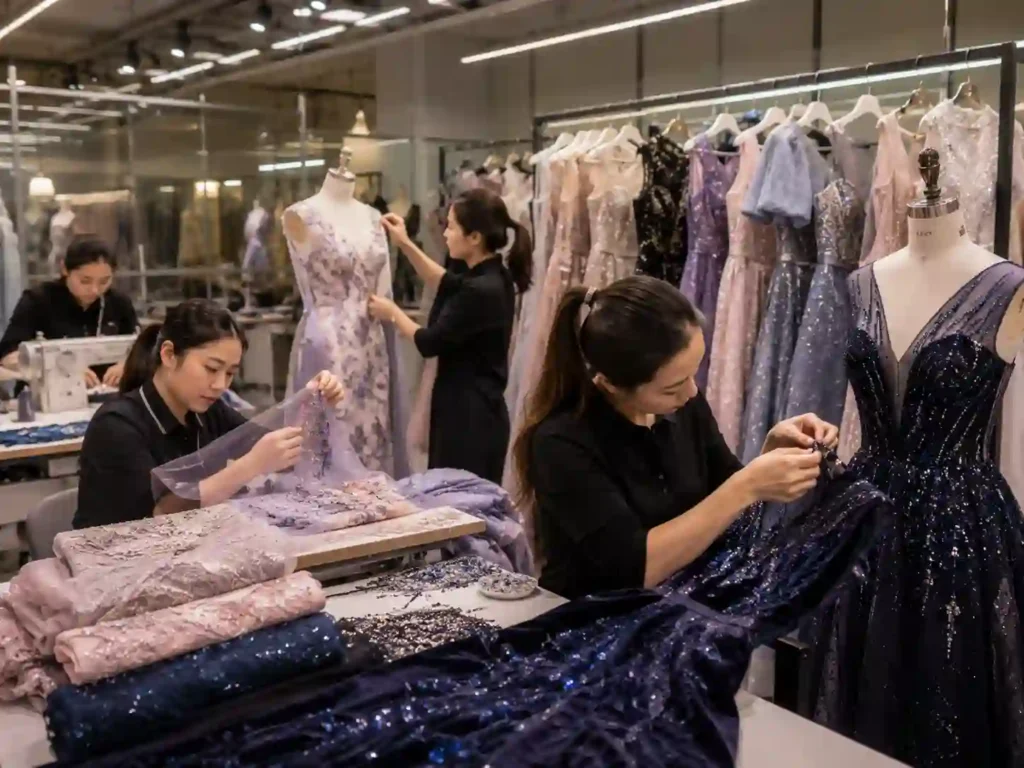
Before bulk production, measure stretch in both directions, evaluate recovery after extension, check dimensional change after the intended care process, and validate the fabric in a complete fit sample. Bulk fabric should then be compared with the approved reference because changes in stretch or recovery can alter fit even when color, weight, and composition appear similar.
Stretch and Recovery Tests
A useful stretch test begins with a controlled original measurement rather than a subjective hand pull. Mark a 10 cm section away from the selvage and extend it smoothly to a realistic working limit without forcing permanent deformation. If the marks move from 10 cm to 14 cm, the measured stretch is about 40%. Repeat the procedure across the width and along the length because one direction may behave very differently from the other. Recovery should then be checked after release, immediately and, where useful, after a short resting interval. Repeated cycles can reveal progressive growth that a single extension misses. A numerical result becomes even more useful when it is paired with a sealed swatch because numbers alone cannot capture compression, thickness, softness, or surface feel. The aim is to create a reproducible reference that can follow the fabric from development into production.
| Test | Example Starting Measurement | Example Result | Development Meaning |
| Crosswise stretch | 10 cm | Extends to 14 cm | Approx. 40% stretch |
| Lengthwise stretch | 10 cm | Extends to 12 cm | Approx. 20% stretch |
| Immediate recovery | 10 cm original | Returns to 10.2 cm | Small residual extension |
| Repeat recovery | After several cycles | Returns to 10.5 cm | Possible bagging risk |
| Wash stability | 50 cm marked length | Returns at 48.5 cm | Approx. 3% length shrinkage |
| Garment hanging | 100 cm dress length | Becomes 101.5 cm | Approx. 1.5% vertical growth |
These examples illustrate the calculation method rather than universal pass/fail limits. Acceptance criteria should reflect the dress silhouette, brand fit standard, fabric construction, care method, and intended wearing conditions. A lightweight jersey mini, a heavy ponte midi, and a lined stretch-satin cocktail dress can all require different tolerances even when their initial stretch readings appear similar, so the garment sample remains essential.
Shrinkage and Stability
Stretch does not protect fabric from dimensional change. Knits can shrink through relaxation, laundering, steaming, or heat, while rayon and viscose blends may change noticeably depending on construction and finishing. Synthetic stretch fabrics may also respond poorly to excessive pressing temperature even when normal washing shrinkage is limited. Testing should therefore measure widthwise and lengthwise change separately. If a marked 50 cm section becomes 48.5 cm after the agreed care process, the dimensional change is about -3%. On a long dress, that percentage can translate into several centimeters of length. The pattern maker needs to know this before grading and final production, not after finished goods have been delivered. Testing should also reflect the garment’s actual care instruction. The goal is not to demand zero movement from every textile; it is to understand predictable movement early enough to engineer around it.
Fit Sample Validation
A stretch fabric should not be fully approved from a tabletop test because the body changes how tension is distributed. During a fit session, the technical team should inspect neckline position, bust compression, waist definition, hip tension, side-seam alignment, zipper behavior, and hem level before asking the wearer to move naturally. Walking, sitting for several minutes, standing again, lifting the arms, and bending can reveal ride-up, bagging, or neckline growth that a static fitting misses. The garment should then be remeasured and compared with the approved pattern and fit standard. If a fabric is replaced after fitting, the result should not be transferred automatically to the substitute material just because the composition and weight look similar. Differences in recovery, thickness, or compression can be enough to justify another sample.
Bulk Production Control
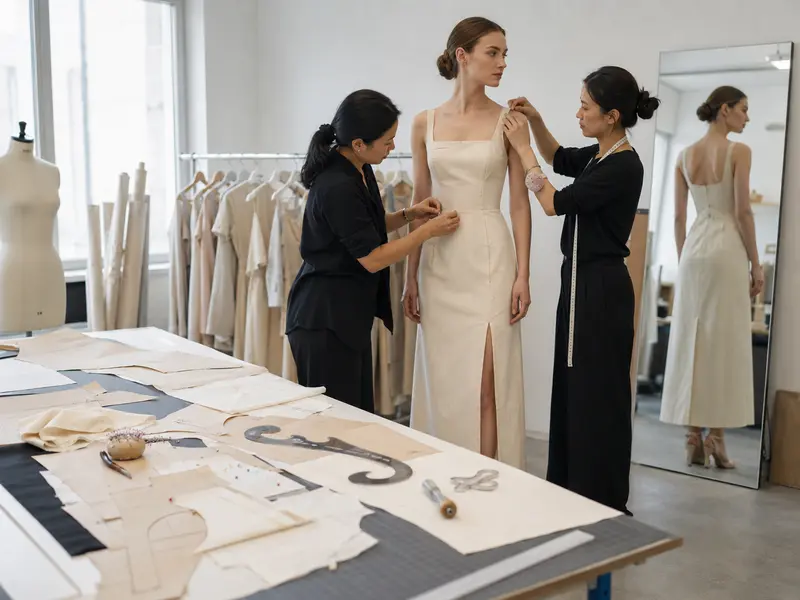
Bulk production is where an apparently good fabric decision has to become repeatable across rolls, colors, sizes, and sewing lines. Incoming fabric should be compared with the approved reference for shade, hand feel, weight, stretch, and recovery. Cutting teams should confirm relaxation, grain direction, and marker orientation, while sewing teams monitor seam waviness, neckline stability, zipper flatness, and left-right symmetry. Finished garments should be checked particularly closely at bust, waist, hip, and total length when the style is fit-sensitive. An approved pre-production or sealed reference garment remains valuable because two dresses can measure similarly on a table while behaving differently on a body. For brands working with Jinfeng Apparel on stretch dresses, fabric review, pattern adjustment, sample validation, and bulk consistency can be treated as one connected development process rather than separate handoffs.
Conclusion
Choosing between 2-way and 4-way stretch becomes much easier once the decision is tied to the dress rather than to the biggest stretch number on a swatch card. A structured cocktail dress may perform better with controlled horizontal give and strong vertical stability, while a pull-on bodycon style may need balanced multidirectional movement. A long knit dress can introduce vertical-growth concerns that barely matter in a mini, and a stretch satin shell can lose much of its mobility when paired with a rigid lining or zipper construction. The most reliable development process measures stretch, reviews recovery, tests shrinkage, checks grain direction, fits the actual sample, and then carries the approved fabric behavior into bulk control. For brands developing bodycon, jersey, rib-knit, ponte, stretch satin, power-mesh, or other fitted dress programs, discussing the intended silhouette and fit standard with an experienced manufacturing team before fabric approval can prevent expensive pattern changes later and make repeat production far more predictable.