Skip to content

A lower quotation can look like the obvious win when a fashion brand is comparing suppliers, but the cheapest line on a spreadsheet rarely tells the whole story. The real differences appear when a sample needs three fit corrections, a custom satin is delayed, a zipper starts rippling in bulk production, or the factory behind the approved sample is suddenly replaced by another workshop. At that point, sourcing becomes less about who offered the lowest unit price and more about who can control the product, communicate clearly, correct problems, and keep the approved standard intact.
For fashion brands that need custom development, consistent fit, transparent production, and repeat orders, a capable direct dress factory is usually the stronger long-term model. A trading company can still be the better choice when the main need is broad supplier sourcing, multi-category coordination, or outsourced local management. The right decision depends on control over development, quality, capacity, cost, and delivery rather than the supplier’s label alone.
That distinction matters especially in dresses. A bias-cut satin slip, structured corset mini, lined mesh style, or sequin occasion dress can involve pattern balance, fabric behavior, lining placement, reinforcement, seam construction, pressing, and several rounds of sample correction. A beautiful first sample proves very little if the bulk order is made elsewhere without the same pattern, people, materials, or QC standard. The most useful comparison is therefore not “factory good, trading company bad.” It is a closer look at who owns each critical decision from the first pattern to the final carton.
What Is the Difference Between a Dress Factory and a Trading Company?
A dress factory directly manages garment development and at least part of physical production, while a trading company usually coordinates orders through external factories. For fashion brands, the meaningful difference is who controls patterns, samples, materials, production allocation, quality corrections, and delivery. A strong supplier makes those responsibilities visible, regardless of whether its commercial structure is factory-led, trading-led, or a controlled combination of both.
Production Control
A genuine dress manufacturer sits close to the decisions that physically change the garment. Pattern makers can review neckline shape, bust ease, waist position, hip balance, sleeve mobility, and hem proportions before the first sample is sewn. Sample machinists can flag construction details that look attractive in a sketch but become unstable in the chosen fabric. Production managers can judge whether a method that works for five samples will remain practical when the order becomes several thousand pieces, while QC staff can catch recurring defects before the line has produced too much inventory.
This proximity matters because dresses are rarely simple cut-and-sew products. A fitted satin style may depend on grain direction, lining tension, zipper stiffness, seam tension, and pressing temperature. A mesh dress can require decisions about stretch recovery, reinforcement, transparency, and lining coverage. A corset style adds cup placement, boning position, shaped seams, and tighter measurement tolerances. When development and production sit within the same technical system, the team can trace these interactions more quickly instead of treating every issue as an isolated complaint from the client.
A factory does not need to manufacture every input internally to maintain control. Fabric mills, dye houses, printers, embroidery units, lace suppliers, zipper makers, and specialist embellishment workshops are normal parts of apparel production. The important question is whether the garment manufacturer owns the approved specification, manages the production route, checks critical stages, and remains accountable for the finished result. Direct manufacturing is valuable only when that control is real and documented.
Trading Company Coordination
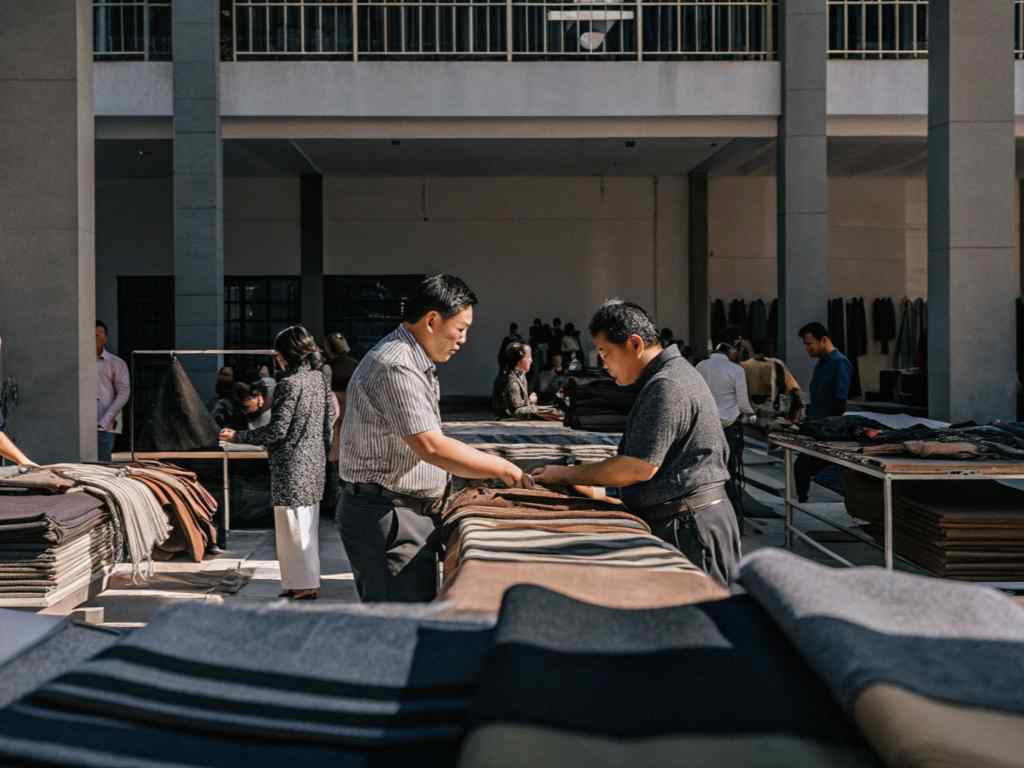
A trading company creates value in a different way. It may source factories, collect quotations, arrange samples, negotiate materials, coordinate production, organize inspections, prepare export documents, consolidate shipments, and provide one commercial contact for the brand. That can be very efficient when a collection includes unrelated categories such as dresses, knitwear, accessories, bags, scarves, and branded packaging, because the brand does not need to build and manage a separate supplier relationship for every item.
The trade-off is communication distance. A technical comment such as “lower the back neckline by 8 mm without changing shoulder width or armhole depth” may pass from the brand to a merchandiser, from the merchandiser to the trading company, and then from the trading company to the factory pattern maker. Every handoff creates a chance that context disappears. The original request can gradually become “make the back lower,” which is not enough information for a technically controlled correction.
Strong trading companies reduce this risk through technically experienced merchandisers, stable partner factories, written sample histories, controlled measurement files, and clear responsibility when production changes. Weak trading companies simply forward messages and add margin. The difference is easy to see during sampling: a capable intermediary explains the technical consequence of a requested change, while a weak one only confirms that the factory “can do it” without showing how the change will be executed.
Responsibility Matters More Than Labels
The biggest sourcing mistake is assuming that “factory” automatically means strong control and “trading company” automatically means weak control. A factory can outsource production without explaining where the order goes. A trading company can maintain better technical records than a poorly managed factory. A factory may be excellent at basic woven dresses but struggle with structured corsetry, while a trader may work with several specialist factories and allocate each product intelligently.
Brands should therefore follow the product rather than the marketing language. Ask who makes the pattern, who sews the first sample, who approves bulk fabric, which facility cuts and sews the order, who performs inline inspection, and whether production can move to another factory without approval. Then ask who bears responsibility if bulk production fails the approved sample or measurement standard. These questions reveal the operating model far more clearly than a supplier’s website headline.
| Area | Direct Dress Factory | Trading Company |
| Pattern development | Usually internal or directly managed | Usually coordinated with a partner factory |
| Sample making | Factory sample room or controlled unit | External factory selected by the trader |
| Bulk line allocation | Direct production decision | Coordinated through supplier network |
| Technical corrections | Shorter route to technical team | Additional communication layer |
| Multi-category sourcing | Usually narrower | Usually broader |
| Production visibility | Often higher when transparent | Depends heavily on disclosure |
| QC accountability | Manufacturer-led | Trader, factory, or third party |
| Supplier consolidation | Limited by factory scope | Often a core advantage |
Supplier Identity and Verification
Supplier identity should be verified before the purchase order becomes expensive to reverse. Words such as “manufacturer,” “direct factory,” and “OEM factory” are used loosely across websites and sourcing platforms. A company may own several factories, own only a sample room, subcontract most sewing, operate a factory-plus-partner model, or function almost entirely as a trading office. None of those structures is automatically unacceptable, but the brand should know which one it is actually buying from.
A practical verification process connects business evidence with production evidence. Check whether company information matches contracts and invoices, and then trace the development route: where patterns are made, where samples are sewn, where bulk cutting happens, who controls inline QC, and which facility will pack the final order. A live video review or factory visit can be useful, but it should focus on the relevant product flow rather than a general walk through rows of machines.
For example, Jinfeng Apparel uses a manufacturer-led structure with 6 owned women’s fashion factories and 10+ long-term satellite production partners. The relevant point is not simply the number of facilities; it is that product development, technical documents, key production stages, quality standards, and final delivery remain under a managed system. For a sourcing team, that kind of transparency is more useful than an unsupported claim that every process happens under one roof.
Which Is Better for Price, MOQ, and Total Sourcing Cost?
Direct factories can provide a clearer path to manufacturing cost, but they are not automatically cheaper overall. Fashion brands should compare unit price together with sampling, material minimums, revisions, inspection, rework, delays, freight changes, and internal management time. MOQ also needs to be understood by style, color, fabric, and trim because a headline minimum can hide much larger commitments once a collection becomes more complex.
Unit Price vs Real Cost

The quotation is only the first layer of sourcing cost. Suppose one supplier quotes a dress at $14.20 while another quotes $14.80. The $0.60 saving looks meaningful until the cheaper supplier needs two additional samples, bulk measurements drift from the approved standard, and the shipment must be upgraded from sea freight to air freight because production finishes late. The original saving can disappear long before the goods reach the warehouse.
A more realistic calculation looks at the full path to sellable inventory. Total sourcing cost includes the garment price, sample development, custom material commitments, inspection, correction, logistics changes, internal merchandising time, and the commercial impact of delays. Not every risk can be converted into an exact dollar figure before production, but mature sourcing teams still evaluate it because the cheapest FOB price can become the most expensive program after rework, returns, markdowns, and missed launch dates are included.
Direct factories can reduce some hidden costs because technical communication is shorter and repeat-order knowledge stays close to production. Trading companies can reduce different costs by handling supplier searches, local-language communication, factory comparison, consolidation, inspection, and export coordination. The right question is therefore not whether an intermediary adds margin. It is whether the margin buys useful work that the brand would otherwise need to perform internally.
MOQ Is More Than One Number
MOQ becomes more complicated as soon as a fashion collection includes multiple styles, colors, fabrics, and custom components. If a supplier says “MOQ 200 pieces,” the next question should be “200 pieces of what?” It may mean per order, per style, per color, or per style and color. Stock fabric may support one minimum, while custom dyeing, printing, special lace, sequins, custom hardware, or branded packaging can create completely separate minimums.
Consider a collection with 10 dress styles in three colors. At 200 pieces per style and color, the garment quantity already reaches 6,000 pieces before fabric-mill requirements are considered. If one style needs a custom-dyed satin, another requires a printed mesh, and a third uses a molded metal trim, the effective commitment can increase even when the garment factory itself is willing to sew 200 pieces. This is why realistic manufacturers avoid promising one universal MOQ for every design.
Jinfeng Apparel’s standard starting point is 200 pieces per style/color, with actual requirements depending on fabric availability, color development, trims, construction complexity, packaging, and production scheduling. That kind of conditional wording reflects how fashion production works in practice. The most useful sourcing conversation separates garment MOQ from fabric, dye, print, trim, and packaging minimums before the sample is approved, so the brand understands the commercial consequences of the design rather than discovering them after development.
Cost Changes With Complexity
Two dresses can use the same fabric and still have very different costs because sewing time, pattern complexity, yield, finishing, and inspection requirements are different. A simple slip dress may have a short operation sequence, while a structured corset dress can require shaped panels, cups, boning, lining, seam reinforcement, multiple fit checks, and careful pressing. A sequin style may use additional cutting time and hand finishing, while a lace dress can require motif matching and more waste during marker planning.
The best cost discussions separate visible design features from the operations needed to create them. A custom-dyed fabric adds development and minimums. Full lining increases both material consumption and sewing operations. Ruching can look simple but requires consistent gathering and more operator time. An invisible zipper needs accurate insertion and pressing. Custom labels, hangtags, barcode stickers, special polybags, and carton marks also add cost even though they are not part of the garment silhouette.
| Cost Driver | Practical Cost Effect |
| Custom-dyed fabric | Adds color development, lead time, and material MOQ |
| Printed fabric | Adds artwork, strike-off approval, and print minimums |
| Lace placement | Increases cutting waste and matching labor |
| Sequins | Raises cutting, sewing, and finishing difficulty |
| Corset construction | Adds panels, boning, cups, fitting work, and sewing time |
| Full lining | Adds material consumption and sewing operations |
| Ruching | Increases operation time and consistency control |
| Invisible zipper | Requires precise insertion and pressing |
| Multiple sample revisions | Adds development time and cost |
| Special packaging | Adds packaging MOQ, labor, and documentation |
Repeat Orders Change the Economics
The first order often carries the largest development burden because the supplier learns the brand’s fit preference, fabric standard, finishing requirements, label positions, grading rules, packaging method, and tolerance expectations. Patterns are corrected, materials are approved, and construction methods are refined. If the product sells and the brand repeats it, those records become a commercial asset that can reduce time, cost, and uncertainty on the next order.
A supplier that retains approved patterns, measurement histories, fabric references, trim details, construction notes, and packing standards can restart production more efficiently. A supplier that frequently changes factories may have to recreate part of that knowledge or risk differences in sewing method, pressing, fit, or finishing. For this reason, experienced fashion companies often care less about saving the last few cents on the first order and more about controlling variance over several seasons.
The financial benefit appears in fewer repeated sample rounds, less pattern redevelopment, faster replenishment, more stable measurements, fewer material surprises, and a lower chance of emergency corrective work. A sourcing relationship should become easier as the supplier learns the brand. If every repeat order feels like a completely new development project, the supply chain is not capturing enough value from the work already completed.
How Do Factories and Trading Companies Compare in Product Development?
A specialized dress factory usually has an advantage in technical product development because pattern, sample, material, and production teams are closer to the garment. A trading company can perform equally well when it employs strong technical merchandisers and uses stable specialist factories. Fashion brands should compare how accurately each supplier turns a design into a repeatable bulk product, not simply how quickly the first sample arrives.
Tech Pack Review
A tech pack reduces ambiguity, but it does not remove the need for technical judgement. Even detailed specification files can contain conflicts between sketches, measurements, fabric behavior, construction notes, and the intended fit. A neckline measurement may not match the drawn shape, a requested fabric may stretch more than the development fabric, or a hem width may look correct on paper but produce poor balance once the garment is fitted on a body.
A capable supplier identifies these conflicts before cutting the first sample. For a fitted dress, one measurement can influence several others. Increasing bust width can change the armhole. Moving the waist seam alters the proportion of the skirt. Reducing hip ease on a bodycon style can affect walking comfort and seam tension. Lowering a back neckline can influence shoulder stability and zipper length. Technical development is therefore not a series of isolated measurements; it is a connected system.
Direct factories usually have an advantage when merchandisers can discuss a question directly with the pattern room and sample team. Strong trading companies can achieve the same result if they have technically experienced staff and stable manufacturing partners. The weak point in either structure is a salesperson who confirms every request without understanding what the change does to fit, construction, grading, or bulk consistency.
Fabric and Trim Decisions
Fabric choice often decides whether an attractive dress becomes commercially successful or unexpectedly difficult to manufacture. Two satins with the same fiber composition can behave very differently in cutting, seam puckering, drape, shine, snagging, and pressing. Mesh can vary in stretch direction, recovery, transparency, and stability. Lace changes with motif size and edge structure, while sequin fabric affects cutting, needle selection, seam bulk, finishing, and the risk of surface damage during packing.
A useful material decision should consider weight, stretch, recovery, opacity, drape, shrinkage, shade consistency, cutting stability, pressing behavior, supplier lead time, MOQ, and reorder availability. Trim decisions deserve the same attention. A zipper that is too stiff can distort light satin. Elastic with poor recovery can change fit after wear. Boning that is too rigid can affect comfort. Lining can improve opacity while simultaneously changing drape and seam behavior.
This is where product specialization becomes visible. A manufacturer that regularly handles party dresses, occasionwear, bodycon styles, mesh, satin, lace, sequins, corset structures, jumpsuits, and matching sets is more likely to recognize the production consequences of these materials before bulk. Jinfeng’s documented product focus includes those categories, which makes material discussion more than a swatch-selection exercise; it becomes part of the engineering needed to keep the sample achievable at scale.
Sample Revision
The first sample is rarely the final answer for fitted or construction-sensitive fashion. A simple style may need only one correction, but a structured dress can reveal neckline gaping, zipper bulging, incorrect waist placement, armhole discomfort, uneven hem balance, excess tension across the hip, or a lining that pulls against the shell. The value of the supplier shows in how intelligently those problems are diagnosed and corrected.
A poor revision process treats every comment separately. A stronger process looks for the cause. If a zipper waves, the issue might come from zipper stiffness, seam tension, fabric instability, pattern shape, or pressing. If the neckline gaps, reducing one measurement may not be enough; cup shaping, dart position, neckline geometry, or fabric stretch may need to change together. Good development teams make the correction at the source instead of hiding symptoms with last-minute sewing adjustments.
Jinfeng’s production facts document 2 sample rooms, 7+ senior pattern makers, and 20+ sample machinists. Those numbers matter because a sample process depends on real technical capacity, not just the ability to send a prototype quickly. A practical development sequence moves from design review and material confirmation to pattern development, first sample, fit comments, pattern correction, revised sample where needed, pre-production approval, and a retained bulk reference standard.
Complex Dresses Expose Capability

Complex fashion exposes supplier capability much faster than basic apparel. A satin corset mini dress can combine shaped cups, multiple panels, boning, lining, an invisible zipper, and a close-fitting skirt. A mesh evening dress may require strategic lining placement without destroying the intended transparency. A sequin style creates cutting and finishing challenges, while a bias-cut slip depends heavily on grain direction, hanging behavior, seam control, and the way the fabric settles after sewing.
These products cannot be controlled by saying, “Please make it look like the picture.” The supplier needs to explain where the garment will be stabilized, which seams are likely to stretch, how the lining interacts with the shell, how the zipper is supported, where reinforcement is necessary, and whether the same construction works across the full size range. The method also has to remain practical when one sample becomes hundreds or thousands of pieces.
Brands can learn a great deal by asking technical questions before approving development. A supplier that explains the trade-offs between appearance, fit, fabric behavior, cost, and production stability is usually more valuable than one that simply agrees to every design request. The best development partner does not make the product less creative; it helps translate the idea into a garment that can be fitted, produced, inspected, packed, reordered, and sold consistently.
Which Gives Better Quality Control and Production Transparency?
Direct factories often provide stronger production visibility because QC, technical, and manufacturing teams operate within the same management system. Trading companies can still deliver strong control when they use qualified inspectors and disclose the actual factory. Fashion brands should judge quality by when defects are detected, who has authority to correct them, and whether approved standards remain unchanged from sample development through bulk production and packing.
Quality Starts Before Sewing
Final inspection is important, but it is too late to be the first meaningful quality checkpoint. If bulk fabric has the wrong shade, poor recovery, unexpected shrinkage, or excessive defects, discovering the problem after thousands of garments have been sewn is expensive. If cutting is off grain, final inspection cannot restore the intended drape. If the wrong zipper has been used throughout production, every finished garment may require rework.
A practical dress-control sequence starts with incoming materials. Fabric, lining, lace, elastic, zippers, trims, labels, and packaging components should be checked against approved references. Cutting control then reviews grain direction, marker placement, matching requirements, and critical panel dimensions. Inline sewing inspection looks for recurring workmanship or measurement issues while correction is still practical. Finished-garment inspection checks measurements, appearance, seam quality, zipper function, finishing, pressing, and cleanliness before packing.
The earlier a deviation is found, the lower the correction cost normally becomes. This is one reason integrated factory systems can be effective: material teams, production managers, QC staff, and technical teams can act while the order is still in process. A trading company can manage the same stages, but it needs enough visibility and authority to intervene before a problem reaches final inspection.
Corrective Action Matters More Than Perfect Claims
Every real production run has variation. Fabric lots behave differently, operators change, machines require adjustment, and a construction method that looked stable in sampling can expose new problems at higher volume. Experienced sourcing teams are usually more interested in how a supplier manages these deviations than in promises such as “zero defects” or “perfect quality,” which do not reflect normal manufacturing reality.
Consider a side seam twisting on a fitted dress. Telling operators to sew more carefully may not solve the issue because the real cause could be fabric torque, grain direction, pattern imbalance, feeding tension, or handling during pressing. The same reasoning applies to satin puckering, zipper waves, uneven ruching, lace mismatch, loose sequins, measurement drift, uneven hems, and lining distortion. Effective correction requires diagnosis, not just more inspection.
A strong process links QC, technical staff, production management, and merchandising. QC identifies the deviation, the technical team looks for the cause, production changes the method, and the correction is documented so later units follow the updated standard. Direct manufacturing can shorten that loop because the relevant people sit closer together. A trading company can still control it well if its team has genuine technical authority rather than functioning only as a communication relay.
Production Transparency
Transparency does not mean a fashion brand needs a live camera pointed at every sewing machine. It means the brand understands how the order is being made, where the approved standard is stored, and what happens if the production plan changes. Before bulk production, the supplier should be able to explain which facility is producing the order, who made the approved sample, which pattern is used, what materials were approved, which QC checkpoints apply, and whether subcontracting is possible.
One of the most useful questions is: “If the facility that developed the approved sample cannot handle the bulk order, what happens next?” A strong answer explains how patterns, approved samples, material references, construction notes, measurements, and QC standards transfer to the new production unit, and whether the client is informed before the change. A weak answer stays vague because the supplier does not want to disclose where the garments will actually be made.
A factory-led network can still be transparent. Jinfeng, for example, uses owned factories together with long-term satellite production partners, while maintaining centralized order management, technical-document output, key-stage follow-up, quality-standard control, and final delivery coordination. The model matters because scaling production should not mean losing the approved product standard each time capacity moves between production units.
Supplier Verification
Verification should connect commercial evidence with manufacturing evidence rather than relying on one document or one factory tour. A business license confirms legal identity but does not prove that the supplier is capable of producing a complex dress. A polished factory video can be genuine but still show a facility that will never touch the order. A sample room proves development activity but does not automatically prove bulk capacity.
A stronger review follows the product through the system. Confirm who makes patterns, where samples are sewn, how bulk fabric is approved, which unit handles cutting and sewing, how inline inspection is recorded, and what the packing standard looks like. Ask whether the supplier keeps approved samples, measurement files, fabric references, and production records for repeat orders. These pieces of evidence should tell one consistent story.
Brands do not need to eliminate every sourcing risk before ordering; that is unrealistic. The goal is to make responsibility visible early. When the supplier can show how decisions, materials, quality checks, and production allocation are controlled, problems are easier to correct. When nobody can explain who owns a decision, the brand usually discovers the weakness only after the order has become expensive to change.
How Do Lead Time, Communication, and Scalability Compare?
Direct factories can shorten technical communication, while trading companies can simplify coordination across several suppliers. Neither model automatically guarantees faster lead times or greater scale. Fashion brands should examine material lead times, sample approval, line planning, multi-style production, peak-season capacity, and repeat-order records to determine whether a supplier can support growth without losing the fit, workmanship, and specifications established during development.
Technical Communication

Fast replies do not always mean fast problem solving. A salesperson may answer within minutes while the real technical response still has to come from a pattern maker, sample technician, production manager, or fabric supplier. For custom fashion, brands should separate commercial communication from technical communication because they solve different problems and often involve different people.
Commercial communication covers quotations, quantities, payment, scheduling, packing, and shipping. Technical communication covers fit, measurements, patterns, fabric behavior, construction, sample revisions, grading, and production deviations. Trading companies often perform strongly on the commercial side because coordination is their core service. Direct factories can have an advantage on technical questions because the relevant specialists are closer to the decision.
The strongest suppliers connect both layers through technically capable merchandisers. A good merchandiser does not simply forward a message saying “waist too loose.” They confirm the correction with the pattern team, consider whether the change affects lining or grading, update the controlled measurement file, and make sure the revised specification follows the next sample. A useful test during sampling is to ask one technical question with consequences. The quality of the answer often reveals more than the speed of the reply.
Lead Time Is a Chain
A single production lead-time number can be misleading because dress manufacturing is a chain of dependent events. Fabric availability, custom dyeing, printing, trim preparation, pattern development, sample revision, pre-production approval, bulk material preparation, cutting, sewing, finishing, inspection, packing, and shipment release all have their own schedules. If one critical stage moves, the final delivery date can move with it.
Custom materials are common bottlenecks. A factory may be able to sew a dress quickly but still be waiting for custom-dyed satin, printed mesh, special lace, branded hardware, or private-label packaging. Brands should therefore ask for milestone dates rather than relying on a single statement such as “35 days production.” A realistic schedule separates material approval, PP sample approval, bulk cutting, inline inspection, finishing, final inspection, and cargo-ready dates.
This approach also makes responsibility clearer. If the fabric mill is late, the sourcing team can see the effect on cutting. If sample approval is delayed, the line booking can be adjusted before the factory is left waiting. A slightly longer but credible schedule is usually more useful than an aggressive promise built on the assumption that every material, approval, and production line will be available exactly when needed.
Multi-Style Collections
Fashion companies rarely produce one style forever. A seasonal program may contain stretch bodycon dresses, satin slips, corset minis, mesh occasionwear, sequin party dresses, jumpsuits, and matching sets. These products do not necessarily belong on the same line because they require different skills, machines, handling methods, operator experience, and production speeds. Total monthly capacity therefore tells only part of the story.
The more useful scalability question is: “How many of my styles can you develop and produce at the same time without losing control?” A supplier can claim high total output and still struggle when ten complex styles need fit correction, fabric confirmation, grading, and PP approval within the same two-week window. Sample-room workload, pattern capacity, material coordination, QC coverage, and line specialization can be more important than a headline factory-capacity number.
Jinfeng’s confirmed production system includes 18+ sewing lines, 6+ flexible production lines, 2 sample rooms, and regular monthly capacity of 100,000+ pieces, supported by owned factories and long-term production partners. The useful point is not to treat those numbers as a guarantee for every project. They provide context for how multi-style orders can be allocated, while actual capacity still depends on product complexity, fabric readiness, order size, and seasonal line loading.
Repeat Orders and Capacity Networks
Scalability becomes much easier when product knowledge is retained. For a repeat style, the supplier should ideally keep the approved pattern, size specification, grading rules, fabric reference, color record, trim details, construction notes, QC comments, packing instructions, and previous production issues. This information reduces interpretation and allows the next production cycle to start from a known standard rather than from memory.
Repeat-order capability matters because fashion sales are uneven. A brand may launch twenty styles and discover that only four become strong sellers. The supply chain then needs to shift from broad seasonal development to faster replenishment of proven products. A supplier that retains clean records can respond more efficiently because the pattern, fit, and construction do not need to be rediscovered each time.
This is also where a factory-led partner network can be useful. Owned factories can handle development, complex styles, or strategic programs, while qualified long-term production partners add capacity for selected products under the same technical and QC framework. The network only creates value if product standards move with the order. Scaling through unknown workshops without controlled records is not flexibility; it is a new production risk introduced at exactly the point when the brand needs repeatability most.
Which Sourcing Model Is Better for Fashion Brands?
A direct specialist factory is generally the stronger choice when custom development, fit, technical communication, production transparency, and repeat orders are priorities. A trading company can be more suitable when the main need is broad category sourcing or outsourced supplier coordination. The best partner is the one that can prove control over development, quality, capacity, records, and delivery instead of relying on a low quotation or a persuasive company label.
When Direct Factories Win
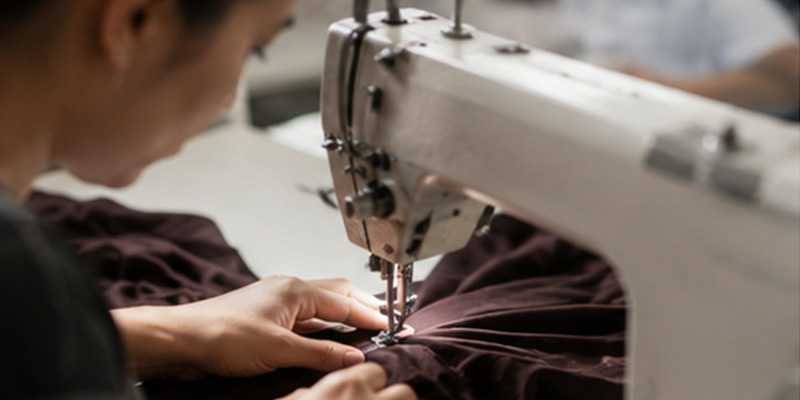
Direct manufacturing becomes more valuable as products become more technical and purchasing becomes more repetitive. A brand developing fitted occasion dresses, satin, mesh, lace, sequins, corsetry, or other construction-sensitive products benefits from being close to the people who make technical decisions. The same is true for brands that depend on consistent fit, because small changes around a neckline, bust, waist, hip, or zipper position can visibly change the garment.
Direct relationships are especially useful when the brand needs custom pattern development, multiple sample revisions, fabric-specific construction, stable bulk measurements, repeat orders, seasonal collections, technical QC, private-label execution, and clear factory allocation. The advantage is not simply the absence of an intermediary. It is the connection between development, production, corrective action, and retained product records.
A factory should still be judged critically. Sewing machines and factory photos do not prove strong development capability. The supplier should be able to explain how a tech pack is reviewed, who corrects patterns, how approved materials are controlled, how bulk measurements are checked, and what happens when a production line finds a recurring defect. Direct access creates value only when the factory has the systems and people to use that access well.
When Trading Companies Win
A trading company can be the better choice when the sourcing problem is broad rather than technically concentrated. Imagine a retailer launching a seasonal program containing dresses, knitwear, belts, handbags, scarves, hats, and branded gift packaging. Managing separate specialist factories for every category can become a full-time sourcing function, especially when the brand does not maintain its own local office.
A strong trading company can consolidate supplier identification, quotations, sample collection, communication, inspections, documentation, payment coordination, and shipment planning. That margin can be commercially reasonable when it pays for real work that reduces the brand’s internal management burden. The key is understanding exactly what the intermediary controls and where responsibility sits when a problem appears.
Ask who selects the factory, who approves materials, who reviews samples, who performs inline and final QC, and who is responsible if the production unit fails. If the trading company can answer those questions clearly and show stable supplier relationships, its model may be efficient. If every difficult question is passed to an unnamed factory, the brand may be paying for another communication layer without gaining meaningful control.
A Practical Supplier Scorecard
The final choice should be based on evidence rather than labels. A simple scoring framework helps sourcing teams compare suppliers on the same criteria instead of allowing a low quotation, fast sales response, or polished presentation to dominate the decision. The weights can be adjusted by product category, but development, product specialization, quality control, transparency, capacity, and communication should usually carry more importance than small differences in quoted price.
| Supplier Capability | Suggested Weight | What to Check |
| Product development | 20 points | Pattern, sampling, fit correction, technical review |
| Dress specialization | 15 points | Relevant fabrics, silhouettes, and constructions |
| Quality control | 15 points | Incoming, inline, final, and packing checks |
| Material capability | 10 points | Fabric and trim sourcing, substitutions, MOQ awareness |
| Production transparency | 10 points | Factory allocation, subcontracting, production records |
| Capacity | 10 points | Multi-style production, peak-season planning, repeats |
| Communication | 10 points | Technical accuracy and commercial follow-up |
| Commercial terms | 5 points | MOQ, quotation clarity, payment structure |
| Delivery support | 5 points | Packing, documentation, shipment coordination |
A factory that scores strongly across these areas may be a safer commercial choice even if its quotation is several percentage points higher. Likewise, a technically capable trading company can outperform a direct factory that lacks pattern skill, inspection discipline, or transparent production planning. The scorecard does not replace judgement; it simply forces the team to compare the risks that will still matter after the deposit has been paid.
Evidence Over Labels
The most useful principle is simple: do not buy the label; buy the operating system behind it. A supplier calling itself a factory should be able to show how patterns, samples, materials, bulk production, QC, packing, and repeat orders are controlled. A trading company should be able to show how it selects factories, protects technical information, manages quality, and remains accountable when production does not follow the approved standard.
For established fashion brands, four questions usually matter more than the supplier’s title. Can this partner reproduce the approved product consistently? Can it identify and correct technical problems before they become expensive? Can it support the volume and style complexity of future collections? Will the relationship become easier and more predictable after several production cycles? If the answer to those questions is supported by evidence, the sourcing model is probably workable.
For brands seeking a manufacturer-led relationship in Guangdong, Jinfeng Apparel offers OEM, ODM, private-label, sampling, bulk production, QC, packing, and export coordination within a women’s-fashion-focused system. Its standard MOQ starts from 200 pieces per style/color, subject to fabric, color, trim, construction, packaging, and production conditions. That makes the most productive discussion one built around a real tech pack, reference sample, collection brief, quantity plan, and target market rather than a request for the lowest possible price.
Conclusion
The better choice between a dress factory and a trading company depends on what the fashion brand needs to control. A capable direct factory is usually stronger when fit, technical development, material decisions, quality correction, repeat orders, and production transparency are central to the business. A trading company can be more efficient when broad sourcing, local coordination, supplier consolidation, or multi-category management creates more value than direct technical access. In either model, the safest decision comes from evidence: approved-product control, clear factory allocation, realistic MOQ and costing, documented QC, retained development records, and a team that can explain how problems are corrected. The company name on the quotation matters less than who actually controls the dress from first pattern to final carton.