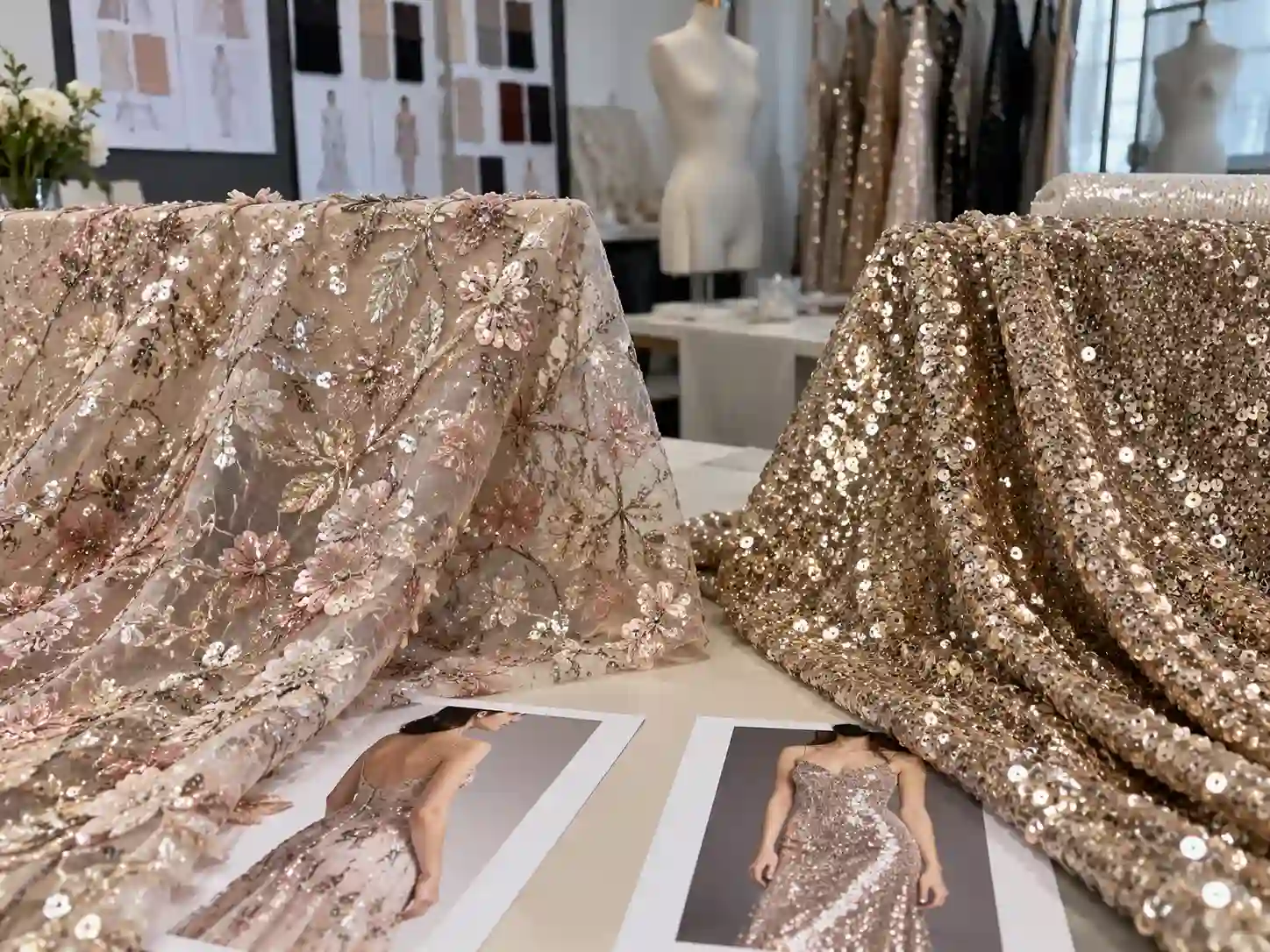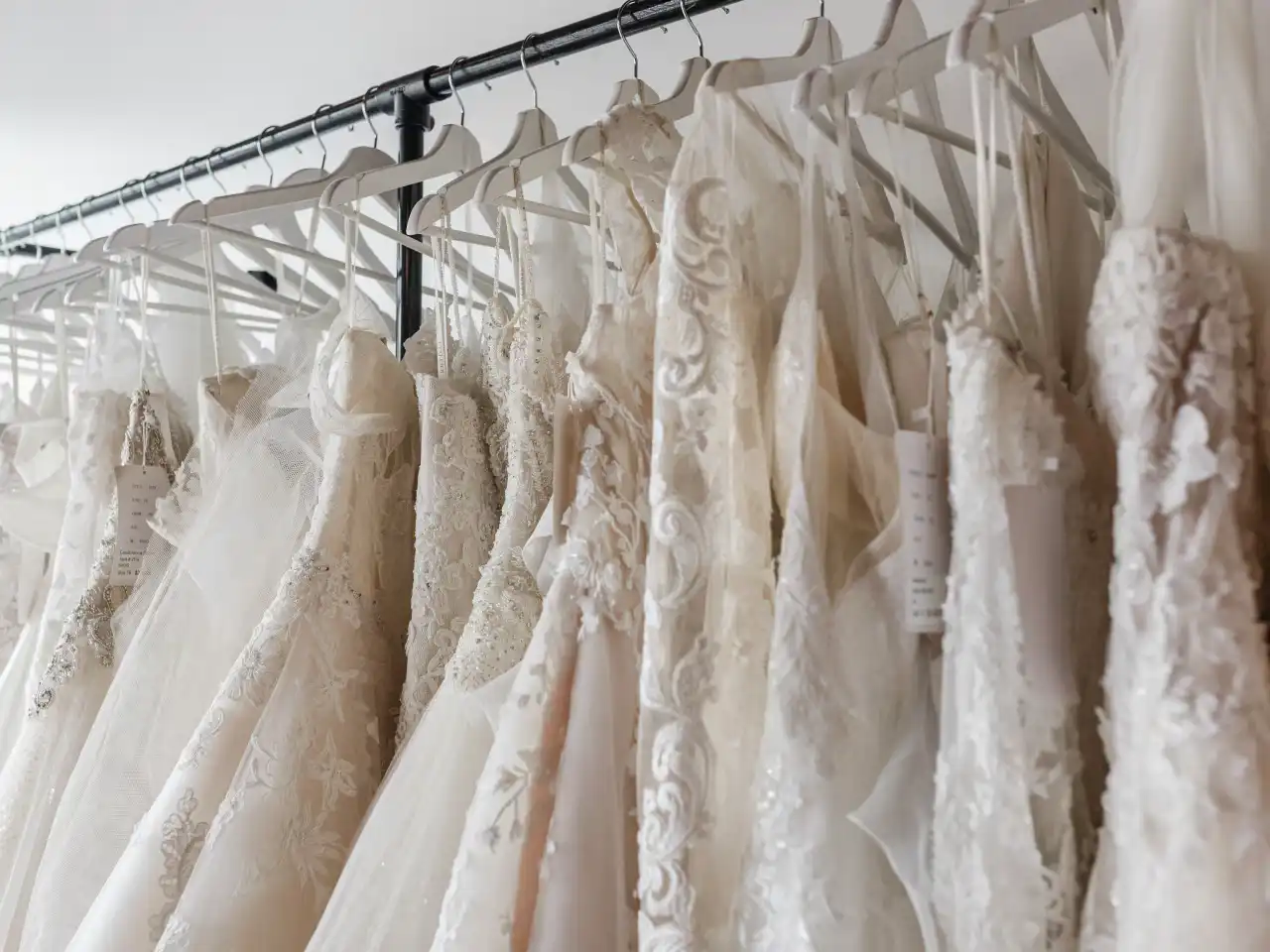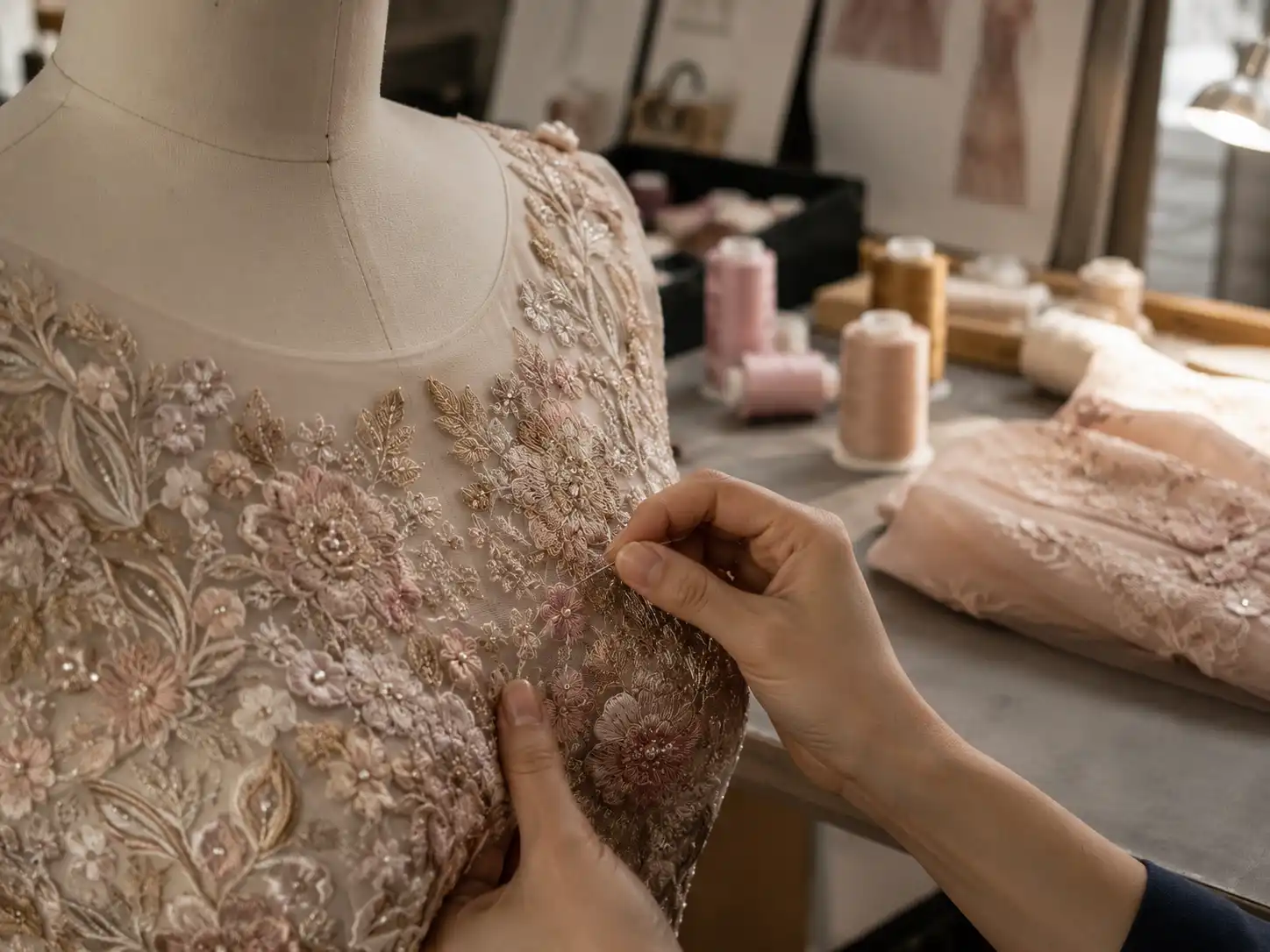
A dress manufacturer and a clothing manufacturer may look almost identical when you first compare supplier websites. Both can source fabric, make patterns, cut material, sew garments, prepare samples, inspect production, and pack finished goods. The difference becomes much more important when the product is fitted, visually sensitive, difficult to grade, or made from materials that expose small production mistakes. A factory that performs well on T-shirts, hoodies, or straightforward casual garments may still need a very different technical setup to manage satin, mesh, corsetry, bodycon fit, bias cuts, layered linings, invisible zippers, or eveningwear finishing.
A dress manufacturer is a specialized type of clothing manufacturer that concentrates more of its development and production experience on dresses, female fit, dress fabrics, silhouette, construction, sampling, and dress-specific quality risks. A general clothing manufacturer normally covers a wider garment range. Neither model is automatically better; the stronger choice is the one whose everyday technical experience matches the products that matter most to your collection.
The useful question is therefore not simply, “Can this factory sew a dress?” A better question is, “What happens when the first sample pulls across the bust, the satin zipper starts to wave, the lining twists, or several sizes must reproduce the approved silhouette?” Once those problems appear, the difference between broad capability and deep category specialization becomes much easier to see.
What Is the Core Difference?
A dress manufacturer is generally a clothing manufacturer with deeper specialization in dress fit, silhouette, fabric behavior, construction, sampling, and dress-specific quality risks. A general clothing manufacturer may cover many garment categories, while a dress-focused factory builds more of its daily technical experience around products where bust, waist, hip, neckline, lining, drape, length, and finishing strongly influence the final result.
What Does a Dress Manufacturer Focus On?
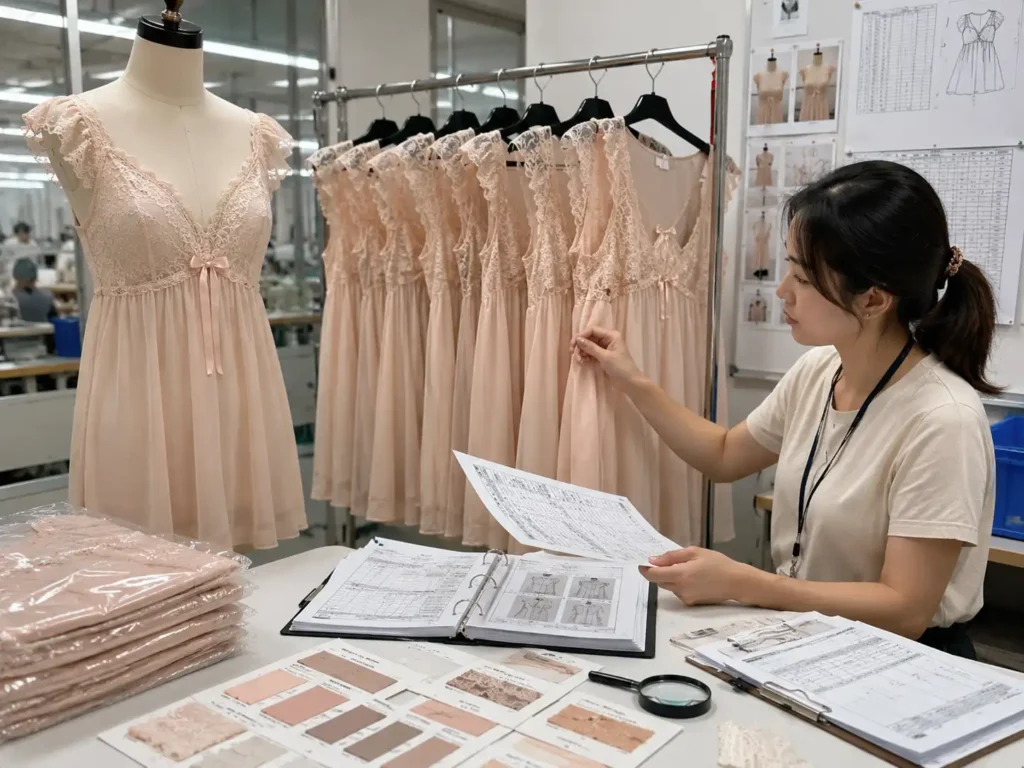
A dress-focused manufacturer spends more of its technical time solving problems that are specific to dresses rather than simply adding dresses to a long product list. The work often centers on bust shaping, waist position, hip balance, neckline stability, armhole shape, shoulder or strap length, back balance, skirt fall, slit placement, lining, closures, drape, and finished length. These details can determine whether a garment looks commercially convincing even when the basic measurements are technically within tolerance.
This specialization becomes more visible as the product grows more demanding. A loose shift dress made from a stable woven fabric may be straightforward for many competent factories. A fitted satin mini dress, stretch mesh bodycon style, corset dress, bias-cut slip dress, lace occasion dress, or sequined evening style creates a very different production problem because fit, fabric, construction, and finishing affect one another. Repeated exposure to these combinations teaches development teams where failure usually starts and which points need control before bulk production.
The practical value is early diagnosis. When a neckline gaps, an experienced dress team should be able to consider pattern shape, strap length, fabric stretch, seam stabilization, and bust balance rather than simply tightening one seam. When a bodycon skirt rides upward, the team should investigate hip ease, stretch recovery, side-seam balance, and garment length. That ability to distinguish the cause from the visible symptom is one of the clearest signs of real category specialization.
What Does a Clothing Manufacturer Cover?
“Clothing manufacturer” is a broad commercial term. It can describe a factory producing knit basics, sportswear, outerwear, denim, uniforms, children’s clothing, womenswear, dresses, or several categories at the same time. That broad capability can be an advantage when a brand needs coordinated production across many relatively standardized products, especially when common fabrics, labels, packaging, or shipment schedules can be shared between categories.
A general manufacturer is not automatically less skilled. In some categories, it may be far more capable than a dress specialist. A factory built around technical activewear may understand bonded seams, compression fabrics, performance testing, and heat-transfer processes better than a dress-focused supplier. A denim specialist may be much stronger in wash development and heavy-duty construction. The issue is therefore product relevance, not whether one label sounds more professional than another.
Problems begin when a broad product catalog is treated as proof of equal depth in every category. A website may list dresses, hoodies, jackets, swimwear, sportswear, trousers, and T-shirts, but that does not show how often each product actually moves through the sample room or production floor. Sourcing teams should look at where the factory’s pattern, sample, fabric, sewing, and QC experience is concentrated rather than counting how many product categories appear in a menu.
Is a Dress Manufacturer a Clothing Manufacturer?
Yes. A dress manufacturer is a type of clothing manufacturer, but the useful distinction is the depth of specialization. Manufacturing capability exists on a spectrum. One supplier may focus almost entirely on dresses; another may produce dresses together with skirts, jumpsuits, matching sets, and fashion tops; a third may handle dresses as a small part of a much wider assortment. All three can legitimately describe themselves as clothing manufacturers.
For purchasing decisions, the better indicator is how much of the organization is built around dress development. Ask who corrects female fit, what percentage of current samples involve dresses, which production teams handle fitted woven styles, how delicate fabrics are allocated, and whether QC checklists change by dress type. Those questions reveal operating reality more clearly than a marketing label.
The distinction also matters when a brand plans to scale. A supplier that occasionally makes one uncomplicated dress may succeed on a small project but struggle when a collection introduces several silhouettes, fabrics, colors, and size ranges at the same time. Deeper specialization usually becomes more valuable as the number of interacting variables increases, because the manufacturer needs not only sewing capacity but enough pattern, sample, merchandising, and QC knowledge to keep the collection aligned.
Where Does the Difference Matter Most?
The difference matters most where small technical errors create large commercial consequences. Fit-sensitive dresses are a good example because a one-centimeter change does not have the same visual impact everywhere. Many commercial specification sheets use tolerances around ±0.5 to ±1.0 cm on selected measurement points, depending on the garment and the brand, but a one-centimeter difference at a loose hem is not equivalent to a one-centimeter change in a strap, bust seam, cup position, or narrow waist section.
It also matters when surface appearance is unforgiving. Satin can expose seam tension and pressing marks. Mesh may reveal lining placement and stretch distortion. Lace can make poor motif alignment immediately visible. Sequins can create surface loss, abrasion, seam bulk, and packing damage. In these products, the cost of a technically acceptable but visually weak garment can show up in photography, customer reviews, returns, markdowns, and damaged confidence in the supplier.
| Decision Area | Dress-Focused Manufacturer | Broad Clothing Manufacturer |
| Product range | Narrower, dress-led womenswear | Wider range of garment categories |
| Fit emphasis | High: bust, waist, hip, neckline, balance | Varies strongly by category |
| Fabric exposure | Frequent satin, mesh, lace, chiffon, sequin, stretch | Depends on core product mix |
| Sampling | Often more iterative on silhouette and fit | Can be faster on standardized categories |
| QC priorities | Dress-specific visual and fit risks | Broader general garment criteria |
| Best fit | Fashion-led, fit-sensitive, occasion or complex dresses | Broad assortments and stable basic categories |
Which Skills Make Dress Manufacturing Specialized?
Dress manufacturing becomes specialized when pattern making, fabric behavior, internal structure, sewing sequence, and finishing must be controlled together. The more a dress depends on close fit, delicate materials, stretch recovery, draping, lining, cups, boning, lace placement, sequins, asymmetry, or bias cutting, the more useful repeated dress-specific technical experience becomes from development through bulk production.
How Does Pattern Making Affect Dress Fit?
A dress pattern does much more than define garment dimensions. It controls how fabric is distributed around the body and how the silhouette holds together when the wearer stands, sits, walks, or moves. In fitted styles, the pattern maker may need to manage bust volume, neckline shape, armhole depth, waist suppression, hip ease, back width, shoulder angle, strap position, slit placement, and skirt balance at the same time. Adjusting one point can easily change another.
For example, tightening a neckline without reconsidering the upper-bust shape may create diagonal pull lines. Reducing the waist aggressively can rotate the side seam or distort the hip. Shortening straps can lift the neckline but also change the armhole and bust position. A bodycon dress that fits well while standing may still climb upward during walking if hip ease, negative ease, or fabric recovery is poorly balanced. These interactions are why experienced dress pattern makers evaluate both measurements and garment behavior.
Grading adds another layer. A flattering base-size sample does not guarantee that every size will keep the same proportion. Strap length, cup position, neckline width, slit height, bodice length, and waist placement may need different grade rules rather than simple proportional enlargement. Brands with several sizes should therefore review how the pattern behaves across the size range, not only whether one development sample looks good on a fit model.
Which Fabrics Need More Expertise?
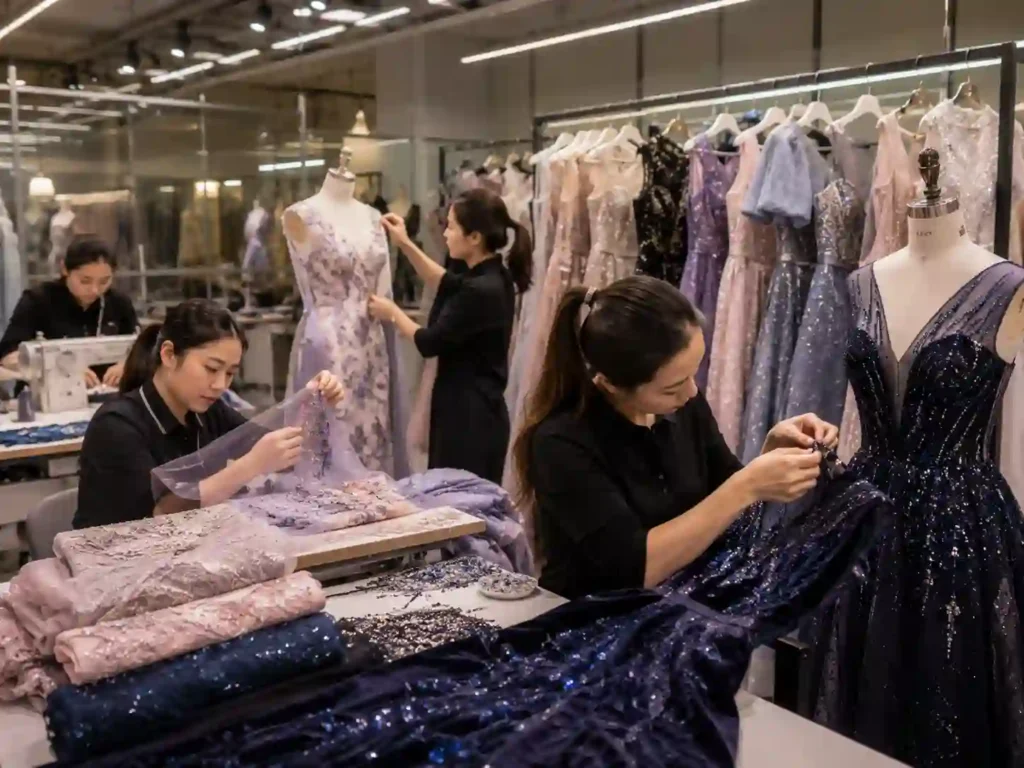
Fabric expertise matters because the same pattern can behave very differently when the material changes. Satin is smooth and reflective, so seam puckering, zipper waves, needle marks, pressing shine, and handling damage can become highly visible. Stretch mesh may grow during sewing, recover differently in the warp and weft directions, and require careful decisions around lining, transparency, seam type, and neckline stabilization. Lace introduces motif placement, edge treatment, seam bulk, and lining-color questions.
Chiffon can shift during cutting and sewing. Jersey can grow, twist, or recover poorly depending on construction and stretch. Velvet can show pressure marks or nap-direction errors. Sequined fabric may damage needles, create uncomfortable seam areas, shed decoration, or require more protective packing. Bias-cut woven fabrics can lengthen after hanging because the diagonal grain allows more movement, so final hem leveling may need to happen after the garment has relaxed rather than immediately after assembly.
The correct method depends on fabric weight, fiber content, finishing, stretch percentage, surface treatment, garment structure, and the expected end use. This is why a useful supplier discussion goes beyond “Do you work with satin?” The stronger question is “How do you control satin on this construction, and what problems would you expect before we approve bulk production?”
| Fabric / Construction | Typical Risk | Practical Control Point |
| Satin | Puckering, snagging, shine, zipper waves | Fine needle choice, seam stabilization, controlled pressing |
| Stretch mesh | Growth, transparency, stretched edges | Stretch/recovery review, lining confirmation, seam recovery |
| Lace | Motif mismatch, fraying, bulky joins | Placement planning, edge treatment, lining coordination |
| Sequin | Missing decoration, needle damage, abrasion | Seam-area preparation, lining protection, careful handling |
| Chiffon | Slippage, twisting, uneven hems | Stable cutting, controlled feeding, hem balance checks |
| Jersey | Growth, side-seam rotation, weak recovery | Stretch testing, feed control, recovery assessment |
| Bias-cut woven | Length change, twisted seams | Grain control, hanging relaxation, final hem leveling |
How Do Complex Constructions Change Production?
Complex dress construction increases the number of dependencies inside one garment. A simple unlined shift dress may involve relatively few panels, seams, closures, and finishing operations. A corset dress can add cups, boning, fusible support, multiple bodice panels, lining, underlining, internal elastic, stay tape, hooks, zippers, and carefully controlled seam shaping. A ruched mesh style may require several layers to be stabilized before the final seam can be assembled cleanly.
The challenge is not only making one attractive sample. Bulk production requires the approved construction to be broken into repeatable operations that several sewing operators can follow consistently. That often means defining operation sequences, seam allowances, stitch specifications, reinforcement points, notches, templates, pressing steps, component placement, and first-piece approval criteria. A sample machinist can solve small problems by hand while making one garment; a production line needs the solution to be standardized.
This is where technical planning protects both quality and cost. If a design contains a construction detail that cannot be repeated efficiently, a skilled factory may propose a controlled adjustment that preserves the visual effect while making the operation more stable. That is not a reduction in design value. In many cases it is what allows the approved look to survive the transition from one development sample to hundreds or thousands of finished garments.
How Does Finishing Affect the Result?
Finishing is often treated as the last cosmetic step, but with dresses it can alter fit, surface appearance, length, and presentation. Pressing with too much temperature or pressure can create shine on satin, flatten textured surfaces, crush velvet, stretch necklines, or distort seams. Bias-cut and lightweight dresses may change length after hanging or steaming, which means final hem balance should sometimes be checked after the garment has had time to relax.
Packing creates another group of risks. Structured bodices can be crushed, sequins can abrade neighboring surfaces, long skirts can develop deep folds, and delicate fabrics can snag if trims are not protected. A dress that leaves the sewing line in good condition can still arrive at a warehouse looking poor if finishing and packing methods are not matched to the product.
For fashion brands, finishing should therefore be included in the technical conversation before bulk production. The team should agree on pressing method, presentation standard, folding, internal tissue or protective layers where needed, hanger or flat-pack requirements, and carton configuration. These decisions are especially important for ecommerce and retail programs because the product may be photographed, displayed, or shipped to the final customer soon after it leaves the factory.
How Do Sampling and Fit Development Differ?
Dress sampling is often more iterative because pattern, fabric, body shape, support, movement, and visual proportion must be confirmed together. A strong development process moves from product information to pattern, first sample, fit review, revision, and an approved production reference. For technically demanding dresses, one impressive first sample matters less than a controlled path from design intent to repeatable bulk production.
How Is a Dress Sample Developed?
Professional dress development usually begins with information rather than sewing. The supplier needs enough detail to understand the intended silhouette, fit, materials, construction, target market, and commercial level. Development can start from a tech pack, original sample, reference photographs, sketches, line sheets, moodboards, size charts, fabric swatches, trim references, or a combination of these inputs. The more complete the information, the fewer assumptions have to be made during the first round.
The first sample then becomes a physical test of the design. It can reveal whether the fabric has enough structure, whether the neckline needs stabilization, whether the lining is too heavy, whether the zipper creates tension, whether the waist sits in the intended position, or whether the skirt volume matches the visual reference. Even a detailed tech pack cannot predict every interaction between fabric and body shape, so sample development should be treated as a controlled learning process rather than a simple pass-or-fail event.
A practical sequence often includes style review, material confirmation, pattern development, first sample, fit comments, pattern or construction revision, revised sample when needed, and then a production approval stage. The factory should also make clear where information is missing. If the starting point is only a photograph, hidden construction details such as internal support, exact measurements, lining, or seam finishes still need to be defined before the supplier can responsibly promise a precise result.
Which Fit Points Need Correction?
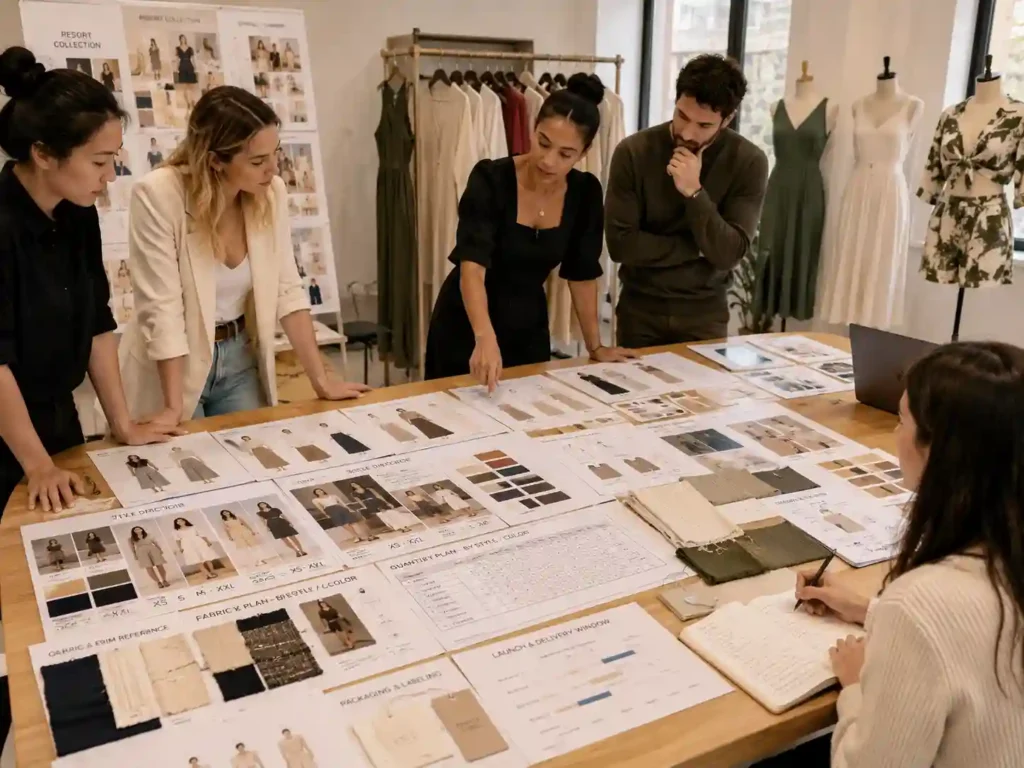
Dress fitting should be visual, measurable, and functional. A garment can match the measurement chart and still look unbalanced because the waist seam sits too low, the bust point is misplaced, the neckline stands away from the body, the armhole exposes too much skin, or the skirt pulls forward during movement. Those are not always sewing problems. They may originate in pattern balance, fabric behavior, stretch, lining, or construction sequence.
Useful fit reviews examine bust shape, neckline, armhole, strap length, shoulder angle, waistline, hip area, back balance, zipper behavior, slit opening, finished length, hem level, and lining ease. Movement matters as well. A bodycon dress should be observed when the wearer walks and sits. A high slit should be checked under movement rather than only in a static photograph. A corset bodice should be reviewed for both support and comfort instead of simply being made tighter.
Good fit comments identify the cause and the correction. “Too loose at bust” is less useful than explaining whether the excess comes from bust volume, neckline width, strap length, fabric stretch, or cup position. This distinction reduces endless sample loops because the development team is solving the underlying issue rather than repeatedly adjusting the visible symptom.
What Do PP and Golden Samples Control?
PP and Golden samples create a bridge between development and production. Naming varies between companies, but the practical purpose is similar: establish a clearly approved physical reference before a large quantity is produced. A pre-production sample can confirm final fabric, color, trims, measurements, construction, labels, workmanship, and other details. An approved or Golden sample can then act as the benchmark against which bulk garments are compared during production and inspection.
This becomes especially valuable when a dress contains many variables. Consider a satin corset style with cups, boning, lining, ruching, an invisible zipper, custom labels, and special packing. A written specification may describe every component, but it cannot communicate every visual expectation as clearly as a physical reference. The approved sample shows how those specifications are meant to come together in three-dimensional form.
A strong production package normally connects the physical sample with the final measurement chart, BOM, pattern version, approved fabric and trims, construction notes, color standards, workmanship requirements, label placement, QC checklist, and packing instructions. This reduces subjective disputes later. When the bulk garment looks different, the team can compare a specific measurement, material, seam, gathering ratio, or finishing method against the approved reference rather than relying on memory.
How Many Sample Rounds Are Practical?
There is no universal number of sample rounds that guarantees a good result. A straightforward repeat style made in a known fabric may move quickly, while a new corset dress, complex draped style, unusual stretch construction, or multi-layer occasion dress can require several rounds before fit and construction are stable. The goal should not be to minimize sample rounds at any cost; it should be to make each round answer a clear technical question.
A useful development team should therefore track what changed between rounds. If the first sample corrected the general silhouette, the second may focus on neckline stability, bust shape, or fabric choice. If the fit is already accepted, the next stage may confirm final trims and production construction. Repeating the same unclear comments across several samples usually signals a problem in communication, diagnosis, or documentation rather than simply a difficult style.
Brands can control development time by supplying clear reference material, approving fabrics early, consolidating fit comments, using consistent fit models, and avoiding late changes after the pattern is nearly finalized. Manufacturers can help by separating fit, construction, fabric, trim, and workmanship comments instead of mixing them into one vague revision list. The more structured the development loop becomes, the easier it is to predict when the style is genuinely ready for bulk production.
How Do Production and QC Differ?
Dress production and QC should follow the risks of the specific style rather than one generic inspection routine. Suitable line allocation, first-piece control, in-line checks, fit-sensitive measurements, fabric-specific workmanship standards, pressing, and final packing all contribute to sample-to-bulk consistency. The objective is not the unrealistic promise of zero variation, but controlled variation within an agreed commercial standard.
How Are Dresses Matched to Production Lines?
Factory capacity is only valuable when the assigned team has the right experience. A line that performs very efficiently on stable jersey dresses may not be the best line for a structured woven corset. A team experienced with basic woven styles may work slowly or create unnecessary risk when handling slippery satin, heavy sequins, intricate lace, or multi-layer occasionwear. Production planning should therefore match line capability to product risk rather than treating every sewing machine as interchangeable capacity.
Useful allocation factors include knit or woven construction, fabric stability, stretch percentage, number of panels, lining complexity, cups or boning, decorative work, quantity per style, number of colors, delivery deadline, and operator experience. Complex styles often need a smaller number of experienced operators at critical operations, while straightforward styles can move more efficiently through higher-output lines. Flexible lines can also be useful when fashion brands run several styles with moderate quantities rather than one very large basic program.
The best production question is not simply, “How many pieces can the factory make each month?” It is, “Which unit would make this style, what similar products does that team run, and how will the factory protect quality when several styles are produced at the same time?” Those answers show whether capacity is technically usable for the collection rather than theoretical capacity on a company profile.
Which Defects Need Dress-Specific QC?
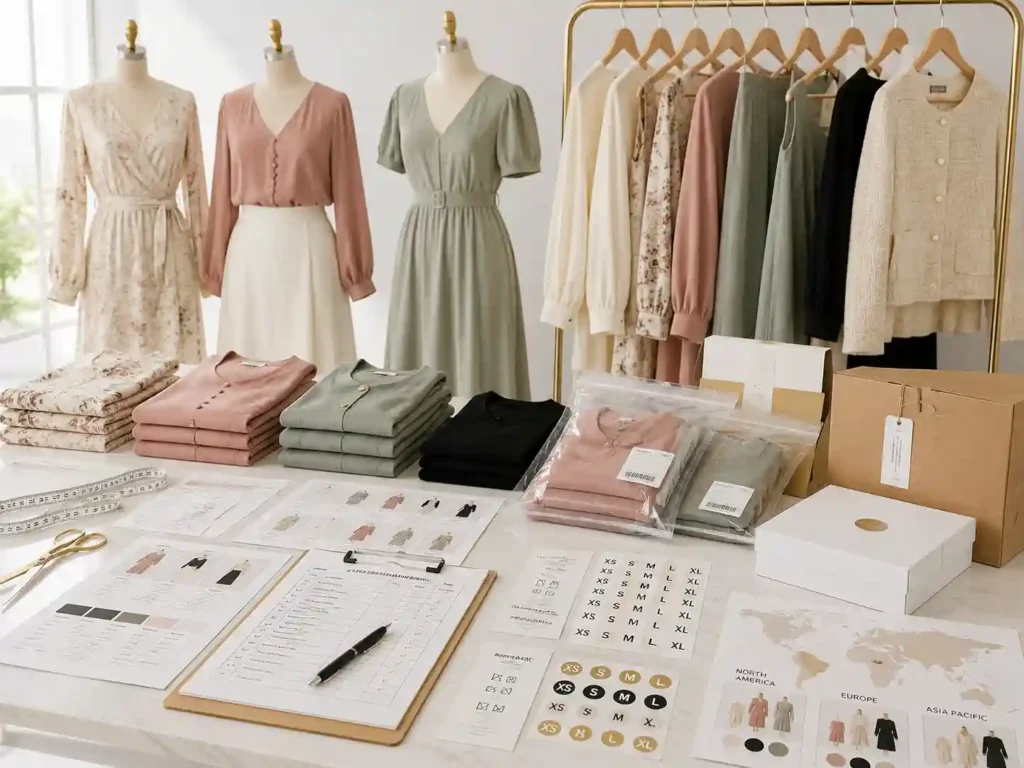
Generic garment checks such as stains, loose threads, measurements, labels, and packaging are necessary, but they do not cover many of the problems that determine whether a dress looks good on the body. Inspection criteria should change with the style. Satin dresses need close attention to puckering, snagging, pressing shine, and zipper waves. Mesh dresses need checks for holes, transparency, stretched edges, and lining placement. Bodycon dresses require attention to side-seam rotation, recovery, ride-up, and bust-waist-hip balance.
Corset dresses create another set of priorities: cup symmetry, boning position, neckline support, internal finishing, closure alignment, and comfort. Lace styles need motif placement, clean joins, lining coordination, and edge finishing. Sequined garments need checks for missing decoration, rough seam areas, broken or loose elements, lining protection, and surface damage during packing. Maxi dresses require careful finished-length and hem-balance checks because small cutting or hanging differences can become visually obvious over a long skirt.
Final inspection systems such as AQL are commonly used in apparel sourcing, and AQL 2.5 is a familiar reference point for major defects in many commercial programs, but it is not a universal rule. Critical defects may be handled with zero tolerance, and brands can apply different inspection levels depending on product, market, and risk. The most important point is that acceptance criteria are agreed before shipment rather than negotiated after defects have already been found.
How Is Sample-to-Bulk Consistency Controlled?
The hardest part of apparel manufacturing is not making one good garment; it is making a large quantity that stays acceptably close to the approved reference. Consistency depends on controlling decisions before and during production. Fabric lots need review, cutting must remain accurate, operations need clear instructions, measurements should be monitored while production is running, and corrective action should happen before a small variation turns into a full-order problem.
A practical control path can include incoming fabric and trim inspection, shade or lot review, fabric relaxation when required, cutting checks, bundling and size identification, first-piece approval, in-line sewing inspection, key measurement checks, workmanship review, finishing inspection, pressing control, packing verification, and pre-shipment inspection. Not every style needs the same intensity at every stage, but the control plan should reflect the product’s specific risks.
In-line inspection is especially valuable because final inspection can identify a problem without making it economical to repair. If zipper puckering is found after 1,500 dresses are completed, the factory may face extensive rework. If the same issue is identified during the first few dozen pieces, seam stabilization, thread tension, operation method, or operator instruction can still be adjusted. Strong production control is therefore preventive rather than dependent on sorting defects at the end.
What Changes Across Sizes and Colors?
Bulk consistency is not only about making the base size correctly. Grading can introduce new problems at larger and smaller sizes, especially around bust shape, cup position, neckline width, armholes, straps, slit height, and dress length. A pattern that looks balanced in one size can lose proportion if the grade rules are too mechanical. Sampling or measuring selected sizes across the range is therefore important for fit-sensitive products.
Colorways can create technical variation as well. Different dye lots may have small differences in weight, hand feel, stretch, shrinkage, surface finish, or recovery. Even when the fabric specification is nominally the same, a black stretch knit and a pale color can sometimes behave differently because of dyeing and finishing. Delicate fabrics may also show color-dependent visual defects; seam puckering and pressing marks can appear more obvious on some shades than others.
For multi-color and multi-size programs, quality control should therefore sample across the actual order mix instead of relying only on one approved sample. The supplier should confirm that measurement, appearance, labeling, and workmanship remain within the agreed standard across representative sizes and colors. This becomes increasingly important when a brand runs several production batches or repeats a successful style months later using new fabric lots.
Which Manufacturer Fits Your Product Line?
A general clothing manufacturer often suits broad assortments of relatively standardized garments, while a dress-focused manufacturer becomes more valuable as fit sensitivity, fabric difficulty, construction complexity, and visual expectations increase. Brands selling dresses alongside skirts, jumpsuits, sets, and fashion tops may benefit most from a womenswear manufacturer that combines deep dress capability with credible production across adjacent categories.
Are General Manufacturers Better for Basic Apparel?
Sometimes they are. A collection built around T-shirts, sweatshirts, joggers, straightforward tops, and stable knit basics may benefit from a manufacturer whose lines are optimized for those categories. Standardized construction, repeated fabric use, efficient marker planning, high operator familiarity, and larger production runs can make a broad or category-specific basic-apparel factory more efficient than a dress specialist trying to handle products outside its strongest area.
Supplier strategy should therefore follow the products that drive the business. A brand whose sales and margin are concentrated in knit basics should prioritize knit capability. A brand whose identity depends on occasion dresses should place more weight on dress development, fit, fabric handling, and visual finishing. A mixed lifestyle brand may need several strategic suppliers because the technical requirements of denim, outerwear, activewear, and dresses are too different to expect one factory to be equally strong at everything.
The key is to separate administrative convenience from production capability. Consolidating many categories with one manufacturer can simplify communication and shipping, but it can also create hidden product risk if the supplier is only average in the categories that matter most. The strongest sourcing model gives commercially important products access to the right technical expertise while keeping the overall supplier base manageable.
Which Dresses Need a Specialist Manufacturer?
Specialist capability becomes more valuable when several technical risks appear in one style. A loose unlined woven dress made from a stable fabric can often be handled well by many competent garment factories. A stretch mesh bodycon dress with lining, asymmetric ruching, a cut-out, and an invisible zipper is a different production problem because every feature influences fit, recovery, sewing sequence, and visual balance.
The same is true for corset dresses, satin occasionwear, lace cocktail dresses, sequined evening styles, bias-cut slips, structured mini dresses, and long layered maxis. Risk rises when a garment combines close body fit, high stretch, weak recovery, sheer fabrics, slippery surfaces, internal support, delicate decoration, multiple layers, asymmetry, long hems, or strict visual expectations. One difficult feature may be manageable for a broad factory; several interacting features make repeated dress-specific experience much more valuable.
Sourcing teams can use cumulative complexity as a practical guide. If the design has only one or two moderate risk factors, a good general womenswear manufacturer may be enough. If five or six technical factors interact, the team should look more closely at relevant samples, pattern capability, fabric handling, production allocation, and QC. The more the style depends on silhouette rather than simple assembly, the more specialization tends to matter.
Do Mixed Womenswear Collections Need Both Capabilities?
Many established fashion brands do not sell dresses alone. A seasonal launch may contain a satin midi dress, matching skirt and top, jersey bodysuit, jumpsuit, fashion blouse, and several supporting items that share colors, trims, labels, or packaging. Splitting every product across unrelated suppliers can create extra work in color matching, trim minimums, shipping, quality standards, and launch coordination.
A useful middle ground is a womenswear manufacturer whose deepest specialization is dresses but whose production system can also support adjacent fashion categories. That model allows related products to share development knowledge, fabric sourcing, private-label standards, packing instructions, and shipment planning without pretending that the supplier should make every apparel category. For brands with frequent seasonal drops, the ability to run several related styles in parallel can be commercially more useful than extremely high output on one basic SKU.
The supplier still needs to prove that adjacent-category capability is real. A factory strong in dresses should not automatically be asked to produce technical outerwear, denim washing, seamless activewear, or other specialized categories without evidence. The goal is a coherent womenswear capability, not an unlimited product claim. Brands should keep the supplier portfolio aligned with technical reality rather than the desire to simplify purchasing at any cost.
When Should You Split Production Across Suppliers?
Splitting production makes sense when different products require genuinely different manufacturing systems. A brand may use one supplier for satin occasion dresses, another for knit basics, and a third for denim because the machinery, fabric sourcing, pattern knowledge, finishing processes, and QC standards differ substantially. More suppliers increase coordination work, but they can reduce technical risk when each factory is strong in its assigned category.
The decision should consider order volume, margin, launch timing, product complexity, logistics, and the cost of managing more relationships. If a small supporting category represents only a tiny part of a collection, keeping it with a main supplier may be practical even if that supplier is not the absolute specialist. If a category drives revenue or creates significant return exposure, dedicated expertise is more important than administrative convenience.
A mature sourcing strategy therefore avoids two extremes: sending every product to a different specialist and forcing every product through one general factory. The more useful approach is to identify strategic product families and match each family to suppliers with proven capability. Over time, successful suppliers can take on related categories when their performance shows they are ready, while technically distant products remain with specialists that understand their own production risks.
What Should You Check Before Choosing?
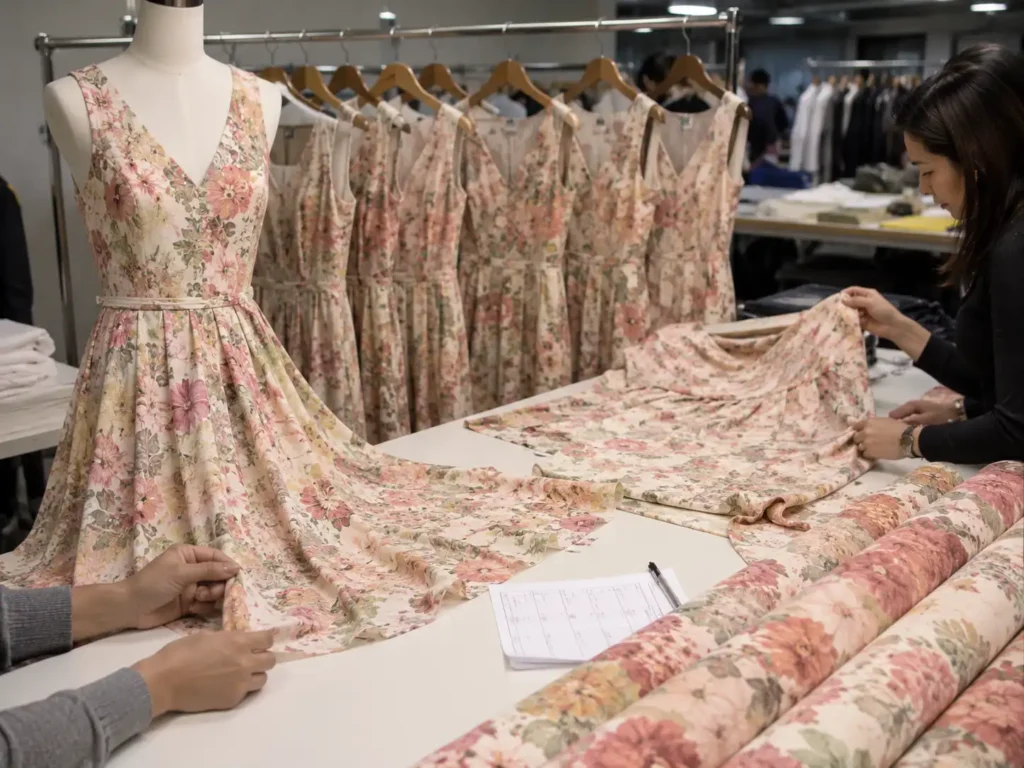
Before choosing a manufacturer, verify product-specific evidence rather than relying on claims such as “high quality,” “professional factory,” or “many years of experience.” Review relevant samples, pattern and fitting capability, fabric knowledge, production allocation, QC procedures, MOQ structure, development communication, capacity, private-label execution, confidentiality, and repeat-order systems. The right supplier should explain how your exact product will move from development to bulk production.
What Proof Shows Real Dress Expertise?
Relevant evidence is more useful than impressive but unrelated factory information. If the project is a corset dress, ask to discuss corset construction. If the collection is built around satin occasionwear, ask how the factory controls satin. If the product uses stretch mesh, ask about stretch recovery, transparency, lining, seam stabilization, and neckline behavior. A supplier that can explain the expected problems and control points is usually more informative than one that simply shows a large showroom.
Good evaluation questions include who develops and corrects the pattern, which sample team would handle the style, which production line would receive the order, how first-piece approval works, what defects are common in similar products, how fit is transferred across sizes, how fabric lots are controlled, and what happens if bulk output starts to differ from the PP sample. Ask how the team records changes between sample rounds and how those records reach production operators and QC staff.
Physical and documentary evidence can include relevant samples, patterns, sample comments, measurement charts, construction sheets, fabric test records where applicable, QC checklists, approved packing instructions, and repeat-order records. Not every supplier will share confidential customer documents, and they should not. A professional manufacturer can still demonstrate process knowledge without exposing another brand’s private information.
How Do MOQ and Capacity Affect the Choice?
MOQ should be evaluated as a system rather than one marketing number. The sewing factory may accept a certain quantity, while fabric suppliers, dye houses, print mills, lace suppliers, hardware vendors, or packaging manufacturers impose their own minimums. A style with stock fabric and standard trims may support a lower production quantity than the same silhouette made with custom-dyed fabric, bespoke print, special lace, custom hardware, or complex branded packaging.
Capacity has the same problem when reduced to one monthly output figure. A fashion collection with twenty-five technically different dresses can create more pressure on sample rooms, pattern makers, merchandisers, fabric sourcing, and approval management than a much larger order of one basic style. Brands should therefore evaluate development capacity, number of concurrent styles, sewing-line availability, QC coverage, finishing capacity, peak-season scheduling, and repeat-order flexibility together.
For established fashion programs, the practical question is whether the supplier can support the launch calendar without pushing technically difficult styles into unsuitable lines or delaying samples because development resources are overloaded. A manufacturer with moderate total output but strong sample and flexible production capability can sometimes be more useful than a larger factory optimized for repetitive basics. Capacity should be matched to the way the brand actually develops and launches products.
Which Questions Reveal a Long-Term Fit?
The first successful order is only the beginning of a useful manufacturing relationship. Long-term value appears when the supplier can preserve approved knowledge and reduce the amount of work required to repeat or extend a style. Ask whether the factory retains pattern versions, grading rules, measurement charts, BOM records, fabric references, color standards, trim details, construction notes, QC requirements, label specifications, packing instructions, and previous order history.
Confidentiality also matters because tech packs, original samples, unreleased designs, pricing, launch calendars, packaging, and sourcing information can carry significant commercial value. A professional supplier should be comfortable discussing NDA-based cooperation and clear access rules for confidential materials. Strong confidentiality is not only a legal issue; it is part of the operational discipline expected from a long-term manufacturing partner.
Finally, ask how repeat orders are handled. Does the supplier retrieve the approved pattern and production file, or rebuild the style from memory? Can best-selling styles be replenished without repeating the entire development process? Can a successful dress be extended into new colors, fabrics, or related silhouettes while preserving brand fit? These questions reveal whether the factory is organized for a one-time transaction or for an ongoing seasonal development relationship.
What Should a Final Supplier Comparison Include?
A final comparison should balance technical capability, commercial fit, and operating reliability. Price matters, but comparing quotations without considering material level, sample development, QC, packaging, and production risk can create a false sense of savings. A lower unit price is not useful if the product requires extra sample rounds, arrives with inconsistent fit, misses a launch window, or creates avoidable returns and rework.
The following framework is an example of how a sourcing team might weight the decision. It is not an industry standard, and the percentages should change according to the brand’s priorities, but it helps prevent price from becoming the only visible metric.
| Evaluation Area | Example Weight | What to Verify |
| Product specialization | 20% | Similar dresses, fabrics, silhouettes, construction |
| Pattern and sampling | 20% | Fit diagnosis, revision process, grading, sample documentation |
| Bulk production control | 15% | Line allocation, first-piece approval, process control |
| QC and consistency | 15% | In-line inspection, measurement, product-specific defect checks |
| Fabric and trim capability | 10% | Sourcing, alternatives, lot control, difficult material handling |
| Capacity and lead-time fit | 10% | Concurrent styles, peak season, repeat-order flexibility |
| Communication and records | 5% | Merchandising, change control, production files |
| Commercial terms and cost | 5% | MOQ, price structure, payment, packaging, logistics assumptions |
A mature sourcing team should adjust the weighting to the product. A highly technical occasion collection may place more weight on pattern, sample, and QC capability. A high-volume basic program may place more weight on line efficiency, capacity, material purchasing, and cost. The point is to compare suppliers against the actual risks of the collection instead of using the same checklist for every garment category.
Conclusion
The difference between a dress manufacturer and a clothing manufacturer is not a simple matter of one factory being better than the other. A dress manufacturer sits within the wider clothing-manufacturing industry but usually concentrates more technical experience on female fit, dress silhouettes, difficult fabrics, dress construction, iterative sampling, and the visual defects that can make or break a fashion product. A broader clothing manufacturer may be the stronger choice for basic or highly diverse assortments, while a dress-focused partner becomes more valuable as fit, fabric sensitivity, internal structure, and presentation demands increase.
The smartest sourcing decision starts with the products that matter most to the brand. Look at where revenue, margin, return risk, fit sensitivity, visual importance, and launch timing intersect. Then test suppliers with the actual style rather than generic questions. Send the tech pack, reference sample, fabric direction, or collection brief and ask how the factory would develop the pattern, identify risk, manage samples, allocate production, control bulk quality, and preserve the approved standard for repeat orders. For brands building dress-led or broader womenswear collections, Jinfeng Apparel’s documented operating model is centered on custom dresses and related womenswear with pattern development, fabric sourcing, sampling, bulk production, QC, private-label packing, and repeat-order support for established fashion clients. The strongest supplier conversation begins when both sides stop asking only, “Can you make it?” and start discussing, “How will we make it consistently?”