Skip to content

A polished factory website, a neat sample room, and a competitive quotation can all create a strong first impression. None of them proves that a manufacturer can reproduce a fitted satin dress across six sizes, control color and fabric lots, attach the correct barcode, and ship the order in time for a fixed launch. The real comparison begins when sales promises are converted into patterns, samples, production files, inspection records, and commercial commitments that can be checked before bulk cutting starts.
To compare custom dress manufacturers, give each factory the same product brief and score the same factors: relevant dress experience, pattern and fit capability, sample accuracy, fabric handling, quotation scope, MOQ, lead time, quality controls, capacity, communication, and repeat-order support. Verify important claims through samples, documents, production records, and written commercial terms before approving bulk production.
The difference often becomes visible during the first week of development. One supplier may send a price within two hours but leave fabric weight, lining, grading, labels, and inspection outside the quote. Another asks detailed questions, identifies a zipper risk, and explains how the chosen mesh will affect fit. The second conversation feels slower, yet it may prevent weeks of rework and a season of avoidable returns. The following framework shows how to tell those two suppliers apart.
What Should You Define Before Comparing Factories?
Before comparing manufacturers, define one consistent product brief, service scope, quality target, order structure, and delivery requirement. Every factory must quote the same garment under the same assumptions. Otherwise, price and lead-time differences often come from missing information, substituted materials, or excluded services rather than genuine manufacturing efficiency.
Editorial manufacturing image showing a fashion sourcing team comparing one custom dress tech pack, fabric swatches, trim cards, measurement sheets, quotation documents, and a delivery calendar on a clean worktable. Include hands reviewing identical specification packs for several factories, realistic apparel-development details, natural studio light, premium womenswear context, no logos, no text overlay, and no staged corporate handshake.
Build One Comparison Brief
A meaningful factory comparison starts before the first quotation arrives. Send every shortlisted manufacturer the same technical and commercial information instead of allowing separate conversations to drift into different assumptions. The package should identify front, back, and detail views; base-size measurements; intended size range; fabric direction; lining; trims; colorways; estimated quantity; label and packaging requirements; destination market; and the required warehouse or launch date. A developed tech pack is ideal, but an original garment, line sheet, sketch, reference image, fabric swatch, and measurement chart can also form a workable starting package.
- Front, back, and close-up design views
- Tech pack, original sample, sketch, or reference garment
- Base-size measurements and intended size range
- Fabric composition, weight, stretch, finish, and color direction
- Lining, zipper, cups, boning, elastic, lace, and embellishment details
- Quantity by style and color, packaging standard, destination, and required date
Unconfirmed details should be marked as provisional rather than left invisible. Writing ‘140-160 gsm stretch mesh, final quality subject to swatch approval’ gives a factory a usable boundary. Writing only ‘mesh dress’ allows each supplier to imagine a different stretch percentage, transparency, recovery, width, lining requirement, and price level. Early quotes are naturally estimates, but the assumptions behind them must be visible. When one factory prices a lined garment and another assumes an unlined construction, the lower number is not evidence of better value; it is evidence that the products being quoted are not the same.
Match the Service Scope
Two factories can quote the same sketch while accepting very different responsibilities. A cut-make-trim supplier may expect the client to provide fabric, trims, patterns, grading, labels, and packing materials. A full-package manufacturer may manage those items, develop samples, coordinate testing, conduct inspections, prepare retail packaging, and support export delivery. OEM, ODM, private-label production, and full-package manufacturing overlap in practice, but they should not be treated as identical until each supplier defines the work it will perform and the files or materials the client must provide.
- Pattern development and size grading
- Fabric and trim sourcing
- Sample making, revision samples, and PP approval
- Bulk cutting, sewing, finishing, and inspection
- Private labels, barcodes, retail packing, and cartons
- Export documents, freight coordination, and shipment follow-up
Ask for a written inclusion and exclusion list covering pattern development, grading, fabric sourcing, trim sourcing, sample rounds, cutting, sewing, finishing, quality inspection, labels, hangtags, barcodes, polybags, cartons, testing, and logistics coordination. Jinfeng Apparel, for example, works as an OEM, ODM, private-label, and custom womenswear manufacturer rather than a ready-stock wholesaler. Its documented scope covers development, pattern work, fabric and trim sourcing, sampling, bulk production, quality control, branded packing, and export coordination. This makes the quotation comparable with other full-service proposals, not with a sewing-only price.
Set Commercial Priorities
Factories should not be ranked with one universal formula because the risk profile changes by product and sales channel. A structured corset dress requires strong pattern engineering, cup and boning control, stable neckline construction, and careful fitting. A printed rayon resort dress relies more heavily on fabric sourcing, print direction, hem balance, and repeatable color. A premium ecommerce label may place extra weight on camera-ready samples and return-risk control, while a retail program may prioritize testing documents, carton accuracy, fixed delivery windows, and repeat-order consistency.
Decide which factors are non-negotiable and which can be optimized after development. The weighting should reflect the cost of failure, not the loudest sales claim. A factory that is excellent at high-volume jersey basics may still be a poor choice for embellished occasionwear. A specialist sample room may produce a beautiful first piece but lack the line management required for several thousand units. The practical question is not ‘Which factory is best?’ It is ‘Which factory is best equipped for the risks, volume, construction, and calendar of this specific collection?’
| Comparison area | Suggested weight | Evidence to verify |
| Sample and fit accuracy | 20% | Measurements, balance, silhouette, revision quality |
| Dress specialization | 15% | Similar products, fabrics, structures, workmanship |
| Bulk quality control | 15% | Inspection stages, tolerances, records, sealed sample |
| Commercial transparency | 15% | Quote scope, exclusions, MOQ, payment terms |
| Delivery reliability | 15% | Material plan, capacity, production schedule |
| Communication | 10% | Technical accuracy, response quality, reporting |
| Long-term scalability | 10% | Repeat orders, multi-style production, data retention |
Standardize the Order Structure
Order structure has a direct effect on price, efficiency, and production risk. One thousand units of one style in one fabric are not operationally equal to one thousand units divided across ten styles, twenty colors, and an extended size range. Each color can require separate fabric booking, cutting, bundling, line setup, inspection, labeling, and packing. Each additional style creates another pattern set, sample approval, BOM, construction file, and production learning curve. Comparing factories on total order quantity alone can therefore hide the real workload.
- Quantity per style and per color
- Number of sizes and the planned size ratio
- Fabric, print, trim, and label variations
- Retail packaging and warehouse-label variations
- Number of shipments and final delivery locations
Standardize quantity per style, quantity per color, number of sizes, size ratio, fabric variation, label variation, packaging variation, shipment frequency, and delivery location. A 1,200-piece style divided into three colors provides 400 units per color; the same order divided into eight colors provides only 150 units per color and may fall below a dye house, print supplier, or trim supplier minimum. The goal is not to reduce assortment unnecessarily. It is to let each factory calculate the same production reality and explain where fragmentation changes material cost, labor efficiency, or lead time.
Which Dress Capabilities Matter Most?
The most important capability is proven experience with dresses similar to your own in silhouette, fabric, structure, and quality level. General womenswear experience is not enough. Compare pattern skill, material handling, construction knowledge, sample accuracy, and the factory’s ability to reproduce those results consistently in bulk.
Realistic custom dress development scene inside a specialist sample room, showing several dress types on forms: a satin slip dress, structured corset mini, stretch mesh bodycon style, lace occasion dress, and printed resort maxi. Include pattern pieces, lining, boning, invisible zippers, and skilled technicians checking fit and construction. Premium editorial photography, accurate garment details, no brand logos, no text overlay, and no claim that the location is a specific factory.
Check Product Specialization
The phrase ‘women’s clothing manufacturer’ is too broad to prove dress expertise. Ask what proportion of the factory’s recent work involves dresses and request examples close to your silhouette, material, construction, quality level, and order size. A supplier experienced in loose cotton shirt dresses may not be ready for corset minis, bias-cut satin slips, stretch mesh clubwear, embellished evening dresses, or fully lined chiffon maxis. Similarity should be judged across the shape, wearing occasion, length, support structure, lining method, closure, and visible finishing – not only by whether both products are called dresses.
Review inside construction as carefully as the outside. Lining attachment, zipper installation, boning channels, cup placement, hem treatment, gathering, lace edges, reinforcement points, and seam finishing show how the garment was built and whether the method can be repeated. Styled photographs can make average workmanship look impressive, while a close view of the inside reveals puckering, uneven seam allowances, exposed raw edges, weak stress points, or unstable support. A credible factory should also identify likely problems before sampling, such as a neckline that may stretch, a zipper that may ripple, or a fabric that will not hold the intended silhouette.
Evaluate Fabric Knowledge
Fabric behavior changes the pattern, cutting plan, sewing method, pressing temperature, inspection focus, and packing method. Satin can snag, show puckered seams, and reflect small shade differences. Chiffon moves during cutting and may require the hem to settle before leveling. Mesh varies in transparency, stretch direction, and recovery. Lace requires motif placement and careful edge handling. Sequin fabric can damage needles, create bulky seams, irritate the wearer, and lose decoration during production or transport. A factory that says every material is ‘no problem’ without discussing these risks has not demonstrated material knowledge.
Ask how the supplier will test fabric width, weight, stretch, recovery, shrinkage, shade, opacity, hand feel, and compatibility with the lining or construction. A useful material recommendation protects the intended appearance and wear performance, not only the target price. Two stretch meshes can look alike in a swatch yet behave differently after sewing or wearing; one may return to shape while another grows at the waist and neckline. The material decision should therefore be connected to the pattern, sample, measurement tolerance, and final use of the garment rather than approved as an isolated swatch.
| Dress material | Common production risks | Capabilities to verify |
| Satin | Snagging, puckering, shade variation, pressing marks | Fine-needle sewing, controlled handling, clean pressing |
| Chiffon | Cutting movement, transparency, uneven hems | Fabric settling, lining control, balanced hemming |
| Mesh | Stretch variation, holes, visible seam allowances | Stretch-direction control, clean edges, lining placement |
| Lace | Motif mismatch, damage, difficult edge finishing | Lace placement, panel matching, careful cutting |
| Sequins | Needle damage, shedding, bulky seams, skin irritation | Sequin removal at seams, protection, needle control |
| Jersey | Growth, twisting, neckline stretch, inconsistent fit | Recovery testing, stretch patterns, suitable machinery |
| Velvet | Directional shade, crushing, seam marks | Nap control, low-pressure handling, special pressing |
Examine Pattern and Fit Skills
Fit is where many comparisons fail because a sample can resemble the reference image while remaining unstable on the body. For dresses, examine bust-to-waist proportion, hip ease, shoulder angle, armhole shape, neckline depth, strap position, side-seam balance, waist placement, skirt balance, slit height, lining length, and movement. Stretch garments add negative ease, recovery, and direction of greatest stretch. Jumpsuits introduce torso length and rise. Long bias-cut or lightweight dresses may change length after hanging, so the hem cannot always be judged immediately after sewing.
- Bust, waist, hip, underbust, and torso proportion
- Neckline depth, shoulder angle, armhole, and strap position
- Side-seam balance, waist placement, skirt sweep, and hem level
- Stretch reduction, recovery, and grain or fabric direction
- Version control between fitting, grading, cutting, and QC
Ask who develops the pattern, who reviews fitting comments, how pattern versions are identified, and how approved changes reach grading and bulk production. Informal adjustments made only by a sample sewer are difficult to reproduce because the corrected shape may never reach the master pattern. For grading, request the rule set instead of assuming that every measurement grows by the same amount. Bust, waist, hip, armhole, neckline, strap length, and garment length often need different increments. The strongest evidence is not the number of pattern makers listed on a website, but a sample whose fit comments are understood, corrected, measured, and documented.
Confirm Capacity by Product Type
Capacity should be measured against the actual product, not only the factory’s total monthly output. A straightforward jersey dress may move quickly through a line, while a fully lined occasion dress with cups, boning, draping, lace placement, or embellishment uses more skilled labor and more inspection time. Ask how many lines can handle your category, how many trained operators are available, what the current bookings are, how many styles can run in parallel, and which operation creates the main constraint. A general capacity number without this context does not predict the delivery date of your order.
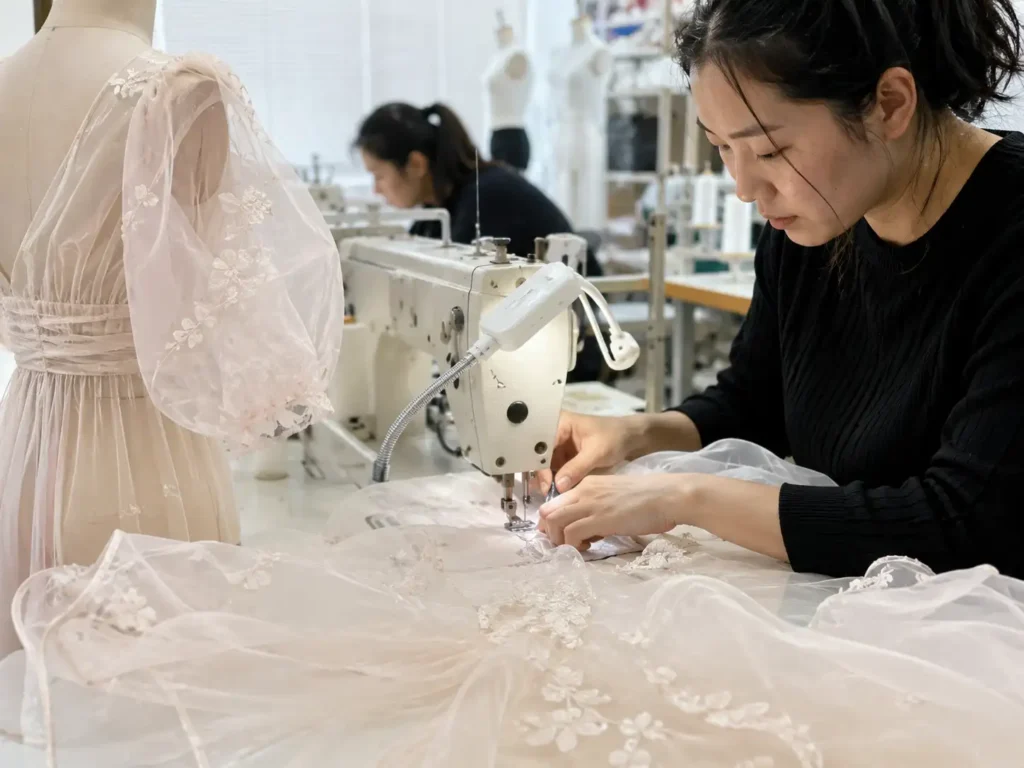
Jinfeng Apparel’s documented system includes six owned womenswear factories, more than ten long-term satellite production partners, over 18 sewing lines, six or more flexible lines, two sample rooms, more than 20 sample machinists, seven or more senior pattern makers, 15 or more QC inspectors, and regular monthly capacity above 100,000 garments depending on style complexity and scheduling. These figures are useful because they connect capacity to specific resources. For any supplier, however, the next question remains essential: which facility, line, and technical team will actually handle this style after the PP sample is approved?
How Should You Compare Samples?
Compare samples through a documented review of silhouette, fit, measurements, fabric, construction, workmanship, finishing, and bulk-production feasibility. Pay equal attention to how the factory manages revisions. A good first sample is valuable, but a disciplined correction process is a stronger indicator of reliable bulk production.
Professional sample-review scene for custom dresses, with a fit model or dress form wearing a fitted sample while a pattern maker and product developer compare the garment against a measurement chart and annotated tech pack. Show tape measures, revision photographs, fabric swatches, pattern version labels, and a sealed reference sample nearby. Realistic fashion-workroom environment, natural expressions, premium editorial style, no text overlay, and no visible brand logos.
Review the First Sample Properly
The first sample should prove that the factory understands the design, can build the intended structure, has selected a workable material, and can identify what still needs correction. It does not have to solve every detail, particularly when development begins from a sketch or reference image rather than a complete technical package. Review the garment in a fixed sequence: overall silhouette, on-body fit, flat measurements, fabric behavior, construction, workmanship, comfort, and bulk feasibility. A beautiful sample can still be commercially weak when it needs excessive handwork, uses unavailable trims, or cannot be repeated across the size range.
- Overall silhouette and visual proportion
- Bust, waist, hip, length, and other critical measurements
- Neckline, armhole, shoulder, strap, zipper, lining, and support
- Fabric weight, stretch, opacity, drape, and recovery
- Symmetry, stitching, seam appearance, finishing, and comfort
- Suitability for grading and repeatable bulk production
Use a fit model whose measurements are close to the intended base size and record those measurements with the sample comments. Front photographs alone are not enough because the garment may pull across the back, open at the neckline, twist at the side seam, restrict movement, or shift at the waist. Separate design preference from manufacturing error. Asking for a lower neckline because the collection direction changed is a design revision; correcting a neckline that was cut deeper than the tech pack is a workmanship or pattern correction. This distinction matters when tracking cost, sample rounds, and responsibility.
Use Measurable Fit Comments
Vague comments create unnecessary sample rounds. ‘Make it tighter,’ ‘the skirt feels wrong,’ or ‘the neckline is not right’ does not tell the pattern maker where the problem is, how much to change, or which neighboring measurements must remain stable. A useful comment identifies the exact location, current measurement, required measurement, visible problem, expected correction, and reference photograph. For example: ‘Reduce the total waist circumference by 2 cm, removing 0.5 cm at each side seam on the front and back, maintain the hip measurement, and blend the correction gradually over 12 cm.’
Not every visible fit problem should be solved by changing a measurement. A gaping neckline can result from pattern shape, fabric stretch, seam handling, missing stabilization, or several causes at once. Simply shortening the neckline can create rippling without improving fit. Experienced development teams separate pattern problems, sewing problems, fabric problems, measurement errors, construction limitations, and intentional design changes. The correction should address the cause and then be verified on the next sample. This diagnostic ability is one of the clearest differences between a basic sewing supplier and a development partner capable of supporting complex dresses.
Track Revisions by Version
Every sample round should carry a style number, version number, and review date. Comments should be consolidated into one controlled document rather than dispersed across email threads, messaging apps, voice notes, and photographs. A practical revision log records the issue category, current condition, approved action, pattern impact, material impact, cost effect, schedule effect, and status. This approach does not make development bureaucratic; it prevents the same correction from being interpreted differently by the pattern maker, sample machinist, merchandiser, production line, and quality team.
- Style number, sample version, sample date, and review date
- Issue category, current condition, and required correction
- Pattern, measurement, material, cost, and schedule impact
- Responsible file and final approval status
Once a revision is approved, all affected files must change together. The list may include the paper or digital pattern, measurement chart, grade rule, bill of materials, construction sheet, fabric record, trim card, label specification, and QC checklist. Many bulk failures occur even after a correct sample has been made because an older pattern or size chart remains in circulation. Version control is therefore not an office detail. It is a production safeguard. Set realistic review deadlines as well, because long gaps between sample receipt and feedback can change fabric availability, quotations, and line bookings.
Approve the Production Reference
The sample approved for bulk should be made as closely as possible to the final production specification. Confirm the shell fabric, lining, color, trims, pattern, measurements, construction, labels, finishing, and packaging method. A pre-production sample is normally approved before bulk cutting, and a sealed Golden sample should remain available as the physical standard for sewing, finishing, quality inspection, repeat orders, and dispute review. The sample becomes much more useful when it is linked to the correct tech pack, BOM, measurement chart, fabric approval, trim approval, and packaging file.
One sample cannot always answer every question. A fit sample validates body shape and measurements. A photo-ready sample may receive extra attention to pressing and visual presentation but may be made before final material or grading approval. A size-set sample checks the grading across selected sizes. A PP sample confirms the production-ready garment. A packaging sample verifies folding, labels, barcodes, polybags, and carton presentation. Jinfeng Apparel’s documented process uses PP sample approval, Golden sample standards, production orders, BOMs, fabric and trim approvals, size charts, sewing instructions, QC checklists, and packing instructions to help keep bulk production aligned with the approved reference.
How Do You Compare Commercial Terms?
Compare commercial terms only after confirming that every quotation covers the same garment specification and service scope. Review materials, labor, sampling, labels, packaging, testing, inspection, shipping terms, MOQ, payment conditions, and possible surcharges. The lowest unit price may exclude essential costs or assume a lower product standard.
Overhead editorial image of a sourcing manager comparing several custom dress quotation sheets beside fabric swatches, zipper and boning samples, packaging specifications, an MOQ breakdown, a production calendar, and freight documents. Include a calculator and annotated cost assumptions, but no visible currency totals or company names. Realistic fashion sourcing workspace, premium natural lighting, organized rather than sterile, no text overlay, and no handshake imagery.
Compare the Same Quotation Scope
A professional quotation should explain what the factory is pricing. A single unit figure without material specifications, construction assumptions, quantity basis, packaging level, and exclusions is difficult to evaluate and easy to change later. Request a written scope that identifies shell fabric, lining, trims, pattern work, grading, samples, cutting, sewing, finishing, pressing, quality checks, labels, hangtags, barcodes, polybags, cartons, testing, and delivery terms. The factory does not need to reveal confidential margins, but it should make clear which finished product and service package the number represents.
Check whether the fabric is final or provisional and whether pricing is based on estimated consumption, sample consumption, or marker-based consumption after pattern completion. Confirm whether additional colors, extended sizes, placement prints, embellishments, special packaging, split shipments, or third-party inspection create extra charges. Compare quotations on the same trade term and destination. An EXW price cannot be placed directly beside a DDP price without separating inland handling, export charges, freight, customs, duties, and destination delivery. A fair commercial comparison removes these differences before ranking the suppliers.
| Cost category | Details to confirm | Common source of later increases |
| Shell fabric | Composition, weight, width, finish, color, consumption | Final consumption or fabric substitution |
| Lining | Type, coverage, color, weight | Adding full lining after fitting |
| Trims | Zippers, cups, boning, buttons, elastic, lace | Custom color or special specification |
| Development | Pattern, grading, samples, revisions | Additional sample rounds |
| Production | Cutting, sewing, finishing, pressing | Construction changes after sampling |
| Branding and packing | Labels, tags, barcodes, polybags, cartons | Low-volume custom printing or retail packing |
| Quality and testing | Inline QC, final inspection, tests, reports | Third-party or market-specific requirements |
| Logistics | EXW, FOB, CIF, DAP, or DDP | Freight, duty, customs, destination handling |
Understand the Real MOQ
MOQ is rarely controlled by one number. The garment factory, fabric mill, dye house, print supplier, zipper producer, label printer, and packaging supplier may each have separate minimums. Clarify whether the stated MOQ applies per style, color, fabric, print, embroidery design, custom trim, size range, purchase order, or shipment. A manufacturer may accept 200 pieces per style and color with available fabric and standard trims, while the same design requires a higher commitment when it uses custom-dyed satin, exclusive lace, specially molded hardware, certified fabric, or unique printed packaging.
- MOQ per style and per color
- Fabric-mill, dye-house, print, and trim minimums
- Number of sizes and the quantity in each size
- Custom label, barcode, and packaging minimums
- Repeat-order potential and whether materials can be reserved
Color and size fragmentation should be discussed together with MOQ. Six hundred units in one color are usually more efficient than six hundred units divided across six colors because every color creates separate material handling, cutting, line setup, inspection, and packing. Jinfeng Apparel’s basic MOQ starts from 200 pieces per style and color, subject to fabric availability, custom dyeing or weaving, printing, special trims, certified materials, packaging, complexity, and scheduling. That number should be treated as a starting production condition, not a promise that every fabric, decoration, and assortment can be produced economically at the same minimum.

Identify Price-Change Triggers
Many pricing disputes begin because the brand treats the first figure as final while the factory treats it as an early estimate. Common triggers include higher fabric consumption after the pattern is completed, full lining added after fitting, a heavier or wider fabric, custom dyeing, exclusive printing, special zipper development, cups, boning, underwire, additional ruching, hand-applied decoration, more sample rounds, a wider size range, complex size ratios, urgent scheduling, and upgraded retail packaging. Ask the supplier to identify the open variables and the point at which the quotation becomes production-ready.
Price movement is not automatically a warning sign. The important questions are whether the cause is technically reasonable, documented, and communicated before the cost is incurred. Marker-based fabric consumption after pattern completion is normally more reliable than a photograph-based estimate. A supplier should also state the validity period because fabric prices, freight, currency, and capacity can change when development lasts several months. Jinfeng Apparel’s documented quotation logic includes fabric, trims, construction, sampling, pattern work, cutting, sewing time, pressing, QC, packing, wastage, logistics, testing or certification, and reasonable factory margin, with cost optimization based on material and construction choices rather than hidden quality reduction.
Calculate Total Landed Cost
The lowest ex-factory unit price does not always create the lowest landed cost. Add sample fees, sample courier charges, pattern and grading costs, fabric or trim development, labels, packaging, testing, inspection, freight, insurance, duties, customs clearance, warehouse delivery, and any required relabeling or ticketing. Use the same currency, trade term, destination, packing standard, and quantity split for every supplier. A difference of fifty cents per garment can disappear after adding packaging, inspection, freight, rework, or destination handling that was excluded from the first quote.
Quality and delivery risk also have a financial value. A lower-cost garment that generates more returns can create outbound freight, reverse logistics, refunds, customer service work, markdowns, damaged reviews, and lost repeat sales. Missing a campaign, wholesale appointment, retail delivery window, or seasonal event may cost more than a modest unit-price saving. A useful commercial comparison therefore places factory price, landed cost, defect exposure, and schedule exposure on the same page. The winning quotation is not necessarily the smallest number; it is the most credible cost for achieving the agreed product and delivery standard.
How Are Quality and Delivery Controlled?
Quality and delivery are controlled through approved materials, correct production files, early-stage inspection, inline monitoring, final verification, and a realistic shipment plan. Strong manufacturers do not wait until the order is finished to find problems. They identify risk before cutting and correct defects while production is still recoverable.
Detailed garment quality-control scene showing inspectors reviewing custom dresses at several stages: fabric inspection, cut-panel checking, inline sewing measurement, final garment appearance, barcode and label verification, and carton packing. Include satin, mesh, lace, and bodycon styles with tape measures, QC sheets, trim cards, and a sealed reference sample. Realistic workshop-style visual, premium editorial photography, no logos, no text overlay, and no claim that it depicts a specific factory.
Check the Full QC Process
Final inspection is only one part of quality control. By the time a finished dress reaches the final table, the fabric has already been purchased, relaxed, cut, sewn, pressed, and often packed. Some faults can still be repaired, but shade problems, incorrect cutting direction, missing seam allowance, wrong pattern versions, and widespread measurement errors may be expensive or impossible to correct. A sound process covers incoming fabric and trims, pre-production documents, cutting, first output, inline sewing, measurements, garment appearance, pressing, packing, and pre-shipment review.
- Incoming fabric and trim inspection
- Pattern, BOM, size chart, and PP sample confirmation
- Cutting, first-output, and inline sewing checks
- Measurement, appearance, pressing, and function inspection
- Packing, assortment, barcode, carton, and pre-shipment review
Each stage should focus on the defects most likely to occur there. Print direction, grain, stretch orientation, panel placement, and size bundling belong in cutting control. Zipper rippling, uneven gathering, seam puckering, lining attachment, and left-right symmetry should be checked while sewing is in progress. Stains, loose threads, pressing shine, missing decoration, and final shape belong in finishing. Labels, care content, barcodes, size stickers, folding, carton assortment, carton marks, and weights belong in packing. Ask who can stop production when a serious issue appears, not only who writes the final inspection report.
Control Measurements and Workmanship
Measurement tolerances should be agreed before production because one general allowance does not suit every point. Bust, waist, hip, underbust, neckline opening, strap length, armhole, torso length, garment length, and slit height affect fit in different ways. Many brands use tighter control for critical fitted points and a wider allowance for long lengths or large sweeps, with the exact tolerance adjusted for fabric behavior and construction. The number should be written in the measurement chart rather than assumed from a factory’s normal practice.
- Define critical and non-critical measurement points
- Set tolerances by garment structure and fabric behavior
- Use the approved sample and defect photographs as visual standards
- Measure after the required resting, pressing, or hanging period
- Record recurring defects for corrective action and repeat orders
Workmanship standards should be visual and specific. ‘Good stitching’ is too subjective to guide a sewing line or settle a final inspection. Use approved samples, close-up photographs, seam specifications, stitch requirements where necessary, and examples of unacceptable defects. Common dress issues include puckered seams, uneven gathering, twisted side seams, wavy necklines, exposed lining, crooked zippers, mismatched lace, missing sequins, pressing shine, needle damage, oil marks, and uneven hems. Stretch garments may need measurement checks after resting, while long chiffon or bias-cut styles may need time to drop before final hem leveling.
Protect Bulk Consistency
Bulk garments should be produced from a controlled package rather than from memory. The package normally includes the approved pattern version, final measurement chart, grade rules, bill of materials, fabric and trim approvals, construction instructions, PP sample, Golden sample, label files, packaging instructions, and QC checklist. Confirm how revisions are issued and how obsolete files are removed. A measurement change approved after PP review may affect pattern making, grading, cutting, sewing, QC, and packing, so updating only one document does not complete the change.
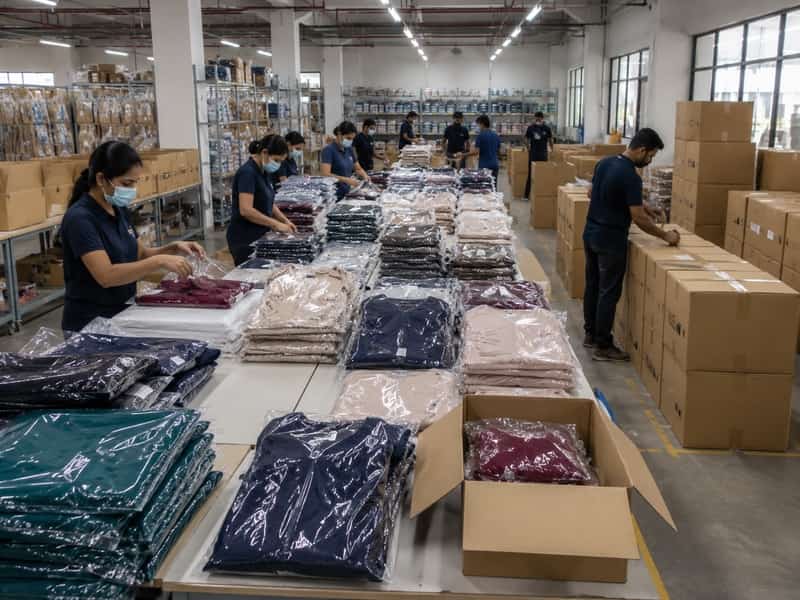
When partner factories or subcontractors are used, ask which facility will make the order, which operations may be external, who issues the technical files, who checks the first output, who performs inline and final inspection, and who remains accountable for defects. Outsourcing is common and can improve specialization and peak-season flexibility, but only when centrally managed. Jinfeng Apparel operates six owned womenswear factories and more than ten long-term satellite partners, assigning work by product, fabric, complexity, quantity, and schedule while retaining responsibility for technical information, key production stages, quality standards, packing, and delivery coordination.
Monitor Delivery Milestones
A realistic production schedule should show more than one shipment date. Track fabric booking, fabric and trim arrival, PP sample approval, bulk cutting, first output, sewing progress, finishing, final inspection, packing completion, freight booking, and dispatch. Ask for updates at meaningful milestones rather than daily reassurance. A useful update states the completed quantity, current stage, open issue, recovery action, and next decision required. This makes it possible to detect a slipping critical path while there is still time to change capacity, sequence styles, or adjust the shipping plan.
- Fabric and trim booking dates
- PP approval and bulk cutting date
- First output and inline inspection milestones
- Finishing, final inspection, and packing completion
- Freight booking, dispatch, and expected arrival
Delays often begin before the sewing line starts. Late fabric approval, missing label artwork, unconfirmed size ratios, delayed deposits, slow sample comments, or a changed packaging requirement can reduce production time. A shared calendar should separate factory commitments from client approval deadlines. When a delay occurs, request four facts: the cause, the quantity affected, the recovery plan, and the revised completion date. ‘Production is busy’ is not a sufficient explanation. A reliable supplier identifies the actual constraint and explains what can realistically be recovered without hiding quality risk behind an aggressive promise.
Which Manufacturer Is the Best Long-Term Fit?
The best long-term manufacturer combines relevant dress expertise, reliable samples, transparent costing, documented quality control, realistic capacity, accountable communication, brand protection, and repeat-order support. Select the supplier that reduces total operational risk while meeting your product and commercial goals, not simply the supplier with the lowest initial quote.
Strategic supplier-selection scene showing a fashion brand team reviewing a weighted factory scorecard alongside approved custom dress samples, production records, NDA documents, a seasonal collection calendar, fabric archives, and repeat-order files. Include several professionally made dresses and a clear sense of long-term planning rather than a sales meeting. Realistic editorial photography, sophisticated but approachable, no visible brand names, no text overlay, and no handshake cliché.
Test Communication Quality
Communication should be judged by accuracy, ownership, and technical usefulness, not only response speed. A capable supplier asks specific questions, identifies missing information, summarizes decisions, separates estimates from confirmed facts, explains cost and schedule consequences, and reports problems before they become emergencies. Complex womenswear involves trade-offs among fit, fabric, construction, price, and delivery. A factory that agrees instantly with every request without discussing those trade-offs may be trying to win the order rather than demonstrating that the design has been reviewed carefully.
- One accountable project contact
- Written summaries after important decisions
- Version numbers for tech packs and samples
- Clear warnings about cost and schedule effects
- Regular, factual development and production updates
Use sampling as a controlled communication test. Request one measurable fit change, one fabric alternative, and an updated schedule, then check whether the revised sample, measurement chart, material record, quotation, and timeline all reflect the same decisions. Strong communication reduces repeated explanations and preserves choices made months earlier when the style moves from development to bulk. Jinfeng Apparel identifies Kelly as the external contact for inquiries, tech packs, reference images, sample reviews, MOQ, quotations, lead times, and coordination with development or production teams. A named owner is useful only when that person can trace decisions and bring technical questions to the right team.
Measure Scalability
Scalability does not simply mean accepting a larger purchase order. It means maintaining the approved product standard while managing more styles, colors, sizes, launches, and delivery destinations. Ask how the manufacturer handles parallel sampling, shared fabrics across a collection, additional colorways, extended sizing, split deliveries, peak-season demand, best-seller replenishment, and regional packaging. A supplier may perform well with one style yet struggle when ten styles require pattern approval, material booking, production, inspection, and packing at the same time.
Repeat-order support depends on retained production knowledge. Patterns, measurement charts, fabric references, trim records, color standards, construction files, QC notes, and packaging instructions should be retrievable for future orders. Retention does not remove the need to check material availability, lot differences, changed regulations, or revised labels, but it prevents every replenishment from starting at zero. Jinfeng Apparel documents support for seasonal collections, repeat orders, multi-batch production, and the retention of pattern, measurement, fabric, trim, workmanship, packing, and order records. This is the kind of operating memory that reduces development time and helps preserve consistency across seasons.
Protect Designs and Records
Fashion development involves commercially sensitive information: unreleased designs, original samples, tech packs, patterns, target prices, quantity plans, brand labels, packaging files, launch dates, and customer-specific standards. Ask whether the factory supports an NDA and how confidential files and physical samples are handled. Protection should cover who can access the materials, whether samples can be photographed, how customer-owned patterns are identified, how rejected or outdated samples are stored or disposed of, and whether unreleased products can appear in a showroom, social post, or case study without written permission.
- Tech packs, patterns, samples, and measurement charts
- Fabric developments, custom trims, and color standards
- Labels, packaging artwork, barcodes, and warehouse files
- Prices, quantities, launch dates, and unreleased collections
- Rules for photography, display, storage, access, and disposal
Confidentiality is an operating habit as much as a contract. Long-term records must remain accessible for authorized repeat production without becoming visible to unrelated customers or external partners. Jinfeng Apparel supports NDA-based cooperation and documents protection for tech packs, original samples, patterns, unpublished designs, label files, packaging files, pricing, order information, and brand materials. It also states that client names, logos, sample photographs, order quantities, and pricing are not disclosed without permission. Similar written commitments should be requested from every finalist before sensitive collection files are shared.
Use a Weighted Final Score
A weighted scorecard prevents one attractive feature, usually price or a polished sample, from dominating the final decision. Score each category from 1 to 5, multiply the score by the agreed weight, and attach evidence to the result. A score of 5 should be supported by a sample, measurement report, technical explanation, production record, inspection file, factory discussion, or trial-order result. Sales claims without supporting evidence should not receive the same value as verified performance.
The final choice does not need to be perfect in every category. The stronger manufacturer is the one whose capabilities match the product risks, whose limitations are communicated honestly, and whose operating system can support the collection after the first order is finished. End the evaluation when serious warning signs appear: unexplained pricing far below comparable suppliers, refusal to identify the proposed material or production location, pressure to cut bulk before PP approval, no measurement or inspection records, inconsistent payment information, uncontrolled subcontracting, repeated changes to MOQ or lead time, weak document control, unrealistic delivery promises, or reluctance to protect unreleased designs.
| Evaluation factor | Suggested weight | Evidence to review |
| Relevant dress experience | 12% | Similar styles, materials, construction, order scale |
| Pattern and fit capability | 15% | Sample fit, measurements, revision quality |
| Sample execution | 13% | Design accuracy, workmanship, repeatability |
| Fabric and trim knowledge | 10% | Risk assessment, sourcing, material approvals |
| Bulk quality system | 15% | QC stages, inspection files, corrective actions |
| Cost transparency | 10% | Scope, assumptions, exclusions, change control |
| Capacity and delivery | 10% | Relevant line capacity, schedule, milestones |
| Communication | 8% | Accuracy, ownership, reporting, version control |
| Brand protection | 3% | NDA, file handling, sample confidentiality |
| Repeat-order support | 4% | Record retention, replenishment, seasonal capacity |
| Total | 100% | Weighted evidence-based decision |
A useful manufacturer comparison does more than select a supplier for one purchase order. It establishes the working standard for product information, sampling, revision control, quotation approval, material confirmation, production, quality inspection, packing, and repeat orders. When those expectations are documented before bulk production, both sides can make decisions faster, separate design changes from manufacturing errors, and resolve problems with evidence instead of relying on memory or sales assurances.