Skip to content

Two fabrics can look almost interchangeable on a sourcing table and produce noticeably different dresses once they are cut, lined, sewn, pressed, photographed, and worn. Chiffon and georgette are a classic example. Both can create flowing skirts, soft sleeves, overlays, ruffles, occasion dresses, and resort styles, yet they react differently to movement, light, seam tension, lining weight, and embellishment. That difference matters most when a design is expected to move from a sketch or reference image into a repeatable production garment rather than remain a beautiful swatch.
Chiffon is usually the stronger choice when a dress needs an airy, floating, semi-sheer effect, while georgette generally works better when the design needs more body, surface texture, and controlled drape. Neither fabric is universally better. The right choice depends on silhouette, opacity, fiber content, GSM, lining, construction, embellishment, and the intended movement of the finished garment.
A useful way to think about the comparison is to imagine approving a floor-length dress from a moodboard. On the screen, the skirt looks soft, romantic, and effortless. The first sample arrives and the hem hangs too heavily, the ruffles look flat, or the lining shows through under daylight. The pattern may not be the real problem. Very often, the fabric changed the personality of the design before the sewing line even began.
What Is the Difference Between Chiffon and Georgette?
Chiffon is generally lighter, smoother, more transparent, and more responsive to air movement, while georgette usually has a grainier crepe surface, slightly more body, and a steadier fall. The difference is not only visual. Texture, weight, yarn twist, opacity, fiber content, and finishing affect how each fabric gathers, drapes, layers, photographs, and behaves during sewing.
What Are Chiffon and Georgette?
Chiffon is a lightweight woven fabric made with highly twisted yarns that create a fine, slightly crisp hand and a soft transparent appearance. Commercial chiffon may be made from polyester, recycled polyester, silk, or blends, so the word “chiffon” does not describe one fixed performance level. In dress development, common chiffon qualities can range roughly from 30 to 90 gsm, which is wide enough for one chiffon to feel almost weightless while another has noticeably more body and coverage.
Georgette is also produced with twisted yarns, but its surface is normally more pebbled and crepe-like. It tends to feel drier and more textured in the hand, and many commercial qualities have slightly more body than chiffon. Both fabrics can be used for dresses, skirts, sleeves, overlays, and occasionwear, which explains why they are often treated as substitutes. The important distinction is that chiffon emphasizes lightness and flutter, while georgette usually gives fluidity with more visual control.
How Do Texture and Finish Differ?
Texture is one of the quickest ways to separate chiffon from georgette. Chiffon normally looks finer and feels smoother, although highly twisted yarns can still give it a subtle crispness. Georgette has a more obvious granular surface that can often be felt by rubbing the cloth lightly between the fingers. That surface changes how the fabric catches light, which becomes much more noticeable across a full skirt or long sleeve than it does on a small swatch.
Finish also affects the mood of a garment. Chiffon can appear softly luminous, especially in silk or finely finished polyester qualities, while georgette usually reads as more matte. On black, navy, burgundy, chocolate, or emerald dresses, a matte georgette can look visually denser and more grounded. A chiffon in the same shade can still feel lighter because its fine surface, translucency, and movement allow light to pass and shift more freely as the wearer moves.
How Do Weight and Sheerness Differ?
Chiffon is usually the more transparent option, particularly at the lighter end of the weight range. That is why white, ivory, blush, pale yellow, champagne, and other light-colored chiffon dresses commonly need lining even when the fabric looks acceptable indoors. Strong daylight, backlighting, or flash photography can reveal seam allowances, underlayers, or the outline of a lining that seemed invisible during a quick fitting.
Georgette often gives a little more coverage because its structure is denser and its surface scatters light differently, but lightweight georgette should never be assumed to be opaque. Color, weave density, finish, fiber, and garment tension all affect visibility. For development teams, the useful comparison is not simply “which fabric is sheer,” but how much coverage remains after the fabric is stretched over the body, layered over lining, photographed, and viewed while moving.
| Property | Chiffon | Georgette | Practical Dress Effect |
| Typical visual character | Airy, fine, delicate | Textured, matte, controlled | Changes the overall mood of the dress |
| Relative body | Lower | Usually higher | Influences folds, gathers, and skirt shape |
| Transparency | Usually higher | Often slightly lower | Affects lining and coverage decisions |
| Movement | Fast, floating, fluttering | Fluid, steadier | Changes hem and sleeve behavior |
| Surface | Fine and relatively smooth | Pebbled or crepe-like | Changes light reflection and texture |
| Chiffon reference range | About 30-90 gsm | Varies by quality and supplier | Exact swatch approval remains necessary |
| Embellishment tolerance | Better for lighter decoration | Often better for moderate decoration | Influences backing and reinforcement needs |
| Cutting stability | More prone to shifting | Often somewhat easier to control | Affects panel accuracy and sewing consistency |
How Can You Tell Them Apart?
Start with the surface rather than the label. Place both fabrics flat under natural light and view them from a shallow angle. Georgette usually reveals a more visible crepe grain, while chiffon appears finer and cleaner. Then hold each fabric against a bright light source. Chiffon generally transmits more light, although dark colors can make either material appear more opaque than it really is. Comparing similar colors gives a much more useful result.
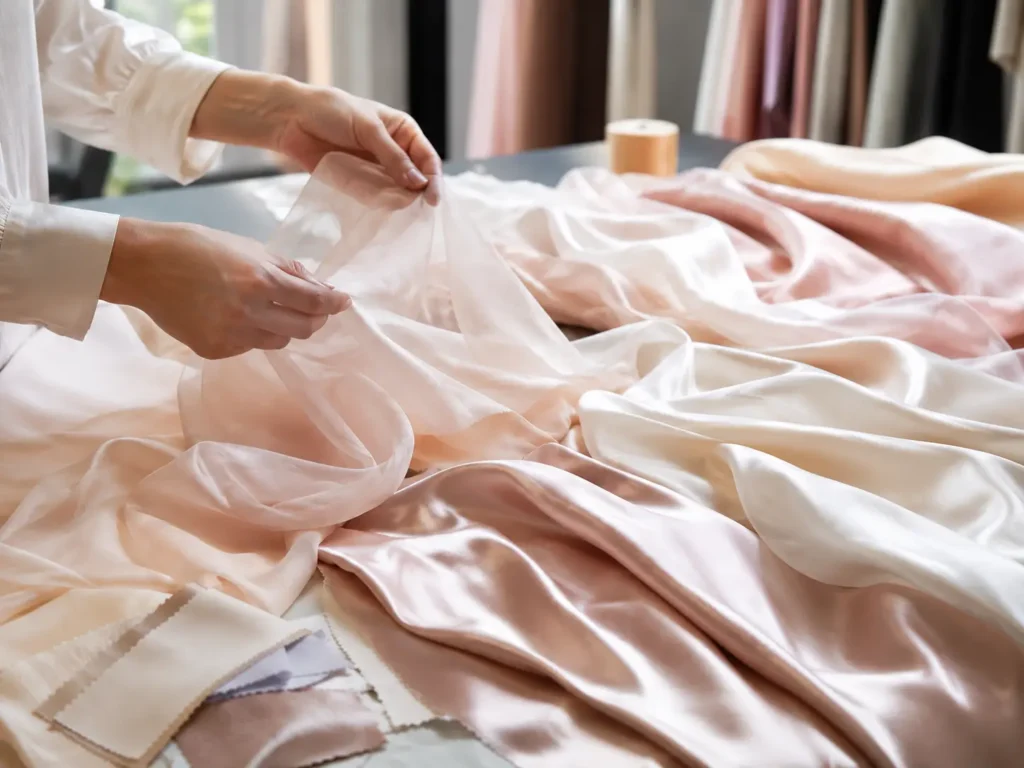
The next test is drape. A 10 x 10 cm swatch can show color and texture, but it cannot tell you how a 120 cm skirt panel will behave. Let a larger piece hang freely, create several folds, and gently move it from side to side. Chiffon usually responds faster and separates more easily between folds. Georgette tends to return to a more controlled vertical fall. For serious dress development, the best identification test is still the finished sample because gathering, lining, seam construction, and skirt circumference can exaggerate or reduce the differences seen in raw cloth.
Which Fabric Drapes Better in Dresses?
Neither fabric drapes better in every design. Chiffon creates lighter, more airborne movement and works well when softness, flutter, and visible motion are part of the concept. Georgette normally falls with slightly more weight and definition, making it useful when a dress should remain fluid but not overly floaty. The silhouette, skirt volume, lining, and garment length should decide the winner.
How Does Chiffon Move?
Chiffon reacts quickly to small movements. A wearer does not need to make a dramatic turn for the hem to lift, layers to separate, or a flutter sleeve to move. That sensitivity is exactly what makes chiffon so attractive for resort maxis, bridesmaid skirts, scarf details, cape overlays, and softly gathered sleeves. The cloth can create visible motion without adding much physical weight, so a relatively simple pattern can appear much more dynamic once the garment is worn.
The same sensitivity also exposes weak production control. On a long chiffon skirt, small differences in grain direction, panel handling, or seam tension can create an uneven hem that becomes obvious after the garment hangs. Lightweight layers can also shift during cutting, especially when several plies are spread together. In our chiffon dress development, transparency, lining, cut-piece slippage, and hem balance are recurring checkpoints because the fabric’s strongest visual advantage – movement – can also make small inconsistencies easier to see.
How Does Georgette Drape?
Georgette generally produces a steadier, more grounded fall. It can still look soft and fluid, but the folds often stay closer to the body and remain more defined. That makes it useful for wrap dresses, long-sleeve occasion styles, soft columns, draped midis, and garments that need movement without appearing weightless. Its slightly grainier surface can also make a simple silhouette look richer because the fabric carries more visible texture even when the pattern is minimal.
The trade-off is that “georgette” describes a family of fabrics rather than one exact drape. A lightweight silk georgette can feel soft and highly fluid, while a firmer polyester georgette may feel drier and more controlled. When a sourcing request only says “use georgette,” the team can still receive very different results. A better specification combines the fabric name with desired hand feel, opacity, weight, surface texture, and the kind of folds the finished dress should produce.
Which Fabric Creates More Volume?
Chiffon creates a large amount of visual volume for relatively little weight. A gathered chiffon skirt can look full and romantic without feeling physically heavy, which is one reason it performs so well in tiered maxis, ruffled skirts, layered occasion dresses, and floating sleeves. Multiple chiffon layers can also create depth because each translucent layer adds color and movement without building the same bulk that would occur in a heavier woven fabric.
Georgette creates a different kind of fullness. Its extra body usually gives folds more definition, so a smaller amount of fabric may still look substantial. It helps to separate gathered volume, layered volume, structural volume, and movement volume. Chiffon is especially strong in layered and movement volume, while georgette often gives stronger gathered folds. Neither fabric should be expected to create the rigid projection of organza or taffeta. Pattern decisions such as a 1.5:1, 2.5:1, or 3:1 gathering ratio can change fullness as much as the fabric itself.
Which Fabric Is More Sheer?
Chiffon is usually more sheer, particularly in pale shades and lighter weights. That can be a design advantage for transparent sleeves, overlays, layered necklines, and skirts where controlled translucency adds softness. The challenge begins when the style needs chiffon movement but not chiffon visibility. Adding lining solves coverage, but the lining becomes part of the drape system rather than a hidden afterthought.
A heavy or stiff lining can pull the outer fabric downward and reduce the flutter that made chiffon attractive in the first place. Georgette often gives slightly more coverage while preserving fluid movement, yet strong backlighting can still reveal body outlines or internal construction. For ecommerce and occasionwear, opacity should be checked in indoor light, bright daylight, direct backlighting, and photography. Two layers may look covered while standing still, then separate during walking and reveal much more of the lining or body underneath.
Which Fabric Is Better for Different Dresses?
Chiffon is usually stronger for dresses built around airy movement, layered softness, ruffles, and translucent details, while georgette often suits styles that need controlled drape, slightly more coverage, and stronger folds. The best choice changes by silhouette. A resort maxi, bridesmaid dress, cocktail dress, evening column, and ruffled mini all place different demands on the same fabric.
Which Is Better for Maxi Dresses?
Chiffon is a natural choice for maxi dresses because length magnifies its strongest quality: movement. Long A-line panels, tiered skirts, gathered waists, and full circular shapes can open and close gracefully while the wearer walks. Printed chiffon also works well in resort and vacation collections because translucent layers soften a print and create depth when placed over a coordinated lining. For a design that should feel effortless rather than heavy, chiffon is often the more intuitive starting point.
Georgette becomes attractive when a maxi dress needs more control. A wrap maxi, long-sleeve evening dress, or narrow A-line style may benefit from a fabric that falls vertically and does not lift as easily around the hem. With floor-length garments, production details become more visible because the skirt provides such a large visual area. Panel count, grain direction, lining length, gathering ratio, hem method, and time allowed for the skirt to settle can all affect the final balance more than a small difference in fabric price.
Which Is Better for Bridesmaid Dresses?
Chiffon remains highly suitable for bridesmaid dresses because it creates a soft formal appearance across a broad size range. Floor-length A-line skirts, flutter sleeves, gathered bodices, and layered necklines can all benefit from a fabric that adds movement without making the body look visually heavy. The lightweight character also helps coordinated groups look cohesive in photographs because the skirts respond naturally as people walk, turn, and stand at slightly different angles.
Consistency matters more in bridesmaid programs than it first appears. Several dresses may be ordered in multiple sizes and photographed together, so small differences in shade, lining color, skirt length, or transparency become easy to notice. Georgette can be a good alternative when the collection wants more coverage or a steadier fall. Pale colors such as blush, sage, ivory, champagne, dusty blue, and lavender generally require more careful opacity checks than burgundy, navy, emerald, or black, regardless of the fabric name.
| Dress Type | Chiffon Advantage | Georgette Advantage | Main Production Check |
| Maxi dress | Floating movement and soft volume | Controlled vertical fall | Hem balance and lining length |
| Bridesmaid | Lightweight formal drape | Extra coverage and steadier folds | Shade and size consistency |
| Resort | Airy prints, tiers, and ruffles | More controlled wrap silhouettes | Comfort, transparency, and print behavior |
| Evening | Sheer overlays and dramatic movement | Matte surface and stronger folds | Decoration weight and support |
| Cocktail | Light overlays and flutter details | Cleaner, more grounded drape | Shape retention and seam finish |
| Wedding guest | Romantic movement | Refined fluidity | Daylight opacity and lining color |
| Ruffled dress | Soft fluttering edges | More defined ruffle shape | Edge finishing and gathering ratio |
Which Is Better for Evening Dresses?
Evening dresses often place more stress on the base fabric because they may combine draping, asymmetric panels, corset sections, rhinestones, beading, long skirts, transparent sleeves, or multiple linings. Chiffon is excellent when the evening effect depends on softness. A chiffon cape, overskirt, scarf detail, or layered lower skirt can create drama without adding much weight, and its movement photographs beautifully when the garment is styled in motion.
Georgette often works better when the main body needs stronger folds or moderate decoration. Its matte surface can also create a sophisticated contrast against satin, sequins, or rhinestone trims. Many evening dresses are not truly a one-fabric product; they may use a structured bodice, lining, mesh support, chiffon overlay, and another flowing woven fabric in different zones. In that case, the useful question is not which fabric is better for the whole dress, but which fabric belongs in each functional area and how the transitions between materials will be controlled.
Which Is Better for Ruffles and Pleats?
Chiffon produces softer ruffles because thin strips move easily and narrow edges can flutter with minimal force. That works well around necklines, shoulders, sleeve openings, asymmetric skirts, and tiered hems. Georgette usually gives a more defined ruffle because the fabric has greater body, so the wave remains easier to see when the garment is standing still. If the style is designed mainly for ecommerce imagery, that stronger definition can sometimes be more useful than maximum movement.
Pleats require a more careful distinction. Loose pleats, soft gathers, and draped folds can work in both fabrics, but permanent sharp pleating depends on fiber content and finishing. Polyester versions can often be heat-set more predictably than natural silk, yet exact performance still needs a trial. Ruffle width and gathering ratio matter just as much as fabric choice. A 5 cm ruffle behaves very differently from a 20 cm flounce, and a 1.5:1 gather will look far calmer than a 2.5:1 or 3:1 ratio.
How Do Chiffon and Georgette Affect Construction?
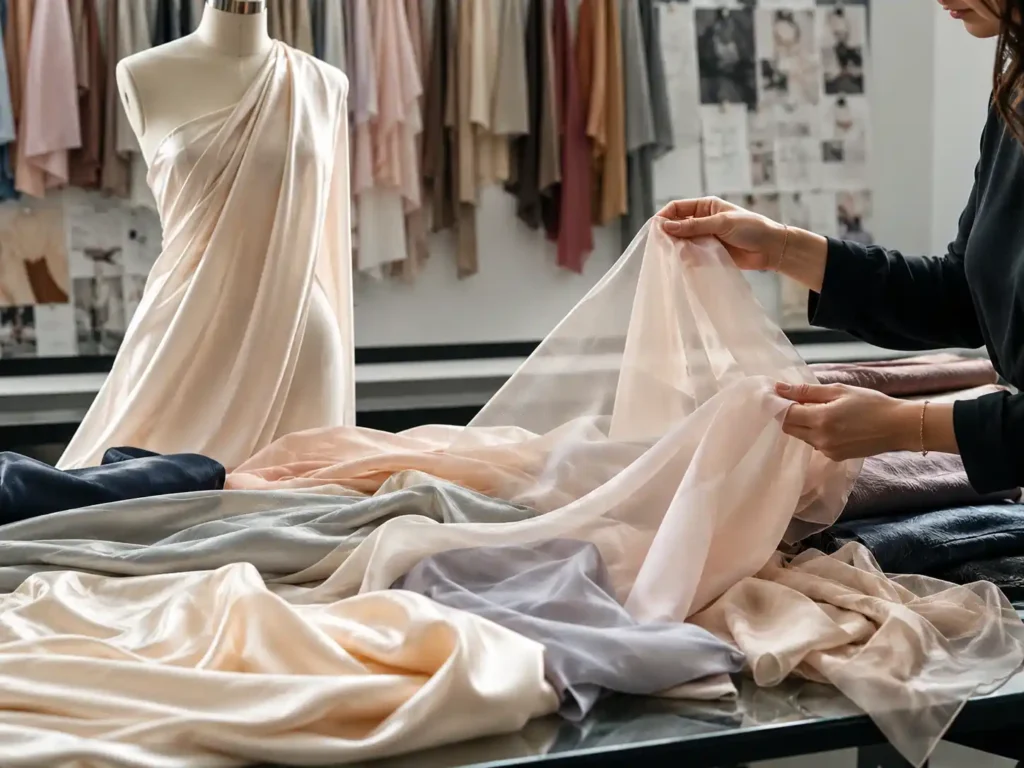
Chiffon generally needs tighter control during spreading, cutting, sewing, lining, pressing, and hemming because it shifts easily and reveals construction through its transparency. Georgette is often somewhat easier to handle, but lightweight qualities can still distort, pucker, or stretch on bias areas. Good results come from matching seam finishes, lining, needle choice, thread tension, and handling methods to the exact fabric.
Do Chiffon and Georgette Need Lining?
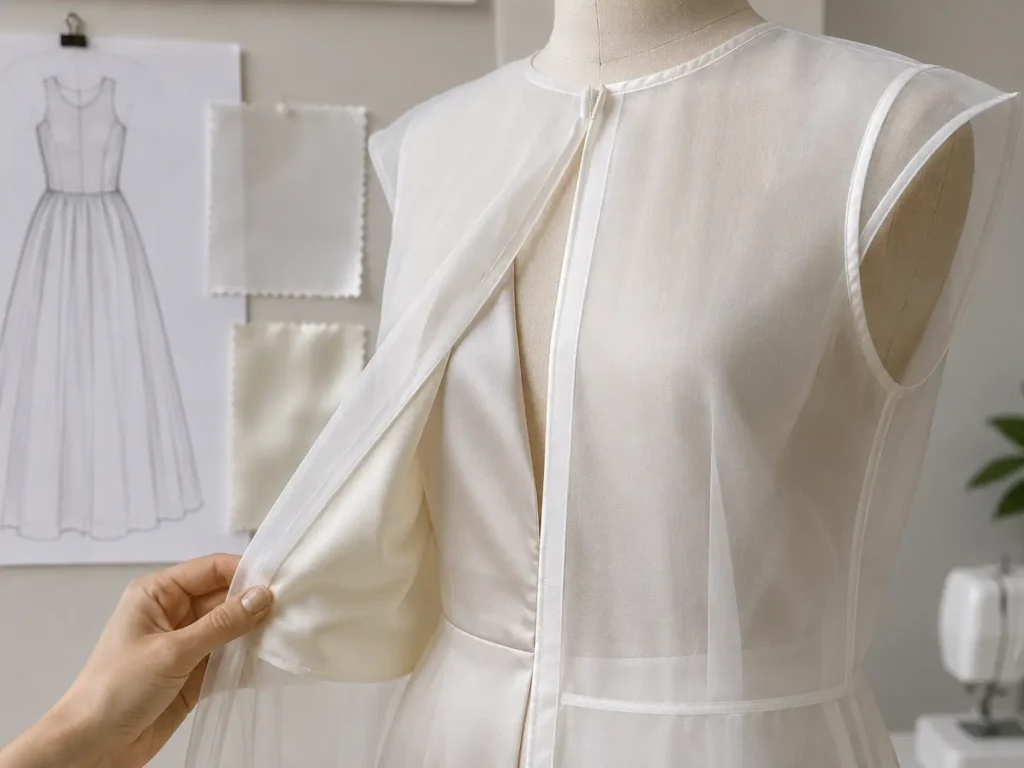
Chiffon dresses frequently need lining, especially in white and other light shades, long skirts, and formal styles. The lining has more than one job: it provides coverage, improves comfort, supports internal construction, and changes the visual color of the outer layer. A tonal lining can deepen a pale chiffon, while a contrasting lining can change the entire appearance of the dress. Because the shell is transparent, lining quality becomes part of the visible product rather than something hidden inside.
Weight compatibility matters just as much as opacity. If the outer chiffon is very light and the lining is substantially heavier, the lining can dominate the garment and flatten its movement. A lining that is too light may cling, twist, or fail to provide enough coverage. Georgette may need less lining in some dark or denser qualities, but formal dresses are still commonly lined for comfort and finish. The outer fabric and lining should therefore be approved as a pair, with daylight opacity, static, stretch compatibility, seam shadowing, and hem interaction checked together.
Which Fabric Is Easier to Sew?
Georgette is often easier to control than very fine chiffon, but neither fabric should be handled like a stable cotton poplin. Chiffon can shift while layers are being spread, move during cutting, distort on bias sections, and pucker when stitch formation or thread tension is not well matched to the cloth. Those risks increase when a style contains many panels because every extra seam creates another opportunity for grain variation, stretching, or length mismatch.
The best time to solve these issues is during sampling. Side seams, necklines, armholes, zipper areas, waist seams, curved sections, and hems should be reviewed before bulk cutting begins. A fabric can look beautiful in raw form and still be a poor match for a specific construction method. For brands developing a new chiffon or lightweight crepe dress, sending a clear tech pack, reference garment, or approved swatch gives the pattern and sample team a much better starting point than asking for a quotation from a photo alone.
Which Fabric Handles Embellishment Better?
Georgette usually handles moderate embellishment more easily because its additional body can support more weight. Chiffon can certainly be embroidered, sequined, beaded, or decorated with rhinestones, but the key variable is weight distribution. A few scattered sequins create very little stress, while a dense stone layout around the neckline can pull the cloth downward, stretch local areas, and change the drape of the entire bodice.
Decoration should therefore be evaluated by weight per area rather than by simply counting pieces. Heavy sections may need backing, reinforcement, or a separate support layer such as fine mesh or organza. Placement around zippers, armholes, and seam allowances also matters because thick decoration can interfere with sewing and create uncomfortable edges against the skin. If the final garment contains meaningful embellishment, the sample should reproduce enough of that weight and placement to expose real construction problems before the PP sample is approved.
How Should Hems and Seams Be Finished?
Fine fabrics generally need fine finishes. A bulky hem on chiffon can create a visible weighted line that interrupts the movement of the skirt, so narrow hems and controlled rolled finishes are commonly used. The challenge grows with circumference. A simple mini dress may have a relatively short hem, while a full maxi skirt can contain several meters of curved edge. Every extra meter increases handling time and the possibility of stretching, waviness, or inconsistent feeding.
Bias areas need particular attention because they can drop after the garment hangs. A long fluid skirt may therefore need sufficient settling time before final hem balancing, especially if different panels are cut on different grain directions. Seams must also be judged from the outside because transparent chiffon can reveal allowances through the shell. A test seam should be sewn on the actual fabric, pressed using the intended method, viewed under strong light, and checked for puckering, comfort, stretching, and visual bulk before the same method is released for production.
How Do Fiber, GSM, and Lining Change the Result?
Fiber content, GSM, finishing, and lining can change chiffon or georgette enough that the fabric name alone becomes a poor predictor of performance. Polyester, recycled polyester, and silk versions differ in hand feel, care, consistency, and cost. Higher GSM often increases body and coverage, while lining can either preserve a fabric’s natural movement or make the finished dress noticeably heavier and more controlled.
Is Polyester Different From Silk?
Polyester and silk versions can look similar in photographs but behave differently in production and wear. Silk usually has a more natural hand, subtle luster, and characteristic softness, while polyester offers strong commercial advantages in consistency, care, availability, and cost control. Polyester chiffon can also be engineered with many different finishes, ranging from very soft and fluid to slightly crisp, crinkled, matte, or printed, so fiber content alone still does not define the final garment behavior.
Silk should not automatically be treated as the superior choice. A commercial collection may need repeatable color, predictable replenishment, simpler care instructions, and stable sourcing across several production runs. Polyester or recycled polyester may fit those needs better. A premium capsule may prioritize natural fiber character and accept higher material costs and more demanding care. The useful sourcing question is therefore whether the fiber supports the intended hand feel, retail positioning, care standard, order volume, and repeat-order plan rather than whether one fiber sounds more luxurious on a label.
How Does GSM Affect Drape?
GSM means grams per square meter, and it is one of the most useful numbers in fabric development because it provides an objective reference for mass. It does not, however, describe stiffness, softness, transparency, stretch, or surface finish. Within a chiffon range of roughly 30 to 90 gsm, the lighter and heavier ends can behave very differently. A very light quality may work beautifully for transparent sleeves but feel too weak for an unlined skirt, while a heavier chiffon can provide more body without losing its fluid character.
Pattern dimensions change the meaning of GSM as well. Two skirts can use the same 60 gsm fabric and still move differently if one uses 1.8 meters of cloth and the other uses 4.5 meters because of tiers, gathers, or a larger circumference. Lining adds another layer to the equation. A 60 gsm shell paired with a 90 gsm lining will not behave like the same shell paired with a 55 gsm lining. GSM is therefore useful for narrowing choices, but it should always be considered together with fiber, finish, fabric width, lining weight, layer count, and pattern volume.
How Does Lining Change the Dress?
Lining changes both appearance and mechanics. It can deepen the outer color, reduce transparency, make the inside more comfortable, support seams, and prevent a sheer shell from clinging directly to the body. It can also reduce movement. A chiffon selected for its floating quality may hang much straighter when paired with a stiff or heavy lining, while an overly lightweight lining can twist or cling and make the outer layer look less controlled.
Stretch compatibility is equally important. A non-stretch chiffon shell combined with a highly elastic lining can shift differently during wear, while a fitted georgette dress may feel restrictive if the shell has slight mechanical give but the lining does not. Length also changes the visual result. A short lining creates an intentional sheer lower section; a full-length lining gives continuous color and coverage. For reliable approval, the garment should be checked from the front, side, and back while walking, sitting, and standing in strong light rather than judged only on a hanger.
Do Color and Print Change Performance?
Color changes perceived transparency even when the fabric construction remains the same. Black chiffon can appear much more covered than ivory chiffon because the eye sees less contrast from the layers underneath. White, nude, blush, lemon, champagne, and other pale shades require more careful tests because internal components such as seam allowances, pockets, boning channels, bra cups, or lining edges can become visible through the shell.
Print can disguise transparency visually without physically reducing it. A dense floral chiffon may look more opaque in a product photograph, yet strong backlighting can still reveal the body or lining underneath. Large motifs can also create placement issues, while borders, stripes, and directional artwork may increase consumption because panels need alignment. Fabric approval should therefore include face and reverse color, print repeat, motif direction, opacity over the selected lining, appearance across seams, and shade consistency between panels. A swatch that looks perfect flat can appear noticeably darker where layers overlap at gathers, pleats, or ruffles.
Which Fabric Should You Choose for a Dress Collection?
Choose chiffon when the collection depends on airiness, sheer layering, flutter, and lightweight volume. Choose georgette when the concept needs fluid movement with more body, texture, and control. For commercial production, however, the final decision should be made after reviewing the actual swatch, lining, sample silhouette, seam behavior, color, and finishing because a fabric name alone cannot guarantee the intended result.
Which Fabric Fits the Silhouette?
Start with the silhouette rather than a preferred fabric. If the concept shows a dress that floats away from the body, reacts visibly during walking, or relies on soft transparent layers, chiffon is usually the stronger starting point. If the design should remain fluid but fall closer to the body, georgette may be more suitable because its extra texture and body can define folds without producing the same amount of airborne movement.
A useful development sequence is silhouette, movement, coverage, detail, fabric, lining, and then sample. This order prevents a common mistake: selecting a beautiful material first and trying to force a design onto it later. A narrow bias dress needs different behavior from a tiered resort maxi, and a gathered-waist dress needs different control from a fitted bodice with a flowing skirt. Even when two products are both called chiffon dresses, the required fabric weight, lining, gathering ratio, and finish may be completely different.
Which Fabric Fits the Design Details?
Design details often make the decision clearer than the broad silhouette. Chiffon is particularly effective for flutter sleeves, scarf ties, cascading ruffles, translucent overlays, gathered necklines, cape panels, and layered maxi skirts because these details benefit from rapid movement and low weight. Georgette often suits controlled draping, wrap fronts, long sleeves, more defined gathers, matte evening styles, and moderate embellishment where the fabric needs to hold a clearer fold or provide a little more support.
Not every detail needs to use the same fabric as the main body. A dress can pair a more stable main fabric with chiffon sleeves, or use a controlled fluid skirt with a lighter overlay. The attachment points then become part of the engineering. A very light sleeve joined to a heavier bodice may need reinforcement, while a chiffon ruffle attached beside dense beading can be distorted by the weight of the decorated section. Evaluating each detail by whether it needs to float, fold, support weight, remain sheer, or hide construction usually leads to a more reliable material choice.
What Should You Check in Sampling?
Sampling is the point where a fabric choice becomes a garment decision. A swatch can confirm hand feel, color, and basic opacity, but it cannot fully reveal bust fit, skirt movement, lining behavior, seam stability, or how a long hem settles. The first sample should therefore be treated as a test of the whole system rather than a miniature version of bulk production. For lightweight dresses, walking, turning, sitting, and photographing the sample can reveal issues that remain invisible on a mannequin.
A disciplined review can move through fabric approval, first sample, fit sample, revised sample, photo sample when needed, PP sample, bulk production, and final inspection. At each stage, the questions should become narrower. Early samples confirm silhouette and material behavior; later samples confirm corrected fit, construction, trims, and repeatability. Jinfeng Apparel’s development workflow supports fabric sourcing, pattern development, sample revision, PP approval, bulk production, and QC, so brands with a clear tech pack, reference sample, or approved swatch can use the sample stage to resolve fabric risk before it becomes a bulk-order problem.
| Stage | Main Check | Typical Risk to Catch Early |
| Fabric approval | Hand feel, weight, opacity, color | Wrong drape or transparency |
| First sample | Silhouette, movement, lining | Design does not translate from sketch |
| Fit sample | Bust, waist, hip, length | Fabric changes fit balance |
| Revised sample | Corrections and construction | New distortion after changes |
| Photo sample | Movement and appearance | Sheerness under strong lighting |
| PP sample | Final fabric, trims, workmanship | Bulk standard remains unclear |
| Bulk production | Measurements, seam quality, consistency | Sample-to-bulk variation |
| Final inspection | Appearance, hem, packing | Visible defects reach shipment |
How Do You Control Bulk Consistency?
Bulk consistency starts before sewing. The approved fabric reference, lining, trims, pattern version, measurement chart, construction method, and sample standard should all be clear before the cutting room releases production. Lightweight fabrics make this discipline especially important because small differences in hand feel, finish, or weight can alter the drape of a dress even when color and fiber content appear to match the approved swatch.
Useful production records include the approved fabric swatch, fiber composition, agreed weight reference, color standard, lining specification, BOM, pattern version, measurement chart, construction sheet, PP sample, approved trim references, and packing instructions. Inspection should then look beyond measurements and check panel direction, seam puckering, lining position, transparency, skirt balance, pressing, and finished appearance. A strong bulk standard is not simply “make it like the sample.” It is the approved sample plus the records that explain how that sample was achieved and how the same result should be repeated across sizes, colors, and production batches.
Can Chiffon and Georgette Be Substituted?
They can sometimes be substituted, but the change should be treated as a product-development decision rather than a simple purchasing replacement. Replacing chiffon with georgette may create more body, stronger folds, greater apparent opacity, a more matte surface, and more total garment weight. Replacing georgette with chiffon may increase movement and transparency while reducing support for dense decoration and increasing the need for lining or more careful seam control.
The pattern may need adjustment as well. Ruffle width, gathering ratio, skirt circumference, sleeve volume, hem finish, and lining can all have been developed around the original fabric. Before substitution, compare fiber content, weight, hand feel, transparency, drape, surface texture, stretch or mechanical give, sewing behavior, lining requirement, and finished movement. Then make the relevant sample. A slightly cheaper roll is not automatically a cheaper garment if the replacement needs additional lining, more difficult sewing, higher wastage, or extra finishing time.
Conclusion
Chiffon and georgette sit close enough to each other in the fabric world that they are easy to compare, yet different enough that a careless substitution can change the finished dress. Chiffon is usually the better starting point for floating movement, translucent layering, flutter sleeves, soft ruffles, and lightweight volume. Georgette becomes more attractive when a design needs fluidity with stronger folds, more surface texture, slightly greater coverage, or better support for moderate construction details.
The most reliable choice is never made from a fabric name alone. Fiber, GSM, finish, color, lining, pattern volume, seam construction, embellishment, and the intended wearing occasion all affect the result. For a brand developing a dress collection, the practical sequence is simple: define the silhouette, approve the physical fabric, pair it with the correct lining, build the sample, test it in movement and strong light, and only then lock the material for production. That approach protects the original design idea while reducing avoidable revisions, opacity surprises, construction problems, and sample-to-bulk differences.