 Skip to content
Jersey Fabric Guide for Dress Manufacturing: Which Knit Is Right for Your Design?

Your trusted Women’s Apparel Manufacturer from China
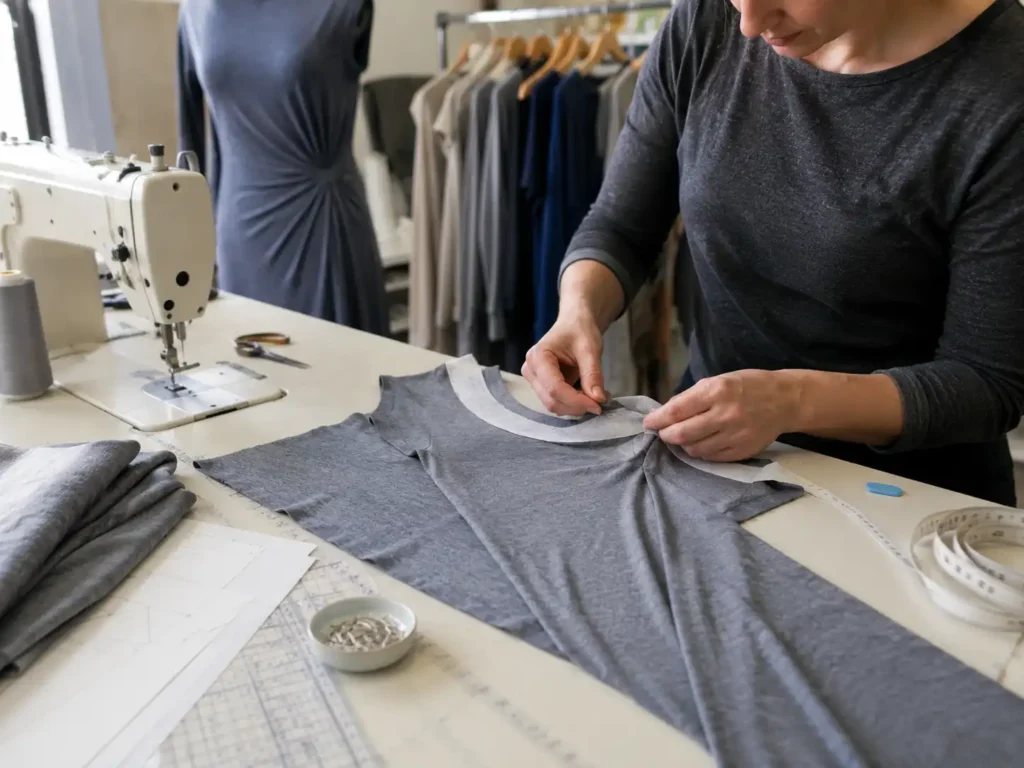
Jersey can make a dress feel effortless, flattering, and comfortable, but it can also expose every weakness in fabric selection, pattern development, and sewing control. Two rolls may look almost identical on a swatch card yet behave very differently after cutting. One may recover cleanly after stretching, while the other grows at the hips, twists at the side seams, or becomes several centimeters longer after hanging and washing. That difference is rarely visible in a supplier’s composition line alone.
Jersey is a knitted fabric family, not a single fiber. The right jersey for a dress depends on knit construction, GSM, stretch direction, recovery, opacity, drape, shrinkage, and the intended silhouette. Reliable production comes from matching the fabric to the pattern, seam system, testing plan, and finished-garment fit standard.
The practical question is therefore not whether jersey is good for dresses. It is whether a particular jersey is suitable for a particular dress, size range, care method, price position, and production volume. A fluid viscose jersey may look beautiful in a wrap dress but lose shape in a close bodycon style. A dense ponte may smooth an office dress yet feel too firm for a summer collection. The costliest mistakes are often fabrics that appear acceptable during sourcing and sampling, then change during bulk production or normal wear. This guide follows the decisions experienced dress teams make before the first roll is spread on a cutting table.
What Is Jersey Fabric?
Jersey is a family of weft-knitted fabrics made from interconnected yarn loops rather than crossed warp and weft yarns. Its behavior depends on construction, fiber blend, stitch density, finishing, GSM, stretch, and recovery. In dress manufacturing, the word jersey is only a starting description; the complete specification determines fit, drape, opacity, comfort, and production stability.
Knit Structure and Fiber Blend
Most jersey fabrics used for dresses are produced by weft knitting, where yarn forms connected loops across the width. Those loops can open and move under tension, giving jersey more natural extensibility than a conventional woven fabric. Single jersey is usually smooth on the face and visibly different on the reverse. It feels light and flexible, although its cut edges often curl and can complicate narrow straps, neckbands, and lightweight hems.
Interlock and other double-knit constructions are more balanced. They are generally thicker, more opaque, and easier to control during cutting and sewing. Ponte and Roma are compact double knits that provide a smoother outline and stronger shape retention. They are not automatic upgrades, however. A fabric that supports a structured office dress may feel heavy and lifeless in a gathered summer style, so construction must be judged against the design rather than against a simple quality hierarchy.
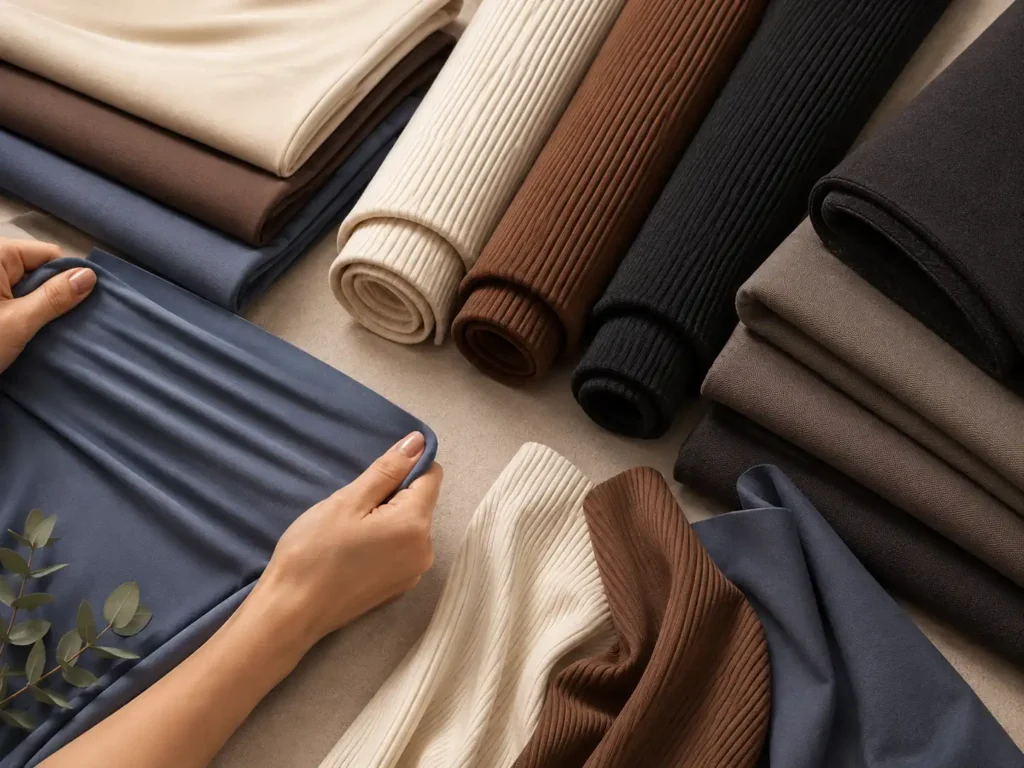
Jersey describes the knitting method, not the fiber. Cotton, viscose, modal, polyester, nylon, and blended yarns can all form jersey fabrics, with elastane added when extra extension and recovery are required. A specification such as 95% polyester and 5% elastane still leaves major questions unanswered. Yarn size, stitch density, finishing, usable width, surface, and stretch behavior can turn the same composition into either a thin unstable fabric or a dense supportive one.
Stretch, Recovery, and Drape
Stretch describes how far a fabric extends, while recovery describes how closely it returns to its original measurement after tension is removed. The distinction matters because a jersey can feel very stretchy in the hand and still perform poorly in a fitted dress. Weak recovery creates bagging at the seat, waist, elbows, and knees, especially after repeated movement or several hours of wear.
Direction also matters. Many jersey fabrics stretch mainly across the width, while others provide meaningful extension in both width and length. Lengthwise stretch affects shoulder-to-hem measurements, armhole depth, neckline stability, and the way long skirts grow while hanging. Supplier terms such as two-way and four-way stretch are not always used consistently, so the production team should measure both directions instead of relying on a label.
Drape is related to weight, yarn flexibility, structure, and finishing rather than to fiber content alone. Viscose and modal jerseys often fall in soft folds, while compact interlock and ponte hold a cleaner outline. The desired drape should be reviewed in a garment-sized panel because a small swatch cannot show how a long skirt, cowl neckline, or heavily ruched section will behave under its own weight.
Benefits in Dress Design
Jersey is popular because it combines comfort, movement, and design flexibility. It can follow the body with fewer rigid shaping seams, making it suitable for T-shirt dresses, bodycon dresses, wrap styles, ruched minis, soft maxis, rib columns, and stretch occasionwear. Depending on the fabric, it can also provide breathability, wrinkle resistance, quick drying, rich color, or a smooth compact surface.
The fabric can simplify some garment features, but it does not make technical development unnecessary. A dress without a zipper may still need carefully calculated neckline stretch, shoulder stabilization, and negative ease. Stretch allows the garment to move with the wearer, yet the same movement can distort openings and seams when the pattern or sewing method is not matched to the fabric.
Good jersey design begins with the wearing experience. Teams should consider how the dress feels when standing, sitting, walking, and being worn for several hours. They should also consider whether the customer expects a soft casual hand, a sculpting bodycon effect, fluid movement, or structured coverage. The same visually simple silhouette can require a very different fabric once those expectations are made explicit.
Common Manufacturing Risks
Common problems include edge curling, dimensional change, spirality, seam waviness, skipped stitches, neckline stretching, uneven hems, surface pilling, and transparency under tension. Lightweight fabrics can distort while being spread if operators pull them to make the lay appear smoother. After cutting, the panels relax toward their original dimensions, creating mismatched seams and finished garments that measure smaller than expected.
Spirality is especially visible in straight T-shirt dresses and narrow bodycon silhouettes because the side seams rotate after washing or relaxation. Seam waviness can result from excessive feeding, high presser-foot pressure, unsuitable stitch settings, or stretched handling. A seam may look acceptable immediately after sewing but become rippled after steaming, washing, or hanging, which is why process trials must include the expected finishing method.
Opacity is another practical risk. A dark jersey may look fully covered on the inspection table but open between loops when stretched across the hips. Pale shades, loose constructions, and high negative ease increase the chance of grin-through. Fabric should be assessed relaxed and stretched, under strong light, and over contrasting backgrounds before the design is approved for bulk production.
Knit Type | Typical Working GSM | Common Dress Uses | Main Strength | Common Risk |
Lightweight single jersey | 120-170 | Summer and T-shirt dresses | Soft, light, breathable | Curling, transparency, growth |
Medium single jersey | 170-230 | Casual fitted and wrap dresses | Flexible and versatile | Shrinkage, seam waviness |
Interlock | 190-300 | Smooth casual and fitted dresses | Balanced and opaque | Less fluid movement |
Rib knit | 180-320 | Column and fitted midi dresses | High width stretch | Rib opening, length growth |
Ponte or Roma | 250-380 | Structured and bodycon dresses | Coverage and recovery | Bulk and seam thickness |
Which Jersey Is Best for Each Dress?
The best jersey is the one that supports the intended silhouette, movement, coverage, and wearing experience. Fluid viscose jersey suits draped styles, cotton-spandex works well for casual fitted dresses, polyester-spandex supports resilient bodycon designs, and interlock or ponte provides more structure. Selection should begin with the dress shape and performance requirements rather than composition alone.
Casual and Everyday Dresses
Casual dresses usually need softness, comfort, and enough stability to survive regular washing. Lightweight single jersey, cotton-spandex, modal blends, viscose blends, and light interlock are common candidates. A relaxed T-shirt dress can often use 140-190 GSM fabric with modest width stretch because the pattern includes positive ease. Stable length and acceptable wash shrinkage matter more than strong compression.
A fitted everyday midi dress generally benefits from more dependable recovery. Cotton-spandex around 180-240 GSM can provide a familiar hand with enough stretch for movement, although shrinkage and pilling still need to be checked. Interlock is useful when the brand wants better opacity, a smoother surface, and less edge curling. Its trade-off is a firmer hand and less fluid movement than soft single jersey.
Everyday use is demanding in a different way from occasionwear. Customers may wash the dress weekly, sit in it for long periods, and expect the neckline and hem to remain stable. A sample should therefore be worn and laundered rather than judged only on a standing fit model. Comfort at the first fitting does not prove that the garment will retain shape after repeated use.
Bodycon and Ruched Dresses
A bodycon dress needs controlled extension, reliable recovery, and enough density to smooth the surface of the body. Maximum stretch is not the goal. A fabric that extends very easily but does not return can become loose at the seat and waist. Polyester-spandex, nylon-spandex, compact rayon blends, rib knits, ponte, and Roma are common starting points for close-fitting styles.
For a light club dress, a 180-250 GSM polyester-spandex jersey may provide useful stretch, color intensity, and quick recovery. A premium fitted midi often performs better in 240-340 GSM ponte or compact double knit, depending on the climate and desired pressure. Pale colors and high-tension areas must be checked for transparency because loops can open when stretched even if the relaxed fabric appears opaque.
Ruching changes the calculation because gathered sections create local weight, multiple layers, and repeated seam stress. The jersey must feed smoothly without skipped stitches or excessive bulk. Recovery should be tested after repeated cycles, not just after one pull. The pattern should also be developed for the exact fabric; a block designed for firm ponte should not be reused unchanged for fluid rayon jersey.
Draped and Flowing Dresses
Viscose, rayon, modal, and lightweight blended jerseys usually create the softest drape. They work well for wrap dresses, cowl necks, asymmetric skirts, relaxed maxis, and softly gathered designs. A working range of roughly 150-220 GSM is common, although the correct weight depends on garment length, opacity, gathering volume, and whether a lining is used.
Fluidity can become uncontrolled growth when the skirt is long or heavily gathered. Fabric that falls beautifully from the shoulder may continue to lengthen while hanging. The sample should rest on a hanger before the hem is finalized, especially for asymmetric shapes. Cutting and sewing also require low-tension handling because the fabric can shift under marker weights and stretch beneath the presser foot.
A small swatch is useful for judging softness, but it cannot reproduce the weight of a full skirt panel. For long or draped designs, a half-garment test or complete sample provides more reliable information. Teams should review movement in natural light, walk the garment, and check whether the fabric clings, twists, or reveals construction details when the wearer changes position.
Structured Knit Dresses
Ponte, Roma, double knit, and compact interlock are stronger choices when a dress needs a clean outline, smooth coverage, or light structure. They are often used for office dresses, fitted midis, column silhouettes, A-line knits, and peplum designs. Their density helps control cling and supports panel seams, but added weight can reduce movement and increase warmth.
More structure is not always better. A heavy ponte can make gathers bulky, create visible ridges at seam joins, and feel uncomfortable in a summer market. Four layers at a waist seam behave very differently in 320 GSM ponte than in 180 GSM single jersey. Sampling may require reduced seam allowances, lighter facings, alternative bindings, or a different zipper construction.
The right structured jersey should hold its shape without feeling board-like or developing shine over curves. Review the fabric hanging freely, stretched on the body, and folded into the actual seam build. A material that looks polished on a hanger may become stiff or glossy when worn. That complete review is more useful than choosing the heaviest fabric available.
Dress Style | Practical Starting GSM | Typical Width Stretch | Priority Characteristics |
Relaxed T-shirt dress | 140-190 | 15-30% | Softness and wash stability |
Casual fitted midi | 180-240 | 25-45% | Comfort and recovery |
Wrap or cowl dress | 150-220 | 25-50% | Fluid drape and controlled growth |
Ruched mini dress | 180-260 | 35-60% | Recovery and seam resilience |
Bodycon dress | 220-340 | 40-70% | Opacity and shape retention |
Structured office dress | 260-380 | 20-45% | Smooth surface and stability |
Rib column dress | 200-320 | 50-100% | Recovery and rib closure |

How Do Jersey Specifications Affect Fit?
Jersey specifications control how closely a dress fits, how much it moves, whether it becomes transparent, and how well it keeps its shape. GSM, density, stretch percentage, stretch direction, recovery, shrinkage, drape, and opacity must be considered together. Changing one value can alter garment measurements, body pressure, seam appearance, and the finished silhouette.
GSM and Fabric Density
GSM records fabric weight in grams per square meter. It is useful for comparing materials, but it does not directly measure thickness, stretch, opacity, or quality. A tightly knitted 200 GSM fabric may feel firmer and cover better than a loose fabric at the same weight. Yarn type and finishing can also change the hand without changing the reported GSM significantly.
Lightweight jersey tends to feel softer and more fluid, although it may curl, distort, or become transparent. Medium weights are versatile for casual and moderately fitted dresses. Heavy double knits provide stronger coverage and structure but create warmer garments and thicker seam joins. The best target is therefore a performance range rather than a belief that higher GSM always means better quality.
Bulk fabric should be checked against the approved sample within an agreed tolerance. A weight change that appears small on paper can affect a garment with heavy ruching, double layers, or a long skirt. GSM also interacts with width and yield, so a denser fabric may change material consumption and finished garment weight even when the silhouette remains the same.
Stretch and Negative Ease
Stretch percentage can be estimated by marking a known length, extending the fabric with consistent force, and calculating the increase. A 10-centimeter section that extends to 14 centimeters has about 40% stretch. The method, direction, conditioning time, and applied force must remain consistent, otherwise figures from different suppliers or production lots cannot be compared meaningfully.
Negative ease means the garment is smaller than the corresponding body measurement and relies on fabric stretch to fit. A relaxed dress may use positive ease, while a close bodycon dress may reduce bust, waist, and hip measurements. The amount should be based on actual stretch, recovery, density, lining, and desired pressure rather than a standard percentage copied from another style.
Excessive negative ease can open the knit structure, expose underwear, strain seams, and pull necklines or armholes out of shape. Too little reduction can leave a fitted style loose after a short period of wear. Fit trials should include sitting, walking, reaching, and repeated movement because a garment that looks correct during a brief standing review may not behave the same way in normal use.
Recovery, Drape, and Opacity
Recovery controls whether the dress returns to shape after the fabric stretches over the body. Strong recovery is important for waist definition, seat shape, rib closure, and bodycon silhouettes. Soft draped styles can tolerate more movement, but uncontrolled growth still affects hem length and garment balance. Recovery should be assessed after repeated extension and after a defined rest period, not only by snapping a swatch once.
Drape determines whether the fabric falls away from the body, follows every contour, or holds a defined outline. Lightweight viscose jersey often creates soft folds, while ponte produces a cleaner shape. The correct choice depends on the design and the customer’s expectations. A fluid fabric is not automatically more luxurious, and a firm fabric is not automatically more supportive if it shines or feels restrictive.
Opacity must be assessed under the extension expected in the garment. Stretching a swatch over contrasting cards or a form provides a simple early check. The team should also consider studio lighting, daylight, pale colors, and seam allowance visibility. Adding a lining can improve coverage, but the lining must have compatible stretch and recovery or it may restrict movement and distort the shell.
Shrinkage and Pattern Balance
Jersey may shrink in width, length, or both, and some fabrics can shrink in one direction while growing in the other. A four percent length change equals four centimeters on a one-meter dress, which is visible to the wearer. Pattern measurements and finished tolerances should be set using fabric that has been tested with the intended care method rather than an unrelated laboratory condition.
Lengthwise stretch and relaxation affect shoulder-to-hem balance, armhole depth, waist placement, and skirt level. Long dresses, asymmetric hems, and gathered skirts should be allowed to hang before final hemming. The pattern maker may need to compensate for predictable growth, but compensation should follow measured results. Guessing can create a garment that is correct before washing and too short afterward.
Pattern balance also depends on fabric direction. Wale alignment, ribs, stripes, and printed motifs must be placed consistently. If the knit direction shifts across panels, the dress may twist or hang unevenly. A stable pattern is therefore the result of fabric data, correct grain placement, and fit testing, not only accurate paper measurements.
Fabric Performance | Common Negative-Ease Starting Point | Suitable Applications | Main Caution |
Low stretch, 10-20% | 0% to 5% | Relaxed or lightly shaped dresses | Limited movement |
Moderate stretch, 20-40% | 3% to 8% | Casual fitted dresses | Check bust and hip pressure |
High stretch, 40-70% | 8% to 15% | Bodycon and ruched dresses | Opacity and seam strain |
Very high stretch, above 70% | 10% to 20% | Sculpting or performance-inspired styles | Recovery must be strong |
Soft draped jersey | 0% to 8% | Wrap, cowl, and gathered dresses | Length growth |
Compact ponte | 3% to 10% | Structured fitted dresses | Can feel restrictive if over-fitted |
What Should Brands Test Before Production?
Before bulk cutting, brands should verify composition, GSM, usable width, stretch, recovery, shrinkage, spirality, pilling, colorfastness, shade consistency, and sewing performance. Testing is valuable only when it predicts the finished dress. The selected fabric should be evaluated through measurable checks, a sewn sample, the intended care method, and realistic wear conditions.
Dimensional Stability
Shrinkage testing should follow the care method planned for the garment. A machine-washable dress should not be approved only through a dry-cleaning condition. Length and width changes need separate records because a knit may move differently in each direction. Many commercial programs begin with a target near three to five percent, but the acceptable limit should reflect style length, fiber, finishing, care label, and retail expectations.
Spirality should be checked after washing and drying on a marked panel or sewn garment large enough to show directional movement. Straight side seams make rotation easy to see, but the same issue can distort fitted dresses, pockets, and slit positions. Testing a tiny swatch is not enough because the fabric needs space to release knitting and finishing tension.
Conditioning and relaxation are part of the measurement. Rolls can retain tension from knitting, dyeing, heat setting, finishing, and transportation. Width, GSM, and shrinkage values taken immediately after unrolling may not represent the material used on the cutting table. The test procedure should record the relaxation period so that sample and bulk results are compared on the same basis.
Stretch and Wear Testing
Stretch should be measured in width and length using a repeatable method. Recovery should be recorded after release and after a defined rest period. Where formal laboratory testing is required, methods such as ASTM D2594 can support evaluation of stretch and growth in knitted fabrics. For routine factory control, a documented in-house method can still be useful when the same marks, force, hold time, and cycles are applied consistently.
Wear testing adds information that a laboratory swatch cannot provide. The dress should be worn while sitting, walking, bending, and reaching, with attention to the seat, waist, bust, knees, neckline, and straps. A two-hour or four-hour trial often reveals bagging, rolling edges, or discomfort that does not appear during a ten-minute fit review.
Repeated cycles matter for bodycon and rib styles. A fabric may recover well after one extension and weaken after repeated movement. The garment should also be checked after resting because some jerseys recover slowly. A practical approval combines numerical results with photos and garment measurements before wear, immediately after wear, and after the agreed recovery period.
Surface, Color, and Sewing Tests
Pilling and surface fuzzing affect cotton, viscose, and blended jerseys that experience repeated rubbing. Underarms, side seams, the seat, and areas beneath handbags are common wear zones. The required pilling grade depends on product position and use frequency, but the test should be agreed before production rather than judged after customers begin returning worn garments.
Colorfastness should cover the care method and the risks of the style. Deep black, red, navy, and saturated fashion shades deserve careful review for washing and rubbing. Printed jersey should also be checked for cracking, registration, color change, and loss of clarity when stretched. A print that looks sharp while relaxed may become pale or distorted across the bust and hips.
Sewing trials confirm whether the fabric can be handled with the intended needle, thread, seam, elastic, and pressing process. The trial should look for skipped stitches, yarn damage, seam waviness, needle holes, shine, and heat marks. A fabric can pass composition and shrinkage tests yet remain unsuitable if normal production settings cannot create a stable, attractive seam.
Bulk Fabric Approval
Bulk fabric should be compared with a sealed standard rather than with memory, a phone photograph, or the supplier’s description. The approval record should cover color, hand feel, weight, width, surface, stretch, recovery, shade lot, and visible defects. Roll numbers and dye lots should be linked to cutting records so that later issues can be traced to the material used in specific garments.
Color lots should not be mixed casually within one garment. Slight differences that are difficult to see under warehouse lighting can become obvious in daylight, photography, or retail display. Separate approval by color is also useful because dyeing and finishing can alter stretch, GSM, and hand feel. A black fabric and a pale version of the same base quality may not behave identically.
A passing material report does not replace the approved garment. Fabric, pattern, seam construction, lining, elastic, and pressing interact. The final decision should therefore combine roll data with a pre-production dress made from bulk fabric. That garment provides the most useful evidence that the material will reproduce the expected fit and appearance on the production line.
Test Item | Practical Development Target | Production Reason |
GSM | Match sealed standard within the agreed tolerance, often around +/-5% | Controls drape, coverage, consumption, and garment weight |
Usable width | Measure after relaxation and exclude damaged edges | Protects marker efficiency and material planning |
Width and length stretch | Meet the pattern requirement in both directions | Controls fit, movement, and garment length |
Recovery | Limit residual growth after the agreed cycles and rest period | Reduces bagging and shape loss |
Wash dimensional change | Common commercial starting range is about 3-5%, style dependent | Protects finished measurements and hem level |
Spirality | No visible side-seam rotation beyond the agreed standard | Maintains garment balance |
Colorfastness | Match care label and market requirements | Reduces fading, staining, and transfer |
Pilling | Set a grade appropriate to wear frequency and price position | Protects surface appearance |
Sewing trial | Stable seams without holes, skipped stitches, or waviness | Confirms production compatibility |

How Are Jersey Dresses Made at Scale?
Jersey dresses are made consistently at scale by controlling fabric relaxation, pattern reduction, grain direction, cutting tension, stretch-compatible seams, pressing, and measurement at every stage. The approved fabric, pattern, seam settings, and sample must operate as one production standard. Reliable scale comes from repeatable records and inline control, not from sewing the same design faster.
Pattern and Sample Development
Pattern development should begin with the actual production fabric or a close material with matched stretch, recovery, weight, and drape. A block made for firm ponte cannot be transferred directly to soft viscose jersey even when body measurements are unchanged. The pattern maker must consider reduction at bust, waist, and hip, as well as lengthwise growth, neckline stability, armhole tension, and hem behavior.
The first sample confirms design direction, while the fit sample and pre-production sample control the move into bulk. The approved version should define garment measurements, stretch direction, seam type, elastic length, binding ratio, neckline shape, hem method, pressing limits, and any stabilization. Samples should be reviewed after relaxation and, where relevant, after washing so that the sealed standard represents the condition in which production will be inspected.
A professional sample review looks beyond whether the dress resembles a reference image. It checks how the garment sits at the shoulder, whether the waist remains level, how the side seams hang, whether the fabric opens over curves, and whether construction can be repeated across sizes. Corrections should be recorded in the pattern, measurement chart, and operation notes rather than left as verbal instructions.
Fabric Relaxation and Cutting
Jersey should relax before cutting because rolls can retain tension from knitting, finishing, rolling, and transport. The required time depends on the fabric and roll condition. Lightweight viscose and highly elastic constructions usually need closer attention than compact ponte. Width and length should be checked after relaxation because those values affect marker planning, panel dimensions, and expected garment measurements.
Spreading must avoid pulling the fabric. A tensioned lay may look smooth and efficient, but cut panels can contract after release, producing undersized pieces and mismatched seams. The face, back, wale direction, rib line, stripes, print direction, and any surface effect should be identified before the marker is placed. These controls are especially important for narrow dresses where even slight rotation is visible.
Cutting tools should be sharp enough to avoid dragging layers. Excessive lay height can reduce accuracy around curves, armholes, necklines, and small components. High production volume does not justify stacking more layers than the fabric can support. Bundles should remain identifiable by size, color, dye lot, and section so that material variation does not become mixed within finished garments.
Sewing and Stabilization
Stretch seams must extend with the garment without breaking or creating hard ridges. Overlock, coverstitch, flatlock, and chain-stitch constructions are common, but the correct choice depends on fabric weight, seam location, appearance, and required extension. Needle type, thread, stitch density, differential feed, presser-foot pressure, and operator handling should be confirmed through production trials before the line begins.
Ballpoint or stretch needles are often used to move between knitted loops rather than cutting them. The wrong needle can create skipped stitches, damaged yarns, or holes that enlarge during wear. Differential feed helps manage seam stretch, although poor settings can gather the seam or create waviness. Operators should not compensate for an unstable process by pulling the garment into shape during sewing.
Necklines, shoulders, zipper openings, straps, and selected waist seams may need stabilization. Clear elastic, knit tape, stay tape, or a controlled binding ratio can prevent growth without making the edge rigid. Pressing temperature and steam must suit the fiber blend because excessive heat can glaze polyester, weaken elastane, or permanently mark thick seam allowances.
Bulk Quality and Repeat Orders
Inline quality checks are especially useful with jersey because one incorrect setting can affect hundreds of garments quickly. Inspectors should review neckline shape, seam waviness, skipped stitches, side-seam rotation, bust and hip measurements, skirt length, hem level, elastic tension, and symmetry. Early checks at the first bundles allow the line to correct problems before they become a finished-stock issue.
Finished garments should rest before final measurement because handling and pressing can temporarily change dimensions. The same relaxation period should be used across inspection teams. Each color and size should be compared with the approved standard, since dyeing and finishing can alter fabric behavior. A style in black may require different handling from its pale version even when both are ordered under one fabric code.
Repeat orders depend on preserved technical records. The manufacturer should retain the approved fabric reference, pattern version, grading rules, stretch data, sewing settings, elastic lengths, measurement tolerances, pressing method, and packing requirements. Without those records, a reorder may resemble the previous production visually but fit differently. Stable repeatability comes from disciplined documentation and controlled material sourcing.
Jinfeng Apparel supports custom jersey dresses, bodycon styles, ponte dresses, rib-knit garments, jumpsuits, and matching sets through dedicated knit and stretch production capacity in Guangdong, China. The development system covers fabric sourcing, pattern work, sample making, bulk production, quality control, private-label packaging, and export coordination. Projects can begin from a tech pack, original sample, sketch, reference image, or line sheet, with NDA-based cooperation available for unpublished collections.
Share This Article :

Jerry Lee
Categories

Latest blogs
Table of Contents
Here, developing your OEM/ODM private label clothing collection is no longer a challenge—it’s an excellent opportunity to bring your creative vision to life.

