Skip to content


A chiffon dress can look beautiful on a hanger and still disappoint the moment someone turns it inside out. The fabric floats, the color catches the light, and the silhouette seems effortless—until a thick side seam shows through the skirt or loose threads appear beside a sleeve. These are not tiny details to the person wearing the garment. They affect how a dress feels, moves, and holds up after repeated use. For a fashion brand, they can also determine whether a carefully developed style looks consistent across an entire production run.
For most lightweight chiffon garments, a narrow French seam is the best starting point. It encloses raw edges, reduces fraying, and gives sheer fabric a neat interior without exposed overlock stitching. A baby French seam can suit very fine overlays, while fine overlocking or double-stitch-and-trim construction may work better on tight curves. The final choice depends on transparency, fabric stability, seam stress, and garment design.
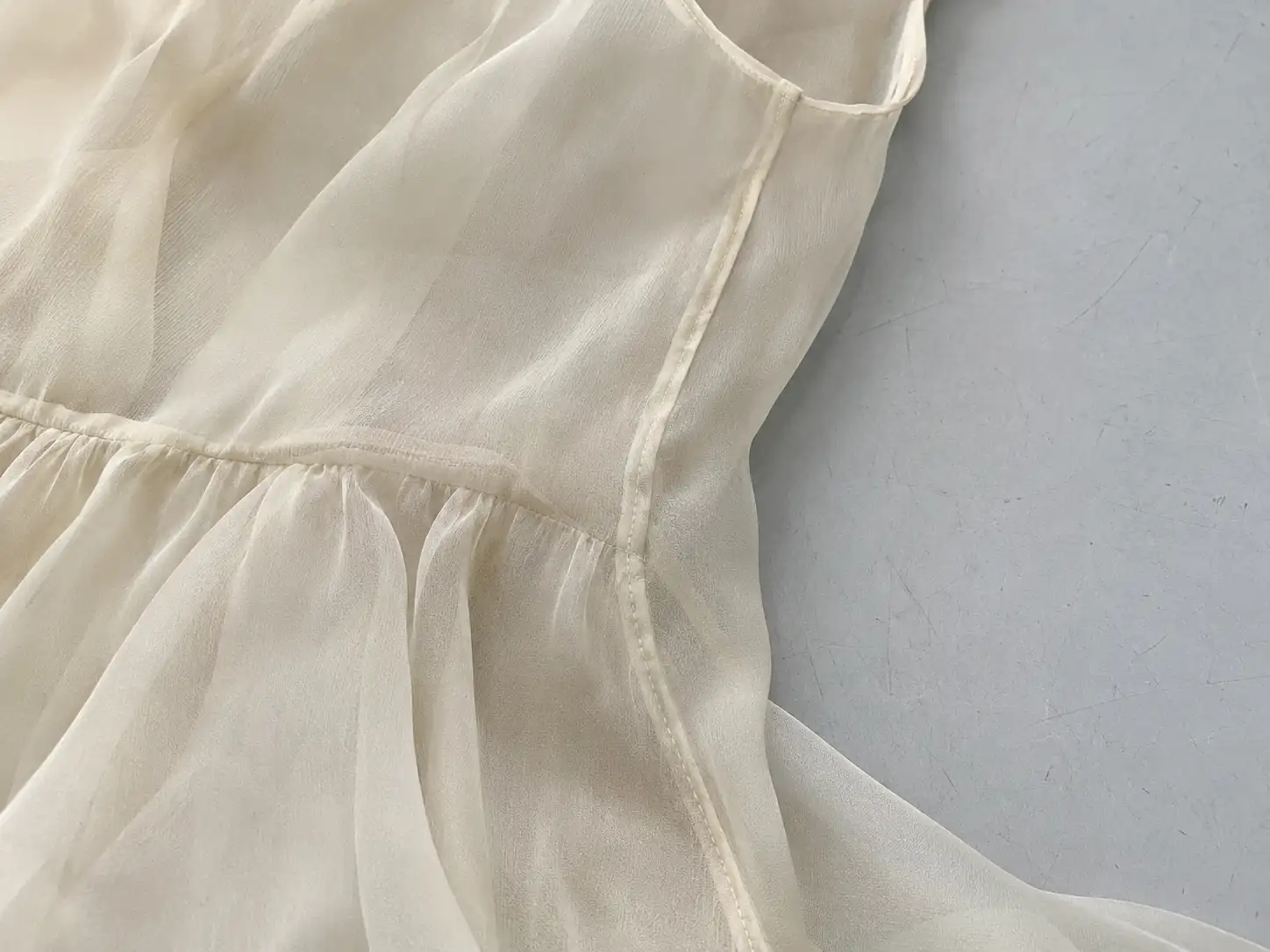
Imagine two otherwise identical ivory chiffon maxi dresses photographed under the same studio lights. One has smooth, discreet seams; the other has a dark ridge running down each side. Both may have been sewn carefully, but only one preserves the designer’s original idea. At Jinfeng Apparel, the practical question is not simply which seam has the most refined name. It is which construction performs properly on the actual fabric, survives sampling, and can be reproduced in bulk without changing the drape that made the dress appealing in the first place.
What Is the Best Seam Finish for Chiffon?
A narrow French seam is usually the most reliable all-around finish for straight seams in lightweight, transparent chiffon. Two stitching passes enclose the cut edges, helping control fraying while keeping the interior tidy. It is not a universal solution: curved seams, tightly fitted areas, complex joins, and lined bodices may need different methods to balance appearance, flexibility, and strength in daily wear.
Is a French Seam the Best Choice for Chiffon?
A French seam earns its reputation because it solves two visible problems at once: it hides the raw edge and gives the inside of a sheer garment a deliberate finish. Instead of leaving an overlocked allowance that can be seen through the outer fabric, the construction folds the edge inside a narrow channel. On long, relatively straight panels—such as the side seams of a relaxed chiffon skirt—that is often exactly what the garment needs. It also reduces the chance that loose threads will rub against the wearer or appear after handling.
The construction requires care. With a total allowance of 12 mm, an illustrative method is to sew wrong sides together at 6 mm, trim the resulting allowance to about 3 mm, fold the fabric right sides together, and stitch 6 mm from the fold. The finished enclosure is approximately 6 mm wide, while the original pattern’s intended seam line is preserved. Those measurements are starting points for sampling, not requirements for every chiffon. If the fabric shifts under the machine or the second pass fails to enclose the trimmed edge, the attractive finish can quickly become unreliable.
What Makes a Seam Finish Suitable for Chiffon?
A good chiffon seam has to pass four practical tests: the edges stay secure, the stitching remains stable, the finish looks discreet, and the fabric still moves naturally. These requirements pull against each other more than they do in heavier materials. Adding width may help protect a loosely woven edge, for example, but it can also leave an opaque stripe inside a translucent skirt. Reducing width may look elegant, yet it offers little benefit if the fabric yarns begin moving away from the stitching when someone sits down.
The right finish also depends on what the garment does. An airy resort dress has different stress points from a close-fitting occasion dress, even if both use the same chiffon. An unlined sleeve invites inspection of its interior, while a fully lined bodice may hide conventional seam allowances completely. We therefore assess a seam on the actual panel, against contrasting backgrounds, and on a moving garment. A short, perfectly pressed sample can be useful, but it cannot reveal every problem that appears along a full-length side seam.
When Should You Choose Another Seam Finish?
French seams can struggle when a seam changes direction sharply. Curved armholes, shaped necklines, narrow gathered joins, and intersections with several layers may resist the extra fold, leaving puckers or a stiff lump. In those places, a fine overlock, a carefully trimmed double-stitched seam, or a plain seam concealed by lining may give a better result. The aim is not to replace French seams everywhere; it is to choose a construction that respects what each part of the dress needs to do.
Stress is another reason to reconsider the default. A narrow French seam does not make a loosely woven fabric immune to yarn slippage under tension. If a fitted hip seam begins to open in a wear or laboratory test, adding one more fold may do little to solve the real problem. Pattern ease, fabric stability, stitch selection, and seam placement should be reviewed together. Jinfeng Apparel’s sample-development workflow allows construction changes to be evaluated before the approved pattern and sewing instructions are released for bulk production.

Which Seam Finishes Work Best for Chiffon?
French seams, baby French seams, fine overlocking, double-stitch-and-trim finishes, and lightweight bound seams can all be appropriate for chiffon. French seams are often the cleanest choice for exposed straight joins; baby French seams reduce visible width on delicate overlays. Curves and lined sections may work better with flexible or concealed finishes. The decision should follow the actual fabric and design.
How Do French and Baby French Seams Differ?
Both techniques hide raw edges between two rows of stitching, but they differ in how much fabric remains inside the finished fold. A conventional narrow French seam might finish at around 5–6 mm, while a baby French seam may finish at roughly 2–3 mm if the weave and sewing accuracy allow it. That slimmer profile can be attractive on a sheer sleeve or lightweight overlay where a wider seam would catch the light. It is especially helpful when the finished seam is meant to remain visually quiet rather than become a design detail.
The smaller construction is less forgiving, however. Trimming too close can remove the fabric needed to protect the edge, and the second pass must enclose every loose fiber. A narrow seam may also be harder to reproduce over long production runs if the chiffon shifts or curls. A dress brand should compare both options on the real fabric, preferably in a longer panel rather than a tiny swatch. A 2 mm finish that frays after handling is not a quality improvement over a stable 5 mm finish that sits smoothly.
Is Overlocking Suitable for Chiffon?
Fine overlocking is a practical option for areas where an enclosed French seam would add too much stiffness or handling. A three-thread overlock, with carefully selected thread and tension, can secure a lightweight edge in one sewing operation. A width of about 2–4 mm is a reasonable initial trial range for some fabrics, although there is no single width that suits every chiffon. The method can be useful for curved joins, lining connections, and gathered sections, especially when the edge will not be prominently visible from the outside.
An overlocked seam can also go wrong quickly. Excessive tension may pull the edge into a cord, the cutting knife may leave an uneven allowance, and heavy thread loops may create a dark line beneath pale chiffon. Differential feed must be adjusted to prevent unwanted stretching or gathering. We prefer to assess long test seams after the fabric has relaxed, because a short sample may conceal waviness that becomes obvious on a hanging skirt. A faster operation only improves production if the result meets the approved appearance and performance requirements.
How Does Double-Stitch and Trim Work?
Double-stitch-and-trim construction uses a main seam and a second, closely spaced row of stitching to stabilize the allowance before the excess fabric is trimmed. It offers a lighter alternative when a folded French seam would distort a curve. An initial trial might place the second line approximately 2–3 mm into the allowance, followed by careful trimming beyond it. The exact distance must depend on how readily the chiffon frays, how accurately it can be sewn, and how much stress the area will experience during wear.
The trade-off is important: the raw edge is not fully enclosed. Two stitch lines can help contain the fabric, but they do not automatically stop yarns slipping away from a seam under load. This finish is therefore better considered for selected low-stress sections than as a default for a tightly fitted dress. After sewing, examine the trimmed edge, handle the panel repeatedly, and check it again under bright light. A visually delicate construction is only successful when the edge remains secure in the finished garment, not just on the machine table.
Are Bound Seams Suitable for Chiffon?
A lightweight bound seam can give selected parts of a chiffon garment a deliberate, polished interior. The raw allowance is covered with a narrow strip of suitable fabric, such as matching chiffon or a soft, fine binding material. This can be useful when the inside of an occasionwear piece is intentionally visible or when an exposed edge needs extra protection. A trial binding around 3–6 mm wide may be workable, but its final width and material must be confirmed on the garment rather than adopted as a standard dimension.
Binding adds another material layer, another sewing operation, and another potential source of stiffness. That matters in a floating skirt, where a bound seam can become a vertical weight that interrupts otherwise soft folds. Differences in shrinkage, pressing response, or fabric hand can also cause problems later. We would normally reserve binding for specific design or structural needs instead of applying it to every chiffon seam. The best-looking finish on a close-up photograph may not be the one that makes the whole dress hang beautifully.
| Seam finish | Trial finished width | Often suitable for | Main caution |
| Narrow French seam | 5–6 mm | Straight sheer panels and relaxed side seams | Extra bulk on tight curves |
| Baby French seam | 2–3 mm | Very fine overlays and delicate exposed joins | Demanding trimming and edge control |
| Fine three-thread overlock | 2–4 mm | Curves, gathers, some lined sections | Loops and edge distortion may show |
| Double-stitch and trim | Case-dependent | Selected low-stress curved areas | Raw edge remains exposed |
| Lightweight bound seam | 3–6 mm binding | Selected visible interior details | Adds fabric and handling |
These dimensions are illustrative sampling ranges, not universal production specifications. An approved width must match the actual fabric, pattern allowance, seam placement, and garment-performance requirements. Even two garments cut from the same chiffon may need different finishes when their fit, lining, seam curvature, or expected stress differs. The best comparison is made on a full-size sample, not on dimensions alone.
How Does Chiffon Type Affect Seam Choice?
Chiffon composition, weight, weave stability, transparency, and drape can change which seam finish performs best. Silk and polyester chiffon may use similar constructions but require different handling and pressing conditions. Very sheer fabrics expose seam shadows, while soft or loosely woven fabrics may resist narrow stitching poorly. The safest choice comes from testing the selected production material, not from its fiber label alone.
Do Silk and Polyester Chiffon Need Different Seams?
Silk chiffon is often soft and fluid, while polyester chiffon can range from featherlight and supple to noticeably crisp. Yet fiber content alone tells only part of the story. Yarn twist, weave density, finishing, and surface texture can make two polyester chiffons behave less alike than a polyester and a silk sample. Both may accept a narrow French seam, but the preferred seam width, thread, and handling method can change. A stable weave may be easy to enclose; a slippery, loosely constructed fabric may need closer control during every sewing pass.
Pressing requires equal attention. Polyester can be damaged by excessive heat, while silk may develop marks or distortion when moisture and pressure are poorly controlled. Before a complete sample is pressed, a scrap from the actual lot should be tested with the intended equipment and protective cloth if necessary. It is also worth rechecking the seam after cooling and relaxation. A temporary improvement created by pressing should not be mistaken for a well-balanced seam that will remain smooth during wear and cleaning.
How Does Fabric Weight Affect Seam Finishing?
Fabric weight affects how prominent a seam becomes, but it cannot be used as a shortcut for construction quality. Compare, for illustration, a chiffon weighing 35 g/m² with one weighing 65 g/m². The lighter fabric may show the layers of a French seam more clearly, while the heavier one may accommodate the same finish with less visible ridging. These numbers illustrate two possible materials, not official weight classes or a claim about specific fabrics supplied by Jinfeng Apparel. Real behavior still depends on weave structure and finishing.
Layer count can matter as much as grams per square meter. A straight join between two panels is very different from a gathered waist seam joining several layers and lining. The latter concentrates much more fabric into a small area, so even an airy chiffon can produce a noticeable lump. During sampling, we compare the seam on a flat panel and after assembly. We look for twisting, stiffness, changes in fold formation, and whether the allowance produces a dark stripe beneath the outer fabric.
Does Sheerness Change the Best Seam Finish?
Sheerness makes the inside of a garment part of its outside appearance. On an opaque dress, a well-made seam allowance can remain practically invisible. On ivory or pale chiffon, the same allowance may show as a darker vertical line because several fabric layers overlap. Even perfectly matched thread cannot remove the shadow created by folded material. For some designs, a baby French seam offers a quieter profile; for others, a fine overlock may look lighter, especially if the seam is hidden behind lining or another layer.
The simplest useful check is to view the sample against white, dark, and skin-toned backgrounds. Then inspect it under ordinary room light and stronger backlighting, preferably while the fabric is hanging. Printed chiffon can disguise a seam in patterned areas yet reveal it where the print becomes pale. This is one reason a seam that looks excellent on a cutting table may disappoint in a finished studio photograph. Construction approval should reflect the lighting and wearing conditions in which customers are likely to see the garment.
How Can Seams Preserve Chiffon Drape?
Chiffon’s appeal comes largely from the way it falls and moves. Stiff binding, dense thread loops, excessive allowances, or an overly tight stitch can turn a fluid panel into one with an awkward structural line. To compare finishes sensibly, a development team can prepare two panels of the same chiffon, each about 30 × 50 cm, with matching grain direction and similar seam placement. One might use a narrow French seam and the other a fine overlock; both can then be hung and observed under similar conditions.
That visual comparison is not a formal drape or durability test, but it often reveals practical differences. Watch whether the seam twists, whether surrounding folds break unnaturally, and whether the panel becomes stiff when gently moved. The complete dress still needs evaluation, because a seam that hangs well on a panel may behave differently beside a zipper, gathering, or lining. It is also important not to confuse softness with strength: the lightest-looking finish should not be approved until its edge security and resistance to relevant stress are acceptable.

Which Seams Work Best for Chiffon Dresses?
Different parts of a chiffon dress may need different seam finishes. Narrow French seams are useful for straight, exposed skirt panels; fine overlocking or double-stitching can be more flexible on tight curves. Fully lined bodices may conceal conventional allowances, while gathered waists and layered skirts need careful bulk control. The best plan assigns each seam to its function rather than forcing one method throughout.
Which Finish Works Best for Side Seams?
Side seams often run through large, visible areas of a chiffon dress, making them a natural place to consider a narrow French seam. On a relaxed maxi dress, the finish can protect the raw edges while preserving a neat interior. The construction is particularly attractive when the dress is unlined or lightly layered. A finished width near 5–6 mm may be a useful starting point for sampling, but the correct width depends on the fabric and the original pattern allowance. Consistent panel alignment matters just as much as the finishing method.
A fitted side seam raises a different question. Around the hip or waist, fabric may be pulled sideways when the wearer sits or moves. A beautiful seam can still fail if yarns slip near the stitching or the garment has insufficient ease. In that situation, reducing seam width is unlikely to solve the problem. We would review fabric stability, garment fit, stitch formation, and seam placement together. This is where pattern development and sewing decisions must inform each other: a good side seam should support the silhouette without becoming the weak point of the design.
How Should Armholes and Curves Be Finished?
Armholes and shaped necklines are difficult because the fabric has to follow a curved path. A French seam requires extra folding, and the inner and outer parts of the curve do not travel the same distance. If the curve is tight, the enclosure can pull, wrinkle, or create a raised ridge. A fine overlock, a carefully trimmed double-stitched finish, or a plain seam hidden by lining may be a better choice. The result should be assessed on the garment, where curvature and body movement are easy to see.
Before changing the seam method, check whether the fabric was stretched during cutting or handling. Bias-influenced edges can lengthen unexpectedly, so a sewing problem may actually begin at the cutting table. Staystitching or temporary support can help selected designs, but these operations must be tested on chiffon because needle marks and unwanted stiffness may remain visible. Once sewn, the armhole should be examined with the arm relaxed and moving. A seam that looks smooth while flat is not necessarily comfortable or stable when worn.
Do Lined Chiffon Dresses Need French Seams?
A fully lined chiffon dress does not need French seams everywhere. When a lining encloses the raw allowances completely, a properly made conventional seam can be both neat and practical. This is especially relevant in fitted bodices, where darts, zipper installations, shaping seams, and lining attachments already produce several layers. Adding a French enclosure at every join can make the construction thicker without improving the appearance that the customer sees. The important distinction is whether a seam is exposed, concealed, or subjected to significant stress.
A lined evening dress might therefore combine plain seams inside the bodice, narrow French seams on visible skirt panels, and fine overlocking at a gathered attachment. Those differences should be intentional and documented. The lining itself must also be considered: a stiff or poorly attached lining can pull on the chiffon shell and create wrinkles even if every outer seam is beautifully sewn. We assess both layers together during fitting and movement, checking that the lining remains concealed, the outer fabric hangs naturally, and the wearer can move comfortably.
How Should Gathered and Layered Seams Be Finished?
Gathering concentrates extra fabric into a shorter joining line. At a gathering ratio of 1.5:1, for example, 150 cm of chiffon is drawn into a 100 cm attachment length. That additional material must be distributed evenly, and it may sit beside lining or other skirt layers. A French seam can become bulky at such a join because its enclosed allowance adds more folds. A narrow overlock or another controlled, low-bulk construction may work better, provided it gives the required edge protection and stability.
Layered dresses present another challenge: a seam that looks acceptable in one chiffon layer may become stiff when two or three layers attach at the same point. Depending on the design, staggered attachment levels, adjusted allowances, or a different seam treatment may help distribute thickness. None of these decisions should compromise the planned silhouette or skirt length. After assembly, the garment needs to hang freely so that uneven gathers, lumpy areas, or a layer lifting above the others become visible. The correct finish allows the layers to move as intended rather than locking them into a heavy band.
How Do You Prevent Chiffon Seam Problems?
Preventing chiffon seam problems starts with suitable cutting, handling, needles, thread, and machine settings. French seams help contain fraying, while balanced feeding and thread tension reduce puckering. Excessively narrow allowances can weaken edge security, and dense stitching can damage delicate fabric. Because chiffon varies widely, the actual production material should be tested and approved before settings are used across a complete order.
How Can You Prevent Fraying?
Fraying happens when yarns escape from a cut edge, sometimes during sewing and sometimes only after repeated handling. Chiffon with a loosely constructed weave can be especially troublesome, so edge protection begins before the garment is assembled. Avoid rough handling, repeated unpicking, or leaving unstable cut pieces exposed to unnecessary friction. A French seam offers strong visual and physical protection because the raw edge is enclosed. Fine overlocking can also secure the edge when the thread loops are formed correctly and the cutter is set carefully.
Trimming deserves its own attention. In a French seam, the first allowance has to be narrow enough to fit inside the second pass but wide enough to avoid escaping from it. Cutting too close may look tidy initially and fail later. Also distinguish fraying from seam slippage: fraying concerns loose fibers at the cut edge, whereas slippage occurs when yarns shift away from a stitched join under load. The visible result may appear similar, but the corrective action is different. A stable edge finish will not compensate for unsuitable fabric or an overly stressed pattern.
What Causes Seam Puckering?
Puckering appears as wrinkles or ripples along a stitch line, and light chiffon makes them surprisingly easy to spot. Excessive thread tension is one possible cause, but it is not the only one. A dull or unsuitable needle, overly short stitches, uneven feeding, presser-foot pressure, and stretching during sewing can also contribute. On a long skirt panel, very small differences between the upper and lower layers may accumulate into visible waviness. Starting with a straight stitch around 2.0 mm can be reasonable for some chiffon, but the actual setting must be tested.
The most useful troubleshooting approach is to change one variable at a time. Begin by checking the needle and thread, then evaluate tension, stitch length, fabric support, and feed behavior. If several controls are changed together, it becomes difficult to know which adjustment solved—or worsened—the issue. Pressing may smooth minor irregularities, but it should not hide a fundamentally unbalanced seam. Examine the sample after sewing, again after pressing, and after the fabric has relaxed. A finish that stays smooth without constant pressing offers better evidence of sound construction.
Which Needle, Thread, and Stitch Settings Work Best?
Fine woven chiffon commonly responds well to a sharp, fine needle, such as a Microtex 60/8 or 70/10, but needle choice must account for the fabric layers, thread, and machine. A suitable fine polyester thread is often a practical option; other threads may be appropriate when they meet the garment’s performance and care requirements. The objective is balanced stitches that do not drag yarns, leave holes, or create a heavy visible line. A thinner thread is not automatically better if it breaks or produces weak seams.
A stitch length around 1.8–2.5 mm provides a useful trial range for some lightweight woven chiffon, but it is not a compulsory specification. Very short stitches increase the number of needle penetrations, and very long ones may not give the desired appearance or stability. Tension and presser-foot settings should be established using the actual fabric, ideally with samples resembling real seam lengths and layer counts. Once the approved combination performs well, it should be entered into the sewing instructions so that a successful sample does not depend entirely on one operator’s memory.
| Sewing variable | Illustrative starting point | What the sample should reveal |
| Needle | Microtex 60/8–70/10 | Holes, snags, skipped stitches |
| Straight stitch length | 1.8–2.5 mm | Puckering and stitch stability |
| Narrow French seam | 5–6 mm finished | Complete enclosure and discreet bulk |
| Baby French seam | 2–3 mm finished | Edge security and trimming accuracy |
| Fine overlock width | 2–4 mm | Loop visibility and edge distortion |
| Pressing | Fiber-safe, sample-tested settings | Shine, distortion, shrinkage, marks |
These figures describe initial trials, not universal factory tolerances or published performance limits. Approved machine settings should be checked against the selected fabric, seam design, equipment, and customer’s product specifications. When fabric or thread changes, a short test seam should be repeated even if the construction name stays the same. Small changes in material behavior can require meaningful adjustments in feeding, tension, or pressing.
How Do You Avoid Bulky or Visible Seams?
When a chiffon seam looks heavy, the first task is to find where the thickness comes from. Wide enclosed allowances, several intersecting layers, unsuitable binding, dense thread loops, and unnecessary reinforcement can all make a delicate garment feel stiff. A bulky waist seam may require a different solution from a dark side-seam line showing through ivory fabric. One concerns concentrated layers; the other may be largely a transparency problem. Treating them as the same defect can lead to repeated adjustments that do not improve the finished dress.
Reducing width helps only when enough fabric remains to keep the edge secure. At layered joins, grading or repositioning allowances may be more effective than trimming everything as narrowly as possible. Thread color matters as well: a perfectly sewn dark thread can still show through pale chiffon. We recommend examining garments at normal wearing distance and close range, against contrasting backgrounds and in realistic light. The objective is not to make every seam literally invisible; it is to ensure that the construction looks intentional, feels comfortable, and does not interrupt the intended silhouette.
How Are Chiffon Seams Checked Before Bulk Production?
Before bulk production, chiffon seams should be checked on actual fabric samples and complete garments for width, stitch balance, fraying, puckering, visibility, drape, and relevant seam strength. Approved methods belong in the sewing instructions and pre-production references. Consistent measurements and clear defect criteria help operators reproduce the chosen finish across different sizes, colorways, and production batches without relying on informal verbal guidance.
What Should Be Checked During Sample Development?
A small seam sample can reveal whether a finish is worth exploring, but a complete garment is needed to confirm how it behaves beside curves, gathers, linings, and closures. Development should begin with the intended production fabric, not only a substitute that happens to have a similar color. Changes in weight, yarn structure, or finishing can alter sewing behavior. For a controlled comparison, a team might try two seam methods at two stitch lengths, producing four combinations; the point is to isolate meaningful differences, not to create tests for their own sake.
Each sample should be reviewed for stitch balance, fraying, puckering, seam thickness, and movement. If the seam is stressed during wear, the team should also consider fabric slippage and an appropriate strength assessment. Jinfeng Apparel’s documented sampling process includes first samples, fit reviews, revised samples, pre-production approval, and Golden Sample references. Construction changes can be recorded alongside pattern and material updates. A seam is ready for production when it works on the garment and its approved construction can be communicated clearly, not merely when one sample looks attractive in a photograph.
How Are Seam Specifications Approved?
Instructions such as “make a clean chiffon seam” are too vague for dependable production. A useful specification states the seam method, total pattern allowance, finished width, stitch type, thread selection, any special feeding or pressing instructions, and the garment areas where the method applies. An illustrative French-seam instruction might use a total allowance of 12 mm, a first pass at 6 mm, trimming to about 3 mm, and a second pass 6 mm from the fold. That construction must be confirmed on the actual approved sample before it becomes a production requirement.
The specification should also identify exceptions. A straight skirt side seam may use a French finish while a lined bodice or curved armhole uses something else. Photographs or physical samples can clarify what an acceptable result looks like, and any dimensional tolerance should be agreed rather than assumed. In Jinfeng Apparel’s documented workflow, sample comments can be converted into updated patterns, measurement charts, bills of materials, sewing instructions, and QC checklists before bulk production. Clear records reduce the risk that a good sample is reproduced with a subtly different construction later.
Which Seam Defects Should Quality Control Detect?
Quality control for chiffon must consider both appearance and structural performance. Common visible defects include skipped stitches, broken threads, uneven seam width, puckering, exposed raw edges, fabric pulls, twisted joins, and unwanted bulk. Transparent garments also need checks for dark seam shadows and lining or allowance edges that show through unexpectedly. A seam can be visually clean yet still be weak, so a simple inspection of stitch neatness should not be treated as proof that the construction will withstand normal use.
For woven-seam performance, ASTM D1683/D1683M-22 describes a laboratory method for evaluating sewn-seam failure, including strength and yarn displacement. It does not predict actual wear performance, and it does not provide one universal acceptance value for every chiffon dress. The customer and manufacturer must determine suitable requirements for the product. Jinfeng Apparel’s documented quality-control scope includes incoming fabric checks, cutting checks, sewing checks, garment inspection, and final review. The most useful defect checklist connects each visible issue with its probable cause so that corrections address the construction rather than merely improving presentation.
| Inspection point | Practical assessment | Potential problem |
| Finished seam width | Compare with approved sample and specification | Variation along a panel |
| Stitch formation | Inspect both sides under suitable light | Skipped or broken stitches |
| Enclosed or finished edge | Open and inspect the allowance carefully | Exposed fibers or fraying |
| Seam appearance | Check flat, hanging, and after relaxation | Puckering or twisting |
| Fabric around needle holes | Inspect close up | Snags or pulled yarns |
| Visibility on sheer fabric | Check against contrasting backgrounds | Dark shadow or ridge |
| Strength and slippage where relevant | Apply agreed test method and criteria | Thread failure or yarn displacement |
This checklist supports technical discussion, but acceptance limits must come from the approved garment specification and any required testing. It should not be interpreted as a claim that all chiffon styles have identical strength or seam-width tolerances. A sheer, relaxed maxi skirt and a fitted bodice can place very different demands on the same woven fabric. Inspection priorities should reflect the actual design and expected wearing conditions rather than a generic garment category.
How Do Seam Choices Affect Production Cost?
A seam finish affects cost through sewing time, trimming, pressing, thread use, handling difficulty, and rework. French seams usually involve two sewing passes plus careful folding and trimming; a fine overlock may finish an edge in fewer operations. Yet the shorter operation is not automatically the better financial choice. If visible thread loops lead to rejected samples or a distorted edge requires extra correction, apparent labor savings can disappear. The real comparison should include the finished garment’s quality and repeatability, not only the speed of a single stitch line.
A useful development trial might involve ten comparable 50 cm seams made by each proposed method. Recording preparation, sewing, pressing, and correction time would provide a better estimate than guessing from the seam name alone. Those dimensions and quantities are a suggested comparison exercise, not measured production results. Construction may also need to differ by location: paying for a French seam on an exposed skirt panel can make sense while using an appropriately enclosed conventional seam inside a lined bodice may avoid unnecessary work. The right decision balances visual quality, durability, and a production method that can be repeated reliably.
Conclusion
For most straight seams in light, sheer chiffon, a narrow French seam remains a sensible first choice because it encloses raw edges and keeps the inside of a garment clean. But there is no single finish that automatically works best for every chiffon, every curve, and every style. Baby French seams can reduce visible width, fine overlocking may help in difficult joins, and lining can make a conventional seam perfectly appropriate. The deciding factors are how the seam looks, how the fabric moves, and whether the construction remains secure under the stresses the garment will actually face.
For fashion brands developing chiffon dresses, this decision belongs in sampling rather than being left until the sewing line is running. Jinfeng Apparel supports custom womenswear development through fabric review, pattern work, sample revisions, pre-production approval, and documented quality checks. When a brand has a specific silhouette, fabric swatch, tech pack, or original sample, those materials provide a better basis for discussing seam construction than a generic instruction to use the “best” finish. A well-chosen seam should protect both the garment’s delicate appearance and the consistency of the finished collection.
Frequently Asked Questions
Is a French Seam Better Than an Overlock for Chiffon?
A French seam is often better for long, exposed seams in sheer chiffon because it hides the raw edges completely and gives the garment a clean interior. An overlock is often more practical around tight curves, gathered attachments, or areas hidden by lining. Neither method is automatically superior in every situation. The right choice depends on visibility, thickness, movement, seam stress, and the behavior of the actual fabric. Comparing both finishes on a sample panel usually gives a more useful answer than relying on the technique name alone.
Can You Use a Serger on Chiffon Without Puckering?
Yes, chiffon can be finished on a serger, but success depends on careful adjustment. Fine thread, suitable needles, balanced loop tension, correct cutting width, and appropriate differential feed all influence the result. An overly tight setting can pull the edge into a cord, while poor feeding may stretch or gather the fabric. Test the settings on the production material, ideally along a seam long enough to reveal waviness. Then let the sample relax and inspect it while hanging, because a smooth-looking edge directly under the presser foot may change afterward.
What Is the Best Seam Allowance for Chiffon?
There is no single seam allowance that fits every chiffon garment. For one narrow French-seam construction, a 12 mm total allowance can be worked in two 6 mm stitching passes, with trimming between them. A baby French seam may require a different allocation, while lined or overlocked seams may use another pattern allowance entirely. The important detail is to distinguish the total allowance on the pattern from the final visible width of the finished seam. Sampling should confirm that the edge is secure and that the construction follows the intended seam line accurately.
How Do You Stop Chiffon Seams From Fraying?
The most dependable approach is to secure the raw edges with a suitable finish and avoid damaging them during handling. A French seam encloses the edge completely, while a carefully adjusted overlock wraps it with thread. Double-stitch-and-trim construction may be useful on selected sections, but it leaves the cut edge exposed and should be tested carefully. Avoid trimming allowances excessively close, particularly on unstable weaves. If yarns are moving away from the stitch line rather than escaping from a raw edge, investigate seam slippage and fabric stability instead of treating the problem as ordinary fraying.
What Is the Best Stitch Length for Chiffon?
A straight stitch in the approximate range of 1.8–2.5 mm can be a useful starting point for many lightweight woven chiffons, with about 2.0 mm often worth testing first. The exact result depends on the needle, thread, machine, seam structure, and fabric weave. Very short stitches increase needle penetrations and may contribute to damage or puckering; long stitches may produce an unsuitable appearance or unstable seam. Change one machine setting at a time and inspect the seam after sewing, pressing, and relaxation before approving a production specification.
Do Chiffon Dresses Need French Seams if They Are Lined?
Not necessarily. In a fully lined bodice, conventional seam allowances may already be enclosed and invisible, so French seams can add unnecessary bulk. Exposed skirt panels, sheer sleeves, and transparent overlays may still benefit from narrow French seams because the interior construction remains visible. A single dress can therefore combine different seam finishes without sacrificing quality, provided the transitions are intentional and the lining does not pull against the outer fabric. The best approach is to review the complete garment during fitting, rather than deciding every seam from the fabric name alone.