Skip to content

A mesh dress looks simple on the surface, but production reality is far more complex. Stretch behavior, transparency control, lining balance, seam stability, and size grading all interact at the same time. Many production failures do not come from design creativity—they come from missing technical clarity before sampling begins.
In real factory operations, mesh styles often trigger the highest revision rate in early sampling stages. A 2–3 cm deviation in stretch recovery or a small mismatch in lining density can completely change fit expectation. The core challenge is not design interpretation, but information precision.
A mesh dress tech pack is a structured production document that defines fabric composition, stretch rate, measurements, construction details, stitching methods, lining strategy, and grading rules. It ensures factories can translate design intent into accurate sampling and stable bulk production without repeated revisions or fit errors.
In many production floors, a mesh dress that looks identical in photos can produce completely different fits when tech packs are incomplete. One missing detail—like stretch percentage or seam allowance direction—can shift the entire silhouette.
There was a common case in sampling where two mesh dresses from the same sketch produced three different fits across factories. The only difference was documentation clarity. That moment usually changes how technical preparation is treated.
What Is a Mesh Dress Tech Pack?
A mesh dress tech pack is the core production document that converts a design idea into a measurable manufacturing instruction set. It defines fabric behavior, stretch limits, garment structure, seam engineering, and size grading logic in a way factories can directly execute without interpretation. For mesh garments, where elasticity and transparency strongly influence final fit, this document becomes even more critical than the design sketch itself.
In real production workflows, mesh dresses often fail not because of design issues, but because of missing technical clarity—especially around stretch ratio, lining balance, and seam stability. A structured tech pack reduces sampling uncertainty by 30–60% and helps stabilize first-round sample accuracy.
Factories do not “read design ideas.” They follow measurable inputs such as GSM, stretch %, seam allowance, and grading increments. A mesh dress tech pack is the bridge between creative direction and industrial execution.
What defines a mesh dress in production terms?
In manufacturing, a mesh dress is defined by fabric behavior rather than visual appearance. It typically uses knitted stretch mesh with elasticity ranging from 20% to 80%, depending on style direction (tight bodycon vs soft drape). Unlike woven garments, mesh relies on controlled tension to form silhouette.
Key production identifiers include:
- Stretch rate: 20%–80% (horizontal direction critical)
- Recovery rate: minimum 85% after extension
- Fabric weight: 80–160 GSM typical range
- Transparency level: low / medium / high classification
A small variation in stretch behavior can shift garment fit by 1–3 cm in waist or bust area, which is why mesh garments require stricter technical definition than structured fabrics.
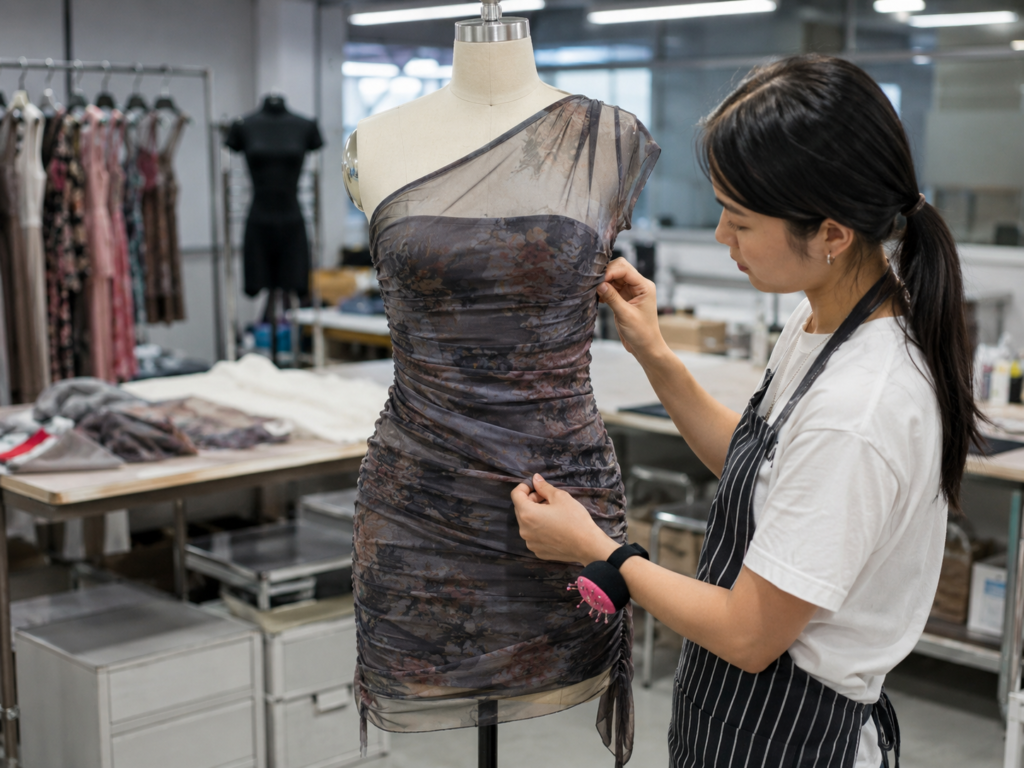
What is included in a mesh dress tech pack?
A complete mesh dress tech pack includes all measurable production data required for sampling and bulk production consistency. Missing even one section can cause interpretation gaps during manufacturing.
| Section | Content | Production Purpose |
|---|---|---|
| Fabric Specification | GSM, composition, stretch % | Controls fit behavior |
| Measurement Sheet | Body + garment dimensions | Ensures size accuracy |
| Construction Details | Panels, seams, structure | Defines garment assembly |
| Lining Instructions | Coverage + fabric type | Controls transparency |
| Stitch & Seam Type | Overlock, flatlock, binding | Ensures durability |
| Grading Rules | Size scaling logic | Maintains fit consistency |
| QC Standards | Tolerance range (±1.5–2.5 cm) | Reduces defects |
In mesh production, the most critical sections are fabric stretch definition and lining specification, because they directly impact visual appearance and body fit.
Why is mesh harder to produce than woven dresses?
Mesh fabric behaves dynamically under tension, making it significantly more complex than woven materials. The main challenge is that mesh does not hold a fixed structure—it reacts continuously to stretch, recovery, and seam tension.
Three core production difficulties:
- Unstable shape memory: Mesh can distort during cutting and sewing if tension is not controlled
- Seam shifting risk: High-speed stitching may pull fabric unevenly
- Fit inconsistency across sizes: Stretch compensation varies between S–L grading
Even with identical measurements, two mesh dresses can produce different silhouettes if fabric batches differ in elasticity by just 5–8%.
Do factories rely on tech packs for sampling?
Yes, sampling systems are built entirely around tech pack instructions. In professional garment manufacturing, sampling teams do not make design assumptions—they execute documented parameters.
Typical sampling workflow:
- Pattern making based on measurement sheet
- Fabric cutting using specified stretch direction
- First sample assembly
- Fit testing against tech pack tolerance
- Revision based on deviation report
When tech packs are incomplete, factories default to internal standards. This often leads to inconsistent outcomes across different production lines or suppliers.
Why does a weak tech pack increase production risk?
A weak or incomplete tech pack creates ambiguity at multiple production stages:
- Pattern makers interpret stretch differently
- Sewing teams choose different seam tension
- QC teams apply inconsistent tolerance standards
- Fabric sourcing may vary in GSM or elasticity
In mesh dresses, these variations amplify quickly. A 2 cm deviation in waist stretch can completely change the intended silhouette. This is why professional brands treat tech packs as a production control system rather than a design document.
What Information Must Be Included in a Mesh Tech Pack?
A mesh tech pack must contain all measurable and executable production data that allows a factory to build the garment without assumptions. For mesh dresses, the risk is not design complexity—it is missing technical clarity around stretch behavior, transparency control, and seam stability. When these details are incomplete, sampling errors increase significantly, often leading to 2–3 rounds of revisions before approval.
In production practice, a complete mesh tech pack reduces sampling deviation by 30–50% and shortens development time by at least 20%. The goal is to define every element that affects fit, structure, and visual output in numeric or clearly measurable terms.
Which measurements matter for stretch mesh garments?
Mesh garments cannot rely on standard flat measurements alone. Every key point must include both relaxed and stretched values because fabric behavior directly changes body fit.
Core measurement points:
- Bust (relaxed / stretched)
- Waist (elastic tension range)
- Hip (maximum expansion point)
- Body length (unstretched reference)
- Strap length (adjustment tolerance)
- Sleeve opening (elastic recovery range)
Typical tolerance range used in production:
- Lightweight mesh: ±2.0 cm
- Medium stretch mesh: ±1.5–2.0 cm
- High compression mesh: ±1.0–1.5 cm
Without defining stretch-based measurements, factories may cut patterns too tight or too loose, especially in bodycon mesh styles.
How to specify fabric composition, GSM, and stretch ratio?
Fabric specification is one of the most critical sections in a mesh tech pack. Mesh fabrics with identical appearance can behave completely differently in production due to fiber ratio and knitting density.
A complete specification must include:
- Fabric name (e.g., Power Mesh, Soft Mesh, Stretch Tulle)
- Composition ratio (Nylon / Polyester / Spandex)
- GSM range (grams per square meter)
- Horizontal stretch %
- Vertical stretch %
- Recovery rate after 30 seconds stretch
| Fabric Type | GSM | Composition | Stretch (H) | Recovery |
|---|---|---|---|---|
| Power Mesh | 120–160 | 90% Nylon / 10% Spandex | 50–70% | ≥90% |
| Soft Mesh | 80–110 | 85% Polyester / 15% Elastane | 30–50% | ≥85% |
| Heavy Mesh | 150–180 | Nylon Blend | 40–60% | ≥88% |
Even a 5% variation in stretch ratio can shift waist or bust fit noticeably in tight silhouettes.
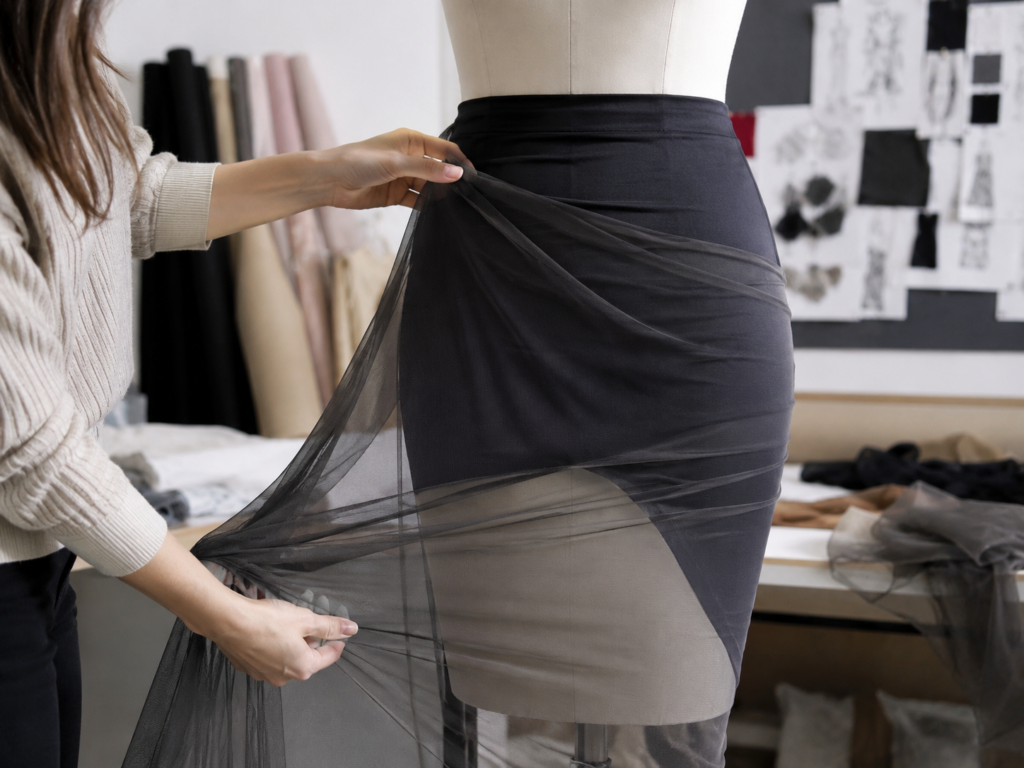
How should lining and transparency be defined?
Transparency control is a key risk point in mesh dress production. Without clear definition, factories may choose different lining strategies, resulting in inconsistent visual output.
A proper tech pack should specify:
- Lining coverage (full / partial / zone-based)
- Lining fabric type (jersey, mesh lining, stretch knit)
- Color matching rule (skin tone / garment tone / contrast)
- Double-layer or single-layer structure
- Transparency level classification (low / medium / high)
Common production standards:
- Full lining: full opacity, stable fit, heavier weight
- Partial lining: bust/hip coverage, balanced breathability
- Illusion mesh: skin-tone lining for sheer effect
If lining stretch rate differs from outer mesh by more than 10%, distortion or wrinkling will occur during wear.
What stitch and seam details are required?
Mesh fabrics require precise seam engineering because they react strongly to tension during stitching. Incorrect seam type can lead to puckering, tearing, or uneven stretch recovery.
Essential seam specifications:
- Overlock seam for general construction
- Flatlock seam for body-contact areas
- Elastic binding for neckline and hem
- Reinforced stitching at stress points
Seam allowance standards:
- Lightweight mesh: 0.5 cm
- Medium mesh: 0.6–0.7 cm
- Heavy mesh: up to 1.0 cm
In production, seam direction must also follow stretch direction. Misaligned seams can cause twisting after washing or repeated wear.
How should grading rules be defined for mesh dresses?
Grading mesh garments is not a linear scaling process. Because mesh has elasticity, size expansion must balance fabric stretch capacity with silhouette integrity.
Recommended grading logic:
- S → M: +2 to +3 cm per key point
- M → L: +3 to +4 cm per key point
- Compression styles: reduced grading increment
Additional rules:
- Maintain consistent stretch ratio across sizes
- Adjust negative ease proportionally
- Avoid over-grading in waist area for bodycon styles
Without clear grading rules, larger sizes often lose design proportion or become too loose due to uncontrolled fabric recovery behavior.
What QC and tolerance standards should be included?
Quality control specifications ensure consistent production output across batches. Mesh garments require tighter tolerance control due to fabric instability.
Standard QC parameters:
- Measurement tolerance: ±1.5–2.5 cm
- Seam deviation: ≤0.3 cm
- Color consistency: ΔE ≤ 3
- Stretch variation between batches: ≤5%
Inspection checkpoints:
- Pre-production fabric test
- First sample fit approval
- Mid-production random check
- Final AQL inspection
If QC standards are not defined in the tech pack, factories may apply different internal criteria, leading to inconsistent bulk results.
How Do You Build a Tech Pack for Mesh Dresses?
A mesh dress tech pack is built by converting a visual idea into a production-controlled document that defines structure, fit logic, fabric behavior, and manufacturing rules. The goal is not design presentation—it is production execution without interpretation gaps.
For mesh dresses, the building process is more technical than standard woven garments because stretch, recovery, and transparency must be controlled numerically. A well-built tech pack reduces sampling revisions by 30–50% and improves first-sample accuracy significantly.
How to turn a sketch into technical flats?
The first step is translating a fashion sketch into flat technical drawings that show how the garment is constructed.
Key actions:
- Convert front/back views into flat outlines
- Mark seam positions clearly (side seam, princess seam, panel lines)
- Define mesh + lining separation zones
- Indicate stretch direction (horizontal / vertical)
- Highlight tension areas (bust, waist, hip)
If a seam is not drawn, it is assumed not to exist in manufacturing.
| Sketch Element | Technical Flat Output | Production Purpose |
|---|---|---|
| Draped mesh effect | Panel segmentation lines | Pattern accuracy |
| Body silhouette | Negative ease mapping | Fit control |
| Sheer areas | Transparency zones | Lining decisions |
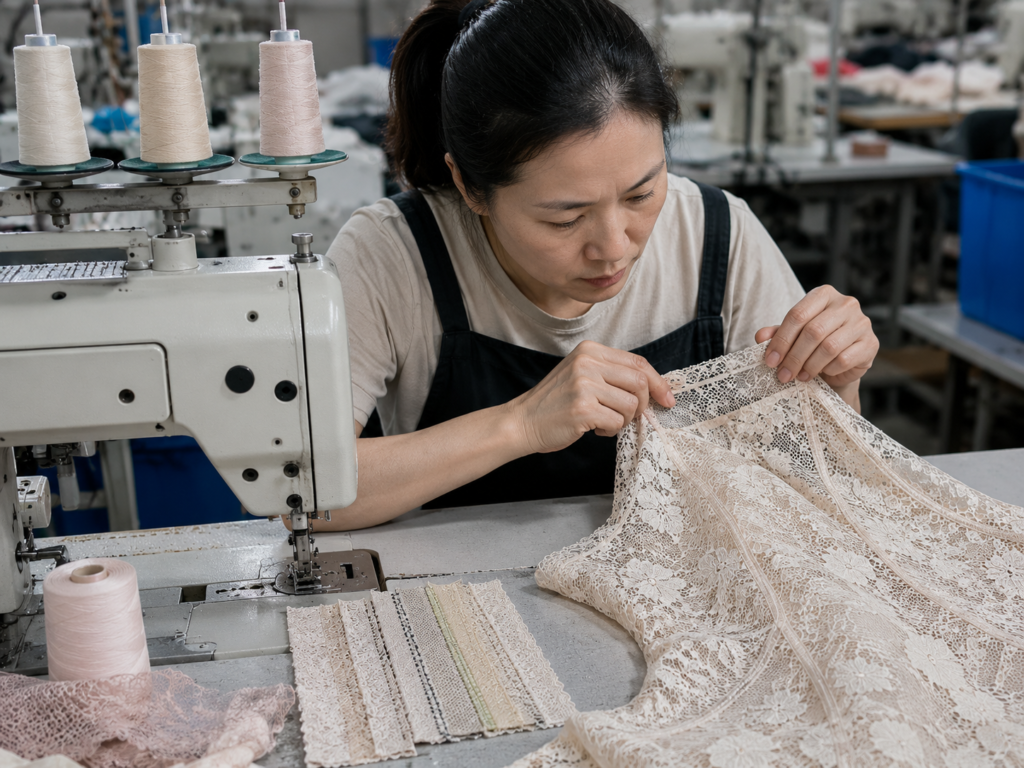
How to define construction and structure logic?
Construction logic explains how the mesh dress is physically assembled. Without this section, factories will choose their own assembly method, which leads to inconsistent results.
Core definitions required:
- Panel structure (1-piece / multi-panel / layered mesh)
- Seam direction aligned with stretch direction
- Bust shaping method (compression / dartless stretch / inner structure)
- Waist control (elastic band / power mesh shaping / seam contouring)
- Hem stabilization method
Example structure rules:
- Side seams follow maximum stretch direction
- Bust area uses reinforced elastic stitching
- Waist uses 10–15% higher compression mesh
- Hem finished with 0.6 cm binding
A missing structure rule often leads to fit variation of 2–4 cm in production.
How to set grading rules for multiple sizes?
Mesh garments cannot use standard grading logic directly because fabric stretch absorbs part of size variation. Grading must balance measurement scaling with fabric recovery capacity.
Recommended grading structure:
| Size Transition | Bust Adjustment | Waist Adjustment | Hip Adjustment |
|---|---|---|---|
| S → M | +2–3 cm | +2 cm | +2–3 cm |
| M → L | +3–4 cm | +3 cm | +3–4 cm |
| L → XL | +3–5 cm | +3–4 cm | +4–5 cm |
- Maintain consistent stretch ratio across sizes
- Do not over-grade waist in bodycon mesh styles
- Apply reduced grading for high-elastic fabrics
- Keep silhouette ratio consistent (not just measurements)
Without defined grading logic, larger sizes often lose intended design proportion.
How do factories interpret incomplete information?
When tech packs are incomplete, factories rely on internal default standards. This creates variability between suppliers and even between production batches.
Typical interpretation gaps:
- Stretch assumption (low vs medium vs high elasticity)
- Seam selection based on machine setup
- Lining choice based on available materials
- Fit preference based on past similar styles
Impact in production:
- Fit variation between samples: 2–5 cm
- Re-sampling frequency increases by 1–2 rounds
- Bulk inconsistency across size sets
- Increased fabric waste due to redesign adjustments
In mesh dresses, missing one key parameter often changes the entire garment behavior, especially in tight silhouettes where compression balance is critical.
What files and formats should a complete tech pack include?
A production-ready mesh tech pack is not a single file—it is a structured set of documents that ensure clarity across departments.
Standard file structure:
| File Type | Purpose | Format |
|---|---|---|
| Technical Flat Sketch | Visual construction guide | PDF / AI |
| Measurement Sheet | Size control reference | Excel |
| Fabric Sheet | Material specification | PDF / Excel |
| BOM (Bill of Materials) | Trim & accessory list | Excel |
| Construction Sheet | Sewing instructions | |
| Color & Finish Sheet | Color + effect control |
Recommended submission rule:
- One style = one complete tech pack folder
- All files must use consistent measurement units (cm recommended)
- Fabric swatch images should be included for reference
Factories operate faster when all documents are structured in one standardized format rather than scattered references.
How Do Manufacturers Use Tech Packs in Production?
A tech pack becomes the operational center of mesh dress production once sampling and bulk manufacturing begin. It is not treated as a reference document—it functions as a control system that guides every department, including pattern making, cutting, sewing, and quality inspection.
For mesh garments, where stretch behavior and seam accuracy directly influence final fit, manufacturers rely heavily on measurable specifications rather than visual interpretation. A well-prepared tech pack reduces production deviation by 25–40% and significantly lowers rework during bulk orders.
How is a tech pack used in pattern making?
Pattern making is the first stage where a tech pack is translated into physical garment structure. For mesh dresses, pattern makers do not simply copy measurements—they adjust for fabric elasticity and negative ease requirements.
Key usage points:
- Convert garment measurements into flat pattern blocks
- Apply stretch reduction factors (typically 10–30%)
- Align seams with fabric stretch direction
- Adjust bust/waist shaping based on compression level
- Define panel segmentation for mesh + lining structure
Production reference table:
| Fabric Type | Pattern Adjustment | Fit Strategy |
|---|---|---|
| Low stretch mesh | 5–10% reduction | Semi-fitted |
| Medium stretch mesh | 10–20% reduction | Body-contouring |
| High compression mesh | 20–30% reduction | Tight fit shaping |
Without these parameters, pattern makers rely on experience-based estimation, which increases fit variation between samples.
How do factories calculate fabric consumption?
Fabric consumption is derived directly from tech pack specifications, including garment dimensions, panel layout, and fabric width efficiency. Mesh fabrics require additional consideration due to stretch direction and cutting stability.
Typical calculation factors:
- Garment surface area based on flat pattern
- Stretch direction alignment (warp/weft orientation)
- Seam allowance waste
- Shrinkage and recovery allowance
- Multi-layer construction (lining inclusion)
Standard consumption ranges:
| Dress Type | Fabric Usage |
|---|---|
| Simple mesh mini dress | 1.1 – 1.4 meters |
| Double-layer mesh dress | 1.6 – 2.2 meters |
| Complex panel bodycon dress | 2.0 – 2.8 meters |
Incorrect or missing tech pack data can increase fabric waste by 10–18% per style, especially in multi-panel mesh designs.
How is sampling controlled through tech packs?
Sampling teams follow tech pack instructions as a step-by-step production guide. Each sample stage validates different technical aspects before approval.
Standard sampling workflow:
- First sample (fit test):
Confirms silhouette, stretch behavior, and base structure - Second sample (correction stage):
Adjusts measurement deviations and seam stability - Pre-production sample (final approval):
Locks fabric, color, lining, and finishing standards
Key control checkpoints:
- Measurement accuracy within ±1.5–2.5 cm
- Stretch recovery consistency ≥85%
- Seam stability after tension test
- Lining alignment under movement conditions
In mesh dresses, most revisions occur at the first sample stage due to missing stretch or lining clarity in tech packs.
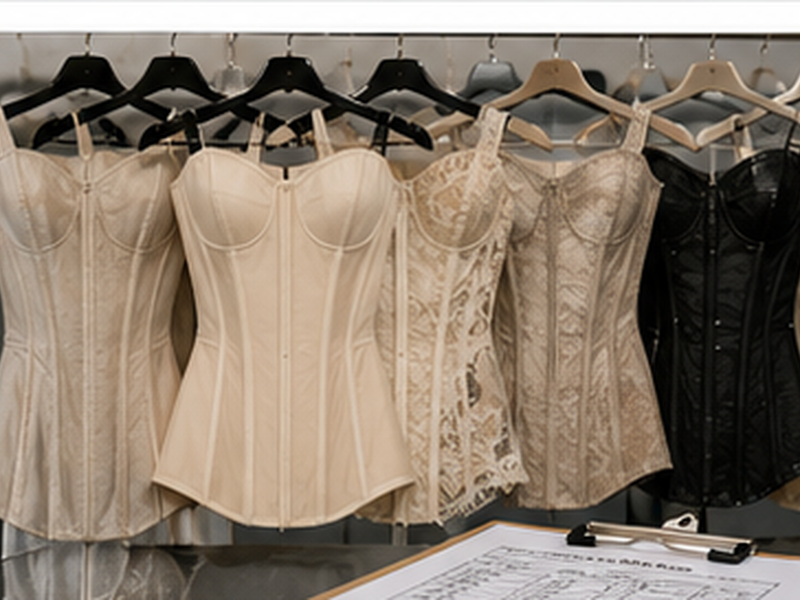
What happens when instructions are unclear?
When tech pack information is incomplete, factories fill gaps using internal production standards. This leads to variation across different suppliers and even between batches from the same factory.
Common consequences:
- Pattern makers apply default stretch assumptions
- Sewing teams select standard seam types instead of optimized ones
- Lining decisions vary based on available stock materials
- Fit interpretation shifts across production lines
Production impact summary:
| Issue Area | Typical Deviation |
|---|---|
| Fit variation | 2–5 cm difference |
| Sampling rounds | +1 to +3 cycles |
| Fabric waste | +8–15% increase |
| Delivery delay | 7–20 days extension |
In mesh garments, even small ambiguities—such as missing stretch percentage—can result in completely different final silhouettes.
How do quality control teams use tech packs?
Quality control teams use tech packs as inspection benchmarks during both sampling and bulk production stages. Every garment is measured against predefined tolerances and construction rules.
QC application points:
- Check measurement accuracy against spec sheet
- Verify seam type and stitch density
- Inspect stretch recovery consistency
- Confirm lining coverage and transparency level
- Test durability under tension and movement
QC tolerance standards commonly applied:
| Parameter | Acceptable Range |
|---|---|
| Bust/Waist/Hip | ±1.5–2.5 cm |
| Seam deviation | ≤0.3 cm |
| Color difference | ΔE ≤ 3 |
| Stretch variation | ≤5% batch difference |
Without tech pack standards, QC teams must rely on subjective judgment, which increases inconsistency in bulk inspection results.
What Are the Common Risks in Mesh Dress Development?
Mesh dress development carries higher production risk than standard woven garments because fabric behavior is unstable under tension, transparency levels vary by batch, and seam performance changes under stretch conditions. Most issues appear not during design, but during sampling and bulk production due to missing technical control points in the tech pack.
In real factory cases, 60–70% of mesh sampling revisions come from three areas: stretch mismatch, lining inconsistency, and grading distortion. When these risks are not clearly controlled in documentation, production timelines extend by 7–20 days and material waste increases significantly.
Why do first samples often fail in mesh styles?
First samples fail mainly because mesh fabric behaves differently from flat pattern assumptions. Many designs are built visually, but mesh requires numerical control of elasticity and recovery.
Common failure triggers:
- Missing stretch percentage definition in tech pack
- Incorrect negative ease application in pattern making
- Uncontrolled seam tension during stitching
- Fabric substitution with different GSM or elasticity
Typical first-sample deviation data:
| Issue | Frequency | Impact |
|---|---|---|
| Fit mismatch | 65% | ±2–4 cm variation |
| Waist instability | 48% | Loose or over-tight fit |
| Bust distortion | 42% | Shape imbalance |
| Hem twisting | 30% | Visual deformation |
Without clear technical parameters, sampling becomes trial-based instead of specification-driven.
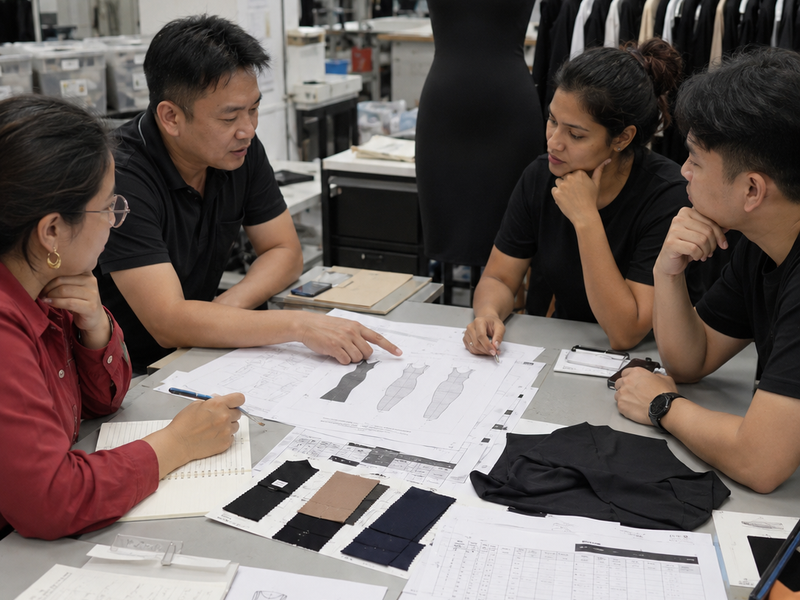
How does stretch variation affect fit accuracy?
Mesh fabric stretch variation is one of the most critical risks in production. Even small differences in elasticity between batches can change garment fit noticeably.
Key risk factors:
- Horizontal stretch inconsistency (±5–10%)
- Recovery rate variation after repeated tension
- Fabric roll differences within same order batch
- Heat-setting differences during finishing
Impact on garment fit:
| Stretch Change | Fit Deviation |
|---|---|
| 3% variation | ±1 cm shift |
| 5% variation | ±1–2 cm shift |
| 10% variation | ±2–3 cm shift |
In tight mesh dresses, waist and hip areas are most affected because they rely heavily on controlled compression. Without fabric testing before cutting, bulk production results may vary across size sets.
What causes lining or transparency issues
Transparency problems occur when mesh and lining fabrics are not properly matched in weight, stretch, or color tone. This is especially visible under strong lighting or movement.
Main causes:
- Lining GSM too heavy or too light compared to outer mesh
- Mismatch in stretch recovery between layers
- Incorrect color pairing (skin tone vs garment tone mismatch)
- Uneven layering tension during sewing
Common production outcomes:
- Visible seam lines under stretch
- Uneven opacity in bust or hip zones
- Wrinkling due to differential stretch rates
- “Double shadow” effect in photography or stage lighting
Recommended balance range:
| Component | Standard Range |
|---|---|
| Mesh GSM | 80–160 |
| Lining GSM | 90–140 |
| Stretch difference | ≤10% |
| Color variance | Low ΔE ≤ 3 |
Without proper alignment, mesh dresses lose visual consistency even if measurements are correct.
How do grading errors increase production defects?
Grading mesh garments is more complex than standard sizing because fabric stretch partially compensates for measurement differences. Incorrect grading logic leads to disproportionate size scaling.
Typical grading issues:
- Over-scaling waist in larger sizes
- Ignoring stretch compensation factor
- Maintaining rigid woven-style grading rules
- Inconsistent adjustment between bust and hip ratios
Observed production deviation:
| Size Range | Common Issue |
|---|---|
| S–M | Slight looseness in waist |
| M–L | Loss of body contour |
| L–XL | Silhouette collapse |
In practice, grading errors contribute to 20–30% of size-related rework in mesh dress production. Without controlled grading logic, larger sizes often fail to maintain intended design proportion.
What increases re-sampling costs in mesh development?
Re-sampling costs increase when technical clarity is insufficient at the early stage of development. Mesh garments amplify small mistakes due to fabric sensitivity.
Main cost drivers:
- Missing stretch specification in tech pack
- No defined seam construction method
- Fabric substitution between sampling stages
- Inconsistent measurement tolerance standards
Cost impact breakdown:
| Issue Source | Cost Increase |
|---|---|
| Fit correction | +15–25% |
| Fabric re-cutting | +10–18% |
| Additional sampling round | +20–35% |
| Production delay | 7–20 days |
Most re-sampling cycles are avoidable when technical data is fully defined before first sample cutting.
How do production delays occur in mesh dresses?
Delays usually come from repeated clarification cycles between design interpretation and factory execution. Mesh garments require more communication due to material sensitivity.
Common delay reasons:
- Waiting for revised tech pack instructions
- Re-sourcing fabric with correct elasticity
- Adjusting pattern after failed first sample
- Reconfirming lining and transparency standards
In production environments, each additional sampling round typically adds 5–10 working days. When multiple issues overlap, total delay can extend beyond 20 days.
Work with Jinfeng Apparel
Mesh dress development requires technical precision, not just design creativity. A complete tech pack reduces sampling risk, stabilizes fit, and improves production efficiency across all stages.
Jinfeng Apparel supports global fashion labels with OEM & ODM mesh dress development, sample making, and bulk production. With structured technical review, fabric control systems, and experienced production teams, development cycles become more predictable and efficient.
For custom mesh dress manufacturing, sample development, or full collection production, direct inquiry is welcome to Jinfeng Apparel. A production-ready solution can be structured based on design reference, target pricing, and delivery timeline.