Skip to content

Changing a dress manufacturer can feel like replacing an engine while the production calendar is still moving. Current collections may already be selling, wholesale deliveries may be booked, campaign dates may be fixed, and warehouse stock may cover only a few weeks. Stopping everything while a new factory learns the patterns, fabrics, sizing, labels, and quality standards can create a costly gap. Remaining with an unreliable supplier can be equally dangerous because the next missed shipment may arrive during the season that matters most.
To change dress manufacturers without delaying production, secure all technical and physical references, qualify the replacement factory before ending current orders, build enough inventory for the overlap, move one stable style first, approve a production-ready sample, and keep both factories active until the new supplier completes a verified bulk shipment.
The safest change is rarely a clean break on one date. It is a controlled handover with overlapping responsibilities, measurable approval gates, and a defined exit point. One fashion team moved twelve styles at once because the new supplier had produced attractive samples. Bulk production later revealed differences in lining tension, zipper application, and grading. The launch survived only because three bestsellers were still running at the original factory. The lesson was simple: the sequence of the transfer mattered more than the speed of the decision.
Is It Time to Change Dress Manufacturers?
A manufacturer change is usually justified when delays, quality failures, communication gaps, capacity limits, or unexplained cost changes become repeated rather than occasional. Review recent order performance, calculate the cost of staying, and judge whether corrective actions have produced measurable improvement before starting a controlled transition.
Repeated Problems Matter More
Every apparel factory experiences disruption. A fabric mill may miss a dyeing date, a custom zipper may arrive late, or one sewing line may lose time because of rework. These events do not automatically mean the manufacturer is unsuitable. The stronger warning is repetition without effective corrective action. Review at least the last three completed orders, or the last six months when orders are frequent, and look for recurring patterns in delivery accuracy, sample revisions, measurement failures, material substitutions, packing mistakes, and response time.
Dress production is particularly sensitive to small errors that repeat. A waistline positioned 1.5 cm too low, a satin zipper that does not lie flat, or a lining that restricts stretch may appear minor on a hanger, but the result can alter fit, increase returns, and weaken customer confidence. A dependable factory may encounter a problem, yet it should explain the cause, provide a recovery plan, and prevent the same failure from returning in the next order.
Measure the Cost of Staying
Brands often focus on the visible cost of changing factories while ignoring the operational cost of remaining with an underperforming supplier. That cost can include air freight used to recover a late shipment, discounts after a missed launch, reinspection and repair expenses, returns caused by inconsistent sizing, lost wholesale orders, unused packaging, and many hours spent chasing information. A low unit price can become expensive when the production system repeatedly creates emergency work.
Compare the quoted garment price with the actual landed and operational cost. A dress quoted at USD 12 may effectively cost much more after rework, expedited freight, replacement units, and lost selling time are included. The decision becomes clearer when delivery failures, defects, communication time, and recovery expenses are recorded by order instead of treated as isolated frustrations. The following table provides a practical framework for separating a manageable problem from a pattern that deserves a supplier transition.
| Performance Area | Healthy Pattern | Warning Pattern | Evidence to Review |
| Delivery | Occasional documented delay with recovery plan | Repeated missed dates and changing explanations | Production plans, ex-factory dates, shipping records |
| Quality | Isolated defects corrected before the next order | The same fit or sewing defect across several orders | Inspection reports, returns, corrective actions |
| Communication | Scheduled milestone updates and early risk warnings | Information appears only after repeated follow-up | Email history, update frequency, named owner |
| Capacity | Line allocation matches the confirmed order | Orders accepted without a realistic production slot | Cutting plan, sewing line, weekly output |
| Cost | Changes linked to fabric, trim, labor, or quantity | Unexplained increases after development approval | Cost breakdowns and revised quotations |
| Corrective Action | Root cause, owner, deadline, and recheck result | Promises without measurable process change | CAPA records and later order performance |
Separate Temporary and Structural Risk
Temporary disruption normally has a clear cause, a responsible owner, and a credible end point. A dyeing failure may delay one fabric lot, but the manufacturer can show when the replacement lot will be completed, how cutting will move, and whether the shipment date can still be protected. Structural risk is different. It appears across orders because the supplier lacks reliable planning, technical control, workforce stability, or production visibility.
Ask where the problem began, when it was detected, why it was not prevented, what corrective action was taken, and how the next order will be handled differently. Experienced production teams can usually identify whether the failure came from pattern approval, shrinkage, cutting, sewing, finishing, inspection, packing, or an external supplier. Vague statements such as ‘the factory is busy’ do not show that the cause is understood, and they offer no evidence that the next order will perform better.
Leave in Stages
Most brands should not stop every order immediately. A sudden exit can create more risk than the original supplier problem, especially when the replacement factory has not completed a successful bulk shipment. Divide current work into confirmed production, stable repeats, and new developments. Orders already in cutting or sewing will often remain where they are, while upcoming styles can move first and critical bestsellers stay temporarily with the current supplier.
Immediate suspension may be necessary when a factory substitutes materials without approval, mishandles confidential designs, hides serious defects, refuses inspection, or creates a compliance risk. Even in those situations, secure patterns, samples, branded labels, trims, packaging, and technical records before communication breaks down. The objective is not to punish the existing supplier. It is to protect the collection, preserve access to production assets, and create enough time for the replacement factory to prove itself.
What Should You Prepare Before the Switch?
Prepare a controlled transfer package containing current technical files, approved physical samples, fabric and trim records, quality standards, packaging instructions, sales forecasts, and delivery requirements. Missing or conflicting information forces the new manufacturer to reverse-engineer the product, creating extra sample rounds and avoidable production delays.
Build a Clean Technical Package
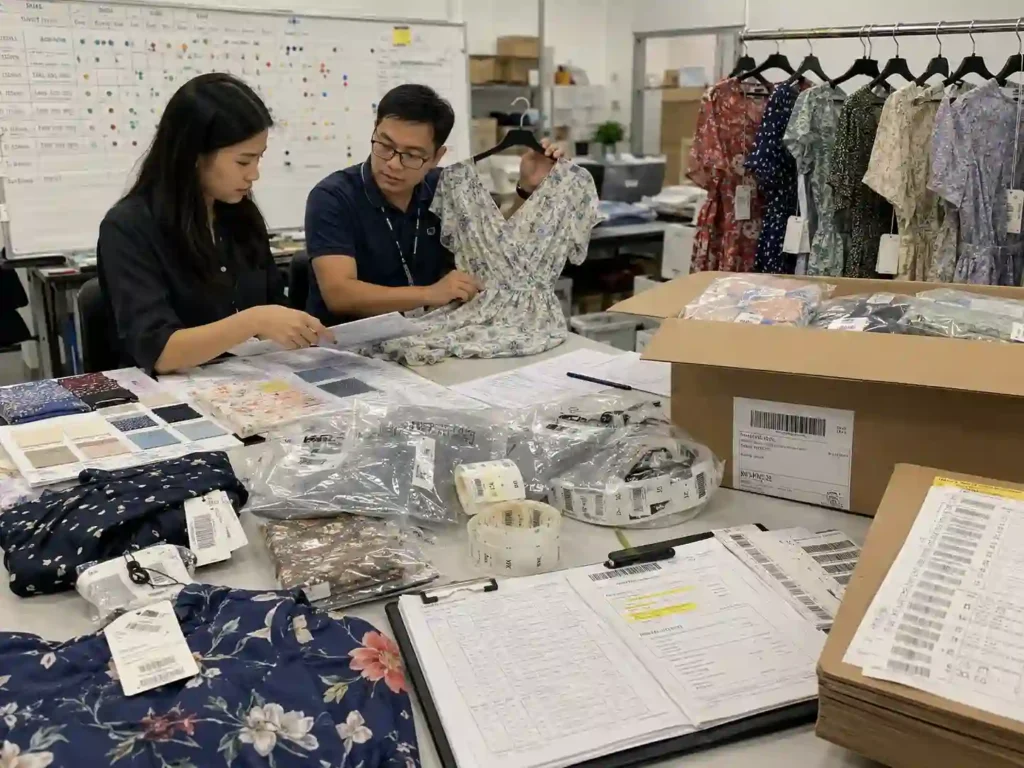
The new factory should receive one approved version of every document required to reproduce the dress. A folder containing several old measurement charts, unnamed pattern files, and conflicting comments creates confusion before development begins. The active package normally includes the tech pack, bill of materials, construction drawings, measurement chart, grading rules, pattern files, seam allowances, fabric specifications, color standards, trim details, label artwork, packaging instructions, inspection requirements, and approved sample comments.
Use consistent file names that include the style number, document type, revision, and date. A file such as DRS-2418_MeasurementChart_R04_2026-06-12 is far safer than Final_Measurements_New. Only the approved version should remain in the active production folder, while older files can be archived separately. Known production lessons should also travel with the style. If a mesh neckline stretches during binding or a satin skirt drops after hanging, that information can save a full sample round.
Secure Physical Standards
Digital files explain the intended product, but physical samples show how it should feel, hang, stretch, and fit. This matters for satin, mesh, lace, jersey, sequin, corset structures, and any style whose appearance depends on drape or internal support. Useful references include an approved bulk garment, a sealed golden sample, fabric and lining swatches, lab dips, trim cards, zippers, cups, boning, elastics, labels, hangtags, polybags, and examples of acceptable workmanship.
Measure and photograph each master sample before sending it. Record the garment weight, key measurements, fabric condition, and any approved difference from the written specification. When possible, retain a duplicate. Not every historical material can be reproduced exactly, so identify which characteristics are non-negotiable. Color, weight, opacity, stretch, recovery, drape, surface shine, and hand feel may matter more than matching an old supplier code that is no longer available.
Confirm Ownership and Access
Many transitions slow down because a brand assumes it owns development assets but cannot obtain them quickly. Confirm access to paper patterns, digital pattern files, grading, markers, print artwork, embroidery programs, custom molds, branded trims, unused fabric, packaging inventory, fit records, and historical inspection reports. Ownership depends on the original agreement, local law, and who paid for development, so it is better to clarify these points while the relationship is still workable.
When a proprietary production method or exclusive supplier cannot be transferred, the replacement factory may need to redevelop part of the product. A dress with custom lace placement, molded cups, branded hardware, or specially dyed fabric can require more than a tech pack handover. Use a written inventory list for every sample, pattern, trim, and material being transferred, including quantities, condition, ownership, and shipping details. This makes the handover easier to verify when several teams are involved.
Calculate Protection Stock
Inventory should cover the complete period until replacement goods are available for sale, not only until they leave the new factory. A useful starting formula is average weekly sales multiplied by protected weeks, plus a demand allowance. Protected weeks may include sample approval, material booking, production, inspection, rework, international transport, customs clearance, and warehouse receiving. The allowance should reflect demand volatility and the commercial importance of the style.
The figures below are planning examples rather than fixed industry standards. A stable occasion dress with predictable demand may need less protection than a fast-selling party dress influenced by social media. Styles using special lace, custom hardware, or made-to-order fabric generally need a larger buffer because replacement materials take longer to secure. Review the plan each week during the transition because sales velocity, sample progress, fabric readiness, and freight conditions can change quickly.
| Average Weekly Sales | Protected Period | Base Stock | With 10% Allowance | With 20% Allowance |
| 75 units | 8 weeks | 600 units | 660 units | 720 units |
| 150 units | 8 weeks | 1,200 units | 1,320 units | 1,440 units |
| 250 units | 10 weeks | 2,500 units | 2,750 units | 3,000 units |
| 400 units | 12 weeks | 4,800 units | 5,280 units | 5,760 units |
Which Dress Manufacturer Is Ready to Take Over?
A replacement manufacturer is ready only when it can demonstrate relevant dress experience, accurate pattern and fit control, repeatable fabric sourcing, realistic capacity planning, documented quality procedures, and reliable project communication. Factory size alone does not prove that the supplier can reproduce a mature product consistently.
Match Capability to the Dress
Dress manufacturing is not one uniform skill. A factory that performs well with relaxed rayon maxi dresses may not have the same pattern, construction, and sewing experience needed for corset dresses, fitted jersey, satin occasionwear, lace garments, stretch mesh, sequin styles, or strapless structures. Begin by matching the factory’s proven product strengths to the styles that will actually be transferred, rather than accepting a general claim that it can make every type of dress.
The technical conversation before quotation is often revealing. A satin specialist may ask about shine direction, zipper weight, seam puckering, pressing temperature, and protective packing. A team familiar with bodycon styles may focus on stretch percentage, recovery, chest-waist-hip proportions, seam stability, and size consistency. A supplier that only says ‘no problem’ provides little evidence. A stronger supplier identifies the difficult points and explains how they will be controlled in samples and bulk production.
Test Pattern and Fit Skills
The safest technical test is a real style with complete reference materials and known fit risks. The factory should review the original garment, measurement chart, pattern, fabric behavior, and construction before making the first sample. For dresses, critical measurements often include bust, underbust, waist, high hip, full hip, front and back length, neckline depth, armhole, strap length, slit position, skirt length, and inseam for jumpsuit-based styles.
Measurement accuracy alone does not guarantee good fit. Two dresses can match the same chart but hang differently because of pattern balance, fabric stretch, seam construction, or lining tension. Review the sample on the intended fit model and inspect it from the front, side, and back. Side seams should remain balanced, the waist should sit at the approved level, the neckline should remain stable, and the hem should hang evenly. Stretch fabrics should also be tested for recovery after extension.
Verify Fabric Repeatability
A sample is only useful when its fabric can be purchased consistently for bulk production and later repeats. Request fiber composition, finished width, weight per square meter, stretch in both directions, recovery, shrinkage, opacity, colorfastness, minimum quantity, lead time, stock status, and the method used to control dye lots. An attractive fabric purchased from an unidentified market source may work for one sample yet disappear before the repeat order is placed.
Material review should reflect the dress category. Satin needs evaluation of surface shine, snagging, crease recovery, zipper behavior, and color under different lighting. Mesh requires checks for transparency, stretch, recovery, edge stability, and hole damage. Lace needs motif direction, usable width, defect allowance, and placement control. Jersey should be reviewed for weight, stretch, recovery, spirality, and shrinkage. Confirm bulk availability before committing to the final production calendar.
Confirm Real Capacity
Capacity should be discussed in relation to the actual style, quantity, and required delivery date. Ask when bulk materials will be ready, which line will sew the order, what weekly output is realistic after line balancing, how many other styles are scheduled at the same time, who will conduct in-line inspection, and whether finishing and packing can keep pace with sewing. A complex lined lace dress will not move through production at the same rate as a simple woven style.
A factory audit can verify organization, equipment, working conditions, and basic controls, but it cannot replace technical sampling and a controlled production test. The strongest qualification combines document review, sample accuracy, material planning, communication performance, and a first bulk order with early inspection points. Jinfeng Apparel’s production system, for example, includes six owned womenswear factories, more than ten long-term production partners, eighteen-plus sewing lines, two sample rooms, seven-plus senior pattern makers, twenty-plus sample machinists, and fifteen-plus QC inspectors. Those resources are useful only when they are matched to a style-specific plan.

How Do You Build a No-Delay Transition Plan?
A no-delay transition uses overlapping production, clear approval gates, and phased style transfer. Keep the current supplier active for confirmed orders and critical repeats while the replacement factory develops one well-documented pilot style. Expand the transfer only after the new supplier meets agreed fit, quality, timing, and communication standards.
Choose the First Style Carefully
The first transferred style should be technically meaningful without being so complicated that every problem becomes difficult to diagnose. A useful pilot normally has complete technical files, an approved physical sample, stable historical fit, repeatable materials, known quality risks, limited colorways, and enough time before launch. It should test the factory’s real capability rather than simply provide an easy sample that says little about future production.
An oversized basic dress may pass without testing fit, lining, zipper installation, or fabric handling. At the other extreme, a heavily beaded gown with several layers and hand-applied details may introduce too many variables for a first transfer. Depending on the brand’s main category, a lined satin midi dress, a structured mesh mini dress, or a fitted jersey style may provide a more useful test. Define success before sampling begins, including fit, measurement tolerance, material standard, defect expectations, packing, and timing.
Run Both Suppliers in Parallel
Parallel production creates time for the replacement factory to learn without leaving the brand unprotected. The existing supplier may complete confirmed orders and continue selected repeat styles, while the new factory develops one pilot, books approved materials, produces a controlled quantity, and passes inspection. Parallel operation does not always mean splitting the same order equally. It can mean dividing work according to product maturity and commercial risk.
Duplicate sampling, smaller initial material bookings, and two inspection schedules can increase short-term cost, but this expense should be compared with the possible cost of stockouts, missed retailer windows, air freight, or a failed full collection transfer. The brand should own and distribute the technical standard directly. Relying on the old factory to teach the new one can create gaps, conflicts, and uncertainty over which version of the product is actually approved.
Work Backward from Delivery
Start with the date the goods must be available in the warehouse, not the factory shipment date. Work backward through receiving, customs clearance, international transport, final inspection, packing, production, material delivery, PP approval, revised sampling, and the first sample. Every milestone needs an owner, a target date, and a latest acceptable approval date. Brand-side delays must be included because slow comments can consume the same buffer as a factory delay.
The ranges below are practical planning allowances rather than guaranteed standards. Custom dyeing, printing, lace, embellishment, branded hardware, complex corset structures, or peak-season congestion can extend development and production. The purpose of the schedule is not to force every project into the same number of days. It is to reveal where the critical path sits and how much time remains if one approval round takes longer than expected.
| Stage | Common Planning Range | Approval Gate | Main Risk |
| File and feasibility review | 3-5 working days | Transfer package accepted | Missing or conflicting documents |
| Fabric and trim matching | 1-3 weeks | Physical materials approved | MOQ, custom color, unavailable quality |
| First or fit sample | 1-3 weeks | Fit comments issued | Pattern and fabric interpretation |
| Revised sample | 1-2 weeks per round | Measurements and appearance approved | Slow comments or major design changes |
| PP sample and size review | 1-2 weeks | Bulk-ready approval | Bulk material differs from sample |
| Bulk production | 3-6 weeks for many standard programs | In-line checkpoints passed | Complexity, quantity, line loading |
| Final inspection and packing | 2-5 working days | Shipment released | Rework, relabeling, repacking |
| Freight, customs, receiving | Route-dependent | Goods available for sale | Capacity, clearance, warehouse processing |
Transfer in Waves
Moving every style at once concentrates risk. A phased transfer allows the brand to learn from each order and helps the factory build knowledge around related fabrics and constructions. Styles can be grouped by fabric family, construction type, product category, sales priority, technical difficulty, or launch date. One wave may contain established satin styles, another may focus on mesh and lace, and a later wave may include structured occasionwear.
Set a clear gate between waves. Do not release the next group simply because the first group has entered sewing. Wait for meaningful evidence such as approved first output, stable in-line measurements, acceptable defect trends, and on-time progress. A phased approach also tests daily project management. Technical skill matters, but the transition will still fail if material approvals, comments, inspection findings, and shipment decisions are not followed consistently.
How Are Samples and Quality Approved?
Samples and quality should be approved through defined stages covering fit, measurements, materials, construction, grading, appearance, labeling, and packing. The final pre-production or golden sample must represent the bulk standard. Verbal approval or an attractive photo sample is not enough to control production.
Give Each Sample a Purpose
Different samples answer different questions. The first sample tests whether the factory understands the design and basic construction. A fit sample focuses on body measurements, balance, comfort, and silhouette. A revised sample confirms whether numbered comments were corrected. A size-set sample reviews grading across selected sizes, while a photo sample may prioritize visual presentation. The PP sample should use approved bulk-intent fabric, trims, labels, construction, and measurements.
A golden sample becomes the sealed physical reference for bulk production and inspection. Factory transitions often require more disciplined sampling than normal repeats because the new team has no inherited knowledge of the brand’s preferred fit, pressing, finishing, or tolerance interpretation. Approve each sample in writing with the style number, version, date, approved categories, and remaining comments. A message that says ‘looks fine’ does not show whether fit, color, trims, labels, and packing have all been released.
Approve Critical Dress Details
Dress approval must consider how the garment behaves on the body, not only how it looks on a table. Fitted styles require attention to bust shaping, waist placement, hip fit, side-seam position, and recovery. Strapless and corset styles need review of cups, support, grip tape, boning, closure strength, and comfort. Satin should be checked for zipper flatness, seam puckering, shine direction, pressing, and snagging, while maxi dresses may need to hang before the final hem balance is judged.
Before bulk cutting, confirm the final pattern, grading, measurement tolerances, fabric, color, lining, trims, seam construction, stitch type, placement measurements, labels, barcodes, folding, polybags, cartons, and inspection method. Use numbers wherever possible. ‘Move the slit lower’ invites interpretation, while ‘top of slit 39 cm below the waist seam, tolerance plus or minus 0.5 cm’ creates a measurable standard. Critical details should also be photographed and linked to the approved sample version.
Handle Failed Samples Properly
A failed sample should be diagnosed before another sample is made. Simply asking the factory to improve it often produces a new version with different but equally serious problems. Classify the issue as pattern, grading, fabric, trim, construction, sewing, pressing, packing, or communication. A gaping neckline may come from the pattern, insufficient stabilization, or poor fabric recovery, while a twisted skirt may result from grain direction, fabric relaxation, cutting, or sewing tension.
Issue comments in a numbered document showing the location, current problem, required result, measurement or visual reference, responsible person, and deadline. Change as few unrelated variables as possible in each revision. When the fabric, neckline, skirt length, lining, and zipper are all changed at the same time, it becomes difficult to understand what improved the fit or created a new problem. Controlled revisions make the sample history easier for both the brand and factory to follow.

Create a Measurable Quality Standard
The quality standard should define what will be checked, how it will be measured, and what happens when a problem is found. Measurement tolerances should reflect the garment and the point being checked. A critical strap placement may require a tighter tolerance than the sweep of a soft maxi skirt. Exact values should be agreed before production, because brands and factories do not always interpret a general statement such as ‘standard tolerance’ in the same way.
Use the approved measurement chart, sealed sample, photographs, fabric specifications, construction details, label files, packing instructions, and defect definitions as one connected standard. When a third-party inspection method is used, state the inspection level and acceptance criteria in the purchase order or quality manual. Do not assume the factory and inspector will choose the same method automatically. The goal is to remove subjective decisions from the moment when shipment timing is already under pressure.
How Do You Move Bulk Production Safely?
Bulk production should move only after patterns, grading, bulk materials, trims, measurements, PP standards, packaging, capacity, and milestone dates are approved. Protect the first order with a pre-production meeting, first-output review, in-line inspection, measurement audits, and final shipment release before ending the old supplier relationship.
Confirm Bulk Readiness
A good sample does not prove that the factory is ready to reproduce the style at scale. Before cutting begins, confirm approved bulk fabric and trims, the final pattern and grading, the signed PP sample, measurement tolerances, construction details, label and barcode files, packing instructions, the assigned sewing line, production dates, inspection responsibilities, and the shipment plan. Any remaining deviation should be documented and approved before material is committed.
Hold a pre-production meeting with the merchandiser, pattern maker, production supervisor, and QC representative. Review the physical sample and the current technical file together so that every department is using the same version. For the first transferred order, approve initial output before full-speed sewing continues. Depending on the style and order size, a review of the first 20 to 50 garments may expose measurement drift, construction errors, or label mistakes while correction is still manageable.
Inspect Early, Not Only at the End
Final inspection alone cannot protect the launch when the entire order has already been sewn incorrectly. A practical control sequence begins with incoming fabric and trim inspection, followed by cutting checks, first-output approval, in-line inspection, finishing review, measurement audits, packing inspection, and final release. Each stage catches a different type of risk, and the earlier stages provide the greatest opportunity to correct the process without rebuilding completed garments.
Inspection records should show the defect, affected quantity, corrective action, and reinspection result. Photographs are useful evidence, but they need to connect to a decision. For a first order, some brands use their own representative or a third-party inspector in addition to the factory’s QC team. Independent verification does not replace factory control. It confirms that both sides are applying the same measurement, workmanship, labeling, and packing standards before repeat orders become more streamlined.
Protect Packaging and Logistics
A technically successful dress can still fail commercially through incorrect labeling or packing. Confirm the main label, size label, care label, country-of-origin wording, hangtag, price tag, barcode, SKU sticker, polybag warning, folding method, carton quantity, carton dimensions, carton marks, packing list, and commercial invoice. Barcode or size-ratio errors can delay warehouse receiving even when the garments themselves are acceptable.
Freight should be booked against a realistic final inspection date. Booking too early may create amendment charges or pressure the factory to pack unfinished goods, while booking too late can cause the shipment to miss the intended vessel or flight. Customs clearance and warehouse receiving must also remain inside the launch plan. Goods are not commercially available simply because they have left the factory; they must arrive, clear, be received, and become saleable inventory.
Release the Old Supplier Carefully
The replacement factory should complete more than a successful sample before the existing supplier is fully released. Use formal decision gates covering technical approval, material approval, first-output performance, in-line stability, final inspection, packing accuracy, shipment completion, warehouse receipt, and commercial review. A shipment that arrives only after daily emergency intervention may not indicate a scalable relationship, even when the final garments are acceptable.
After the first delivery, compare actual performance with the transition plan. Review sample accuracy, approval speed, material consistency, production lead time, measurements, defect causes, packing accuracy, communication speed, corrective action, and total landed cost. Move additional styles in waves only after the result is accepted. Keep brand-controlled records of patterns, materials, measurement files, comments, packing requirements, and inspection results so that future production does not depend on one supplier’s memory.
| Release Gate | Evidence Required | Hold the Transfer When |
| Technical approval | Final pattern, grading, measurements, and signed PP sample | Fit or construction comments remain open |
| Material approval | Bulk fabric, color, trims, shrinkage, and relevant test results | Bulk material differs from the approved standard |
| Production control | First-output approval and stable in-line records | The same defect continues after correction |
| Quality approval | Final inspection passed and corrective actions closed | Rework is incomplete or measurements are unstable |
| Packing approval | Correct labels, barcodes, ratios, quantities, and carton marks | Warehouse data or packaging files are inconsistent |
| Delivery proof | Goods shipped, cleared, received, and available within the launch window | The shipment date is met but stock is not commercially usable |
| Commercial review | Quality, communication, timing, and landed cost accepted | Performance required constant emergency management |
A Controlled Transfer Protects the Collection
Changing dress manufacturers without delaying production is a management project rather than a sourcing shortcut. Successful transitions are built on controlled files, physical standards, overlapping capacity, staged sampling, measurable quality gates, and realistic calendars. They also recognize that the lowest quotation can become expensive when it creates repeated development, repairs, air freight, returns, or missed selling time. The strongest protection is ownership of the product information and a replacement supplier that can demonstrate performance before receiving the complete program.
Jinfeng Apparel supports established fashion brands and mid-to-large custom apparel programs with pattern development, fabric and trim sourcing, sample revision, PP approval, bulk production, quality control, private-label packing, and export coordination. Since 2008, the company has developed a production network in Guangdong that includes six owned womenswear factories and more than ten long-term production partners. NDA-based cooperation is available for tech packs, samples, patterns, trims, private-label files, and unpublished designs.
Brands preparing a manufacturer transition can send an existing tech pack, approved garment, measurement chart, fabric reference, estimated quantity, current production concern, and required delivery window for a confidential review. Custom production starts from 200 pieces per style and color, subject to fabric availability, trims, construction complexity, packaging, and production scheduling. The project team can assess transfer risks, identify the required sample stages, and prepare a quotation built around a practical route from sample review to stable bulk delivery.