
How to Add Label and Packaging Information to a Garment Tech Pack

Your trusted Women’s Apparel Manufacturer from China

A garment can fit beautifully, use the right fabric, and pass every sewing inspection, yet still become unusable when it reaches a warehouse. A wrong barcode can place a size M dress in a size S inventory location. An inaccurate care label can create a compliance problem. A badly positioned main label can irritate the wearer, while an undersized polybag can leave permanent creases across satin, velvet, or a structured corset panel. Labeling and packaging are therefore not decorative tasks saved for the end of production. They are part of product engineering, inventory control, legal preparation, brand presentation, freight planning, and the customer’s first physical experience with the product.
To add label and packaging information correctly, create a dedicated tech pack section covering every label’s content, material, dimensions, placement, and attachment method, followed by folding, polybag, sticker, carton, barcode, SKU, and warehouse instructions. Approve physical samples, confirm the SKU matrix, and scan every unique barcode before bulk packing begins, so production, packing, and warehouse data remain aligned.
The strongest instructions leave very little open to interpretation. They explain what must be produced, where each component belongs, how it should be checked, and which approved file controls production. Consider a 5,000-piece dress order in which every garment is sewn correctly, but the cartons carry last season’s SKU numbers. The sewing line did its job and the packing room followed the spreadsheet it received. The real failure happened weeks earlier, when nobody established one controlled source for label and packaging data. This guide shows how to prevent that quiet, expensive mistake.
guide shows how to prevent that quiet, expensive mistake.
What Label Information Does a Garment Tech Pack Need?
A garment tech pack should identify every permanent label, removable tag, sticker, and product code required for the style. For each component, specify its purpose, wording, artwork, finished size, material, color, fold, placement, attachment method, and approved file version. Separate brand, compliance, and inventory information so that each change can be reviewed without disrupting unrelated production data.
Which Garment Labels Are Needed?
Most private-label garments need several labels because one small component cannot perform every job well. A main label communicates brand identity. A size label supports fitting, selling, and warehouse identification. A care label carries fiber, origin, and care information. A hangtag presents retail-facing details but is normally removed before wear. Depending on the sales channel, the garment may also need a price ticket, barcode sticker, SKU label, security loop, QR code, color sticker, or warehouse identifier.
The correct combination depends on garment construction and customer experience. A lined occasion dress may use a woven main label at the back neckline, a separate size tab, a printed satin care label in the left side seam, and a hangtag attached through the internal label rather than the outer fabric. A reversible garment, low-back dress, sheer mesh style, or fitted bodysuit may require a heat-transfer label or another discreet solution because a conventional woven label would be visible, bulky, or uncomfortable.
Settle the label list before the pre-production sample because it affects pattern construction, sewing operations, purchasing, and costing. A label inserted into a seam must be available before that seam is closed. Four-side stitching adds a separate operation. A custom woven label may also have a different supplier lead time and minimum order requirement from the garment. Treat each label as an individual bill-of-materials component with its own code, supplier reference, quantity, approval status, and inspection point.
What Goes on Care Labels?
Care-label content should be based on the actual finished garment rather than copied from a similar product. The shell, lining, contrast panels, and significant textile components may need separate identification. Care instructions should reflect the behavior of the complete style, including interlining, boning, padding, prints, coatings, adhesive components, metal trims, rhinestones, sequins, and delicate surface treatments. A fabric may tolerate washing by itself while the finished garment requires a more cautious method.
A practical care-label file normally includes fiber composition, care wording or approved symbols, country of origin, responsible-company information, garment size, style or production reference, and market-specific languages where applicable. Confirm composition using reliable fabric records and testing when the project requires it. A reordered black jersey can use a slightly different fiber blend from the original material even when the hand feel looks similar, so an old care label should never be reused automatically without checking the new fabric specification.
Review the label at its real physical scale. Long multilingual information may need a loop fold, booklet fold, or multiple pages so the text remains readable without creating an uncomfortable strip inside a short or fitted garment. The same long label that sits discreetly inside a maxi dress may hang below the hem of a mini dress or become visible through a side slit. Check the open size, finished construction, reading direction, print durability, edge softness, and final position on the shortest and most fitted styles in the collection.
What Should Hangtags Show?
A hangtag should communicate what the store, warehouse, and final customer need at the point of sale without becoming crowded. Common fields include the brand name, product name, style number, color, size, recommended retail price, SKU, barcode, website, social handle, QR code, and a brief material or product message. The useful information depends on the sales channel, so a boutique order, marketplace program, department-store delivery, and direct-to-consumer collection may use different tag structures.
Separate fixed artwork from variable data. The logo, paper finish, and general layout may remain consistent across a collection, while the barcode, size, price, color, and SKU change for every product combination. Variable information is often added with a sticker or digitally printed panel, which reduces the number of completely different hangtag versions. It also creates another matching step during packing, so the tag data must come from the same controlled SKU file used for polybag stickers, cartons, and packing lists.
Specify the finished dimensions, paper weight, surface finish, number of printed sides, hole position, corner shape, string material, string length, seal type, and attachment point. A phrase such as “premium black hangtag” is subjective. A useful instruction states that the tag measures 55 x 90 mm, uses 400 gsm uncoated black stock, has white printing on both sides, and includes a 4 mm hole centered 7 mm below the upper edge. Attachment must also protect delicate satin, lace, mesh, and sequin fabrics from punctures or pulling.
Which Files Should Be Supplied?
Factories need production files rather than screenshots from emails, presentation slides, or chat messages. Logo and line artwork should normally be supplied as editable vector files, such as AI, EPS, or production-ready PDF, so dimensions can change without losing clarity. Fonts should be outlined where appropriate to prevent substitution. Care-label wording should also be provided as editable text because a flattened image can hide spelling problems and makes translations or fiber-composition updates difficult.
The style-color-size SKU table should be structured as a spreadsheet with one row for every valid combination. Barcode files or verified barcode numbers should link directly to that same data rather than being stored in a separate folder with unclear filenames. A controlled package commonly includes the label specification sheet, care-label text, size matrix, hangtag artwork, barcode data, polybag sticker layout, carton-mark template, warehouse guide, packing instruction, purchase-order details, and color-size breakdown.
Filenames should show the component, version, and approval status. A file called “hangtag-final.pdf” becomes unreliable after the next revision. A name such as HT_COLLECTION_V05_APPROVED_20260718.pdf is easier to trace, especially when several teams work across design, merchandising, production, and logistics. The exact approved filename should appear in the tech pack, and only one folder or document set should be treated as the production source. A short revision log with the date, change, and approver prevents an older file from being used simply because it was printed first.
Component | Typical Purpose | Minimum Information to Confirm | Approval Evidence |
Main brand label | Brand identity | Artwork, finished size, material, fold, color, placement | Physical strike-off and garment sample |
Size label | Size identification | Size system, font, orientation, color, attachment | Approved size-set reference |
Care label | Care and compliance | Fibers, care, origin, responsible-party information, languages | Approved text and physical sample |
Hangtag | Retail presentation | Style, color, size, price, barcode, paper and attachment | Printed proof and packed sample |
SKU or barcode sticker | Inventory control | SKU, code type, human-readable number, style-color-size match | Physical scan test |
Carton or warehouse label | Receiving and logistics | PO, style, assortment, carton number, destination, routing data | First-carton verification |

How Do You Specify Label Construction and Placement?
Label instructions should use measurable dimensions and stable garment reference points. Define the open and finished size, material, fold, orientation, edge treatment, attachment method, and distance from a seam or finished edge. Placement must be approved on an actual garment because low backs, sheer panels, linings, fitted silhouettes, and delicate fabrics can make a technically correct label uncomfortable or visible.
How Is Label Size Defined?
Always distinguish between cut size, open size, and finished size. A center-fold label measuring 60 x 40 mm before folding may finish at approximately 60 x 20 mm. An end-fold label requires additional material at both sides so the visible logo area remains the intended size after sewing. When these terms are not separated, a label can arrive twice as tall as expected or too narrow for secure attachment, even though the supplier followed the number shown on the artwork.
The specification should show each fold allowance and the safe area for critical artwork. If a 50 mm-wide label has 7 mm end folds on both sides, the logo should not extend into those areas. Text also needs to be reviewed at a true one-to-one scale. Information that looks clear at 200 percent zoom may become unreadable on a 25 mm-wide printed satin label, especially when it includes multiple languages, several fiber components, care symbols, and a production code.
Set tolerances according to visual importance and practical production capability. A one or two millimeter difference can be obvious on a small centered main label but may have little effect on a long internal care label. The specification should also show reading direction after folding, sewing allowance, edge treatment, and the position of the fold relative to the artwork. For collections containing mini dresses, maxi dresses, bodysuits, and matching sets, one identical label size may not work across every silhouette.
Which Materials Work Best?
The best label material depends on skin contact, garment fabric, brand appearance, cleaning method, and attachment technique. Woven damask labels can reproduce clean logos and provide a premium finish, but dense weaving may feel stiff against bare skin or distort a lightweight neckline. Printed satin works well for detailed care information, while cotton tape offers a softer, natural appearance. Heat-transfer labels reduce physical bulk, but they require compatible fabric and controlled temperature, pressure, and application time.
Choose the material for the garment rather than applying one label solution to every style. Stretch jersey, transparent mesh, fine satin, lace, velvet, and sequined fabric behave differently. A heavy label can pull a delicate seam. A rough cut edge may irritate the wearer. Four-side stitching can leave visible needle impressions on satin. A transfer applied to rib knit must move with the fabric and remain legible after repeated stretch, while a label behind mesh may be visible from the outside under normal lighting.
The specification should identify the substrate or fiber, weave or print method, finish, thickness where relevant, color, edge treatment, and performance expectation. Terms such as “soft,” “luxury,” and “high quality” are useful design language but are not measurable production instructions. Approve a physical sample by touching, folding, stretching, washing when relevant, and attaching it to the actual production fabric. A loose label can feel acceptable in the hand but become uncomfortable once seam allowance, lining, and body pressure are added.
Where Should Labels Sit?
Placement instructions should refer to fixed seams and finished edges. “Inside back” is too vague. “Centered on the inside back-neck facing, with the upper edge 10 mm below the finished neckline seam” gives the sample room and sewing line a measurable target. For side-seam care labels, identify the wearer’s left or right side, name the seam, state the distance from a stable reference, and show which direction the text faces when the label is opened.
Choose the reference point carefully. A position measured from the hem usually remains easy to understand across sizes, but a high side slit may make that location visible. A distance below the underarm or waist seam may be more suitable for that style. References linked to decorative darts, curved panels, or asymmetrical details can shift during grading and create inconsistent placement. Complex occasionwear may also need separate diagrams for the shell and lining so the label does not become trapped between layers or show through a transparent section.
Comfort and appearance must be checked on a dress form or fit model rather than only on a flat garment. Back-neck labels can irritate bare skin. Side-seam labels can create a visible ridge under a fitted bodycon silhouette. Strapless and low-back dresses may have no suitable neckline seam, while reversible garments need a solution that looks acceptable from both sides. Review the placement from the front, back, and side under normal lighting, because sheer and reflective fabrics often reveal problems that are invisible on a worktable.
How Are Artwork and Attachment Approved?
Artwork approval should cover logo proportions, text, color, line thickness, spacing, fold location, and the appearance of both sides. Fine lettering can fill in during weaving, and narrow reversed text may become unreadable in print. Color references help, but a paper Pantone reference will not look identical when woven in polyester yarn or printed on satin tape. A physical strike-off is therefore more reliable than approving a screen image, especially for signature brand colors and small detailed logos.
Attachment approval should state which edges are sewn, the stitch type, thread color, stitch length where relevant, and the intended appearance. Two-side end-fold attachment behaves differently from four-side stitching. Inserting a label into a seam requires planning before assembly. Heat transfers need an application trial on the actual fabric because excess heat can create shine, discoloration, adhesive bleed, or reduced stretch, while insufficient pressure can cause peeling. Temporary stickers and hangtags also need an approved point that will not damage the outer fabric.
A dependable sequence moves from digital artwork to supplier layout, physical strike-off, garment attachment trial, pre-production sample, and retained bulk reference. Inspectors should compare production against one signed physical sample or locked specification rather than a screenshot sent through a message thread. Check that the label is secure, straight, readable, correctly oriented, and free from puckering. On satin and other marking-sensitive fabrics, also consider whether needle holes would remain visible if a label had to be removed and replaced.
Specification Point | Practical Requirement | Main Risk if Missing |
Open and finished size | State width x height in millimeters for both conditions | Wrong fold or visibly oversized label |
Fold allowance | Show the depth of each center, end, loop, or booklet fold | Artwork disappears into a seam |
Artwork safe area | Keep critical text and logos clear of folds and stitch lines | Hidden, distorted, or off-center information |
Placement reference | Use a fixed seam or finished edge plus a measured distance | Inconsistent location across sizes |
Attachment method | Name sewn edges, seam insertion, transfer, or temporary fastener | Puckering, weak attachment, or fabric damage |
Physical approval | Approve the component on production-intent fabric and garment | A loose sample passes but the garment result fails |
What Packaging Information Should You Add?
Packaging instructions should define the garment’s condition after pressing, folding sequence, final folded dimensions, protective materials, polybag construction, stickers, inserts, carton assortment, carton marks, and warehouse labels. Every variable field must match the purchase order and SKU matrix so the sewn size label, hangtag, polybag, carton, and packing list identify the same product without manual interpretation.
How Should Garments Be Folded?
“Standard fold” is not a reliable production instruction because factories, retailers, and product categories use different methods. The tech pack should show the folding sequence through numbered drawings or clear photographs and state the final folded width and length. These dimensions control the polybag size and influence carton loading, freight efficiency, and presentation. The instruction should also show which side faces the front of the bag, where the hangtag sits, and whether the barcode must remain visible.
The method must respect garment structure. A lightweight mini dress can often be folded compactly, while a corset dress with molded cups should not be compressed across its supported area. A long satin dress may need tissue between folds to reduce friction and hard crease lines. Sequined products may require protective paper so the embellishment does not catch the fabric, and garments with hooks, zipper pulls, boning, or metal trim may need those parts covered or positioned away from visible surfaces.
Approve a fully packed sample and leave it under realistic storage pressure before reopening it. A fold can look excellent immediately but create deep creases after several days inside a carton. Velvet, coated fabrics, padded shoulders, pleated surfaces, structured occasionwear, and delicate satin benefit from this simple trial. The test should also confirm that tissue does not transfer color, printed inserts do not rub against light fabrics, and no adhesive surface touches the garment itself.
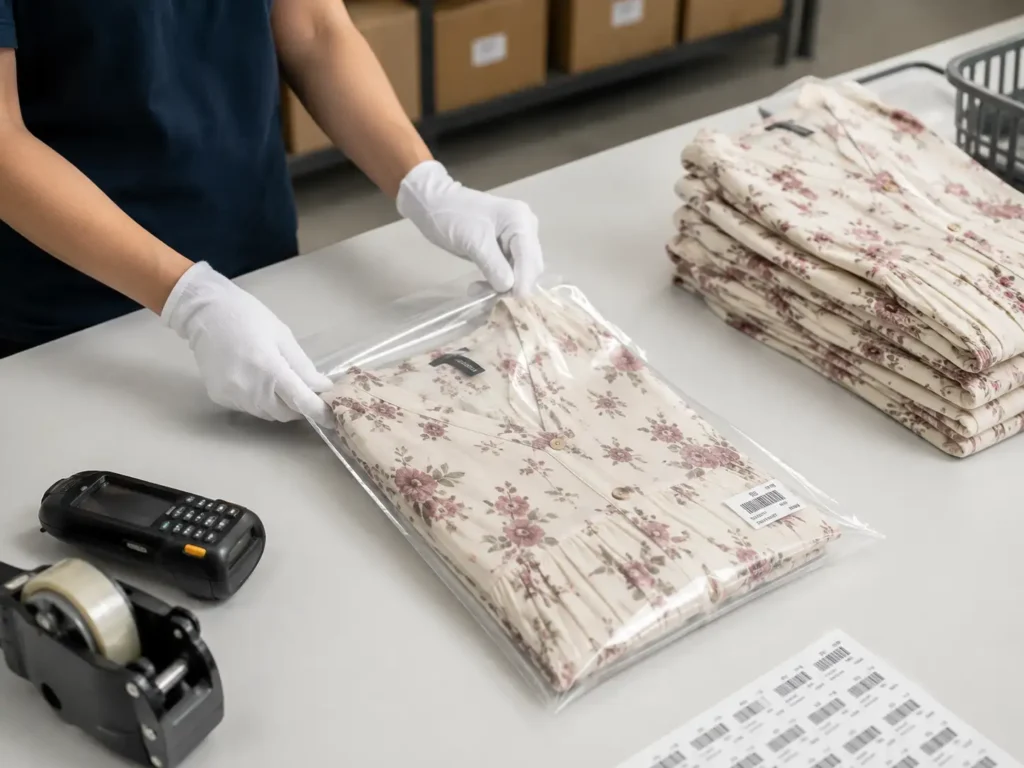
Which Polybag Details Matter?
A complete polybag specification includes the material, finished size, thickness, transparency, closure method, flap depth, ventilation holes, warning text, recycling marks, and sticker positions. Final dimensions should be selected after the folding trial rather than estimated from the garment’s flat measurements. A bag that is too small compresses the product, stresses the seal, and creates creases. A bag that is too large wastes material, shifts inside the carton, and gives the packed product an untidy appearance.
For many lightweight garments, development trials often begin within a practical film range of roughly 30 to 50 microns, but the final choice should follow the customer’s manual, garment weight, sharp trims, distribution route, and local requirements. Heavier products, prominent embellishments, or long storage periods may need stronger film or added protection. The packed garment should slide into the bag without excessive force and remain stable enough that size and barcode stickers stay flat and readable.
Warning wording and ventilation requirements vary by market and retailer, so text should not be copied from an unrelated order. When considering paper, recycled-content film, glassine-style alternatives, or reusable pouches, test tearing, moisture exposure, ink transfer, garment visibility, seal strength, and barcode scanning. Environmental claims on the packaging should be supported by evidence. Words such as “recyclable,” “compostable,” “plastic-free,” or “100% recycled” should not be printed solely because a packaging supplier used them in promotional material.
What Should Stickers and Cartons Show?
Stickers normally carry variable information such as the style number, color, size, SKU, barcode, price, purchase-order reference, or destination. Because they are easy to apply, they are also easy to mix. The safest system uses one controlled SKU table with a separate row for every valid style-color-size combination. A single style in five colors and six sizes already creates 30 SKUs, and a larger seasonal collection can place hundreds of visually similar stickers in the packing area.
The sewn size label, hangtag, polybag sticker, carton assortment, and digital SKU record should all come from the same master data. Manual recognition alone is weak when adjacent sizes or colors look nearly identical. A two-step packing check is more reliable: the first operator matches the garment label to the hangtag, and the second scans or verifies the barcode after the garment enters the polybag. Scan testing is particularly valuable for ecommerce and retail programs where an incorrect code can create receiving errors even though the physical garment is correct.
Carton instructions should state whether packing is solid-size, solid-color, mixed-size, mixed-color, or a fixed prepack assortment. Include units per carton, size ratio, color ratio, inner arrangement, carton dimensions, material strength, sealing method, gross-weight limit, and carton-number sequence. Dimensions should be confirmed through a physical trial because two dresses with similar garment measurements can have very different packed volumes. Chiffon compresses easily, while corsetry, ruffles, padding, velvet, and sequins increase volume and may limit stacking pressure.
Which Warehouse Labels Are Needed?
Warehouse labels may contain receiving barcodes, routing codes, fulfillment-center addresses, shipment references, carton identifiers, pallet numbers, or retailer-specific data. They are not necessarily the same as the consumer-facing barcode on the garment. Ask for the receiving guide before packaging materials are ordered, because some systems specify exact label dimensions, barcode formats, printer resolution, placement, carton orientation, and whether each carton or pallet needs a unique identifier.
The packing instruction should clarify whether the warehouse label replaces or supplements the normal carton mark. Old routing labels and unrelated barcodes must be removed or completely covered so automated scanners do not capture the wrong code. Print a small trial batch at actual size and scan the physical labels from the final paper or adhesive stock. Scaling, low contrast, glossy surfaces, wrinkles, and poor printer resolution can make an apparently correct barcode unreliable in a real receiving environment.
A first-carton approval is one of the most efficient controls for a large shipment. The team verifies the physical assortment, marks, gross weight, warehouse label, sealing method, and label position before full packing begins. Correcting one carton takes minutes, while reopening hundreds of cartons after discovering that every label is in the wrong location can delay dispatch and create additional handling damage. The first-carton check should be documented with photographs, measured weight, scanned codes, and the name of the person who released the packing run.
Packaging Field | Example Production Instruction | Verification Point |
Folded size | 280 x 340 mm after approved tissue placement | Garment fits without compression or hard creasing |
Polybag | 310 x 380 mm plus 40 mm resealable flap; thickness per client standard | Bag size, seal, warning, ventilation, sticker area |
SKU sticker | Lower-right front, 20 mm from both edges | Style-color-size data and physical scan |
Carton quantity | 24 individually packed garments per carton | Physical count and assortment ratio |
Size ratio | XS:S:M:L:XL = 2:5:8:6:3 | Purchase-order and packing-list match |
Carton numbering | 1 of 36 through 36 of 36 | No duplicated or missing sequence numbers |
Carton marks | PO, style, color, size range, quantity, net/gross weight, destination | Physical carton, packing list, and PO agree |
Warehouse label | Apply to the approved panel at the specified orientation | Code scans and routing data are current |
How Do Labeling Rules Change by Market?
Garment-labeling rules vary by sales country, fiber composition, product category, and the business responsible for placing the product on the market. Brands should maintain a market-specific compliance matrix rather than rely on one universal label. The brand, importer, or qualified local adviser should approve legal wording, while the manufacturer reproduces the approved information accurately and protects version control.
What Does the US Require?
For most covered textile and wool products sold in the United States, labels generally need to disclose fiber content, country of origin, and the identity of the manufacturer or another business responsible for marketing or handling the product. The Federal Trade Commission permits an appropriate U.S. business to use its Registered Identification Number in place of its name in qualifying situations, but RNs are not issued to businesses outside the United States. The brand or importer should therefore confirm the correct responsible-party information before artwork approval.
Covered wearing apparel also requires suitable care instructions under the FTC Care Labeling Rule. The label generally provides a washing instruction or dry-cleaning instruction supported by a reasonable basis showing that the method will not damage the garment or other items cleaned with it. The care decision must reflect the finished product rather than only the shell fabric. A polyester satin dress containing adhesive interlining, boning, molded cups, rhinestones, or sensitive trim can need more cautious care than the base fabric suggests.
Before bulk printing, confirm the actual shell, lining, and significant component compositions; the final origin statement; the company name or RN; and the care method. Maintain supporting fabric and production records when the project requires them. A foreign manufacturer should not invent an RN, substitute its own preferred care wording, or assume that the same label used for another client is suitable. The legal owner of the U.S. program should sign off on the final text and any required placement or permanence rules.
What Do the EU and UK Require?
In the European Union, textile products generally need labeling or marking that shows fiber composition using recognized fiber names. The current EU textile framework applies broadly to products containing at least 80 percent textile fibers by weight, subject to its detailed provisions and exceptions. Information also needs to be available in the official language or languages required where the product is sold. An English-only care label prepared for one market should not automatically be used throughout every EU member state.
Great Britain requires textile labels to show fiber content and to identify fur or other animal-origin components where applicable. If a product contains two or more components with different fiber compositions, separate disclosure may be necessary. Retailers can also impose their own care-symbol, supplier-code, traceability, and label-placement requirements. These commercial instructions matter operationally, but they should be separated from statutory requirements in the compliance file so teams know which rule comes from law and which comes from a customer manual.
For a multi-country European collection, create language and market groups rather than placing every possible translation on one crowded label. Confirm the exact destination countries, fiber terms, component disclosures, responsible economic-operator details where applicable, and customer requirements before production quantities are allocated. EU sustainability rules and product-information systems are also developing, so a label approved several seasons ago should not be treated as permanently valid without review, particularly when the brand enters a new country or changes material composition.

What Do Canada and Australia Require?
Canada’s textile-labeling framework requires accurate and meaningful information for covered consumer textile articles, including fiber-content disclosure and dealer identification under the applicable rules. Official guidance addresses generic fiber names, percentages, label types, accuracy, and other presentation details. Language and permanence requirements should be reviewed for the exact product and sales territory. The Canadian dealer or importer should approve the final commercial identity and wording rather than leaving those decisions to a foreign factory.
Australia has a mandatory care-labeling information standard covering clothing and many textile products. The Consumer Goods (Care Labelling) Information Standard 2023 permits adequate care instructions in English, the recognized set of international care symbols, or both, subject to the standard’s details and exemptions. Country-of-origin labeling is not universally mandatory for all non-food products under Australian consumer law, but any origin claim that is made must be truthful, accurate, and supported by reasonable grounds.
A garment intended for both Canada and Australia should therefore not rely on a generic “international” label without market review. Fiber wording, languages, care symbols, dealer information, origin statements, and physical label construction may differ. Special categories can also carry additional rules beyond general textile labeling. Children’s nightwear is a familiar example in Australia, where safety and warning-label obligations can apply. Brands should identify these category-specific requirements before sample approval because late legal changes often require new labels and reopened seams.
Are QR Codes Required?
A QR code can connect a garment to digital care information, authentication, repair services, material records, registration, resale data, or traceability details. It can be useful, but it should not automatically replace information that must remain physically attached to the garment. The code should be treated as a controlled data carrier with an approved destination, product identifier, print size, contrast, quiet zone, and long-term link-management plan rather than as a decorative graphic added at the end of artwork.
The European Union’s Ecodesign for Sustainable Products Regulation establishes a framework for Digital Product Passports, and textiles are a priority area for ongoing product-specific work. As of mid-2026, technical preparation and textile studies are continuing, so brands should avoid publishing a single universal deadline unless they have verified the latest delegated requirements for their product category. The practical preparation step is to organize reliable product identifiers, fiber and material records, supplier data, care information, and SKU relationships now.
Test every QR code at the final printed size on the actual label or hangtag material. Scan it with common mobile devices, under ordinary retail lighting, and from the curved or flexible position in which it will be used. Confirm that the destination page remains live, mobile-friendly, and connected to the correct style rather than a temporary campaign link. Digital traceability fails when the physical code is unreadable, the database is inaccurate, or the webpage disappears long before the garment reaches the end of its useful life.
Market | Common Label Focus | Who Should Approve Final Content | Operational Reminder |
United States | Fiber content, origin, responsible business identity, care instructions | U.S. brand, importer, or qualified compliance adviser | Do not invent or misuse an FTC RN |
European Union | Recognized fiber names, composition, required market languages, developing product-data rules | EU responsible entity and local compliance team | Prepare language groups by destination |
Great Britain | Fiber content and relevant animal-origin component information | UK brand, importer, or compliance adviser | Separate law from retailer-specific manuals |
Canada | Fiber disclosure, dealer identity, accuracy, language and permanence considerations | Canadian dealer or importer | Confirm the exact article and territory |
Australia | Mandatory care information; truthful origin claims when used | Australian supplier, importer, or local adviser | Check special product-category standards |
How Are Labels and Packaging Approved Before Shipment?
Approval should pass through controlled gates: digital artwork review, physical component sample, garment-placement approval, packed-sample review, barcode scanning, first-carton verification, and final inspection. Bulk packing should begin only after the approved label files, SKU table, folding method, polybags, carton ratios, carton marks, and warehouse labels all use the same revision and match the purchase order.
What Should Samples Prove?
A loose label sample proves only that the supplier can weave or print the component. It does not prove that the label works on the garment. Approval should continue through an attachment trial and a production-intent sample. On the garment, check wording, spelling, color, dimensions, fold, placement, orientation, stitch method, comfort, and visibility. Confirm that the component does not pull a neckline, show through sheer fabric, interfere with a zipper, or create an obvious ridge under a fitted silhouette.
The packed sample should then prove that the folding sequence, tissue, polybag, stickers, inserts, and protection method work together. Open it after a realistic storage period and inspect crease lines, transfer marks, trapped moisture, damaged embellishment, adhesive contact, and barcode readability. A pre-production sample is most useful when it contains production-intent labels and packaging. If temporary components remain, record exactly what is provisional and require a separate approval before bulk sewing or packing begins.
Do not assume that approval of a fit sample also approves packaging. The first sample, revised sample, photo sample, pre-production sample, and golden sample can serve different purposes. A product may be ready for photography while its care wording, barcode file, or carton plan is still unresolved. Use separate status fields or signatures for fit, fabric, trims, labels, packaging, and bulk release so one approval cannot be misread as permission to start every production stage.
How Are Barcodes and SKUs Checked?
Barcode control begins with the SKU master file. Each row should represent one valid style-color-size combination and contain the exact barcode number, description, price or market information where relevant, and any warehouse references. Data should be generated from one controlled source instead of being typed separately into hangtag, polybag, carton, and packing-list templates. Manual re-entry creates transposition errors that often look plausible enough to escape a visual review.
Before bulk printing, scan every unique barcode from a physical proof and confirm that the scanner returns the expected SKU. The human-readable number should also match the digital record. During printing, scan samples from the beginning, middle, and end of the run to detect changes in contrast, scaling, or print quality. On the packing line, compare the sewn garment size, the hangtag or price ticket, and the polybag barcode before the item enters a carton.
Carton-level control needs more than a total quantity check. A carton planned for four S, eight M, and four L units may still contain 16 garments while being commercially wrong because two sizes were exchanged. Compare the physical assortment with the purchase order and carton packing list. For large collections, use scan or system-assisted verification where practical, but keep a documented manual fallback. Technology helps only when the master data, scanner settings, and label placement are already correct.
How Is Packing Inspected?
Packing inspection should start before the polybag or carton is sealed. The operator verifies that the garment is clean, correctly pressed, free from loose threads, and matched to the right label set. The fold, tissue, hangtag, barcode, size sticker, color sticker, insert, and bag should follow the approved packed sample. Inspectors must distinguish visual defects from data defects because a beautifully packed garment can still carry the wrong SKU, and a correctly coded garment can still be unacceptable due to stains, damage, or poor pressing.
At carton level, confirm the style, color, size ratio, quantity, carton number, marks, gross weight, destination label, and barcode where applicable. Mixed-size or mixed-color cartons require particular attention because the outside information must describe the actual contents. Inspection coverage should reflect the shipment structure. Checking several cartons from one style is not enough when the order includes many styles, destination groups, production batches, and packing ratios.
Common rejection risks include unreadable barcodes, duplicated carton numbers, incorrect size stickers, missing inserts, wrong color-size ratios, excessive carton weight, outdated warehouse labels, visible old barcodes, and carton marks that do not match the packing list. Record packing findings with photographs, checklists, and corrective-action results. A useful report explains what was found, how much product could be afected, what was repaired, and how the team confirmed the correction beforeshipment release.

What Records Support Reorders?
Repeat production becomes faster only when the previous order records are accurate. Retain approved label artwork, supplier references, physical strike-offs, care-label text, placement diagrams, barcode master data, SKU tables, packed-sample photographs, carton plans, warehouse-label instructions, inspection reports, and known corrective actions. Digital files are best for text, dimensions, codes, and revision control, while physical references remain valuable for woven color, paper finish, hand feel, and attachment appearance.
Do not rely on “same as last order” without naming the exact purchase order and approved version. A style may have been produced twice with different prices, care wording, destination labels, or carton ratios. Before a reorder begins, reconfirm the fabric composition, care method, destination, retailer guide, barcode data, and any environmental claims. The visual design can remain unchanged while a material supplier or sales market changes, and that alone can require a new label review.
Jinfeng Apparel supports private-label women’s fashion production with woven labels, size labels, care labels, hangtags, barcode and SKU stickers, polybags, carton marks, warehouse labels, and packing inspection. The company has operated since 2008 from Guangdong’s apparel supply region and coordinates six owned women’s fashion factories with more than ten long-term production partners. For a practical project review, provide the tech pack, label artwork, care content, SKU and barcode files, packing instructions, carton-mark template, destination guide, and expected order structure so the development and costing teams can evaluate the complete delivery requirement rather than only the garment sewing price.
The most reliable label and packaging system is not the one with the most pages. It is the one in which every component has a clear purpose, every variable code comes from one controlled file, every physical detail is approved on the actual garment, and every carton can be traced back to the purchase order. When these decisions are made before bulk production, the factory can focus on execution instead of interpreting late messages, and the brand receives a product that is ready for retail, ecommerce, warehousing, and repeat production.
Share This Article :

Jerry Lee
Categories

Latest blogs



Table of Contents
Here, developing your OEM/ODM private label clothing collection is no longer a challenge—it’s an excellent opportunity to bring your creative vision to life.

