Skip to content

Velvet and velour can look almost interchangeable when they are folded on a swatch card, yet they rarely behave the same once a pattern is cut, sewn, fitted, pressed, packed, and worn. That gap between showroom appearance and garment performance is the real reason the comparison matters. A rich pile can make a simple dress look expensive, but the wrong backing, weight, recovery, or nap direction can also create rippled seams, uneven shading, bulky zippers, or a fit that changes after an hour of wear. For fashion teams choosing material for a commercial dress collection, the useful question is not which fabric feels nicer in the hand. It is which construction gives the intended silhouette, comfort, surface depth, and production stability at the same time.
Velvet is generally the stronger choice for dresses that need a richer, more formal appearance and controlled silhouette, while velour is often better when softness, stretch, and relaxed comfort are higher priorities. The final choice should be based on the actual fabric construction, stretch recovery, GSM, drape, pile direction, seam behavior, and dress shape rather than on the fabric name alone.
A useful way to think about the choice is to picture the same fitted midi dress made twice. In one sample, a stable velvet creates deep color and a clean evening line, but the wearer needs a zipper and more carefully placed ease. In the other, a knitted velour follows the body more easily and feels more forgiving, but the silhouette may look softer and less formal. Neither sample is automatically better. The better sample is the one that matches the collection’s promise to the customer and can be repeated reliably across sizes, colors, and bulk production. The sections below focus on exactly those practical differences.
What Is the Difference Between Velvet and Velour?
Velvet and velour are both pile fabrics, but they usually differ in base construction, stretch behavior, surface character, and garment use. Velvet is commonly associated with a more structured or refined appearance, while velour is often knitted and therefore tends to feel softer and more flexible. In dresses, the practical difference appears in fit, drape, recovery, seam behavior, and how the surface reflects light.
| Property | Velvet | Velour | Dress Relevance |
| Base construction | Often woven; knit/stretch versions also exist | Commonly knitted | Changes ease, stability, and recovery |
| Typical flexibility | Low to medium in conventional qualities; higher in stretch types | Often medium to high | Important for bodycon and sleeves |
| Surface effect | Deep directional pile and pronounced tonal change | Soft plush pile, often more relaxed | Affects formal vs casual positioning |
| Jinfeng velvet working range | Approx. 180-350 gsm | Confirm exact supplier specification | Weight changes drape and seam bulk |
| Nap control | Critical | Important | Prevents optical shade mismatch |
| Pressure sensitivity | Often significant | Varies by finish | Affects pressing and packing |
What Is Velvet?
Velvet is identified by its short, dense pile surface rather than by one single fiber composition. Modern dress velvet can be made from polyester, polyester-spandex blends, viscose blends, or knitted constructions, so two fabrics sold under the same name can behave very differently. A stable woven velvet may hold the line of an evening dress with relatively little stretch, while a knit or spandex velvet can move much more easily around the bust, waist, and hip. For commercial dress development, the word velvet is therefore only the starting point; the useful specification is the combination of fiber, backing structure, finished weight, stretch, recovery, pile density, and finishing.
In Jinfeng Apparel’s internal fabric knowledge base, commonly handled velvet qualities are recorded at roughly 180-350 gsm, with medium-to-high drape and generally low-to-medium stretch, while knitted velvet can offer more extension. That range is broad enough to explain why one velvet can feel appropriate for a fitted party mini while another feels better suited to a substantial evening dress. The same internal specification also identifies nap direction, pressure marks, thickness, and visible sewing marks as important sampling issues. These are not abstract textile concerns: each one affects whether the finished garment looks clean when photographed, merchandised, or inspected in bulk.
What Is Velour?
Velour is also a pile textile, but in modern fashion it is commonly associated with a knitted base. The knit structure usually gives the fabric more natural flexibility because the loops can deform under tension, even before elastane is considered. That is one reason velour often feels easier around the body in fitted dresses, long sleeves, and other areas where movement matters. The trade-off is that a very soft velour may not create the same controlled, formal line as a stable velvet, especially when the design relies on crisp shaping or a strong eveningwear impression.
The word velour should not be treated as a guarantee of high stretch or easy recovery. Different yarns, gauges, pile densities, finishes, and elastane levels can change the fabric substantially. One velour may extend generously and snap back cleanly; another may feel soft in the hand but relax after wear, creating bagging at the seat, elbows, or waist. A development team should therefore ask for measured stretch by direction and review recovery after repeated extension. The practical question is not whether velour stretches more in theory, but whether the exact quality being considered will maintain the intended silhouette throughout normal wear.
How Are They Made Differently?
The most useful construction difference is the structure underneath the pile. Traditional velvet is strongly associated with woven pile construction, while velour is frequently knitted. Woven structures are generally more dimensionally stable unless stretch is deliberately engineered into them, whereas knitted loops can open more readily under tension. That difference affects pattern ease, zipper requirements, seam stabilization, and the way a finished dress responds when the wearer sits, walks, or raises her arms. It also affects production because stretch direction and feed behavior need to be understood before the line starts sewing.
Pile direction adds another layer of complexity. Once a fabric has a directional surface, pattern pieces cannot always be rotated simply to improve marker efficiency. A front skirt cut with the pile running one way and a back panel cut in the opposite direction may appear to be different colors under the same light, even when both came from the same roll. With pile fabrics, cutting direction therefore becomes part of visual quality control. Material yield, fabric cost, and marker planning need to reflect that rule instead of assuming every empty space on the marker can be filled by turning a piece 180 degrees.
Do Velvet and Velour Look the Same?
At swatch size, velvet and velour can look surprisingly similar because both have a plush face and can show directional shine. The difference becomes clearer when the material is hung vertically or shaped around a body. Velvet often produces deeper shadow, stronger tonal contrast, and a more dramatic response to directional light, while velour usually looks softer and more relaxed because the base construction bends more easily. For dress selection, it is worth evaluating the material on a dress form rather than only on a cutting table, because gravity and body curvature reveal the behavior that customers will actually see.
Color also needs to be judged as a surface effect, not only as a dye-lot value. Velvet is particularly sensitive to apparent shade variation because the pile changes the angle at which light is reflected. Jinfeng Apparel’s velvet control notes classify color-difference risk as high for this reason and identify inconsistent pile direction, pressure marks, and packing impressions as significant bulk concerns. A practical showroom check is to rotate one swatch 180 degrees beside another piece from the same roll. If the tonal difference is obvious on a small sample, it can become much more noticeable across large skirt panels or sleeves.
Which Is Better for Dresses: Velvet or Velour?
Neither fabric is universally better. Velvet is usually the stronger option for evening, party, holiday, and statement dresses that need visual depth and a controlled silhouette, while velour often performs better for softer, stretch-oriented, and more casual styles. The better fabric is the one whose weight, recovery, drape, sheen, and construction match the specific pattern and wearing occasion.
Which Looks More Luxurious?
For formal dresses, classic velvet usually creates the stronger luxury signal because its dense pile absorbs and reflects light in different directions. That surface behavior gives black, burgundy, emerald, navy, and other deep colors an unusual visual depth, allowing a simple column or long-sleeve midi to look more substantial without heavy embellishment. The effect is especially useful in evening and holiday photography, where directional lighting can create highlights along folds, ruching, princess seams, and curved body lines. This is one reason velvet remains strongly associated with occasion dressing even when the pattern itself is relatively simple.
Luxury, however, does not come from the word velvet on a fabric card. Sparse pile, inconsistent nap, harsh backing, crushed pressure areas, or bulky seams can make an expensive material look poor very quickly. Velour can also look premium when its pile is dense and the garment is well made, but it usually communicates softness and comfort more strongly than formal structure. The best question is what the product page is promising. If the visual story is candlelight, winter occasionwear, holiday parties, and formal dressing, velvet normally reinforces that message more convincingly. If the promise is soft movement and easy body fit, velour may be the more coherent choice.
Which Feels Softer?
Both materials can feel very soft because both use a raised pile surface, but the sensation is not identical. Velvet often feels dense, plush, and substantial, while velour commonly feels softer in motion because the underlying knit bends more easily. That difference can be obvious when a large piece is wrapped around a dress form: the velour may collapse and follow curves more readily, while the velvet may resist slightly and create more defined folds. For fashion teams, that distinction matters more than the first touch of a swatch because the body experiences the complete garment rather than the isolated face of the textile.
The inside of the dress also changes comfort. Thick seam allowances, zipper tapes, facings, linings, elastic, and multiple layers can make a soft outer fabric feel unexpectedly firm at the waist or neckline. A velvet dress may need lining for comfort, opacity, movement, or seam protection depending on the style, and the lining itself must be compatible with the outer fabric’s stretch and drape. This is why sample garments are more informative than hand feel alone. Our fabric-development system evaluates hand feel together with drape, stretch, lining requirement, sampling risk, and bulk risk so that softness is treated as one performance factor rather than the whole decision.

Which Is More Comfortable?
Velour often has an advantage when the design requires frequent body movement because a knitted construction can provide useful flexibility across the torso and sleeves. That can make a difference in fitted mini dresses, long-sleeve styles, or nightlife garments where the wearer needs to sit, dance, raise her arms, and move without the fabric pulling sharply at the seams. Stretch velvet can close much of that gap when its backing and elastane level provide reliable extension, but the key performance measure is recovery rather than stretch alone. A fabric that extends dramatically and then stays relaxed can create a comfortable first fitting but an unstable finished product.
Comfort also depends on climate and weight. Jinfeng Apparel’s velvet knowledge base records common velvet weights around 180-350 gsm and positions the material mainly for evening, winter party, holiday, and selected club dresses rather than lightweight hot-weather resort styles. A 300 gsm pile fabric may feel exactly right for a December evening collection and far too warm for a tropical summer capsule. The comfortable choice is therefore contextual. Design teams should consider movement, garment weight, lining, breathability, sleeve coverage, and wearing season together instead of treating softness as a universal proxy for comfort.
Which Is More Versatile?
Velvet is highly versatile within occasionwear because different constructions can serve very different silhouettes. A stable quality can support a column dress, A-line midi, or structured evening shape, while stretch velvet can work in ruched minis, fitted party dresses, and club styles. Crushed velvet adds a deliberately irregular surface that can suit more trend-led fashion. Velour is versatile in a different direction: its flexibility makes it useful for fitted dresses, relaxed styles, and coordinated sets that sit between casualwear and nightlife. Neither material needs to cover the entire collection to be commercially useful.
In practice, a strong seasonal capsule may use several related pile qualities rather than forcing one fabric to do every job. A formal maxi can use stable velvet, a bodycon mini can use stretch velvet, and a softer coordinated set can use velour while the collection still reads as visually coherent. This approach also reduces the temptation to make technically weak substitutions for the sake of consistency. A fabric that looks similar in a swatch can have different stretch, recovery, seam bulk, or weight, so every substitution should be validated in the actual pattern before it becomes a production decision.
How Do Stretch, Drape, and Weight Compare?
Velour generally provides more natural flexibility because it is commonly knitted, while velvet ranges from relatively stable woven qualities to highly flexible knit or spandex versions. Jinfeng Apparel’s documented velvet range is approximately 180-350 gsm with medium-to-high drape. For dress development, stretch percentage, recovery, GSM, and stretch direction should be evaluated together because each one changes fit and silhouette.
Which Fabric Stretches More?
In a conventional comparison, velour usually stretches more than traditional woven velvet because the knitted loops can open when tension is applied. Modern stretch velvet changes that simple rule. Knit velvet and polyester-spandex velvet can offer substantial extension, which is why some fitted party and club dresses are made in velvet without feeling rigid. The commercial name therefore tells less than a measured test. Pattern teams should confirm crosswise stretch, lengthwise stretch, and recovery before deciding how much ease the dress needs or whether an opening such as a zipper is required.
A practical calculation helps teams talk about stretch consistently. If a 10 cm marked section extends to 13 cm under the agreed test force, the extension is 30 percent: (13 – 10) / 10 x 100. That number still needs a recovery check because two fabrics can both stretch 30 percent while returning very differently. For fitted womenswear, our documented knit controls include stretch direction, recovery stability, bust-waist-hip measurements, hem-length change, neckline deformation, side-seam smoothness, and bulk measurement consistency. These checks are particularly relevant when deciding whether stretch velvet or velour can support negative ease without losing shape during wear.
Which Fabric Drapes Better?
Drape is not a simple scale from stiff to soft; it describes how the material falls under its own weight and responds to folds, body shape, and gravity. Velvet can have medium-to-high drape while still looking substantial because its pile and weight create downward pull. A dense 300 gsm velvet may fall smoothly in a long column but still look much heavier and more controlled than a lightweight satin. Velour often falls in a softer, more relaxed way because the base construction bends easily, which can be useful for body-following or casual silhouettes.
The pattern determines what better drape actually means. A cowl neckline needs a fabric willing to collapse into soft folds, while a corset dress needs enough control around internal support. A gathered mini needs sufficient body to keep the gathers visible without turning bulky. A column dress needs a clean vertical fall without excessive clinging. For this reason, fabric should be draped over a form and, ideally, sampled in the intended silhouette. A material that looks beautiful when hanging freely may behave very differently once seams, lining, elastic, or a zipper introduce local structure.
How Does Weight Affect Fit?
Weight changes the whole garment system. Heavier pile fabrics pull more strongly at shoulder seams, straps, waistlines, and long skirt panels, while thicker qualities create more bulk where several layers meet. Within a 180-350 gsm velvet range, the difference between the lighter and heavier ends is large enough that the same pattern may not behave consistently across both. A 180 gsm stretch velvet can suit a fitted party dress, while a dense 350 gsm quality may feel more natural in a substantial winter evening style and may require different seam, lining, or hem decisions.
Long dresses deserve special attention because fabric weight is multiplied by length. A maxi can settle after hanging, particularly in areas cut off grain or along curved sections, which may change the final hem. A practical sample-room check is to record key measurements immediately after sewing, hang the garment under normal conditions, and check again before approving the production pattern. Weight also changes customer comfort and packaging pressure, so it should be evaluated together with season, garment length, lining, seam construction, and the amount of compression the dress will experience during transport.
Is Stretch Velvet Like Velour?
Stretch velvet and velour can behave similarly when both have knitted structures, but they should not be treated as interchangeable without testing. A stretch velvet may offer firmer compression and stronger shape retention, while a soft velour may extend farther but recover more slowly. Those differences change the amount of negative ease a bodycon pattern can carry and may alter neckline stability, sleeve fit, or seat recovery after wear. Even when two swatches look almost identical, the finished dress can feel and fit differently once the fabric is placed under body tension.
Surface appearance under stretch is another useful check. Some pile fabrics look noticeably lighter when extended because the backing becomes more visible or the pile separates. On a fitted dress, that can create different tones over the bust, hip, or elbow even though the garment is technically the same color. A development team should therefore stretch the actual fabric over representative body curves and inspect it under normal lighting before approval. The most reliable substitution is one that matches not only color and hand feel but also weight, directional stretch, recovery, surface coverage, and seam behavior.
| Development Check | Example Measurement | What It Tells You | Dress Impact |
| GSM | 180 vs 300 vs 350 gsm | Finished fabric mass per square meter | Changes drape, warmth, seam bulk |
| Crosswise stretch | 10 cm to 13 cm = 30% extension | Width-direction flexibility | Important at bust, waist, hip |
| Lengthwise stretch | Measured separately | Vertical movement potential | Affects sleeves and garment length |
| Recovery | Re-measure after extension | Ability to return toward original size | Controls bagging and shape retention |
| Hang check | Measure before and after hanging | Settling under garment weight | Important for midi and maxi lengths |
| Surface under tension | Inspect stretched area visually | Pile coverage and backing show-through | Affects fitted body zones |
Which Dress Styles Suit Velvet or Velour?
Velvet is especially well suited to evening, holiday, winter party, and statement dresses, while velour generally suits softer, stretch-led, and more casual silhouettes. Stretch velvet can also work effectively in bodycon and club dresses. The right choice follows the silhouette: structured shapes need stability, fitted shapes need controlled stretch, and flowing shapes need suitable weight and drape.
Which Is Better for Evening Dresses?
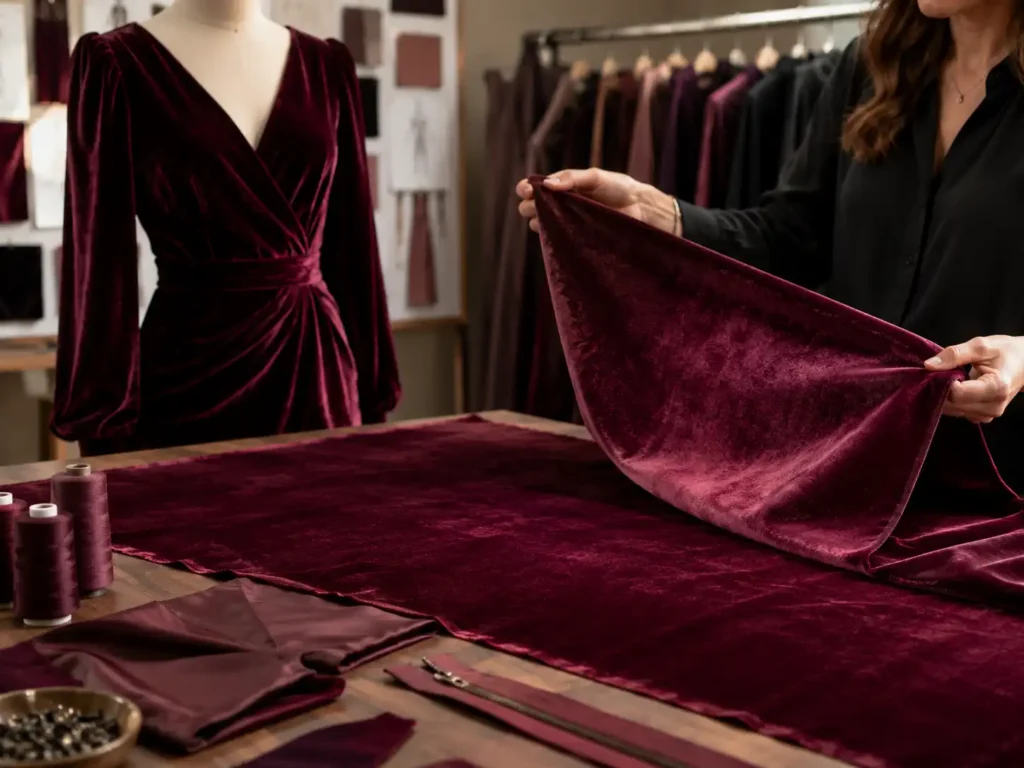
Velvet is usually the more natural starting point for evening dresses because its pile creates depth, shadow, and tonal movement under changing light. That quality allows a relatively minimal column, off-shoulder midi, long-sleeve gown, or selected corset silhouette to feel visually substantial without relying on heavy beadwork. For dark colors in particular, velvet can make the garment appear richer as the wearer moves because different parts of the pile catch light at different angles. The effect supports formal styling well, but it also makes production errors in nap direction or pressure much easier to see.
An evening velvet should therefore be judged after sewing and pressing, not simply at fabric inspection. Large skirt panels make pile mismatch more obvious, while zipper areas and darts can show flattened surface if handling is too aggressive. It is also useful to inspect the sample under daylight, overhead retail lighting, and directional photography light because each environment may reveal different tonal behavior. Our velvet specification positions the material for evening, winter party, holiday, and selected club dresses, which reflects this combination of visual richness, weight, and seasonal suitability rather than a claim that every velvet works for every formal style.
Which Is Better for Bodycon Dresses?
For bodycon dresses, stretch and recovery matter more than the fabric name. A stable velvet can create a fitted silhouette, but it usually needs more carefully shaped seams, controlled positive ease, and often a zipper. Stretch velvet or suitable velour can follow the body more directly and may allow greater movement. The material needs to stretch over the bust, waist, and hip without becoming transparent, losing pile coverage, twisting the side seam, or remaining loose after repeated movement. Maximum stretch is not the goal; predictable stretch with dependable recovery is more useful.
A good bodycon fitting should include more than standing in front of a mirror. The wearer should sit, walk, raise the arms, and remain in the sample long enough for recovery problems to appear. Side seams should stay visually straight, the neckline should return after movement, and the seat should not become baggy. Jinfeng Apparel’s knit-production controls specifically include stretch direction, recovery, bust-waist-hip measurements, side-seam smoothness, neckline deformation, and size stability in bulk. Those checkpoints make stretch velvet and velour much easier to compare objectively than a simple hand-stretch test at the fabric table.
Which Is Better for Party Dresses?
Both fabrics can work well in party dresses, but they create different products. Velvet is particularly effective for autumn-winter collections, holiday capsules, cocktail dresses, and elevated nightlife styles because the surface immediately communicates season and occasion. Stretch velvet is especially useful when the design combines that holiday appearance with a fitted mini or ruched body shape. Velour works when the product needs to feel softer, younger, or more relaxed, especially for stretch-led silhouettes that prioritize movement over formal structure.
Decoration also needs to be considered with the pile. Jinfeng Apparel’s velvet fact card notes that localized embroidery and decorative rhinestone, bead, or sequin applications can be used for festive products, but the method must be tested on the exact fabric. Heat, adhesive, dense stitching, and heavy trims can flatten the pile or distort the backing. Partywear also has a timing issue: velvet is strongly seasonal in many markets, so sampling, fabric booking, production, and delivery need to align with the selling window. A technically excellent holiday dress that reaches the warehouse too late may still be a weak commercial result.
Which Is Better for Casual Dresses?
Velour generally has the clearer advantage when everyday comfort and flexibility are the main priorities. A soft knitted velour can work well for fitted casual dresses, easy minis, and coordinated fashion looks where the customer expects movement rather than formal structure. Velvet can still be used casually, especially in stretch or crushed versions, but it tends to carry a more dressed-up visual language. That difference is useful for brands that intentionally blur the line between casual and occasionwear, but it should be a conscious styling choice rather than an accidental result of fabric substitution.
Climate and care expectations matter more in casual products because they are typically worn and cleaned more often. Heavy pile fabrics are rarely the first choice for very hot-weather dresses, and our internal fabric guidance specifically avoids positioning heavy velvet as a primary material for lightweight high-temperature resort styles. The care method also needs to be confirmed at garment level because lining, elastic, trims, zippers, and embellishment can impose restrictions that the outer fabric alone does not reveal. A casual velour dress that feels comfortable in the first fitting but loses recovery or surface quality after repeated care is not a successful material choice.
How Do Velvet and Velour Behave in Production?
Pile fabrics need more production control than their soft appearance suggests. The main risks include inconsistent nap direction, optical shade changes, pressure marks, seam impressions, distortion, and packing marks. Velvet is particularly sensitive to these issues. Cutting direction, sewing pressure, pressing method, and final packing should therefore be planned during development rather than corrected only at final inspection.
How Does Nap Affect Cutting?
Nap direction is one of the most important controls in velvet cutting because the pile can make identical dye color appear lighter or darker depending on orientation. For many velvet dresses, major pattern pieces need to be placed in one consistent direction. That rule protects visual continuity between the front, back, sleeves, and skirt, but it can also reduce marker efficiency because pieces cannot always be rotated to fill empty spaces. The cost implication is real: a one-direction layout can consume more fabric than an equivalent non-directional woven style, especially when the dress has long or wide panels.
Nap instructions should therefore appear clearly in the technical and cutting information rather than being passed verbally from one operator to another. Jinfeng Apparel’s cutting QC system checks pattern version, panel direction, panel quantity, size bundling, fabric direction, and stretch direction. Those controls help distinguish different causes if a shade problem is discovered later. A visible mismatch may come from the dye lot, a reversed panel, local pile flattening, or another finishing issue. Treating every tonal difference as a color problem can waste time and may lead to the wrong corrective action.
How Do Seams Behave?
Pile surfaces can make ordinary seam problems more visible. Velvet can shift during sewing because the pile layers do not always feed evenly against each other, while stretch velvet and velour can become wavy if the operator pulls the fabric or if feed balance is wrong. Dense qualities create another issue at intersections where several layers stack around zippers, facings, waist seams, or gathered sections. The finished dress may show a ridge from the outside even when the seam itself is technically secure, so seam planning needs to consider appearance as well as strength.
Needle, thread, stitch length, presser-foot pressure, seam allowance, stabilization, and pressing method should be validated during sample development using the actual fabric. Jinfeng Apparel’s velvet sampling notes flag thickness and sewing marks as specific concerns, while its general sewing QC reviews stitch density, seam quality, seam allowance, symmetry, zipper flatness, lining attachment, and related construction points. The cleanest pile-fabric seam often comes from controlling pressure before a mark appears rather than trying to erase it later with stronger pressing, which can flatten the surface further.
How Do Zippers Affect the Fabric?
Zippers bring together several difficult variables: a relatively stable zipper tape, a soft pile surface, local thickness, and body tension. On a low-stretch velvet dress, an invisible zipper is common, but the zipper seam needs to remain flat without creating a raised ridge or crushing the surrounding pile. If the fabric stretches during insertion, the zipper can ripple. If seam allowances are bulky, the area can look raised. If pressing is too aggressive, the pile beside the zipper may become visibly flatter than the rest of the garment.
Stretch velvet creates an additional compatibility issue because the garment body may extend while the zipper tape does not. Local stabilization can help the two materials behave more predictably, but the exact method needs to be confirmed in sampling. Zipper checks should include smooth opening and closing, flatness while worn, no pulling at the waist or hip, no visible bubbling, and no obvious pile crushing along the seam. Jinfeng Apparel’s sewing and garment inspection standards specifically include zipper flatness and zipper function, which is important because a zipper that looks clean on a table can distort once the dress is under normal body tension.
How Do You Control Shade and Pressure Marks?
Shade and pressure marks are closely connected to pile behavior. Velvet can show optical color differences when nap changes direction, while pressure from sewing, pressing, stacking, folding, or packing can flatten the pile and create visible dark or light areas. Jinfeng Apparel’s velvet fact card identifies nap inconsistency, pressure marks, color difference, and packing impressions among the main bulk risks, with QC attention on nap, shade, pressure marks, stains, and pressing. The important point is that these risks can be introduced at several stages, so final inspection alone is not enough to prevent them.
A practical control sequence begins with roll and shade review before cutting, followed by one-direction cutting where required, fabric-appropriate sewing pressure, careful pressing, and finished-garment inspection while hanging under directional light. Packing should then be treated as part of garment quality rather than a warehouse afterthought. A dress can leave the sewing floor looking perfect and still develop fold lines or compressed pile after hours under carton pressure. For larger orders, a packing trial using the intended fold and carton density can reveal whether surface impressions are likely to recover before the method is released for bulk shipment.
| Production Stage | Main Risk | Practical Control | What to Review |
| Incoming fabric | Shade or finish variation | Compare rolls and dye lots before cutting | Color, hand feel, width, defects |
| Cutting | Reversed nap | Use one-direction marker where required | Panel direction and size bundling |
| Sewing | Pile flattening or seam waviness | Validate feed, stitch, pressure, stabilization | Seam appearance and symmetry |
| Zipper insertion | Ripple or local bulk | Control tension and stabilize as needed | Flatness while worn |
| Pressing | Crushed pile | Use fabric-appropriate pressure and protection | Surface recovery after pressing |
| Packing | Fold and compression marks | Run packing trial before bulk shipment | Pile recovery after unpacking |
How Do You Choose Velvet or Velour for a Dress Collection?
Choose velvet or velour by working backward from the finished dress. Define the occasion, silhouette, stretch requirement, target weight, surface appearance, comfort, care expectations, and production volume first. Then compare actual fabric specifications and make a sample. For commercial production, the final decision should include recovery, nap direction, shade consistency, seam behavior, pressing response, and packing performance, not price per meter alone.
Which Factors Matter Most?
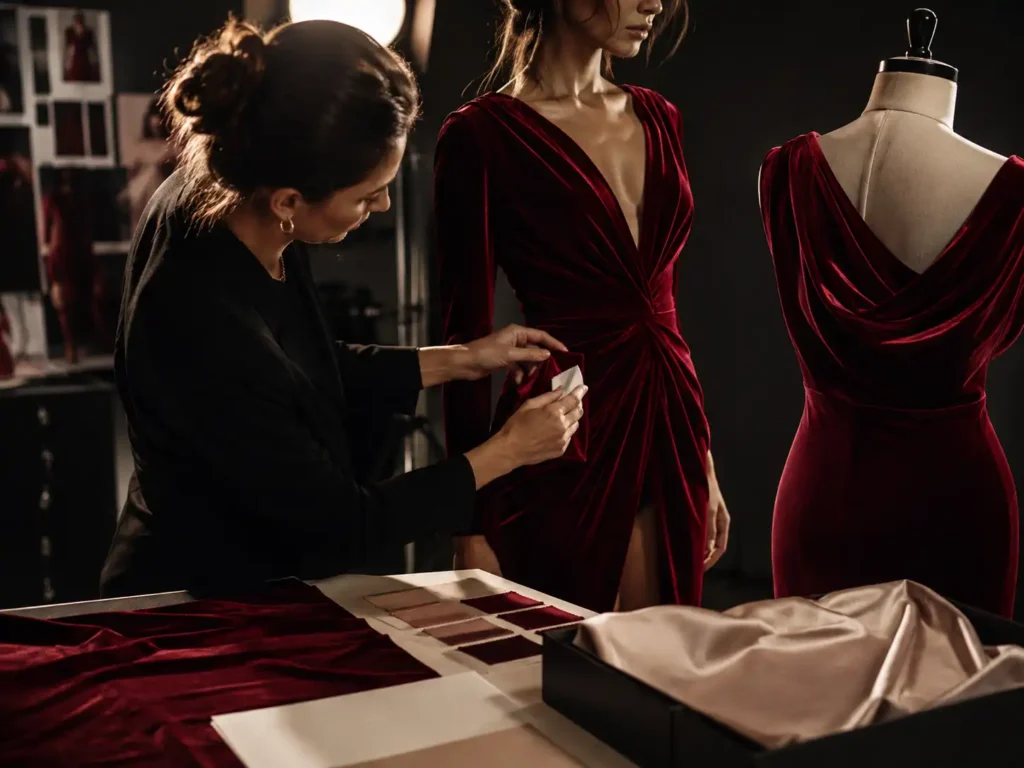
A reliable fabric decision starts with the finished garment rather than the fabric rack. Define the wearing occasion, then define the silhouette and movement requirement. A winter evening dress can tolerate more weight and may benefit from deep surface shading, while a fitted nightlife mini may need stronger recovery and more stretch. The design team should also decide whether a zipper is acceptable, whether lining is required, how much warmth the product can carry, and how the fabric is expected to behave through the customer’s care routine. These questions quickly eliminate materials that are attractive in a swatch but wrong for the real product.
The technical review should then cover nap direction, stretch by direction, recovery, weight, usable width, seam bulk, shade consistency, pressing response, and packing behavior. Jinfeng Apparel’s documented fabric system evaluates materials by wearing occasion, silhouette, target price, hand feel, drape, stretch, transparency, lining requirement, and bulk-production risk. That multi-factor approach is useful because it prevents one desirable property, such as softness or sheen, from dominating the whole decision. A fabric is commercially strong when its aesthetic value and its manufacturing behavior support the same product concept.
Is Velvet More Expensive Than Velour?
There is no responsible universal price rule because finished garment cost depends on far more than the commercial fabric name. A dense premium velvet may cost more than a standard velour, but fiber composition, pile density, fabric width, finishing, color development, supplier MOQ, and order volume can reverse the relationship. Directional cutting can also change consumption because velvet panels may need to face the same way, reducing marker efficiency. The material that has the lower price per meter is therefore not automatically the lower-cost dress once actual fabric yield and production handling are included.
Construction and quality requirements create another cost layer. Lining, seam stabilization, slower sewing, careful pressing, special packing, wider size ranges, and multiple colors can all affect unit cost. Jinfeng Apparel’s costing framework identifies fabric weight and width, lining, double-layer construction, ruching, corset structure, embellishment, size range, color quantity, MOQ, and lead time as relevant cost drivers. The better comparison is total garment cost at the required quality level. A cheaper pile fabric that produces poor recovery, visible shade issues, or a higher defect exposure can become the more expensive decision by the time bulk production is completed.
What Should You Test First?
The first checks should focus on properties most likely to change fit, appearance, and repeatability. For velvet or velour, that normally means finished weight, usable width, stretch by direction, recovery, shrinkage, colorfastness, shade consistency, nap direction, surface defects, seam appearance, pressing response, zipper behavior, garment measurements, hanging stability, and packing recovery. The order should follow risk. There is little value in perfecting packaging if the fabric cannot maintain the intended body fit after repeated stretching or if the pile shows major shade mismatch between panels.
Sampling then connects textile data to the dress itself. Jinfeng Apparel’s documented development system includes first samples, fit samples, revised samples, PP samples, and sealed-sample management through two sample rooms. Each stage can expose a different issue. A first sample may show poor drape, a fit sample may reveal insufficient recovery, a revised sample may correct seam tension, and the PP sample may expose a difference between the approved showroom swatch and the actual bulk fabric. For new pile fabrics, this staged route is much safer than moving from a small swatch directly into bulk cutting.
How Do You Reduce Bulk Risks?
Bulk risk decreases when every important property approved during development is converted into a production control. Start with the exact bulk fabric reference and record its composition, finished weight, color, width, stretch behavior, recovery, pile direction, and approved surface appearance. Then convert visual requirements into cutting instructions, including one-way nap rules where needed. Sewing and pressing settings should follow the same handling logic that produced the approved sample, and finished inspection should review pile direction and pressure marks in addition to measurements and workmanship.
Packing is the final manufacturing operation, not a separate logistics detail. Velvet can pass final inspection and still develop surface impressions under transport pressure, so the intended folding method and carton density should be validated when the pile is sensitive. Jinfeng Apparel’s documented QC chain covers incoming materials, cutting, sewing, in-line inspection, finished garments, pressing, packing, and AQL review, while velvet-specific controls add nap direction, shade, pressure marks, stains, and packing management. For brands moving from material selection to commercial production, involving an experienced dress manufacturer during fabric approval can prevent costly pattern changes after the fabric has already been booked.
Velvet and velour are close enough in appearance to invite simple comparisons, yet different enough in construction and behavior that the wrong choice can change the whole dress. Velvet remains the stronger starting point for many evening, holiday, and premium party styles because of its visual depth and controlled character. Velour becomes especially attractive when softness, flexibility, and relaxed body movement matter more. Stretch velvet sits between those positions and can be an excellent solution for fitted silhouettes when recovery and pile coverage are stable.
For a commercial dress collection, the most useful habit is to stop buying a fabric name and start approving fabric performance. Check the weight, stretch, recovery, nap, shade, seam behavior, pressing response, and packing recovery in the actual pattern. A beautiful swatch is only the first step; the real proof is whether the material still looks and fits the way it should after sampling and then repeats consistently in bulk. For brands that want support with velvet or velour dress development, Jinfeng Apparel can help move from fabric evaluation and sampling into pattern refinement, bulk production, QC, and private-label delivery without turning the material decision into a sales pitch.