Skip to content

A dress can look effortless on a product page, but making it production-ready is rarely effortless. A flattering neckline may depend on millimeters of pattern adjustment. A satin selected for its shine may reveal every seam underneath. A corset dress that looks perfect from the front may twist, collapse, or restrict movement when worn. Product development is where these problems are found and solved before hundreds or thousands of garments are cut.
Custom dress product development turns a design idea into a production-ready garment through requirement review, fabric and trim selection, pattern making, sample sewing, fit correction, cost confirmation, pre-production approval, size grading, bulk manufacturing, quality control, private-label packing, and shipment. Each stage reduces risk before the brand commits to commercial quantities.
The best development process is not simply the fastest one. It is the process that creates a dress the factory can reproduce consistently, the brand can sell confidently, and the customer can wear comfortably. Two labels can submit the same sketch and receive very different outcomes: one gets a sample that only looks acceptable in a photograph, while the other gets a fitted, costed, documented, and repeatable product standard. The difference is not the sketch. It is the development discipline behind it.
What Is Custom Dress Product Development?
Custom dress product development is the controlled process of turning a design idea, sketch, reference garment, or tech pack into a fitted, costed, approved, and repeatable product. It connects creative design with fabric selection, pattern engineering, sampling, fit correction, size grading, bulk production, quality control, private-label packaging, and final delivery.
What the Process Covers
Product development begins before the first sample is sewn. The initial task is to understand what the dress is expected to achieve: how it should look, how it should fit, where it will be sold, what price level it must support, and how many units the brand expects to produce. Without that commercial context, technical decisions are often made in isolation.
A satin mini dress for a premium occasionwear collection may need a structured lining, controlled seam tension, and cleaner internal finishing. A stretch-mesh club dress may place greater importance on recovery, transparency control, and body measurements. Both are dresses, but they require different development methods and different production controls.
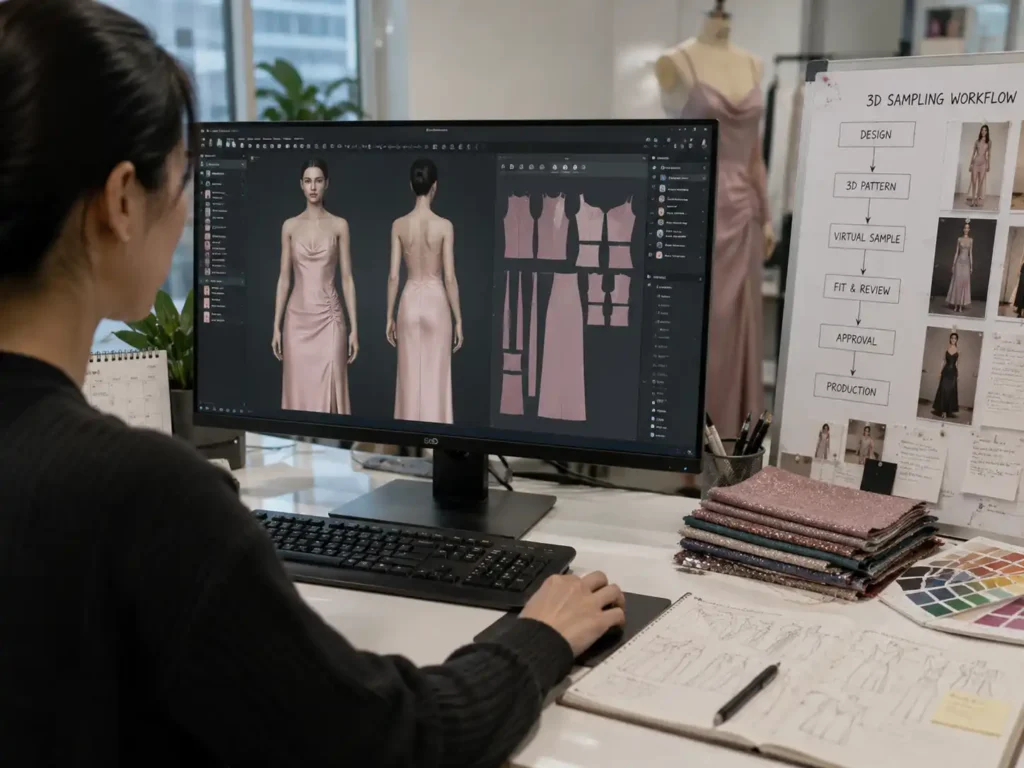
A complete workflow normally moves through design review, technical clarification, fabric and trim sourcing, preliminary costing, pattern making, sample construction, fitting, revision, pre-production approval, grading, bulk manufacturing, inspection, packing, and shipment. Each stage produces a measurable output rather than a vague promise that the style is progressing.
| Development Stage | Main Question | Required Output | Approval Point |
| Design review | Is the concept clear and manufacturable? | Style brief and open-question list | Product direction confirmed |
| Material development | Will the fabric perform as intended? | Approved fabric and trim references | Material approval |
| Pattern development | Does the shape reflect the design and size chart? | Base-size pattern | Pattern ready for sampling |
| First sampling | Does the first physical version work? | First sample and measurement report | Revision comments issued |
| Fit correction | Are proportion, comfort, and movement acceptable? | Updated pattern and revised sample | Fit approval |
| Pre-production | Can the style be repeated in bulk? | PP sample, BOM, final specifications | Bulk authorization |
| Production and packing | Is the approved standard being followed? | Inspected, labeled, packed garments | Shipment release |
OEM, ODM, and Private Label
OEM, ODM, and private-label production describe different levels of responsibility, but they frequently overlap in real projects. In an OEM project, the brand normally provides a detailed tech pack, measurement chart, artwork, construction instructions, and material requirements. The factory interprets those documents, identifies risks, develops the sample, and reproduces the approved specification in production.
ODM development starts with less technical information. A label may provide a mood board, reference image, original garment, target customer, desired retail position, or target cost. The manufacturer then contributes more actively to material selection, construction methods, pattern development, trim choices, and cost engineering while keeping important visual decisions under client approval.
Private-label production concerns brand identity and retail preparation. The finished garment uses the client’s main label, size label, care label, hangtag, barcode, packaging, and carton information. A single project can therefore be OEM in design, ODM in material development, and private label in its final retail presentation.
When a Design Is Production-Ready
A dress is production-ready when the major creative and technical decisions have been converted into stable production documents. A sample that looks attractive in photographs is not automatically ready for bulk manufacturing. The factory still needs a confirmed pattern, measurement chart, material list, construction standard, tolerance, trim reference, label placement, packaging instruction, and approved physical sample.
The production team should be able to confirm that the final fabric is available in the required quantity and color, the approved sample uses the same zipper and internal support planned for bulk, and the measurements have been updated after the last fitting. It must also be clear that the sewing method can be repeated on a line rather than only by one highly skilled sample machinist.
A style should not move forward merely because the launch calendar is under pressure. Unresolved decisions do not disappear when cutting starts; they become more expensive. A one-centimeter neckline correction is simple before production, but after thousands of panels have been cut, the same change can trigger re-cutting, shortages, delays, and commercial disputes.
Who Owns Each Decision
Development works best when every decision has a clear owner. The brand controls product identity, target customer, visual direction, intended fit, retail position, launch timing, commercial requirements, and final approvals. The manufacturer controls technical interpretation, production feasibility, material sourcing, construction engineering, process planning, and quality execution.
The pattern maker owns pattern accuracy but should not decide whether the label wants a relaxed or body-conscious silhouette. The fabric team can explain that a selected satin is difficult to replenish, yet the client decides whether that exclusivity is worth the supply risk. The production manager estimates realistic capacity, while the client chooses whether to split delivery or adjust the launch.
A merchandiser normally connects these functions by organizing documents, sample comments, costing updates, deadlines, material approvals, and production handovers. Many development failures are not caused by a complete lack of technical ability; they come from unclear ownership, conflicting comments, uncontrolled changes, or correct information being applied to the wrong version.
What Do Brands Need to Start?
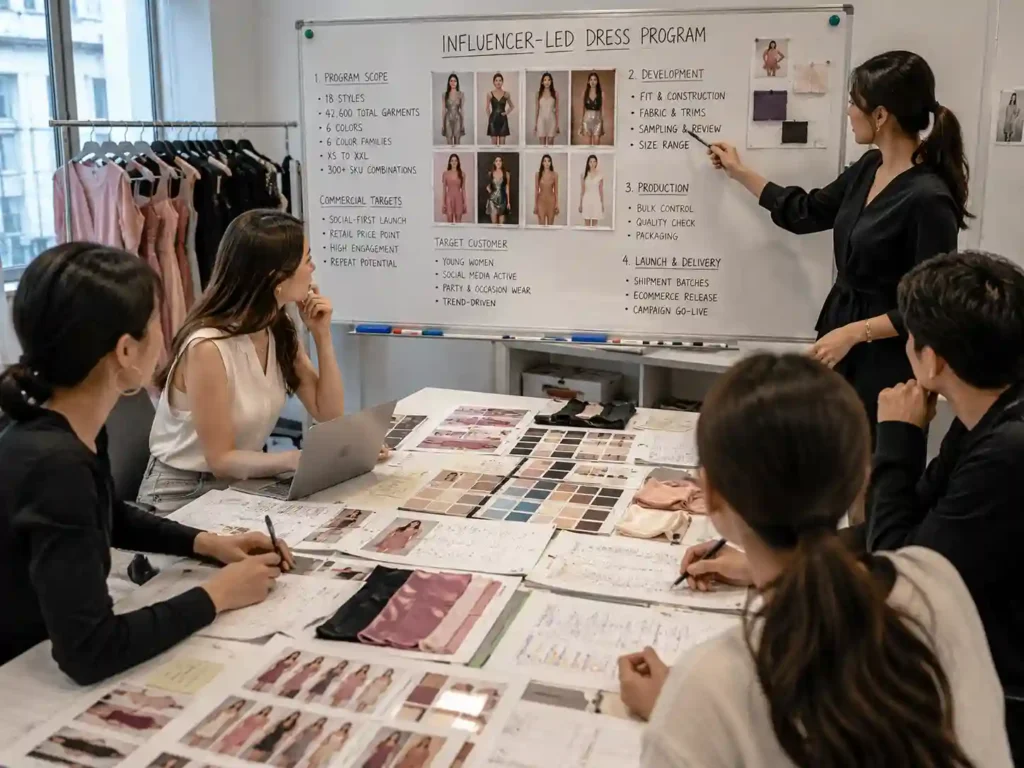
A brand can start custom dress development with a full tech pack or with a clear combination of sketches, reference images, an original sample, measurements, fabric direction, quantity, target market, and launch requirements. The starting information need not be perfect, but it must be specific enough to expose missing decisions and technical risks.
Minimum Starting Information
At minimum, the factory needs to know what is being developed, who it is for, how it should fit, and whether a realistic production plan sits behind the request. A clear front image alone is not enough. It may show the silhouette, neckline, and surface appearance, but it rarely explains the back construction, lining, closure, internal support, seam finishing, or intended measurements.
Useful starting information includes the product category, intended length, base size, target measurements, preferred fabric characteristics, color plan, estimated order quantity, size range, target market, desired delivery date, and private-label requirements. The quantity matters earlier than many labels expect because it affects fabric availability, custom color options, trim minimums, and suitable production routes.
For Jinfeng Apparel, standard custom production starts from 200 pieces per style and color, subject to fabric availability, color development, trims, construction complexity, packaging, and production scheduling. That threshold helps determine whether stock materials, custom development, color consolidation, or a higher supplier minimum will be the most practical route.
Tech Packs and Alternatives
A good tech pack reduces interpretation risk. It normally includes technical drawings, measurements, construction notes, stitch details, material specifications, trim references, artwork, labels, color information, and packaging requirements. Its value comes from clarity and consistency rather than page count, because a long file containing conflicting information can be more dangerous than a short, controlled brief.
A drawing may show a high waist while the measurement chart places the seam lower. The bill of materials may list an invisible zipper while the sketch shows a side opening. These conflicts need to be resolved before sampling. The same rule applies when a revision changes the fabric, neckline, lining, or closure but older documents remain active.
Labels without a complete tech pack can begin through a structured combination of reference garments, line sheets, mood boards, fabric swatches, size charts, and marked photographs. The manufacturer can help convert these materials into production documents, but it should not silently decide the neckline depth, skirt length, lining quality, or target fit merely because the information was omitted.
| Input | Useful Minimum Detail | Why It Matters |
| Reference images | Front, back, side, and close-up views | Reduces assumptions about construction |
| Measurements | Base size and defined points of measurement | Establishes fit and pattern targets |
| Fabric direction | Composition, weight, stretch, or physical swatch | Guides sourcing and pattern engineering |
| Quantity | Units by style and color | Affects material MOQ and production planning |
| Size range | Smallest, base, and largest sizes | Influences grading and fit validation |
| Target market | Country, region, channel, and customer profile | Supports sizing, labeling, and product decisions |
| Target cost | Realistic factory-cost range | Keeps material and construction commercially viable |
| Launch date | Required shipment or warehouse date | Determines the development calendar |
| Branding files | Labels, hangtags, barcode, and packaging artwork | Prevents late-stage packing delays |
Commercial Inputs Brands Often Miss
Many briefs describe the garment but not the business conditions surrounding it. Those details directly affect development choices. Ecommerce collections need consistent measurements, strong product photography samples, and packaging that supports fast SKU handling. Retail programs may require specific barcode formats, hangtag positions, carton ratios, testing, and inspection procedures.
Target retail price alone is not enough. The manufacturer needs a realistic factory-cost range and a clear understanding of which visual or functional details are non-negotiable. One label may value premium satin, a structured corset interior, and hand-finished draping, while another prefers simpler internal construction if the external appearance remains strong and the style can be replenished quickly.
The expected reorder pattern also matters. A distinctive material may be acceptable for a one-season capsule even if future availability is uncertain. A potential core bestseller should use fabrics and trims that can be sourced again with reasonable consistency. The strongest brief therefore explains how the dress will be sold, photographed, priced, packed, delivered, and repeated.
Design Protection and Version Control
Custom development frequently involves unreleased designs, proprietary patterns, brand labels, target prices, launch plans, packaging files, and supplier information. These materials should be handled through controlled access and NDA-based cooperation where required. Confidentiality, however, is only one part of protection; version management is equally important to prevent obsolete instructions from reaching production.
Each style should have a consistent code. Sample comments should identify the version, date, color, fabric, and size under review. Updated documents should clearly replace older files, and approval messages should state exactly which sample and specification have been accepted. A file named `DR2418_Measurements_V4` is much safer than one called `final measurements new`.
Physical samples also need identification. The approved PP sample should show the style, color, size, approval date, and any remaining limitations. Good version control reduces repeated discussion, but its greater value is accountability: when a question appears, the team can trace which instruction was followed, when it changed, and who approved it.
How Are Fabric and Patterns Developed?
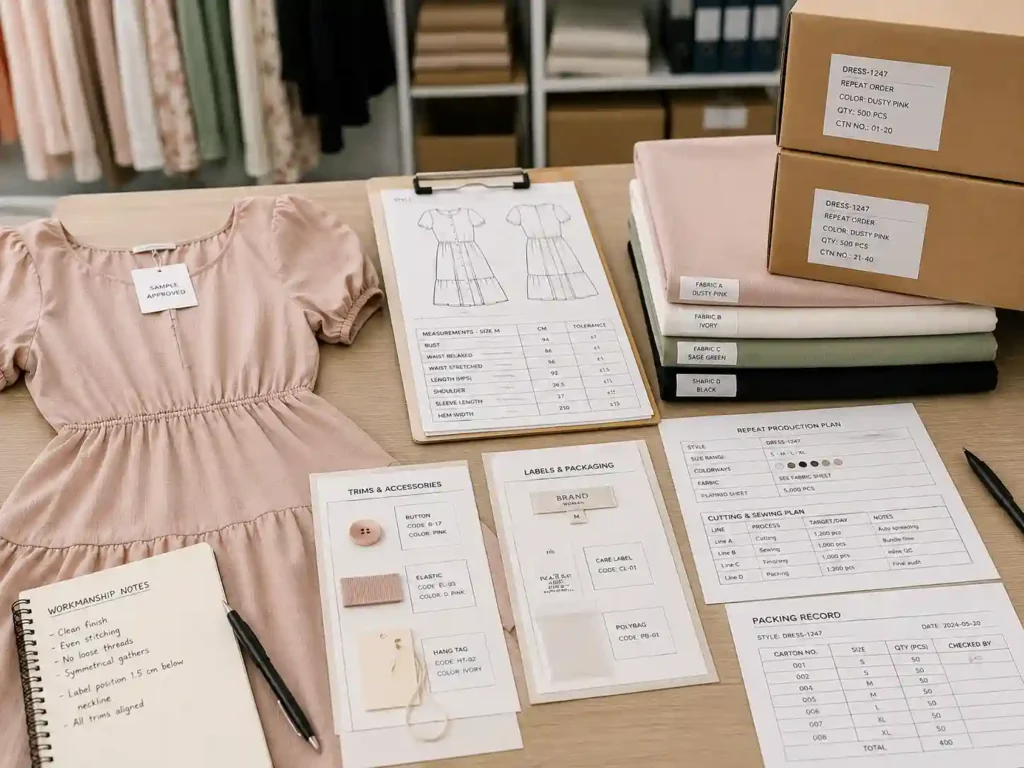
Fabric and pattern development must happen together because material behavior determines fit, support, drape, comfort, and construction. The team evaluates weight, stretch, recovery, opacity, shrinkage, width, surface, and availability, while pattern makers adjust shape, ease, balance, seam position, and internal structure to suit the approved material.
Fabric Performance First
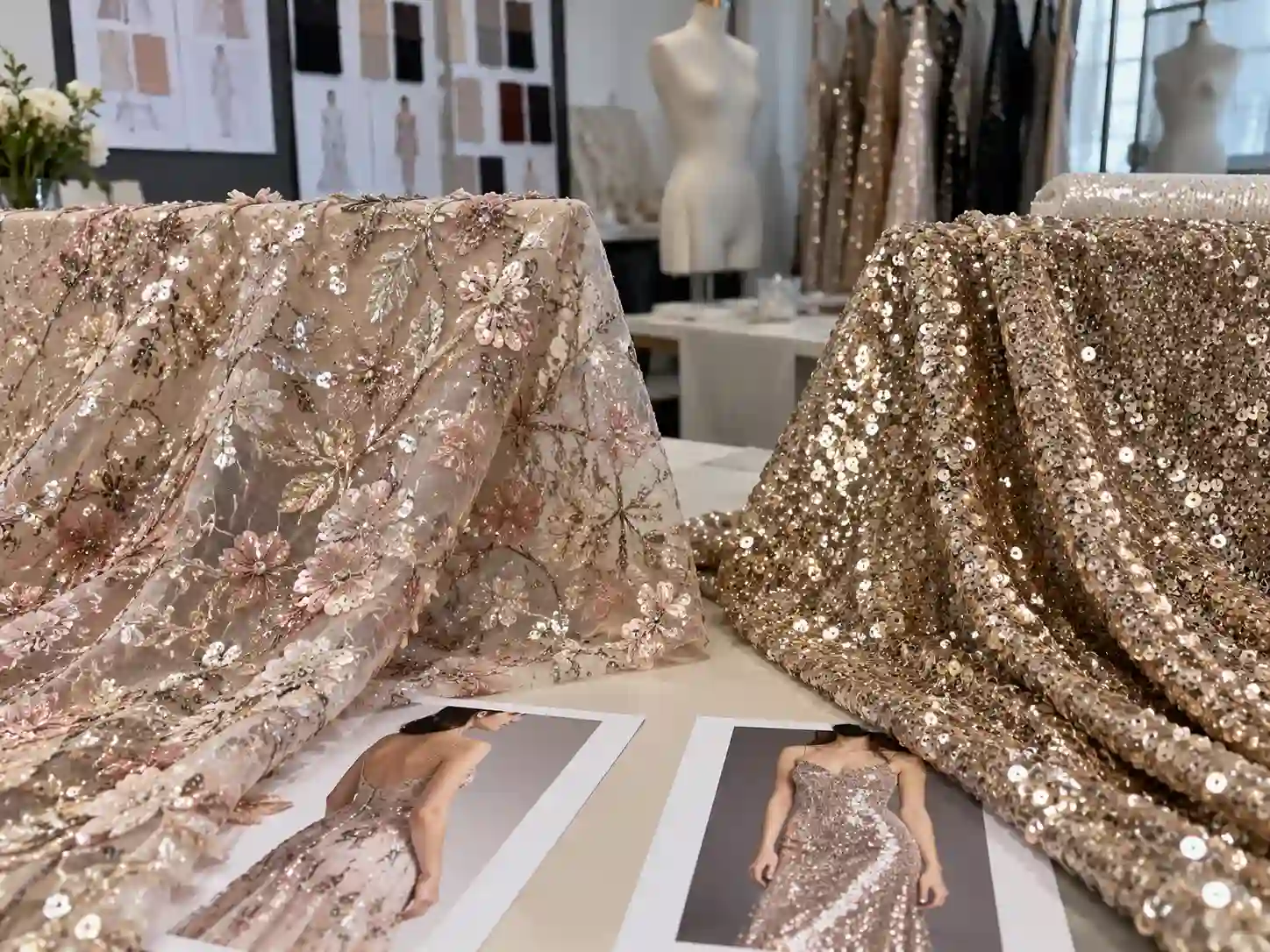
Fabric should be selected for what the dress must do, not only for how attractive the swatch looks. Satin creates a polished surface, but light colors may reveal seam allowances and lining edges. Chiffon offers movement and softness, yet it can shift during cutting. Mesh creates transparency and flexibility, while its stretch direction and recovery require careful control.
A practical fabric review considers composition, weight, total and usable width, stretch percentage, recovery, shrinkage, colorfastness, opacity, drape, surface sensitivity, supplier minimum, lead time, and future availability. Stretch percentage alone is not enough. Two fabrics can extend by a similar amount, but one returns to its original dimensions while the other grows after wear.
Supplier continuity also influences suitability. A technically appealing fabric may be commercially weak if the minimum is much higher than the garment order, the required shade cannot be repeated, or the lead time conflicts with the launch. Development therefore tests the material in the real pattern rather than assuming that a small swatch will behave like a finished dress.
| Dress Type | Common Fabric Direction | Critical Performance Checks | Common Risk |
| Bodycon dress | Jersey, ponte, stretch mesh | Stretch, recovery, opacity, dimensional stability | Growth and uneven fit |
| Slip dress | Satin, crepe, viscose | Drape, seam puckering, shade consistency | Pulling and visible seam lines |
| Occasion dress | Satin, lace, mesh, chiffon | Structure, lining, color matching, pressing | Poor support or surface damage |
| Resort dress | Rayon, viscose, chiffon, linen blend | Shrinkage, drape, print alignment | Distortion after care |
| Corset dress | Structured satin, mesh, suiting | Support, strength, fusibility, lining | Collapsing panels |
| Sequin dress | Sequin mesh or embellished woven | Sequin security, seam thickness, skin comfort | Dropping sequins and abrasion |
| Maxi dress | Chiffon, satin, crepe, lightweight woven | Fabric drop, hem balance, transparency | Uneven length after hanging |
Pattern Engineering
Pattern making translates a design into cuttable shapes that must work on a real body and within a repeatable sewing process. The pattern maker controls bust shaping, waist position, hip ease, neckline depth, shoulder angle, armhole form, strap placement, side-seam balance, skirt volume, and hem level. Every decision is affected by the material selected for the style.
The first pattern is a technical hypothesis. The sample tests whether those assumptions were correct. A pattern developed for a stable woven cloth cannot simply be reused in a high-stretch knit. Likewise, a softly draped slip dress and a structured corset dress may share a similar outline on paper but require completely different internal construction and balance.
Experienced pattern makers also watch visual proportion. A dress can match the numerical chart yet still look wrong because the waist appears too low, the side seams rotate, or the front hem lifts. Small corrections can have a large effect: moving a waist seam by one centimeter or changing a strap angle may alter the whole silhouette.
Fit and Construction Risks
Fit should be reviewed on the body and in motion. Standing still in front of a mirror does not reveal whether a neckline opens while sitting, a skirt rides up while walking, or an armhole cuts into the skin when the arms are raised. Movement tests often expose risks that remain hidden in flat measurements or mannequin photographs.
Critical areas include bust support, under-bust position, waist placement, hip ease, neckline stability, strap angle, armhole coverage, side-seam direction, slit height, and hem balance. Construction can create additional problems even when the pattern is correct. Excessive seam tension may shorten one side of a satin dress, while a tight lining can restrict the outer layer.
Measurement tolerances should reflect the garment and the risk. Fitted bust, waist, strap, and neckline dimensions normally need tighter control than a flowing skirt panel. Comments should always identify a location, direction, and amount. ‘Improve the waist’ is subjective, whereas ‘raise the front waist seam by 1 cm’ creates a repeatable correction.
Cost Engineering
Cost engineering preserves the visible and functional value of the dress while removing unnecessary expense or production risk. The main cost drivers are usually fabric consumption, material price, lining, construction complexity, trim quantity, sewing time, embellishment, wastage, inspection requirements, packaging, and the way quantities are divided across colors and sizes.
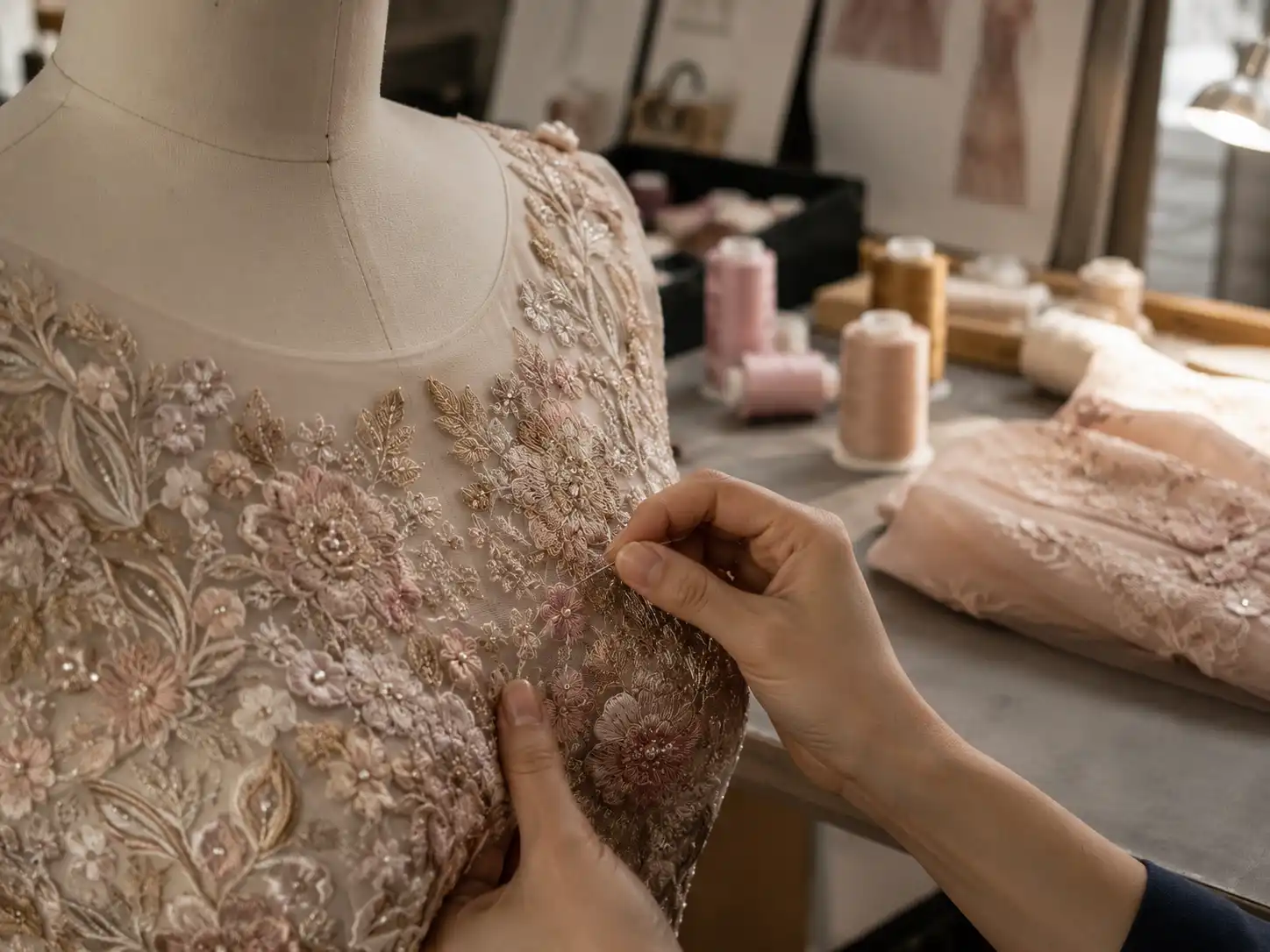
A ruched dress may consume far more fabric than a clean bodycon style. A corset interior adds pattern pieces, cups, boning, lining, and skilled labor. Lace placement can increase cutting waste because motifs must align, while sequin materials slow sewing, require seam cleaning, and need more protective packing. These costs are linked to the design rather than added arbitrarily.
Savings are often possible without making the style look inexpensive. A similar fabric with a more useful width may reduce consumption. A complex internal seam may be simplified while preserving the outside shape. An existing trim can replace a custom molded component. The best costing discussion happens before the sample is finalized, because late cost cuts often force visible compromise or renewed sampling.
How Does Dress Sampling Work?
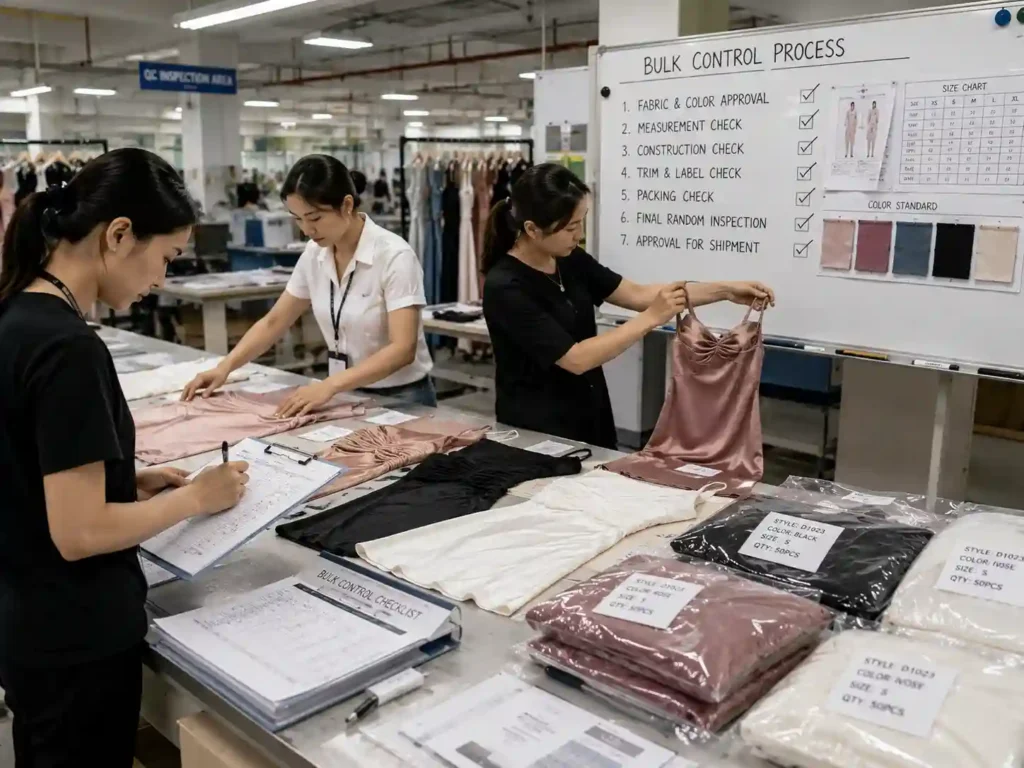
Dress sampling tests the design, pattern, fabric, construction, fit, cost, and production feasibility before bulk cutting begins. A first sample reveals the initial interpretation, fit samples verify body proportions, revised samples confirm corrections, and the pre-production sample establishes the standard for manufacturing, quality inspection, packing, and future repeat orders.
The First Sample
The first sample is the first complete physical test of the product brief. Its purpose is not to prove that the original concept was perfect. It should reveal what needs correction before the project becomes expensive. The team checks silhouette, measurements, fabric behavior, neckline, armholes, bust shaping, waist position, hip fit, length, closures, lining, support, seams, and internal finishing.
Substitute material may be used when the final fabric is unavailable, but the limitation must be understood. A sample made in stable cotton can help verify basic proportion, yet it cannot fully predict how stretch satin, mesh, or chiffon will drape, recover, or behave at the seams. Material changes may therefore require another fit and construction review.
The first sample also tests manufacturability. A detail that one sample machinist can sew slowly may not suit commercial production. Internal inspection before shipment saves time because measurements, workmanship, fabric condition, and obvious construction problems should be reviewed by the manufacturer rather than left for the client to discover.
Fit Review
Fit review combines numerical measurement, visual balance, comfort, and movement. The garment is measured using the agreed method and then evaluated on a suitable form or fit model. Front, side, and back views are equally important. A style can appear correct from the front while the side seam rotates or the back neckline opens.
The wearer should sit, walk, raise her arms, turn, and bend. These simple actions reveal neckline security, strap stability, skirt mobility, lining restrictions, zipper tension, and slit behavior. Fit must also reflect the intended customer. A fitted club dress may use negative ease, while an occasion dress generally needs more room for comfortable sitting and movement.
Comments should be consolidated by one authorized contact. When design, merchandising, marketing, and management teams send separate instructions, the pattern maker may receive conflicting requests. A useful review ends with one controlled comment sheet, marked photographs, measurement changes, and a clear decision on whether another physical sample is required.
Revision Control
A revised sample is usually needed when changes affect the pattern, fit, fabric, trims, construction, support, comfort, or overall appearance. Major revisions include changes to bust volume, neckline depth, waist location, hip ease, dress length, slit height, strap placement, lining, boning, cups, zipper type, draping, or material quality.
Each round should update every related document. If the waist measurement changes, both the chart and pattern must change. If the fabric changes, the bill of materials, costing, consumption, and possibly the pattern should be reviewed. If a zipper is replaced, its size, color, supplier reference, and placement need to appear in the current specification.
Unlimited revision is not an efficient strategy. Revisions should solve defined problems rather than reopen previously approved design decisions. Repeated changes often reveal that the original brief, target fit, or approval authority was unclear. One additional controlled sample is usually far less costly than correcting a bulk order that was started with unresolved questions.
Sample Types and Approvals
Different samples answer different questions and should not be used interchangeably. A photo sample may be fitted specifically to one model and should not automatically become the production reference. A salesman sample may be produced before every trim is finalized. The PP sample should closely represent the exact materials, pattern, workmanship, labels, and construction planned for bulk.
The golden sample is particularly valuable for long-term programs. It allows production teams, inspectors, and the client to compare future output with an agreed physical benchmark. It should be labeled with the style code, color, size, version, and approval date, then stored under controlled conditions so it can support repeat orders and quality discussions.
Approval should cover more than appearance. Fabric, color, trims, measurements, tolerances, construction, labels, packaging, and order data all need confirmation. Jinfeng Apparel’s typical sample ranges are about 7-10 days for simple styles, 10-15 days for standard dresses, and 15-25 days for complex designs, excluding additional supplier time for special materials.
| Sample Type | Main Purpose | Material Standard | Approval Result |
| First sample | Test initial pattern and design interpretation | Final or representative material | Revision direction |
| Fit sample | Check measurements, proportion, and movement | Material with similar behavior | Fit correction |
| Revised sample | Verify agreed changes | Preferably final material | Fit or design approval |
| Photo sample | Support campaign or ecommerce photography | Visually correct material and color | Photo-use approval |
| Salesman sample | Support market presentations and sales | Representative production standard | Commercial review |
| PP sample | Confirm bulk materials and workmanship | Production materials and trims | Bulk authorization |
| Golden sample | Preserve the final physical standard | Final approved specification | QC and reorder reference |
How Does a Dress Enter Bulk Production?
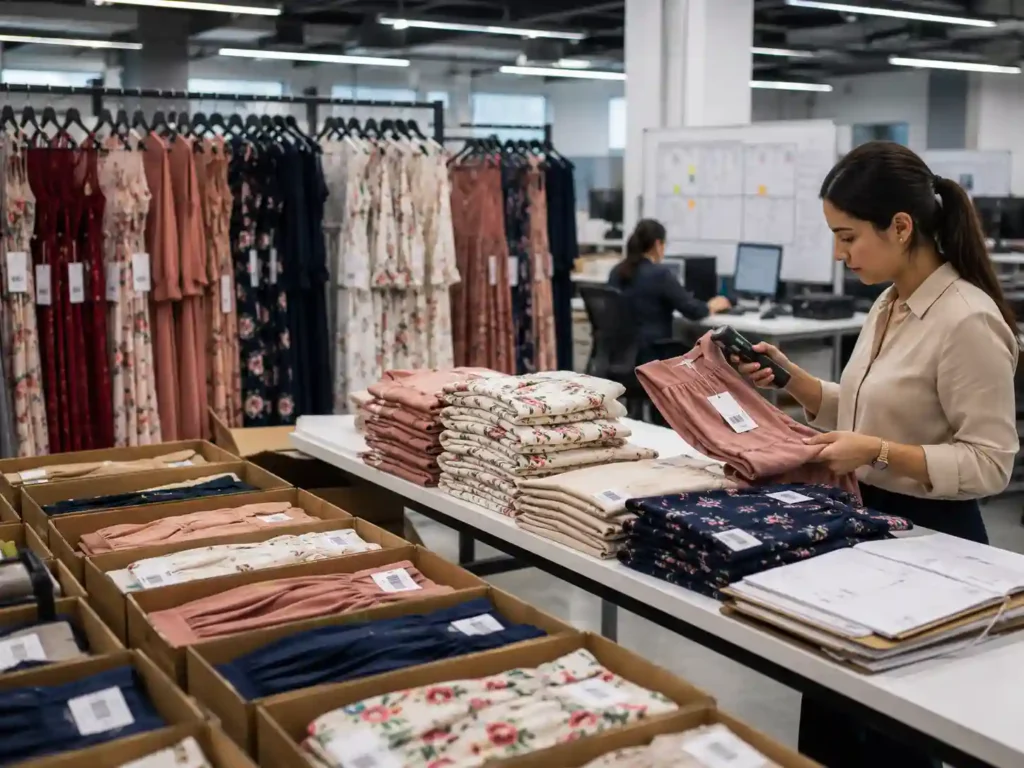
A dress enters bulk production after the PP sample, final pattern, graded measurements, fabric, trims, bill of materials, workmanship, labels, packaging, quantities, tolerances, and delivery plan are approved. The manufacturer then books materials, plans cutting and sewing, controls inline quality, completes finishing and inspection, and prepares the order for retail or warehouse delivery.
Production Handover
The production handover converts development information into instructions that can be followed by cutting, sewing, quality, finishing, and packing teams. The working package should include the approved sample, final pattern version, size chart, tolerance, bill of materials, fabric and trim references, construction sheet, placement measurements, label files, packaging requirements, and quantity breakdown.
Every department must use the same version. A correct pattern combined with an outdated measurement chart can still create inspection disputes. A replacement zipper approved by email but not updated in the material list may lead purchasing to order the previous component. Before cutting, a pre-production meeting should review high-risk details, material limitations, sewing methods, measurements, inspection points, and packing requirements.
Complex dresses need more detailed preparation. A satin slip style may require instructions for needle size, seam tension, pressing temperature, and handling. A sequin dress may require removal of embellishment from seam allowances, careful needle control, protective lining, and reinforced packing. The fewer decisions that depend on memory, the more consistent production becomes.
Grading and Marker Making
Size grading converts the approved base pattern into the complete size range. It is not achieved by adding the same amount to every edge. Bust, waist, hip, shoulder, neckline, armhole, rise, sleeve, and length may follow different rules, while design features such as cut-outs, ruching, waist seams, and slits must remain visually balanced.
The largest and smallest sizes carry more risk because they are furthest from the fitted base size. For broader ranges, physical fit samples in additional sizes may be more reliable than digital grading alone. This is especially important for corset dresses, fitted jumpsuits, low necklines, and styles where cup volume or under-bust position changes substantially by size.
Marker making arranges graded pattern pieces across the fabric width and influences consumption, grain direction, print position, nap, and shade control. Printed garments may require motif matching, while velvet and directional satin need one-way cutting. A marker that saves fabric but creates twisting seams, mismatched prints, or visible shade changes is not a genuine cost saving.
Line Planning and Quality Control
Production planning matches the dress with a sewing line that has the appropriate skills, machinery, capacity, and experience. A simple woven dress can move through a standard line, while corset, lace, mesh, sequin, or draped occasion styles may require slower operations, specialist machinists, additional checks, and more controlled handling.
The first bulk garments are especially important. Supervisors and inspectors review the initial output before the line continues at full speed, confirming seam methods, measurements, zipper installation, support structure, trim placement, and overall appearance. Material inspection and cutting checks should already have identified shade variation, shrinkage, grain, print direction, defects, and size accuracy.
Jinfeng Apparel’s production system includes six owned factories, more than ten long-term satellite partners, over eighteen sewing lines, and at least six flexible lines. Regular monthly capacity exceeds 100,000 womenswear pieces, although the actual output depends on product mix, material behavior, order structure, craftsmanship, and the number of complex styles running at the same time.
Private-Label Packing and Shipping
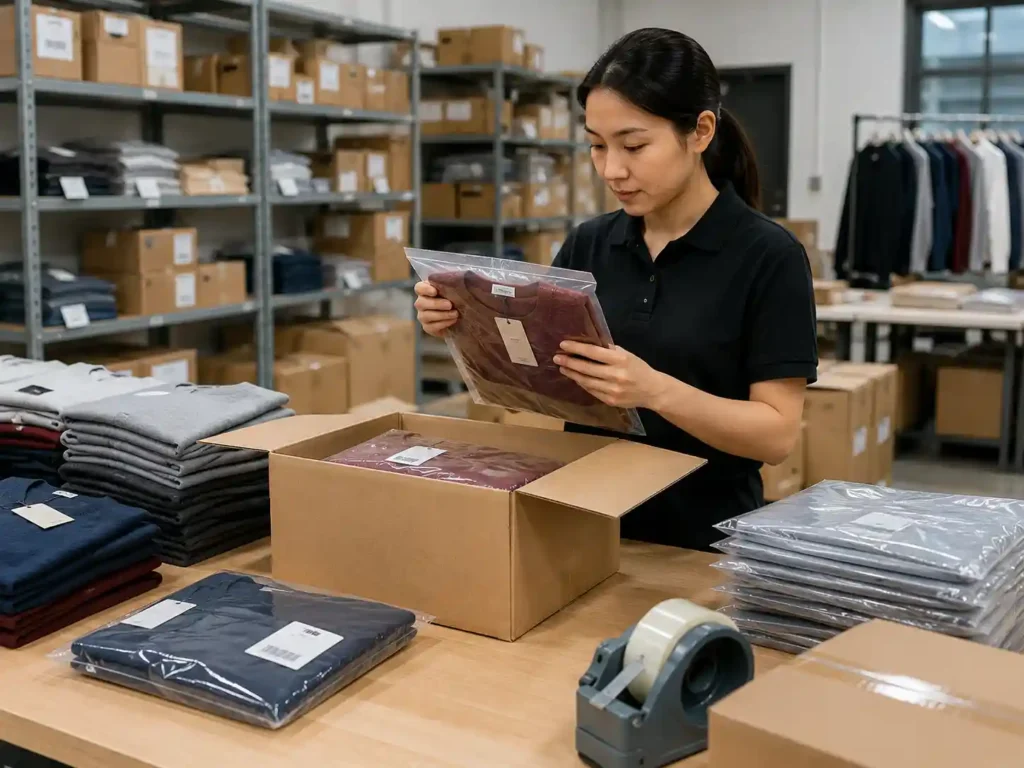
Packing is part of production quality because a correctly made garment can still create warehouse, retail, or customer-service problems if it is labeled or packed incorrectly. Requirements may include a main woven label, size label, care label, country-of-origin information, hangtag, barcode, SKU sticker, price ticket, polybag, tissue, carton mark, and assortment ratio.
The packing team should use a controlled matrix linking style, color, size, SKU, barcode, and carton quantity. Pressing and folding methods must suit the fabric. Satin needs protection from shine marks, sequin garments may require tissue layers, structured dresses can need larger bags or inserts, and long dresses should be folded consistently to avoid deep creases.
Shipping plans should be confirmed before packing begins. Air, sea, courier, or combined delivery may involve different carton limits, timelines, and costs. Split delivery can protect an urgent launch, but it needs early planning because it affects packing, documentation, inspection, and freight booking. Retail-ready delivery is achieved only when the garment, data, packaging, and shipping documents all agree.
How Long Does Development Take?
Custom dress development often takes several weeks from initial review to an approved production standard, but the schedule depends on document quality, material availability, pattern complexity, revision rounds, approval speed, testing, and special trims. Simple samples may take about 7-10 days, standard dresses 10-15 days, and complex styles 15-25 days before client review.
Typical Development Ranges
Development time should be divided into stages rather than presented as one fixed promise. Initial review may take one to three working days when the brief is clear. Fabric and trim sourcing can be quick for stock materials, while custom-dyed colors, prints, embroidery, lace, molded components, or specialized packaging can follow much longer supplier schedules.
At Jinfeng Apparel, a simple style may require approximately 7-10 days for the first sample. A standard dress commonly needs around 10-15 days. Complex products involving corset structures, difficult draping, lace placement, sequins, unusual mesh, or custom trims may require 15-25 days or more, particularly when supplier sampling or special color development is involved.
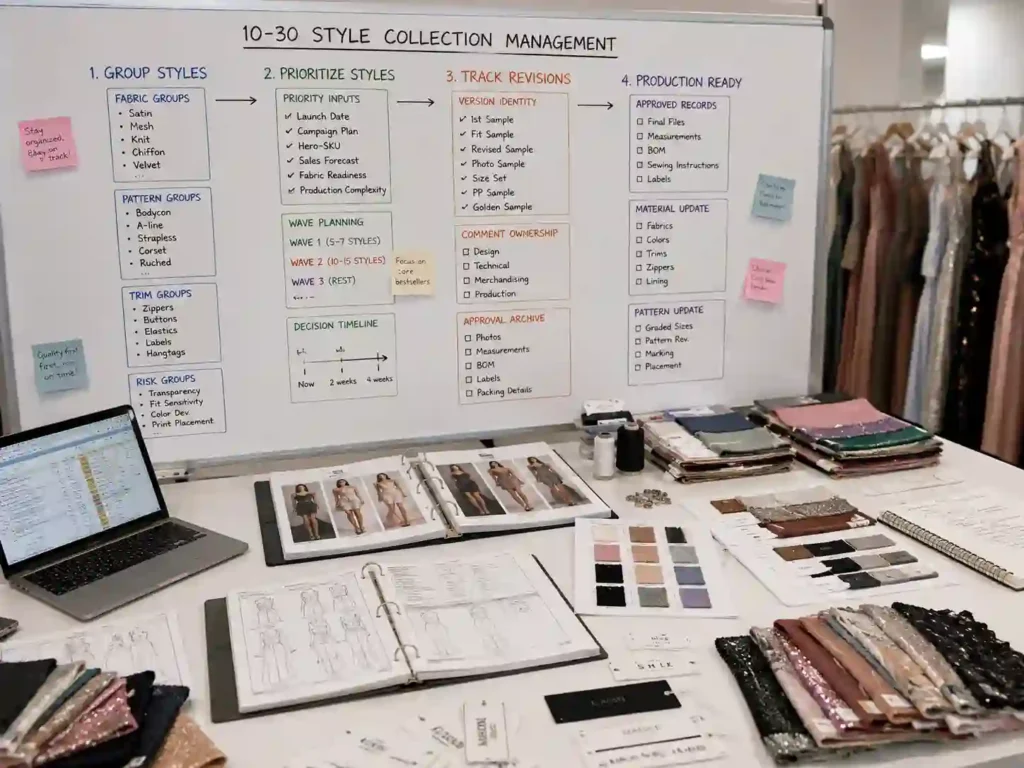
These ranges describe sample preparation rather than the entire approval journey. Courier transit, fitting, internal client review, comment consolidation, and revision can add considerable time. Bulk production follows a separate schedule and depends on material arrival, production capacity, quality requirements, packaging, and whether several styles are being developed as one collection.
What Causes Delays
Incomplete or changing information is one of the most common causes of delay. A sample cannot be finalized while the size chart, fabric, neckline depth, lining, or closure method continues to change. Material sourcing is another major variable because stock fabric may be available immediately, while custom colors, prints, lace, branded hardware, and unique packaging involve supplier minimums and separate lead times.
Slow or conflicting feedback extends the calendar even when sewing itself is efficient. A sample that waits two weeks for comments has not taken two additional weeks to make, but the launch calendar is still two weeks shorter. Late label artwork, unapproved barcodes, additional testing, and production-capacity changes can create similar pressure near the end of the project.
International sample shipping also needs realistic allowance. Customs checks, weekends, holidays, and regional delivery conditions can affect review dates. Photographs and video calls help clarify details, but they do not always replace physical assessment of fit, hand feel, stretch, opacity, and comfort. Fast development depends on fast, controlled decisions as much as fast sewing.
How to Shorten the Process Safely
The safest way to shorten development is to remove avoidable waiting and confusion rather than skip technical controls. A clear brief, realistic target cost, confirmed base size, intended size range, and consolidated references prevent repeated interpretation. Fabric direction should be specific enough to avoid endless sourcing rounds, ideally supported by a physical swatch or a measurable benchmark.
Comments should be delivered in one document, with each request linked to a location and measurable change where possible. Parallel preparation also saves time. Label artwork, care information, packaging, barcode files, testing plans, and shipping requirements can be developed while fit sampling is in progress instead of being left until the garments are almost finished.
Some steps should not be removed. Skipping the PP sample, approving a style before final fabric is tested, or beginning cutting with an unfinished size chart may appear to save days but can create weeks of corrective work. A professional fast-track process is disciplined rather than rushed; it reduces repeated decisions while preserving material, fit, construction, and production approvals.
Repeat Orders and Seasonal Development
Repeat orders are normally faster because the approved pattern, measurement chart, fabric references, trims, bill of materials, workmanship standard, labels, packaging, and golden sample already exist. Even so, a repeat should not start with the assumption that nothing has changed. Fabric lots can vary in shade, weight, stretch, or shrinkage, while trim suppliers may update components.
Before restarting production, the team should confirm material continuity, order quantity, color, size breakdown, delivery date, label files, and any comments from the previous shipment. A new PP sample may still be appropriate when the fabric, supplier, construction, or sizing has changed. Repeat production is faster because information is controlled, not because verification is abandoned.
Seasonal cooperation becomes more efficient when patterns, preferred fits, material references, construction methods, and packaging standards are retained. Over time, the manufacturing team learns the label’s preferred waist placement, dress lengths, stretch expectations, finishing level, and target customer. New styles can then build on proven blocks rather than returning to zero with every collection.
Start a Custom Dress Development Review
A reliable custom dress program is built by controlling decisions before they become production problems. Clear input, suitable materials, experienced pattern work, disciplined sampling, written approvals, and stage-by-stage quality checks make the finished style easier to price, manufacture, inspect, replenish, and sell. Jinfeng Apparel supports dress collections from tech-pack or reference review through fabric sourcing, pattern development, sampling, bulk production, private-label packing, and export coordination. Brands preparing a new collection can send a tech pack, line sheet, reference sample, size chart, planned quantity, and target delivery date to request a development review and project-based quotation.