 Skip to content
How to Evaluate a Dress Manufacturer’s Sample Room Before Bulk Production

Your trusted Women’s Apparel Manufacturer from China

Many fashion brands only judge a dress manufacturer after seeing a sample. That is already too late. The real question is not whether the factory can sew one attractive dress for a photo. The question is whether its sample room can turn a tech pack, reference sample, fitting comment, fabric direction, trim requirement and target cost into a production-ready standard that bulk teams can repeat hundreds or thousands of times. A weak sample room creates hidden cost: extra revisions, unstable sizing, unclear construction, late launch dates and bulk pieces that no longer match the approved sample. For dress categories, the risk is higher because proportion, fit, fabric behavior and inside structure all affect how the garment looks on the body.
To evaluate a dress manufacturer’s sample room, check pattern ability, fit correction, sample types, fabric and trim testing, measurement control, sewing quality, revision records, PP sample discipline and how clearly the approved sample is transferred into bulk production. A strong sample room should reduce risk before cutting bulk fabric.
Think of the sample room as the rehearsal stage before the real performance. If the rehearsal is messy, the launch will be messy. But when the sample room is organized, technical and production-minded, your dress collection has a much better chance of arriving on time, fitting correctly and selling with fewer quality surprises.
What Is a Dress Manufacturer’s Sample Room?
A professional fashion sample room with pattern tables, fabric swatches, dress forms, sample machinists sewing satin and mesh dresses, measurement charts on a workbench, realistic garment production environment, clean documentary style.
A dress manufacturer’s sample room is the technical development area where design ideas become testable garments before bulk production. It connects pattern making, fabric behavior, trims, sewing methods, fitting, measurements, revisions and production standards. For a fashion brand, it is where early production risk is discovered before money is committed to bulk fabric, cutting and delivery schedules.
A serious sample room is not just a corner with sewing machines. It is the place where a buyer’s design information becomes something measurable, wearable and repeatable. A dress may look simple in a reference image, but the sample room has to answer practical questions: Will the neckline sit correctly? Will the side seam twist after sewing? Will the hem hang evenly? Will the lining pull the outer fabric? Will the zipper ripple on satin? Can the same effect be repeated across XS to XL or across several colorways?
For B2B fashion brands, the sample room is also an early trust test. A sales team may promise fast delivery and good quality, but the sample room proves whether the manufacturer truly understands dress structure, fit correction, fabric risk and bulk production standards. If the room cannot document comments, correct patterns, control fabric behavior and prepare a reliable PP sample, bulk production becomes a gamble rather than a managed process.
This matters even more for dress categories. Dresses are less forgiving than many basic garments because the whole silhouette depends on proportion. A bodycon dress, corset dress, slip dress, halter dress, strapless dress, evening dress or maxi dress cannot hide a wrong neckline depth, hip curve, waist seam, slit height or lining length. The sample room is where these issues should appear early, while they are still affordable to fix.
What it controls
A sample room translates your design information into a real garment that can be fitted, measured, corrected, priced and prepared for production. The starting point may be a tech pack, reference photo, original sample, sketch, line sheet, size chart or fabric swatch. The work usually includes pattern development, fabric trial, cutting, sewing, fitting, measurement checking, construction review and revision.
In dress manufacturing, this work is more technical than many buyers expect. A bodycon dress needs stretch recovery control. A satin slip dress needs drape and seam smoothness. A corset dress needs support and internal structure. A backless dress needs strap balance and anti-slip planning. A maxi dress needs hem balance across front, back and side seams. A good sample room does not only ask whether the buyer likes the sample. It asks whether the sample can be produced repeatedly, within tolerance, at the target quality, with the selected fabric and trims, under the required delivery schedule.
Why it matters early
The sample room matters because it is the last low-risk stage before high-cost decisions begin. Once bulk fabric is purchased, cutting starts and production lines are arranged, every mistake becomes more expensive. A wrong neckline on one sample is a revision. A wrong neckline on 5,000 pieces is a commercial problem.
A strong sample room helps brands confirm five things before bulk production: fit, fabric, construction, measurement tolerance and production feasibility. These five points decide whether the approved design can survive real manufacturing conditions. For example, if a ruched mini dress looks good in a sample but the construction is too slow for bulk, the cost may rise. If a deep V dress looks attractive but lacks support, customer complaints may follow. If a long chiffon dress has no hem balance control, production pieces may vary by size. Evaluating the sample room early protects both the launch calendar and the product margin.
Sample room versus line
A common mistake is assuming that a good sewing line automatically means a good sample room. They are related, but not the same. A production line focuses on repeat efficiency. It follows approved patterns, approved measurements, approved sewing methods and approved QC standards. A sample room works before all of that is fully stable. It must interpret incomplete information, test different solutions, correct fit and prepare the standard that production will later follow.
That is why sample room workers need strong technical judgment. They often handle complex first versions, special fabrics, urgent revisions and design details that have not yet been simplified for bulk. A good sample room should also be production-minded. Some sample rooms can create beautiful one-off garments that are too slow, costly or unstable for bulk production. A better sample room asks whether the detail can be repeated by production workers within the target quality, lead time and cost range. That question separates a showpiece sample from a production-ready sample.
First signs to check
When evaluating a dress manufacturer’s sample room, start with the basics. Ask how many sample makers are involved, whether pattern makers work directly with sample machinists, how fit comments are recorded, how many sample revisions are normally needed and whether the final PP sample becomes the production standard.
The room does not need to look luxurious. It needs to be organized. You want to see clear sample tags, measurement sheets, pattern version records, fabric cards, trim references, revision notes and approved sample storage. If a manufacturer cannot explain which sample version is current, which comments were corrected, which fabric is approved and which measurements are locked, the risk is not only in sampling. The same confusion can move into production. A reliable sample room should make development easier, not more mysterious.
How Do You Check Pattern and Fit Ability?
A senior womenswear pattern maker adjusting paper patterns for a fitted dress, dress form with pinned sample, measuring tape, bust waist hip measurement notes, tech pack pages, practical fashion development scene.
You check pattern and fit ability by reviewing how the manufacturer reads tech packs, creates patterns, measures key dress points, handles fitting comments and updates pattern files after revisions. A strong sample room should explain why a fit issue happened and how it was corrected. Good fit ability is shown through repeatable pattern logic, not just one attractive sample photo.

Pattern and fit ability is one of the clearest signs of whether a dress manufacturer understands womenswear or only knows basic sewing. A dress is built around the body. Even a small pattern error can change the whole appearance. A strapless dress that slips down, a deep V dress with weak support, a bodycon dress that pulls at the hip or a maxi dress with an uneven hem usually comes from pattern and fit control problems, not only sewing problems.
When evaluating a sample room, ask the factory to show how fit comments are processed. Do they mark the sample? Do they update the measurement chart? Do they revise the paper pattern? Do they explain the impact on fabric consumption or sewing method? Do they keep the previous version for comparison? These habits reveal whether the factory has a technical workflow rather than a trial-and-error habit.
For mid-to-large fashion brands, pattern ability also affects scalability. One sample in size S may look good, but the real test is whether the factory can maintain the same design language across size grading. This is why sample room evaluation should include size set thinking, not only first sample approval.
Tech pack reading
A professional sample room should read a tech pack as a technical instruction file, not as decoration. The team should check sketches, measurement charts, tolerance notes, fabric composition, lining details, seam construction, trim placement, label position, packing requirements and any special finishing instructions. If the tech pack is incomplete, the factory should ask precise questions before cutting.
For dress production, the most important tech pack areas are often bust, waist, hip, length, neckline depth, strap length, armhole, slit height, zipper position, lining length and hem finish. These points directly affect fit and customer experience. A weak sample room may rush into sewing after seeing only a reference image. That can create a beautiful but inaccurate sample. A strong sample room slows down at the beginning to avoid bigger delays later. It clarifies fabric, construction, target market, fit preference and production quantity.
Fit correction
Patterns should be adjusted after fitting whenever the sample reveals fit, balance or construction issues. A sample room that only alters the garment by hand but does not update the pattern is a warning sign. The physical sample may look corrected, but the bulk production pattern remains wrong.
A proper correction process should include three layers: fitting observation, pattern adjustment and measurement update. If the underarm area exposes too much skin, the team may adjust armhole shape, side seam or upper bust control. If a strapless dress slips, the issue may involve upper bust measurement, internal grip tape, boning, elastic tension or fabric stretch. If a maxi hem is uneven, the problem may be front-back balance, fabric drape, cutting direction or hanger distortion. The key question is whether the factory knows the cause or is only patching symptoms. A good pattern team can explain the cause clearly.
High-risk fit points
Certain parts of a dress deserve closer control because they directly affect wearing confidence, movement and visual balance. These usually include bust, upper bust, waist, hip, neckline, strap, armhole, zipper, slit, lining and hem. In many fast fashion dress orders, the most common fit problems appear around bust and waist. A dress can look fine on a hanger but fail on the body because the upper bust is too open, the waistline sits too high or the hip is too tight.
Backless and halter styles create additional pressure points because support must come from fewer structure areas. For satin and woven dresses, pattern balance is especially important because the fabric may not stretch enough to hide small mistakes. For knit and mesh bodycon dresses, stretch direction and recovery must be considered during pattern development. For corset-style dresses, internal structure must support the outer shape.
Revision records
Fit comments are only useful when they become clear revisions. Many brands send comments like make the waist better, improve the bust or fit is strange. A strong sample room can turn those comments into measurable actions: reduce waist by 1 cm, raise neckline by 1.5 cm, shorten strap by 2 cm, increase hip ease by 1 cm, lower slit by 3 cm, adjust back neck drop or change lining tension.
The best sample room communication is specific and traceable. Each revision should connect to a sample version, pattern change, measurement update and approval status. This protects the brand from repeating the same issue in later samples. For sourcing teams, this is a practical test. Send a controlled set of sample comments and observe the factory’s response. If the reply is vague, bulk production may also be vague. If the reply is structured, technical and action-based, the sample room is more likely to support stable development.
| Fit Area | Common Dress Risk | Practical Check | Typical Control Note |
| Bust / upper bust | Gaping, flattening, weak support | Check neckline, cup position and side seam tension | Often reviewed within 0.5-1.5 cm depending on style |
| Waist | Poor proportion, twisting, loose fit | Check waist seam, darts and panel balance | Needs tighter control on fitted dresses |
| Hip | Pulling, riding up, side seam distortion | Check ease, stretch recovery and seat curve | Critical on bodycon and jumpsuit styles |
| Strap length | Slipping, digging, uneven neckline | Measure from fixed points and test movement | Small changes can alter neckline directly |
| Armhole | Exposure, discomfort, pulling | Review front and back armhole curve | Depends on sleeveless shape and fabric |
| Hem balance | Uneven front/back, poor drape | Hang test and on-body check | Long dresses need visual balance review |
| Slit height | Too high, tearing, walking restriction | Check movement and reinforcement | Must match market and wearing scenario |
| Zipper area | Wavy back seam, hard closure | Check zipper type, seam support and pressing | Satin and fitted styles need extra control |
Which Sample Types Should a Factory Handle?
A fashion development table showing labeled dress samples: first sample, fit sample, size set sample, PP sample, golden sample, with fabric swatches, trim cards and measurement sheets, professional apparel sourcing scene.
A reliable dress manufacturer should handle first samples, fit samples, photo samples, size set samples, PP samples and reference samples when needed. Each sample type has a different purpose. The first sample checks design interpretation, the fit sample checks body balance, the size set checks grading and the PP sample confirms the final production standard before bulk cutting.
Many sourcing problems happen because buyers and factories use the word sample too casually. One sample may be used to check style. Another may be used to check fit. Another may be used to approve fabric, color, trims, packaging or production method. If the factory does not separate these sample purposes, the approval process becomes risky.
A first sample is not a PP sample. A fit sample is not always photo-ready. A photo sample may look good but may not use final production fabric. A size set sample checks grading, not just appearance. A PP sample should be the production standard before bulk cutting. When a manufacturer understands these differences, the buyer gains more control.
For dress categories, sample types are even more important because different design risks appear at different stages. The first sample may show whether the style is possible. The fit sample may reveal bust, waist, hip, shoulder or length problems. The size set sample may reveal grading distortion. The PP sample confirms whether bulk can begin.

First sample
The first sample is the first physical version of the design. Its main job is to show whether the factory understood the style direction, basic silhouette, main seams, fabric idea and construction logic. It does not always need to be perfect, especially if the buyer has provided only a reference image or partial information. However, it should be close enough to start a useful technical discussion.
For a dress brand, the first sample should be reviewed with a practical mindset. Check whether the shape is commercially usable. Look at the front, back, side, inside, zipper area, lining, hem and high-stress points. Compare the sample with the tech pack or reference image, but also ask whether the style can be produced consistently. A good first sample opens the right conversation. A poor first sample creates confusion.
Fit sample
The fit sample is used to check how the garment sits on the body. This is one of the most important sample types for dresses because small fit issues can change the whole product experience. It should be measured against the spec sheet and reviewed on a dress form or fit model close to the target market body standard.
For bodycon dresses, review bust, waist, hip, hem opening and side seam twisting. For strapless dresses, review support, upper bust tension and slipping risk. For halter or backless dresses, review neck pressure, strap angle and back balance. For maxi dresses, review hem level, walking comfort and lining movement. A fit sample should not be approved only from flat photos. On-body review is much more reliable, especially for occasionwear, party dresses, corset styles and bodycon silhouettes.
Size set sample
A size set sample checks whether the approved style works across the size range. This stage is often skipped to save time, but skipping it can create major production issues, especially for fitted dresses. A style that looks good in size S may not hold the same proportion in size L or XL. Necklines can become too deep, straps may not scale properly, bust shaping may shift, hip ease may become too tight and skirt length may not balance across sizes.
Size set review is most important for styles with close fit, low necklines, corset structures, cut-outs, mesh panels, long hems, special straps or non-stretch fabric. The purpose is not only to confirm measurements. It is to confirm that the design still looks like the same style in different sizes. For brands selling in the US, UK, Europe, Australia or Canada, size expectations can differ by market. A good sample room should be able to discuss grading carefully instead of treating size changes as simple mathematical scaling.
PP sample
The PP sample is the pre-production sample. It should represent the final approved garment before bulk cutting starts. This is not the time for vague comments, temporary decisions or unapproved substitutions. A true PP sample should use approved production fabric, approved color, approved trims, approved measurements, approved construction, approved labels and approved finishing.
If the factory says it will fix something in bulk, the PP sample is not ready. Bulk production should not rely on hope. It should rely on a locked sample, clear specifications and agreed tolerance. For buyers, the PP sample is one of the strongest tools for controlling production. It becomes the physical standard for cutting, sewing, QC, pressing, packing and final inspection.
| Sample Type | Main Purpose | What Buyers Should Check | Risk If Skipped |
| First sample | Design interpretation | Silhouette, style lines, construction direction | Wrong design understanding continues |
| Fit sample | Body fit and balance | Bust, waist, hip, strap, neckline, comfort | Poor fit and higher return risk |
| Photo sample | Visual presentation | Surface finish, color, styling, photography effect | Product images may not match bulk |
| Size set sample | Size grading | Proportion across sizes and key measurements | Larger or smaller sizes may fail |
| PP sample | Bulk production standard | Final fabric, trims, sewing, measurements, labels | Bulk may not match approval |
| Reference sample | Future comparison | Approved standard for QC and repeat orders | Reorders become inconsistent |
How Are Fabrics, Trims, and Dress Details Tested?
Close-up of dress fabric and trim testing in a sample room: satin, chiffon, lace, mesh, sequins, zippers, boning, cups, lining, trim cards, sample seams and measurement notes, realistic apparel development photo.
Fabrics, trims and dress details are tested by checking how they perform in the actual garment, not just as loose swatches. A good sample room reviews drape, stretch, recovery, transparency, shrinkage, seam performance, lining compatibility, zipper behavior, trim security and whether complex details can be repeated consistently in bulk production.
Fabric can make or destroy a dress. The same pattern may work beautifully in stretch satin but fail in non-stretch woven satin. A ruched bodycon dress may need strong recovery. A chiffon maxi dress may need the right lining weight. A lace dress may need careful placement and seam handling. A sequin dress may require special sewing control to prevent scratching, bulkiness or broken needles.
A professional sample room should treat fabric as part of engineering. It should check drape, opacity, stretch direction, recovery, shrinkage tendency, color consistency, seam performance, pressing behavior and lining compatibility. It should also consider whether the fabric is available for bulk production in the required quantity and color.
The same logic applies to trims. Zippers, cups, boning, underwire, hooks, sliders, elastic, lining, lace trims, rhinestones, sequins, labels, hangtags and packaging all affect appearance, comfort, cost, lead time and quality risk. A trim should not be approved only because it looks attractive on a table. It must work inside the garment.
Fabric behavior
Fabric behavior should be checked by cutting and sewing it into the actual style or a test panel, then reviewing how it performs under real garment conditions. Swatches are helpful, but they do not tell the full story. A fabric may look beautiful on a table and still fail after being cut into curved seams, ruching, straps, pleats or bias panels.
For dress sample rooms, the most practical fabric checks include drape, stretch recovery, transparency, shrinkage, seam slippage, puckering, pressing marks, color shading and lining interaction. If a style has a slit, the fabric must move cleanly when walking. If it has a zipper, the fabric must support a smooth closure. If it has a fitted waist, the fabric must hold shape without distortion. A strong manufacturer will flag risky fabric choices early. This may feel inconvenient at first, but it protects the buyer from poor bulk results.
Trim compatibility
Trims must be matched to both the design and production needs. A zipper, hook, button, strap slider, elastic band, bra cup, underwire, boning, anti-slip tape, lining, lace trim, rhinestone, bead chain, sequin, label, hangtag, polybag or carton can affect cost, comfort, lead time, durability and QC risk.
A sample room should not approve trims only by appearance. It should test whether they work with the fabric and structure. An invisible zipper on thin satin may need seam support. A strap slider must hold tension without slipping. Boning must support the bodice without poking through. Bra cups must match size grading and neckline shape. Before PP approval, the factory should also confirm whether the trim can be sourced consistently for bulk. A beautiful trim with unstable supply can delay an entire launch.
Complex dress details
Complex dress details need practical testing because they often create both the selling point and the production risk. Ruching, pleats, cut-outs, slits, corset panels, lace inserts, mesh panels, tie straps, backless structures, rhinestones, feathers, sequins and ruffles may all require special handling.
A detail is not ready for bulk just because it looks good on one sample. It must be repeatable. The sample room should check whether the detail can be sewn consistently by production workers, whether it changes after pressing, whether it survives packing and whether it affects wearing comfort. Ruching must be evenly distributed. A slit needs reinforcement at the top opening. Cut-outs must stay stable without stretching or exposing too much. Lace inserts should align properly. Sequin seams may need trimming or protection to avoid discomfort. The buyer should ask which details are high-risk and how they will be controlled.
Bulk material readiness
A sample should not be approved without confirming whether the fabric and trims are realistic for bulk. Sometimes a sample is made from available substitute fabric, which is acceptable in early development. But before PP approval, the production material must be confirmed.
Bulk readiness includes fabric availability, color consistency, fabric width, shrinkage expectations, supplier MOQ, lead time and dye lot control. For printed fabrics, placement and repeat size should also be checked. For lace or sequin fabrics, cutting waste and panel placement may affect cost. If the production fabric changes after sample approval, the fit and construction may also change. A stretch satin sample cannot automatically approve a non-stretch satin bulk fabric. Material confirmation protects the buyer from approving one garment and receiving another.
| Material / Detail | Common Risk | Sample Room Test | Buyer Decision Point |
| Satin | Seam puckering, zipper waves, shine marks | Sew zipper and side seam test | Need seam support or fabric change |
| Chiffon | Cutting shift, uneven hem, transparency | Hang test, lining test, hem review | Confirm lining and hem method |
| Mesh | Stretching, exposure, edge distortion | Recovery test, neckline test | Confirm opacity and support |
| Lace | Placement inconsistency, rough seams | Layout review, seam finish test | Confirm lace positioning rule |
| Sequin | Broken needles, scratchy seams, bulkiness | Seam sample and comfort check | Confirm seam treatment |
| Jersey | Twisting, growth, poor recovery | Stretch direction and recovery test | Adjust pattern and cutting direction |
| Zipper | Wavy back, hard closure | Wear test and pressing check | Choose zipper type and support |
| Boning / cups | Discomfort, poor support | Fit test and movement test | Confirm internal structure |
How Is Sample Quality Reviewed?
Quality control specialist reviewing a dress sample with measurement tape, spec sheet, seam close-up, zipper inspection, lining check, garment on dress form, clean professional fashion QC scene.
Sample quality is reviewed by checking measurements, fit, stitching, seams, hems, zippers, lining, trims, finishing, pressing and whether the latest comments were correctly applied. A good review is not based on front-view photos alone. It combines technical measurement, on-body evaluation, inside construction inspection and production-readiness judgment.
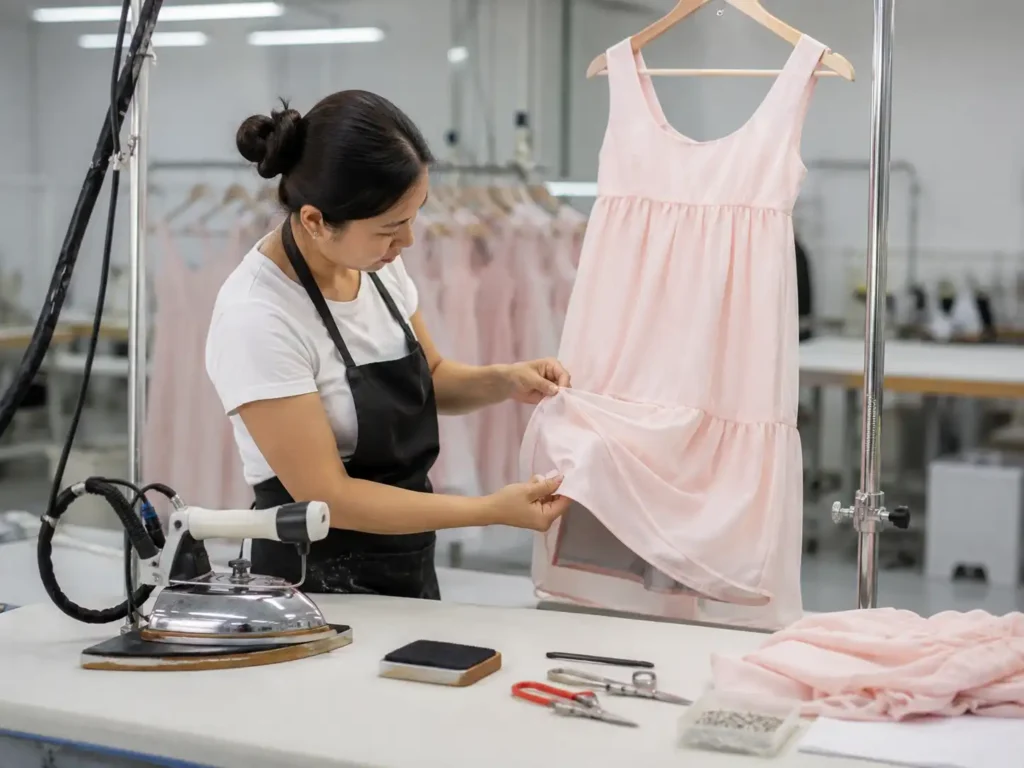
A sample can look good in a front-view photo and still fail in real quality review. The zipper may ripple from the side. The hem may be uneven at the back. The lining may pull inside. The bust may gape when the wearer moves. The side seam may twist after pressing. The garment may measure correctly in one point but feel wrong because the pattern balance is off.
This is why brands should review samples with a checklist. The checklist does not need to be complicated, but it must be specific. For dresses, the most important review points usually include measurements, silhouette, symmetry, seams, hems, zipper, straps, neckline, lining, slit, pressing, fabric defects, trim placement and comfort.
The most useful sample review combines two views: the buyer’s commercial view and the factory’s technical view. The buyer asks whether the sample looks right for the market. The factory should explain whether it can be produced consistently. When both views are aligned, the sample becomes a reliable production reference instead of a pretty one-off garment.
Measurements
Measurement review should always be based on the latest approved spec sheet. The sample should be measured flat using consistent methods, and the results should be compared with allowed tolerance. Key dress measurements usually include bust, waist, hip, full length, front length, back length, shoulder, strap length, armhole, neckline depth, sleeve length if applicable, slit height, hem sweep, lining length and zipper length.
Not every style needs every point, but every style needs a clear measurement logic. Tolerance should be realistic. Very tight tolerances may not be practical for all fabrics, especially stretch, chiffon, lace or bias-cut styles. However, fit-critical areas need closer control. A 1 cm difference in a loose maxi hem may be less serious than a 1 cm difference in upper bust on a strapless dress. A good factory measures, reports, explains and corrects. It does not hide deviations or ask the buyer to approve unclear numbers.
Workmanship
Workmanship review shows whether the sample room can sew the style cleanly and whether the construction is suitable for production. Buyers should check outside appearance and inside finishing. Look at seam straightness, stitch density, thread tension, seam allowance, overlock quality, hem finish, zipper insertion, strap attachment, lining join, dart points, pleats, gathers and reinforcement areas.
Different fabrics need different workmanship control. On satin, watch for puckering and shine marks. On chiffon, check seam stability and shifting. On mesh, check whether tension distorts the neckline or armhole. On sequin fabric, check whether seam edges scratch the skin. For fitted dresses, seams must be strong enough to handle body movement. For backless or halter dresses, strap attachment points need reinforcement. For slit dresses, the top of the slit should be secure. Clean workmanship is not only about beauty. It affects comfort, durability, customer reviews and brand trust.
Comment tracking
Sample quality cannot be reviewed properly without checking whether previous comments were applied. If the buyer requested five changes, the next sample should clearly show all five changes, not only two or three. A practical comment tracking record should include the original comment, sample version, responsible action, measurement change, pattern update, material change if any and approval status.
This is especially important when a collection has many similar styles. Several satin midi dresses may share fabric, zipper type, lining and fit logic, but have different necklines or slit heights. Without comment tracking, one style’s correction may be confused with another. Buyers should be cautious if a manufacturer relies only on scattered chat messages. Chat is useful for quick communication, but technical approvals need organized records.
Wear movement
A dress should be tested as something a person will wear, not just as a flat product. This is especially important for party dresses, occasionwear, bodycon dresses, backless styles, strapless styles and long dresses. Simple movement checks can reveal important problems. Ask whether the wearer can sit, walk, raise arms, bend slightly and move naturally without exposure, pulling, slipping or discomfort.
Check whether the slit opens too high, whether the neckline gaps, whether the hem catches, whether the zipper feels stiff and whether the lining moves correctly. These checks do not need to be complicated, but they need to happen. A dress that looks beautiful in one standing pose may fail during normal use. For commercial brands, movement comfort affects return rates and reviews. Sample quality should always include real wearing behavior.
How Does the Sample Room Support Bulk Production?
Sample room team transferring an approved PP dress sample to production: golden sample on rack, final pattern files, QC checklist, fabric card, trim card, production line in background, professional womenswear factory workflow.
The sample room supports bulk production by turning the approved sample into a clear production standard. It locks patterns, measurements, fabric, trims, sewing methods, labels, finishing, packaging and QC points before cutting begins. Its job is to make sure the production team can repeat the approved garment consistently across sizes, colors, batches and delivery schedules.
This is the most important part of sample room evaluation. Many suppliers can produce an acceptable sample. Fewer can transfer that sample into consistent bulk production. The sample room must work with production teams, QC inspectors, merchandisers, fabric sourcing and packing staff to make sure everyone follows the same standard.
For dress brands, this transfer can affect launch timing, product reviews, return rates and reorder performance. If the PP sample is not clear, production workers may interpret details differently. If measurements are not locked, size variation may appear. If fabric shading is not controlled, color inconsistency may show. If trims are not approved, substitutions may happen too late. If QC does not know the critical points, problems may reach final inspection.
A strong sample room does not disappear after the buyer approves the sample. It helps convert the approved garment into production documents, QC checkpoints and repeat-order records. That is how a sample becomes a system.
Final approval files
Before bulk production, the factory should prepare final approval files that connect the sample room to production. These files usually include the approved pattern version, measurement chart, tolerance, fabric quality, trim card, construction notes, label and packing details, PP sample photos and buyer approval record.
This paperwork may sound basic, but it prevents many production mistakes. If the cutting team uses one pattern version and the sewing line follows another sample, problems are almost guaranteed. If QC checks a measurement chart that was not updated after fitting, the inspection result becomes unreliable. The best production files are simple, clear and current. They answer the production team’s real questions: What fabric? Which side? Which trim? Which seam? Which measurement? Which sample? Which tolerance? Which packing method? Clear files reduce repeated questions and protect launch timing.
PP sample transfer
The PP sample should become the physical standard for bulk production. Production workers, line supervisors, QC inspectors, merchandisers and packing teams should all understand that this sample represents the approved garment. A strong sample room does not simply send the PP sample away and disappear. It helps transfer the standard.
This may include explaining difficult sewing points, marking critical measurements, confirming trim placement, showing inside construction and identifying areas that need in-line QC attention. For complex dresses, PP transfer is especially important. Satin zipper areas, corset structure, lace placement, mesh tension, slit reinforcement, strap attachment, lining length and hem balance should be clearly understood before bulk starts. When PP sample transfer is weak, the production line may make practical changes without buyer approval. Those small changes can quickly become visible differences in bulk.
QC connection
QC should follow the approved sample standard, not only a generic inspection checklist. A generic checklist can catch stains, broken stitches, wrong labels or poor packing. Dress-specific QC must also check fit-critical measurements, silhouette, neckline, bust, waist, hip, strap, zipper, lining, slit, hem balance and trim security.
A good sample room gives QC clear control points. On a strapless dress, upper bust, anti-slip tape, side seam, zipper and internal support may be critical. On a chiffon maxi dress, hem balance, lining length, transparency and seam neatness may matter more. On a bodycon dress, stretch recovery, hip fit, side seam twisting and hem opening need attention. QC should start during production, not only at final inspection. In-line checks help catch problems before hundreds or thousands of pieces are finished.
Repeat order value
A good sample room creates long-term value beyond one order. If the first bulk run sells well, the brand may reorder the same style, add new colors, change fabric, extend the size range or develop related styles. Organized sample records make this much easier.
Useful records include pattern files, measurement specs, fit comments, fabric references, trim details, approved PP sample photos, label files, packing requirements and QC notes. With these records, repeat production can start faster and with fewer misunderstandings. For seasonal fashion brands, this is especially valuable. A successful dress shape can become the base for several new styles. A proven corset block, bodycon fit, slip dress pattern or maxi dress silhouette can save development time and improve consistency across collections. The sample room is not only a place to solve today’s sample. It is also where a brand’s future production library begins.
| Bulk Transfer Item | What Must Be Locked | Why It Matters |
| Pattern version | Final approved pattern and grading | Prevents wrong cutting |
| Measurement spec | Final size chart and tolerance | Controls fit consistency |
| Fabric quality | Approved bulk fabric, color and shrinkage | Avoids sample-to-bulk difference |
| Trim card | Final zipper, lining, labels and accessories | Prevents unauthorized substitution |
| Sewing method | Seam type, stitch type and reinforcement | Supports repeatable workmanship |
| PP sample | Physical production reference | Aligns production and QC |
| Packing standard | Fold method, polybag, label and carton | Protects presentation and logistics |
| QC points | Fit-critical and style-critical checks | Reduces bulk defect risk |
Final Checklist Before You Approve Bulk Production
A dress manufacturer’s sample room is not a small side department. It is the control center of product development. It is where style ideas become patterns, patterns become samples, samples become approved standards and approved standards become bulk production. If the sample room is weak, every later stage becomes harder. If the sample room is strong, the whole production process becomes more predictable.
For B2B fashion brands, the right question is not only, Can you make this dress? The better question is: Can your sample room prove that this dress can be fitted, corrected, documented, costed, approved, graded and repeated in bulk? That is the question that protects your launch calendar, your product margin and your customer experience.
Before approving bulk production, confirm that the final pattern, size chart, fabric, trims, PP sample, construction method, QC points and packing requirements are all locked. Keep a clear record of fit comments, sample versions and buyer approvals. Treat the sample room as your early warning system. If the sample stage is disciplined, production has a much better foundation.
Jinfeng Apparel is a Guangdong-based premium custom women’s fashion manufacturer specializing in dresses, skirts, jumpsuits, matching sets and private-label womenswear for global fashion brands and mid-to-large custom apparel clients. Since 2008, the company has supported clients with pattern development, fabric sourcing, trim selection, sample making, bulk production, quality control, private-label packaging and export delivery.
To start a custom dress project, prepare your tech pack, reference image, original sample, line sheet, size chart, target fabric, quantity plan and packaging requirements. Jinfeng Apparel can review your design direction, evaluate sampling feasibility, develop your sample and help move approved styles toward stable bulk production.
Share This Article :

Jerry Lee
Categories

Latest blogs

Table of Contents
Here, developing your OEM/ODM private label clothing collection is no longer a challenge—it’s an excellent opportunity to bring your creative vision to life.

