
How Does Cup Shape Change Dress Fit? Bust Support, Pattern Balance, and Production Control

Your trusted Women’s Apparel Manufacturer from China

A dress can match the approved bust measurement and still sit badly on the body. The neckline may stand away from the chest, the cups may flatten the bust, the waist seam may climb toward the ribs, or the side seams may swing forward. These problems are often described as a size issue, yet the less obvious cause is frequently cup shape: the three-dimensional relationship between width, depth, projection, apex position, upper-cup openness, lower-cup volume, and support.
Cup shape changes dress fit by controlling where bust volume sits, how far the bodice projects, and where support is applied. Cup width, depth, apex position, lining, boning, fabric tension, and underbust stability influence neckline security, side coverage, waist balance, strap position, comfort, and the final silhouette. Correct cup volume alone cannot repair an incompatible three-dimensional shape.
Consider a fitted corset dress that looks clean on a standing mannequin. The waist appears sharp, the cups look symmetrical, and the zipper lies flat. Then the fit model sits down, lifts her arms, and turns sideways. The lower cup collapses, the front waist rises, and the neckline opens. The stated bust circumference has not changed; the structure simply failed to manage a real body in motion. That moment separates basic sizing from professional dress fitting.
What Is Cup Shape in Dressmaking?
Cup shape is the three-dimensional space built into a dress to receive, position, and support the bust. It is defined by cup width, depth, height, apex placement, lower-cup volume, upper-cup openness, and the surrounding structure. Cup shape is not the same as cup size because equal volume can be distributed in very different ways.
Cup Shape and Cup Size
Cup size describes an amount of volume within a particular sizing system, while cup shape describes where that volume is placed. The distinction matters because a wide, shallow cup and a narrow, projected cup can hold a similar amount of volume yet produce completely different pressure, coverage, and visual balance on the same wearer. A letter such as B, C, or D does not explain the geometry that the dress must create.
Retail bra sizing, sewing-pattern cup sizing, and molded-cup supplier codes are not automatically interchangeable. Bra labels change with band size, market, wire system, and brand practice. Dress blocks may use the difference between high bust and full bust to select a cup group, while component suppliers may number molded cups by an internal mold series. A professional tech pack therefore treats a cup label as a reference, not a complete specification.
The practical development questions are more specific: How broad is the bust root? Where is the point of maximum projection? Is the upper cup open or closed? Does the design need natural coverage, compression, lift, or a push-up effect? Once these questions are answered, the team can select or build a cup that supports the intended body profile rather than forcing the body into a generic component.
Core Cup Measurements
A full-bust circumference is useful, but it cannot describe cup shape on its own. That measurement includes the front bust, side body, back width, posture, and soft-tissue distribution. Two fit models can share the same full-bust number while needing different cup bases, front lengths, and apex positions. Reliable development combines the full bust with the high bust, underbust, apex-to-apex distance, shoulder-to-apex length, cup-base width, and underbust-to-apex height.
An illustrative comparison makes the point. Two models might both measure 92 cm at the full bust, yet one may have an 86 cm high bust and a wider back, while the other may have an 82 cm high bust and stronger forward projection. Those figures are not a grading rule; they simply show why the same circumference can sit on two very different frames. Selecting the entire garment from the full bust alone may oversize the shoulders and armholes for the more projected model.
Experienced pattern teams often establish the upper frame from the high bust or shoulder structure, then add or remove localized bust volume. This preserves the neckline, shoulder width, and armhole while correcting the area that actually needs space. The table below shows how each measurement should be documented so that pattern, sample, and quality teams are working from the same reference.
Measurement | Specification Format | What It Controls | Common Risk |
High bust | Circumference in cm or in | Upper frame and base pattern size | Oversized shoulders or armholes |
Full bust | Circumference through apex | Overall bust capacity | General tightness or excess ease |
Underbust | Circumference below bust | Cup base and bodice anchoring | Sliding or floating structure |
Apex-to-apex | Horizontal point-to-point distance | Cup spacing and center-front balance | Cups appear too wide or close |
Shoulder to apex | Vertical length from HPS | Bust-point height | Darts and seams point incorrectly |
Cup base width | Measured along cup root | Side coverage and wire shape | Underarm pressure or gaping |
Cup depth | 3D depth or approved physical reference | Forward projection | Flattening or empty apex space |
Underbust to apex | Vertical cup measurement | Lower-cup volume | Collapse or lower-cup compression |
Width, Depth, and Apex
Cup width is the horizontal space around the base of the bust. Cup depth is the forward distance from that base to the fullest point. The apex is the location of maximum projection. These variables can change independently, so increasing one does not automatically correct the others. A wider cup can still be too shallow, and a deeper cup can still place its fullest point too high or too far apart.
The apex is especially important because most shaping lines are aimed toward it. Bust darts, princess seams, cup seams, gathering, and molded peaks all depend on the correct bust-point position. When the apex is misplaced, the garment can look poorly cut even if the circumference is within tolerance. Satin, structured mesh, bonded fabrics, and corset panels reveal this error quickly because their surfaces show every curve and tension line.
Corrections should therefore be directional. If the bust is compressed at the center but the side edge fits, the cup may need more central depth rather than greater width. If the side edge cuts into the body while the apex has space, the base may need to widen without increasing projection. Clear comments such as move the apex inward, add lower-cup depth, or open the upper edge are far more useful than a general instruction to make the cup larger.
Common Cup Constructions
Molded foam cups have a fixed three-dimensional form created by heat and pressure. They produce a smooth surface and can be efficient in repeat production, but the available fit is limited by the mold. Trimming the top or side edge changes coverage without fundamentally changing the internal depth, base width, or projection. A visually neat molded cup can therefore remain anatomically incompatible with the target body.
Seamed cups build volume through two or more shaped panels. By changing seam curvature, panel width, and grain direction, a pattern maker can add lower-cup depth, strengthen side support, open the upper cup, or move the apex. This gives greater fit control, although curved seams must be sewn consistently. Small differences in seam allowance or pressing can create left-right variation that becomes obvious in smooth fabrics.
Soft cups rely on darts, gathers, princess seams, lining, or fabric tension rather than rigid foam. Underwired and corset-style cups may combine foam, seams, wire, boning, elastic, and structured lining. Even a dress without a visible insert still has a cup shape in the broader fitting sense because the front pattern must create space for the bust. The construction method changes how that space is formed, supported, and repeated in bulk.
How Does Cup Shape Change Dress Fit?
Cup shape changes dress fit by controlling where bust volume sits and how tension travels through the bodice. Incorrect depth causes compression or empty space, incorrect width affects side coverage, and an incorrect apex distorts seams and darts. These local issues can then alter the neckline, armholes, straps, waistline, zipper, side seams, and hem balance.
Cup Depth and Projection
Cup depth controls how much room the bust has to project forward. When the cup is too shallow, the bust cannot settle into the intended space and pushes against the structure. Pressure then moves to the nearest flexible areas, which may be the neckline, underarm, center front, or side seam. The result can look like a small size even when the cup base and total circumference appear reasonable.
Common signs of insufficient depth include horizontal strain lines, a flattened bust profile, overflow at the upper or side edge, and an underbust seam that sits below the natural bust root. The front waist may rise because the bodice is borrowing vertical length to travel over the bust. In stretch fabrics, the same problem may appear as excess shine, transparency, or a hem that pulls upward rather than an obvious hard wrinkle.
A cup that is too deep produces the opposite pattern: empty apex space, collapsing foam, lower-cup wrinkles, or an unnaturally pointed profile. Depth should also be diagnosed by location. Some bodies need more volume below the apex, while others need central or upper projection. Adding volume evenly around the whole cup may unnecessarily enlarge the neckline, side edge, and armhole, so the correction should follow the exact pressure or empty-space pattern.
Cup Width and Coverage
Cup width determines how the dress surrounds the bust at its base. It influences side coverage, center-front spacing, underarm comfort, and the relationship between the cup and any wire, boning, or side-front seam. A cup can have enough total volume yet still fail because that volume begins and ends in the wrong places across the torso.
When the base is too narrow, the bust may sit partly outside the cup. The wearer can experience side pressure, underarm bulging, or a wire that rests on soft tissue rather than around the bust root. When the base is too wide, the cup can extend into the arm area, spread the bust outward, flatten the center, and leave a loose upper or inner edge. Both conditions can be mistaken for a simple size problem.
Width changes also affect the design. Widening a cup may move the side-front seam, strap position, neckline edge, and boning channel. A correction that improves physical coverage can still weaken the intended silhouette if these surrounding elements are left behind. For this reason, width is best assessed from the front, side, and three-quarter views, with the arms moving naturally rather than held in a rigid fitting pose.
Apex Position and Seam Balance
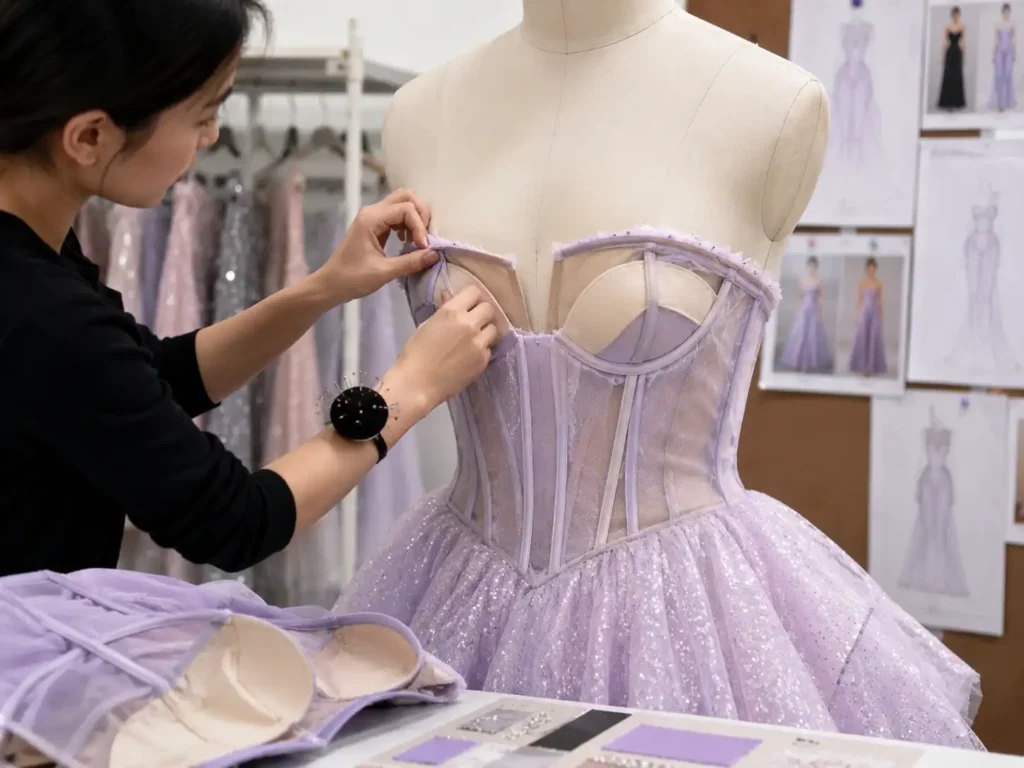
The bust apex is the point of maximum projection and the reference that organizes most front-bodice shaping. Darts, princess seams, cup seams, gathering, and decorative panel lines should relate to that point even when they stop short of it. If the apex is too high, the lower cup may look empty while the upper edge presses into the body. If it is too low, the bust can look unsupported and the upper cup may wrinkle.
Horizontal placement matters just as much. An apex that is too far apart can create a broad, outward silhouette, while an apex that is too close can compress the inner bust and leave unused side volume. Misplacement also shifts visual details: a sweetheart peak, lace motif, print placement, or cutout may no longer align with the body. In fitted styles, these errors are noticeable before a customer can explain exactly what looks wrong.
Apex corrections must preserve volume and seam logic. Moving the visible seam without reshaping the cup can create a cosmetic improvement while leaving the pressure unchanged. The pattern team should review center front to apex, shoulder to apex, underbust to apex, and apex-to-apex distance together. Revised samples should then be compared with the original fit comments so that the adjustment solves the actual problem rather than merely relocating it.
Whole-Bodice Effects
Cup-shape problems rarely stay inside the cup because the bust consumes both width and length in the front body. When the cup lacks projection, the side seam may pull forward and the front waist may rise. When the upper cup is too open, the neckline may gape. When the cup base is unstable, straps may be tightened to compensate, creating shoulder pressure without solving the underlying support issue.
This explains why moving to a larger dress size often gives a disappointing result. The larger size adds room to the shoulders, back, armholes, waist, and hips as well as the bust. The wearer gains space in one area while losing the intended shape elsewhere. A localized full-bust adjustment, small-bust adjustment, princess-seam correction, cup replacement, or front-length change is usually more precise than uniform grading.
A useful diagnosis begins with the visible symptom and then traces the tension back to its source. The table below connects common problems with the cup-related causes that should be reviewed first. It is not a substitute for fitting, but it helps teams avoid treating every neckline, strap, or zipper issue as an isolated sewing defect when the true cause may be the three-dimensional bust shape.
Visible Fit Problem | Possible Cup-Related Cause | Areas to Review |
Neckline gapes | Excess upper-cup space or weak edge control | Upper cup, neckline length, elastic, apex |
Front waist rises | Insufficient projection or front length | Cup depth, FBA, waist seam, front balance |
Armhole gapes | Excess side volume or misplaced shaping | Cup width, side seam, armhole curve |
Side seam pulls forward | Front bodice lacks localized volume | Cup depth, front width, pattern balance |
Straps feel too tight | Straps are carrying support the bodice lacks | Underbust, cup base, strap position |
Back zipper arches | Front and back tension are unbalanced | Cup volume, waist reduction, boning |
Front hem looks shorter | Bust consumes excess vertical length | Front bodice length and skirt balance |
Cup edge shows through | Component shape or lining is unsuitable | Cup size, seam allowance, lining, pressing |
Which Cup Shape Fits Each Bust Profile?
The best cup shape follows the wearer’s distribution of volume rather than relying on a cup letter alone. Shallow busts usually need more width and less depth, while projected busts need greater forward space. Upper or lower fullness changes cup-edge tension, and bust spacing affects center-front placement. A larger cup is not automatically a better-shaped cup.
Shallow and Projected Busts
A shallow bust distributes volume over a broader area with less forward projection. A deep, narrow cup can leave empty space near the apex even when the edges feel tight. The wearer may see central wrinkles, a pointed appearance, or a cup that looks too sculpted for the body. The correct direction is often a wider base with moderate depth rather than a uniformly smaller cup.
A projected bust carries more volume forward and may have a narrower root relative to its depth. A shallow cup compresses that projection, pushes the cup or underbust seam downward, and can lift the front waist. Side overflow may appear even when there seems to be space at the center because the bust is being redirected rather than fully received. Deeper center and lower-cup space often solve the problem more effectively than a larger overall dress size.
Some profiles combine a broad root with strong projection, so the development team must add both width and depth. This is a reminder that fit categories are not rigid boxes. The useful approach is to observe where the body begins, where it projects, and where the sample creates pressure or emptiness. Structured components should match the target profile from the start, while softer fabrics can accommodate more variation if the front length and shaping remain correct.
Upper and Lower Fullness
Bust volume may be concentrated above or below the apex, and this changes how the cup edge behaves. A full-on-top profile often needs a more open upper cup. A rigid or closed edge can cut into the body even when the lower cup fits, producing visible overflow or a doubled contour under smooth fabric. Tightening the neckline to control movement usually makes this pressure worse.
A full-on-bottom profile needs more lower-cup capacity and may leave space along a tall or rigid upper edge. The correct response is not always to reduce the entire cup. The team may need to deepen the lower panel, soften the top edge, or reshape the seam so that volume is removed from the upper area without losing support below. Seamed cups make this redistribution easier than fixed molded shapes.
The desired silhouette also influences the choice. A push-up party dress intentionally moves volume upward and inward, while a slip dress may preserve a softer, lower, and more natural line. A cup can be comfortable but visually inconsistent with the design brief, or visually dramatic but unsuitable for normal movement. Fit review should judge body compatibility, comfort, and the promised fashion effect together rather than treating any one shape as universally correct.
Spacing and Asymmetry
Bust spacing changes cup position relative to the center front. Close-set profiles generally need less distance between apexes, while wide-set profiles require greater spacing and more side-oriented shaping. If cups are too far apart, the bust may be pushed outward and the center can look flat. If they are too close, the inner edge may press into the body while the outer cup remains underfilled.
Spacing becomes especially visible in sweetheart, deep-V, cutout, balconette, and corset designs because the cup boundaries form part of the style. A small positional error can make the neckline look uneven or place decorative lace, seams, and cutouts away from the natural bust line. The center-front bridge, cup separation, strap location, and side coverage should therefore be reviewed as a connected arrangement rather than as independent measurements.
Natural asymmetry is common: one side may have slightly more volume, a different apex height, or a different root width. Mass-produced dresses cannot be individually tailored to every variation, but the structure should tolerate normal differences without twisting, collapsing, or exposing a cup edge. Flexible upper edges, balanced lining, and stable side support are often more forgiving than highly rigid cups, especially under smooth satin or bonded fabrics.

Why Bigger Is Not Always Better
Increasing cup size usually changes several dimensions at once, including width, depth, height, and sometimes apex spacing. That can solve one issue while creating new ones. A wearer who needs more depth may receive unwanted width; a wearer who needs a broader base may receive too much central projection. In a finished dress, the larger component may also interfere with the armhole, neckline, side seam, or strap position.
The better question is which part of the cup is incorrect. Compression at the apex with comfortable side coverage suggests more depth. A side edge that cuts into the body while the center remains loose suggests a wider base or different root shape. A full lower cup with a gaping top edge suggests volume redistribution rather than an overall increase. This diagnosis keeps the correction focused and reduces the risk of over-adjusting the entire bodice.
Sample comments should describe direction and location whenever possible. Move the apex inward, open the upper edge, add lower-cup depth, or widen the base without changing the neckline gives the technical team a usable task. Make the cup bigger does not identify the problem and may encourage uniform scaling. Clear language is especially important when development, pattern, sampling, and production teams work in different locations or languages.
Bust Profile | Better Starting Direction | Common Mismatch |
Wide and shallow | Wider base with moderate depth | Deep apex remains empty |
Narrow and projected | Narrower base with stronger depth | Shallow cup compresses or shifts down |
Broad root with projection | Add width and center depth | Standard cup lacks both dimensions |
Full on top | More open or flexible upper cup | Top edge cuts into the bust |
Full on bottom | Greater lower-cup capacity | Upper edge gapes or wrinkles |
Close set | Reduced apex spacing and stable center | Cups push the bust outward |
Wide set | Greater spacing and side-oriented shaping | Center cup appears empty |
Mild asymmetry | Flexible edge with balanced support | Rigid cup reveals twisting or gaps |
How Do Dress Structures Change Cup Fit?
Dress structure determines how firmly a cup shapes the body and how support is transferred. Molded cups impose a fixed form, while seamed and soft cups allow more adjustment. Boning, underwire, lining, elastic, closures, and fabric tension decide whether the approved cup remains stable in corset, strapless, slip, bodycon, and other dress constructions.
Molded and Seamed Cups
Molded cups create a smooth appearance and suit styles where visible shaping seams are undesirable. They can improve repeatability because the form already exists before sewing, but their success depends on selecting the correct mold. A molded component may match a nominal size while being too wide, too shallow, too tall, or too closed at the upper edge for the target body and neckline.
Trimming a molded cup reduces coverage without rebuilding the internal geometry. Likewise, covering an unsuitable mold with fabric can hide the component while leaving the pressure unchanged. The development team should approve the cup from front, side, and inside views, confirm how it meets the underbust and neckline, and retain the supplier code or physical reference so that a later production batch does not substitute a similar-looking but differently shaped mold.
Seamed cups offer more control because their shape is created by panel curves. A two-piece or three-piece cup can be changed at the lower panel, side panel, center seam, or upper edge. This makes it possible to add projection, improve lift, strengthen side support, or open the neckline. The trade-off is sewing sensitivity: curved seams, notches, seam allowances, pressing, and left-right pairing must remain consistent for the approved shape to survive bulk production.
Boning, Underwire, and Support
Boning and underwire manage force rather than simply making a dress tighter. Underwire defines the lower cup boundary and distributes support around the bust root. It must correspond to the cup base and intended wearer. A wire that is too narrow can press into soft tissue, while one that is too wide may extend into the underarm, flatten the center, and fail to support the bust where the design expects.
Boning stabilizes the bodice vertically, resists folding, and helps transfer load toward the waist and back. Placement is usually more important than the total number of bones. Channels should support key seams and panel boundaries without creating hard pressure points. In fitted dresses, poorly placed boning can push the cup away from the body, distort a zipper, or create ridges that remain visible after pressing.
Structured lining, waist stay tape, anti-slip elastic, underbust elastic, power mesh, zippers, hooks, and lace-up closures complete the system. A strong cup with a weak back can still slide downward, and a tight neckline cannot replace a stable underbust. Each component should have a clear role, an approved material reference, and a construction method that can be repeated across sizes and production lines without changing the intended silhouette.
Corset and Strapless Dresses
Corset and strapless dresses have little tolerance for cup-shape error because the bodice must remain stable without normal shoulder support. A secure structure usually depends on six connected areas: the cup receives the bust, the underbust supports the cup base, boning resists collapse, the waist anchors the garment, the back provides controlled tension, and the neckline edge prevents local rolling or opening.
Tightening only the top edge rarely solves a sliding strapless dress. Excessive edge tension can create overflow while the lower bodice continues to move downward. Corset styles introduce another balance issue because waist reduction affects torso length and cup position. If the waist is over-reduced, the entire bodice may be pushed upward, making the cups appear too high even when their original pattern placement was correct.
Fit testing should include sitting, walking, turning, breathing deeply, and raising the arms. A corset dress can look perfect while the model stands still and fail during ordinary movement. Review points include the upper bust, full bust, underbust, center front, side seam, back height, zipper flatness, boning position, cup symmetry, and waist comfort. The neckline should remain secure without cutting into the body, and the waist should anchor without forcing the structure upward.
Slip, Bodycon, and Soft Dresses
Slip and bodycon dresses contain less visible engineering, yet cup shape still controls the fit. These styles rely more heavily on fabric stretch, bias behavior, lining, seam shaping, and carefully planned ease. A bias-cut slip can follow curves gracefully, but the fabric may lengthen after hanging or wearing. Necklines and armholes that look stable on the cutting table can open once gravity and body movement act on them.
Bodycon dresses use stretch to accommodate volume, but stretch cannot replace correct pattern geometry. If the front bodice lacks projection or vertical length, the fabric overstretches across the bust, becomes shinier or more transparent, and pulls the waist or hem upward. A material with generous stretch but weak recovery may look acceptable during the first fitting and then loosen after repeated movement, creating a different cup shape over time.
The key fabric properties are stretch percentage, stretch direction, recovery, weight, thickness, and surface friction. Soft structures can accommodate more natural variation than rigid corsets, but only when the fabric and lining are tested together. The outer material may stretch more than the lining, or a smooth satin may slide over the cup while a grippy mesh holds it. Pattern, component, and fabric decisions must therefore be evaluated as one system.
How Do Brands Control Cup Fit in Production?
Brands control cup fit by converting the approved three-dimensional shape into measurable specifications, physical references, graded patterns, controlled components, and inspection checkpoints. A dependable process includes a detailed tech pack, representative fit model, movement testing, size-set review, PP or Golden sample approval, inline inspection, and packing methods that protect the cup from distortion.
Tech Pack Specifications
A tech pack should describe the cup as an engineered component rather than using a vague note such as insert C cup. Useful specifications include the cup type, supplier or mold reference, base width, height, depth, apex location, cup spacing, foam thickness, underwire shape, boning position, lining, neckline coverage, seam allowances, and approved tolerances. The exact list depends on whether the design uses molded foam, seamed panels, soft shaping, or a full corset structure.
For seamed cups, the document should show panel shapes, seam directions, notches, grain lines, and construction order. For molded cups, it should identify the approved mold or physical component rather than relying only on a supplier size code. Front, side, and inside drawings are valuable because the side view shows projection while the inside view explains how the cup connects to the lining, underbust, boning, elastic, and closure.
The tech pack should also identify the base size, intended fit model, target market, and desired silhouette. Natural, rounded, lifted, compressed, and push-up are different outcomes. When these decisions remain unwritten, the sample room must guess, and two competent teams may produce visibly different dresses. A sealed cup component or complete approved sample is often the strongest reference for a complex structured style.
Fit Sample Review
Fit samples should be evaluated on a suitable live model whenever possible. A mannequin helps with symmetry, balance, and construction, but it cannot reproduce breathing, posture, soft-tissue movement, or comfort. The model should stand naturally, turn, raise the arms, sit, walk, and test the closure. These simple actions reveal sliding, cup collapse, neckline opening, and pressure points that static photographs often miss.
Comments should be separated into volume, width, depth, apex position, neckline coverage, underbust support, fabric tension, movement stability, comfort, and visual silhouette. This keeps unrelated corrections from being mixed together. Increasing depth may relieve compression but lower the neckline; moving an apex may improve seam direction while creating side imbalance. Each revised sample should be compared with the previous version and the original design reference.
Measurable language shortens the correction cycle. Move the apex down 6 mm, add lower-cup depth without increasing the upper edge, or reduce center-front cup spacing gives the pattern and sample teams a specific task. Make it fit better does not. Photographs should include front, side, back, and inside views, with the model in a neutral posture and in movement so that the approval reflects both appearance and wearability.
Grading Across Sizes
Cup grading should reflect how the target body changes across the size range rather than enlarging every cup dimension equally. The grading plan needs to define how width, depth, height, spacing, apex position, underbust, neckline coverage, strap position, wire, and boning change. A larger full-bust measurement does not mean that all additional circumference belongs at the front; some increase may come from the back, rib cage, and side body.
A single proportional cup block may work across a limited range, but a broader range often needs additional cup groups or component sizes. One molded cup family stretched across too many sizes may fit the middle acceptably while becoming too tall in smaller sizes and too shallow in larger ones. Size-set review should include selected sizes below and above the base, with attention to coverage, side support, apex position, waist balance, and movement.
Passing the measurement chart is not enough. A garment can meet full-bust and underbust tolerances while the cup grows in the wrong direction. The smallest size may have excessive cup height, while the largest size may gain width without adequate depth. Fit teams should compare the visual proportion of the neckline, cup, straps, and torso across the size set so that grading preserves the design rather than merely increasing circumference.

Production and QC Control
Cup shape must be protected from incoming material inspection through final packing. Bulk production introduces variables that do not appear in a single development sample, including foam batches, wire curves, fabric relaxation, cutting direction, seam handling, operator technique, pressing temperature, and carton pressure. The approved PP or Golden sample should remain available to production and quality teams because flat measurements cannot fully describe a three-dimensional cup.
Inspection should begin before sewing. Incoming cups, foam, wire, boning, elastic, and lining are compared with approved references. Cutting teams check grain direction, panel accuracy, notches, and left-right pairing. Sewing teams review curved seam allowance, apex matching, channel position, and cup symmetry on the first production pieces. Inline inspectors then compare measurements and appearance by size before a large quantity is completed.
Packing deserves equal attention because molded cups can be crushed by tight folding or heavy carton pressure. Structured dresses may require tissue, inserts, shaped folding, hanging, or a controlled carton load. A reliable system does not depend on final inspection alone; it identifies variation at component approval, cutting, sewing, and inline stages, when the cause can still be corrected without reworking a finished order.
Production Stage | Cup-Fit Check | Practical Control Method |
Incoming materials | Mold shape, foam thickness, wire curve, elastic recovery | Compare with sealed component or approved sample |
Cutting | Panel accuracy, grain, notches, left-right pairing | Overlay pattern and check first cut bundles |
Sewing start-up | Seam curvature, apex match, channel position | Approve first production pieces before line release |
Inline inspection | Bust, underbust, spacing, neckline, symmetry | Measure and compare selected pieces by size |
Pressing | Cup distortion, shine, crushed foam, seam flattening | Use approved temperature, pressure, and forms |
Final inspection | Support, appearance, exposed edges, zipper balance | Compare with PP or Golden sample |
Packing | Collapse, pressure marks, deformation | Use inserts, suitable folds, and controlled carton load |
Cup shape is one of the clearest examples of how dress fit depends on more than a circumference. The cup must match the target body’s width, projection, apex, spacing, and fullness, but it must also cooperate with the neckline, fabric, lining, waist, back, straps, and closure. The commercial value appears when that approved relationship can be documented, graded, reproduced, and protected through bulk production rather than achieved only on one development sample.
Jinfeng Apparel has focused on custom women’s fashion manufacturing since 2008, supporting structured dresses, corset styles, occasionwear, bodycon designs, and private-label collections through pattern development, sample revision, PP sample approval, bulk production, and quality control. The production system includes dedicated sample rooms, senior pattern makers, sample machinists, and staged inspection. Standard custom production starts from 200 pieces per style and color, subject to fabric, component, construction, and scheduling requirements.
Share This Article :

Jerry Lee
Categories

Latest blogs


Table of Contents
Here, developing your OEM/ODM private label clothing collection is no longer a challenge—it’s an excellent opportunity to bring your creative vision to life.

