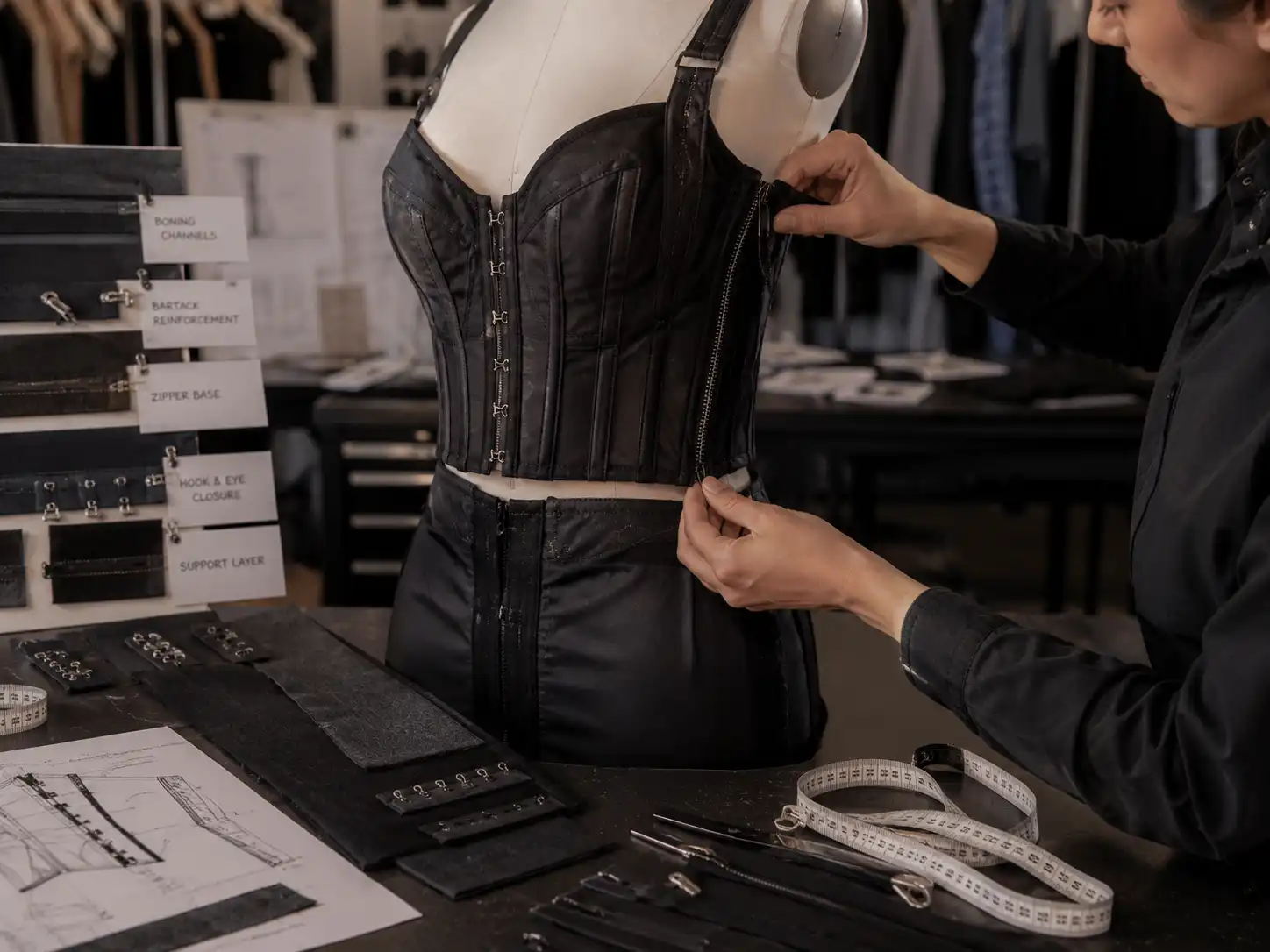
A zipper may be one of the smallest items on a dress bill of materials, yet it can change the way the garment is put on, how a fitted seam sits against the body, how smoothly the lining behaves, and even whether the finished piece feels refined or frustrating. That is why choosing between a closed-end and an open-end zipper should not be treated as a last-minute trim decision. The useful starting question is simple: does the garment need to open for access, or does it need to separate completely into two sections?
Closed-end zippers remain connected when fully opened, while open-end zippers separate into two halves. Most conventional dresses use a closed-end zipper because they only need enough opening for the wearer to get in and out. Open-end, or separating, zippers are more common on jackets and convertible garments. Fabric weight, stretch, lining, zipper placement, seam structure, and body tension still determine the final specification.
The difference sounds obvious until production begins. A satin dress can develop a wave along the center back, a bodycon style can become difficult to close once it is on the body, and a structured corset dress can put much more load on the zipper than the sketch suggests. Those problems are rarely solved by asking only whether the zipper is “open” or “closed.” The more useful approach is to understand the zipper as part of the pattern, fabric, seam, lining, and wearing experience. The sections below show how that decision works in real garment development.
What Is a Closed-End Zipper?
A closed-end zipper opens along its usable length but remains permanently connected at the bottom. A fixed bottom stop prevents the slider from leaving the chain and keeps both zipper tapes joined. This construction is widely used in dresses, skirts, trousers, jumpsuits, pockets, and other garments that need enough opening for dressing without requiring the garment to separate into two pieces.
What Closed-End Means
“Closed-end” describes the way the zipper terminates, not the material used for its teeth or the way it looks on the garment. A closed-end zipper may use nylon or polyester coil, molded elements, or metal teeth. It may be exposed, partly concealed, or installed as an invisible zipper. The defining feature is that the two tapes remain connected when the slider reaches the bottom, so the opening becomes larger without turning the garment into two separate pieces.
That distinction matters because zipper terms are often mixed together during development. “Invisible zipper,” for example, describes a concealed coil construction and the way the chain sits inside a seam. It does not describe the end configuration by itself, even though invisible zippers used in dresses are normally closed-end. In the same way, a metal zipper can be closed-end or separating depending on how the bottom is built. End construction, chain type, visual finish, and installation method should be treated as separate specification fields.
In dress development, the closed-end format is usually appropriate when the zipper is functioning as an entry opening. The wearer only needs enough extra circumference to pass the garment over the shoulders, bust, waist, or hips. Once the garment is on the body, the seam below the zipper stays connected and helps maintain the intended silhouette. This is particularly important in fitted woven dresses where the finished waist may fit correctly but cannot pass over the hips unless the opening is long enough.
How the Bottom Stop Works
The bottom stop prevents the slider from travelling beyond the end of the chain and keeps the two sides joined at the lower termination point. Mechanically, the job is simple, but the garment construction around that stop deserves careful attention. In a fitted dress, the lower end of the zipper often sits near a part of the body where circumference changes quickly, so the transition from an open seam to a permanently stitched seam can become a visible stress point.
If horizontal pulling lines, a small bump, or waviness develops near the zipper base, the zipper itself may not be defective. The cause can be insufficient garment ease, excessive seam bulk, a zipper that is too stiff for the shell fabric, uneven sewing tension, or an opening that ends in the wrong place relative to the waist or hip. A sample that looks flat on a hanger can behave differently once the garment is under body tension.
For that reason, zipper evaluation should include sitting, standing, walking, and repeated opening and closing. The technician should also look at the seam from the side rather than only from the back. This reveals whether the bottom stop area is projecting away from the body, whether the lining is adding bulk, and whether the pattern needs correction before changing the zipper specification.
Common Dress Applications
Closed-end zippers are most useful where the garment needs controlled access without complete separation. Typical applications include center-back and side-seam dress closures, skirts, trousers, fitted jumpsuits, structured tops, pockets, and certain boots or fashion accessories. In womenswear, the same end construction can serve very different silhouettes, so zipper length and chain type should always follow the pattern rather than a generic category rule.
A backless mini dress may need only a short zipper because the open back already creates substantial entry space. A high-neck woven midi with a fitted waist can require a much longer opening so the garment passes comfortably over the shoulders and hips. Jumpsuits often need longer openings because the wearer must negotiate both the torso and hip area. The best length is usually the shortest one that still gives comfortable access without creating unnecessary stiffness, cost, or sewing difficulty.
The ranges below are practical development references, not mandatory standards. Actual zipper length should be confirmed on the fit sample and measured using the zipper supplier’s agreed method.
| Garment Application | Common Development Range | Main Concern |
| Short side-seam dress opening | 20-35 cm | Underarm comfort and hip access |
| Center-back mini or midi dress | 35-55 cm | Waist and hip entry |
| Long fitted woven dress | 45-60+ cm | Dressing access and seam stability |
| Skirt | 15-25 cm | Waist and hip access |
| Jumpsuit | 40-60+ cm | Torso access and body movement |
| Short backless dress | 15-30 cm | Limited seam length and clean finish |
Closed-End Is Only One Specification
Specifying only “closed-end zipper” leaves too much room for interpretation. Product teams still need to define the chain construction, approximate gauge, slider, puller, tape color, chain color or finish, usable length, garment placement, and installation method. A fine concealed coil zipper designed for satin is not interchangeable with a heavier exposed metal zipper simply because both stay connected at the bottom.
The relationship between the zipper and the garment is more important than choosing the strongest-looking component. Lightweight satin, chiffon, lace, or mesh generally benefits from a closure that does not dominate the seam. A structured corset dress may need a more robust solution because the zipper can carry meaningful tension at the waist and bust. Sequin styles may require additional clearance around the chain so decoration does not interfere with the slider.
The practical lesson is that closed-end describes only the termination. It answers one important question—whether the garment stays connected when the zipper is open—but not the questions of weight, flexibility, visibility, durability, or compatibility with the pattern. Those decisions have to be made together during sample development.
What Is an Open-End Zipper?
An open-end zipper is designed to separate completely into two halves when fully opened. Instead of a fixed bottom stop, it normally uses an insertion pin and retaining box that allow the zipper tapes to disconnect and reconnect. Open-end zippers are commonly used for jackets, coats, hoodies, and other garments where complete separation is an essential part of how the product is worn.
What Open-End Means
“Open-end” refers to the zipper’s ability to separate completely at the bottom. When fully opened, the left and right tapes become independent pieces. To close the zipper, the wearer normally inserts a pin into the retaining box, seats it correctly, and then pulls the slider upward. That operation is fundamentally different from a dress zipper that simply expands an opening while the lower seam remains connected.
The construction solves a different product problem. A closed-end zipper creates temporary access into a garment; an open-end zipper joins two garment panels that are meant to function independently once the zipper is released. That is why separating zippers are standard on many jackets. When the jacket is opened, each front panel needs to move freely, and the wearer expects the garment to come apart at the hem rather than remain tethered by a small section of zipper.
Open-end construction should not be treated as a quality upgrade. It can be made in light coil, molded plastic, or metal systems, and quality varies within every category. The correct choice is the one that matches the garment’s intended behavior. If complete separation adds no practical or design value, the extra hardware may simply introduce bulk and a more complicated sewing operation.

Pin and Box Function
The bottom assembly of a conventional separating zipper usually contains an insertion pin on one tape and a retaining box on the other. Before the slider can engage the chain correctly, the pin must be inserted fully and aligned. This sounds routine on a jacket front because the wearer can see and reach the hardware, but the same mechanism can become awkward if it is placed at the center back of a fitted dress.
The surrounding garment must also support the starting action. Excess lining, folded seam allowances, bulky waist seams, or soft fabric can make it harder to seat the pin accurately. A poorly supported bottom can twist while the user is trying to start the zipper, which makes the garment feel lower in quality even when the zipper itself is technically sound. The pin, box, tape reinforcement, and sewing around the base therefore work as one system.
For fashion garments, the starting area should be tested repeatedly on the sample. The user should be able to insert the pin without fighting the fabric or holding several layers out of the way. If a separating mechanism is part of the design concept, ease of operation deserves the same attention as appearance.
Where Open-End Zippers Are Used
Open-end zippers are most common on garments that must open completely from an edge, including jackets, coats, hoodies, zip-front cardigans, some sportswear, and convertible fashion pieces. In these products, the zipper is not simply a dressing aid. It is the connection between two sections of the garment, which means its end construction directly affects how the product is worn.
Fashion designers also use separating zippers for removable overskirts, detachable panels, modular dresses, transformable outer layers, or pieces that can switch between several silhouettes. These applications can be visually strong and commercially interesting, but the separating function should have a reason to exist. A full-length zipper added only for decoration can introduce extra weight and stiffness without improving the wearer experience.
In dress development, the location of the pin-and-box assembly deserves particular attention. Hardware sitting near the waist, hip, or hem can create a hard point against the body. If the opening is at the back, the wearer also needs to reach and align the mechanism. A successful separating closure therefore combines concept, accessibility, comfort, and clean construction.
One-Way and Two-Way Options
Open-end zippers can use one slider or two. A conventional one-way separating zipper closes upward after the bottom pin is inserted. Two-way separating systems use two sliders, allowing the lower section to open upward while the upper section remains closed. This is useful on longer coats and jackets because releasing the lower portion gives more room for sitting, walking, cycling, or stepping into a car.
Two-way hardware can also be used deliberately in fashion design. A long zip-front dress or coat-dress may use the second slider to control how much of the lower opening is exposed. The effect can be both functional and visual, but the extra slider increases weight and adds another alignment point that must be controlled during sewing and quality inspection.
For most conventional dresses, the added complexity is unnecessary unless the design truly benefits from adjustable separation. A more complicated zipper is not automatically more premium. The better closure is the one the wearer understands immediately, can operate comfortably, and can rely on after repeated use.
How Are Closed-End and Open-End Zippers Different?
The main difference is separation. A closed-end zipper stays connected at the bottom when fully opened, while an open-end zipper separates into two independent tapes. That change affects the bottom hardware, user operation, pattern construction, installation, and suitable garment applications. Neither type is inherently better; the correct choice depends on whether the garment needs an access opening or complete panel separation.
Separation and Bottom Construction
The fastest way to understand the two zipper types is to inspect what happens at the bottom. A closed-end zipper normally stops at a fixed lower point and keeps the tapes connected. An open-end zipper uses a starting mechanism that allows one tape to disengage completely from the other. That small difference changes how the zipper interacts with the pattern and how the wearer handles the garment.
On a closed-end dress zipper, the seam continues below the opening, so the zipper becomes one controlled access point within an otherwise connected garment. On a separating jacket zipper, the zipper line is the boundary between two panels that must disconnect. As a result, the lower edge of the pattern, facing, lining, and reinforcement must be designed around different hardware and different user movement.
The comparison table below shows the most useful practical distinctions. It is more meaningful than asking which zipper is stronger, because strength depends on chain size, material, tape, slider, sewing, and load. End construction primarily determines function.
| Feature | Closed-End Zipper | Open-End Zipper |
| Fully separates | No | Yes |
| Typical bottom component | Fixed bottom stop | Insertion pin + retaining box |
| Primary function | Creates an access opening | Joins two separable panels |
| Typical dress use | Common | Limited or design-specific |
| Typical jacket-front use | Uncommon as main closure | Common |
| Invisible zipper use | Common | Rare |
| Lower-end user action | Slide only | Insert pin, align, then slide |
| Detachable panel use | Not suitable | Suitable |
Separating vs Non-Separating Terms
In everyday apparel production, “open-end” and “separating” are commonly used for a zipper that comes apart completely, while “closed-end” and “non-separating” are used for a zipper whose tapes remain joined. The terms are useful, but supplier catalogues may add categories such as one-way separating, two-way separating, reversible, waterproof, molded, coil, or specialty systems.
For that reason, technical files should describe the required behavior instead of depending on a short name alone. “One-way separating front zipper” is more precise than “open zipper.” “Closed-end invisible zipper, center back” is more precise than “zipper.” When a collection contains several closure systems, that extra clarity reduces the chance that a factory or trim supplier substitutes something that is technically similar but functionally wrong.
This becomes particularly important in multi-style production. A single collection may use fine invisible zippers on satin dresses, stronger closed-end zippers on structured corset dresses, and molded separating zippers on jackets. Consistent terminology helps purchasing, sampling, sewing, and repeat production refer to exactly the same component.
Function Matters More Than Strength
It is easy to assume that a separating zipper is stronger because it is often used on jackets, or that an invisible closed-end zipper is weaker because it looks finer. Neither conclusion is reliable. Strength depends on the zipper chain, approximate gauge, tape construction, slider, stop design, seam reinforcement, sewing quality, and the actual load placed on the closure.
A lightweight coil separating zipper can be less robust than a heavy closed-end metal zipper. A fine invisible zipper can perform well in a fitted satin dress when the pattern carries the body load correctly, yet the same zipper can struggle in a heavily structured corset bodice if the garment is relying on the closure to absorb excessive tension. The useful comparison is therefore not “open versus closed” but “specified load versus actual garment demand.”
Many apparent zipper failures are really mismatch failures. The trim may be too stiff for the shell, too light for the structure, too short for comfortable dressing, or installed into a seam that stretches differently from the zipper tape. The end type tells you how the zipper opens; it does not guarantee how well it will perform.
How to Identify Them
A quick physical check usually settles the question. Open the zipper completely. If the two tapes remain connected, the zipper is non-separating or closed-end. If the tapes become two independent pieces, the zipper is separating or open-end. Then inspect the lower hardware: a fixed bottom stop points toward closed-end construction, while an insertion pin and box assembly identifies a typical separating zipper.
After that, identify the remaining specifications separately. Look at the chain type, approximate gauge, tape material, slider, puller shape, finish, color, usable length, and installation style. This sequence is particularly helpful when reverse-engineering a reference garment because it prevents the team from concentrating on visible details while missing the functional architecture.
Clear photographs can support this process. A close-up of the zipper top, slider, chain, bottom hardware, and garment placement is far more useful than a distant full-body image. For repeat styles, preserving the approved trim card or sample reference gives production teams an even stronger standard.
Which Zipper Is Best for Dresses?
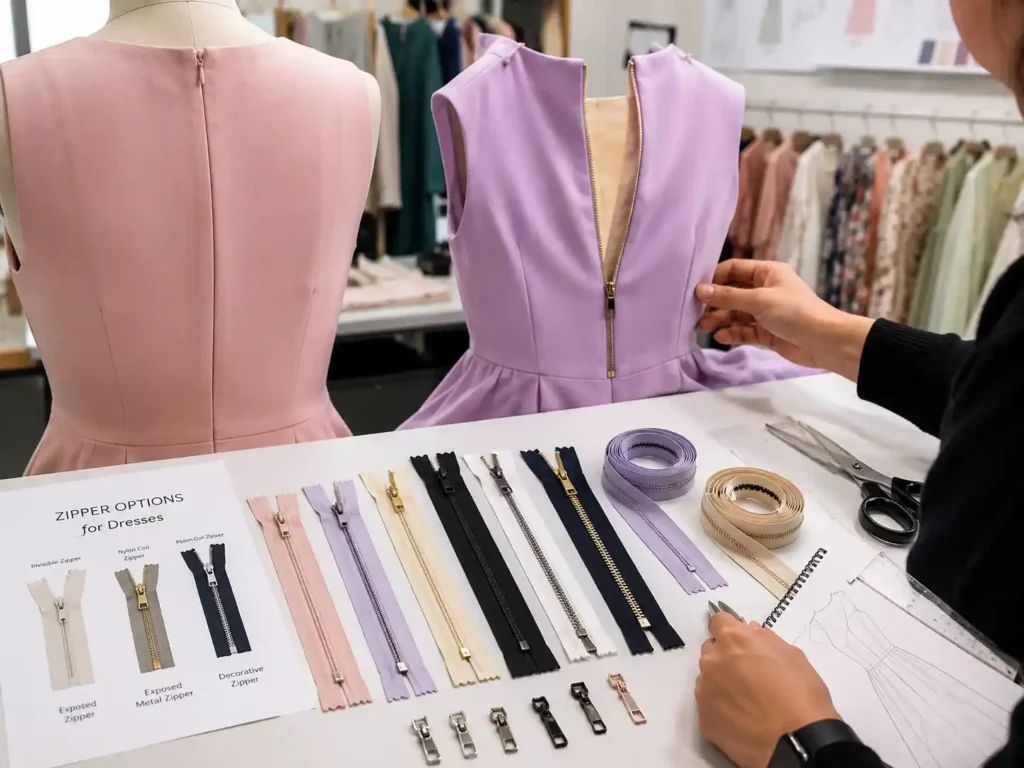
For most conventional dresses, a closed-end zipper is the practical starting point because the garment needs an opening for dressing rather than complete separation. Invisible closed-end zippers are especially common in fitted, occasion, satin, and woven dresses. The final specification should still reflect fabric weight, stretch, body tension, zipper position, garment structure, lining, and the amount of opening needed for comfortable entry.
Access, Not Separation
The purpose of a dress zipper is usually to create enough temporary opening for the wearer to get into the garment. Consider a fitted woven midi with a waist that sits close to the body and very little stretch. The finished waist can fit perfectly once the dress is on, yet that same circumference may be too small to pass over the wearer’s hips. Opening the side or center-back seam solves the access problem without requiring the dress to split into two pieces.
That is why closed-end zippers are so common in dresses, skirts, and many jumpsuits. They let the pattern temporarily gain usable opening length while the seam below the zipper remains structurally connected. The length should be established during fitting rather than chosen from habit. A zipper that is too short can make dressing uncomfortable, while an unnecessarily long zipper can add stiffness, cost, and extra sewing operations.
The fit test should include the actual dressing route. It is not enough for the sample to close when already placed on a dress form. Someone should put it on, remove it, sit, and move naturally. This quickly reveals whether the opening length is practical.
Invisible Zippers in Dresses
Invisible zippers are widely used when the closure should disappear into the seam rather than become a visual feature. Their coil is designed to roll toward the back of the tape, allowing the seam to close close to the chain. This makes them a common solution for satin dresses, cocktail dresses, eveningwear, fitted woven styles, bridesmaid dresses, and skirts.
The concealed appearance does not automatically make an invisible zipper suitable for every dress. Thick waist seams, multiple lining layers, boning, dense lace, or heavy embellishment can create local bulk that interferes with the slider. High body tension can also make a fine zipper difficult to close even when the trim itself is good. In these cases, the pattern and seam architecture need as much attention as the zipper.
Delicate surfaces deserve special care. Satin can show puckering and sewing damage, mesh can stretch away from stable zipper tape, and lace or sequin edges can catch in the slider. The closure should therefore be judged on the complete sample, not as a loose trim on the worktable.
Choice by Dress Construction
Different dress constructions put different demands on the closure. A satin slip dress needs a light, smooth installation that does not interrupt drape. A woven bodycon dress needs enough opening for hip access while controlling tension at the zipper seam. A corset dress may contain boning, cups, lining, interfacing, and several seam intersections, making local bulk and closing force more important than in a simple sheath.
Lace and mesh add their own problems. Lace motifs and loose threads can interfere with the slider, while soft mesh can stretch differently from zipper tape. Sequin dresses require the seam allowance to be managed so hard embellishment does not sit directly in the zipper path. Backless dresses often need shorter openings because the open back already gives the wearer more entry space.
The table below shows practical starting directions. These are not universal standards; sampling remains the deciding step because two dresses in the same category can have completely different pattern geometry.
| Dress Construction | Common Zipper Direction | Primary Development Risk |
| Satin slip or fitted satin | Fine closed-end / invisible where required | Rippling, snagging, seam show-through |
| Woven bodycon | Closed-end | Hip access, seam strain |
| Corset dress | Closed-end selected for load | Waist tension, bulky intersections |
| Lace dress | Concealed closed-end | Lace catching, motif disruption |
| Mesh dress | Lightweight closed-end | Stretch mismatch, transparency |
| Sequin dress | Closed-end with cleared seam allowance | Sequin interference |
| Backless dress | Shorter closed-end where needed | Limited seam length, clean finish |
| Full-front fashion dress | Closed or open-end by function | Whether full separation is required |
When Open-End Makes Sense
A dress can use an open-end zipper when full separation is genuinely part of the product concept. A zip-front fashion dress may be designed to open completely. A convertible piece may use separating zippers to remove an overskirt, sleeves, or decorative panels. Performance clothing can also use them when rapid dressing is important. In these cases, the zipper is functioning as a modular connection rather than a conventional seam opening.
The design team still needs to consider what happens at the bottom hardware. A pin-and-box assembly positioned near the waist, hip, or hem can create a hard point and may be more visible than expected. User access also matters. A separating front zipper is easy to reach, while a separating center-back zipper can be frustrating because the wearer cannot see the pin clearly.
Before approving an open-end zipper in a dress, the sample should answer three practical questions: does complete separation add real value, can the wearer operate it easily, and does the hardware sit comfortably against the body? If not, a closed-end solution is usually cleaner.
How Does Garment Construction Affect Zipper Choice?
Garment construction often matters more than the simple closed-end versus open-end label. Fabric weight, stretch and recovery, seam position, lining, embellishment, body tension, and zipper length determine whether the closure sits flat and operates reliably. A technically correct zipper can still perform badly when its stiffness, tape, installation method, or placement does not match the garment around it.
Fabric Weight and Zipper Stiffness
A zipper should behave like part of the garment rather than a rigid strip attached to it. Lightweight fabrics such as satin, chiffon, mesh, or fine jersey expose distortion easily. If the zipper tape is significantly heavier or stiffer than the shell, the seam can become visibly rigid, causing a ridge or wave that interrupts otherwise fluid drape. Fine satin is particularly unforgiving because reflected light makes small irregularities easier to see.
The opposite mismatch happens in structured dresses. A closure that is too light can feel unstable when installed next to interfacing, boning, cups, waist seams, or several lining layers. The slider may also struggle where seam thickness changes abruptly. Zipper numbers such as #3 and #5 are commonly used as approximate size categories, but actual dimensions vary by manufacturer, so the number should be treated as a sourcing reference rather than a complete strength specification.
A sample team should compare zipper flexibility with fabric hand, seam bulk, expected tension, and the visual scale of the garment. The strongest available zipper is not automatically the best one. Balance usually produces the cleaner result.
Stretch and Recovery
Stretch fabrics create a built-in mechanical mismatch because the garment may extend significantly around the body while the zipper tape remains relatively stable. In a bodycon dress, the shell can stretch across the bust, waist, and hips but the zipper seam behaves more like a fixed vertical strip. If the pattern relies on excessive negative ease near that seam, the zipper area can develop horizontal drag lines, bulging, or difficult slider movement.
Stretch percentage alone is not enough to predict the outcome. Recovery, fabric weight, seam placement, garment ease, and pattern shape all matter. A fabric that stretches 30 percent but recovers poorly can behave very differently from another fabric with similar stretch and stronger recovery. The zipper does not need to duplicate the fabric’s extension; instead, the pattern should distribute body tension so the closure is not asked to absorb more load than intended.
Fit testing should include standing, walking, sitting, and bending. If the zipper operates smoothly when the dress is flat but becomes difficult on the body, the first investigation should be fit and load distribution rather than simply specifying a heavier zipper.
Zipper Placement
Center-back, side-seam, and front zippers can provide similar access but create different fit and construction conditions. A center-back zipper follows the changing curves of the upper back, waist, and hip. On highly fitted dresses, poor pattern balance or insufficient shaping can show up as zipper waviness because the stable tape highlights even small deviations in the seam line.
A side zipper is less visible from the back but passes through an area where circumference changes quickly between bust, waist, and hip. The upper end also needs enough clearance from the underarm so the slider and top stop do not irritate the wearer. Front zippers are easier to operate and can become a deliberate design feature, but any misalignment or ripple is highly visible because it sits at the visual center of the garment.
Placement also changes the required zipper length. A strapless or backless style may already provide substantial entry space, while a fitted high-neck dress may need a much longer opening. Zipper location should therefore be resolved during pattern development, before bulk trim quantities are ordered.
Lining, Corsetry and Embellishment
Construction becomes more demanding when the zipper seam intersects several materials. A corset dress may combine shell fabric, lining, interfacing, boning channels, cups, waist seams, and decorative overlays. If too many layers converge beside the chain, the slider can encounter a sudden increase in thickness, and the outside seam may develop a visible lump even when the zipper itself is correctly specified.
Lace creates a different risk. Loose motifs, eyelash edges, or fine threads can catch in the slider, so the seam allowance often needs careful clearing and stabilization. Sequin fabric usually requires hard decoration to be removed or controlled in the zipper path. Sewing directly through dense sequins can cause broken needles, uneven stitches, excess seam bulk, and interference with the slider. Lining also needs enough clearance so it does not get pulled into the chain during repeated use.
These are reasons to approve the zipper on a fully constructed sample whenever possible. Testing the loose trim tells you almost nothing about how it will behave once several real garment layers are sewn around it.
How Do Manufacturers Control Zipper Quality?
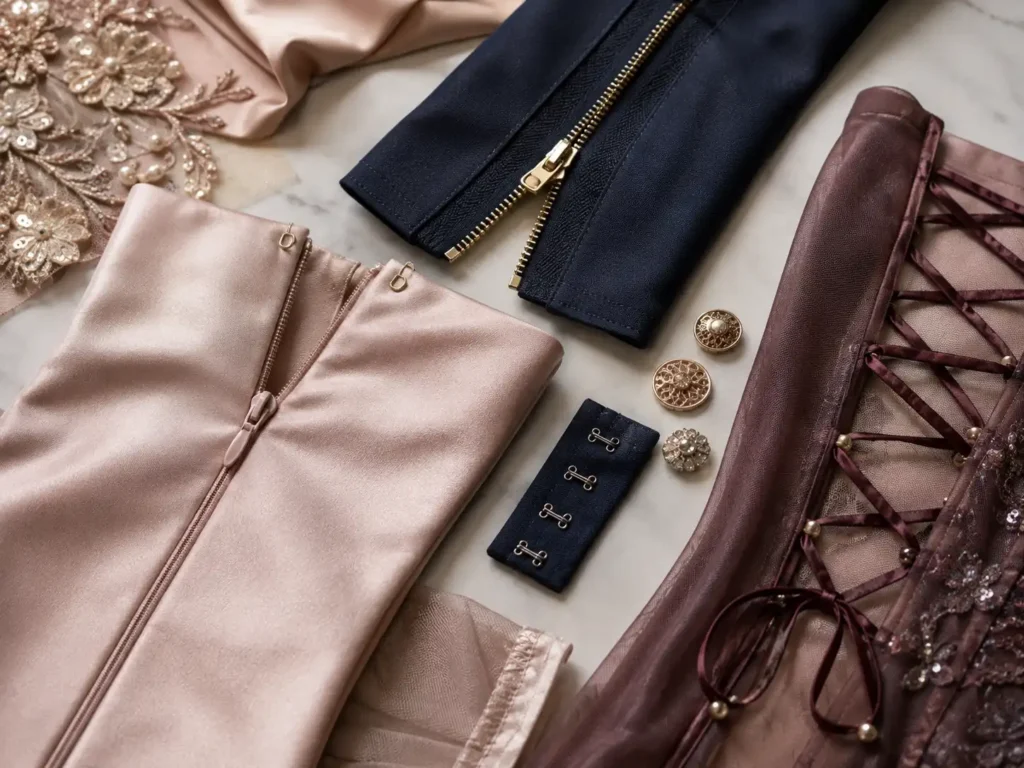
Manufacturers control zipper quality by defining the component before bulk production and checking it through trim approval, sample fitting, incoming inspection, sewing, in-line inspection, finished-garment QC, and repeat-order records. Reliable control covers zipper type, length, color, slider, operation, installation position, seam appearance, and interaction with the garment rather than checking only whether the slider moves.
Tech Pack Specifications
A useful tech pack should describe the zipper in enough detail that a merchandiser, trim supplier, sample room, and production line can reproduce the approved result without guessing. At minimum, the file should identify whether the zipper is closed-end or separating, the chain construction, finished usable length, tape color, chain color or finish, slider type, garment placement, and installation method.
For styles where the zipper is visible, the puller shape and hardware finish may also be part of the design language. For concealed closures, placement measurements can be more important. Instead of writing only “center-back zipper,” the technical file can identify where the zipper begins relative to the neckline and where it ends relative to the waist or hip reference line. When possible, an approved physical trim card or supplier reference gives production an even stronger standard.
The point is not paperwork for its own sake. Each field removes one decision from the factory floor. When a closure is left vague, different people can make individually reasonable choices that produce inconsistent results across samples, colors, sizes, or repeat orders.
Sample and Fit Approval
A zipper can pass an incoming trim check and still perform badly once it is sewn into the garment. Sample review should therefore evaluate the complete closure system: opening length, slider movement, seam flatness, bottom termination, top-stop comfort, lining clearance, garment tension, and the interaction between the zipper tape and the shell fabric.
Repeated operation is useful. Open and close the sample several times rather than judging the zipper after one cycle. Fit it on the intended body shape, sit and stand, and observe whether the seam changes under tension. A tight waist can make a perfectly good zipper seem defective because the slider is being asked to close against more load than the pattern should carry. A soft stretch fabric can make the zipper look rigid even though the component meets its own specification.
The garment should also be checked after pressing and finishing. Steam, pressure, and handling can change how delicate fabrics sit around the seam. Satin may reveal shine or puckering that was not obvious earlier. Approval is strongest when it is based on a sample that represents the final construction as closely as possible.
Bulk Inspection and Common Defects
Bulk control begins when the zippers arrive, not at final inspection. Incoming checks can confirm the correct type, length, color, slider, finish, and obvious operation issues. During sewing, line control should monitor zipper position, matching points, seam feeding, and the lower termination. Finished garments then need another functional check because a trim that was good before sewing can be distorted, damaged, or obstructed by the garment construction.
Common production issues include incorrect zipper length, wrong tape color, slider finish mismatch, wavy seams, uneven top positions, bulging near the zipper base, fabric or lining caught in the slider, lace or sequin interference, difficult operation, loose stops, and inconsistent placement between sizes or colorways. Each defect needs diagnosis rather than an automatic decision that the zipper supplier is at fault.
A wavy seam may come from differential feeding or pattern tension. Difficult closing may come from insufficient garment ease. A hard bump can be created by stacked seam allowances. Good QC separates component defects from construction defects so corrective action addresses the cause instead of merely changing the trim.
Repeat Orders and Trim Records
Repeat orders often appear easier because the style has already been approved, but trims can drift between production batches. The original zipper color may no longer be available, a supplier may propose a similar chain, a slider finish may change, or a substitute tape can have slightly different stiffness. Without records, each replacement can seem minor until the new garments no longer match the approved standard.
Useful repeat-order records include zipper type, usable length, tape and chain color, slider specification, supplier reference where available, garment placement, installation notes, approved trim card, and the sealed sample or Golden Sample used for comparison. Multi-color collections benefit particularly from this discipline because nude, ivory, white, navy, black, and seasonal colors may require separate tape approvals even when the zipper construction is identical.
For brands developing custom womenswear, a manufacturer should be able to connect those records with the BOM, pattern, sample approvals, sewing instructions, and QC comments. Jinfeng Apparel uses zipper type, length, and color as part of repeat-order trim records, allowing the closure to be checked against the approved garment rather than rebuilt from memory.
Conclusion
Closed-end and open-end zippers solve different garment problems. A closed-end zipper creates a controlled opening while keeping the garment connected; an open-end zipper allows the two sides to separate completely. For most dresses, that makes a closed-end construction the natural starting point, particularly at center-back and side-seam openings. Open-end zippers become valuable when complete separation is deliberately part of the product, such as a jacket-style front, removable panel, or convertible design.
The harder decision begins after that basic classification. Satin, mesh, lace, sequin, bodycon, corset, and structured evening dresses all place different demands on zipper flexibility, seam stability, opening length, body tension, lining clearance, and sewing technique. A reliable closure is therefore the result of pattern work, trim specification, sampling, fitting, and production control working together. When those pieces are aligned, the zipper disappears into the wearing experience instead of becoming the first problem the customer notices.