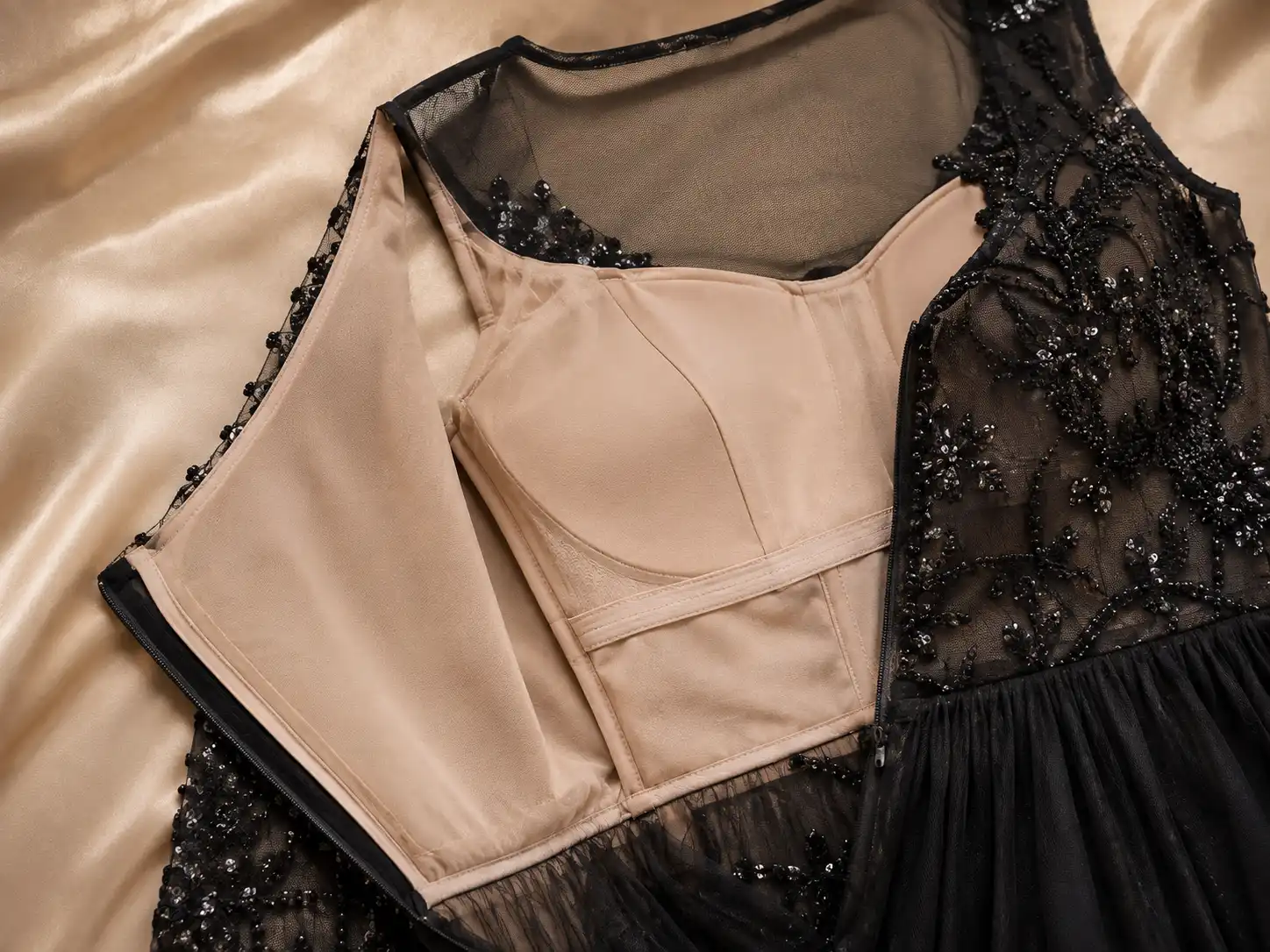
A dress is often judged by what can be seen first: the satin sheen, a clean neckline, a sculpted waist, a soft mesh layer or the way a skirt moves in a short video. Yet many of the details that decide whether that dress actually works are hidden. Lining, underlining, interfacing, boning, cups, underwires, elastic, support tapes and reinforcement layers influence how the outer fabric hangs, how firmly a bodice holds the body, whether a sheer panel feels secure and whether the garment still looks balanced after hours of movement. In development, these hidden materials are not an afterthought. They are part of the architecture of the dress, and changing one internal component can alter fit, comfort, drape and even the apparent quality of the outer fabric.
Internal materials affect dress structure by controlling stiffness, support, stretch, opacity, drape and shape retention. A soft outer fabric can become more stable with reinforcement, a strapless bodice can stay in position through boning and anti-slip support, and a sheer dress can gain coverage through carefully planned lining. The right combination depends on the shell fabric, silhouette, fit target, wearing conditions and production method.
This becomes obvious when two dresses cut from similar-looking satin reach a fitting. One may fall softly and skim the body, while the other keeps a firm waist and structured bust because its internal construction uses a different lining, cup and boning system. Neither result is automatically better. The better result is the one that matches the design brief and can be reproduced consistently in production. That is where internal materials stop being invisible sewing supplies and start becoming one of the clearest explanations for why a dress feels polished, unstable, stiff, comfortable or disappointing once it is worn.
What Are Internal Dress Materials?
Internal dress materials are the hidden fabrics and support components used to control opacity, shape, stability, stretch, comfort and fit. They include lining, underlining, interfacing, boning, bra cups, underwires, elastic, anti-slip tape and reinforcement tapes. These materials are not interchangeable; each solves a different construction problem, and some influence the final silhouette much more strongly than others.
Lining, Underlining and Interfacing
Lining is the internal layer most consumers recognize, but it is not simply any fabric placed behind the shell. A conventional lining usually forms a separate inner layer that covers seams, reduces direct skin contact with rough construction, improves opacity and helps the garment move more comfortably over the body. Even when its purpose is mainly comfort and finish, its weight, stretch, friction and recovery can still change how the outer fabric hangs. A lining that is too heavy can pull on a fluid skirt, while a lining that stretches less than a fitted shell can become the real limit on movement.
Underlining behaves differently because it is generally cut to correspond with the outer garment panel and handled together with the fashion fabric during construction. It can add body, reduce transparency, stabilize delicate material or provide a stronger base for seams and support components. Interfacing is usually more localized. It may reinforce a neckline, facing, waist area, opening or closure without changing the whole dress. The practical issue is placement: reinforcement that is too firm or ends abruptly under smooth satin can become visible from the outside, while reinforcement that is too soft may add cost and bulk without solving the original stability problem.
| Internal material | Main function | Typical areas | Practical specification to check |
| Lining | Opacity, comfort, inner finish | Bodice, skirt, sleeves | Weight, stretch, color, friction, shrinkage |
| Underlining | Panel stability and body | Bodice, skirt panels, delicate shells | Drape compatibility, opacity, seam bulk |
| Interfacing | Local reinforcement | Neckline, facing, waist, closure | Firmness, adhesion, edge visibility |
| Boning | Vertical structural support | Corset, bustier, strapless bodice | Length, stiffness, channel width, end finish |
| Bra cup | Bust volume and shaping | Corset, evening, party dresses | Cup depth, width, placement, symmetry |
| Underwire | Defined bust support | Structured bodices | Wire shape, casing, pressure points |
| Anti-slip tape | Edge grip and security | Strapless upper edge | Grip, stretch, skin comfort |
| Power mesh | Stretch support | Bodycon panels, corset lining | Stretch direction, recovery, weight |
Boning, Cups and Underwires
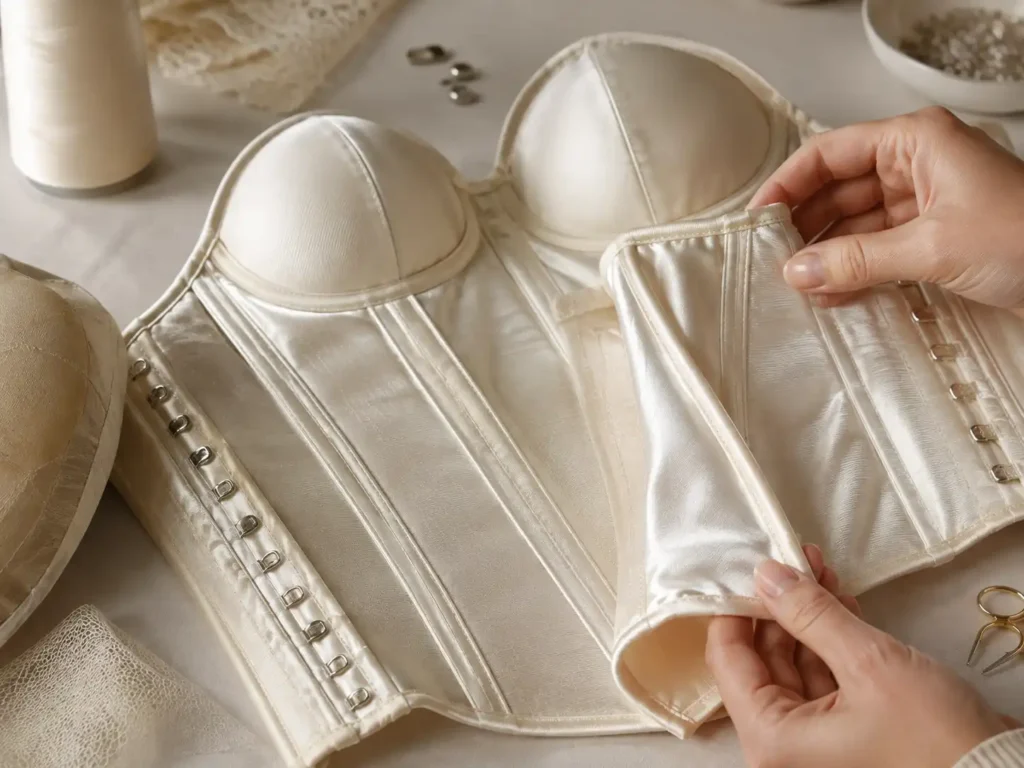
Boning, cups and underwires belong to a more active group of internal materials because they directly influence how the garment carries load around the torso. Boning helps resist vertical folding and can keep a structured bodice from collapsing when the wearer bends, sits or moves. The useful question is not how many bones can be added, but where support is actually needed. A bone that ends at an uncomfortable point can press into the body, while one that is too short may fail to stabilize the section where the bodice starts to buckle.
Bra cups create volume and define bust shape, so cup width, depth, projection and vertical position need to work with the bodice pattern rather than simply matching a nominal size label. Underwires can provide more defined support under the bust, but they also require accurate casing and careful positioning to prevent pressure points. In practice, these components should be fitted as a system. Changing a cup, bone or wire late in development can alter neckline tension, side-seam balance, waist fit and even how a back zipper lies against the body.
Elastic, Tapes and Hidden Reinforcement
Small internal components can have a disproportionately large effect on how a dress behaves. Elastic may stabilize a waist seam, support gathers or allow a fitted section to recover after stretching. Stay tape can control a neckline or diagonal edge that would otherwise grow during sewing and wear. Anti-slip tape can improve security at a strapless upper edge without forcing the entire bodice to be excessively tight. Used well, these trims make it possible to strengthen only the zones that need help while keeping other areas soft and comfortable.
The risk appears when hidden trims are selected only by width, color or price. Two elastics of the same nominal width can have noticeably different resistance and recovery. Two tapes can vary in thickness, grip and skin feel. A stronger option may look safer during sampling but create puckering, pressure or distorted seams when repeated across production. Experienced development teams compare these components by stretch direction, recovery, firmness, surface behavior and sewing compatibility, then confirm the result on an actual garment rather than relying on the supplier description alone.
Are All Internal Layers Structural?
Not every internal layer is intended to make a dress firmer. A lightweight lining may improve comfort and opacity while contributing almost no meaningful stiffness. A soft underlayer may reduce transparency without changing the silhouette very much. In contrast, boning or a firm interfacing can deliberately resist deformation. The distinction matters because adding internal material is not automatically the same as adding useful structure. A dress can become heavier and more expensive without becoming better controlled if the added layer does not address the force that is causing the problem.
A practical way to judge any hidden material is to ask what job it is expected to perform. Is it there to cover the body, reduce friction, stabilize an edge, support the bust, resist vertical collapse, control stretch or protect the skin from sequins and rough seams? Once the function is clear, material selection becomes much more precise. This also helps avoid the common development mistake of solving every issue with a heavier lining, which can improve one area while changing drape, comfort and movement somewhere else.

How Do Internal Materials Change Dress Structure?
Internal materials change dress structure by altering how the garment responds to gravity, body tension and movement. They can increase stiffness, stabilize edges, distribute pressure, limit stretch or hold a specific shape. The same outer fabric can therefore produce a soft, fluid dress or a sharply defined silhouette depending on the weight, placement and mechanical behavior of the hidden layers underneath it.
Stiffness and Silhouette
Stiffness determines how easily a dress follows the body and gravity. A soft construction tends to collapse toward the wearer and react quickly to movement, while a more structured construction can hold a neckline, define a waist or keep a bodice standing away from the body. This is useful in corset dresses, strapless occasionwear and sharply shaped mini dresses, but it can become a problem when the design depends on fluid movement. A bias-style satin dress can lose much of its appeal if a firm internal layer forces the skirt to move like a much heavier fabric.
The transition between reinforced and unreinforced zones is just as important as the stiffness itself. If the center front of a smooth bodice is heavily supported while the side panels remain soft, directional light may reveal a clear change in surface tension. The best results usually come from graded structure: strong support where the garment carries load, light stabilization where edges need control and deliberate softness where movement is part of the silhouette. The goal is not maximum rigidity. It is enough resistance to preserve the intended shape without making the dress look or feel overbuilt.
Support and Fit
Fit and support are related but different. Fit describes how the garment corresponds with body measurements and intended ease, while support describes how the garment holds its position and shape once it is being worn. A strapless dress can match the bust and waist measurements on a specification sheet and still slip downward when the wearer moves. Making the whole bodice tighter may reduce slipping, but it can also create underarm pressure, zipper strain and visible horizontal pulling. A more balanced solution shares the load across upper-bust control, cups, boning, stable lining and anti-slip support.
Structured dresses should therefore be assessed during realistic movement, not only during a short standing fitting. Sitting can reveal boning that is too long, raising the arms can show whether a strapless neckline migrates downward, and walking can expose twisting around the waist or back zipper. A technically correct measurement chart cannot predict all of these behaviors because support depends on where tension is distributed. When structure is working well, the dress feels secure without requiring extreme compression at one seam or one narrow band around the body.
Stretch, Recovery and Drape
Stretch dresses are particularly sensitive to hidden materials because the least flexible layer often becomes the effective limit of the entire garment. A shell with generous stretch offers little practical benefit if the lining, binding or internal tape stops extending much earlier. A simple development comparison can use the same marked length on each material: stretch percentage equals the stretched length minus the original length, divided by the original length, multiplied by 100. For example, a 10 cm section that extends to 13 cm has approximately 30% extension.
Recovery deserves a separate check because a material can stretch easily and still fail to return close to its original length. Weak recovery may lead to growth around the waist, hip or seat after wear. Drape creates the opposite concern: a lining that is too heavy or too resistant can stop satin, crepe or soft jersey from moving naturally. The most reliable approach is to test the shell and internal material separately, then test them again as a sewn assembly because seams, elastic and bindings can change the effective stretch and movement more than the loose swatches suggest.
Shape Retention Over Time
Shape retention is what happens after the dress has been worn, sat in, stretched, packed and handled rather than immediately after pressing. A structured sample can look excellent on a mannequin yet gradually lose its intended form if the internal system does not recover well. Waist seams may grow, strapless edges may relax, cups may shift slightly and soft panels can crease around boning channels. These changes can be subtle at first, but they become much more obvious in fitted or highly structured silhouettes.
For that reason, the most important internal reinforcement is often concentrated in load-bearing areas rather than applied everywhere. The upper bust, neckline, waist and closure zone may need greater dimensional stability than a flowing skirt panel. This keeps the garment supportive without unnecessary weight. In repeat production, shape retention also depends on material consistency. A substitute lining with the same fiber description may behave differently because of construction, finish or elastane performance, so repeat orders benefit from comparing new material lots against retained approval references rather than assuming that a similar composition will produce the same result.
Which Internal Materials Suit Different Dresses?
The right internal materials depend on the dress silhouette, shell fabric and fit requirement. Corset and strapless dresses need concentrated bust and upper-body support, satin styles need smooth low-bulk construction, mesh and lace require deliberate opacity planning, and bodycon dresses need internal layers with compatible stretch and recovery. Applying one lining or reinforcement formula across every dress category usually creates unnecessary compromises.
Corset and Strapless Dresses
Corset and strapless styles usually need the most deliberate internal engineering because the garment must maintain its position without relying much on shoulder support. Common components include boning, molded or sewn cups, structured lining, underwire, anti-slip tape and stable closures. The exact combination depends on neckline shape, bust volume, shell fabric and the intended level of compression. A lightweight party mini with a softly shaped bodice may need less support than a formal corset dress designed to create a strong waist and a clearly defined bust.
During fitting, the upper edge should stay close to the body without cutting into the skin, the cup should contain rather than flatten the bust, boning should remain vertical and the center-back closure should lie flat. The wearer should be able to sit and raise the arms without the bones pressing painfully into the torso. These checks are especially important because a dress can look secure in a front photograph while failing at the side or back. For a custom program, reviewing the internal construction during sampling can prevent late changes to cups or boning from forcing another round of pattern correction.
Satin Dresses
Satin needs restrained internal construction because its smooth reflective surface reveals pressure, seam bulk and uneven tension quickly. A heavy lining can change the hand of a lightweight satin, while thick seam allowances, cup edges or abrupt interfacing boundaries can create visible ridges. Directional light makes these defects easier to see than flat factory lighting, so structured satin samples should be reviewed from the front, side and back under lighting that catches surface changes rather than hides them.
The challenge becomes greater when satin is used for corset or occasionwear styles because the dress needs both visual smoothness and real support. The internal layer must stabilize the bust and waist, but the shell should still look soft and uninterrupted. This usually calls for selective reinforcement rather than simply increasing thickness everywhere. Pressing also needs care because excessive heat or pressure can leave shine and seam impressions. A well-developed satin dress therefore balances four things at once: support, low bulk, controlled seam tension and enough freedom for the shell to keep its characteristic fluid appearance.
Mesh and Lace Dresses
Mesh and lace add another question beyond stiffness: where should the body remain visible, and where should the garment become opaque or supportive? That decision should be made before the pattern is finalized because lining boundaries become part of the visual design. A nude lining can preserve a sheer illusion, a tonal lining can deepen color, and a contrast lining can deliberately change the look. Power mesh may add support in fitted zones, but it can be too firm for areas that are supposed to look light and transparent.
Lace also introduces motif placement and surface texture. A full lining may make coverage simple but can flatten the depth that makes lace attractive. Partial lining keeps more visual dimension but requires cleaner internal finishing and more precise edge placement. Heavily embroidered lace or sequin lace may need an additional soft barrier against the skin even when the design is intentionally sheer elsewhere. Rather than treating a sheer dress as one uniform structure, experienced teams divide it into zones that are opaque, semi-sheer and transparent, then develop the lining and reinforcement around those zones.
Bodycon and Stretch Dresses
Bodycon dresses depend on controlled tension, so hidden layers must stretch and recover in a compatible way. A non-stretch lining behind a high-stretch shell can reduce movement, create horizontal drag lines and make the garment feel smaller than its measurements suggest. Stretch direction matters as much as the total amount of extension. Some fabrics stretch primarily across the body, while others also have meaningful vertical stretch that affects torso length, seat comfort and how the dress returns after sitting.
Recovery should be checked after repeated extension rather than after a single pull. If the internal layer grows while the shell snaps back quickly, the lining may wrinkle or shift inside the dress. If the inner material is much stronger, it can pull the shell inward and create surface distortion around seams. Seams, binding and elastic also become part of the structure, so the final stretch test should be performed on a stitched assembly. A flexible fabric paired with a rigid seam can fail at the seam long before the fabric reaches its normal wearing extension.

How Should Internal Materials Match Outer Fabrics?
Internal materials should be compatible with the shell in weight, stretch direction, recovery, drape, transparency and surface behavior. They do not need identical specifications, but they should support the same design objective. A mismatch can restrict movement, make a dress unexpectedly stiff, create visible ridges, change opacity or cause the shell and lining to respond differently after wear and pressing.
Weight and Drape
Weight affects both movement and load. A heavy internal layer can pull against a lightweight shell, while an extremely light lining may not provide enough stability for a structured bodice. Small swatches are not always sufficient to judge this relationship because gravity becomes much more obvious when full-length panels are hanging. For flowing skirts, development teams often learn more by hanging larger pieces of the proposed shell and lining together and watching how they fall, separate and swing than by comparing hand-sized swatches on a table.
The table below gives practical compatibility logic rather than fixed rules because fiber content, weave or knit construction and finishing can change performance significantly even at similar weights. The point is to identify the most likely conflict before the sample is cut. If a fluid shell is paired with a much firmer inner layer, the team should expect the silhouette to become more controlled. If that is intentional, the combination can be useful. If the original design depends on movement, the same combination may be the reason the sample feels wrong even though both fabrics seem individually suitable.
| Outer fabric | Typical behavior | Internal strategy | Main mismatch risk |
| Lightweight satin | Smooth, fluid, surface-sensitive | Light lining; localized structure where needed | Bulk, ridges, loss of drape |
| Chiffon | Very light, sheer, mobile | Lightweight lining or selective underlayer | Excess weight, hem imbalance |
| Stretch mesh | High stretch, transparent | Stretch lining or power mesh by zone | Restricted stretch, seam tension |
| Lace | Open or textured surface | Tonal or nude lining, selective support | Motif flattening, visible edges |
| Ponte | Stable knit with body | Minimal or stretch-compatible lining | Unnecessary thickness |
| Jersey | Soft and stretch-led | Stretch lining only where needed | Recovery conflict |
| Velvet | Pile and directional surface | Smooth, low-friction lining | Drag, pressure marks |
| Sequin fabric | Heavy and abrasive | Protective lining, reinforced seams | Skin irritation, weight imbalance |
Stretch and Recovery
Stretch compatibility should be checked in the direction the garment actually needs to move. In a fitted dress, crosswise extension is usually important around the bust, waist and hip, while vertical extension can influence torso length, shoulder comfort and the way a garment behaves after sitting. A simple comparative test can mark a 10 cm section, extend it comfortably and record the new length. If that section reaches 14 cm, the approximate extension is 40%. The value is not a universal pass-or-fail standard; it is a consistent way to compare shell and internal materials using the same method.
Recovery is then checked after release. If the same 10 cm section settles at 10.5 cm instead of returning close to its original length, there is visible residual growth that may matter in a fitted style. The sewn assembly should be tested as well because seams, elastic, bindings and tapes often reduce effective stretch. For repeat orders or material substitutions, these comparisons are particularly useful. Two fabrics with the same fiber composition can still behave differently because the yarn, knit structure, finish and elastane percentage or quality are not necessarily the same.
Sheerness and Color
Transparency is a design specification, not simply a defect to be discovered at final inspection. White, ivory, pastel, chiffon, lace and mesh dresses can look different under daylight, strong frontal light, backlighting and studio flash. A lining that appears adequate in normal indoor lighting may become much more visible or much less opaque in photography. The location where a lining stops can also become a strong visual line, so the boundary should be deliberately placed rather than allowed to fall wherever the easiest pattern construction happens to put it.
Color interaction matters just as much. Nude lining can create an illusion effect, tonal lining can intensify a lace or mesh color, and contrast lining can become a deliberate design feature. The best choice is therefore approved on the assembled garment rather than from material codes alone. For ecommerce-focused styles, checking the sample under realistic photography lighting can be particularly valuable because the final consumer may first see the dress through high-resolution images where lining edges, color differences and unintended transparency are more obvious than they were during factory handling.
Surface and Texture
Smooth outer fabrics are sensitive to internal impressions, while textured materials create different types of risk. Satin can show seam allowances and reinforcement edges, velvet can be marked by pressure, lace can snag and sequins may scratch the wearer or catch against the lining. For these categories, internal selection should consider friction as well as weight. A lining that grips strongly against the shell can interfere with natural movement, while a smoother surface may allow the two layers to slide enough to preserve drape and comfort.
Thickness accumulation is another practical concern. Several individually thin components can become bulky where they meet at a waist or side seam: shell, lining, cup edge, boning channel, seam allowance and zipper tape may all overlap within a very small area. Reducing unnecessary overlap can improve the surface more effectively than changing the outer fabric. Good internal construction therefore considers the full cross-section of the garment. The question is not only what each hidden material does on its own, but what happens when multiple layers meet in the same fit-critical area.
What Happens When Internal Materials Are Wrong?
Incorrect internal materials can make a dress too stiff, too weak, uncomfortable, visibly bulky or dimensionally unstable. Typical symptoms include collapsing bodices, slipping strapless necklines, exposed linings, distorted cups, twisting boning, zipper bulging, restricted stretch and uneven drape. The visible defect may appear in the outer fabric even though the actual cause is a hidden material, placement or compatibility problem.
Excessive Stiffness and Collapse
Too much structure and too little structure can produce equally poor results. Excessive stiffness often appears when an internal layer is heavier or firmer than the silhouette requires. The dress may stand away from the body, lose fluid movement or show visible boundaries where reinforcement ends. Collapse appears when the shell, pattern and support system cannot resist the forces acting on the garment. A long bodice may fold at the waist, a strapless neckline may turn outward or the center front may crease once the wearer sits.
The tempting response is to add something stronger, but the underlying cause may be pattern geometry rather than material strength. A poorly positioned seam or too much vertical length cannot always be corrected with firmer boning. Likewise, a soft lining may not be the reason a neckline collapses if the upper-bust circumference is simply too large. A more reliable troubleshooting sequence starts by locating where the deformation begins, then checking pattern shape, grain, stretch direction, seam placement and support material one variable at a time. This makes the improvement understandable and therefore repeatable in production.
Lining Problems
Exposed lining is easy for consumers to notice because it makes an otherwise finished dress look careless. The cause is not always that the lining was cut too long. Different stretch, shrinkage or hanging behavior between shell and lining can gradually move the inner layer below the hem. In fitted garments, a lining can also twist or pull the shell if the two layers recover differently. At necklines and armholes, poor balance or attachment can allow the lining to roll outward even when its cut length looks correct on a flat table.
Lining should therefore be evaluated after assembly, pressing and realistic movement. Long, fluid or bias-influenced garments may also benefit from time on a hanger before the final hem relationship is confirmed because different layers can settle differently. During fitting, the wearer should walk and sit to see whether the lining climbs around the hip or pulls against the skirt. Light-colored styles need an additional check because the lining may remain physically hidden but still create an obvious tonal boundary through the shell under strong light.
Cups, Boning and Closures
Cup and boning problems often interact with each other and with the closure. A poorly positioned cup can change neckline tension, which changes how the boning sits, which can then affect the shape of the back zipper. Common cup issues include gaping at the upper edge, flattening, overflow and visible ridges where the cup ends. Moving to a larger cup does not automatically solve these problems because width, depth, placement and surrounding pattern geometry can all be responsible.
Boning defects include twisting, buckling, visible ridges and uncomfortable pressure at the ends. The channel may be too wide, the bone may be too long or the surrounding pattern may be applying too much compression at one point. A zipper can bulge even when the zipper quality itself is good if the shell, lining and adjacent support have different stability. Structured dresses should therefore be fitted as complete systems. Reviewing the cup, bone or zipper separately on a worktable cannot predict how those components will behave once body tension is applied.
Bulk Shape Distortion
A single approved sample can be excellent while bulk production gradually drifts away from it. Fabric lots may differ slightly in stretch or hand, internal components can be placed a few millimeters differently and seam allowances or pressing can vary between operators. In an unstructured dress, some of these changes may be visually minor. In a corset or fitted strapless style, several small differences can accumulate until the final garment fits noticeably differently from the approved reference.
Critical points should therefore be defined before production begins. Cup position, boning length, lining specification, upper-bust measurement and closure behavior may deserve more attention than less sensitive areas of the skirt. Different dress categories also need different priorities: a slip dress depends heavily on drape and seam smoothness, while a mesh bodycon style depends on stretch and lining alignment. Using the same inspection emphasis for every dress is convenient, but it misses the construction risks that are specific to each silhouette and material system.
How Do Manufacturers Control Internal Materials?
Manufacturers control internal materials through clear specifications, sample testing, fitting, revision and in-line production checks. The approved garment should establish reference points for lining, cups, boning, stretch, placement and comfort. Bulk control then focuses on keeping those materials and positions consistent across sizes, colors and production batches instead of relying on final inspection to discover hidden structural problems.
Material Approval
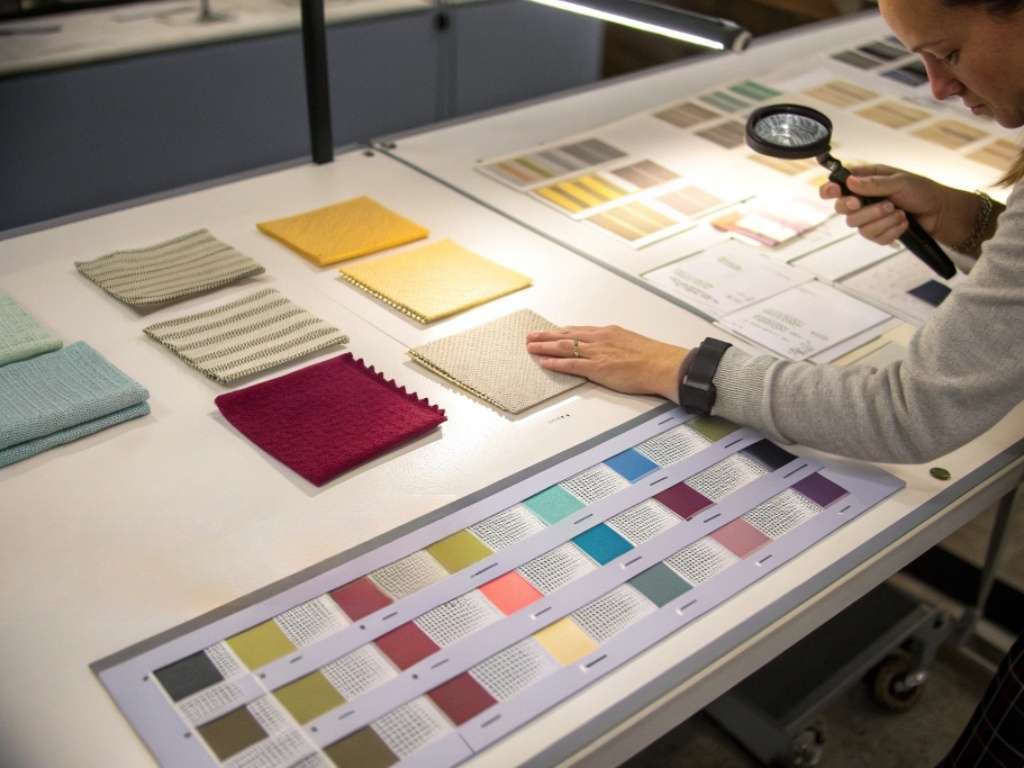
Material approval should begin before the first full sample whenever an internal component can materially affect fit. Cups, boning, power mesh, structured lining and anti-slip materials are examples where a late substitution can change the garment enough to require another fitting. Development records should include more than a supplier code. Useful information includes composition where available, weight, width, stretch direction, recovery, color, thickness and the exact location where the component is used. For boning and cups, physical dimensions and shape are often more meaningful than the fiber description.
Replacement materials should be compared with the approved reference rather than accepted because they look similar. Two linings may have nearly identical colors but different friction. Two power meshes may have similar weight but very different recovery. Two cups with the same nominal size can differ in width and projection. The first complete garment remains the most practical test because it reveals interactions that loose components cannot predict. If a hidden material changes bust position, neckline security, drape or comfort, it should be treated as a fit-related component rather than a disposable trim.
Fitting and Revision
A structured-dress fitting should include more than front and back photographs while the wearer stands still. Sitting, walking, raising the arms and turning the torso reveal how internal support behaves under real movement. Comments are easier to manage when they are separated into fit, structure, comfort and appearance. Fit covers bust, waist, hip and length; structure covers cups, boning, lining stability and neckline control; comfort covers pressure and restricted movement; appearance covers smoothness, symmetry and drape.
Revision notes should be measurable wherever possible. A comment such as “fix cup” leaves too much room for interpretation, while a note such as “lower cup position by 8 mm and reduce upper-edge tension” gives the pattern and sample teams something concrete to execute and verify. The same principle applies to lining and boning. Recording exactly what changed turns the approved sample into a technical reference rather than a one-off garment that only one sample maker knows how to reproduce.
Production Checkpoints
Internal materials should be controlled before they disappear inside the finished dress. Waiting until final inspection makes many structural defects expensive or impossible to correct. The production sequence below is practical for structured or fit-sensitive dresses, although the exact checkpoints should be adjusted according to the product. A simple slip dress does not need the same level of boning control as a corset style, while a stretch bodycon dress needs more attention to recovery and seam extension than a rigid woven dress.
| Production stage | What to verify | Practical measurable check |
| Material receipt | Shell and lining identity and behavior | Compare approved swatch, width and specified weight |
| Pre-cut check | Stretch and recovery | Test in the same direction and method as approval |
| Cutting | Grain and panel accuracy | Match pattern notches and critical dimensions |
| Cup setting | Height and symmetry | Compare left and right position from reference points |
| Boning | Length and placement | Verify channel and end positions before closing lining |
| Sewing | Seam balance | Check puckering, twisting and zipper flatness |
| In-line fitting | Bust, waist, hip and structure | Compare approved size specification |
| Pressing | Surface condition | Check shine, impressions and structural distortion |
| Final inspection | Appearance and comfort | Inspect movement-sensitive and skin-contact zones |
| Packing | Shape preservation | Confirm folding does not crush cups or structured areas |
Bulk and Repeat Orders
Bulk consistency depends on maintaining the approved internal system across the entire order. Multi-color and multi-size programs create additional risk because light colors may require more attention to lining opacity, larger sizes may place greater loads on support components and a new fabric lot may behave slightly differently from the sample lot. These differences do not always require a different construction, but they do justify verification rather than assumption. A small mismatch in several components can accumulate into a noticeable fit change once hundreds or thousands of garments are produced.
Repeat orders deserve the same discipline. A style made several months later may use a replacement lining, elastic or cup even though the product code has not changed. Retaining pattern records, measurement specifications, approved material references and final sample comments makes it easier to compare substitutes and preserve the original fit. For brands working with satin, mesh, lace, bodycon, corset or strapless dresses, discussing the shell fabric and internal structure together during sampling can save more time than trying to correct the finished silhouette after production has already started.
A successful dress does not need the most internal structure; it needs the right internal structure in the right places. Lining, reinforcement, cups, boning and support tapes should work with the shell fabric instead of fighting it. When those materials are selected around the intended silhouette, tested through movement and documented before production, the exterior looks cleaner, the fit becomes easier to reproduce and the wearer experiences fewer surprises. For brands developing complex dresses, the hidden construction is often where the difference between an attractive sample and a reliable product is decided. Treating those materials as part of the design from the beginning makes development more predictable and gives the finished dress a better chance of looking and feeling the way it was originally imagined.