Skip to content

Lining is one of the easiest details to underestimate on a dress sketch. A designer may add a short note such as “fully lined,” yet that decision can change fabric consumption, pattern work, cutting, sewing order, pressing, fitting, and inspection. Two dresses made from the same outer fabric can therefore arrive at very different manufacturing costs simply because their internal construction is different. The difference becomes especially noticeable in chiffon, mesh, lace, satin, sequin, bodycon, corset, and occasion dresses, where lining often has to solve several problems at once rather than simply hide seams.
Lining affects dress cost through five main channels: the price of the lining fabric, the amount of lining consumed, the extra pattern and cutting work, additional sewing and finishing operations, and the quality-control work needed to keep the inner and outer layers stable. Full, partial, stretch, structured, and self-lined constructions can produce very different costs even when the outside appearance looks similar.
A useful way to think about lining is to imagine two dresses hanging side by side in a showroom. From three meters away, they may look almost identical. Put them on, walk ten steps, sit down, zip them twice, and look at the hem under strong light. Suddenly, the better lining decision becomes obvious. Costing lining well means understanding what the customer will never consciously notice – because the garment simply feels right.
What Makes Up Lining Cost?
Lining cost is the combined result of material price, fabric consumption, pattern development, cutting, sewing, finishing, wastage, and inspection. The largest mistake is treating lining as only another meter of fabric. In production, the way the lining is shaped and attached can affect unit cost just as much as the price of the lining itself.
Material and Consumption
The first visible cost is the lining fabric, but price per meter is only the starting point. What matters is the effective material cost inside one finished garment. A lining quoted at a lower rate can become more expensive if it is narrower, produces poor marker efficiency, or requires more consumption because of the garment shape. A practical calculation therefore starts with fabric price multiplied by actual consumption, then adds a realistic allowance for cutting loss and defects rather than assuming every centimeter purchased becomes usable garment area.
Dress length has an obvious effect, but silhouette can matter just as much. A fitted mini dress may use a relatively small inner layer, while a flared maxi dress can require a large lining sweep. Circular skirts, bias-cut pieces, and directional stretch requirements can reduce marker efficiency further. The same applies to lining fabrics with a narrow usable width. If two skirt panels cannot nest efficiently across the width, consumption can rise even though the material itself looks economical on a supplier quotation.
Small consumption differences become meaningful at production scale. If marker improvement saves only 0.05 meter per garment, a 1,000-piece order saves 50 meters, while a 10,000-piece order saves 500 meters. That is why experienced costing teams review width, marker layout, size ratio, and panel shape together. Material cost is not controlled by choosing the lowest fabric price; it is controlled by choosing the right material and using it efficiently.
| Cost Variable | Illustrative Change | Effect at 5,000 Dresses |
| Lining price | +$0.50/m at 1.20 m consumption | +$3,000 |
| Consumption | +0.10 m at $2.50/m | +$1,250 |
| Fuller skirt lining | +0.30 m at $2.50/m | +$3,750 |
| Marker loss | +3% on 1.20 m consumption | About 180 extra meters |
| Self-lining | 0.25 m of $8 shell instead of $2.50 lining | About +$6,875 |
The figures are illustrative production math rather than market quotations. They show the scale effect of small design decisions, which is the useful lesson for costing. Actual fabric prices vary by fiber, finish, color, supplier, certification, order quantity, and market conditions, so a final quotation should always be based on the approved material specification and confirmed bulk consumption.
Pattern and Cutting Work
A lined dress normally needs its own internal pattern set. Even when the lining follows the shell closely, it often needs different seam allowances, hem length, ease, neckline treatment, zipper handling, or shaping around cups, boning, slits, and facings. Copying the shell pattern without adjustment can create pulling, twisting, or lining exposure, so good development work treats the lining as a functional layer rather than an automatic duplicate.
Pattern complexity increases quickly on structured garments. A simple slip dress may use front and back lining panels, while a corset-style dress can require several shaped bodice sections, separate cup areas, waist pieces, and a multi-panel skirt. Every additional part has to be numbered, graded, nested into the marker, cut, bundled, and delivered to the correct sewing operation. The customer never sees this workflow, but it contributes directly to development time and production cost.
Cutting behavior matters as well. Lightweight slippery linings can shift during spreading, while stretch linings must be placed with the correct stretch direction. A fabric that distorts easily may need more careful laying and handling to keep panels consistent. On a long order, a small cutting error can repeat across hundreds of garments, so production teams usually prefer stable, repeatable handling rather than chasing a tiny material saving that creates higher cutting risk.
Sewing and Finishing
The difference between raw lining fabric cost and finished lining cost becomes most obvious on the sewing line. Lining may need its own side seams, darts, princess seams, waist seams, zipper connection, neckline connection, armhole finish, understitching, tacking, pressing, and hem. A simple style can add only a few operations, while a structured occasion dress can create an internal construction sequence that is almost a second garment.
Take a sleeveless woven dress as an example. The lining may be assembled separately, joined around the neckline and armholes, turned, understitched, pressed, connected to the zipper, secured at strategic seams, and hemmed independently from the shell. Add a corset bodice, cups, or boning, and the work becomes more sensitive because the lining must cover structural components without changing the outside shape or creating pressure points against the body.
Labor cost therefore depends on operation count and difficulty, not on whether the tech pack contains one short sentence saying “add lining.” On large programs, a few additional minutes per garment can represent hundreds of production hours. That is why responsible manufacturers review construction before quoting, especially when the design combines lining with stretch panels, lace, sequins, corsetry, cut-outs, or unusual zipper arrangements.
QC and Wastage
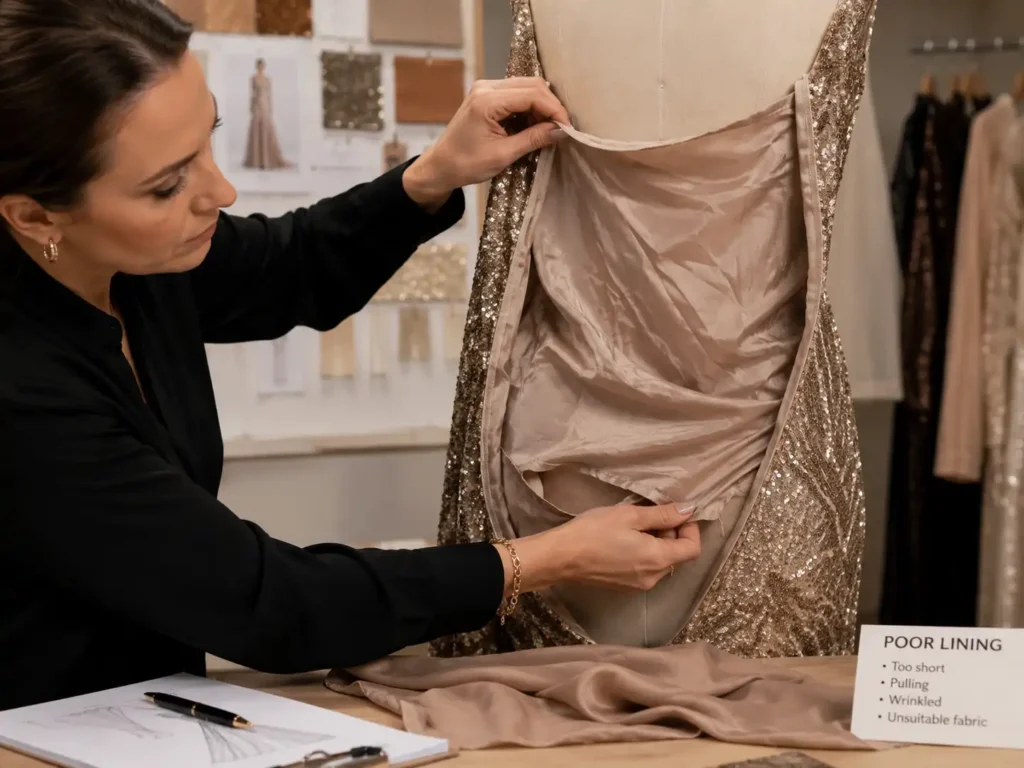
Lining creates quality issues that do not exist on an unlined garment. The inner layer can hang below the shell, twist around the body, pull at side seams, become caught in a zipper, roll outward at the neckline, or restrict movement through the bust and hip. In sheer garments, the lining color or length can also become part of the visible design, so an error that seems minor inside the dress may be obvious in daylight or photography.
A reliable inspection checks both appearance and movement. The garment should hang without twisting, the lining should remain hidden where required, and the zipper should operate without catching fabric. Fit should also be checked with the lining included because a shell can measure correctly while a tighter inner layer restricts the wearer. This is particularly important in fitted dresses, where the lining may become the true limiting circumference.
Wastage is another part of the cost equation. Flared pieces, directional stretch, damaged sections, and shade separation can all reduce usable yield. An experienced production team therefore works with realistic consumption rather than theoretical pattern area. The goal is not to inflate the allowance; it is to make sure the approved quotation can survive bulk cutting without repeated price changes or quality compromises.
Which Lining Fabrics Cost More?
Lining prices vary by fiber, weave, finish, weight, width, color, supplier, quantity, and special requirements. Basic polyester often sits toward the economical end, while viscose, acetate, cupro, silk, stretch linings, and specialist support materials can cost more. The best lining is not automatically the cheapest or the most expensive; it is the one that performs correctly inside the dress.
Polyester Lining
Polyester remains one of the most common lining choices because it is available in many weights, finishes, colors, and constructions. That broad availability can be valuable for seasonal dress programs, especially when several styles need consistent black, ivory, nude, or fashion-color linings. Polyester can also offer good durability and straightforward care, which helps when a collection needs repeatable bulk production rather than one-off couture handling.
The term “polyester lining,” however, is too broad to function as a real specification. A lightweight plain weave, polyester satin, stretch polyester, and heavier taffeta can behave very differently. Some versions feel smooth and fluid, while others can feel crisp, shiny, warm, or prone to static. The correct choice depends on the outer fabric and the wearer experience the dress is expected to deliver.
Costing teams should therefore look beyond fiber name and compare usable width, weight, hand feel, opacity, stretch, recovery, and sewing behavior. An economical polyester that makes lightweight satin stand away from the body is not a successful saving. If the style has to be resampled because the lining changes drape or fit, the apparent material advantage can disappear quickly.
Viscose and Acetate
Viscose or rayon lining is often considered when a softer hand and a less synthetic feel are important. It can work well in fluid dresses where the inner layer sits directly against the skin and needs to move without making the shell feel rigid. For occasionwear, bridesmaid dresses, and some premium day dresses, that more comfortable feel can contribute to the overall impression of quality.
The trade-off is that material behavior needs careful attention. Viscose constructions can require more control over shrinkage, pressing, dimensional stability, and care compatibility. A lining that feels excellent on a swatch still has to remain stable after cutting, sewing, pressing, hanging, fitting, and the intended cleaning method. If the shell and lining react differently, the dress can begin to pull or twist after finishing.
Acetate is another traditional lining option valued for smoothness and drape. It can suit certain woven garments well, but care, durability, and supplier availability must be considered alongside price. The useful comparison is not simply polyester versus viscose versus acetate. It is whether each candidate gives the required comfort and movement without creating unnecessary sourcing or production risk.
Cupro and Silk
Cupro and silk usually enter the discussion when internal feel, fluidity, and premium positioning are more important than minimizing the lining material budget. A smooth premium lining can make a noticeable difference when the dress is worn for several hours, especially in occasionwear where the garment may have a refined outer fabric but still needs to feel comfortable against the body.
The higher material cost is justified only when the garment benefits from it. A premium cupro-type lining in a tailored or high-value occasion dress can support a more polished wearer experience, while the same upgrade in a low-contact garment area may add cost that the customer never feels or sees. Silk can provide an exceptionally light and luxurious feel, but it may also demand more delicate handling and stricter care.
Product teams should evaluate retail positioning, shell fabric value, direct skin contact, drape, static, care instructions, and expected quantity before upgrading. The question is not whether a premium lining is “better” in general. The question is whether it solves a comfort, movement, or quality problem that matters in that specific dress and at that specific price level.
| Lining Type | Broad Cost Position | Main Strength | Main Watchpoint |
| Basic polyester | Economical | Availability and durability | Static, heat, hand feel |
| Polyester satin | Low to mid | Smooth surface | Shine and shell compatibility |
| Viscose/rayon | Mid | Softness and fluidity | Shrinkage and stability |
| Acetate | Mid | Smooth drape | Care and durability |
| Cupro-type lining | Mid to premium | Fluid hand and comfort | Higher sourcing cost |
| Silk | Premium | Light, luxurious feel | Cost and delicate handling |
| Stretch lining | Varies | Movement and fit | Recovery and stretch direction |
| Power mesh | Varies | Stretch and support | Weight, transparency, compression |
These positions are broad industry categories rather than fixed price bands. A high-spec stretch polyester can cost more than a basic viscose, and special colors, certifications, fabric minimums, and supplier capacity can change the economics. The table is most useful as a technical comparison framework, not as a substitute for current fabric quotations.
Matching Lining to Dress Type
A lining should be selected from the outside in. The shell fabric, silhouette, transparency, stretch, embellishment, and wearing occasion determine what the inner layer needs to do. A satin slip dress typically needs fluidity and a surface that will not interrupt the outer drape. A chiffon dress needs opacity without excessive weight. Lace may require lining color to become part of the visible design rather than merely disappear inside it.
Sequin dresses create another requirement: protection from rough backing and seam areas. In that case, smoothness against the skin can matter more than whether the lining has a luxurious fiber name. Bodycon dresses need stretch compatibility so the inner layer does not become tighter than the shell. Corset dresses may require lining to work with cups, boning, and internal support, which makes structural stability and comfort more important than a simple low-cost woven lining.
This is also where sample testing earns its value. Jinfeng Apparel’s fabric development system evaluates material direction together with hand feel, drape, stretch, transparency, lining requirement, target price, and bulk-production risk. A swatch can suggest a direction, but the complete sample shows whether the lining actually behaves correctly inside the dress.
How Does Lining Coverage Change Cost?
Coverage affects both material consumption and sewing work. Full lining generally costs more because it uses more fabric and creates more seams, while partial lining can reduce cost when only selected areas need opacity, comfort, or structure. Self-lining can become expensive when the shell fabric itself has a high price or difficult cutting requirements.
Full Lining
Full lining means most major areas of the garment receive an internal layer. In a simple style, that can include the whole bodice and skirt. In a structured dress, full lining may also cover the internal support work and create a cleaner finish around the waist, zipper, neckline, and armholes. This construction can be valuable when opacity, comfort, or premium internal finishing is a genuine product requirement.
Material consumption is the obvious cost driver. If a dress uses 1.00 meter of partial lining but 1.70 meters when extended through the full skirt, the additional 0.70 meter becomes 3,500 meters across a 5,000-piece order. The extra fabric is only part of the increase because longer lining also creates more seam length, more handling, a longer hem, and more inspection.
Full lining makes sense when it solves a real problem. Chiffon or lace may need full coverage for modesty, while sequined surfaces may require broad skin protection. It makes less sense when it is specified automatically in opaque areas that already perform well without it. Premium construction is not measured by how much lining is used; it is measured by whether the garment feels, looks, and wears better because the lining is there.
Partial Lining
Partial lining covers only the areas that need it. Common examples include a lined bodice with an unlined skirt, a short opaque inner skirt beneath a sheer maxi layer, lining only through the bust, or selective coverage under lace and mesh. Used intelligently, this can reduce fabric consumption, sewing length, hem work, and garment weight without reducing the visual quality of the design.
The challenge is deciding where the lining should stop. A poorly placed edge can create a visible horizontal line beneath chiffon or mesh. A lining that is too short can ride upward, while one that is too tight can restrict walking. The internal layer must also have enough ease to move independently from the shell without becoming bulky or twisting inside the garment.
Partial lining works best when it is designed from the beginning rather than introduced at the end as an emergency cost cut. When product teams decide which areas need opacity, support, and skin protection during development, the pattern can be shaped around those functions. The result is usually cleaner than taking a fully lined sample and simply shortening the inner layer after the target price becomes a problem.
Self-Lining
Self-lining uses the outer fabric itself as the internal layer in selected areas such as bodices, straps, necklines, bust panels, or small facings. The main advantage is compatibility. The inner and outer layers naturally share color, stretch behavior, surface character, and care performance, which can help when visible edges or close-fitting areas need to look seamless.
The downside is material value. If a conventional lining costs an illustrative $2.50 per meter while the shell costs $9.00 per meter, using an extra 0.30 meter of shell for self-lining represents $2.70 of shell value. The same quantity of regular lining represents $0.75. The difference is $1.95 per garment before wastage, which becomes $15,600 across 8,000 pieces.
That calculation does not mean self-lining should be avoided. It means the decision should be intentional. On expensive satin, custom-dyed fabrics, lace, specialty knits, or embellished materials, a small increase in self-lined area can have a large cost effect. Pattern teams can sometimes keep self-lining where it is visible or structurally useful while using a more economical internal fabric elsewhere.
| Coverage Method | Material Use | Labor Tendency | Best Use |
| Full lining | Highest | Highest of the three in most comparable styles | Complete opacity, comfort, premium finish |
| Partial lining | Lower | Lower when construction is simplified | Strategic coverage and sheer design zones |
| Self-lining | Depends on area, but uses shell value | Moderate to high | Visible edges, matched stretch, structured bodice |
| Mixed system | Optimized by zone | Depends on complexity | Styles combining sheer, structured and comfort areas |
The relationships in the table assume comparable dress designs. A complicated partial lining can still cost more than a very simple full lining, so coverage should never be priced in isolation. Pattern count, skirt volume, attachment method, and fabric behavior remain important parts of the final cost.
Functional Coverage
A more useful way to develop lining is to divide the dress into functional zones rather than choosing “full” or “partial” as a general label. Opacity zones need coverage because the shell is transparent. Comfort zones need protection from sequins, lace edges, or rough seams. Structure zones support the bust, waist, or silhouette. Sheer design zones are intentionally left transparent, while movement zones need enough ease or stretch for walking and sitting.
This approach can improve both cost and product clarity. A lace sleeve may need no lining because transparency is part of the design, while the bodice beneath the same lace needs complete coverage. A sequin bodice may require a smooth internal barrier, while a stretch mesh panel may need a different supportive lining to preserve fit. One dress can therefore use several lining strategies without feeling inconsistent.
The cost becomes easier to justify when every lined area has a purpose. Instead of asking how little lining can be used, the better question is what each zone needs to achieve. That shifts the discussion from cutting cost blindly to engineering the garment around opacity, comfort, movement, structure, and appearance.
How Does Lining Add Labor Cost?
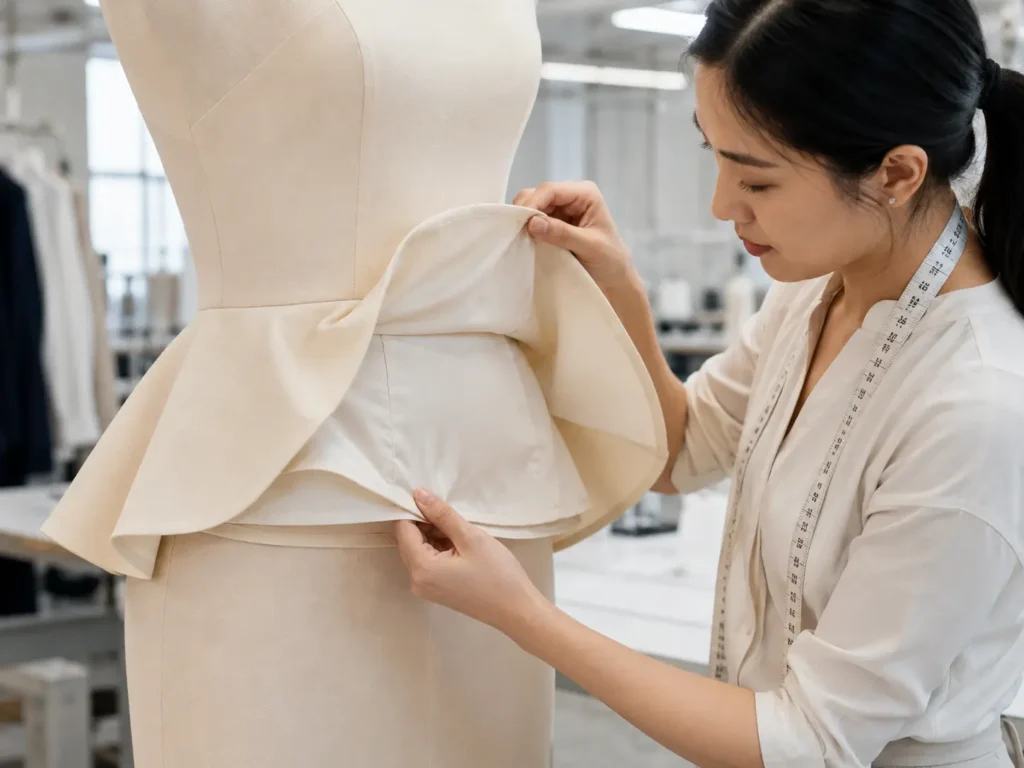
Lining adds labor by creating more sewing, handling, pressing, and inspection operations. The increase can be modest on a simple slip dress and substantial on a corset, evening dress, or multi-panel style. The key cost driver is not the presence of lining alone but the number, length, and difficulty of operations needed to integrate it with the shell.
Sewing Operations
Lining cost grows operation by operation. A straightforward woven dress may need the lining side seams joined, darts closed, neckline and armholes attached, edges understitched, zipper area connected, strategic points secured, and the lining hem finished. Each step is short in isolation, but together they create a meaningful amount of extra sewing and handling, particularly when thousands of units move through the same production route.
An illustrative eight minutes of additional work per garment equals 40,000 production minutes across 5,000 dresses, or about 667 production hours. That figure is not a universal sewing standard because actual time depends on equipment, operator skill, construction method, and fabric behavior. It simply demonstrates why small per-piece changes matter at volume and why labor cannot be estimated from the lining fabric price.
The most expensive operations are often those that demand accuracy rather than speed. Concealed zipper attachment, curved neckline turning, delicate under-stitching, and joining lining around structured bodices can require more control than straight seams. If the fabric slips, stretches, or frays easily, handling becomes slower again. Good costing therefore looks at the construction sequence before production, not after the line discovers the dress is taking longer than expected.
Structured Dresses
Structured dresses magnify lining labor because the inner layer must work around components that already demand precision. Corset and bustier dresses may include bra cups, boning, underwire, waist support, anti-slip tape, princess seams, a concealed zipper, and several shaped bodice panels. The lining has to protect the wearer from those elements while also helping the dress maintain its intended shape.
A small lining error can affect several other areas. If the inner panel is too short, it may pull the neckline down. If it is too tight, it can distort the cup shape. If it is attached unevenly around the zipper, the back can ripple. Rework is more expensive than on a simple loose dress because correcting the lining may require reopening seams and disturbing previously finished structural work.
This is one reason a minimal-looking dress can have a high manufacturing cost. Much of the labor is hidden between the shell and the body. A clean strapless satin dress with no visible embellishment may contain more internal sewing than a looser decorative style. The outer simplicity can actually depend on precise internal construction.
Stretch Compatibility
Stretch dresses create a different labor problem because the lining has to move with the shell rather than simply sit inside it. If a bodycon outer fabric stretches significantly but the lining has limited extension, the wearer feels the restriction from the inner layer first. The dress may meet flat measurements and still feel smaller than expected once it is worn.
Stretch percentage, direction, and recovery therefore need to be reviewed together. Power mesh is one material direction used in supportive and fitted applications; Jinfeng Apparel’s product knowledge base lists power-mesh-type materials around 100-250 gsm for uses including lined sheer dresses, corset lining, shaping panels, and bodycon applications. The correct weight still depends on whether the garment needs light coverage, moderate support, or a stronger shaping effect.
Stretch materials can also slow production if they curl, distort, or feed unevenly under the machine. Seam type, needle selection, machine settings, and operator technique all influence stability. A lining chosen only because it stretches may still create problems if recovery is weak or the stretch direction is wrong. Fit testing should include sitting, walking, dressing, and repeated movement rather than checking only a standing mannequin.
Inspection Time
Lining adds inspection because some defects remain hidden until the dress is worn, zipped, or moved. A complete check looks for lining hanging below the outer hem, twisting between layers, neckline roll, zipper catching, uneven ease through the bust and hip, visible seam impressions, color problems under sheer fabric, and restricted movement in stretch styles. These issues can exist even when the shell itself appears well made.
The fitting process should include the lining when measurements are reviewed. A common mistake is to check only the outer circumference and assume the inside layer follows automatically. If the lining is smaller through the hip, the finished dress will feel tight regardless of what the shell measurement says. The same is true through the bust on corset and bodycon styles.
Inspection also has to consider movement. A lining can look perfect while the wearer stands still but ride upward while walking or bunch when sitting. For this reason, quality teams often check walking ease, sitting ease, zipper function, and hem relationship rather than relying only on a flat table inspection. That additional attention is part of the true production cost of lining.
How Does Lining Affect Dress Quality?
Lining can improve opacity, drape, comfort, structure, durability, and the appearance of the inside of a dress. Its value depends on how well it matches the shell fabric and the intended wearing experience. A more expensive lining is not automatically better; the strongest result comes from choosing a lining that improves the garment without adding stiffness, heat, restriction, or unnecessary bulk.
Opacity and Color
Transparency is one of the clearest reasons to add lining, especially in chiffon, lace, mesh, tulle, pale satin, and lightweight woven dresses. The job is not merely to make the garment “not see-through.” Lining color and coverage can change how the outer fabric appears, which means the inner layer becomes part of the visible color system of the dress.
A bright white lining can make ivory chiffon look cooler, while a warm nude can soften the same shell. Under black lace, a skin-tone lining highlights the lace motif, whereas black lining creates a denser and more formal appearance. Both can be correct depending on the design. The problem begins when the lining color is selected in isolation from the shell rather than evaluated as a layered combination.
Opacity should also be checked under realistic lighting. Natural daylight, strong retail lighting, studio lights, and camera flash can reveal transparency differently. For ecommerce styles, this is especially important because photography may expose a problem that was not obvious in a fitting room. Stretch mesh creates another complication: a lining that looks opaque at rest can become more transparent when extended over the bust or hip.
Drape and Movement
Good lining follows the movement of the shell rather than controlling it unintentionally. A fluid satin or chiffon dress usually needs an inner layer with enough softness to preserve the outer silhouette. If the lining is too stiff, the skirt can kick outward, hang unevenly, or create folds that were not present in the shell-only sample. Surface friction can also cause the layers to cling instead of moving freely.
A practical pairing review compares weight, thickness, stiffness, drape, stretch, recovery, shrinkage, static, and surface feel. The relationship between the two fabrics is more important than either fabric considered alone. A lining that feels luxurious on the table may still be wrong if it is heavier than the shell or if it drags against the outer fabric during walking.
Long dresses reveal these problems clearly because the layers have more length to interact. A maxi skirt can twist around the legs if the inner layer is too narrow or if side seams are not balanced. Movement testing should therefore include walking, turning, sitting, and climbing a step when relevant. Dress quality is experienced in motion, not only while the garment hangs on a mannequin.
Comfort and Skin Protection
Lining often determines whether an embellished or structured dress is comfortable enough to wear for several hours. Sequins, metallic yarns, lace edges, embroidery backing, boning, underwire, and exposed seam allowances can all irritate the skin. A smooth inner layer acts as a barrier, but comfort depends on more than softness because fit, heat, breathability, and movement all influence the final experience.
A soft lining can still be uncomfortable if it is too tight around the hips or bust. A breathable material can still bunch if the pattern has too much length. A stretch lining can still feel restrictive if its recovery or stretch direction does not match the outer fabric. The complete garment therefore has to be fitted as a layered system rather than checking the lining only as a separate material.
Occasion dresses deserve particular attention because the wearer may sit, walk, dance, and remain in the garment for hours. Small discomforts that seem acceptable during a five-minute sample review can become significant during an event. The most successful lining is often the one the customer hardly notices because it prevents scratching, allows movement, and stays in place throughout wear.
Perceived Quality
Customers often judge lining without consciously naming it. They notice when the dress slides on smoothly, the skirt falls cleanly, internal seams are hidden, embellishments do not scratch, and the lining stays out of sight. These details shape perceived quality even when the customer never checks the fiber composition or understands how the garment has been constructed.
More lining, however, does not automatically mean more quality. A heavy full lining can make a lightweight resort dress feel overbuilt and hot. A premium lining in an area that barely contacts the body may increase cost without improving the wearer experience. Conversely, removing a necessary lining to save a small amount can make a high-value shell look transparent, unstable, or unfinished.
Strong product development allocates cost where the customer can feel the difference. That might mean smoother lining through a sequin bodice, better stretch inside a bodycon dress, or complete opacity through a chiffon skirt while leaving sheer sleeves intentionally unlined. Quality is not created by maximizing material; it is created by matching each internal decision to the function and positioning of the dress.
How Can Brands Control Lining Cost?
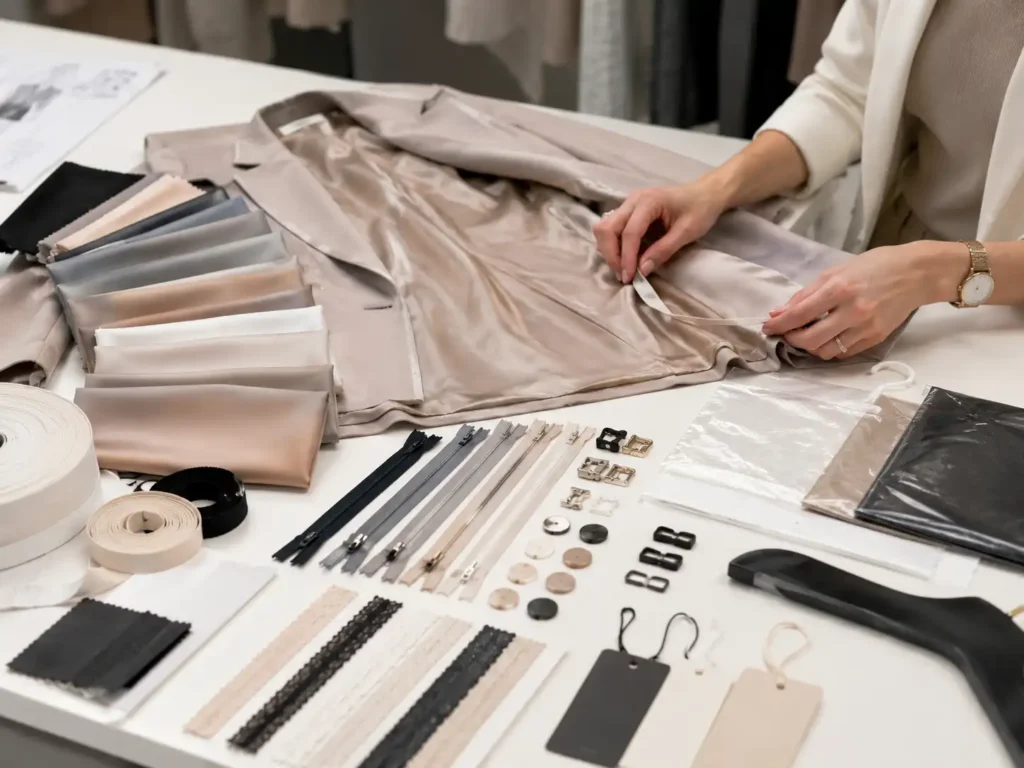
Brands can reduce lining cost without lowering garment quality by focusing on performance rather than simply removing material. The most effective levers are material substitution, coverage, fabric width, pattern efficiency, construction method, shared lining qualities across a collection, and early sample validation. Cost control works best before the final sample and bulk material booking are locked.
Material Substitution
Material substitution is one of the quickest ways to change lining cost, but the request needs a technical target. “Use something cheaper” gives the sourcing team very little protection against quality loss. A stronger brief defines the properties that must remain similar, such as drape, opacity, stretch, recovery, surface smoothness, color, or comfort, then searches for a lower-cost material that can deliver those functions reliably.
Price per meter should not be compared without usable width and consumption. An illustrative lining at $2.20 per meter used at 1.40 meters costs $3.08 in raw material per dress. Another at $2.50 per meter used at 1.15 meters costs $2.88. The second fabric is more expensive on the supplier price list but cheaper inside the finished garment because the marker is more efficient.
The replacement should be sampled in the complete dress before bulk approval. Lightweight satin can reveal changes in thickness, while bodycon styles can expose differences in stretch. Sheer chiffon can change color depending on the lining shade. Jinfeng Apparel’s development approach reviews target price together with drape, stretch, transparency, lining needs, and bulk risk, which is the right logic for substitution: preserve the properties that matter before celebrating the lower quote.
Construction Simplification
Construction can often be simplified without changing what the customer sees. Partial lining can replace full lining in carefully chosen areas, unnecessary double layers may be removed, internal panels can sometimes be combined, and complex attachment methods can occasionally be simplified. The biggest savings often occur when one decision reduces both fabric consumption and sewing operations at the same time.
Pattern review is important because the lining does not always need to copy every decorative seam in the shell. A three-panel outer design may use those seams for visual styling, while the lining could potentially be cut as fewer panels if fit and movement remain correct. Fewer pieces can mean a shorter marker, fewer seams, less handling, and fewer opportunities for mismatch during sewing.
Simplification still needs sample proof. Removing a seam can change ease; shortening lining can create a visible edge under sheer fabric; changing attachment can make the neckline roll. The goal is not to strip construction until the price falls. It is to identify operations that do not improve fit, comfort, structure, opacity, or appearance, then remove them without weakening the finished product.
Collection Planning
Lining cost is often easier to control across a collection than one style at a time. A seasonal range can become unnecessarily complicated when every dress uses a different black lining, several nearly identical nude shades, and separate stretch fabrics that perform the same job. Consolidating technically compatible materials can simplify sourcing, shade control, repeat orders, and inventory management.
A practical collection might use one lightweight woven lining for fluid dresses, one stretch lining for fitted styles, and one supportive power-mesh direction for structured or shaping applications. Not every style should be forced into those groups, but shared specifications make sense when performance requirements overlap. The same logic can apply to core colors such as black, ivory, and selected nude shades.
Quantity planning matters as well. Fabric suppliers may have minimums for custom dyeing, special finishes, or unusual colors. Fragmenting a collection into many small lining orders can therefore raise material cost or leave excess stock. Range-level review helps the brand see these effects before individual tech packs become fixed. Good collection planning does not make every dress the same; it removes unnecessary variation where the customer will never benefit from it.
Costing Before Approval
The most effective time to control lining cost is before the final sample is approved. Once material is booked, patterns are finalized, and production instructions are released, changes become slower and riskier. A clear pre-costing brief should therefore include shell fabric, lining composition or reference quality, usable width, required stretch, color, coverage, exact lining length, self-lined areas, structure, zipper type, dress length, skirt fullness, size range, quantity, and target price.
A line sheet that says only “satin midi dress, fully lined” leaves too many questions unanswered. A stronger brief might state that the style uses a fluid satin shell, a compatible stretch lining, full bodice coverage, knee-length skirt lining, self-lined straps, a concealed back zipper, sizes XS-XL, four colors, and a projected order of 5,000 pieces. The second description gives the factory something meaningful to cost.
For custom dress projects, Jinfeng Apparel reviews lining together with fabric, structure, sample fit, construction complexity, sewing time, and bulk-production risk rather than treating it as a small accessory line. That approach is most useful before the final specification is sealed, because early technical decisions are much cheaper to change than bulk production problems.
Conclusion
Lining is easy to overlook because its best work is almost invisible. When the specification is right, the dress hangs naturally, remains opaque where it should, feels comfortable against the body, moves without restriction, and keeps its internal construction out of sight. When the specification is wrong, the wearer notices the consequences immediately through pulling, scratching, twisting, transparency, bulk, heat, or an inner hem that refuses to stay hidden.
The cost therefore cannot be reduced to a simple fabric surcharge. Material price, consumption, width, panel count, coverage, sewing sequence, stretch compatibility, finishing, inspection, and order scale all influence the final result. Brands that define those variables early can usually make better trade-offs than brands that wait until the final sample and then try to remove cost in a hurry. A well-costed lining is not the cheapest possible inner layer; it is the most efficient construction that delivers the opacity, comfort, movement, structure, and finish the dress genuinely needs.