Skip to content

Organza and tulle can look surprisingly similar in a sketch or reference photo: both are sheer, lightweight, and capable of creating dramatic volume. Once the fabric is cut, gathered, layered, pressed, lined, and worn, however, the difference becomes obvious. Organza tends to define shape, while tulle tends to build volume through layers. That distinction can decide whether a puff sleeve stands correctly, whether a skirt feels romantic or architectural, whether a bow keeps its form, and whether a dress remains comfortable after several hours of wear.
Organza is generally the better choice for crisp structure, sculptural ruffles, defined bows, statement sleeves, and polished sheer layers, while tulle is usually better for soft overlays, airy movement, and lightweight skirt volume. Organza is a woven sheer fabric with a firmer hand; tulle is an open net fabric that can range from very soft to quite stiff. Neither is universally better because silhouette, comfort, transparency, lining, construction, and production consistency all matter.
A useful way to picture the decision is to imagine the same party dress made twice. In one sample, the skirt forms clean, visible waves and the shoulder bow holds its shape all evening. In the other, the skirt looks softer, larger, and almost cloud-like as the wearer moves. Both samples may be beautiful, but they solve different design problems. The right fabric is not the one with the better name or the higher price; it is the one that performs the job the dress actually requires.
What Is the Difference Between Organza and Tulle?
Organza and tulle differ mainly in construction and resulting behavior. Organza is a sheer woven fabric that creates a smooth, crisp surface and controlled structure. Tulle is an open-net fabric that can be soft or stiff and builds volume efficiently through layering. Both are highly transparent and often need lining, but they create distinctly different silhouettes, movement, edge definition, and finishing requirements.
What Is Organza?
Organza is best understood as a lightweight structural fabric rather than simply a transparent fabric. Its woven construction creates a continuous surface that catches light across broad areas and produces cleaner folds than most types of tulle. Common commercial versions include polyester organza and nylon organza, while silk organza occupies a more specialized premium position. For womenswear development, organza often falls around 30–100 gsm, but weight alone does not predict the final hand because yarn, weave density, finishing, and fiber type can change the result considerably.
Its main strength is controlled structure. A suitable organza can keep a puff sleeve away from the arm, help an oversized bow remain open, create a defined peplum, and support tiered ruffles without making the garment visually heavy. It is especially useful in prom, formal, occasion, and statement party dresses where shape needs to remain visible in photographs. The same firmness creates limitations: conventional organza has little useful stretch, high transparency usually calls for lining, and crisp qualities can feel uncomfortable if exposed edges sit directly against the neck, underarm, or waist.
Production teams also pay attention to organza because the fabric can reveal small mistakes. Raw edges may fray, pressed areas can retain marks, and uneven hems become easier to notice when light passes through the garment. A well-developed organza style therefore needs more than an attractive swatch. The sample must confirm how the fabric reacts to gathering, seam construction, pressing, lining, packing, and recovery after the garment has been folded for transport.
What Is Tulle?
Tulle is an open-net fabric commonly made from polyester or nylon. Unlike organza, it does not form one continuous transparent surface; the yarns create a mesh with open spaces that allow the lining color and lower layers to remain visually active. Commercial tulle used in dresses can range roughly from 15–80 gsm, but this range includes very different products. Fine soft tulle can fall around the body almost like a haze, while firm net can stand away from the body and create strong volume.
The most important sourcing lesson is that “polyester tulle” is not a complete performance specification. Mesh size, stiffness, recovery, hand feel, transparency, color, and finished layer count all affect the garment. Soft tulle suits romantic overlays, layered prom skirts, party dresses, and formal silhouettes where the outline should remain light. Firmer qualities can sit underneath softer layers as hidden support, producing more lift without changing the outer texture too much.
Tulle does not usually fray like a woven fabric, so some hems can be carefully cut and left unfinished. That advantage does not make the material risk-free. Mesh can snag, stretch, distort, or develop small holes during cutting and sewing, and several nearly identical skirt layers can easily become mixed if production control is weak. Color must also be judged in the final stack because multiple sheer layers can deepen a pale tone far more than a single swatch suggests.
How Are They Constructed Differently?
The construction difference explains most of the performance difference. Organza is woven, so warp and weft yarns cross closely enough to create a continuous plane. Even though that plane is transparent, it behaves like a thin sheet. It forms clear folds, reflects light across a smooth surface, and resists collapse. Tulle is an open mesh, so its yarns form a network rather than a complete sheet. It occupies space with less visual density and becomes fuller as layers accumulate.
This creates a useful design distinction: organza produces shape-driven volume, while tulle often produces layer-driven volume. A single organza skirt layer may project strongly from the body because the material itself has enough body to hold a wave. One layer of soft tulle may appear relatively flat, yet three or four layers can gradually build a larger, softer silhouette. Replacing one fabric with the other without changing the pattern or layer system can therefore produce a sample that is technically correct in measurement but visually wrong.
The same difference affects bodices, sleeves, and decorative details. A large organza ruffle can hold a recognizable curve and remain visually separate from the garment. A soft tulle ruffle produces a more blurred edge and relies on overlap for depth. Designers often describe both as “sheer volume,” but the source of that volume is different, and the pattern, seam bulk, gathering ratio, and support structure should be developed accordingly.
How Can You Tell Them Apart?
The quickest test is to hold both materials against a light source. Tulle normally reveals a clear mesh or net pattern, while organza reads as a smoother, continuous transparent surface. Then gather the fabric in your hand. Organza usually creates sharper folds and springs back into a more defined shape. Soft tulle compresses into a lighter, cloud-like bundle, although very firm tulle can still feel stiff while retaining its visibly open structure.
A second practical test is to make the same small ruffle in both fabrics. Organza generally produces a cleaner edge and more visible waves. Soft tulle produces softer, less defined folds because the mesh overlaps itself. The difference becomes even clearer on a dress form, where organza tends to create a controlled shell and tulle tends to create transparent volume around the body rather than one smooth outer plane.
For sourcing, visual identification is only the beginning. A reliable fabric record should include composition, weight, width, hand feel, drape, stretch, transparency, color, wrinkle behavior, lining need, MOQ, lead time, and any known production risks. Jinfeng Apparel’s fabric system covers both organza and tulle and evaluates material choices by hand feel, drape, transparency, lining requirements, sampling risk, bulk-production risk, and cost rather than relying on the trade name alone.
| Specification | Organza | Tulle |
| Typical womenswear weight | 30–100 gsm | 15–80 gsm |
| Surface structure | Sheer woven | Open mesh/net |
| Typical stretch | None or minimal | Low; varies by construction |
| Drape | Low to medium | Soft to firm, depending on grade |
| Transparency | High | High |
| Common lining need | Usually required | Usually required |
| Main source of volume | Fabric stiffness | Layer count and mesh stiffness |
| Common uses | Ruffles, sleeves, bows, structured layers | Full skirts, overlays, layered dresses |
How Do Organza and Tulle Compare?
Organza is generally crisper, smoother, and more shape-retentive, while tulle is more effective for lightweight layered volume. Soft tulle usually drapes better than organza, although firm tulle can be very stiff. Both are highly transparent. The better choice depends on whether the design needs a defined architectural silhouette, softer overlapping volume, or a deliberate combination of the two behaviors.
Which Fabric Is Stiffer?
For most fashion applications, organza gives more consistent structural stiffness than soft tulle because its woven surface can maintain shape across a larger area. That property is valuable in sleeves, bows, peplums, ruffles, and overskirts where the design depends on a visible outline. A puff sleeve made from organza can form one clean curve from shoulder to cuff, while the same sleeve made from very soft tulle may collapse closer to the arm unless additional layers or support are introduced.
The comparison becomes less absolute when firm tulle or dress net is involved. Some hard tulle qualities can feel more rigid than lightweight organza, but their stiffness presents differently. Organza behaves more like a thin transparent shell; firm tulle behaves more like a three-dimensional framework. Both can create volume, yet one gives a smoother polished surface and the other gives a visibly open, lighter texture.
For sample approval, stiffness is better tested on the actual garment component than on a flat swatch. If the design depends on an oversized bow, make the bow. If the key feature is a sleeve, construct the sleeve. A 30-centimeter gathered test piece can already reveal whether the material springs outward, collapses, or becomes too bulky when several layers are joined at one seam.
Which Fabric Has More Drape?
Soft tulle generally has more fluid visual drape than organza, although tulle quality varies widely. Organza commonly sits in the low-to-medium drape range because the woven structure resists gravity enough to maintain space around the body. Soft tulle falls more freely, which makes it useful for romantic overlays and skirts where movement should appear light rather than crisp. Firm tulle can move closer to organza in stiffness but still creates a different texture and edge.
Garment length changes the way drape appears. A full-length tulle skirt gains pull from its own weight and may look smoother than the same fabric in a short swatch test. Long organza can soften slightly under gravity too, but the characteristic crispness remains. This is one reason fabric evaluation should include a hanging test rather than relying entirely on hand feel at the cutting table.
Drape also affects how accurately a reference photo can be reproduced. A designer may request a flowing transparent skirt, but a crisp organza can create a result that looks too angular. A soft tulle can fail in the opposite direction if the reference depends on strong, clearly defined folds. When a sample “looks wrong” despite correct measurements, fabric behavior is often one of the first variables worth checking.
Which Creates More Volume?
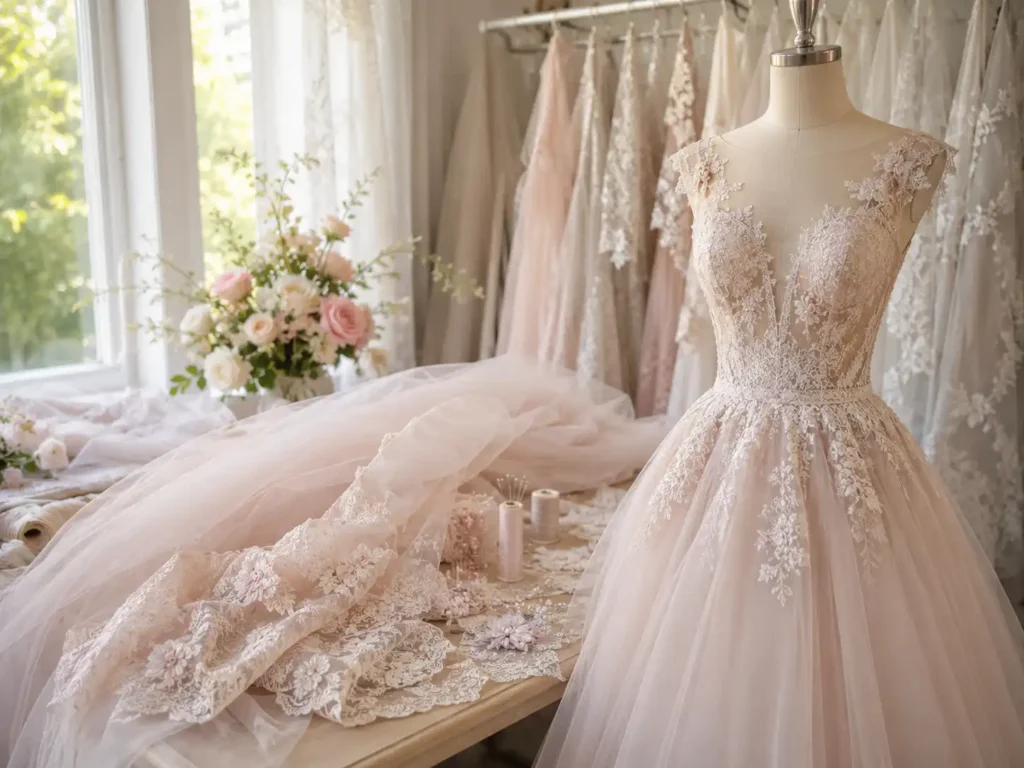
Tulle is generally more efficient when the goal is large, airy skirt volume because multiple layers can be stacked without turning the garment into one visually dense surface. This is why tulle is common in prom skirts, formal silhouettes, bridal-inspired styles, and party dresses with exaggerated fullness. The volume can be adjusted by changing the number of layers, the stiffness of inner support layers, the gathering ratio, or the skirt radius.
Organza creates volume with fewer layers because the fabric contributes more structure by itself. A single organza overskirt can stand farther from the body than one soft tulle layer, and an organza ruffle can remain visibly separate even when the rest of the dress is relatively simple. The effect is more architectural, so organza works well where the design needs clearly readable shapes instead of diffused fullness.
More fabric is not automatically better. Excessive tulle layers increase cutting time, gathering labor, waist-seam thickness, color density, and the risk of uneven hems. Too much organza can become rigid, noisy, and uncomfortable. The strongest development solution is usually the smallest repeatable material system that reaches the approved silhouette without introducing unnecessary bulk or production complexity.
Which Feels More Comfortable?
Fine soft tulle often feels lighter and softer than crisp organza, but comfort depends heavily on the exact grade. Coarse net can scratch the skin, while crisp organza can irritate the neck, underarm, waist, or wrist if raw edges or firm seams sit directly against the body. A swatch that feels harmless between the fingers can become uncomfortable after hours of sitting, walking, raising the arms, and dancing.
Wear testing should therefore focus on contact zones rather than only on the fabric surface. Necklines should be checked while the wearer turns the head, armholes while the arms move, and waist seams while sitting. On a long skirt, the inner thigh and lower leg deserve attention if several sheer layers move against the body. These checks are especially important for party, prom, and occasion dresses that may be worn for an entire evening.
Lining can solve many problems, but the lining itself affects drape and weight. A heavy lining under very soft tulle can suppress the movement that made the outer material attractive, while a lining that is too short may leave scratchy edges exposed. Comfort therefore comes from the combination of outer fabric, lining, edge finish, seam placement, and fit rather than from the fiber name alone.
Which Fabric Is Better for Different Dresses?
Organza is usually stronger for dresses needing defined shape, crisp ruffles, structured sleeves, bows, and polished transparent layers. Tulle is usually stronger for airy skirts, soft volume, romantic overlays, and multi-layer construction. Prom, formal, party, and wedding-inspired dresses can use either fabric successfully when the choice follows the intended silhouette, wearing experience, and production method rather than the category name alone.
Prom and Formal Dresses
Both fabrics work naturally in prom and formalwear, but they create very different visual identities. Organza suits dresses that need polished structure, including full A-line skirts, dramatic ruffles, transparent sleeves, oversized bows, and dimensional flowers. The surface catches light more continuously than tulle, so folds and curves remain easy to read in photographs. That can be useful when the design needs to look sharp from the front, side, and across a large event space.
Tulle is better suited to soft ball skirts and layered silhouettes where the garment needs scale without a dense outer surface. Several layers can create significant fullness while preserving a light, youthful appearance. Softer outer layers can also sit over firmer internal tulle so the skirt retains lift without showing the structural support too clearly. This combination is common whenever designers want volume to look effortless rather than engineered.
The two fabrics can also work together. A firmer tulle layer may create internal lift, while an organza outer layer gives the skirt a cleaner surface and more defined edge. When combining them, the waist seam, gathering ratio, and layer order should be tested carefully because different materials can pull against one another and change the balance of the skirt.
Party Dresses
Short party dresses often benefit from the exaggerated qualities of both materials. Tulle works naturally in layered mini skirts, tutu-inspired shapes, fit-and-flare dresses, and playful silhouettes where fullness around the hip is part of the visual impact. Because tulle is light, a short skirt can become dramatically full without appearing as solid as the same volume built from several woven layers.
Organza gives party dresses a more sculptural direction. Oversized bows, asymmetric ruffles, puff sleeves, transparent peplums, dimensional flowers, and exaggerated shoulder treatments all benefit from a material that can hold a visible edge. Pairing an organza statement detail with a fitted bodice can create a strong focal point without requiring the entire dress to be built from one stiff fabric.
Short lengths make accuracy especially important. A difference of even 5–10 mm between exposed sheer layers can become noticeable on a symmetrical mini skirt, particularly when the hem is photographed against bare legs. For ecommerce and social media styles, the sample should also be tested under studio flash and backlighting because transparent layers that appear subtle under normal room light may become much more obvious on camera.
Wedding and Bridal-Inspired Dresses
Tulle remains a natural choice for soft wedding-inspired silhouettes because it can build large volume while keeping the skirt visually light. It works particularly well for long layered skirts, veils, detachable overskirts, floating overlays, and romantic sleeve or shoulder details. The open mesh allows light to move through several layers, which helps a large dress avoid looking overly heavy.
Organza produces a more polished and architectural bridal effect. It suits modern gowns with sculptural sleeves, structured overskirts, dimensional floral elements, large bows, or clean transparent layers. It is also useful when the dress needs to maintain shape in photographs rather than moving into a soft haze around the body. For minimalist bridal styling, a single well-controlled organza layer can create visual drama without relying on heavy embellishment or excessive skirt volume.
White and ivory make fabric control more demanding. Strong daylight, flash photography, and backlighting can reveal lining edges, boning channels, seam allowances, or shade differences that were less visible in the sample room. Organza, tulle, lining, thread, and trims should therefore be evaluated as one color system. A small shade difference between two white components can become obvious once the materials overlap or catch light from different angles.
Layered Skirts, Ruffles, and Sleeves
Tulle is generally the more flexible choice for layered skirts because fullness can be changed through layer count, mesh stiffness, skirt radius, and gathering. Organza performs especially well when each layer needs a distinct visible edge, as in tiered skirts, cascading ruffles, high-low overskirts, and sculptural flounces. The right choice depends on whether the viewer should perceive one soft mass of volume or a series of clearly separated shapes.
For sleeves, organza usually has an advantage when the design needs a strong outer contour. Puff, lantern, balloon, and statement sleeves can hold themselves away from the arm with fewer layers. Tulle is better when the sleeve should look diffused, delicate, or almost weightless, though firmer tulle or internal support may be needed if the sleeve must remain very full.
Combining the fabrics can solve problems that neither material handles perfectly alone. Tulle can create lightweight lift underneath an organza outer shell, while organza can add defined horizontal lines to an otherwise soft tulle skirt. The combination should still be sampled at the real seam positions because mixed materials can create unexpected bulk or different tension at gathered waistlines.
| Dress Element | Organza | Tulle | Main Decision Point |
| Ball skirt | Defined structured volume | Soft layered volume | Crisp vs airy silhouette |
| Mini party skirt | Polished, sculptural | Light, playful, fuller | Visual density |
| Puff sleeve | Excellent shape retention | Softer; may need support | Outer contour |
| Large bow | Excellent | Usually soft unless reinforced | Structural support |
| Tiered ruffle | Strong visible edges | Soft overlapping edges | Edge definition |
| Sheer overlay | Smooth and polished | Diffused and airy | Surface appearance |
| Detachable overskirt | Structured statement | Romantic volume | Movement and shape |
| Dimensional flower | Crisp petals | Softer petals | Sculptural detail |
How Do Organza and Tulle Affect Dress Design?
Changing from organza to tulle can alter silhouette, gathering, layer count, lining, color, seam thickness, and even pattern balance. Fabrics with similar transparency are not automatically interchangeable. Organza creates structure through its own stiffness, while tulle often relies on several layers. Any substitution should be tested on the garment because the same pattern can produce a completely different result once material behavior changes.
Silhouette and Proportion
Fabric can change the apparent proportions of a dress even when every pattern measurement stays the same. A skirt that projects farther from the waist can make the waist look narrower, while a sleeve that holds more air around the arm can make the shoulders appear broader. Soft transparent layers generally blur the outer contour, while crisp layers create a stronger outline that makes the garment easier to read from a distance.
This is one reason reproducing a reference photo from measurements alone often fails. The original fabric may be responsible for much of the visible proportion. If a fitted bodice is paired with soft tulle, the transition from waist to skirt can look gentle and romantic. Replace the same tulle with crisp organza and the waist may suddenly look sharper because the skirt begins projecting outward almost immediately.
Pattern development should therefore happen together with material approval. When the sample looks wrong despite correct chest, waist, hip, and length measurements, it is worth asking whether the fabric has the same drape and stiffness as the reference. A small change in material behavior can sometimes correct the silhouette more effectively than repeated pattern adjustments.
Layers and Fullness
There is no universal correct number of tulle or organza layers because fullness depends on fabric weight, stiffness, skirt radius, gathering ratio, lining, color, and garment length. Soft tulle may need several layers to create a pronounced ball shape, while firm tulle can reach similar volume with fewer. Organza usually builds visible structure quickly, so too many layers can make the skirt rigid or create excessive bulk at the waist seam.
Layer count also changes color and opacity. One blush tulle layer can appear almost neutral over white paper, while four layers over tonal lining may look significantly deeper. The same principle applies to organza, particularly in saturated colors or materials with surface sheen. Approving a single swatch is therefore not enough when the finished garment uses a multi-layer system.
The waist seam is often the hidden constraint. Every gathered layer adds fabric, and a skirt that looks perfect below the hip can become uncomfortably thick where all layers meet the bodice. Development teams may reduce gathering near the waist, distribute volume through different skirt shapes, or use a firmer internal support layer under softer outer layers. The goal is not maximum fullness; it is controlled fullness that can be repeated cleanly across the planned size range.
Lining and Transparency
Both organza and tulle are highly transparent, so lining is usually part of the design rather than an afterthought. The more useful question is what the lining needs to accomplish. A tonal lining can deepen the outer color and create a more conventional opaque dress. Nude lining can preserve an illusion effect. A shorter lining under a long sheer skirt can deliberately expose the lower leg while maintaining coverage through the upper part of the garment.
Lining length and weight also affect movement. A heavy full-length lining under soft tulle can suppress the airy motion that made the outer fabric attractive. A lining that is too short can make a formal dress look unfinished or allow scratchy edges to contact the skin when the wearer sits. White and pastel dresses need particular attention because strong light can reveal underwear lines, seam allowances, boning, or pockets that were not obvious indoors.
For sheer bodices, internal construction becomes part of the visual design. Bra cups, boning channels, binding, and seam allowances may all remain visible through organza or tulle. The sample should therefore be approved as a complete system: outer fabric, layer count, lining color, lining weight, and internal components. Transparency is not simply a fabric property; it is the result of everything placed underneath the fabric as well.
Weight and Pattern Development
GSM is useful, but it should never be the only specification used to approve organza or tulle. Organza in womenswear can commonly fall around 30–100 gsm, while tulle can fall around 15–80 gsm, which means the ranges overlap substantially. Two fabrics with similar weight can still behave very differently because stiffness, mesh size, finishing, yarn type, and recovery change how the material responds to gravity and movement.
Weight affects pattern behavior in several ways. A heavier skirt puts more downward force on the waist seam, a heavier sleeve can pull on the shoulder, and a denser outer layer can change neckline balance. Stiffness can change apparent size even when the pattern itself is unchanged. A sleeve cut to identical dimensions looks larger in crisp organza because it occupies more three-dimensional space than the same sleeve in soft tulle.
When a fabric is substituted after sample approval, the pattern assumptions should be reviewed again. Jinfeng Apparel’s documented material process compares weight, hand feel, stretch, recovery, drape, transparency, shine, shrinkage, color, cost, MOQ, and lead time, then checks whether the pattern, lining, costing, or sample needs adjustment. In practical development, a fabric replacement is often a garment change rather than a simple purchasing change.
How Do Organza and Tulle Perform in Production?
Organza requires close control of fraying, pressing, seam appearance, hems, and layer alignment. Tulle requires control of holes, mesh distortion, layer count, gathering, and hem consistency. Both reveal workmanship easily because they are transparent. Reliable production depends on approving the exact fabric and construction method during sampling, then carrying the same standards into cutting, sewing, finishing, inspection, and packing.
Cutting and Sewing
Transparent lightweight fabrics make small production errors easy to see. Organza can shift during cutting and fray at raw edges, while several stacked layers can move enough to create uneven hems or asymmetric ruffles. Tulle does not normally fray in the same way, but the mesh can stretch, snag, or distort. Soft varieties are especially likely to move when several layers are cut at the same time.
Layer identification becomes important in complicated skirts. When different tulle panels use different lengths, fullness ratios, or mesh qualities, the cutting room needs a clear method to keep inner and outer components separate. Organza styles can present a similar problem when layered ruffles or overskirt panels look almost identical before assembly. Good bundle control reduces the risk of operators guessing where a piece belongs.
Sewing tension and handling also affect the result. Lightweight organza can pucker if tension is too high, and tulle can stretch if the operator pulls the material while feeding it through the machine. Transparent fabric leaves less room for untidy work because thread ends, twisted layers, uneven seam allowances, and irregular gathering remain visible. The approved sample should therefore define not only measurements, but also seam method, layer order, gathering placement, and finishing quality.
Organza Finishing
Raw organza edges can fray, so finishing should be planned before production begins. Narrow rolled hems are common for exposed lightweight edges because they minimize bulk and maintain a clean appearance. Binding or enclosed construction may be more suitable when an edge needs additional strength. On large ruffles, the total hem length can be several times the garment length, so small variations in stitch width or tension can become visually obvious.
Pressing deserves equal attention. Organza can retain unwanted pressure marks, and synthetic qualities may react poorly to excessive heat. Pressing settings should be tested on the exact approved fabric rather than copied from another style. The garment should be checked under directional light after pressing because creases and puckering can become much more visible when highlights run across the smooth woven surface.
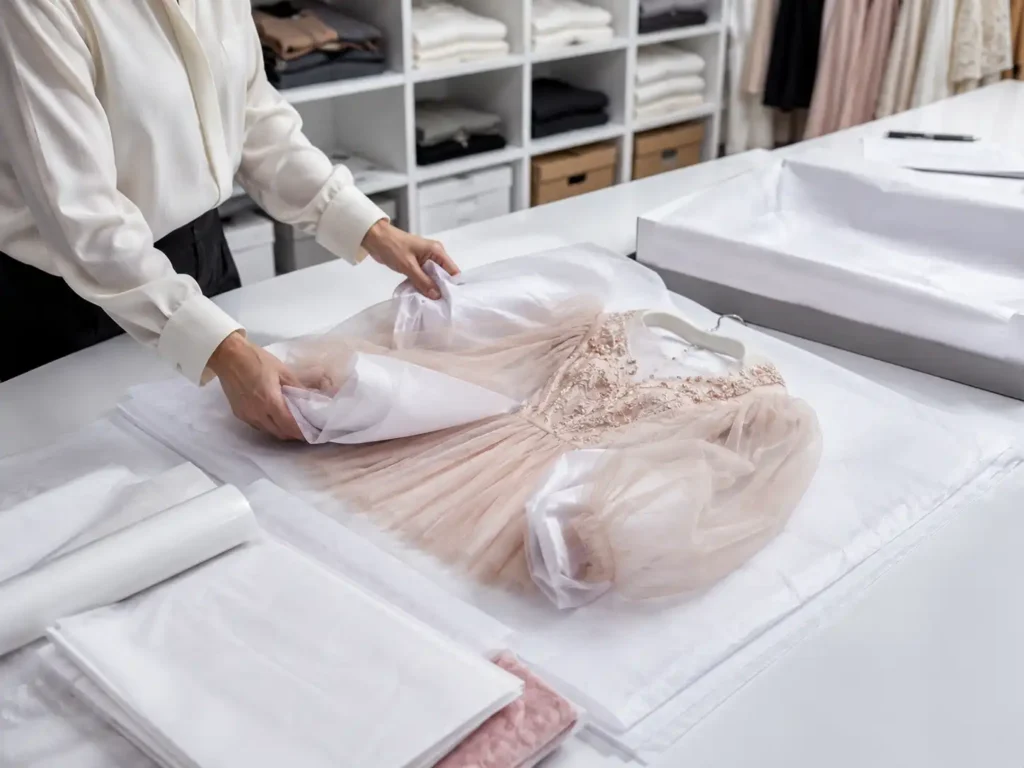
Packaging can undo good finishing if structured features are flattened in transit. Large bows, flowers, puff sleeves, and overskirts should be reviewed after realistic folding and packing, not only at the end of the sewing line. If a feature does not recover after unpacking, the construction or packing method may need adjustment. A successful organza garment has to survive both production and delivery while keeping the shape that made the material worth choosing.
Tulle Layer Control
Tulle production is largely a problem of consistency because several similar-looking layers may contribute different functions to the finished silhouette. One layer may be shorter, another fuller, and a firmer inner layer may provide support beneath softer outer layers. If those pieces are mixed, omitted, or gathered at the wrong ratio, the entire skirt can change even though the bodice and waist measurement remain correct.
Gathering distribution needs particular control. One dense section can make the skirt look darker and fuller, while a sparse section can create a flat area. Overlapping transparent layers amplify these differences, so the problem may be more visible in the finished garment than during sewing. Hem level should also be checked while the dress hangs because gravity separates the layers and reveals imbalances that a cutting table can hide.
Holes can be difficult to see in stacked fabric, especially on pale colors. Inspecting finished tulle against contrasting backgrounds makes small defects easier to find. Color should also be checked as a complete stack because a minor shade change in one bulk lot may become more noticeable once several layers overlap. Reliable tulle production therefore depends on layer count, sequence, gathering, finished length, and shade control rather than on the material name alone.
Sampling and Quality Control
Sampling should expose problems before they become bulk problems. Common tulle issues include insufficient fullness, too much volume, uneven layer lengths, unexpected transparency, and color changes after layering. Organza samples can reveal excessive stiffness, visible pressing marks, fraying edges, uneven hems, or statement features that collapse after packing. These are not minor cosmetic details; they can change the visual identity of the entire garment.
The next question is whether the sample construction can be repeated consistently. A sample machinist may spend extra time manually balancing every ruffle or separating every tulle layer, but bulk production needs a method that can be taught and checked. Layer order, gathering position, seam treatment, pressing, lining length, and packing should therefore be recorded in a way that production teams can follow without relying on memory.
Material substitution is another major control point. A replacement may match color but differ in stiffness, or match hand feel while changing transparency. Jinfeng Apparel’s material records identify organza risks such as edge fraying, press marks, uneven hems, and inconsistent layering, while tulle risks include holes, inconsistent layer counts, uneven hems, and color differences created by layering.
| Production Point | Organza Risk | Tulle Risk | Useful Check |
| Incoming fabric | Creasing, shade variation | Holes, hand-feel variation | Compare with approved swatch |
| Cutting | Shifting, fraying | Distortion, layer confusion | Identify layers and check cut accuracy |
| Sewing | Puckering, visible seams | Mesh stretching, uneven gathering | In-line appearance review |
| Layering | Uneven levels | Wrong count or sequence | Confirm approved layer system |
| Hem | Uneven edge, fraying | Uneven cut level | Hang garment before approval |
| Pressing | Pressure marks, heat damage | Crushing or distortion | Test settings before bulk |
| Color | Sheen changes appearance | Layers deepen tone | Approve complete stack |
| Packing | Structured details flatten | Volume compresses | Pack-and-recovery test |
Which Should You Choose, Organza or Tulle?
Choose organza when the design needs crisp structure, defined edges, statement sleeves, bows, or sculptural volume. Choose tulle when the dress needs airy layering, soft movement, or large lightweight skirt volume. Neither is automatically superior. The correct choice is the material that achieves the intended silhouette while remaining comfortable, manufacturable, consistent in bulk, and realistic for the target cost and delivery plan.
For a Structured Look
Organza is normally the stronger starting point when the design brief includes words such as crisp, architectural, sculptural, defined, polished, or statement. Large bows are a good example because a suitable organza can keep the loops open and the tails readable from several viewing angles. Soft tulle tends to collapse unless it is heavily layered or supported, so the final feature looks more delicate even when the pattern dimensions are identical.
The same principle applies to dramatic sleeves and structured overskirts. Organza can maintain an inflated shape with relatively few layers, which makes it possible for the material to perform both a decorative and structural role. The goal is not to choose the stiffest organza available. Excessively hard qualities can feel uncomfortable, produce harsh folds, and make the finished garment look less refined than intended.
The most useful test is to sample the feature that carries the design. If the dress is built around an oversized shoulder bow, making a full bow provides better evidence than draping a flat swatch on the table. If the sleeve is the hero element, sample the sleeve. Three-dimensional testing shows whether the fabric has enough body, too much rigidity, or insufficient recovery after pressing and packing.
For Soft, Airy Volume
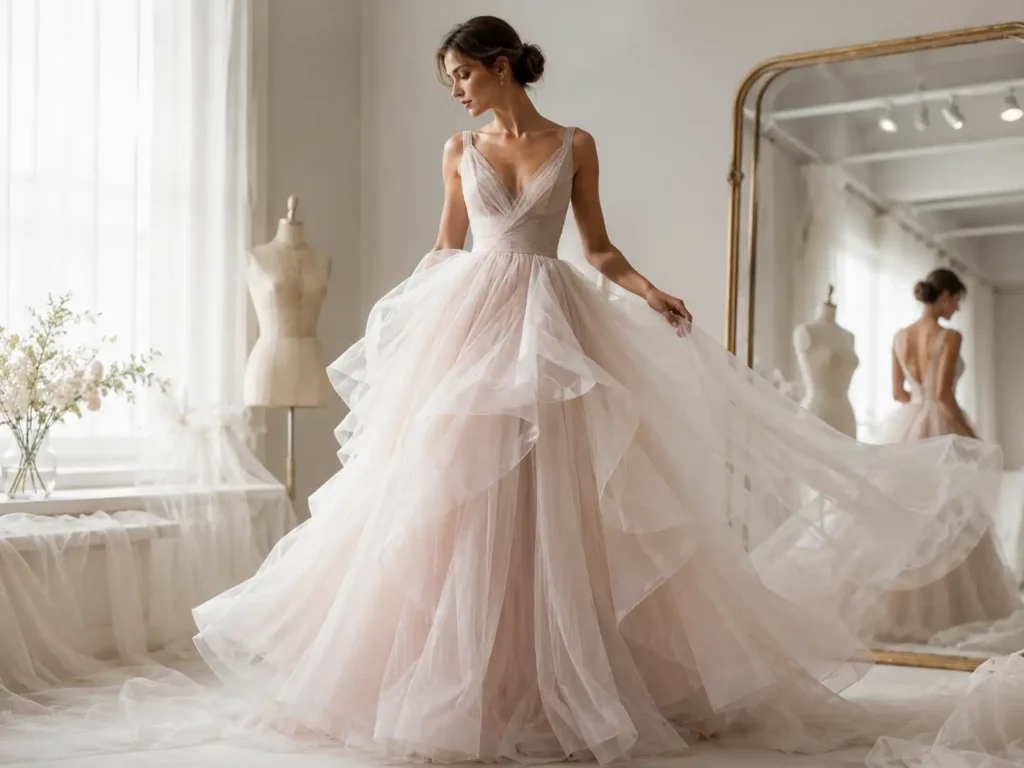
Tulle is usually the stronger choice when the garment needs to look floating, romantic, or cloud-like. Its open structure makes it possible to build substantial volume without creating one visually heavy surface. This is especially useful in full-length skirts, where several meters of material may be needed to produce a broad silhouette without making the dress appear dense from the waist to the floor.
Different tulle qualities can be layered strategically. A firmer inner net can create lift, while finer outer layers soften the surface and conceal the support. This approach works well for prom dresses, homecoming styles, short party skirts, and bridal-inspired silhouettes. It also allows the development team to adjust fullness without redesigning the entire bodice or waist seam.
Layer count should remain controlled because every added layer increases fabric consumption, cutting, gathering labor, seam thickness, color depth, and the risk of uneven hems. The most practical target is the minimum repeatable layer system that achieves the approved appearance. If the sample uses a particular tulle weight, stiffness, and layer count, those details should remain connected because changing only one variable can noticeably alter the silhouette.
For Statement Details
Organza usually performs better for dimensional details that need a visible outline, including sculpted flowers, oversized bows, structured ruffles, shoulder treatments, and dramatic cuffs. Its crisp surface lets petals, loops, and waves remain readable. Tulle works better when the statement effect comes from softness, transparency, or accumulated volume, such as cloud-like flowers, layered flounces, or airy gathered sleeves.
Combining both fabrics can be effective when each material has a specific job. An organza outer petal can provide a defined edge while tulle underneath adds softness. A tulle skirt can use selected organza ruffles to create clearer horizontal structure. A structured organza overskirt can sit over several tulle layers so the lower material contributes lift without dominating the outer appearance.
The combination still needs testing at the real seam locations because mixed materials can react differently when gathered into one waistband or attached to a fitted bodice. A strong development rule is to define the purpose of every layer. If organza is included, decide what structure it adds. If tulle is included, decide what softness, volume, or transparency it contributes. Clear material roles make complex dresses easier to reproduce.
Before Production
Final material selection should be approved on a complete garment rather than from a swatch book alone. The exact fabric needs confirmation for composition, weight, width, color, hand feel, transparency, and stiffness, followed by a sample that establishes the finished silhouette, lining, layer count, gathering, seam treatment, edge finish, and recovery after packing. Wear testing should also cover the neckline, armholes, waist seam, cuffs, and any area where a sheer fabric touches bare skin.
For organza, check fraying, puckering, pressing marks, hem balance, and whether bows or sleeves recover after folding. For tulle, check holes, mesh distortion, gathering distribution, layer count, color buildup, and hem alignment. If the production fabric differs from the sample fabric, the replacement should be reassessed for weight, stiffness, transparency, cost, lead time, and pattern impact instead of being approved only because the color looks similar.
The final decision becomes much easier when the question is framed correctly. Do not ask whether organza or tulle is the better fabric in general. Ask whether the dress needs defined structure or layered softness, whether the outer surface should hold a clear shape or create atmospheric volume, and whether that appearance can be reproduced consistently across the planned production run.
Organza and tulle are both valuable sheer dress fabrics, but they solve different design problems. Organza turns transparency into structure, helping ruffles, sleeves, bows, and overskirts hold a deliberate shape. Tulle turns transparency into scalable volume, letting designers build soft skirts and layered silhouettes without creating a visually dense garment. The strongest choice comes from testing the exact quality in the real dress rather than relying on a fabric name, a photograph, or a single hand-held swatch.
For brands developing prom, party, occasion, formal, or bridal-inspired collections, the material decision becomes even more important when the style must move from one approved sample into repeatable production. A fabric that looks beautiful but cannot maintain layer count, hem balance, color consistency, comfort, or shape after packing can create expensive revisions later. When organza or tulle is selected with silhouette, lining, construction, and bulk control in mind, the fabric becomes part of the engineering of the dress rather than a decorative afterthought.