Skip to content

A dress can be technically correct and still look wrong. The bust may match the measurement chart, the waist may sit exactly where the tech pack shows, the hem may be the right length, and every seam may be neatly sewn, yet the finished sample can feel too stiff, too flat, too clingy, or simply unlike the design reference. In many development meetings, this is the moment when teams start changing the pattern even though the real problem is the fabric. Drape is one of the most important reasons the same pattern can produce very different visual results.
Fabric drape affects dress silhouette by controlling how material bends, folds, hangs, and moves under gravity. Softer fabrics usually create fluid vertical lines and follow body contours more closely, while stiffer fabrics hold more space away from the body and create clearer structure. Weight, stretch, grain direction, lining, seams, and internal support also modify the result, so silhouette should be judged as a complete fabric-and-pattern system.
That relationship matters long before bulk production. A satin chosen for color can make a slip dress look boxy if it is too firm; a soft crepe can make an A-line lose the projection shown in the sketch; a stretchy jersey can look perfect during the first fitting and then grow after wear if recovery is weak. Experienced product developers learn to ask a practical question before approving a fabric: when this material is cut into this exact dress, where will the fabric go once gravity, movement, lining, seams, and the body begin acting on it?
What Is Fabric Drape and Why Does It Matter for Dress Silhouette?
Fabric drape is the way a textile hangs, bends, folds, and responds to gravity after it becomes part of a garment. It matters because the pattern only defines the intended geometry. The fabric determines how strongly that geometry appears on the body, whether the dress falls vertically, follows curves, holds volume, forms soft folds, or keeps a more structured outline in wear.
What Does Fabric Drape Mean?
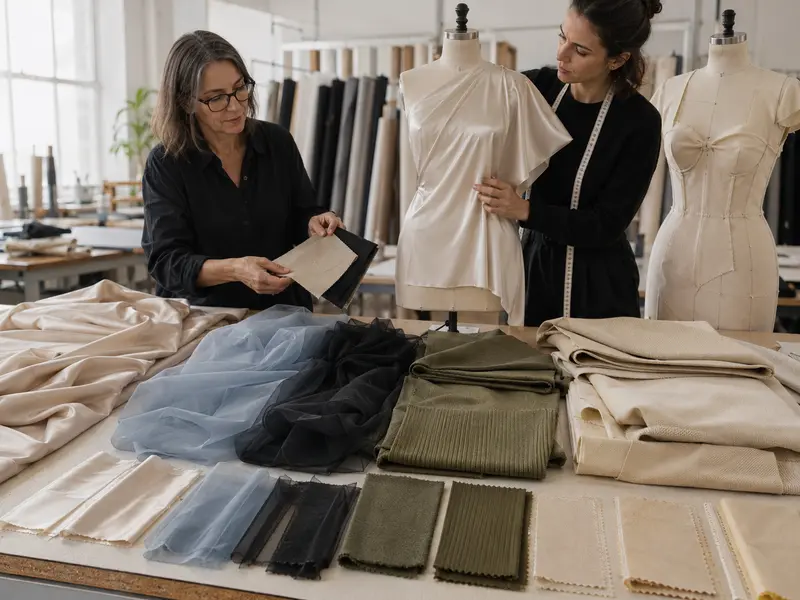
In everyday fashion language, drape is often used as a synonym for softness or flow, but that is only part of the picture. In dress development, drape describes how easily a flat textile becomes a three-dimensional form under its own weight. It influences the number and depth of folds, the distance between fabric and body, the way a neckline falls, and whether skirt fullness drops vertically or pushes outward. Two fabrics can feel similarly soft between the fingers yet form very different shapes once they are cut into full garment panels.
A useful workshop habit is to stop judging the fabric only on the cutting table. Hold a larger piece from one edge, let it hang freely, form a few gathers, drape it over a curved dress form, and watch what happens after you release it. Does the material immediately collapse into narrow folds, or does it maintain broad ridges? Does it conform smoothly over the bust and hip, or bridge across them? These simple observations do not replace laboratory testing, but they expose behavior that composition labels and small hanger swatches cannot show.
What Makes Fabric Fluid or Structured?
Fluidity is created by several properties working together. Fiber composition matters, but yarn size, yarn twist, weave or knit construction, density, thickness, finishing, surface treatment, stretch, bending resistance, and shear behavior can be just as important. This is why polyester chiffon, polyester satin, polyester organza, and polyester ponte should never be treated as one material simply because the fiber label is the same. Their structures produce very different responses to bending, folding, body movement, and seam construction.
A fluid fabric usually bends with relatively little resistance, allowing gravity to pull fullness into smaller, softer folds. A structured fabric resists deformation more strongly, so it tends to hold wider folds, clearer edges, and more distance from the body. Neither result is automatically better. A bias slip dress often needs a fluid material, while a sculpted mini dress may depend on controlled stiffness. The useful question is not whether a fabric is soft or firm in isolation, but whether that behavior supports the exact silhouette, construction, and wearing occasion planned for the style.
Is Fabric Drape the Same as Fabric Weight?
No. Fabric weight, usually expressed as grams per square meter, tells you how much material mass is present; drape tells you how that material deforms. Weight can influence the way a garment falls, particularly in long skirts and full dresses, but it does not measure bending resistance. A lightweight organza can stand away from the body more strongly than a substantially heavier viscose crepe, while a medium-weight jersey can fall close to the body because its knit structure bends and stretches easily.
This distinction becomes important when a development team replaces one fabric with another. Matching a 150 GSM target is useful, but it is not enough if the new material folds differently, stretches more, has a firmer finish, or uses a different construction. A reliable comparison checks weight together with hand feel, bending behavior, stretch, recovery, transparency, shrinkage risk, surface shine, and the actual silhouette produced in a sample. Weight is a useful control point; it is not a shortcut for predicting how the finished dress will look.
How Does Drape Become Garment Shape?
A pattern determines where fabric exists, while drape determines where much of that fabric settles after gravity takes over. Imagine two A-line skirts with identical waist and hem measurements. In a soft crepe, a large share of the circumference may collapse into vertical folds, making the skirt look narrower. In a crisp woven fabric, more of the same circumference can remain projected away from the body, so the skirt appears wider even though the paper pattern has not changed by a millimeter.
The same principle applies to bodices and details. A cowl neckline needs enough flexibility to fall into controlled loops, a ruffle needs the right balance of body and softness, and a fitted dress needs a fabric that follows curves without creating uncontrolled cling or sagging. This is the reason experienced sample reviews separate fit from material behavior. If the measurements are correct but the silhouette is wrong, changing the pattern first may create a second problem. The fabric, pattern, lining, and construction have to be read together.
| Fabric Direction | Approx. Common Weight* | Typical Drape | Common Dress Use |
| Chiffon | 30-80 GSM | Very light and fluid | Layered maxi, ruffles, overlays |
| Organza | 30-80 GSM | Light but comparatively stiff | Structured skirts, sleeves, volume |
| Lightweight satin | 70-140 GSM | Fluid to semi-fluid | Slip, bias, evening dresses |
| Crepe | 100-220 GSM | Soft to controlled | Midi, maxi, occasion dresses |
| Jersey | 140-220 GSM | Fluid with stretch | Bodycon, ruched, casual dresses |
| Ponte | 250-350 GSM | Stable and controlled | Fitted, tailored silhouettes |
| Suiting | 180-320 GSM | Medium to structured | A-line and tailored dresses |
How Does Fabric Drape Change a Dress Silhouette?
Fabric drape changes silhouette by controlling whether fullness falls downward or projects outward, how closely a dress follows the body, and how the garment reacts to movement. Highly drapable fabrics usually create softer vertical lines and smaller folds. More structured fabrics create stronger edges, wider folds, and greater volume away from the body, even when the underlying pattern measurements remain unchanged.
How Does High Drape Create Fluid Silhouettes?
Highly drapable fabrics surrender more readily to gravity, so they tend to create longer vertical lines and softer transitions around the bust, waist, hip, and hem. This makes them especially useful for slip dresses, bias-cut styles, cowl necklines, soft column dresses, draped eveningwear, and many resort silhouettes. The fabric does not need to be extremely light; it needs enough flexibility to bend and shift smoothly around the body without holding unnecessary space away from it during wear and photography.
More drape is not always an advantage. A material can become so fluid that an A-line loses its outward shape, a ruffle looks flat, or a waist seam appears less defined. Very soft fabrics may also reveal seam allowances, lining edges, pocket bags, or the outline of the body more clearly than expected. For commercial dress development, the target is controlled fluidity: enough movement to create elegance and continuity, but enough stability to keep the intended proportion, coverage, and construction visually clean.
How Does Low Drape Create Structured Silhouettes?
A fabric with greater resistance to bending can maintain more three-dimensional space between the body and garment. That quality is valuable when the design depends on visible architecture: a crisp A-line, sculpted mini skirt, exaggerated sleeve, peplum, bubble shape, structured cocktail dress, or a formal silhouette that should keep clear edges. The effect can be dramatic because the fabric does not simply hang from the pattern; it actively supports the outline, preserves edge definition, and distributes fullness away from the body.
Structure also brings production challenges. Firm materials can create bulk at gathered waistlines, folded hems, darts, seam intersections, enclosed edges, and areas containing several layers. A shell fabric that looks balanced on its own may become noticeably stiffer once lining, interfacing, boning, or embellishment is added. Good development therefore aims for the minimum structure needed to hold the design. Too little creates collapse, while too much can make a fashionable silhouette feel heavy, rigid, or visually larger than the sketch intended.
How Does Drape Affect Volume and Fullness?
Pattern fullness and visual fullness are not the same thing. Two skirts can contain the same amount of fabric and still look completely different because drape determines how the material distributes that excess. A soft chiffon gathered at twice the waist measurement can compress into many narrow folds and fall relatively close to the body, while a firmer woven using the same gathering ratio may build a thicker waist seam and project much farther outward through the upper skirt.
Circle skirts show the same principle. A fluid viscose can create deep, narrow waves at the hem, whereas a stiffer material can form fewer but broader waves that increase the apparent diameter of the skirt. This is why copying gathering ratios, flare angles, or hem circumferences from an approved style into a new fabric is risky. Development teams should judge three points separately: where fullness begins, how it travels through the garment, and what it does at the hem. Together, those observations reveal whether the fabric is supporting the design or exaggerating it.
How Does Drape Affect Movement?
A dress does not live only in a front-view fitting photograph. It moves when the wearer walks, turns, sits, climbs stairs, dances, or reaches for something, and drape strongly affects how the fabric accelerates, swings, separates into layers, and settles again. Lightweight chiffon may flutter quickly, satin often moves in broader waves because it carries more mass, and stable ponte usually behaves as a more controlled unit with less secondary motion after the wearer stops.
Movement can expose problems that look harmless when the model stands still. A slit may open too aggressively, a bias skirt may twist, a lining may ride upward, or a heavy full skirt may pull at the waist and change the bodice position. A practical sample review should therefore include walking roughly 10-15 meters, sitting and standing, turning in both directions, and checking whether the garment returns to its original shape. The exact distance is not a standard test; it is simply long enough to make common movement problems visible before approval.
Which Fabrics Work Best for Different Dress Silhouettes?
The best fabric is the one whose drape, weight, stretch, recovery, opacity, and structure support the intended silhouette. Fluid satin and crepe often suit slip or column dresses, chiffon works well for flowing layers, stretch jersey supports bodycon styles, while ponte, organza, and suiting can hold clearer shapes. Final selection should be based on fabric behavior in the actual garment, not the fabric name alone.
Which Fabrics Suit Slip and Column Dresses?
Slip and column dresses usually depend on clean vertical fall and low visual bulk. Lightweight or medium-weight satin, crepe, viscose-based woven fabrics, and other materials with controlled fluidity are common starting points because they can move over the bust, waist, hip, and seat without forcing the garment into a boxy outline. Satin deserves particular care because the word describes a weave family, not one fixed performance level. Two satins can differ substantially in weight, stiffness, stretch, shine, and surface friction.
A column dress often needs slightly more stability than an extremely soft slip dress. If the material is too fluid, the garment may cling around the hip, expose seam allowances, or reveal lining transitions. If it is too firm, the side profile can look straight and bulky instead of clean and elongated. During sampling, check high hip, full hip, seat, side seams, neckline, and hem. These areas quickly show whether the chosen material is producing smooth vertical continuity or fighting the intended silhouette.
Which Fabrics Suit A-Line and Fit-and-Flare Dresses?
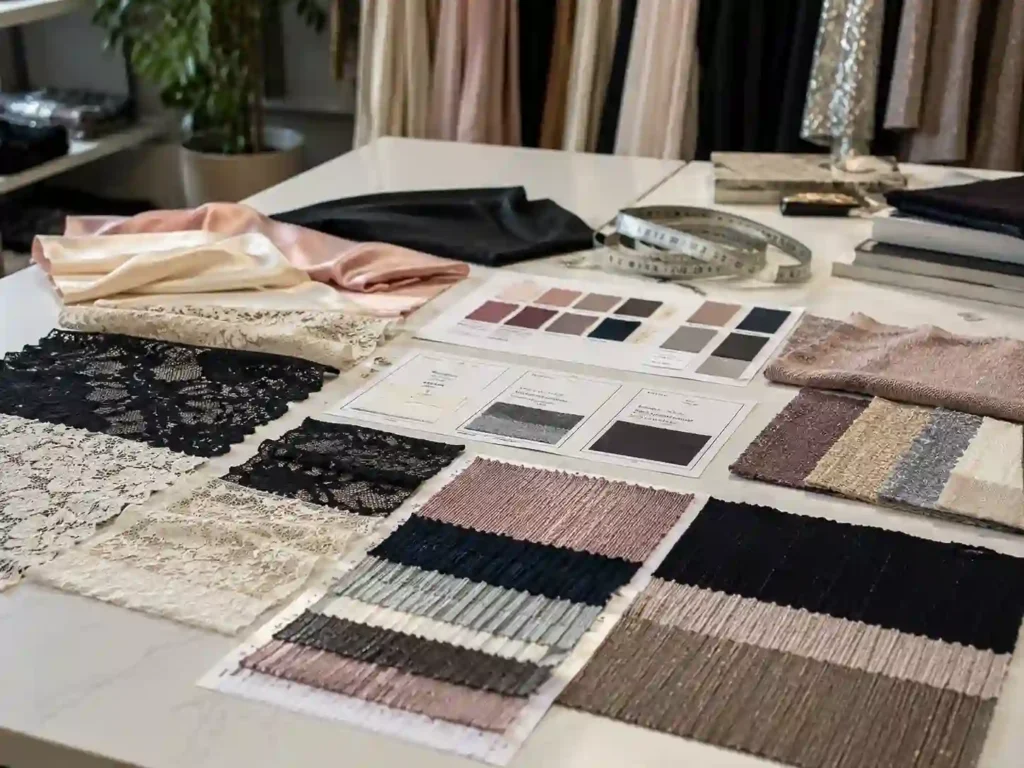
A-line dresses often work best with medium drape: enough softness to move naturally, but enough body to preserve the widening shape from the waist or upper torso to the hem. Crepe, selected satins, cotton blends, lightweight suitings, linen blends, and stable knits can all work, depending on season, lining, finish, and the amount of projection the design requires. A fabric that is too fluid can turn a clear A-line into something closer to a column, while excessive stiffness can create an unwanted triangular shape.
Fit-and-flare designs are more demanding because the bodice and skirt may ask different things from the same fabric. The upper body needs stability for fit and seam control, while the skirt needs enough movement to create attractive volume. Lining, underlining, interfacing, or hem support can adjust the balance, but every added layer changes weight and drape. Instead of asking whether a fabric is generally good for A-line dresses, ask whether it creates the precise amount of projection, fold depth, waist definition, and movement required by this specific style.
Which Fabrics Suit Bodycon and Ruched Dresses?
Bodycon silhouettes depend on stretch and recovery as much as traditional drape. Jersey, rib knit, ponte, stretch mesh, power mesh, and other elastomer-containing materials can follow the body closely, but maximum stretch is only half of the decision. A fabric that stretches easily and does not recover well can develop seat growth, loose knees, neckline distortion, or a less defined waist after wear. The garment may look correct during the first fitting and noticeably different later in the day.
Ruched dresses introduce another variable because extra fabric is deliberately concentrated over the body. A lightweight stretch mesh can create fine, dense gathers, while a thicker jersey may produce larger ridges and more bulk. Stretch direction also matters: a material may offer strong crosswise extension with limited lengthwise stretch, which changes garment length, seam stress, and how the ruching settles. For fitted styles, record stretch and recovery by direction and test the complete construction, especially where lining or a second mesh layer changes the tension.
Which Fabrics Suit Maxi and Structured Dresses?
Flowing maxi dresses usually benefit from fabrics that can cover a large area without becoming bulky. Chiffon, lightweight crepe, viscose, rayon, soft mesh, and selected satins are common directions, but the final choice depends on transparency, lining, gathering ratio, print, season, and intended movement. Length magnifies fabric behavior: several meters of a material can create much more downward pull than a small swatch suggests, so shoulder seams, waist seams, elastic channels, and straps should be reviewed under the full garment load.
Structured dresses sit at the other end of the spectrum. Organza, ponte, suiting, firmer satin, and stable woven fabrics can preserve volume and clear edges. Internal elements such as boning, interfacing, underlining, cups, and hem support can add local structure without requiring the entire outer fabric to be rigid. The most reliable approach is to choose a material system, not simply an outer fabric. Shell, lining, reinforcement, trims, and pattern geometry should be evaluated together because the final silhouette is produced by their combined behavior.
| Silhouette | Target Behavior | Common Fabric Directions | Primary Development Risk |
| Slip | High drape, low bulk | Satin, crepe, viscose | Cling or visible seam allowances |
| Column | Fluid with stability | Crepe, satin | Boxiness or excessive contouring |
| A-line | Medium drape | Crepe, suiting, cotton blends | Collapse or excessive flare |
| Fit-and-flare | Controlled body | Satin, crepe, stable knit | Waist bulk or wrong skirt volume |
| Bodycon | Stretch plus recovery | Jersey, rib, ponte | Growth after wear |
| Flowing maxi | High drape | Chiffon, viscose, soft crepe | Transparency, twisting, weight pull |
| Structured mini | Shape retention | Ponte, organza, suiting | Excessive stiffness or seam bulk |
| Draped evening | Fluid folding | Satin, stretch satin, crepe | Drag lines or unstable bias areas |
How Do Weight, Stretch, and Grain Affect Fabric Drape?
Weight, stretch, and grain modify drape in different ways. Weight increases gravitational pull, stretch changes how closely fabric follows the body, and grain direction changes the mechanical orientation of woven material. These properties interact rather than acting alone. Two fabrics with the same GSM can drape differently, while the same woven fabric can create a noticeably different silhouette when cut on straight grain or bias.
Is Heavier Fabric Always More Structured?
Heavier does not automatically mean more structured. GSM measures mass per square meter, while structure depends largely on how strongly the textile resists bending and deformation. A 200 GSM viscose-based fabric can fall more fluidly than a much lighter organza because the heavier material may bend far more easily. This is one reason fabric specifications that list only fiber composition and GSM are incomplete when the goal is to reproduce a specific dress silhouette rather than merely purchase a similar textile category.
Weight still matters as garment area increases. A long skirt using several meters of fabric can place noticeable downward load on a waist seam, elastic channel, shoulder strap, or bias-cut bodice. If 3 meters of fabric averages 180 GSM and has an effective usable width near 1.5 meters, the theoretical mass of that rectangle is roughly 810 grams before cutting losses, lining, trims, or hardware. The finished garment will use less than the full rectangle in many cases, but the example shows how quickly total mass can become relevant in maxi and heavily gathered designs.
How Does Stretch Affect Dress Shape?
Stretch changes how fabric interacts with the body, while recovery determines how well it returns after the load is removed. A fitted dress can be patterned with less ease when the material stretches sufficiently, but the result is only stable if recovery is also appropriate. Maximum stretch values of 20%, 40%, or 60% can describe very different products, yet none of those figures alone tells you whether the garment will grow at the seat, loosen at the waist, or distort around the neckline after repeated wear.
A simple workshop comparison can make recovery differences visible. Mark a 10 cm span, extend it to a controlled length, release it, wait for a consistent period, and measure the remaining length. If the mark settles at 10.3 cm, the simple check shows 3% residual growth relative to the original span. This is not a substitute for a standardized laboratory method, but it creates a repeatable internal comparison. For bodycon, ruched, and stretch-satin dresses, direction matters as much as the percentage because crosswise and lengthwise behavior may differ significantly.
How Does Bias Cut Change Drape?
Bias cutting places woven pattern pieces diagonally relative to the warp and weft, commonly near a 45-degree orientation. In many woven textiles, this direction allows the yarn system to deform more easily in shear, so the fabric can follow three-dimensional curves with greater fluidity than it does on straight grain. That mechanical difference gives classic bias slip dresses and evening gowns their recognizable body-skimming fall, even though the fabric itself may have very little true fiber stretch along the warp or weft.
The same flexibility introduces production risk. Long bias sections can grow after cutting, side seams can ripple, hems can become uneven, and slippery satins or lightweight crepes can distort during sewing. Many sample rooms therefore allow a noticeably unstable bias garment to hang before final hem correction; 12-24 hours is a common practical starting observation period, although the appropriate time depends on the material and construction. Grain direction must remain part of the approved specification because moving a panel from bias to straight grain can change the silhouette without changing any pattern measurement.
How Do Lining and Interfacing Change Drape?
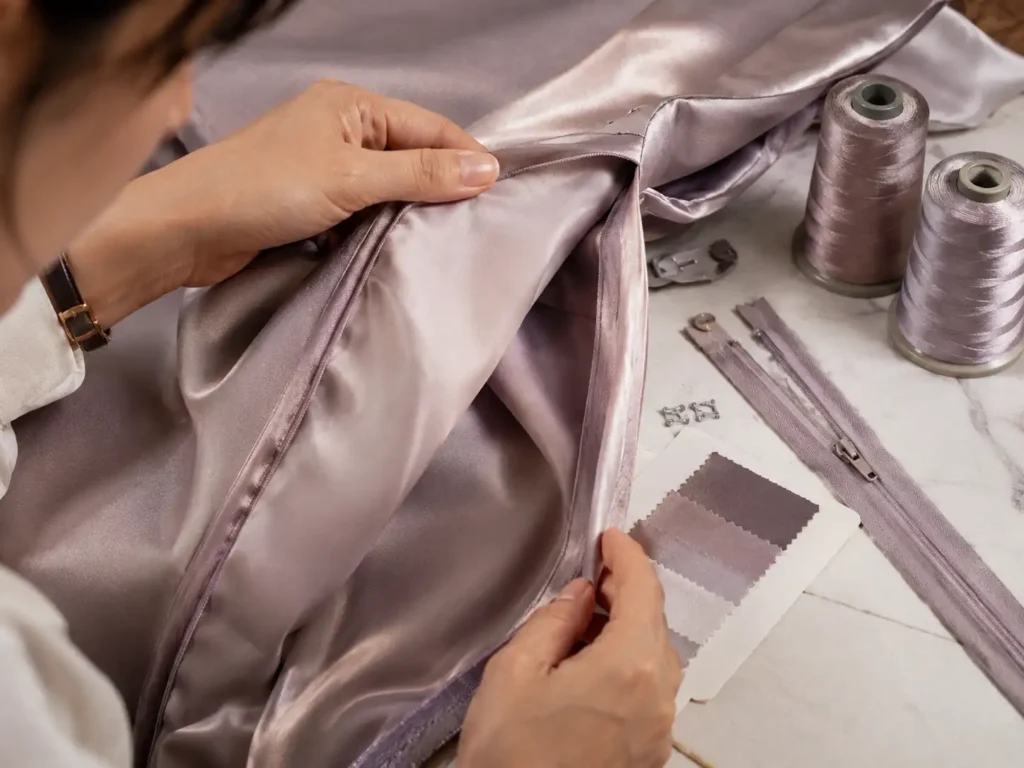
The shell fabric is only one layer of the finished dress. Lining adds weight, friction, and bending resistance; underlining changes the behavior of an entire panel; interfacing creates local stiffness; boning redirects force through a bodice; and cups, elastic, tapes, zippers, seam allowances, beads, or sequins can alter the way nearby fabric hangs. This is especially important with chiffon, mesh, lace, satin, and other materials that are often evaluated as single layers during sourcing but worn as layered constructions in the finished garment.
A soft satin can lose much of its fluidity when paired with a firm lining, while a lightweight slippery lining may preserve more independent movement between layers. A transparent chiffon skirt might look perfect before lining and noticeably more rigid afterward. Interfacing can improve neckline or zipper stability but become visually obvious if it extends too far into a fluid panel. The development rule is simple: approve the complete material stack whenever possible. The silhouette customers see is created by shell, lining, support, trims, seams, and finishing together, not by the face fabric alone.
How Can You Evaluate Fabric Drape Before Sampling?
Evaluate fabric drape in stages: screen meaningful swatches, compare candidates under the same conditions, check weight, stretch, recovery, transparency, folds, and grain response, then confirm the material in a full garment sample. A small swatch can eliminate obviously unsuitable fabrics, but it cannot reproduce the effect of garment length, seams, lining, pattern geometry, body curves, or total fabric weight.
What Can a Fabric Swatch Tell You?
A useful swatch reveals much more than color and hand feel. Hold it vertically and watch how quickly the material settles. Gather one edge and inspect whether the folds are narrow and soft or broad and firm. Drape it over a rounded form to see whether it follows the curve or bridges across it. Fold and release it to observe crease behavior, then check the face and back under directional light because satin and other reflective surfaces can make wrinkles, pulling, and uneven seams more visible in photography than they appear under soft room lighting.
Size matters. A 10 x 10 cm color cutting can confirm shade and texture, but it is usually too small to demonstrate garment drape properly. When material availability allows, a 50 x 50 cm piece offers a much more useful comparison, and half a meter to one meter can reveal additional information for long, gathered, or layered dress designs. Record supplier reference, composition, width, weight if known, stretch direction, hand feel, finish, and approval comments. A description such as ‘black satin’ is not detailed enough to protect silhouette consistency during later sourcing.
How Can You Compare Two Similar Fabrics?
Compare candidate fabrics side by side under identical conditions rather than relying on memory. Use pieces of similar size, hang them from the same support, handle them in the same direction, and view them under the same lighting. Start with objective information such as composition, width, GSM, and measured stretch, then add structured observations for hand feel, fold size, opacity, wrinkle tendency, surface shine, recovery, and how easily the material conforms to a curved form.
A simple 1-5 internal score can help several team members describe the same fabrics consistently, but the highest score should never automatically win. A fabric rated 5 for fluidity may be excellent for a bias slip dress and completely wrong for a sculpted mini. Define the target behavior first, then compare each fabric against that target. Keep an approved cutting or sealed reference with the development record whenever possible. Generic names are unreliable because different mills and suppliers may sell noticeably different materials under labels such as satin, crepe, mesh, or jersey.
Is a Fabric Swatch Enough to Predict the Dress?
No. A swatch is a screening tool, not final proof of garment behavior. The completed dress adds seam orientation, darts, panel size, gathering ratios, bias sections, zippers, lining, interfacing, internal support, embellishment, skirt circumference, and total garment weight. The body adds another set of forces. A fabric that hangs beautifully from a clip can bridge across the bust, catch at the high hip, cling around the thigh, or behave differently once it is layered over lining or shapewear.
Long garments amplify these effects. A maxi skirt can pull downward much more strongly than a short test panel, and bias sections may lengthen after hanging. Ruffles also behave differently once their curved edges and attachment seams are introduced. A reliable development sequence is therefore swatch assessment, fabric selection, prototype or sample, fitting, material or pattern correction, revised sample where necessary, and pre-production approval. Skipping the garment stage because the fabric looks attractive on a hanger card transfers uncertainty directly into bulk production.
How Does a Sample Confirm the Silhouette?
The sample is where fabric behavior becomes garment behavior. Fit measurements remain essential, but silhouette approval needs more than checking bust, waist, hip, and length. Review the outline from front, side, back, and three-quarter views. Check where the skirt starts to flare, whether the waist remains visually defined, whether side seams hang correctly, whether the back collapses below the seat, whether a cowl falls symmetrically, and whether the hem produces the intended wave or flare instead of twisting or dropping unevenly.
Then test movement and recovery. Let the wearer walk, turn, sit, stand, and repeat normal movements before the final inspection. If the waist measurement is correct but the skirt projects too far outward, reducing the waist will not solve a stiffness problem. If a bodycon dress loses shape after wear, tightening the pattern will not correct weak recovery. In Jinfeng Apparel’s documented development process, a fabric substitution is rechecked across composition, weight, stretch, hand feel, drape, transparency, color, cost, lead-time impact, and whether the pattern or sample must change before production moves forward.
| Checkpoint | Practical Review | Useful Data or Reference | Typical Warning Sign |
| Swatch hang | Fold width and projection | 50 x 50 cm or larger when available | Fabric stands too far from the body |
| Weight | Mass per square meter | GSM from supplier or measured sample | Replacement matches color but not fall |
| Stretch | Extension by direction | 10 cm marked span for internal comparison | Pattern assumes more or less stretch |
| Recovery | Length after release | Residual growth from original mark | Seat or waist loosens after wear |
| Layer test | Shell plus lining/support | Approved full material stack | Finished dress becomes too stiff |
| Movement | Walk, sit, turn, recover | Repeat same fitting sequence | Twisting, cling, lining ride-up |
| Bias stability | Length and seam behavior | Observe after hanging | Uneven hem or rippled side seam |
| PP approval | Final material and construction | Sealed reference sample | Bulk setup differs from approved sample |
How Do You Fix a Dress When the Fabric and Silhouette Do Not Match?
Start by identifying whether the mismatch comes from fabric behavior, pattern geometry, lining, internal support, or construction. Do not immediately alter measurements. If the material is fundamentally too stiff, too soft, too stretchy, or too unstable for the intended silhouette, pattern changes alone may create new problems. The most efficient correction usually comes from isolating the physical cause and changing one major variable at a time.
What If the Dress Looks Too Stiff?
Begin by locating where the stiffness appears. If the entire garment feels rigid, the shell fabric may be the main cause. If only the neckline, waist, zipper area, or hem looks hard, the problem may come from interfacing, lining, seam bulk, tape, or finishing rather than from the outer material. Compare the sample with the intended silhouette and look specifically at fold size. Broad angular folds where narrow folds were expected are a strong sign that the construction has more resistance than the design needs.
Corrections may include testing a softer fabric, reducing unnecessary layers, using a lighter lining, limiting interfacing to essential zones, decreasing gathering volume, trimming seam bulk, or changing the hem construction. Make one major change at a time whenever possible. If fabric, pattern, lining, and gathering ratio are all changed together, the team may get a better sample but never understand what fixed it. The objective is not to remove structure completely; the dress still needs enough control to support fit, closures, neckline shape, and any internal bodice construction.
What If the Silhouette Collapses?
A collapsing silhouette usually means the garment has less support than the design requires. An A-line may become nearly straight, a peplum may hang downward, a ruffle may lose its visual depth, or a sculpted neckline may fold inward. First compare the sample material with the approved or intended fabric for weight, thickness, bending behavior, finish, and layer count. If the replacement is noticeably softer, the outer fabric may be the primary reason the silhouette is failing.
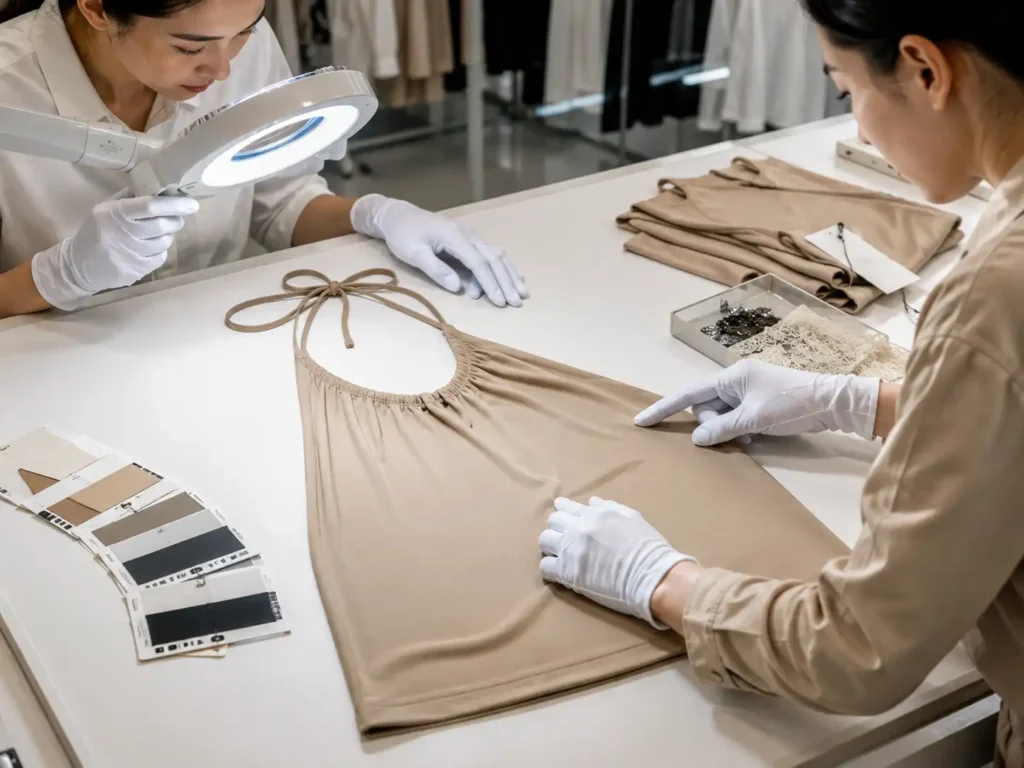
Structure can sometimes be added without replacing the shell. Underlining, localized interfacing, a more supportive lining, internal mesh, boning, or a firmer hem treatment may restore shape. These solutions increase complexity, weight, and cost, so they should not be used automatically to compensate for a fundamentally unsuitable material. Pattern geometry may also need adjustment; a softer fabric can require more flare or a different ruffle ratio to create the same apparent volume. The correct pattern is therefore partly dependent on the fabric for which it was developed.
What If the Fabric Clings Too Much?
Cling can come from several sources, so replacing the fabric immediately is not always necessary. A highly fluid textile may follow every contour, insufficient ease can create tension around the hip or thigh, static can make shell and lining stick together, and surface friction can prevent layers from moving independently. Stretch fabrics add another possibility: the material may be under continuous tension because the pattern assumes more extension than the fabric comfortably provides.
Observe when the problem appears. If the dress clings immediately, review ease, stretch, lining, and material fluidity. If it becomes worse after walking, investigate static, recovery, and layer interaction. If it occurs only at a seam or specific body area, inspect seam allowance bulk and internal components underneath. Satin needs extra attention because reflected light makes drag lines and tension highly visible in photography. For online fashion collections, a sample that looks acceptable in soft fitting-room light should still be checked under stronger front and side lighting before bulk approval.
Should You Change the Fabric or the Pattern?
Change the fabric when its fundamental behavior conflicts with the design. Change the pattern when the material is important to the product and the silhouette can realistically be adapted around it. In many successful developments, both receive modest adjustment. Start by confirming the target shape from the approved sketch, reference garment, or fit sample, then define the visible failure precisely: excess flare, collapse, cling, stiffness, twisting, dragging, sagging, or poor movement. That diagnosis is far more useful than a general comment that the sample ‘does not look right.’
Next compare weight, drape, stretch, recovery, thickness, transparency, grain behavior, lining, interfacing, seam construction, and hem treatment. Make a controlled correction and resample when the change materially affects silhouette. Before bulk production, seal the final combination of fabric, pattern, lining, trims, measurements, and workmanship as one system. For custom dress programs where repeated samples keep missing the intended shape, Jinfeng Apparel can review the tech pack, reference garment or images, fabric direction, and fit comments to help identify whether the next change should come from material selection, pattern adjustment, or construction.
Conclusion
Fabric drape is not a decorative textile detail added after the design is finished. It is one of the forces that creates the finished dress. The strongest development decisions come from connecting the target silhouette with fabric weight, bending behavior, stretch, recovery, grain direction, lining, pattern geometry, and movement before bulk production begins. When those factors are evaluated together, teams make fewer blind pattern corrections, fabric substitutions become easier to control, and samples are more likely to reproduce the intended shape. A beautiful swatch can start a dress, but only the right fabric behavior can carry that design successfully from sketch to fitting room and then into consistent production.