Skip to content

Choosing between China and the USA for dress manufacturing looks straightforward until a real collection reaches development. A quotation may make China appear less expensive, while a domestic factory may appear faster because the production floor is closer to the sales market. Yet dresses are rarely sewing-only products. A satin corset dress, lined mesh mini, sequined occasion dress, or fitted bodycon style can involve pattern corrections, specialist fabrics, cups, boning, zippers, trims, grading, several sample rounds, inspection, packaging, freight, customs, and replenishment planning. Once those factors enter the picture, the country with the lowest sewing price is not automatically the country with the lowest commercial risk, and the closest factory is not automatically the fastest route from design approval to sellable inventory.
China is generally stronger when a dress program needs a dense fabric-and-trim supply chain, complex development, multiple styles, scalable production, and integrated export support. USA manufacturing can be stronger when physical proximity, domestic logistics, close factory access, and Made-in-USA positioning matter more than manufacturing cost. The right choice depends on total landed cost, product complexity, volume, launch timing, sourcing requirements, and replenishment strategy.
That difference matters because fashion companies rarely lose margin only because sewing cost was a few dollars higher than expected. Margin disappears when the wrong fabric is approved, fit needs another revision, a zipper specification changes late, production cannot scale, or a delivery misses the campaign calendar. Picture a 24-style occasionwear collection in which the first ten samples look promising, but three fabrics are unavailable in bulk and four styles need bust and waist corrections. At that moment, the important question is no longer which country looked cheaper on the first quotation. It is which manufacturing system can solve those problems without turning the launch plan into a chain of expensive exceptions.
What Is the Difference Between China and USA Dress Manufacturing?
China and the USA can both produce high-quality dresses, but their manufacturing systems differ. U.S. production often offers closer physical access and simpler domestic logistics, while China offers a denser network for fabrics, trims, specialist processes, product development, and scalable production. The better choice depends on the dress category, technical complexity, order structure, sourcing needs, launch calendar, and distribution model.
What Does USA Dress Manufacturing Offer?
The clearest advantage of manufacturing dresses in the United States is proximity for companies whose design, merchandising, product, or distribution teams are also based there. Physical samples can move between the factory and the brand without crossing an international border, factory visits are easier to arrange, and technical conversations often happen during the same working day. For collections that depend on frequent fittings, rapid sample comments, or close inspection of construction details, those factors can remove calendar time that would otherwise be spent on international courier movement and time-zone handoffs. The advantage is strongest when the domestic factory already has the pattern, sewing, finishing, and material capabilities required for the intended dress category.
Domestic production can also simplify the final leg into a U.S. warehouse because finished garments do not need to cross the Pacific and enter normal international import clearance before reaching domestic distribution. That can be useful for short replenishment windows and programs where holding less inventory in transit has real financial value. Still, local production is not automatically an entirely local supply chain. Satin, lace, mesh, zippers, cups, boning, elastic, hardware, labels, or packaging may still come from overseas. If several critical components have to be imported before cutting can begin, part of the geographic advantage moves upstream. A sourcing team should therefore ask where the garment is sewn, where its critical materials come from, and which step actually controls the delivery date.
What Does China Dress Manufacturing Offer?
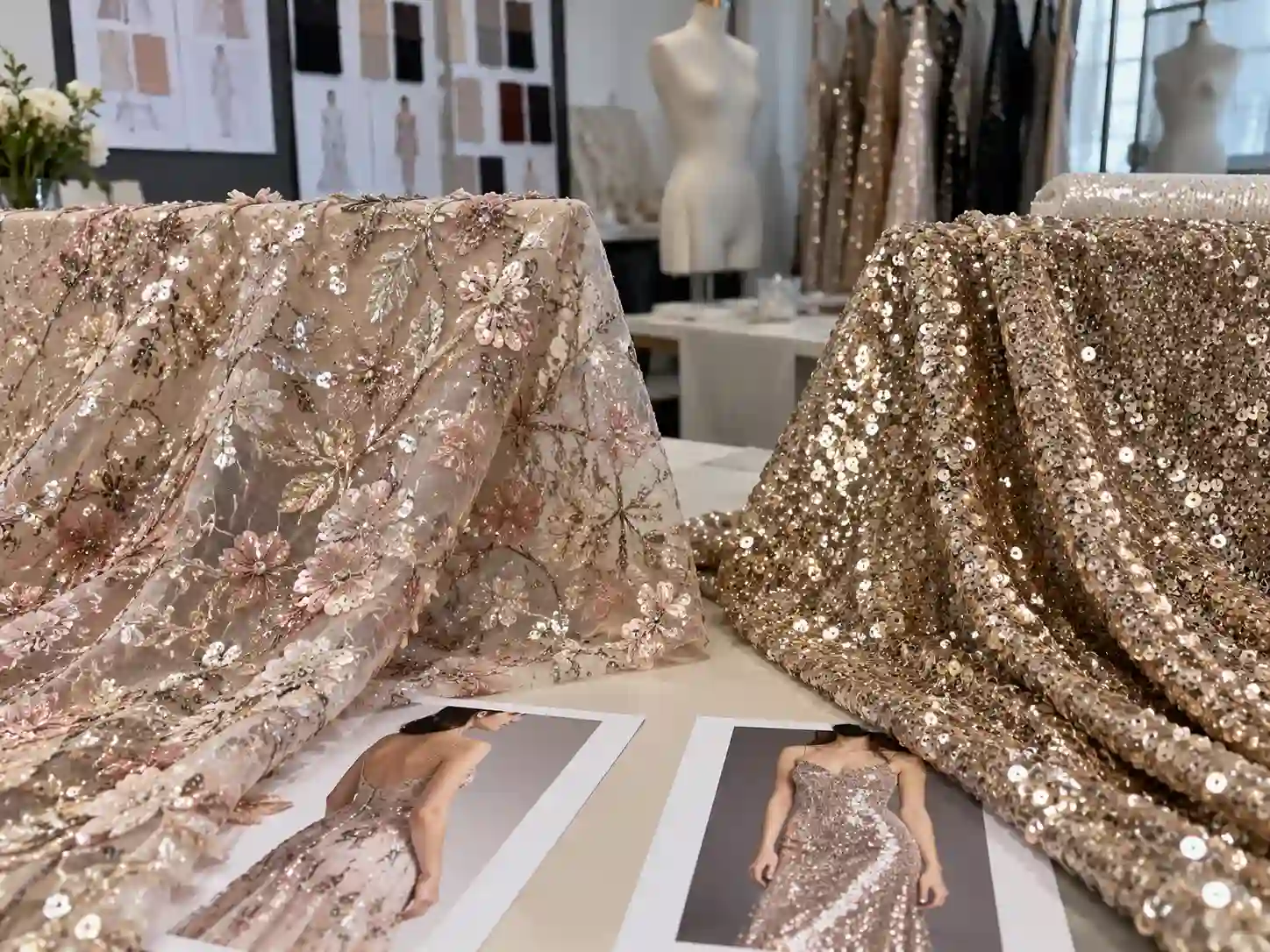
China’s strongest advantage in fashion dresses is usually the ecosystem around the sewing floor rather than a simplistic claim about cheap labor. A single collection may need smooth satin in different weights, stretch mesh with controlled recovery, embroidered lace, sequin fabric, lining, invisible zippers, hooks, cups, boning, elastic, decorative hardware, labels, barcodes, printed packaging, embroidery, pleating, or other specialist processes. In mature apparel regions, many of those resources can be developed and compared within one broader supplier network. When the first fabric is too shiny, the lining is too heavy, or a zipper needs a different tape color, an integrated sourcing environment can make alternative development faster and more practical than restarting the search across unrelated suppliers.
This advantage becomes more important as style count and technical complexity increase. A 20-style dress line is not simply twenty sewing orders; it can be twenty overlapping development calendars, each with its own pattern, fit comments, materials, trim status, PP approval, color breakdown, size ratio, packing instructions, and shipment timing. Jinfeng Apparel is one example of this Guangdong model: the company’s confirmed scope covers custom dress development, pattern work, fabric and trim sourcing, sample making and revision, bulk production, quality control, private-label packing, export coordination, and repeat-order support. That combination is most relevant when a brand needs the manufacturer to manage connected product-development tasks rather than only cut and sew an already finalized garment.
Are All Dress Factories Comparable?
No country comparison is useful if the factories being compared are technically different businesses. A factory focused on basic jersey dresses can be very efficient at high-volume knitwear and still be a poor choice for a boned corset mini with shaped cups, lining, contour seams, ruching, and a concealed zipper. Likewise, a specialist U.S. occasionwear factory can outperform a Chinese supplier that mainly produces basic tops. The fairest comparison starts with the garment and asks whether each factory has handled the same fabric behavior, silhouette, internal structure, finishing standard, size range, and commercial volume. Country becomes a meaningful variable only after product capability is reasonably comparable.
| Decision Area | USA Manufacturing | China Manufacturing | What to Verify |
| Physical access | Usually easier for U.S.-based teams | Requires remote coordination or planned visits | Who attends fittings and approves changes |
| Fabric and trims | Depends heavily on local/import network | Broad supplier depth in major apparel clusters | Actual sourcing options for this style |
| International logistics | Limited for U.S. delivery | Freight and customs are part of the route | True warehouse-ready lead time |
| Complex style support | Factory-specific | Factory-specific, with broad specialist ecosystem | Comparable product experience |
| Scaling | Depends on selected factory capacity | Can be strong in coordinated production systems | Sample, line, QC, and packing bottlenecks |
| Origin positioning | Potential Made-in-USA value when rules are met | Imported origin must be labeled correctly | Applicable origin and labeling rules |
How Do China and USA Compare on Total Cost?
China often has a lower manufacturing cost, while U.S. production can reduce international freight, customs handling, and some inventory exposure. A fair comparison uses total landed and operational cost rather than sewing price alone. Fabric, trims, development, inspection, duty, freight, warehousing, rework, financing, and lost selling time can materially change which sourcing route is more economical.
Which Has Lower Production Cost?
For many fashion-dress programs, China is likely to offer a lower ex-factory manufacturing cost than comparable production in the United States, particularly when the style is labor intensive or uses several specialist components. The difference, however, can vary dramatically between garments. A loose jersey mini has a relatively simple pattern and limited sewing operations, while a structured evening dress may require lining, interfacing, cups, boning, numerous shaped panels, hand finishing, difficult pressing, and tighter appearance control. In the second garment, labor and technical handling become a much larger share of the price, so comparing only fabric consumption or garment weight misses much of the real manufacturing work.
Price comparisons also become unreliable when quotations do not contain the same scope. One manufacturer may include main fabric, lining, zipper, labels, pressing, individual polybags, inspection, and export cartons, while another quote excludes packaging, special trims, or sample-development charges. Before selecting the apparently cheaper country, normalize the BOM, construction, label package, QC expectation, and packing method. If the specifications are not equivalent, the quotes are not equivalent. Experienced apparel teams often discover that a slightly higher initial price is easier to manage than a lower quote that repeatedly grows as missing components are added during development.
What Is the Real Landed Cost?
A practical cost calculation starts with more than the garment price. Landed cost normally includes garment manufacturing, development allocations, packaging, third-party or client inspection when required, international or domestic freight, duty, brokerage, customs-related fees, and final delivery to the warehouse. For management decisions, the calculation should also consider inventory carrying cost, likely rework exposure, and the financial effect of schedule slippage. Those last items rarely appear on a supplier quotation, yet they can determine whether a low-price sourcing decision actually protects margin. A collection that arrives late for a wedding, graduation, holiday, or resort selling window can lose more through markdowns and missed sales than it saved through a lower sewing rate.
| Cost Layer | Typical Items | Common Mistake | Better Comparison |
| Development | Pattern, first sample, revisions, PP sample | Ignoring repeated revision cost | Cost per approved style |
| Garment | Fabric, trims, cutting, sewing, finishing | Comparing different specifications | Normalize BOM and construction |
| Quality | In-line checks, final inspection, rework | Assuming QC is included identically | Define checkpoints and scope |
| Logistics | Freight, brokerage, customs, domestic delivery | Comparing factory price only | Use warehouse-ready landed cost |
| Inventory | Cash tied in transit and safety stock | Treating lead time as free | Model inventory days and launch date |
| Commercial risk | Delay, defects, markdowns, stockouts | Leaving risk outside the costing model | Use scenario-based margin analysis |
How Do Tariffs and Freight Change the Cost?
For dresses entering the United States, duty cannot be reduced to one universal percentage. Classification depends on factors such as whether the garment is knitted or woven, its fiber composition, and its specific tariff heading. A woven synthetic-fiber dress can be treated differently from a knitted rayon dress, a silk dress, or a wool dress. Trade measures can also change over time. For that reason, serious costing should use the current U.S. Harmonized Tariff Schedule and confirm the correct classification with the importer or a qualified customs professional. The responsible approach is to model duty style by style instead of publishing one permanent China-import percentage across an entire dress range.
Freight creates another trade-off. Express courier is useful for samples, pre-production references, photo pieces, or a small urgent balance, but it becomes expensive for full commercial orders. Air freight reduces transit time but can materially change the landed cost of heavier or lower-margin garments. Ocean freight is normally more economical per unit for larger shipments, yet it requires a longer planning window and more buffer around port and inland movement. A good sourcing plan therefore matches transport mode to the selling calendar. Paying more for air can be rational when it protects a high-value launch; using air because production finished late every season usually signals a planning problem elsewhere in the supply chain.
Is USA Manufacturing Worth the Higher Cost?
It can be when the premium creates measurable value outside the sewing line. A U.S.-based fashion company might accept a higher garment cost because it gains easier in-person fittings, shorter domestic movement after production, closer oversight, lower international transit exposure, or a legitimate domestic-origin story that supports the brand’s positioning. These benefits are more likely to work in premium products where retail margin can absorb higher manufacturing expense and where fast access to the production floor affects real decisions. The calculation becomes less attractive if the factory still imports most critical fabrics and trims or if its capacity cannot support the intended collection and replenishment plan.
The best financial comparison therefore includes at least five numbers: ex-factory garment cost, warehouse-ready landed cost, development cost per approved style, inventory investment before launch, and expected contribution margin after realistic return and markdown assumptions. This avoids two common sourcing mistakes. The first is assuming China automatically wins because the factory price is lower. The second is assuming domestic production automatically wins because freight is shorter. Either model can be commercially strong when it matches the collection. Either can become expensive when the product, materials, volume, or launch calendar do not fit the manufacturing system selected.
Which Is Faster for Dress Development and Production?
U.S. manufacturing can be faster for physical communication, sample movement, and domestic delivery, while China can move efficiently once product specifications and materials are controlled. Real speed should be measured from design handoff to warehouse receipt. Pattern development, sample revisions, fabric sourcing, PP approval, bulk production, inspection, packing, freight, and customs all belong in the same calendar.
How Fast Is Sample Development?
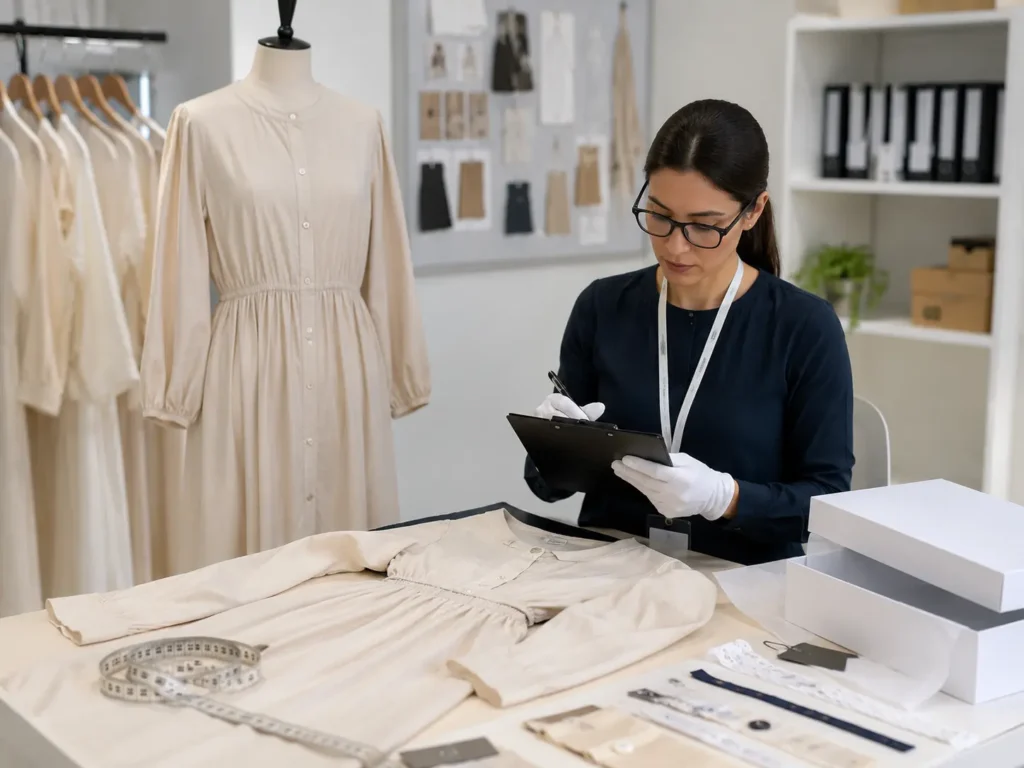
Sample speed depends much more on input quality and construction difficulty than on a factory’s marketing promise. When a development team receives a complete tech pack with measurements, construction details, BOM, color references, fabric specification, trims, artwork, labels, and packaging requirements, there are fewer assumptions to resolve before pattern work begins. When the same project begins from one inspiration image, the factory must interpret internal construction, lining, seam placement, stretch, closure, and fit ease that may not be visible. In custom fashion sourcing, a straightforward first sample is often planned in roughly 7-15 working days when suitable materials are available, while complex corsetry, embellishment, custom printing, or material development can push planning toward 15-25 working days or longer. These are planning ranges, not guaranteed standards.
The more useful measurement is time to an approved sample, not time to the first sample. A first piece delivered in seven days can still be slow if the bust shape, waist position, fabric weight, zipper behavior, and overall balance require three major revisions. A technically stronger first sample delivered several days later may reach PP approval earlier. Jinfeng Apparel’s confirmed development scope supports projects from tech packs, reference images, original samples, sketches, and line sheets, with dedicated pattern and sample functions rather than only bulk sewing. For brands comparing factories, it is worth asking what the quoted sample timeline includes, what material must already be available, how comments are documented, and what qualifies a style to move into the next approval stage.
Which Is Faster for Sample Revisions?
This is one area where a nearby U.S. factory can have a natural calendar advantage. A design team may receive a domestic sample the next day, attend a fitting in person, or physically show the pattern team where the neckline, strap, waist, or skirt balance needs to change. International development adds courier time and time-zone coordination. However, shipping distance is only one source of delay. Vague fit comments can waste more time than transport. ‘Make the bust tighter’ leaves room for interpretation; a comment such as ‘reduce upper bust by 1.5 cm while retaining the waist, lower cup position by 0.5 cm, and keep neckline length unchanged’ creates a measurable pattern action that can be checked on the next sample.
For fitted dresses, a 1-2 cm change can materially alter the appearance or wearability of a neckline, waist seam, strapless bodice, bodycon silhouette, or hip area. A disciplined revision record should therefore show the original measurement, target measurement, pattern action, construction change, fabric effect, photo reference, version number, and approval status. When that discipline is in place, an overseas factory can work very efficiently despite the distance. When it is absent, even a local factory can produce repeated versions that solve one problem while creating another. Sampling speed is ultimately the speed of decision quality as much as the speed of courier movement.
Which Is Faster for Bulk Production?
Bulk speed is controlled by the critical path rather than the number of sewing days printed on a quotation. A typical sequence includes final material confirmation, PP approval, fabric and trim arrival, cutting, sewing, finishing, inspection, packing, and dispatch. For custom fashion dresses using available materials, a planning range of roughly 25-45 working days after final approval and material readiness is commonly used in the industry, while complicated occasionwear, large programs, peak-season production, custom dyeing, printing, or embellishment can require longer. The point is not to treat those ranges as promises; it is to separate what the factory can control from what depends on material suppliers, approvals, and shipment strategy.
| Stage | Common Planning Range | What Usually Extends It | Control Question |
| Straightforward first sample | 7-15 working days | Fabric search, unclear specs, fit complexity | What must be approved before pattern cutting? |
| Complex first sample | 15-25+ working days | Corsetry, embellishment, custom material | Which components are on the critical path? |
| Sample revision | Several working days plus transport | Unclear comments, replacement fabric, new trims | Are changes measurable and version-controlled? |
| Bulk production | 25-45+ working days after readiness | Peak season, style count, complex sewing | When are materials and PP sample fully released? |
| Repeat order | Often faster technically | Material discontinuation, new colors, changed trims | Are pattern, BOM, and approved references retained? |
How Fast Can Repeat Orders Be Made?
Repeat orders show whether a supplier has built a manufacturing memory around the product. The first order requires interpretation and development; a well-managed repeat order should reuse the approved pattern, graded measurements, BOM, fabric reference, color standard, trim specifications, construction notes, packing instructions, QC records, and Golden Sample or equivalent physical reference. When those records are controlled, the technical restart is much shorter because the team does not need to reconstruct the dress from photographs or old chat messages. Material readiness remains the main variable: a discontinued fabric, changed dye lot, unavailable zipper, or new color may still require fresh approval before the line can restart.
This is especially important in fashion because the commercial opportunity may appear after launch. A dress can sell normally for two weeks and then accelerate after a campaign, influencer post, retailer promotion, or seasonal event. The ability to reorder while demand is active can matter more than shaving two days off the first sample. Jinfeng Apparel’s confirmed cooperation model includes repeat orders, seasonal collection development, multi-batch production, and retention of product records for future production. For sourcing teams, this suggests an important qualification question that is often overlooked: not only ‘How fast can you make the first order?’ but also ‘What information will you preserve so the second and third orders start from an approved technical baseline?’
How Do Quality and Dress Capabilities Compare?
Neither China nor the USA automatically produces better-quality dresses. Quality comes from factory specialization, pattern accuracy, material control, approved samples, measurement tolerances, sewing discipline, finishing, and inspection. For fitted or technically difficult fashion dresses, experience with the exact silhouette and fabric behavior often matters more than country of origin, especially when bulk consistency is the real commercial requirement.
Is USA-Made Clothing Better Quality?
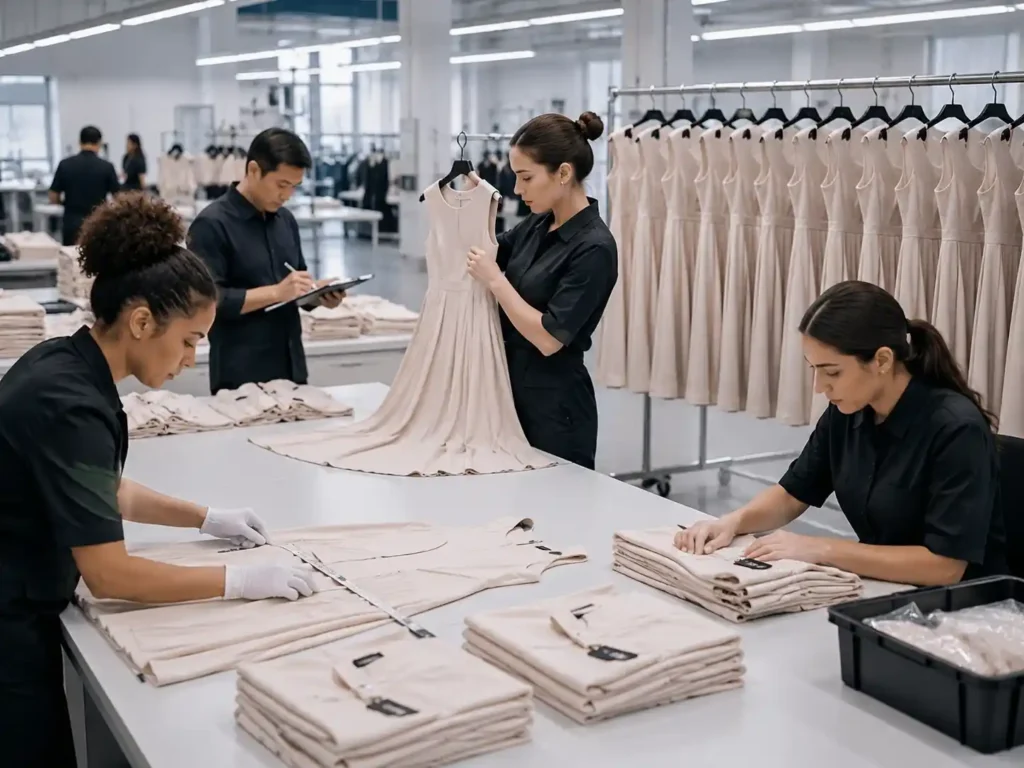
Country of origin is not a quality grade. A dress can be made domestically and still have poor seam balance, inconsistent measurements, distorted pressing, unsuitable fabric, or weak pattern work. A Chinese factory can produce highly sophisticated fashion garments when its technical team, operators, materials, and process controls are appropriate. The reverse is equally true. The more useful question is whether the supplier has a repeatable system that turns an approved sample into a stable bulk standard. That system should define measurements, fabric and color references, trim specifications, seam and construction details, appearance requirements, pressing, label placement, packaging, and the inspection method used to identify deviations before shipment.
For larger programs, consistency matters more than one perfect showroom sample. A factory may produce an impressive development piece with its best sample machinist, but commercial quality is proven when hundreds or thousands of units stay within agreed measurements and appearance expectations. That requires production instructions, operator training, in-line feedback, measurement checks, and escalation rules when defects repeat. Some brands use AQL-based final inspection, while others set their own retailer or product-specific protocol. AQL is a sampling method, not a universal definition of quality, so the acceptance level, defect categories, and inspection scope should be agreed in advance rather than assumed from the word ‘QC’.
How Is Dress Fit Controlled?
Fit is one of the highest-risk areas in women’s fashion because the customer experiences the garment on the body, not on a measurement spreadsheet. A dress can match nominal bust, waist, and hip measurements and still look wrong if the neckline gapes, the waist seam sits too high, the side seam rotates, the cup is positioned incorrectly, or the armhole cuts into the body. Fit control therefore looks at relationships between measurement points, pattern balance, garment ease, fabric stretch, and visual proportion. Critical points often include bust shape, cup position, waist placement, high and full hip, shoulder width, armhole depth, neckline opening, strap length, bodice length, center-front and center-back length, skirt length, and hem balance.
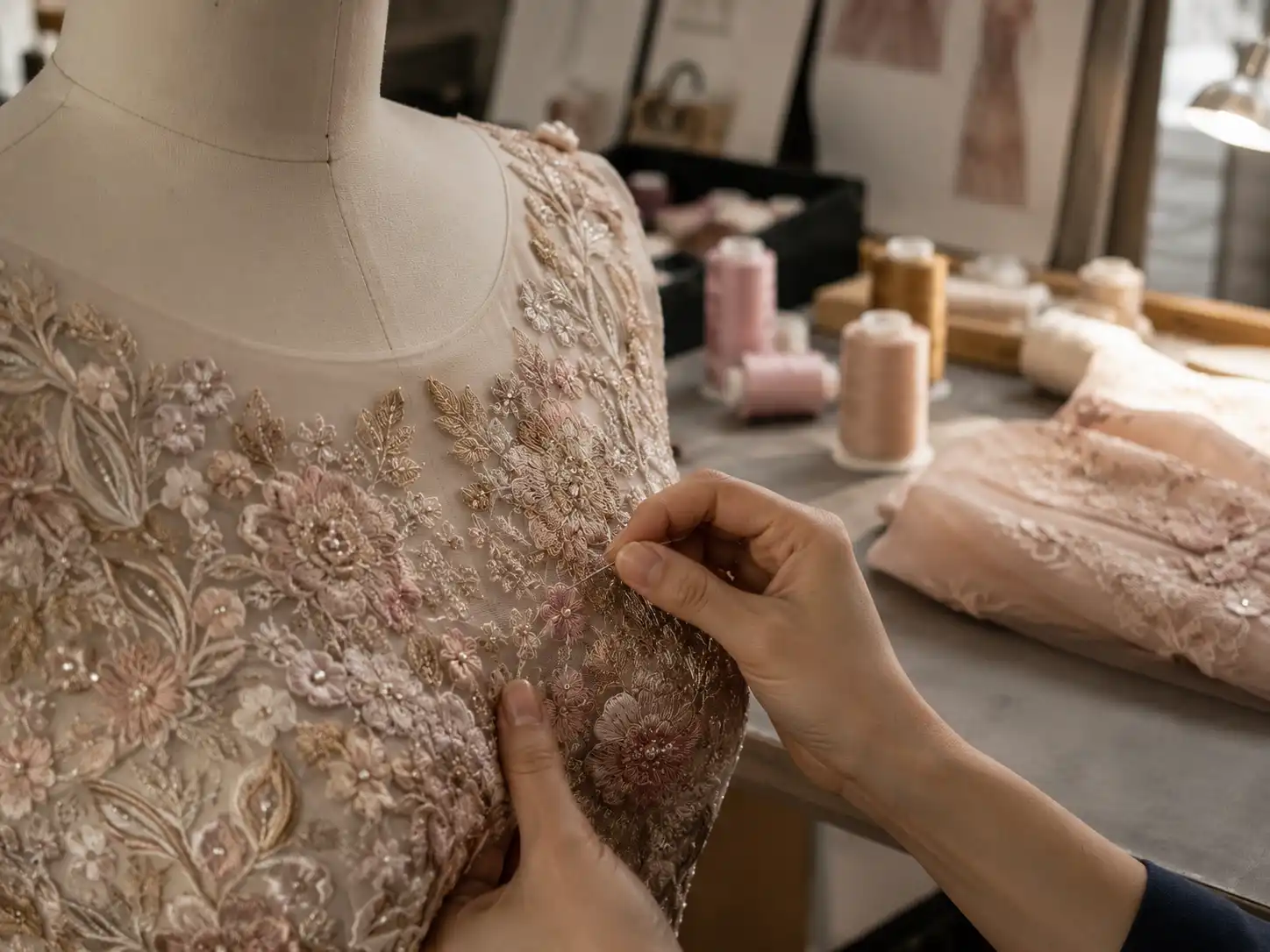
Fabric behavior changes the interpretation of those measurements. A bodycon jersey with strong stretch and recovery can tolerate negative ease that would be impossible in a woven satin. Bias-cut fabric introduces controlled diagonal stretch and can change length after hanging. Mesh can grow during sewing if handling is poor, while a rigid lining can restrict an otherwise stretchy shell. The pattern and material therefore have to be developed as one system. Jinfeng Apparel’s documented technical scope includes corrections around bust, waist, hips, dress length, straps, necklines, fabric suitability, construction risk, and sample revision. That type of fit work is more meaningful to a dress program than a broad claim that a factory makes ‘premium quality’.
Which Is Better for Complex Dresses?
China can be especially competitive when a dress combines several specialist materials and construction techniques, because the surrounding supplier network can make it easier to source and coordinate the required components. Factory specialization still decides the outcome. A corset dress may contain eight to sixteen or more shaped body panels depending on the design, along with cups, boning channels, lining, interfacing, seam reinforcement, zipper construction, and precise neckline balance. A satin slip can appear simple but expose minor grain, tension, pressing, and bias-handling problems immediately. Mesh introduces stretch, transparency, seam reinforcement, and lining compatibility. Sequins add cutting, needle, seam allowance, comfort, and embellishment-security challenges that basic sewing experience does not automatically solve.
The right comparison is therefore style-specific. Ask whether the factory has controlled similar bust structures, whether it understands how a smooth satin shows puckering, how it prevents a concealed zipper from waving, how it manages mesh recovery, or how it clears sequins from seam allowances without damaging the visual surface. Jinfeng’s confirmed core categories include party, occasion, bodycon, satin, mesh, lace, sequin, corset, mini, midi, maxi, and resort dresses. That does not mean every design has identical difficulty, but it does show why category specialization should be part of supplier qualification. A photograph of a vaguely similar dress is not enough; construction knowledge should be visible in the questions the technical team asks before sampling.
How Is Bulk Quality Controlled?
Bulk quality starts before final inspection because no inspector can turn the wrong fabric into the right one after production. The critical product information should be frozen before cutting: approved pattern, measurement chart, main fabric, lining, trims, color, construction, artwork, labels, pressing, folding, packing, and the PP or Golden Sample used as the physical reference. Quality checks then need to happen while the order is still correctable. Finding a seam-tension problem after the first 100 pieces leave a line is operationally manageable; finding the same problem after 5,000 garments have been pressed and packed can become a costly rework program.
A practical control chain can include incoming-material inspection, fabric shade and defect review, cutting checks, sewing in-line inspection, measurement checks, finished-garment appearance review, pressing review, packing verification, and final or client-defined inspection before dispatch. Jinfeng Apparel’s confirmed QC scope covers incoming material, cutting, sewing, in-line, finished garment, pressing, packing, and pre-shipment control. The company documentation also explicitly avoids claims such as zero defects or guaranteed perfect production, which is the more realistic position. Manufacturing always contains variation. Good QC identifies meaningful variation early, corrects the process that created it, and prevents unacceptable product from becoming a shipment-level problem.
Which Has Better Fabrics, MOQ, and Scalability?
China generally offers greater depth in fabrics, trims, specialist processing, and scalable multi-style production, while U.S. manufacturing can be attractive when local access and domestic logistics are more valuable. MOQ is not controlled by the sewing factory alone: fabric mills, dyeing, printing, trims, packaging, color splits, and construction complexity can all determine the practical minimum for a dress program.
Which Has Better Fabric and Trim Access?
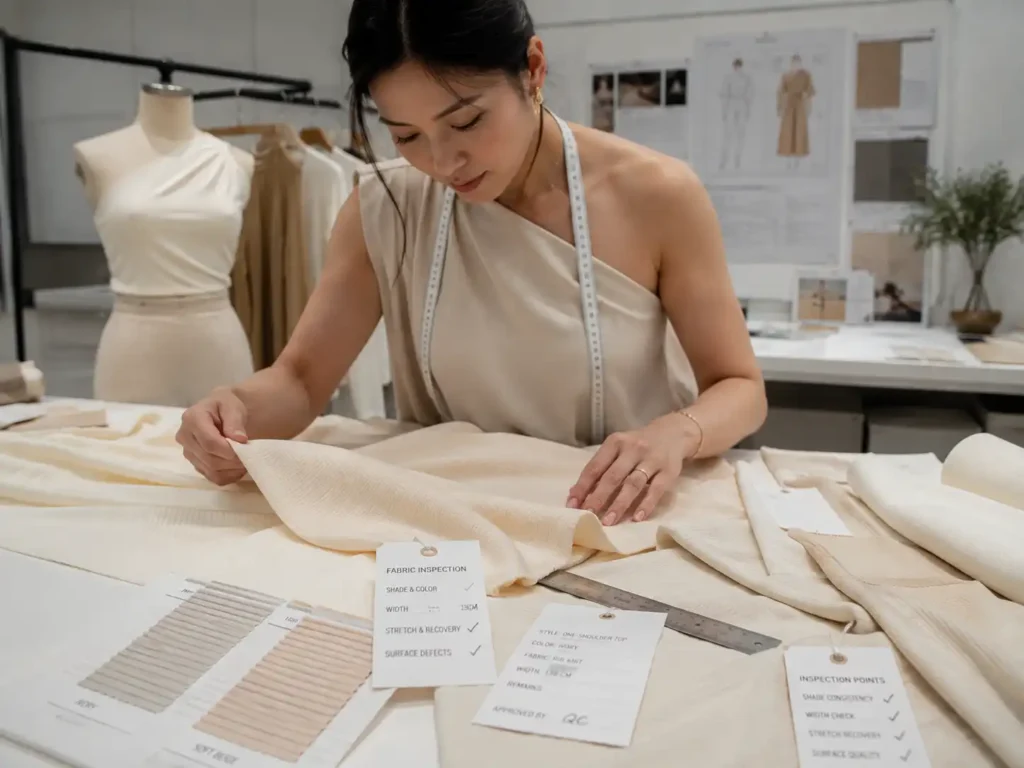
Fabric sourcing is one of the areas where a dense Chinese apparel cluster can offer a practical advantage. Fashion teams often begin with visual language rather than an exact technical specification: ‘soft matte satin with fluid drape,’ ‘slightly sheer mesh with strong recovery,’ or ‘lace with a smaller floral repeat.’ Turning those descriptions into a repeatable production material requires comparison. Common dress materials include polyester or blended satins, chiffon, lace, power mesh, stretch mesh, sequin fabrics, jersey, ponte, rayon, linen blends, velvet, woven lining, and stretch lining. Trims can include invisible zippers, hooks, cups, boning, elastic, silicone tape, strap adjusters, buttons, decorative hardware, labels, hangtags, barcode stickers, polybags, and cartons.
Access alone is not enough; the development team has to judge whether a material will behave correctly in the intended construction. A satin may have the right color but be too light for a structured bodice. A mesh may stretch generously yet recover poorly after wear. A lining can distort an outer shell if their stretch characteristics differ. Lace can create placement and cutting waste when the motif is large, while sequins can raise sewing and finishing time. The best sourcing process connects material performance to fit, construction, price, and bulk availability. Jinfeng’s confirmed service scope includes fabric sourcing and trim development as part of the same custom womenswear workflow, which is useful when material changes must be coordinated with pattern and sample revisions rather than handled as a separate purchasing exercise.
How Do MOQs Compare?
MOQ is often misunderstood because several suppliers may be creating the minimum at the same time. The sewing factory may be comfortable with 200 pieces, while a mill requires a larger meterage for a custom dye lot. A custom print, special lace, sequin base, branded buckle, zipper color, woven label, printed polybag, or rigid box can introduce a separate minimum. Color and size fragmentation also matters: 1,000 pieces in one color is operationally different from 1,000 pieces split into ten colors, even before size ratios are considered. This is why an MOQ should be explained by component rather than treated as one permanent number attached to a factory’s website.
Jinfeng Apparel’s confirmed baseline starts from 200 pieces per style/color, with the final requirement depending on fabric availability, color development, trims, construction complexity, packaging, and production schedule. That number is designed around real custom development and bulk manufacturing rather than no-MOQ, one-piece fulfillment, or ready-stock wholesale. For established fashion programs, the more useful question is whether the MOQ supports a commercially sensible launch and a path to repeat production. A very low first-order minimum is not automatically an advantage if the supplier cannot reserve the same fabric, reproduce the fit, or scale the style when demand grows.
Which Is Better for Multi-Style Collections?
Multi-style collections expose coordination problems that do not appear in a one-style trial. Consider a seasonal release containing 24 dresses. The collection may use six fabric families, more than ten colors, several zipper lengths, different linings, unique construction notes, multiple size ratios, and separate barcode or SKU requirements. The total quantity can be substantial while each style/color combination remains relatively modest. The challenge is no longer merely sewing speed. The manufacturer has to synchronize pattern progress, sample revisions, fabric availability, trim arrival, PP approvals, line allocation, inspection, packing, and shipment consolidation without allowing one delayed component to hide the status of the rest of the program.
Strong collection management uses line sheets, BOMs, sample-status trackers, fabric and trim status records, PP approvals, production calendars, QC checkpoints, and packing plans. It also requires enough development capacity so that several styles can be revised at the same time. A factory may have ample sewing capacity and still become slow if its sample room or merchandising team is the bottleneck. This is why monthly piece capacity alone is a weak measure of suitability for fashion collections. A mature sourcing team should ask how many styles can be developed in parallel, how exceptions are escalated, whether different production units handle different construction types, and how partial shipments or multi-batch delivery are managed when styles do not all finish together.
Which Is Easier to Scale?
Scaling a dress program means more than increasing the quantity of one approved SKU. A successful relationship often grows from sample to initial bulk, repeat order, additional colors, related silhouettes, and eventually a seasonal collection. The manufacturer must retain product knowledge while volume and SKU count increase. That requires enough capacity in pattern making, sample development, fabric sourcing, cutting, sewing, finishing, QC, merchandising, packing, and logistics. If one of those functions does not grow with the others, it becomes the constraint even when more sewing lines are available.
Jinfeng Apparel’s confirmed operating structure includes 6 owned women’s fashion factories, 10+ long-term satellite production partners, regular monthly capacity of 100,000+ pieces, 18+ sewing lines, 6+ flexible production lines, 2 sample rooms, 7+ senior pattern makers, 20+ sample machinists, 15+ QC inspectors, and 12+ merchandising and order-follow-up specialists. Those figures should not be interpreted as unlimited capacity; they are useful because they show the different functions required to support scale. For a larger fashion program, the right question is whether the supplier can increase style count, color count, repeat volume, and delivery frequency without losing the approved pattern, material, QC, and packing standards that made the first order successful.
Which Country Is Better for Your Dress Brand?
Choose the USA when proximity, domestic logistics, close production access, or an authentic U.S.-origin strategy creates enough value to support the manufacturing model. Choose China when the collection benefits more from material sourcing depth, complex dress development, multi-style production, scalable capacity, private-label finishing, and export coordination. Some established fashion companies gain resilience by assigning different roles to both sourcing locations.
When Is USA Manufacturing Better?
USA manufacturing deserves serious consideration when proximity solves a specific business problem rather than simply sounding safer. It can fit a premium collection when the design team needs frequent in-person fittings, physical sample movement is a major part of the development calendar, the selected factory already understands the dress category, domestic replenishment has measurable value, and the retail margin can absorb the production cost. It can also support a domestic-origin strategy when the actual manufacturing and sourcing facts meet applicable U.S. labeling requirements. That last point should be verified carefully; sewing a garment in the United States does not automatically mean every unqualified Made-in-USA statement is appropriate if significant production inputs come from elsewhere.
Domestic production becomes less compelling when the factory has to import most specialist fabrics and trims, outsource several critical processes, or cannot scale with the collection. In that situation, a brand may pay domestic labor costs while still carrying many of the timing dependencies of a global supply chain. A good decision therefore examines the whole route: where the pattern is developed, where the main fabric comes from, how trims are sourced, where specialist operations occur, what the factory’s true line capacity is, and how quickly the finished order reaches inventory. USA manufacturing is at its best when local access is connected to local capability, not when the address is the only local part of the program.
When Is China Manufacturing Better?
China is often a stronger fit when the product itself creates a complicated sourcing problem. A collection that combines corset minis, satin slips, lined mesh bodycon dresses, lace styles, sequined occasionwear, jumpsuits, and matching sets can require several fabric suppliers, different trims, specialist construction, pattern correction, multiple sample rounds, and more than one production line. In that environment, a dense apparel ecosystem can reduce the number of disconnected suppliers the brand needs to manage. China also becomes attractive when the first commercial order is only the beginning and the business expects successful styles to move into repeat orders, new colors, related designs, larger quantities, and multi-batch delivery.
For companies evaluating Jinfeng Apparel, the relevant point is not simply that production is based in Guangdong. The confirmed model covers custom dress development, pattern and fit work, fabric and trim sourcing, sampling, sample revision, bulk production, quality control, private-label packing, export delivery, and repeat-order support for global and mid-to-large fashion clients. The standard MOQ starts from 200 pieces per style/color, subject to materials and project requirements, and the company supports NDA-based cooperation for unreleased designs. These capabilities are most useful when a sourcing team needs one manufacturing partner to coordinate development and production variables that would otherwise be spread across several unrelated vendors.
Is a Hybrid Model Better?

For some established fashion companies, a hybrid model creates a better balance than forcing every style into one country. Design direction, fittings, merchandising, photography, inventory planning, and market-facing decisions can remain close to the U.S. team while scalable production is placed in China. A company may also reserve domestic capacity for a high-margin capsule, urgent replenishment, or a category where local access matters, while using China for the main seasonal volume. This can reduce concentration risk, but it does not automatically reduce operational complexity. Two production sources create two opportunities for fit, fabric, color, construction, and packing standards to drift apart.
Hybrid sourcing works best when the brand owns its technical information. Both suppliers should work from controlled patterns, measurement specifications, BOMs, approved fabric references, color standards, trim codes, sewing details, artwork, packaging instructions, and inspection criteria. A physical Golden Sample or clearly documented approved reference can reduce interpretation. If product knowledge exists mainly in informal messages or only inside one factory, moving production between countries becomes much harder. The strategic value of dual sourcing therefore depends on standardization. It is not simply China plus USA; it is an architecture in which each location has a defined role and the product standard remains portable between qualified manufacturing partners.
How Should You Choose a Dress Manufacturer?
Start with the actual garment and give shortlisted factories the same information. A useful RFQ includes the design or tech pack, target measurements, fabric requirement, colorways, size range, estimated quantity, construction details, labels, packaging, quality expectations, and required delivery window. Then compare not only the quotation but also the questions each factory asks. Strong technical suppliers identify ambiguity before it reaches production. They may ask whether satin is straight-grain or bias-cut, whether mesh needs two-way or four-way stretch, whether a corset is decorative or structurally supportive, how much lining coverage is required, what measurement tolerances apply at key fit points, and which approved sample becomes the reference for bulk production.
- Confirm experience with the exact dress category and construction difficulty.
- Review pattern-making, fit-correction, and size-grading capability.
- Check how main fabrics, lining, trims, and substitutes are sourced and approved.
- Define the complete sampling path, revision records, PP approval, and Golden Sample control.
- Compare MOQ by style/color and identify any separate fabric, trim, or packaging minimums.
- Verify production capacity across sewing, sample development, QC, finishing, and packing – not sewing alone.
- Agree measurement tolerances, inspection checkpoints, defect categories, and final inspection method.
- Confirm private-label, SKU, barcode, folding, carton, and distribution requirements before production.
- Review export or domestic logistics responsibility and the real warehouse-ready calendar.
- Ask how patterns, BOMs, material references, QC records, and packing instructions are retained for repeat orders.
- Use NDA or other confidentiality controls when unreleased styles, tech packs, patterns, or packaging are commercially sensitive.
The final decision can be reduced to one practical test: which manufacturer gives the product team the clearest path from an approved design to a repeatable commercial garment with the fewest uncontrolled variables? For a simple, domestically positioned capsule, that may be a U.S. factory. For a technically demanding, material-intensive, multi-style collection, China may offer the stronger platform. The strongest sourcing decision does not begin with a country preference and force the product to fit it. It begins with the dress, identifies the risks that actually matter, and selects the manufacturing system that can control those risks consistently through development, bulk production, delivery, and repeat orders.
Conclusion
China vs USA dress manufacturing is not a contest with one permanent winner. The United States can create real value through proximity, domestic logistics, hands-on communication, and a credible local-production strategy. China can create real value through a deeper fabric-and-trim ecosystem, specialist dress development, multi-style coordination, scalable manufacturing, and integrated export support. The deciding factors are the ones visible in the garment and the operating plan: fit complexity, material availability, order structure, approved-sample discipline, total landed cost, launch timing, QC requirements, and the ability to repeat successful products without rebuilding them from the beginning. When those factors are compared on the same specification, the sourcing decision becomes much clearer – and much less dependent on stereotypes about either manufacturing country.