Skip to content

Choosing between China and India for dress manufacturing sounds like a country-level decision, but real production rarely behaves that neatly. A relaxed printed cotton maxi dress, a fitted satin corset mini, and a ruched power-mesh party dress may all sit in the same seasonal collection, yet they depend on very different fabrics, trims, pattern skills, sewing operations, finishing methods, and quality controls. That is why comparisons based only on labor rates or a single FOB quotation often lead sourcing teams toward the wrong conclusion. The more useful question is not which country is “better” in the abstract, but which manufacturing ecosystem fits the exact product, launch calendar, quality standard, reorder plan, and destination market.
For most fashion brands, neither China nor India is universally better for dress manufacturing. China is often stronger when collections require broad fashion-fabric and trim availability, synthetic or blended materials, complex construction, rapid product development, and coordinated multi-style production. India can be especially competitive for cotton-rich, natural-fiber, printed, embroidered, and craft-led garments. The right choice depends on product architecture, supplier specialization, total landed cost, and execution reliability.
The difference becomes obvious during development. A fabric that looks perfect on a swatch can stretch differently once cut; a zipper that appears flat on a hanger can wave after a fitting; a beautiful embroidered panel can become commercially unusable if bulk placement varies from piece to piece. The country matters because it shapes access to materials, specialist processes, logistics, and production capacity, but the factory still determines whether those resources are converted into a repeatable garment. The most profitable sourcing decision usually appears only after a brand looks past national stereotypes and starts tracing how one approved sample will become thousands of consistent dresses.
What Is the Difference Between Dress Manufacturing in China and India?
China and India are both major apparel manufacturing bases, but their strengths are built around different supply-chain ecosystems. China generally offers denser networks for synthetic and blended fabrics, fashion trims, specialist processes, rapid development, and multi-SKU coordination. India is particularly strong in cotton, natural fibers, printing, embroidery, and textile-led garments. For dress sourcing, factory-product fit usually matters more than country reputation.
Manufacturing Ecosystems
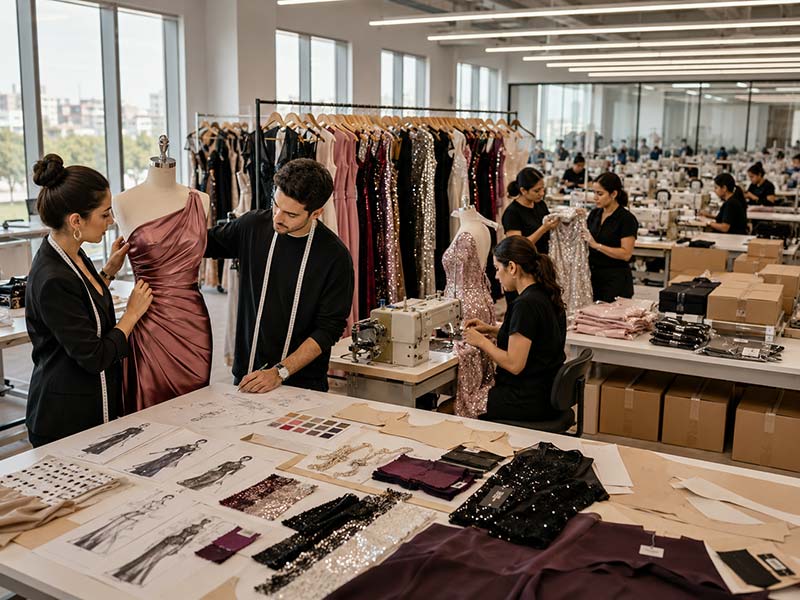
The largest practical difference between the two countries is not the sewing machine itself; it is the network surrounding the sewing machine. A modern dress can require shell fabric, lining, elastic, zipper, lace, boning, bra cups, hooks, decorative hardware, labels, hangtags, packaging, printing, embroidery, pressing, and testing. When a problem appears during sampling, several components can be affected at once. A heavier satin may require a different lining, a softer stretch mesh may need a pattern correction, and a new zipper specification can change the way a side seam hangs on the body. Dense supplier networks reduce the time needed to solve those interactions.
China has large apparel and textile clusters where fabrics, dyeing, printing, accessories, sample development, garment production, packaging, and export services are often geographically close. That density is particularly useful for fashion collections that change during development. India also has deeply established textile centers and vertically integrated supply chains, but its competitive strengths often become especially visible when the textile itself carries substantial product value, such as cotton, natural-fiber constructions, printing, embroidery, and detailed decorative work. Neither ecosystem automatically produces a better dress. The advantage appears only when the selected factory knows how to use the surrounding resources for the product in front of it.
Dress Category Fit
“Dress manufacturing” is far too broad to treat as one production category. A loose cotton maxi dress is mainly a fabric, shrinkage, print, drape, and sewing-control project. A fitted satin corset dress is a structure and fit project. A ruched mesh party dress is a stretch-recovery and seam-control project. A sequin evening dress adds embellishment retention, needle management, lining protection, and wearer comfort. The more technical the product becomes, the more important it is to match the style to a factory that has made similar constructions repeatedly rather than selecting a country first and hoping the supplier can adapt later.
China is often a strong fit for satin, mesh, lace, bodycon, corset, sequin, party, club, and multi-material fashion dresses because these products benefit from broad access to synthetic textiles, stretch fabrics, specialty trims, molded components, and decorative accessories. India deserves close attention for cotton day dresses, printed woven styles, embroidered garments, natural-fiber resort pieces, and products where surface craft is central to the retail story. These are useful screening patterns, not hard rules. A specialized Indian occasionwear factory can outperform a Chinese basics factory on a complicated embellished dress, just as an experienced Guangdong dress specialist can outperform a general apparel supplier on stretch mesh or corset construction.
| Dress Type | Critical Production Variables | China Often Offers | India Often Offers |
| Satin corset dress | Cups, boning, lining, zipper, pressing | Dense trim network and structural component sourcing | Strong results where occasionwear specialization is proven |
| Mesh bodycon dress | Stretch, recovery, lining, fit | Broad stretch-fabric and trim options | Capability varies more by specialist factory |
| Cotton maxi dress | Shrinkage, print, drape, seam quality | Wide cotton sourcing choices | Strong cotton and textile base |
| Embroidered dress | Placement, thread, backing, consistency | Machine and mixed embellishment options | Strong embroidery and craft traditions |
| Sequin party dress | Sequin retention, abrasion, lining | Broad fashion-material ecosystem | Specialist suppliers available |
| Multi-style seasonal line | BOM, materials, colors, timing | Strong multi-supplier coordination | Best when factory and cluster are tightly aligned |
Fashion-Dress Specialization
Fashion dresses are less forgiving than many basic garments because appearance, fit, and construction are tightly connected. A basic T-shirt can sometimes tolerate small differences in drape without looking fundamentally wrong, but a fitted dress cannot. A bust point that sits slightly too high, a waist seam that shifts, a side seam that twists, or a lining that pulls against the shell may change the entire silhouette. Strapless, corset, satin, bodycon, and occasion dresses are especially sensitive because the customer evaluates the product on how it shapes and moves on the body, not simply whether the garment matches a flat measurement chart.
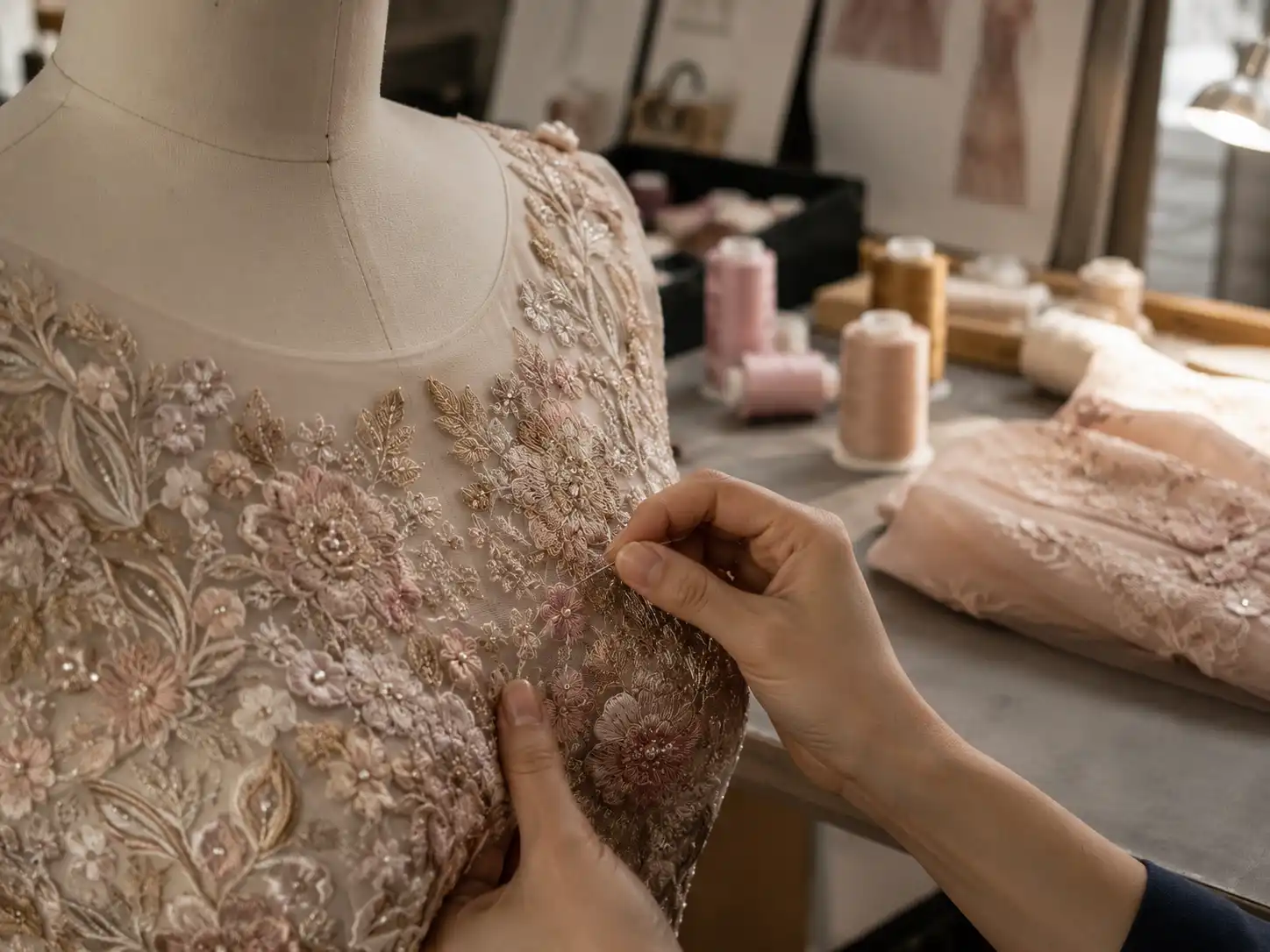
A strong dress factory therefore needs more than competent sewing. Pattern makers and sample technicians must understand bust projection, waist shaping, hip ease, neckline tension, shoulder or strap balance, skirt fall, and the behavior of the selected material. China’s large fashion-production ecosystem provides a substantial pool of factories accustomed to combined materials and changing silhouettes, while India can be especially compelling when embroidery, printing, textile texture, or hand-applied details are part of the perceived value. In either country, ask the supplier to identify technical risks before sampling begins. A specialist will usually discuss material behavior, lining, zipper flatness, cup position, boning, seam construction, and finishing before promising a price or lead time.
Supplier Selection Matters More
Country comparisons help create an initial shortlist, but their usefulness falls sharply once actual factories are under review. Two suppliers located in the same industrial district can have completely different capabilities. One may operate a disciplined product-development process with experienced pattern makers, dedicated sample capacity, documented revisions, clear PP approval, in-line inspections, and retained repeat-order records. Another may depend on verbal instructions, temporary subcontracting, or a small number of highly experienced individuals whose knowledge is not converted into production documents. The flag above the factory does not solve that difference.
A serious supplier review should therefore test whether the manufacturer can control pattern development, fabric and trim sourcing, sample revisions, fit corrections, PP approval, bulk material inspection, sewing instructions, in-line quality checks, finished-garment inspection, private-label packing, and repeat-order records. The commercial question is not simply, “Which country makes better clothing?” It is, “Which production partner can reproduce the approved dress across colors, sizes, seasons, and batches without forcing our team to solve the same problems again?” That question is much closer to the real sourcing decision faced by established fashion brands.
Which Country Has Better Fabric and Trim Sourcing?
China generally provides broader access to synthetic, blended, stretch, and specialty fashion fabrics together with a particularly dense trim and accessory ecosystem. India has major strengths in cotton, natural fibers, printing, embroidery, and textile-led products. The better sourcing location depends on whether the collection’s main difficulty comes from fabric character, fashion components, specialized trims, or frequent material changes during development.
Fabric Availability
Fabric availability affects much more than purchase price. When the correct material can be sourced quickly, the development team can compare alternatives, test drape, revise patterns, and approve colors without restarting the whole project. When a critical fabric must travel from another region or country, every sample round becomes more exposed to transportation time, supplier minimums, delayed color approvals, and communication gaps. This matters in trend-driven dresses because the product often changes after the first fitting. The first fabric choice may look beautiful on a hanger but fail once the garment is stretched, lined, ruched, pleated, or worn under strong lighting.
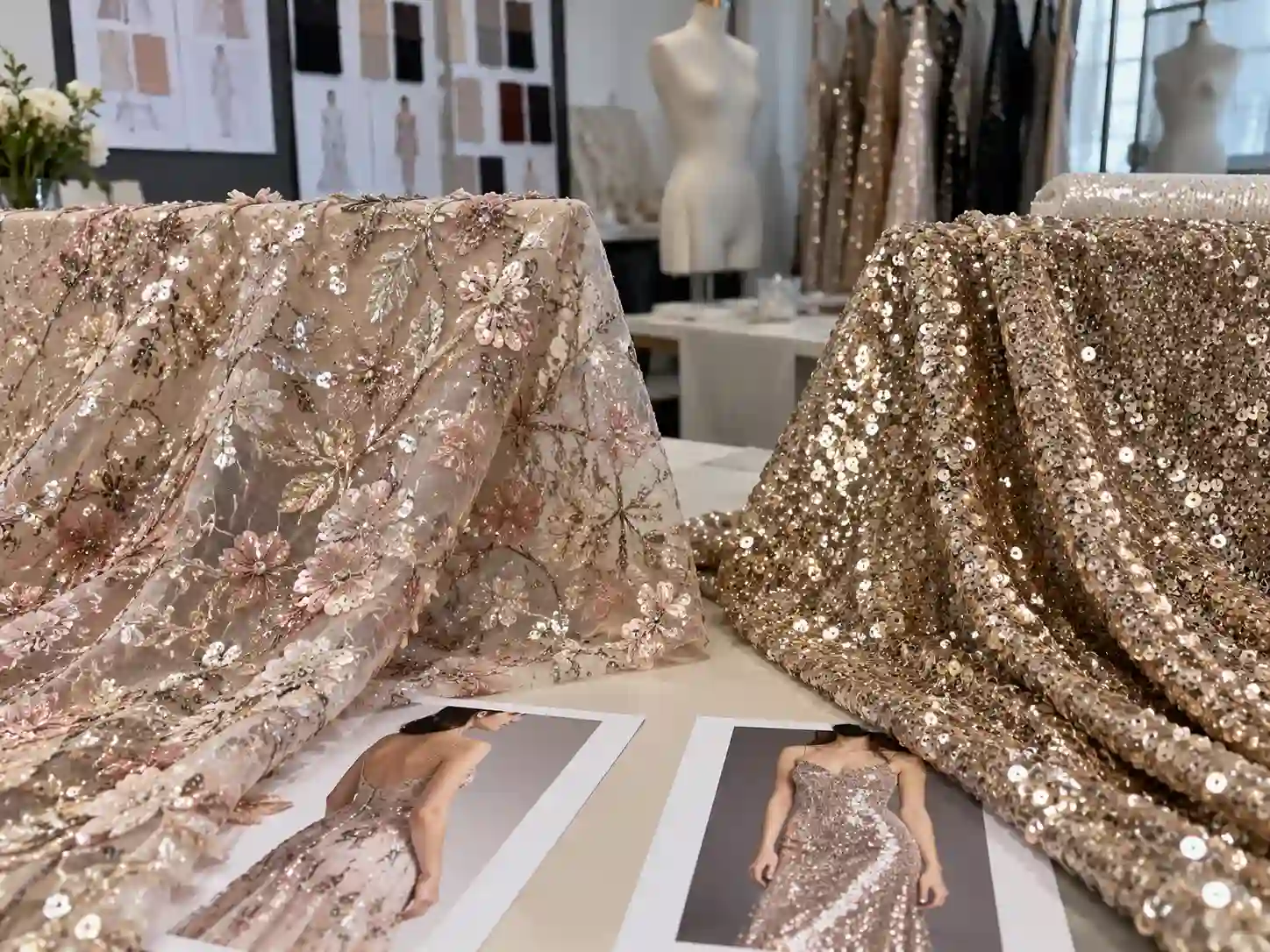
China’s textile clusters are particularly useful for fashion materials such as polyester satin, chiffon, mesh, power mesh, stretch jersey, ponte, lace, sequin textiles, polyester-spandex blends, rayon blends, and specialty linings. The practical advantage is often the number of workable alternatives available within the same category. A satin dress may need a different weight, weave density, finish, or color depth after the first sample, and the ability to compare several substitutes quickly can save more time than choosing the cheapest initial swatch. India’s textile ecosystem is especially important for cotton-led collections, lightweight woven fabrics, printed materials, natural-looking constructions, and embroidered textiles used in summer, resort, casual, and lifestyle dress programs.
Trim Depth
Trims become more important as the dress becomes more structured. A strapless corset dress may use molded cups, boning, elastic, hook-and-eye components, invisible zipper, lining, stay tape, thread, labels, and retail packaging. Each item has its own specification, lead time, MOQ, color range, and quality risk. A bra cup can differ in thickness and shape; boning can differ in stiffness and width; zipper tape can be slightly off-color; elastic recovery can change fit. These components are inexpensive compared with the shell fabric, yet one wrong trim can delay an entire production order.
China’s concentrated accessory networks can make this development easier when several components need to be changed between sample rounds. The important advantage is not simply that “more trims are available,” but that alternatives can be tested without sending every problem through a new international sourcing chain. In India, accessory capability can also be strong, particularly in established export clusters, but a factory’s local network should be verified for the exact product. Ask whether each trim is stock or custom, whether color matching is required, what the supplier MOQ is, whether tooling is needed, how long replenishment takes, whether the identical specification can be reordered, and what incoming inspection is performed before bulk sewing begins.
Material Specifications
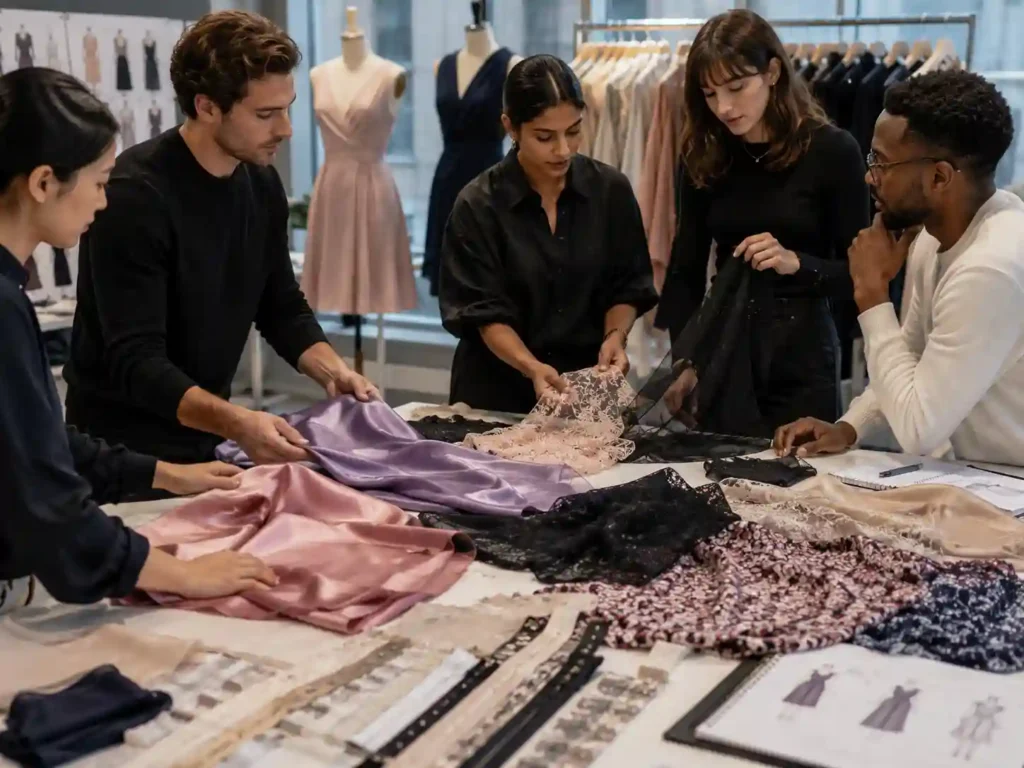
Professional fabric sourcing starts with specifications rather than photographs. Two black stretch meshes can look almost identical online while behaving very differently in a bodycon dress. One may recover cleanly after stretching while the other grows in length during wear. Two ivory satins can match visually but differ in surface friction, snag resistance, thickness, shine, and seam puckering. A beautiful sample cannot be treated as proof that the bulk fabric will behave the same unless the material is identified and controlled. This is one of the most common places where a seemingly attractive quotation becomes expensive later.
Brands should define the variables that matter for each fabric and trim, such as fiber composition, fabric weight, width, stretch direction, recovery, shrinkage, colorfastness, shade tolerance, surface finish, pattern repeat, and bulk availability. Numeric specifications should be used carefully. A 180 GSM fabric is not “better” than a 120 GSM fabric in isolation; a lightweight resort dress and a structured bodycon style need very different behavior. The correct specification is the one that creates the intended drape, coverage, fit, comfort, durability, pressing result, and retail appearance while remaining repeatable in bulk.
Supply-Chain Flexibility
The real value of a sourcing ecosystem appears when the original plan stops working, because that is normal in fashion development. The approved-looking fabric may exceed the target cost, a custom shade may require an impractical dye minimum, a lace pattern may be discontinued, or the design team may add another color after the first fitting. A stretch fabric may look perfect in the sample room but recover poorly after wear testing. At that point, a strong manufacturing partner should offer controlled alternatives rather than random substitutes that solve price while creating new fit or quality problems.
A replacement fabric should be compared against the original for composition, weight, stretch, recovery, hand feel, opacity, appearance, shrinkage, color, and price. The same principle applies to trims. For brands using a Guangdong production partner such as Jinfeng Apparel, an integrated workflow that connects fabric sourcing, trim development, pattern work, sample revision, PP approval, bulk production, QC, private-label packing, and logistics can be useful because material changes are evaluated as product decisions rather than purchasing decisions alone. The point is not to promote one supplier in every case, but to show the level of coordination a dress program should require from any manufacturer selected in China or India.
How Do China and India Compare on Cost and MOQ?
India can have a labor-cost advantage in some garment programs, while China may offset higher labor costs through productivity, supplier density, material access, and faster problem solving. Neither country has a universal dress MOQ. Total economics depend on fabric minimums, color splits, trims, construction, sampling, production volume, quality requirements, freight, duties, rework, and the commercial cost of missing the launch window.
Real Manufacturing Cost
The cheapest sewing cost does not necessarily produce the cheapest finished dress. This becomes obvious when quotations are placed side by side and the assumptions behind them are examined. One supplier may have priced a lighter shell fabric, simpler lining, fewer boning channels, lower-cost zipper, basic pressing, wider measurement tolerance, or standard packaging. Another may have quoted everything shown in the tech pack. The first number looks more attractive, but the products are not commercially equivalent. Comparing prices before aligning materials, construction, workmanship, packing, and inspection standards is one of the fastest ways to create a false saving.
A useful cost review separates the garment into material cost, development cost, conversion cost, quality cost, and delivery cost. Fabric, lining, trims, and wastage sit in the material layer. Pattern work, sourcing, sample sewing, and revisions sit in development. Cutting, sewing, embellishment, pressing, and finishing form the conversion layer. Inspection, testing, rework, and replacement belong to quality. Packaging, freight, duties, warehousing, and financing time complete the delivery picture. For fashion dresses, a missed launch can also create a commercial cost that never appears on the purchase order. A supplier that costs slightly more but reaches approval earlier and reproduces the product more reliably can therefore be the lower-cost decision over the full season.
MOQ Structure
There is no meaningful national answer to “What is the MOQ in China?” or “What is the MOQ in India?” because minimums come from several suppliers inside the same garment. The sewing factory may be willing to schedule 300 dresses, while the mill requires enough custom fabric for a much larger quantity. A dye house may set a minimum per shade, a print supplier may require a minimum per artwork, and a zipper or hardware supplier may have its own threshold for customized colors or finishes. A small garment MOQ can therefore be commercially misleading if the materials create much larger commitments.
For collection planning, separate garment MOQ, fabric MOQ, color MOQ, print MOQ, trim MOQ, and packaging MOQ. Jinfeng Apparel’s confirmed starting point, for example, is 200 pieces per style/color, subject to fabric availability, color development, trims, construction complexity, packaging, and production scheduling. That is a company-specific production model rather than a national China benchmark. Established brands should plan minimums at collection level because ten colors at tiny quantities can be harder to manufacture efficiently than one much larger style. The right MOQ is the quantity that allows the correct materials, stable production flow, appropriate QC, and a realistic cost without forcing unnecessary inventory.
Cost Drivers
The cost gap between a simple dress and a complicated one can be much larger than the labor-cost gap between two countries. A plain unlined woven dress may have few components and relatively predictable sewing minutes. A corset dress with cups, boning, lining, ruching, lace placement, invisible zipper, and detailed pressing contains more material suppliers, more operations, more fitting risk, and more quality checkpoints. The cost therefore moves with product complexity, not just wage rates. Labor structure matters most when the garment contains substantial handwork or many sewing operations; material and supply-chain efficiency matter more when the dress depends on expensive or specialized fabrics and trims.
| Cost Variable | Lower-Complexity Situation | Higher-Complexity Situation | Main Cost Impact |
| Fabric | Stock solid woven | Custom-dyed specialty satin | Material cost and MOQ |
| Structure | Unlined relaxed dress | Corset with cups and boning | Sewing time and sampling |
| Decoration | Plain surface | Sequin, lace placement, embroidery | Material and labor |
| Colors | 1-2 bulk colors | 6-8 fragmented colors | MOQ and planning efficiency |
| Fit | Relaxed silhouette | Fitted bodycon or corset | Pattern, fitting, and QC |
| Trims | Stock zipper and elastic | Custom hardware or matched trims | Development time and MOQ |
| Packing | Standard private label | SKU, barcode, retail-ready packing | Packing labor and controls |
| Inspection | Standard garment check | Tight measurements and appearance points | QC time and rework risk |
Cost engineering can reduce expense without making a dress look cheaper. A manufacturer may improve marker efficiency, replace a hidden internal component with an equivalent option, adjust seam construction, simplify an operation that adds little customer value, or recommend a fabric that has similar drape and appearance but better availability. The principle is simple: protect the parts of the garment that the customer sees, feels, and relies on. Removing the wrong five cents from the product can create a return, complaint, or markdown problem worth several dollars.
Landed-Cost Thinking
FOB price is only the beginning of the commercial calculation. A more useful formula is: FOB cost plus development, inspection, freight, duty, rework, financing time, inventory exposure, and delay risk. The last three are difficult to place in a neat spreadsheet, but they can decide whether the sourcing strategy actually makes money. A supplier that is seventy cents cheaper may become more expensive if development takes several extra weeks, a critical trim must be air-freighted, or the factory cannot support a fast repeat order when the product starts selling.
Brands should model at least three scenarios: the first production order, the landed warehouse cost, and the reorder cost with realistic timing. Duties should be calculated at SKU level using the current rules for the destination market because classification can depend on knit or woven construction, fiber composition, garment category, and country of origin. Trade policy also changes, so last season’s comparison should not be copied without review. China and India can each be the lower-cost choice under different product conditions. The only reliable answer comes from a like-for-like BOM, realistic quality standard, confirmed material minimums, current freight and duty assumptions, and a timeline that includes what happens when something goes wrong.
Which Country Is Faster for Sampling and Production?
China often has an advantage when development requires fast access to several fabrics, trims, pattern corrections, and specialist processes, especially for complex fashion dresses. India can also support professional sampling and production, but actual speed depends on the factory, material availability, product complexity, and decision-making discipline. Brands should measure the full path from complete brief to approved PP sample, not only the days needed to sew a first sample.
Sampling Speed
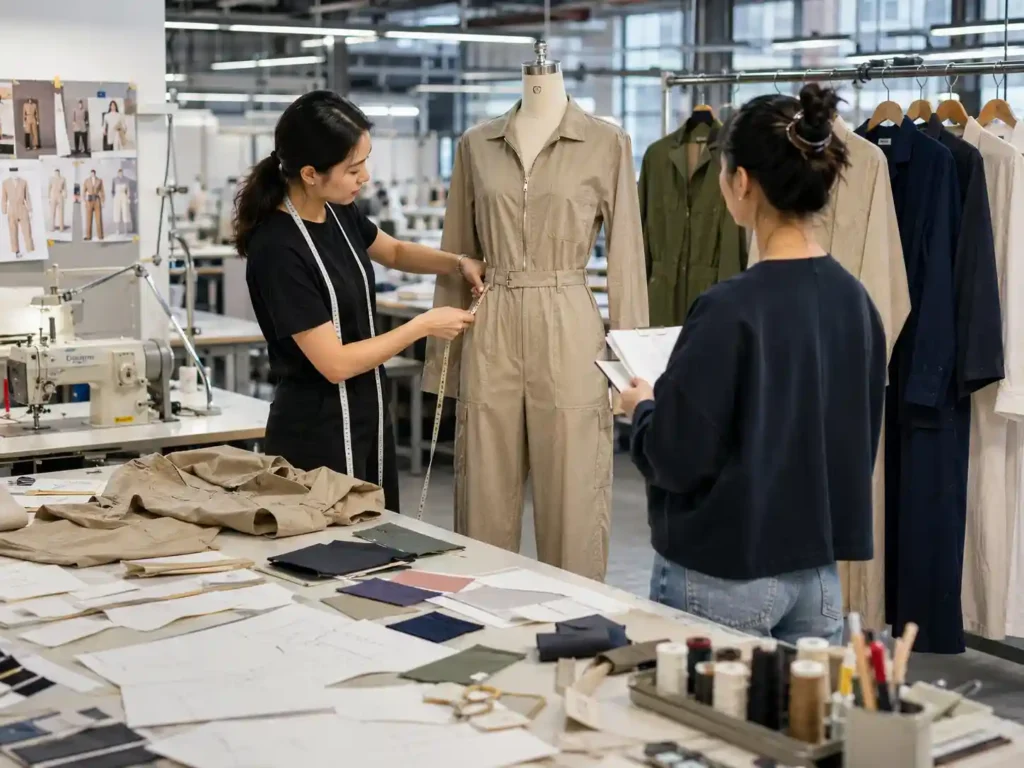
The phrase “sample lead time” can be misleading because suppliers often describe only the sewing stage. For the brand, development begins when the brief arrives and ends when the product is ready to become the bulk standard. Between those points sit fabric confirmation, trim confirmation, pattern development, first sample, fitting, comments, revisions, PP approval, and sometimes testing or packaging confirmation. A factory that sews a first sample in five days but requires three avoidable revision rounds can be slower than a supplier whose first sample takes longer but is technically closer to the target.
The most useful performance indicators are days to confirm suitable materials, days to create the first pattern, first-sample timing, number of revision rounds, response time after fitting comments, time from approved fit to PP sample, and the accuracy with which comments are transferred into production documents. Avoidable delays commonly come from missing measurements, unclear fabric requirements, changing colors, conflicting reference images, late trim decisions, or slow feedback. A professional development team turns every confirmed change into updated patterns, size charts, BOMs, trim records, and sewing instructions instead of leaving decisions scattered across emails and messages. That discipline often matters more than an aggressive sample promise.
Complex Dress Development
Complex dresses rarely fail because an operator cannot sew a basic seam. They fail because several technical elements interact incorrectly. A corset dress, for example, combines bust shape, cup placement, boning, waist suppression, neckline tension, lining, zipper behavior, fabric stability, and seam position. If the fabric changes after the first sample, the entire balance may need review. A mesh bodycon style creates another set of risks because stretch direction, recovery, lining tension, and seam elasticity affect the effective measurements. A satin dress may fit correctly while still looking inexpensive if seam puckering, zipper waviness, shine damage, or pressing marks are not controlled.
China’s broad fashion-material and component network can reduce development time for these styles because alternatives are often available within established sourcing clusters, but factory specialization remains more important than geography. A large plant built around basic shirts may be slower at solving corset-fit problems than a smaller dress specialist with experienced pattern and sample teams. The same logic applies in India. When evaluating complex styles, ask the supplier to describe the expected risk points before work begins. A technically experienced team should be able to discuss fabric stability, lining compatibility, critical measurements, trim behavior, seam choice, pressing, and inspection points without waiting for the first failed sample to reveal the problem.
Multi-SKU Production
A 5,000-piece order can be operationally simple or extremely complex. Five thousand units of one black dress in five sizes are very different from a 5,000-piece seasonal collection containing fifteen styles, forty color combinations, multiple fabrics, seven sizes, different labels, and several packing ratios. The second project creates dozens of independent material, documentation, scheduling, and inspection decisions. Multi-SKU fashion therefore rewards factories that can coordinate information as well as production capacity. Style numbers, color references, BOM versions, fabric allocations, trim colors, barcode files, size ratios, packing instructions, and inspection status all need to remain synchronized.
This is one area where organized Chinese production networks can be particularly useful for trend-led women’s fashion. A structured multi-factory system can allocate different products to different production units while centralizing technical records, merchandising, and QC. Jinfeng Apparel’s documented model uses six owned women’s fashion factories together with more than ten long-term production partners, supported by dedicated sample, pattern, merchandising, quality, finishing, and packing functions. The commercial value is not the headline number of factories; it is the ability to match production units to product structure and capacity needs while keeping the collection under one management system. For seasonal drops, this coordination can matter more than a small difference in unit price.
Reorders and Scaling
The first order tests whether a factory can make the product. The reorder tests whether the factory can support the business. A bestseller may need replenishment while several new styles are already in sampling or bulk production. At that point, speed depends on retained patterns, approved fabric references, previous trim specifications, final measurements, workmanship standards, packaging files, and QC records. Without those records, the brand is forced to redevelop a product it has already paid to develop, creating unnecessary delay and a higher risk that the repeat order will not match the first shipment.
A reliable repeat-order system keeps the approved pattern, size chart, fabric and color references, trim specification, BOM, sewing instructions, Golden sample, QC standard, and packing specification available for the next production run. The operating cycle should gradually become Sample -> Bulk -> Sell -> Reorder rather than Sample -> Bulk -> Sell -> Develop Again. China’s scale can support rapid replenishment when materials remain available and capacity is managed well, while India can also scale substantial programs where the textile source and factory are aligned. Regardless of country, ask a supplier how a six-month-old repeat order is restarted. If the process depends on searching old chats and personal memory, the production system is too fragile for a growing fashion program.
How Do Quality and Supply-Chain Risks Compare?
Neither China nor India guarantees better garment quality. Consistency depends on factory specialization, material control, approved production standards, in-line inspection, documentation, and management discipline. China’s dense supplier network can reduce some material and substitution risks, while India offers strong textile integration and detailed finishing capabilities. In both countries, the safest model turns the approved sample into measurable standards before bulk cutting and checks quality throughout production.
Quality Control
Final inspection alone is too late for serious dress production. If the fabric shade varies, sewing cannot fix it. If the pattern is incorrect, the problem starts at cutting. If the zipper, cup, boning, or lining specification is wrong, finished-garment inspection can identify the defect but may not be able to correct hundreds of completed units economically. A stronger quality system begins before cutting with an approved PP sample, confirmed fabric and trims, final measurements, color standard, BOM, sewing instructions, label files, and packing requirements. Those references create a shared definition of what production is supposed to reproduce.
During production, controls should cover incoming materials, fabric relaxing where necessary, cutting, cut-panel checks, sewing, critical measurements, structural details, finishing, pressing, labeling, and packing. Product-specific checkpoints matter. Satin calls for attention to shade, snagging, seam puckering, zipper flatness, and press marks. Mesh requires checks for holes, stretch, recovery, transparency, and neckline deformation. Lace requires placement and joining control. Corset dresses add cup position, boning, symmetry, neckline stability, and comfort. Sequin dresses add attachment security, needle damage, abrasion, and lining protection. A generic claim such as “100% QC” says very little unless the supplier can explain what is checked, when it is checked, and which defects trigger corrective action.
Bulk Consistency
One approved sample proves that one garment can be made correctly; it does not prove that thousands can be reproduced consistently. Bulk production uses multiple fabric rolls, several operators, different sewing machines, and production that may continue for days or weeks. The manufacturing system has to translate the sample into repeatable instructions. A practical hierarchy is approved materials, PP sample, Golden sample, measurement chart, BOM, sewing instructions, QC checklist, and packing specification. The physical Golden sample becomes especially useful when questions are subjective, such as whether ruching looks balanced, a neckline feels too open, a zipper wave is acceptable, or a pressed satin surface looks overly shiny.
For fitted dresses, measurement control deserves extra attention because bust, waist, hip, body length, strap length, and skirt length influence fit perception differently. Not every point needs the same tolerance. Critical body measurements should receive tighter attention than dimensions with little effect on fit, and the tolerance should be agreed before production rather than negotiated after inspection. A mature factory should be able to explain which measurements and appearance points are critical for the exact style. Jinfeng Apparel’s documented bulk process, for example, uses PP and Golden samples together with BOMs, sewing instructions, QC checkpoints, material checks, in-line inspection, garment inspection, and packing controls. That type of traceable standard is what brands should seek in either country.
Compliance and Traceability
Compliance risk is now part of normal sourcing rather than a separate legal exercise at the end of production. A dress sold in the United States, European Union, United Kingdom, Australia, Canada, or another major market can face requirements involving fiber labeling, care information, flammability, chemicals, product safety, packaging, traceability, or retailer-specific testing. Larger fashion groups may also impose social-compliance, restricted-substance, and documentation requirements that go beyond legal minimums. The practical task is to identify the obligations for the actual product and destination instead of assuming that a country or factory is “compliant” in a general sense.
Brands should confirm the destination market, fiber composition, product category, material supplier, required tests, label wording, care instructions, restricted-substance requirements, customer-specific protocols, factory audit expectations, certificate scope, and certificate validity. Sustainability claims require the same discipline. A manufacturer working with one certified mill cannot automatically describe every fabric or shipment as certified. The evidence needs to match the actual material, supplier, transaction, and claim. This principle applies equally to China and India. Country-level textile strength can make sourcing easier, but it does not replace product-level verification. For established brands, the strongest question is increasingly, “Can this supplier produce the correct evidence for this specific material, style, and shipment?”
Trade and Supply Risk
Geopolitical and trade uncertainty have made sourcing decisions more complicated than the old price-quality-delivery triangle. Brands now consider tariff changes, shipping disruption, origin rules, regulatory shifts, concentration risk, and the possibility that a commercially attractive sourcing country becomes more expensive after a policy change. This is one reason China+1 strategies have gained attention. However, adding India as a second sourcing country does not automatically reduce cost or risk. It creates new supplier qualification work, separate sample development, additional quality systems, more freight lanes, different documentation, and a larger management burden.
Diversification works best when it follows product logic. A cotton-rich embroidered resort collection may be a sensible candidate for India, while a complex stretch-mesh or corset program may still be better supported by an established Chinese fashion ecosystem. Moving a product simply because a board-level strategy says “reduce China exposure” can create hidden quality and development costs. Trade duties also need current SKU-level review because classification may depend on knit or woven construction, fiber composition, garment type, and country of origin. The most resilient sourcing matrix combines product suitability, landed cost, lead time, capacity, compliance, logistics, and geopolitical exposure rather than allowing any single factor to decide the country.
Which Country Should You Choose for Dress Manufacturing?
Choose China when the collection depends on rapid fashion development, broad synthetic and specialty-fabric sourcing, complex construction, extensive trims, multi-SKU coordination, and scalable repeat production. Choose India when cotton, natural fibers, textile character, printing, embroidery, or craft-intensive work drive the product. Larger brands can use both countries, but final factory selection should always be based on product specialization and verified execution rather than geography alone.
When China Fits Better
China becomes particularly attractive when a collection contains many moving parts that must be resolved quickly. Party, occasion, bodycon, corset, mesh, lace, sequin, and satin dresses often need several material suppliers and repeated interaction between the sourcing, pattern, sample, production, and QC teams. A fabric change may require a fit change; a new zipper can affect seam appearance; a different lining may alter stretch or opacity. Dense manufacturing clusters make those adjustments easier to coordinate when the selected supplier has an organized development process and reliable access to specialist factories and material vendors.
China is worth prioritizing when the program requires multiple fashion fabrics, specialty stretch materials, complex trims, molded cups, boning, custom hardware, rapid sample revisions, multi-style development, multi-color production, private-label packing, frequent seasonal launches, or fast replenishment. Guangdong is especially relevant to fashion-dress sourcing because garment production sits close to extensive fabric, trim, packaging, and export-service networks. The strongest reason to choose China is not that the country can “make everything.” It is that the right Chinese production partner can reduce the number of unresolved variables between design approval and bulk delivery, which is particularly valuable when a collection contains many styles and short commercial windows.
When India Fits Better

India becomes especially compelling when the textile itself is central to the collection’s identity. Cotton resort dresses, printed maxi dresses, embroidered summer styles, natural-fiber collections, and products with visible craft content can benefit from the country’s strong textile base and decorative traditions. In these cases, the manufacturing advantage is not simply a lower labor rate. The fabric, print, embroidery, and finishing capability can become part of what the consumer sees and values, making the sourcing location closely connected to the product story and retail positioning.
India should be evaluated carefully when cotton dominates the collection, natural fibers are strategically important, embroidery carries visible value, printed fabrics define the line, or textile craftsmanship supports premium pricing. The same technical discipline still applies. Sourcing teams should verify shrinkage, shade variation, print registration, embroidery placement, fabric width, repeat availability, hand-feel consistency, and bulk finishing. A beautiful development fabric is not sufficient if the mill cannot reproduce it across a full order and later replenishment. The phrase “Made in India” is not a production specification, just as “Made in China” is not one. The mill, factory, development team, and quality system still determine the final result.
Using Both Countries
For larger brands, the most useful answer may be China and India rather than China or India. A product-based allocation model can place structured satin and mesh occasionwear with a strong Chinese dress supplier while assigning cotton-rich, printed, or embroidered resort collections to an Indian partner with the right textile access. This creates geographic diversification without forcing each country to manufacture products that do not match its strongest ecosystem. It also makes internal supplier management clearer because each production base owns complete product families rather than splitting identical styles across factories with different fabrics, patterns, and finishing behavior.
Dual-country sourcing still adds operating cost. Two countries mean two qualification processes, two sets of calendars, quality systems, material chains, documentation flows, freight routes, and relationships. The benefit is strongest when the second country solves a real product or risk problem. Strategic styles can eventually be dual-sourced, but copying an identical fitted dress across two countries is difficult because small differences in fabric, sewing equipment, pressing, and fit interpretation can create visible variation. Diversification works when it reduces dependency without reducing product control, so product families are often a cleaner starting point than splitting a single style simply to create nominal geographic balance.
| Collection Requirement | China Usually Deserves Priority When… | India Usually Deserves Priority When… | Key Verification |
| Structured party/occasion dresses | Multiple synthetic fabrics and technical trims are required | A specialist occasionwear unit has proven capability | Fit, cups, boning, zipper, pressing |
| Cotton resort line | Fast multi-SKU coordination is the main challenge | Cotton, print, embroidery, or natural texture defines the product | Shrinkage, shade, print, bulk repeatability |
| Trend-led ecommerce drops | Short development cycles and rapid revisions are critical | Product is less trim-dependent and textile sourcing is stable | Sample-to-PP timeline and reorder readiness |
| Embellished premium dresses | Machine-intensive mixed decoration is needed | Embroidery or hand-finishing creates visible value | Placement, attachment, wearer comfort |
| Large seasonal collection | Many styles, fabrics, colors, and packaging variants need central coordination | Product families align with local textile clusters | BOM control, scheduling, QC, packing |
| Supply-chain diversification | Existing China ecosystem remains best for technical styles | India adds a genuine second strength for another category | Total landed cost and management complexity |
Choosing the Factory
Once the country shortlist is established, factory due diligence becomes more important than the national comparison. Ask operational questions that force the supplier to explain how the product will actually move through development and production. Has the factory made this exact dress category before? Who creates the paper pattern? How are fabric substitutions approved? How are fitting comments recorded? What becomes the PP standard? Is there a Golden sample? Which dimensions are treated as critical? How are complex trims inspected? How is in-line QC documented? What records remain for repeat orders, and how are private-label, barcode, packing, and export requirements controlled?
For brands evaluating Guangdong, Jinfeng Apparel is one example of a custom womenswear model built around product development rather than ready-stock selling. The company’s documented workflow covers fabric and trim sourcing, pattern development, sampling and revision, PP approval, bulk production, QC, private-label packing, export coordination, NDA-based cooperation, and repeat-order support, with a starting MOQ of 200 pieces per style/color depending on project conditions. Those company facts are not a reason to select the supplier automatically; they illustrate the kind of evidence that should be requested from every candidate. A sourcing decision becomes safer when the manufacturer can show a complete chain from design input to repeat production instead of relying on broad claims about price, quality, or national manufacturing reputation.
Conclusion
China versus India is useful as an initial sourcing framework, but it should never become the final decision rule. China often has the stronger case for complex fashion dresses, synthetic and blended materials, technical trims, rapid development, multi-SKU coordination, and repeat-order scalability. India can be highly attractive for cotton, natural fibers, printing, embroidery, textile character, and craft-led garments. The most durable sourcing strategy compares the actual dress, material chain, factory specialization, sample process, bulk controls, landed cost, compliance needs, logistics, and reorder plan before committing production. A country gets a sourcing team onto the map; the factory and its operating system determine whether the collection reaches the market looking, fitting, and performing the way the brand intended.