Skip to content

A dress order is not truly complete when the last seam is sewn. For an international fashion company, production success only counts when the correct styles, colors, sizes, and quantities reach the intended destination in saleable condition. A satin dress damaged by pressure, a corset style packed too tightly, a carton missing its warehouse label, or a commercial invoice using an unclear product description can create delays that cost more than the freight itself. International delivery therefore deserves the same planning discipline as fit approval, fabric selection, and bulk quality control.
International dress shipping moves finished garments through inspection, protective packing, freight booking, export clearance, international transport, import clearance, and final delivery. The most suitable route depends on shipment volume, launch date, garment sensitivity, customs requirements, warehouse rules, and the Incoterm that assigns transport costs, duties, taxes, and risk between the manufacturer and the customer.
These stages are tightly connected. Packing changes carton volume, carton volume changes freight cost, the selected Incoterm changes responsibility, and document accuracy changes how smoothly customs can release the cargo. Picture a collection of satin mini dresses, embellished party styles, and lightweight mesh dresses leaving Guangdong for an overseas fulfillment center. They may share one purchase order, but they should not automatically share the same protection, shipping priority, or risk plan. The details that separate a smooth delivery from an expensive exception begin long before the truck reaches the factory gate.
How Does International Dress Shipping Work?
International dress shipping begins after production and quality approval. Dresses are pressed, inspected, packed, labeled, and placed into export cartons. Shipment data is verified, transport is booked, customs documents are prepared, and the cargo moves through export clearance, international transit, import clearance, and final delivery to an office, store, fulfillment center, or distribution warehouse.
From Factory Release to Delivery
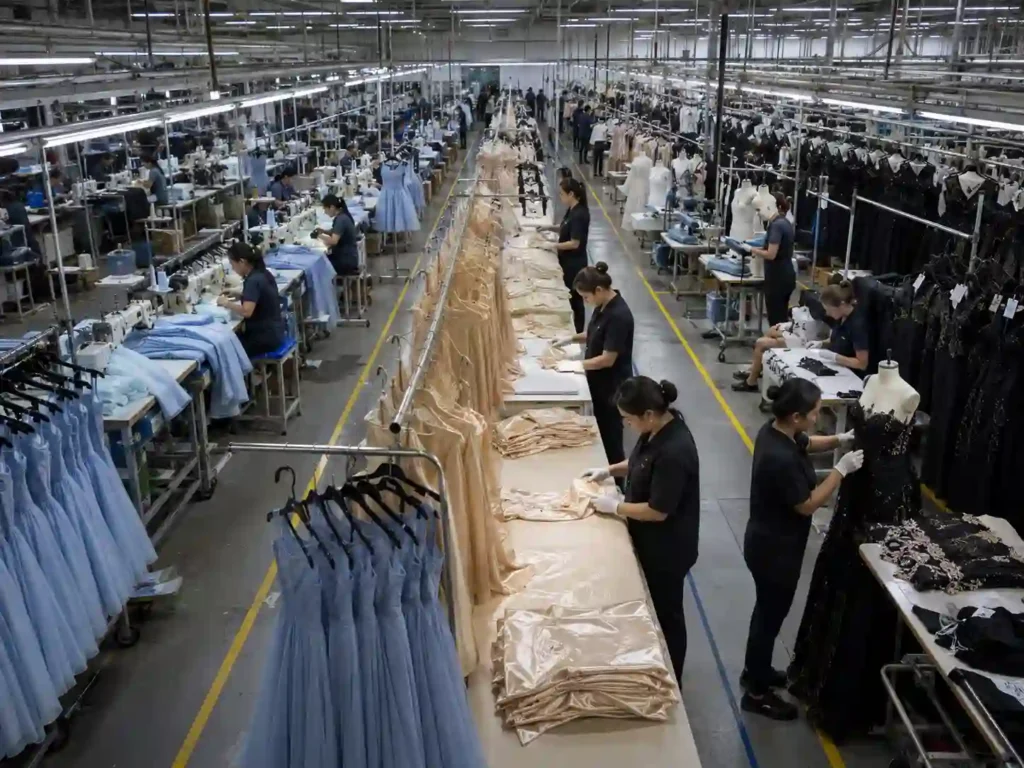
Shipping begins inside the factory rather than at a port or airport. After bulk production, the finished dresses must pass the agreed inspection process. The team checks measurements, sewing quality, fabric appearance, color, labels, pressing, accessories, and packing requirements before releasing the goods. Garments that still need repair, stain removal, re-pressing, or label correction should be separated from approved production rather than hidden inside completed cartons.
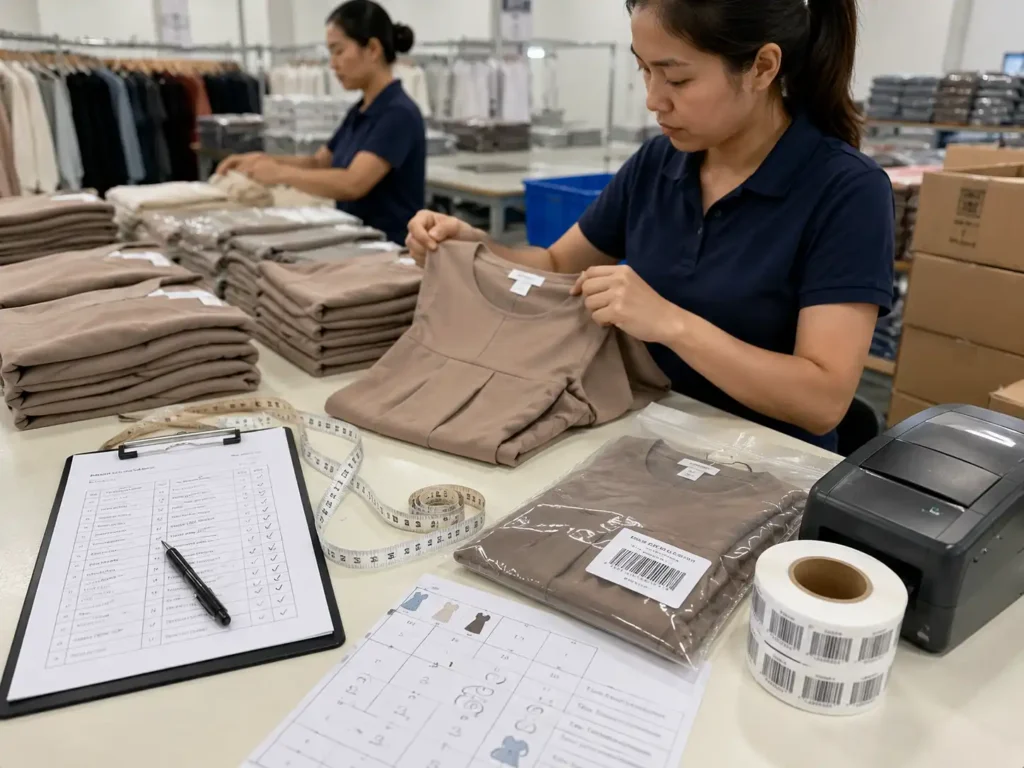
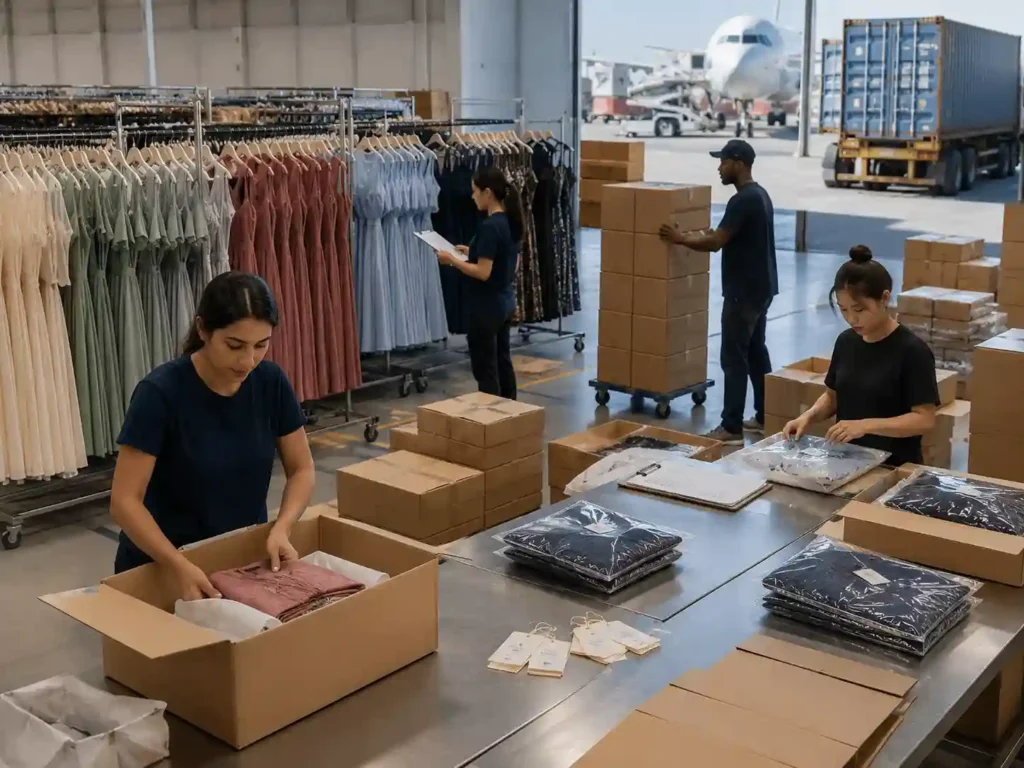
Approved dresses are counted by style, color, and size before they enter individual packaging. The packing team follows the agreed folding method, applies size stickers or barcodes where required, and builds the carton assortment according to the customer’s packing ratio. Some cartons contain one style and one color, while others use a pre-approved size assortment for stores or ecommerce inventory. The correct method depends on how the receiving system records and distributes stock.
Each sealed carton should have a unique number, a recorded quantity, net and gross weights, and measured dimensions. Those figures later support freight quotations, export declarations, customs clearance, cargo tracking, and warehouse reconciliation. When carton 27 is missing or damaged, a precise packing list allows the customer to identify the exact styles and sizes affected without opening the remaining shipment.
| Shipping Stage | Main Task | Common Owner | Key Control Point |
| Factory release | Final inspection and quantity approval | Manufacturer or appointed inspector | Approved goods separated from repairs |
| Export packing | Polybags, folding, cartons, and labels | Manufacturer | Correct SKU and size assortment |
| Freight booking | Reserve courier, air, or sea capacity | Forwarder or logistics team | Cut-off date and cargo measurements |
| Export clearance | Declaration and origin-side formalities | Exporter and customs agent | Invoice and cargo data match |
| International transit | Move cargo between countries | Courier, airline, or shipping line | Tracking and schedule updates |
| Import clearance | Customs review, duties, and taxes | Importer, broker, or DDP provider | Correct classification and importer data |
| Final delivery | Transport to office, store, or warehouse | Local carrier or forwarder | Appointment and label compliance |
Who Controls Each Step?
No single company controls the entire journey. The manufacturer controls production release, packing accuracy, carton information, and most origin-side product documents. The freight forwarder manages booking, cargo handover, transport schedules, and communication with airlines, shipping lines, and overseas agents. Customs brokers prepare declarations based on the commercial information supplied by the exporter and importer.
The importing company still needs to understand its local obligations unless another party has formally accepted them under the agreed delivery term. These obligations may include importer registration, tax numbers, tariff classification, duty payment, product labeling, broker appointment, and warehouse receiving rules. A shipment can leave China correctly and still be delayed because the destination company has not activated its customs account or supplied a valid tax identifier.
Large fashion groups often use nominated forwarders because they already have negotiated rates, customs procedures, and regional warehouse networks. Other companies prefer a manufacturer-coordinated route when they do not maintain a logistics team in China. Both approaches can work, but each task needs one named owner. The phrase ‘the forwarder will handle it’ is not enough when no one has confirmed who provides the HS information, books the delivery appointment, or pays destination charges.
Planning Before Packing
A shipment plan should be discussed before production is completed. Once hundreds of cartons have been packed, it becomes expensive to change the size assortment, barcode placement, carton dimensions, or delivery route. The logistics brief should therefore confirm the delivery address, postal code, contact person, requested arrival date, nominated forwarder, Incoterm, warehouse label format, carton limits, and whether partial shipments are permitted.
- Complete delivery address, warehouse code, and receiving contact
- Required arrival date and the latest acceptable delivery window
- Approved courier, air, sea, or split-shipment options
- Incoterm and named place, port, or warehouse address
- Carton weight, dimension, pallet, and label restrictions
- Barcode, SKU, carton-mark, and packing-ratio files
- Insurance, inspection, and document requirements
- Priority styles, colors, and sizes if partial shipping is allowed
Planning should work backward from the required warehouse date rather than forward from the factory completion date. A September collection may need to reach the distribution center several weeks earlier for receiving, quality checks, photography, allocation, and store delivery. The final sewing date is therefore not the true deadline. The real schedule must include packing, booking, customs, international transit, clearance, and local delivery buffers.
Carton volume also needs early attention. Lightweight dresses do not always produce low freight charges because courier and air services may bill by dimensional weight. Structured corset dresses, long gowns, and embellished occasionwear often require more space than simple jersey styles. Efficient packing saves money, but excessive compression can bend boning, crush molded cups, mark satin, or create steaming work after arrival.
Samples and Bulk Orders
Samples and bulk orders usually travel through different systems because they serve different purposes. A sample shipment may contain one to ten garments needed for fit review, photography, sales meetings, or pre-production approval. Speed and traceability matter more than the lowest freight cost, so international express services are commonly used. The customer may also provide a courier account so freight is billed under its own negotiated contract.
A sample parcel still needs a clear product description, quantity, declared value, country of origin, and complete consignee information. Writing only ‘sample’ or ‘clothing’ can be too vague. A description such as ‘women’s woven polyester dress samples, not for resale’ gives the carrier and customs broker more useful information while remaining accurate.
Bulk orders involve larger commercial values, more cartons, formal packing lists, warehouse labels, and structured customs declarations. Air freight may be used for launch-critical quantities, while sea freight is generally more suitable for routine production. The order can also be divided so urgent styles move by air and the remaining inventory moves by sea. Samples prioritize review speed; bulk shipping balances arrival date, freight budget, inventory needs, and customs responsibility.
Which Shipping Method Is Best for Dresses?
Express courier is generally best for samples, air freight suits time-sensitive commercial quantities, and sea freight is usually more economical for regular bulk production. The correct method depends on chargeable weight, carton volume, launch timing, garment value, customs complexity, and the financial effect of arriving late rather than on freight rate alone.
Express for Samples

Express courier offers an integrated door-to-door network, making it practical for development samples, revised samples, pre-production garments, fabric swatches, lab dips, trim approvals, and photography pieces. Tracking is normally available from pickup through delivery, and the courier manages the physical transfer between origin and destination networks without requiring the customer to arrange separate airport handling.
Courier charges are usually calculated using the greater of actual weight and dimensional weight. Many services calculate dimensional weight by multiplying length, width, and height in centimeters and dividing the result by a carrier-specific factor, often 5,000 or 6,000. The applicable formula should be checked before quoting because it can vary by carrier, service level, and market.
A large box containing three lightweight gowns can therefore cost more than a smaller box containing several heavier jersey dresses. Sample teams can reduce unnecessary volume by folding carefully and selecting a carton that fits the garments without crushing cups, boning, or decoration. Courier delivery on major routes is often planned within about two to seven working days after pickup, but customs review, remote destinations, holidays, and peak-season capacity can extend the timeline.
Air for Time-Critical Orders
Air freight becomes useful when a shipment is too large for economical courier service but cannot wait for an ocean schedule. Common examples include launch stock, graduation-season dresses, holiday collections, retailer replenishment, influencer campaign units, and replacements for delayed or damaged inventory. Air transport is expensive, yet the premium may be commercially sensible when it protects a confirmed selling window.
The fastest flight may take only a few days, but the complete door-to-door journey includes factory pickup, export warehouse handling, security screening, flight allocation, export clearance, arrival-terminal processing, import clearance, and local delivery. A practical planning range for many routes may be around five to twelve days door to door, although congestion, customs examination, and destination conditions can make it longer.
Air freight is also charged by the greater of actual and volumetric weight. Loose packing increases cost, but aggressive compression is not always sensible. Corset styles, molded cups, sequins, structured skirts, and satin surfaces can suffer when cartons are optimized only for lower volumetric weight. The better question is not simply whether air freight costs more than sea freight, but whether the added speed prevents lost sales, retailer penalties, stockouts, or wasted campaign spending.
Sea for Regular Bulk
Sea freight is commonly used for regular bulk production because it can provide a lower transport cost per garment when the order volume is large enough and the delivery calendar has sufficient time. Less-than-container-load shipping, known as LCL, combines cargo from several exporters. It can suit moderate orders, but the shipment receives additional handling during consolidation and destination deconsolidation.
Full-container-load shipping, known as FCL, provides dedicated container space and can suit larger seasonal collections, repeat orders, or combined shipments across many styles. FCL does not automatically mean the container is packed at the garment factory; the actual loading arrangement depends on the forwarder, booking, and export warehouse.
Port-to-port transit on major trade lanes may range roughly from 15 to 45 days, but complete door-to-door delivery can take about 25 to 55 days or longer. Booking availability, transshipment, port congestion, customs exams, destination charges, and warehouse appointments all influence the final date. A brand should compare the total delivered cost rather than the headline ocean rate because origin handling, documentation, consolidation, destination handling, brokerage, storage, and local delivery may be billed separately.
Split Shipping and Route Selection
Split shipping is often the most balanced solution when the complete order cannot arrive by sea before a launch. A selected quantity travels by air while the main inventory moves by sea. This protects the selling calendar without paying air rates for every garment, but it requires careful SKU planning and separate documents.
The air portion should be selected by style, color, and size rather than by carton convenience. Sending 300 units of one promotional style may be less useful than sending a balanced size range across several priority styles. Ecommerce operations need enough units in the core sizes to open sales without creating immediate stockouts, while retail programs may need a specific store allocation rather than a simple percentage of the total order.
Each portion needs separate carton numbering, packing lists, invoices, freight bookings, transport documents, tracking references, and warehouse appointments. The totals should still reconcile with the purchase order. A practical split may send approximately 10 to 30 percent of urgent stock by air and the remainder by sea, but the correct percentage depends on launch demand, inventory coverage, freight budget, and the value of the selling window.
| Method | Best Use | Common Planning Range | Main Cost Basis | Main Limitation |
| Express courier | Samples, swatches, and approval garments | 2-7 working days on many major routes | Actual or dimensional weight | Cost rises quickly with volume |
| Air freight | Urgent launches and replenishment | 5-12 days door to door in many cases | Chargeable weight | High cost for bulky cartons |
| Sea LCL | Moderate bulk shipments | 25-55+ days door to door | Volume or weight-to-measure | Extra consolidation handling |
| Sea FCL | Large programs and repeat production | Route and port dependent | Container and route | Needs advance inventory planning |
| Air and sea split | Early launch stock plus main inventory | Two coordinated schedules | Separate air and sea costs | More SKU and document control |
These figures are working ranges rather than fixed promises. Route conditions, customs, public holidays, carrier capacity, weather, and destination services should be confirmed for every shipment. The most reliable transport plan is the one that matches the commercial deadline while leaving enough room for customs and warehouse receiving rather than relying on the fastest theoretical transit time.
How Are Dresses Packed for Export?
Dresses are inspected, pressed, folded, individually protected, and packed into labeled export cartons according to style, color, size, and warehouse instructions. The packing method must protect fabric surfaces, structure, decoration, and presentation while avoiding unnecessary carton volume, excessive gross weight, barcode errors, and receiving problems at the destination.
Garment-Specific Protection
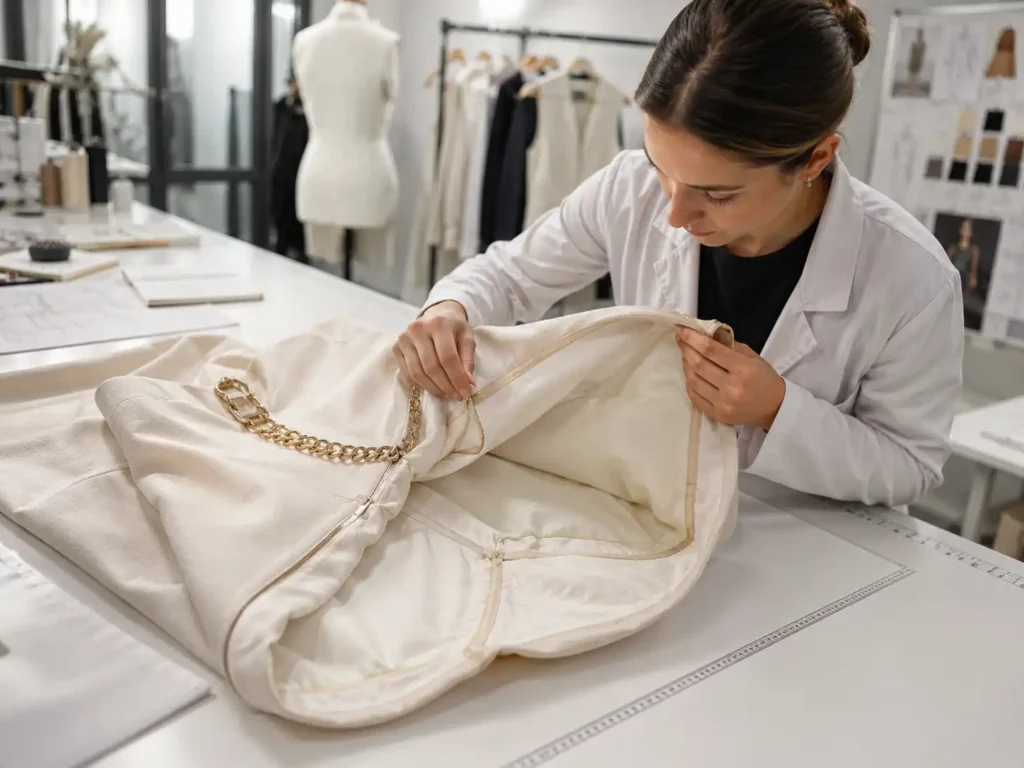
A reliable packing method starts with the construction of the dress rather than with a standard carton target. Simple knit dresses can normally tolerate compact folding, but structured or delicate garments require more space and protection. Packing is also the last point at which the factory can catch loose threads, marks, open seams, incorrect labels, or poor pressing before the garments leave the production site.
Satin should be handled on clean, smooth surfaces because it can show snags, pressure marks, and oil stains. Lace and mesh need protection from hooks, zippers, metal trims, and sharp sequins. Beaded or sequined garments may require tissue or a protective layer between decorated surfaces. Corset dresses should not be folded across rigid boning or heavily compressed over molded cups, while long dresses need a consistent fold pattern that avoids twisting the hem.
Garments must be completely dry before packing. Residual moisture from pressing, humid storage, or damp cartons can create odor, mildew, or surface marks during a long sea journey. Desiccant can provide additional support where appropriate, but it cannot compensate for wet garments, poorly sealed packaging, or weak cartons. The objective is not maximum packaging; it is the minimum system that reliably protects each style without creating unnecessary volume.
| Dress Type | Main Packing Risk | Practical Protection |
| Satin dress | Snags, shine marks, and deep creases | Smooth folding, clean surfaces, and tissue where needed |
| Lace dress | Motif damage and catching | Protect from zippers, hooks, and rough surfaces |
| Mesh dress | Punctures and stretching | Separate sharp trims and avoid excessive compression |
| Sequin dress | Abrasion, scratches, and loose sequins | Use a protective layer between decorated surfaces |
| Corset dress | Crushed cups and bent boning | Support the bust and allow sufficient carton depth |
| Maxi dress | Heavy fold lines and twisted hems | Use a planned multi-fold method |
| Velvet dress | Pile crushing and pressure marks | Reduce compression and keep pile direction consistent |
| Embellished dress | Bead impact and trim breakage | Wrap decorated areas and limit movement |
Carton Engineering
Carton selection affects freight cost, product condition, and warehouse handling. A carton that is too large may collapse when stacked, while a carton that is too small may bulge, split, or compress the dresses. An overweight carton can create manual-handling problems, attract carrier surcharges, or exceed a distribution center’s receiving limit.
The packing team should confirm pieces per carton, internal arrangement, carton dimensions, net weight, gross weight, and total cubic volume through a physical packing trial whenever possible. Total volume is calculated from carton length, width, height, and carton quantity using the same measurement units. A reduction of only a few centimeters in carton depth can create meaningful savings across a large order, but lower volume is not a success if structured dresses arrive distorted.
The delivery route also changes carton requirements. Express carriers may apply maximum dimensions and dimensional-weight formulas. Air cargo rewards compact volume but still requires safe stacking and handling. Sea freight exposes cartons to longer storage, multiple transfer points, humidity changes, and container pressure. Retail and fulfillment warehouses may impose their own gross-weight, label-position, pallet, or carton-size standards, so those rules should be supplied before packing begins.
Labels and Warehouse Compliance
Every export carton should be traceable without being opened. A basic carton mark may include the purchase-order number, style, color, size range, quantity, carton number, destination, and country of origin. A sequence such as ‘Carton 12 of 80’ should match the packing list exactly. When one carton is delayed, damaged, or rejected, the customer can identify its expected contents immediately.
Retailers and ecommerce fulfillment centers may require additional labels, including SKU barcodes, warehouse routing codes, SSCC labels, fulfillment-center identifiers, or appointment references. These requirements are operational rather than decorative. A shipment can contain the correct garments and still be delayed when the outer labels do not match the receiving guide or when a barcode is printed at the wrong size and cannot be scanned.
Individual garments may also need size stickers, price tickets, hangtags, polybag barcodes, care labels, suffocation warnings, or marketplace labels. The placement should be confirmed during sample or pre-production approval, particularly when a barcode must remain visible through the polybag. The factory should always use the latest approved label file because an old style number, color code, or warehouse address can create inventory errors across the full shipment.
Packing Verification
Packing verification should take place before the truck arrives. The team compares the physical cartons with the purchase order, packing list, commercial invoice, barcode file, and warehouse instructions. Selected cartons from different styles, colors, and size assortments should be opened to confirm quantity, folding, polybags, size stickers, hangtags, barcode readability, carton marks, carton strength, and actual gross weight.
Multi-color and multi-size orders deserve special attention because mistakes often occur during assortment packing. The overall quantity may be correct while two cartons contain the wrong size ratio. This does not appear as a production shortage, yet it creates inventory problems after arrival. Carton-level checks should therefore look beyond total pieces and verify the intended distribution inside the shipment.
Shipment photographs provide a useful record of the open-carton arrangement, sealed labels, pallet loading, and cargo handover. They do not replace an inspection report, but they help resolve later questions. The packing list must also be updated if any pieces are held for repair or moved into an urgent air shipment. Export documents should describe the goods that actually leave the factory, not the quantities originally planned several weeks earlier.
What Shipping Documents Are Required?
Most international dress shipments require a commercial invoice, packing list, and transport document. Depending on the destination and route, the shipment may also need a certificate of origin, customs declaration data, HS code information, fiber composition, inspection records, or warehouse paperwork. Every record must match the physical cargo in description, quantity, value, weight, and carton count.
Commercial Invoice and Packing List
The commercial invoice describes the financial and commercial transaction. It normally lists the exporter, importer, consignee, invoice number, purchase-order reference, product description, quantity, unit value, total value, currency, country of origin, and Incoterm. Customs authorities use this information to understand what is being imported and to assess duties, taxes, restrictions, or further document requirements.
Descriptions should be specific enough to identify the goods. ‘Women’s woven polyester dresses’ is more useful than ‘fashion items’ or ‘clothing.’ When the shipment includes both knitted and woven styles, the invoice may need separate product lines because construction and fiber composition can affect customs classification. Sample shipments also need reasonable values even when the garments are not intended for resale.
The packing list explains how the shipment is physically arranged. It records carton count, quantity, style, color, size, net weight, gross weight, carton dimensions, and total volume. Large collections often need carton-level breakdowns so the receiving team can identify every box. The invoice and packing list must reconcile; if one shows 5,000 garments and the other totals 4,980, the shipment may be stopped until the difference is explained.
Transport Documents
The transport document depends on the shipping method. Express shipments use a courier waybill and tracking number. Air freight uses an air waybill, while sea freight uses a bill of lading or sea waybill. These records connect the commercial cargo with the carrier, route, shipper, consignee, number of pieces, and transport reference used for tracking and arrival handling.
An air waybill records the shipper, consignee, airport route, cargo description, number of packages, and chargeable weight. It serves as a receipt and transport record rather than a negotiable title document. A bill of lading contains details such as the shipper, consignee, notify party, port of loading, port of discharge, vessel, container or cargo information, and shipment description.
The sea-freight release method should be agreed before arrival. Original bills, telex release, and sea waybills follow different procedures. Draft transport documents should be checked before final issuance because an outdated consignee address, misspelled company name, wrong port, incorrect carton count, or inconsistent description can create amendment costs and clearance delays. The final references should be shared promptly so the destination broker can prepare before the cargo arrives.
HS Codes, Origin, and Labels
HS classification determines how customs identifies a dress and may affect the duty rate. Knitted and woven dresses are normally classified differently, and the main fiber composition can also change the code. A woven polyester dress may therefore require a different classification from a knitted cotton dress even when both are sold under the same brand category.
The manufacturer can provide garment construction, material composition, product descriptions, and commonly used code references. Final confirmation should come from the importer, licensed customs broker, or relevant customs authority because classification interpretation belongs to the destination market. Copying the code from an unrelated shipment is risky when the fabric, construction, or garment type has changed.
A certificate of origin may be requested by the customer, broker, bank, or customs authority. Whether it is needed depends on the destination, trade arrangement, shipment value, and product. Garment labels can also support customs and compliance review by showing fiber composition, care instructions, country of origin, size, and market-specific information. These requirements should be settled during product development rather than immediately before dispatch.
| Document | Main Purpose | Important Dress-Shipment Data |
| Commercial invoice | Customs value and transaction record | Description, quantity, value, currency, origin, and Incoterm |
| Packing list | Physical cargo breakdown | Cartons, styles, colors, sizes, weight, and dimensions |
| Air waybill | Air transport record | Shipper, consignee, route, pieces, and chargeable weight |
| Bill of lading | Sea transport and cargo record | Ports, vessel, consignee, containers, and description |
| Certificate of origin | Confirms manufacturing origin | Exporter, goods, origin country, and shipment reference |
| Customs declaration data | Supports export or import filing | Material, garment type, quantity, value, and HS information |
| Warehouse labels | Supports destination receiving | PO, SKU, barcode, carton number, and warehouse code |
| Inspection report | Records shipment-condition checks | Quantity, workmanship, measurements, and packing results |
Document Reconciliation
Document reconciliation means checking that every record tells the same story. The commercial invoice, packing list, booking confirmation, carton marks, customs declaration, and transport document should agree on the essential shipment data. The consignee name and address should be consistent, and the product description should not change from ‘women’s woven dresses’ on one record to ‘textile samples’ on another without a valid reason.
Reconciliation is especially important when an order is divided into air and sea shipments. Each shipment needs its own quantities, carton numbers, invoice, packing list, and transport document. The combined records must still reconcile with the full purchase order. If ten garments are moved from the sea shipment into the urgent air portion, both sets of documents need to be updated before customs declaration.
Documents should be reviewed before the export cut-off rather than while the truck is waiting. Last-minute corrections can cause a missed flight, missed vessel, customs amendment, or warehouse rebooking. A short document-checking routine often saves more time than rushing cargo into a booking with inconsistent information. For repeat orders, approved templates can speed the process, but each shipment still requires a fresh check against the final packed goods.
Which Incoterm Should You Choose?

The right Incoterm depends on which party can manage freight, export handling, import clearance, duties, taxes, and final delivery most effectively. EXW gives the customer broad origin control, FOB is common for established importers, CIF covers main ocean carriage to a named port, DAP reaches a named place, and DDP requires careful project-specific evaluation.
EXW and FOB
Under EXW, the seller makes the goods available at the factory or another named location. The customer or its appointed forwarder manages collection and most transport responsibilities. EXW can suit companies with a strong China-based logistics network, but the customer must understand pickup, origin charges, export procedures, and local coordination rather than assuming the factory price covers every origin activity.
A common misunderstanding is that EXW removes every practical responsibility from the manufacturer. The factory still needs to prepare accurate packing data, support cargo handover, and provide product information. The exact export arrangement should be confirmed because local procedures may require an authorized exporting party even when the commercial term places most transport responsibility on the customer.
FOB is commonly used for ocean freight when the customer has a nominated forwarder and import capability. The supplier normally handles the agreed origin activities and places the cargo on board at the named port, after which the customer controls the main freight and destination process. FOB can support consolidation across several factories and give established importers more visibility over rates, carriers, and customs planning.
CIF and DAP
CIF includes the cost of goods, insurance, and ocean freight to the named destination port. It can simplify main-carriage booking for a customer that prefers the supplier to arrange the ocean route. However, CIF does not usually mean door-to-door delivery. The importer still manages destination handling, customs clearance, duties, taxes, and transport from the port unless separate services are included.
Destination charges can be substantial, so the customer should request a clear explanation of what is covered and what will be billed after arrival. A low ocean quotation is not useful when terminal, document, storage, or delivery charges remain unclear. The named port must also be stated precisely because CIF without a destination point leaves room for misunderstanding.
DAP brings the goods to a named destination such as an office, warehouse, or logistics facility. The seller arranges transport to that point, while the customer generally manages import clearance, duties, and taxes. The exact named place matters. ‘DAP United States’ is too broad, while ‘DAP customer warehouse, city, postal code’ provides a practical delivery obligation. Warehouse appointments, unloading, re-delivery, and limited-access charges may still need separate confirmation.
DDP by Project
DDP places broad delivery responsibility on the seller, including import clearance and applicable duties and taxes. It can appear convenient, especially for ecommerce warehouse delivery, but it is not a universal service that should be promised for every country, product, and shipment value. Feasibility depends on the destination, customs environment, HS classification, importer requirements, local tax rules, warehouse address, and the forwarder’s route capability.
Before approving DDP, the parties should confirm who acts as importer of record, how duties and taxes are calculated, whether the service includes a warehouse appointment, and what happens if customs requests additional information. The quotation should state whether remote-area delivery, inspection, storage, relabeling, or re-delivery is included. A low DDP price is risky when the provider cannot explain the clearance structure or the legal party used for import.
For this reason, experienced manufacturers evaluate DDP by project rather than treating it as a standard promise. In some markets, DAP or FOB gives the customer stronger control and clearer customs records. In others, a properly structured DDP service can reduce administrative work. Convenience should never replace transparency about how the cargo enters the destination country.
Choosing by Capability
The best Incoterm depends less on company size than on logistics capability. An established importer with negotiated freight rates, a reliable customs broker, and a regional warehouse network may prefer FOB because it controls the carrier, consolidation, clearance, and landed-cost reporting. A company without a China-based forwarder may prefer a manufacturer-coordinated route, but it should still review the included charges, delivery responsibilities, and customs structure.
- Ability to act as importer of record in the destination country
- Knowledge of local textile duties, taxes, labeling, and customs rules
- Existing freight rates and relationships with forwarders or brokers
- Need to consolidate goods from several factories or product categories
- Warehouse appointment, pallet, barcode, and delivery requirements
- Desired visibility over freight invoices and customs declarations
- Internal capacity to manage exceptions, storage, and re-delivery
The Incoterm should always include the named location. ‘FOB Shenzhen,’ ‘CIF Los Angeles,’ or ‘DAP specified warehouse address’ is clearer than writing only ‘FOB’ or ‘door to door.’ Incoterms allocate tasks, costs, and risk, but they do not replace a commercial contract. Product quality, payment terms, inspection rights, delivery dates, ownership, and claims procedures should still be documented separately.
How Do Customs, Costs, and Delivery Risks Work?
Customs reviews the shipment’s classification, value, origin, documents, and importer information before releasing the goods. Total delivered cost may include freight, handling, insurance, brokerage, duties, taxes, storage, and local delivery. Most transport risks can be reduced through accurate records, realistic timing, route planning, tracking, insurance decisions, and warehouse-ready packing before dispatch.
Landed Cost
Landed cost is the total amount required to place the dresses at the intended destination, ready for receiving or sale. It is broader than the factory price and broader than the international freight quotation. Depending on the route and Incoterm, it may include origin pickup, export handling, freight, fuel surcharges, insurance, destination terminal charges, customs brokerage, duties, taxes, local delivery, appointment fees, pallets, storage, and re-delivery.
A fashion company should calculate landed cost by style or by unit when comparing production and shipping options. A low factory price may not create the lowest final cost when the garments need high-volume cartons, urgent air transport, extensive re-steaming, or warehouse relabeling. Shipping decisions should therefore be included in product-margin planning rather than added after the collection has already been priced for sale.
The allocation method also matters. Dividing total freight equally across every garment can distort profitability when a structured gown occupies several times the volume of a jersey mini dress. Mixed collections can allocate freight by carton volume, chargeable weight, or SKU carton share. Duties and taxes depend on classification, value, origin, and destination rules, so the final amount should be confirmed with a customs professional rather than copied from another company’s shipment.
Customs Clearance
Customs authorities may review product descriptions, HS codes, declared values, country of origin, quantities, material composition, importer registration, and supporting records. A shipment can be delayed even when the garments themselves are acceptable if the paperwork is inconsistent. Clear descriptions reduce unnecessary questions, while vague terms such as ‘apparel’ or ‘fashion goods’ may not provide enough information for classification.
If the shipment contains knitted and woven styles, they should not be combined under one inaccurate description simply to shorten the invoice. Declared values should match the commercial transaction and supporting records. Unusually low values may trigger reassessment. Samples also need a reasonable manufacturing value even when they are provided without a retail sale price.
The importer should confirm that its company details, tax number, customs account, broker authorization, and import registrations are valid before departure. Waiting until the shipment reaches customs can create storage charges while information is collected. Early broker review is especially useful for first shipments, unfamiliar materials, high-value occasionwear, new destination markets, or large orders with several garment classifications.
Tracking and Exception Management
Tracking should begin when the cargo leaves the factory, not when the customer asks where it is. Express shipments use a courier tracking number. Air freight uses the air waybill and forwarder updates. Sea freight uses the bill of lading, container number where applicable, vessel schedule, and destination-agent communication. The logistics file should record pickup, export-warehouse receipt, departure, estimated arrival, customs status, appointment, and proof of delivery.
Common exceptions include a missed vessel, flight rollover, customs hold, incorrect carton label, damaged carton, quantity discrepancy, delayed clearance, warehouse rejection, and failed delivery appointment. Each problem requires a different response. A customs hold may need material information or proof of value. A warehouse rejection may require corrected labels and re-delivery. A damaged carton may require photographs, a carrier notice, and a count of affected units.
The customer should keep the commercial invoice, packing list, transport document, carton photographs, and inspection records in one shipment file. This makes it easier to identify whether a problem began during packing, origin handover, international transit, customs, or final delivery. Schedule changes should be communicated in practical terms, especially when they affect a launch, campaign, retail appointment, or warehouse labor booking.
Reducing Risk Before Dispatch
The strongest shipping controls happen before the cargo moves. Once dresses are inside an overseas customs terminal, corrections become slower and more expensive. Before dispatch, the team should verify final quantity, carton count, dimensions, gross and net weights, style-color-size breakdown, carton numbering, barcodes, warehouse labels, commercial invoice, packing list, consignee details, Incoterm, booking instructions, and required arrival date.
The schedule should include a buffer for customs and local delivery. Fashion orders linked to holidays, graduation, homecoming, weddings, resort seasons, or campaign launches should not depend on the fastest possible transit estimate. For time-sensitive collections, split shipping can protect the launch while limiting air-freight exposure. For regular repeat orders, earlier production release and sea freight often provide a more stable cost structure.
Cargo insurance should be considered according to shipment value, garment sensitivity, route, and commercial risk. The parties should understand the insured amount, exclusions, claim deadline, and evidence required. Insurance does not prevent delay or damage, but it can reduce the financial effect of a covered loss. The same principle applies to inspections and shipment photographs: they do not eliminate risk, yet they create evidence and make responsibility easier to establish.
Plan Production and Shipping as One Project
International dress shipping works best when it is planned alongside product development rather than treated as a final administrative step. The fabric, construction, folding method, carton volume, barcode system, route, Incoterm, customs data, and warehouse deadline all influence one another. A manufacturer that understands these connections can help a fashion company protect its garments, control delivered cost, and reduce the avoidable delays that appear between factory release and final receiving.