Skip to content

A dress can look perfectly balanced in a fashion sketch and still fail as soon as it reaches the sample room. The neckline may open when the wearer moves, the waistline may sit too high, the side seam may rotate, or the finished hem may hang unevenly. These problems are rarely caused by the creative idea alone. They usually appear when design information is translated into patterns, fabric, stitches, and three-dimensional fit. For a fashion team working against a launch calendar, every unclear measurement or unrecorded revision can become another sample round, another courier delay, or a larger risk once fabric is cut for bulk production.
Digital patterns support dress production by converting design measurements and construction details into editable production files. They help pattern makers correct fit, grade sizes, plan fabric markers, communicate revisions, guide cutting, and maintain approved specifications from sampling through bulk production. Their value comes from controlled data and professional pattern judgment, not from software alone.
Consider a fitted satin dress with a low back, narrow straps, an invisible zipper, and a bias-cut skirt. A two-millimeter correction at one seam may seem insignificant on screen, yet that adjustment can change how the zipper lies, where the waist settles, and whether the skirt twists after sewing. The following sections trace those decisions from the first pattern file to the cutting room, showing where digital precision helps and where experienced hands still make the final call.
What Are Digital Patterns in Dress Production?
Digital patterns are editable garment files that define the shape, dimensions, construction marks, seam relationships, and size rules of every dress component. They turn a design concept into measurable production data that can be reviewed, corrected, graded, arranged for cutting, and preserved for future orders. Their real value lies in controlling decisions consistently from sample development through bulk production.
Pattern Data
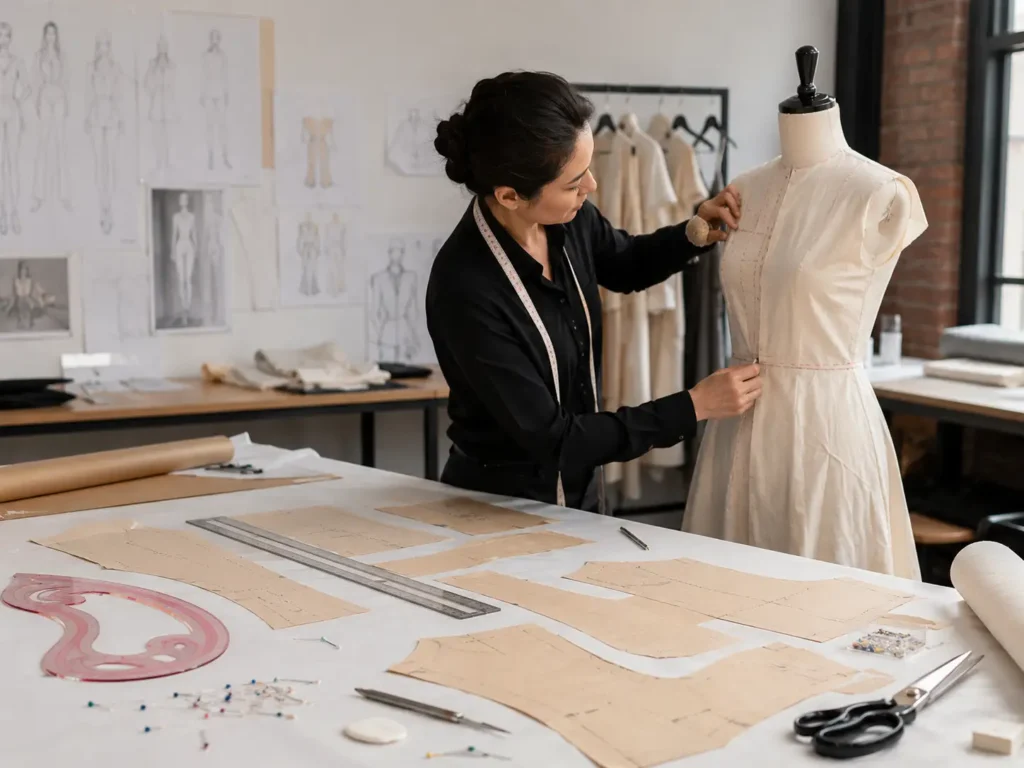
A digital pattern is not simply a scanned outline of a paper pattern. A production-ready file normally contains the front and back bodice, skirt panels, sleeves, facings, linings, waistbands, pockets, reinforcement pieces, and any internal support components required by the style. Each piece needs an identity, cut quantity, size, material assignment, grain direction, seam allowance, and matching information. Without those details, the cutting room may have shapes but still lack the instructions needed to build the approved garment consistently.
The file may also contain darts, pleat lines, gathering sections, drill points, zipper positions, cup placements, boning channels, pocket openings, fold lines, button locations, and embroidery or print references. These marks allow the pattern room, sample room, cutting department, sewing line, and quality team to interpret the same construction. A pattern can be geometrically accurate and still be incomplete for production. For example, a front bodice may match the requested bust measurement, yet the garment can fail if the lining was not adjusted, the neckline lacks stabilization, or a connected seam has a different length.
| Pattern element | Main purpose | Common risk when uncontrolled |
| Grainline | Controls cutting direction, drape, stretch, and surface appearance | Twisted seams, uneven shine, or unstable hang |
| Seam allowance | Defines sewing, trimming, and finishing space | Incorrect finished measurements or exposed seams |
| Notches | Align panels, darts, sleeves, pleats, and gathers | Mismatched seams or uneven fullness |
| Internal lines | Show darts, cups, pleats, pockets, and placements | Details positioned differently from the approved sample |
| Cut quantity | States how many pieces are cut from each material | Missing, duplicated, or incorrectly mirrored pieces |
| Piece code | Connects every component to a style, size, and fabric | Components mixed between styles or revisions |
| Grade rule | Controls size changes around key body points | Distorted proportions across the size range |
| Revision code | Identifies the approved development stage | Old patterns reaching the cutting department |
Patterns and Tech Packs
A tech pack describes what the finished dress should achieve, while a pattern defines the physical shapes needed to make it. The tech pack may show the design, fabric composition, color references, measurements, trims, stitch types, label positions, construction notes, and packing requirements. The pattern converts those instructions into cutting geometry. If the specification calls for a 24-centimeter neckline depth, a 75-centimeter waist, and a 45-centimeter side slit, the pattern must produce those results after seam allowances, lining, closures, pressing, and construction are taken into account.
Problems often appear when one document changes without the other. A designer may lower the neckline but forget to update the facing. The waist measurement may be reduced while the waistband pattern remains unchanged. A skirt slit may be moved without revising the lining opening or reinforcement point. Before a sample or production pattern is approved, the technical team should compare the latest pattern, measurement chart, bill of materials, construction comments, and sample revision record. Matching version numbers are just as important as matching measurements because a correct instruction connected to an outdated file still produces the wrong dress.
2D and 3D Patterns
A two-dimensional pattern is the flat geometry used to cut fabric. A three-dimensional garment simulation shows how those flat pieces may behave when assembled around a digital body. Two-dimensional files control seam lengths, curves, darts, balance, grainlines, allowances, grading, and marker preparation. Three-dimensional review can help a team assess silhouette, proportion, ease, neckline coverage, skirt volume, and obvious tension areas before making another physical sample, particularly when designers and factories are working in different countries.
A convincing 3D image does not guarantee a production-ready dress. The result depends heavily on the fabric data entered into the system. Stretch, recovery, weight, thickness, friction, and drape influence the simulation, yet real sewing adds needle tension, seam bulk, pressing, lining movement, and operator handling. A virtual satin dress may appear smooth even though the real fabric develops zipper rippling. A digital mesh style may look stable while the actual neckline grows during sewing. Three-dimensional tools are therefore most useful for early visual decisions and communication, while real fabric and real movement still require physical confirmation.
Suitable Dress Types
Nearly every dress category can benefit from digital pattern control, but the value becomes more visible as the structure becomes more demanding. Bodycon dresses require careful management of negative ease, stretch direction, recovery, side-seam balance, and bust-to-hip proportions. Corset dresses rely on panel shaping, cup position, underbust fit, boning channels, lining, and closure stability. Slip dresses need controlled neckline coverage, strap placement, bias balance, and drape, while maxi dresses require accurate front and back length, hem balance, slit position, and skirt sweep.
Digital patterns are also useful for product families. A brand may use one approved bodice across mini, midi, and maxi lengths, or adapt the same block into a sleeveless dress, long-sleeve dress, and matching set. The approved base can reduce repeated drafting, but every new fabric or construction still needs review. Changing from stable woven fabric to stretch mesh may require different ease, seam stabilization, lining, and grading. Digital reuse is valuable only when the pattern is treated as a controlled starting point rather than a universal solution that can be applied without testing.
How Are Digital Dress Patterns Created?
Digital dress patterns are created by translating design information into a complete set of measurable garment pieces. Pattern makers review the style, establish a suitable base, shape the garment around target measurements, engineer construction details, and build the first sample. The pattern is then corrected through fit, sewing, and fabric feedback until the approved version is ready for grading and production.
Development Inputs
Pattern development can begin from a detailed tech pack, an original sample, a sketch, a line sheet, reference photographs, a measurement chart, or a combination of these materials. The clearer the input, the easier it is to separate design intention from guesswork. A strong package normally identifies the sample size, target market, size range, intended fit, fabric type, lining, trims, closures, critical measurements, and visual priorities. Front, back, side, and detail views help the pattern maker understand the garment, while internal construction images are especially useful for corsets, lined dresses, cups, boning, and complex closures.
An original sample can reveal seam construction, elastic tension, lining attachment, zipper installation, cup support, and fabric weight. Even so, it should not be copied without analysis because the new product may use a different fabric, fit model, length, cost target, or customer profile. When only photographs are available, the pattern maker must estimate hidden details. The team should identify those assumptions before sampling. A written list of open points, such as lining coverage, zipper length, cup type, slit position, or stretch direction, prevents expensive misunderstandings from being discovered after the first sample has already been sewn and shipped.
Base Measurements
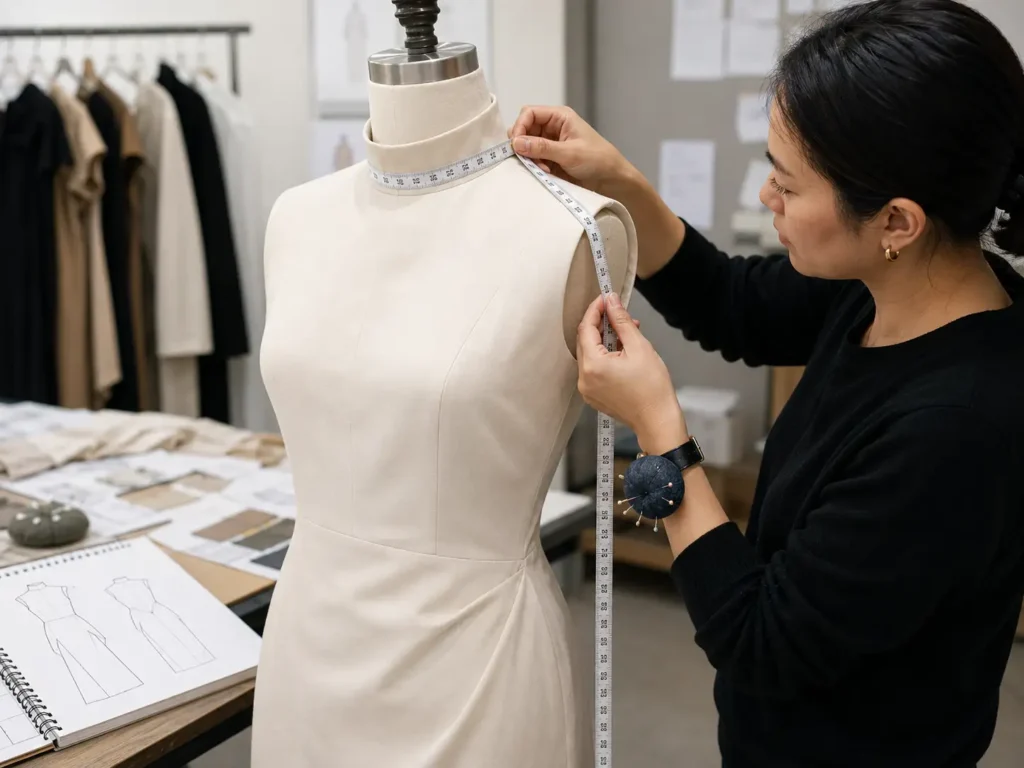
The base pattern should represent the brand’s intended customer rather than rely on a generic size name. Two brands may both sell a Medium dress while using different bust, waist, hip, shoulder, torso, and length standards. Important measurements may include full bust, upper bust, underbust, natural waist, high waist, full hip, front length, back length, shoulder width, armhole depth, strap length, neckline depth, skirt length, hem sweep, and slit height. Jumpsuits add torso length, rise, thigh, and movement requirements that must be balanced with the bodice and waist position.
These measurements interact. Adding bust width may affect the dart, armhole, side seam, front length, and waist. Increasing the hip without reshaping the waist-to-hip curve can create an abrupt line. Lowering a neckline may change coverage, facing depth, strap position, and support. Jinfeng Apparel’s verified development structure includes 7+ senior pattern makers, 2 sample rooms, and 20+ sample machinists. That combination matters because the digital file is tested by people who understand how pattern geometry behaves once satin, mesh, lace, jersey, chiffon, lining, zippers, and internal support components reach the sewing machine.
Construction Engineering
After the base shape is established, the pattern maker converts the design details into pieces that can be cut and sewn repeatedly. Dart volume may be transferred to a princess seam, neckline, waist, shoulder, or side seam while preserving the shaping needed around the bust. Pleats require enough intake to create the desired volume without changing the finished waist. Ruched sections need controlled gathering ratios and clear start and stop points. Asymmetric styles must distinguish left and right components so that one side is not accidentally mirrored during marker preparation or cutting.
Linings need their own pattern logic. A lining should support the dress without pulling the outer fabric, showing below the hem, or restricting movement. Stretch mesh may require different ease in the lining and shell. Satin may need added control around the zipper, neckline, and bias sections, while lace may require carefully planned seams or motif placement. The pattern maker must also consider sewing access, pressing, trimming, seam thickness, fabric fraying, needle behavior, and operator handling. A visually elegant seam can be unsuitable for bulk production when it is difficult to sew consistently or creates excessive thickness at a closure, cup edge, or waist join.
Pattern Approval
Pattern approval should follow defined development stages rather than depend on a file casually named final. A professional record may distinguish the first pattern, revised pattern, fit pattern, photo-sample pattern, pre-production pattern, and approved production pattern. Every revision should include the style number, sample size, date, version, responsible person, and a measurable description of the change. Useful comments state that the front neckline was lowered by 8 millimeters, the underarm coverage increased by 10 millimeters, or the lining shortened by 20 millimeters. Vague comments such as “make it fit better” cannot be reproduced or audited reliably.
Before bulk cutting, the approved pattern should agree with the PP sample, final size chart, construction sheet, bill of materials, and grade rules. A change made after PP approval should trigger a controlled review of every affected component. Lowering the neckline, for example, may alter the outer bodice, facing, lining, strap position, stabilizing tape, and finished measurement. This discipline prevents a small late adjustment from creating mismatched pieces or allowing an old pattern to reach the cutting room after a newer sample has already been approved.
How Do Digital Patterns Improve Fit and Sampling?
Digital patterns improve fit by allowing precise, traceable corrections to garment shapes, measurements, and connected seams. They help teams compare versions, correct body proportions, and transfer approved changes to related pieces. They can reduce avoidable sample rounds, but they do not eliminate physical sampling because fabric behavior, comfort, movement, workmanship, and final appearance must still be tested on an actual garment.
Fit Correction
Fit problems should be diagnosed rather than patched. A gaping neckline may result from excessive edge length, insufficient bust shaping, poor strap placement, or unsuitable fabric recovery. Trimming the neckline alone can create another issue at the armhole or bust. Bust corrections can affect darts, princess seams, cups, underbust seams, armholes, and front length. Waist changes may need to be divided across several seams, while hip corrections should maintain a smooth curve and enough mobility for sitting, walking, and putting on the garment.
Digital pattern files allow the pattern maker to measure every affected seam after a correction. If a princess panel changes, the adjoining panel must still match. If the waistband becomes smaller, the bodice and skirt attachment seams must be checked. If a neckline edge is altered, the facing, lining, and stabilizing tape may also need revision. This connected review is one of the strongest practical benefits of digital work because it reduces the chance that a visible fit correction creates a hidden construction mismatch elsewhere in the dress.
| Fit symptom | Likely causes | Pattern response | Physical confirmation |
| Neckline gapes | Excess edge length, weak bust shaping, or poor strap position | Reshape neckline, redistribute dart volume, or adjust straps | Bending, walking, and arm movement |
| Strapless dress slips | Loose upper bust, weak underbust support, or insufficient structure | Correct panel curves, support pieces, and elastic length | Extended wear and movement test |
| Side seam rotates | Front-back imbalance, incorrect grain, or fabric torque | Rebalance body widths and check grainlines | Hanging and wear test |
| Hip area pulls | Insufficient ease or uneven curve distribution | Add width and smooth the waist-to-hip transition | Sitting, walking, and stair movement |
| Maxi hem hangs unevenly | Body balance, bias growth, or incorrect length distribution | Correct front-back length and panel direction | Hanging test before final hemming |
| Zipper ripples | Unstable seam, incorrect curve, or poor reinforcement | Adjust seam shape and stabilization | Zipper sewn into the actual fabric |
| Armhole exposes too much | Armhole depth, front width, or bust relationship is incorrect | Raise or reshape the armhole and rebalance the bodice | Front, side, and raised-arm review |
Fabric Behavior
A pattern cannot be judged separately from the selected fabric. The same digital pieces can produce very different results in satin, jersey, ponte, mesh, lace, chiffon, velvet, or sequined fabric. Stretch garments need a controlled relationship between body measurements, garment measurements, and recovery. Too much negative ease can cause strain lines, transparency, rolling seams, and discomfort, while too little can make a bodycon dress appear loose. A fabric may stretch 30 percent across the width but very little along the length, which changes how pieces should be oriented and where stabilization is needed.
Drape also changes silhouette and balance. Chiffon collapses softly, organza holds volume, and heavy satin can pull a neckline downward. Bias-cut woven fabric may lengthen after hanging. Even a 2 percent length change on a 120-centimeter dress equals 2.4 centimeters, which is enough to create a visibly uneven hem. Before finalizing a pattern, the team may need to check stretch, recovery, shrinkage, weight, opacity, seam slippage, and hanging behavior. These tests do not need to be elaborate, but they should use the actual material and color intended for production whenever possible.
Fewer Sample Rounds
Digital patterns can reduce sample rounds when they prevent errors that would otherwise be discovered only after sewing. Seam lengths can be compared before cutting, missing notches can be added, linings can be checked against outer pieces, and measurements can be reviewed before another parcel is shipped internationally. The number of samples should not become the only measure of efficiency, however. A team that forces approval after one sample may simply move unresolved problems into bulk production, where correction becomes slower and more expensive.
A better approach is to make every sample answer defined questions. A first sample may confirm silhouette and construction. A fit sample may focus on bust, waist, hip, length, and movement. A revised sample should prove that earlier comments were applied. A photo sample may prioritize visual presentation, while a PP sample should represent the intended bulk materials, measurements, workmanship, trims, and finishing. Digital control helps prevent the same issue from returning in the next round. The goal is not “no sampling,” but better sampling with clear decisions and fewer repeated mistakes.
Physical Validation
Some dress characteristics cannot be fully confirmed on screen. Comfort around the neckline, pressure from boning, cup stability, zipper behavior, lining movement, skin contact, and fabric noise require a real garment. Movement testing is particularly important. A dress may look correct while the model stands still but expose the underarm when she raises her arms, restrict walking around the thigh, pull upward while sitting, or place excessive pressure on a halter neckline. A backless dress may need a different strap angle to remain stable throughout normal movement.
Physical sampling also reveals production behavior. Satin may pucker along curved seams, sequins may increase seam thickness, lace may stretch during handling, and mesh may be damaged by repeated unpicking. Pressing can change the shape of some materials, while a lining may pull differently after it is attached. The approved physical sample and the approved pattern should support each other. When the final sample is accepted, every last adjustment must be transferred into the pattern and measurement records. Otherwise, the sample may be correct while the file used for bulk production remains outdated.
How Are Dress Sizes Graded Digitally?
Digital grading creates additional sizes by applying controlled measurement changes to an approved base pattern. Grade rules move selected points horizontally, vertically, or in both directions so the bust, waist, hip, length, neckline, armhole, and style details develop consistently. Good grading preserves the design’s proportions and fit intention rather than enlarging every part by the same amount.
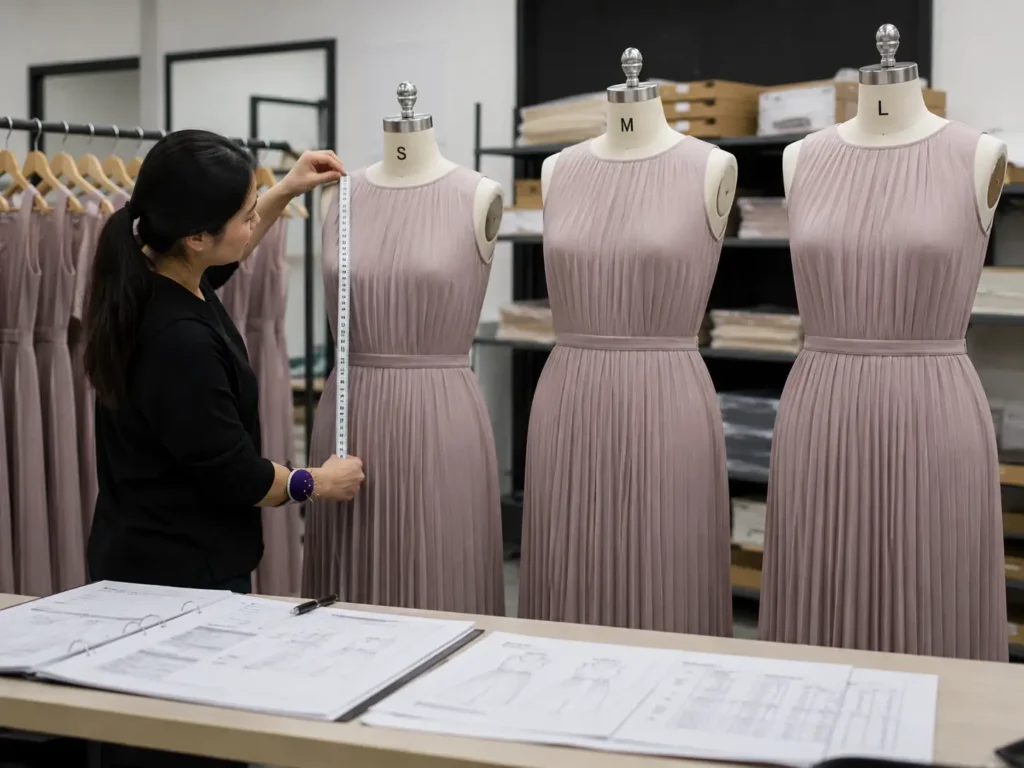
Grade Rules
Grading begins only after the base size has been approved. If the base pattern contains a fit error, digital grading will reproduce that error across the entire size range. Each grade rule defines how a pattern point moves from one size to the next. A bust point may move outward and slightly downward, the waist may increase at side seams and darts, and the hip may require a different increment from the waist. Length may change at more than one level so the waist, hip, knee, slit, and hem remain proportionally positioned.
There is no universal grade rule suitable for every brand. Increments depend on the target market, body shape, product category, fabric stretch, intended fit, and size range. A fitted party dress and a loose resort dress should not automatically use the same grading logic. Circumference increases between adjacent sizes are normally divided across several pattern edges, and the exact amount should come from the approved measurement chart. The pattern maker then checks whether those movements create realistic curves and compatible seam relationships rather than relying only on the software’s mathematical output.
Key Measurement Points
Digital grading should be reviewed through finished garment measurements, not only through the movement of pattern points. For dresses, the most important checks often include bust, waist, hip, upper bust, underbust, front length, back length, shoulder, armhole, neckline, strap position, skirt length, sweep, and slit height. Each point should be linked to a defined measurement method so that the pattern room, sample room, and quality team are measuring the garment in the same way.
Measurement tolerances also need to reflect the garment. A brand may use tighter limits around the waist, neckline, or strap position and slightly wider limits for a long, flowing hem. Tolerances such as plus or minus 0.5 to 1.0 centimeter are often used for critical fitted measurements, while longer dimensions may receive more allowance, but every project should follow the approved specification rather than a generic rule. The practical question is whether the variation changes fit, coverage, balance, or appearance, not simply whether one number falls inside an arbitrary range.
| Measurement area | What grading must preserve | Common grading risk | Practical review |
| Bust | Shape, coverage, dart position, and ease | Bust point moves too far or armhole becomes distorted | Compare pattern and finished bust measurements |
| Waist | Fit level and smooth curve distribution | Waist becomes tight while hip increases correctly | Check circumference and seam transitions |
| Hip | Mobility and balanced side seams | Side seam becomes sharp or shifts position | Review standing, sitting, and walking fit |
| Neckline | Coverage, shape, and stability | Larger sizes become too open or smaller sizes too tight | Compare neckline depth and width by size |
| Armhole | Coverage and movement | Armhole drops too much in larger sizes | Inspect depth, width, and underarm exposure |
| Strap position | Support and visual balance | Straps spread too far apart in larger sizes | Check attachment positions against bust shape |
| Skirt length | Proportion and selling length | Length increases too much or too little | Compare waist-to-hem and design proportions |
| Slit height | Coverage and mobility | Slit becomes too high in small sizes or too low in large sizes | Measure from hem and body reference points |
Complex Details
Certain dress details need more attention than a basic side-seam grade. Corset panels must maintain cup placement, underbust support, boning direction, neckline shape, and waist control. Increasing every panel by the same amount can move the cup or distort the neckline. Ruched garments must preserve gathering ratios. If the base piece becomes wider but the overlay does not increase appropriately, the visual fullness changes by size. Pleats, ruffles, cut-outs, side slits, and asymmetric panels also need individual rules rather than automatic scaling.
A cut-out that looks balanced in the sample size may become too open in a larger size if it is graded proportionally without considering coverage. A thigh slit may need its own rule to remain in a consistent body position. Stretch dresses require additional judgment because the fabric contributes to fit, and the same grade may behave differently in material with strong recovery and material that relaxes after wear. Size grading should therefore be linked to tested fabric behavior and real fit observations rather than treated as a purely mathematical exercise performed after the base pattern is complete.
Size-Set Review
A size set confirms that the approved fit develops correctly across selected sizes before full production. Depending on the order and brand standard, the review may cover every size or a strategic selection such as the smallest, base, middle, and largest sizes. The team should measure the garments using the same methods shown in the specification. Fit should be assessed on suitable models or forms where required, with attention to silhouette, neckline coverage, bust placement, waist position, hip ease, armhole shape, strap placement, garment length, slit height, and movement.
The purpose is not to make every size look identical on different bodies. It is to preserve the same design intention and an acceptable fit level across the range. When a size-set problem is found, the team should determine whether it comes from the grade rule, sewing, cutting, fabric relaxation, or measurement method. Correcting the wrong source can make the next round worse. After approval, the final grade rules and size patterns should be locked together with the production measurement chart so that later changes cannot quietly separate the files.
How Do Digital Patterns Guide Bulk Production?

Digital patterns guide bulk production by converting approved sample information into controlled cutting and sewing data. They support marker planning, material calculations, cutting accuracy, component matching, and measurement consistency. When the production pattern, grade rules, PP sample, material specification, and quality standards agree, the factory has a repeatable reference for producing multiple sizes and colors.
Marker Planning
A marker arranges graded pattern pieces within the usable width of the fabric. Its purpose is to achieve efficient material use while respecting grainlines, nap direction, print orientation, pair requirements, size ratios, and quality restrictions. Marker planning is not simply fitting shapes into empty spaces. Satin may require all panels to face the same direction because reversing them can create visible shade differences. Velvet and brushed fabrics have a nap, while printed fabric may need one-way placement, stripe matching, border positioning, or motif alignment. Lace may require mirrored placement or careful use of decorative edges.
The marker must also reflect the actual order ratio. A layout for equal quantities of XS, S, M, L, and XL will differ from one heavily weighted toward M and L. Width must be based on usable fabric width after excluding damaged edges or required margins. A small improvement can have a measurable effect. Reducing average consumption from 1.80 meters to 1.75 meters saves 50 meters across 1,000 dresses, provided the change does not compromise grain, matching, or quality. Material efficiency is useful only when product integrity remains intact and the marker still matches the approved pattern version.
Fabric Use
Digital patterns help calculate theoretical consumption, but actual purchasing needs should include more than marker length. Fabric shrinkage, shade grouping, cutting loss, print repeat, defects, panel replacement, testing, sample requirements, and supplier minimums can all affect the final order. A style with large skirt panels may leave more unusable gaps than a fitted mini dress. A directional print can increase consumption even when the pieces appear easy to arrange, while motif matching may require extra length that is not obvious from the garment measurement alone.
Fabric width must be confirmed before final consumption is accepted. A marker created for 150-centimeter fabric cannot be transferred directly to a 142-centimeter usable width. Even a small difference may force panels into another row and increase consumption. For delicate or complex dresses, the cheapest marker is not always the safest. Placing pieces too close together may increase cutting risk, lace motifs may require additional space, satin panels may need controlled orientation, and sequin fabric may require special handling around blades and seam allowances. The best marker balances cost, production practicality, and visual consistency.
Cutting Controls
Cutting accuracy affects every later operation. Sewing cannot fully correct panels that were cut off grain, stretched, mixed between sizes, or taken from an outdated pattern. Before cutting, the factory should confirm the style number, color, fabric lot, pattern version, size ratio, marker, cut quantity, grain direction, and lay plan. Fabric may need relaxation before spreading, particularly for knitted or stretch materials. Shade lots should be separated when visible differences exist, and the actual usable width should be checked against the approved marker before the full lay begins.
Cut components need clear identification. Bundles should maintain the correct size, color, ply, and garment group. Notches and internal marks must be visible enough for sewing but should not damage delicate fabric. Left and right asymmetric pieces require special attention. Satin must avoid snagging and incorrect shine direction, mesh can shift or stretch, lace may require motif matching, and sequins can damage blades or create thick seam areas if allowances are not prepared correctly. Digital accuracy is valuable, but the cutting process must preserve that accuracy in real material through disciplined handling and labeling.
Bulk Consistency
Bulk consistency comes from aligning several approved references rather than relying on one sample alone. The PP sample shows the expected appearance, construction, fabric, trims, measurements, and finishing. The final pattern defines cutting geometry. The size chart and grade rules control measurement development. The construction sheet explains sewing methods, the bill of materials identifies fabrics and trims, and quality standards define tolerances and inspection points. When any one of these references remains on an older version, the production team may follow correct instructions for the wrong product.
Jinfeng Apparel supports this handoff through its pattern, sampling, bulk-production, and quality-control structure. The company operates 6 owned women’s fashion factories, works with more than 10 long-term satellite production partners, and uses dedicated sample rooms and pattern teams to move approved styles into production. Those resources are most useful when the records are controlled. A golden sample, final pattern, graded size set, PP approval, fabric reference, and QC measurement record should all describe the same dress. That evidence chain gives production teams a practical basis for controlling neckline exposure, strap stability, hip ease, zipper appearance, hem balance, and finished measurements.
| Production control | What it should confirm | Risk if not aligned |
| Approved PP sample | Overall appearance, workmanship, fit, and finishing | Production follows an earlier sample |
| Final pattern | Cutting shapes, seam relationships, allowances, and marks | Panels do not reproduce the approved garment |
| Size chart | Finished measurements and tolerances | Sewing teams use inconsistent targets |
| Grade rules | Size-to-size development | Larger or smaller sizes lose proportion |
| Bill of materials | Approved fabric, lining, trims, and components | Substitutions change fit or appearance |
| Construction sheet | Stitching, reinforcement, pressing, and assembly | Different lines use different methods |
| Marker and cut plan | Fabric width, direction, quantity, and size ratio | Waste, shortages, or incorrectly cut pieces |
| Golden sample | Final visual and construction reference | Subjective quality decisions during production |
| QC measurement record | Actual results from inline and final checks | Problems are noticed only after packing |
How Are Digital Patterns Managed Across Teams?
Digital patterns are managed through controlled file sharing, clear revision records, approval authority, access protection, and long-term archiving. Brands, pattern makers, sample rooms, merchandisers, cutting teams, production lines, and quality inspectors must work from the same approved version. Good management reduces outdated files, repeated corrections, unauthorized access, and unnecessary redevelopment during repeat orders.
A complete production handoff should include more than a pattern attachment. The receiving team needs enough information to understand what the file represents and how it connects to the approved product. The package may contain the final pattern, graded sizes, measurement chart, grade rules, tech pack, construction notes, bill of materials, fabric specifications, trim details, PP comments, approved sample photographs, marker requirements, and packing information. File names should identify the project code, style number, size, pattern stage, version, and date rather than use vague labels such as new-final-latest.
A master file list can show which documents are active, approved, superseded, or pending. Brands should also confirm the exchange format before development begins because different systems may not preserve every annotation, layer, seam allowance, or grading rule during conversion. A test file can reveal compatibility problems before the entire collection is transferred. The most important rule is simple: every department should know where the current approved files are stored, who controls the master version, and which older files must not be used. Clear ownership prevents multiple teams from making separate corrections to separate copies of the same style.
Revisions and Approvals
Revision control works best when changes are recorded as decisions rather than scattered across emails and chat messages. Each comment should identify the garment area, requested change, measurement, reason, and affected components. Lowering a neckline may require changes to the outer bodice, lining, facing, stabilization, strap position, and measurement chart. The revision record should show that those connected pieces were reviewed. Approval authority should also be clear: a designer may approve visual shape, a technical designer may approve measurements and fit, and the factory pattern team should confirm sewability and pattern integrity.
Late changes need particular care. Once markers are made or fabric is cut, even a small revision can affect cost, schedule, and material availability. Teams should distinguish corrections required for fit or quality from optional styling changes that may be better applied to a later order. The approved production release should have a date, version, and responsible approver. Verbal confirmation alone leaves too much room for interpretation. A concise approval record may feel administrative, but it becomes extremely practical when a question arises during cutting, sewing, inspection, or repeat production several months later.
File Protection
Digital patterns may represent a brand’s unreleased collection, signature fit, commercial styling, and development investment. Access should be limited to people who need the files for sampling, costing, production, or quality control. An NDA can define how patterns, tech packs, samples, materials, labels, packaging, quantities, prices, and launch information are handled. Practical protection also requires controlled folders, permission levels, secure transfer methods, restricted sharing, and clear rules for external production partners. Legal language is useful, but daily discipline determines whether confidential information is actually protected.
Factories should not publicly display client patterns, unpublished samples, original tech packs, or brand-specific construction details without authorization. Anonymous process examples can be useful for education, but they should not expose identifiable designs or commercial information. Jinfeng Apparel supports NDA-based cooperation and protects client tech packs, samples, patterns, trims, private-label details, unpublished designs, and order information throughout development and production. That protection is not simply a sales promise. It is part of the operating standard required for brands that share upcoming collections, proprietary fit blocks, and packaging details months before public release.
Repeat Orders
Well-managed digital records make repeat orders faster and more stable, but only when the archive is complete. The factory should retain the approved pattern, grade rules, measurement chart, fabric reference, color record, trim specification, construction notes, sample comments, golden-sample information, label details, packaging method, and previous QC findings. A pattern alone cannot reproduce a dress if the original fabric stretch, lining, zipper, elastic, pressing method, or shade standard has changed. Repeat production should begin with a short verification step rather than assume that every historical material and process remains identical.
The team should confirm whether the original material is still available and whether the current batch behaves the same way. A nominally identical fabric can vary in weight, shade, stretch, recovery, or finishing. Any substitution should trigger a focused review and, when necessary, a new sample. The archived pattern should also remain connected to its production history. If the previous order required a correction during sewing or inspection, that learning must be transferred into the master file before the next order. Jinfeng Apparel retains pattern records, measurement files, fabric references, trim details, and packing requirements to support seasonal collections, replenishment, and multi-batch production.