Skip to content

A dress collection can look commercially strong on a mood board and still become expensive, late, or difficult to repeat once production begins. The problem is often not the sketch itself. It is the manufacturing route chosen before the factory has reviewed the fit, fabric behavior, construction, branding, and approval process. OEM and private label are frequently presented as two competing options, yet they describe different parts of the supply relationship and can be used together in the same collection.
OEM dress manufacturing is usually best when a brand owns the design and needs a factory to develop it accurately. Private label describes garments sold under the customer’s branding and may use an original OEM design, a manufacturer-assisted design, or an existing style. The right choice depends on control, speed, exclusivity, technical resources, MOQ, and development risk.
Consider two teams preparing a satin occasionwear launch. One arrives with graded measurements, construction drawings, approved fabric standards, and complete label files. The other arrives with campaign references, a target retail position, and a clear customer profile but no production-ready documents. Both may receive finished dresses carrying their own labels, but their pattern work, sample schedule, responsibilities, costs, and risks will be completely different. The sections below explain how those differences affect real dress development, bulk consistency, and the long-term value of the product files created along the way.
What Is OEM Dress Manufacturing?
OEM dress manufacturing means a brand provides the original product direction while the manufacturer converts it into a production-ready garment. The factory may handle patterns, fabrics, samples, fit correction, grading, bulk production, quality control, labels, packing, and delivery, while the brand normally controls the design identity, specifications, and final approvals.
OEM Development Inputs and the Risks They Control
| Development Input | Practical Detail Required | Risk Controlled |
| Technical drawing | Front, back, internal, and close-up views | Construction misinterpretation |
| Measurement chart | Points of measurement, base size, and tolerances | Fit inconsistency |
| Fabric specification | Composition, weight, stretch, finish, and color | Wrong drape or performance |
| Bill of materials | Zippers, cups, boning, lace, buttons, and labels | Missing or substituted components |
| Construction notes | Seams, lining, hems, closures, and reinforcement | Unstable bulk workmanship |
| Artwork files | Print scale, placement, repeat, and color references | Incorrect visual execution |
| Packing instructions | Folding, polybags, barcodes, and carton ratios | Warehouse and retail errors |
Design Inputs
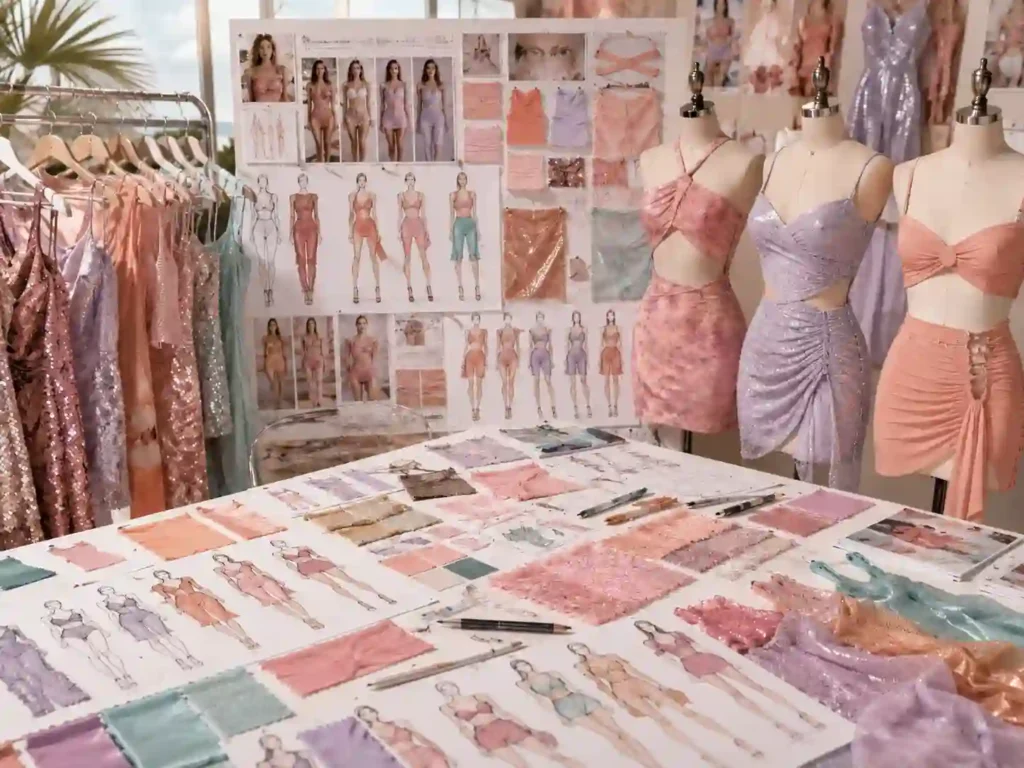
An OEM project begins with information owned, supplied, or approved by the fashion company. A mature product team may send a complete tech pack with front and back drawings, a measurement chart, a bill of materials, construction notes, color references, label files, and packing instructions. Other projects may begin with an original sample, a detailed sketch, a line sheet, a fabric swatch, or several reference images supported by clear commercial requirements.
The starting information matters because dress development contains details that a photograph cannot show. A front view does not confirm whether the neckline is stabilized, how the lining is attached, which direction the fabric should stretch, where internal support is placed, or how much ease has been allowed at the bust, waist, and hips. When these decisions are not documented, the factory has to interpret them, and each interpretation becomes another item that must be checked during sampling.
A strong technical file reduces assumptions, but it does not remove the need for professional review. Measurement points can conflict with the intended silhouette, an attractive fabric may not support the construction, and a decorative feature can create unnecessary bulk or sewing risk. Experienced manufacturers review these issues before the first sample so that the initial garment tests the right solution rather than simply reproducing an avoidable problem.
Factory Responsibilities
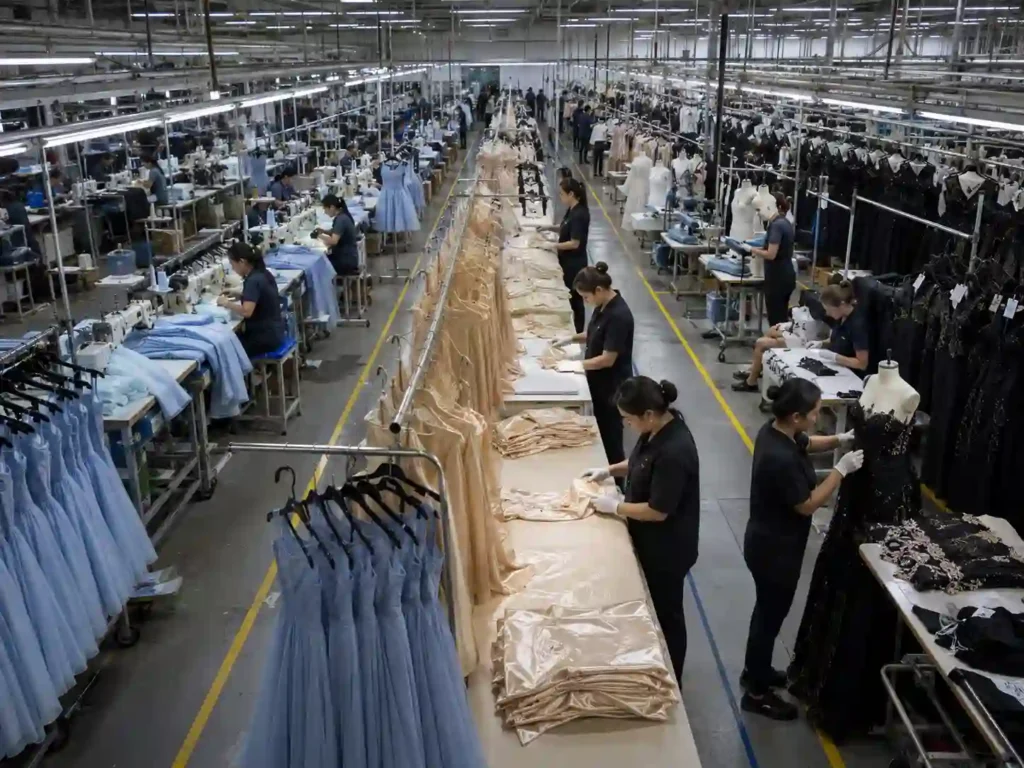
A capable OEM manufacturer does more than cut fabric and operate sewing machines. Its role is to turn the approved design direction into a repeatable production standard that can be followed across sizes, colors, sewing lines, and repeat orders. That work includes pattern development, fabric and trim sourcing, sample construction, fit correction, grading, construction documentation, pilot production, inline control, final inspection, and packing verification.
Dress manufacturing requires close attention to the relationship between fabric and pattern. A bodycon pattern developed for four-way stretch cannot be transferred directly to a fabric with limited crosswise stretch. A satin slip dress may appear simple, yet grain direction, neckline stabilization, side-seam control, lining tension, zipper behavior, and pressing methods can determine whether the finished result looks clean or inexpensive.
The factory should also challenge specifications that create predictable failures. It may recommend a stronger invisible zipper, additional reinforcement at a cut-out, a different lining stretch, reduced seam bulk at a lace intersection, or a corrected cup position in a corset bodice. These recommendations do not weaken creative control. They protect the intended design from problems that become far more difficult to correct after bulk fabric has been cut.
Best-Fit Dress Types
OEM is most valuable when a dress depends on original fit, technical structure, exclusive proportions, or carefully controlled materials. Corset dresses, structured strapless styles, bodycon silhouettes, bias-cut satin dresses, mesh panel designs, lace occasionwear, sequin party dresses, multi-layer chiffon dresses, and jumpsuits with controlled torso length usually require more development than a simple label change.
A corset dress illustrates the difference clearly. Its success depends on cup depth, boning position, neckline height, lining tension, waist reduction, zipper strength, seam allowance, and the relationship between support and comfort. These elements must be tested together. Treating the outer silhouette as the complete design often produces a sample that looks acceptable on a mannequin but fails during movement or grading.
OEM also supports brands that want a recognizable fit across several seasons. Once a base pattern and measurement logic have been approved, that foundation can be extended into different colors, fabrics, sleeves, lengths, or surface treatments. Retaining the pattern, measurement chart, material references, and construction record can make later developments faster while keeping the customer experience more consistent.
- Corset, boned, and structured strapless dresses
- Bodycon styles built around a controlled brand fit
- Satin, bias-cut, lace, mesh, and sequin dresses
- Occasionwear, eveningwear, and multi-layer chiffon styles
- Custom-printed resort dresses and fitted jumpsuits
Cost Drivers
OEM normally requires more upfront development than selecting a pre-developed garment because pattern creation, material sourcing, sample sewing, fitting, revision, grading, and production preparation all require skilled work. The lowest sample fee or unit estimate is not always the lowest commercial cost. A poorly developed dress can create returns, delays, fabric waste, rejected bulk goods, and campaign samples that do not match delivered inventory.
The main cost drivers include pattern complexity, the number of sample rounds, fabric minimums, custom dyeing or printing, branded trims, internal support, lining, lace placement, sequin handling, color quantity, size breakdown, quality requirements, and customized packaging. Costing should separate development charges from bulk pricing and clearly state whether labels, hangtags, barcodes, testing, inspection, and packing are included.
For a dependable quotation, the manufacturer needs enough information to price the actual structure rather than a visual impression. Two satin mini dresses can differ substantially in cost when one uses lightweight unlined fabric and the other requires stretch satin, full lining, cups, boning, reinforced seams, a premium zipper, and individual protective packing. Transparent assumptions make comparisons more useful than a headline unit price.
What Is Private Label Dress Manufacturing?
Private label dress manufacturing means dresses are produced and supplied under the customer’s brand identity. The product may come from an existing range, an adapted factory pattern, manufacturer-assisted development, or a fully original OEM process. Private label mainly defines how the garment is branded and delivered rather than identifying who originally designed it.
Common Private-Label Development Levels
| Level | Starting Point | Typical Changes | Likely Exclusivity |
| Label-only | Existing factory style | Labels, hangtags, and packaging | Usually limited |
| Style adaptation | Existing pattern or sample | Fabric, color, length, sleeve, or trim | Depends on agreement |
| Custom private label | Manufacturer-assisted development | Pattern correction, sourcing, and construction changes | Can be negotiated |
| OEM private label | Brand-owned design or tech pack | Full custom fit, materials, trims, and packing | Normally agreement-based |
Branding Scope
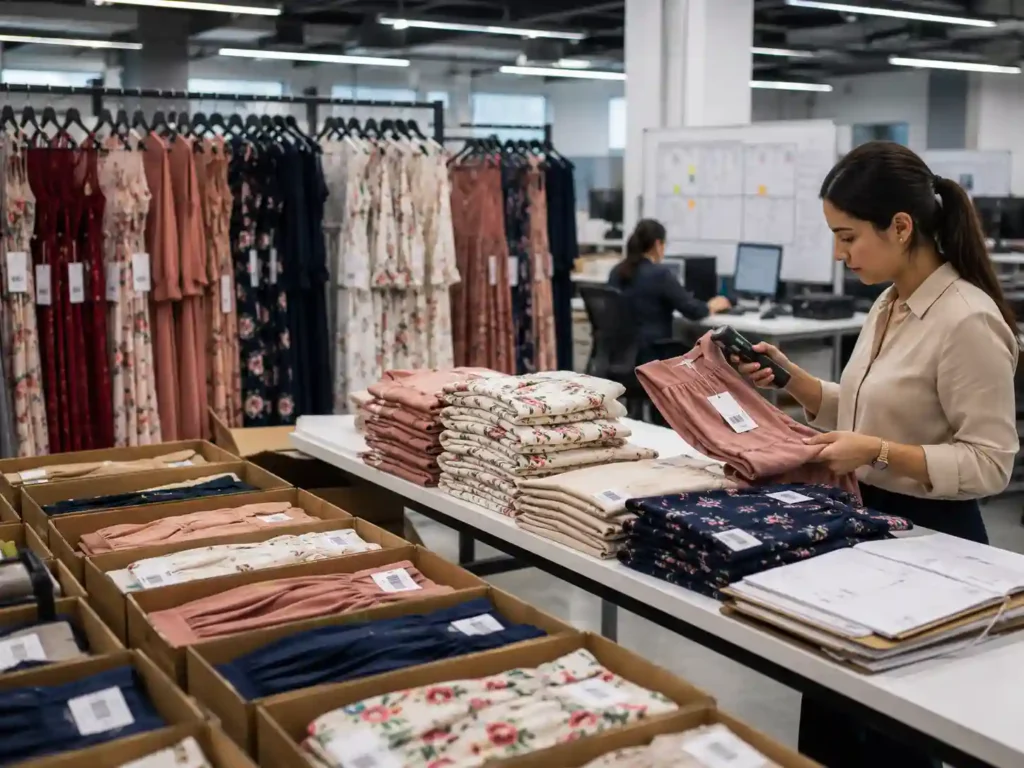
Private labeling extends well beyond sewing a name into the neckline. A retail-ready dress may require a main label, size label, fiber and care label, country-of-origin information, hangtag, barcode, SKU sticker, price ticket, polybag warning, folding method, carton assortment, and warehouse identification. Each component must match the correct style, color, size, destination, and sales channel.
These details have operational consequences. A garment can pass every sewing inspection and still become commercially unusable if the care label shows the wrong fiber content, a barcode belongs to another size, or the carton ratio does not match the warehouse booking. Private-label packing should therefore be treated as a controlled production stage rather than a decorative task completed after the garments are finished.
Brands selling into several markets may need different care-label languages, legal information, pricing stickers, or packaging warnings. Those variations should be planned before bulk production because they affect artwork approval, trim quantities, sorting, packing labor, and delivery schedules. The product file should record label positions, folding methods, sticker placement, and carton assortments so the packing team does not have to interpret scattered messages at the last minute.
- Main labels, size labels, care labels, and country-of-origin information
- Hangtags, hang strings, price tickets, barcodes, and SKU stickers
- Polybags, inserts, folding instructions, carton assortments, and shipping marks
Development Levels
Private-label production can involve very different levels of product development. Some programs use a finished factory style and change only labels and packaging. Others modify an existing pattern by changing the fabric, color, length, sleeve, neckline, or trim. More advanced projects may require new patterns, fit correction, material sourcing, and the same technical approval process used in OEM manufacturing.
A label-only program can be useful when launch speed matters more than originality because the base pattern and construction have already been tested. Style adaptation creates more distinction, but small visual changes can require substantial technical work. Converting a sleeved woven dress into an off-shoulder style may require a new bodice balance, revised armhole construction, additional support, and another fitting round rather than a simple sewing adjustment.
A fully custom private-label project may be technically identical to OEM. The customer supplies the design direction, the manufacturer develops and produces the garment, and the finished order carries the customer’s labels and packaging. In that arrangement, OEM describes the product-development relationship, while private label describes the commercial identity under which the finished dress will be sold.
Exclusivity and Ownership
Private label does not automatically mean the dress is exclusive. A garment may carry one company’s branding while using a pattern that the manufacturer offers to several customers. This is not necessarily unsuitable, especially for supporting products, but the arrangement should be understood before sampling and reflected in the commercial agreement.
Ownership questions should cover original sketches, tech packs, digital and paper patterns, graded size files, custom prints, embroidery artwork, exclusive color developments, branded molds, approved samples, and modified factory base patterns. When a factory pattern is adapted, the manufacturer may retain the original foundation while the customer controls its custom changes, or the final version may be reserved for the customer under a written agreement.
An NDA can protect unreleased designs, technical files, samples, branding materials, quantities, pricing, launch dates, and other confidential information. It should also address whether the manufacturer may photograph the product, display it in a showroom, or use it in marketing. Exclusivity can be created through the combination of fit, fabric, print, color, trims, and packaging even when the outer silhouette begins from a familiar commercial shape.
Terms That Cause Confusion
The most common misunderstanding is treating private label as the opposite of OEM. The terms describe different aspects of the same supply relationship and can apply to one project at the same time. Another common mistake is assuming that private label always means selecting a ready-made dress from a catalogue, even though some manufacturers use the term for fully customized products developed from original files.
White label generally refers to standardized products supplied to more than one customer with limited changes. Private label can also begin from a standard product, but it may include deeper adaptation or exclusive development. ODM usually indicates that the manufacturer contributes more actively to the product concept or design development. Because suppliers use these terms differently, practical questions are more reliable than service names.
Ask whether a new pattern will be created, whether measurements can follow the brand’s size chart, whether fabrics and colors can be developed, whether the same style is supplied elsewhere, who owns the final pattern, how many samples are expected, and whether labels and packing are included. Clear answers to these questions reveal the actual service far more accurately than a broad claim of offering private label.
What Does OEM vs Private Label Really Compare?
OEM versus private label is not a simple choice between opposite services. The practical comparison concerns who develops the product, how much can be customized, who owns the pattern and technical files, how branding is applied, and how cost, MOQ, timing, approvals, exclusivity, and production risk are divided between the fashion company and the manufacturer.
OEM and Private-Label Comparison for Dress Projects
| Commercial Factor | OEM Dress | Basic Private Label | Custom Private Label |
| Starting input | Tech pack, sample, or original design | Factory style selection | Reference, concept, or adapted design |
| Pattern work | New or customer-specific | Existing pattern | Modified or newly developed |
| Fit control | High | Limited | Medium to high |
| Sample rounds | Often 1-3 depending on complexity | Usually approval-focused | Often 1-3 depending on changes |
| Upfront development | Usually higher | Usually lower | Medium to high |
| Differentiation | High | Limited | Medium to high |
| MOQ drivers | Fabric, colors, trims, setup, complexity | Available materials and factory policy | Fabric, customization, and setup |
| Repeat-order value | Strong when records are retained | Strong while base product remains available | Strong with controlled files |
Design Control
OEM usually gives the customer greater direct control because the garment begins from its own technical direction. The silhouette, fit, fabric, lining, trims, internal structure, colors, and construction remain subject to customer approval even when the manufacturer recommends technical changes. Private-label control varies from basic branding to fully customized development, so the service name alone does not reveal how much can be changed.
The depth of a change matters. Selecting another color is different from replacing the fabric construction. Shortening a hem is different from rebuilding the waist and hip balance. Adding a sleeve can require a new armhole, shoulder line, sleeve head, and fit review. A quotation that treats every modification as a minor change may underestimate the pattern and sample work required.
Design control should be supported by one current measurement chart, one approved bill of materials, one set of construction notes, and one physical reference standard. When several versions circulate at the same time, teams can follow different instructions even when everyone is acting carefully. Version numbers, issue dates, and written approvals are simple controls that prevent expensive misunderstandings.
Cost, MOQ, and Timing
OEM normally requires more development time because the product has to be engineered from original information. A basic private-label program can move faster when the pattern, material, and construction have already been tested. The actual schedule still depends on the garment. A simple knit mini dress and a lined corset evening dress should not be planned with the same sampling or sewing assumptions.
MOQ is influenced by more than a factory policy. Fabric mills, dye houses, print suppliers, zipper vendors, label producers, and packaging suppliers may each impose minimums. A sewing factory may accept a production quantity that is smaller than the material minimum required for a custom color. The practical minimum should therefore be discussed per style, per color, and across the total material purchase.
Size distribution also affects efficiency. Two hundred garments divided across five sizes creates workable production groups, while the same quantity divided across five colors and five sizes creates much smaller cutting and sewing batches. The unit price may rise because material utilization, setup time, bundling, inspection, labeling, and packing are spread across more variants. A useful quotation should explain the assumptions behind these variables.
Ownership and Risk
Ownership affects long-term control. When the customer owns the design direction, measurements, and approved specifications, it can preserve a recognizable fit and carry successful products into later seasons. That control also carries responsibility because errors in the tech pack, measurement chart, or artwork can be reproduced accurately and still create a poor commercial result.
Private-label products based on manufacturer styles reduce some early development work, but future availability may be less predictable. A fabric can be discontinued, an existing pattern can be updated, or a similar product can be offered to other customers. The risk is not automatically unacceptable, but it should match the role of the product within the collection and the level of differentiation expected.
The strongest risk controls are practical records rather than broad assurances. Approved measurement charts, signed material swatches, sealed samples, revision histories, pre-production confirmation, inspection reports, and packing instructions create an evidence chain from development to shipment. They make it easier to identify whether a later difference came from the approved specification, a material change, a production error, or an unrecorded instruction.
Commercial Choice
A deeper OEM route is usually suitable when the silhouette is original, fit is central to the brand identity, the garment contains structured details, exclusive materials are required, or the product is expected to return across several seasons. A simpler private-label route can be suitable when speed is the main priority, the style supports rather than defines the collection, and an existing pattern already meets the required fit and quality.
The decision is not a judgment of quality. A well-managed private-label program can produce dependable garments, while a poorly managed OEM project can fail despite its originality. The correct route is the one that matches the product’s commercial importance, technical difficulty, internal resources, launch schedule, and acceptable level of exclusivity.
For many collections, the most useful question is not whether OEM or private label is better in general. It is which route gives each style the right balance of differentiation, development effort, speed, and repeat-order control. Classifying every SKU before quotation creates clearer pricing and prevents suppliers from costing the same design under different assumptions.
Which Model Fits Your Dress Collection?
Choose OEM when the collection relies on original silhouettes, controlled fit, complex construction, or proprietary specifications. Choose a simpler private-label route when speed and reduced development work matter more than deep differentiation. Many established fashion companies combine both, using OEM for signature dresses and adapted private-label production for supporting styles.
Internal Product Capacity
The right manufacturing model begins with an honest review of the company’s internal product capability. A team with experienced designers, garment technologists, and sourcing staff can manage detailed OEM development more efficiently than a team working mainly from campaign references. A company does not need every document to begin, but any missing technical information still has to be created by either the customer or the manufacturer.
Before approaching a factory, confirm whether the team can provide clear style drawings, a measurement chart, construction expectations, fabric direction, a target customer, size requirements, label files, packaging instructions, consolidated sample comments, and one person with final approval authority. Projects slow down when design, merchandising, marketing, and management send separate comments or reverse earlier decisions without updating the technical file.
It also helps to separate essential requirements from flexible ones. Bust fit, neckline coverage, print placement, or fabric hand feel may be non-negotiable, while zipper brand, internal seam finish, or packaging material may allow alternatives. This distinction lets the manufacturer solve sourcing or cost problems without repeatedly requesting approval for details that do not change the product’s commercial identity.
Collection Complexity
A collection containing several technical dress categories normally benefits from a structured OEM or custom-development process. Complexity comes not only from decoration but from the interaction between fabric, fit, support, and movement. Strapless necklines, built-in cups, boning, deep openings, bias-cut satin, sheer mesh, lace matching, sequin seams, heavy ruching, cut-outs, multi-layer skirts, and jumpsuit torso fitting all increase development risk.
Changes to one area can affect several others. Tightening the upper bust may alter cup position and zipper tension. Shortening a strap can change the neckline and armhole. Replacing the lining may alter stretch and fit. Moving the waist seam can change the visual proportions of the entire garment. Complex styles need enough time for physical testing rather than relying only on screen-based corrections.
Simple-looking dresses can also be demanding. A minimal satin slip dress has few details to hide twisted seams, uneven necklines, puckering, or poor pressing. A plain bodycon dress can create high return rates if fabric recovery or size grading is inconsistent. Classifying the range into lower-, medium-, and higher-risk styles helps direct development time toward products where errors would be most visible or commercially damaging.
- Strapless necklines, cups, boning, and internal support
- Bias-cut satin, sheer mesh, lace matching, and sequin seams
- Heavy ruching, cut-outs, multi-layer skirts, and floor-length hems
- Jumpsuit torso length, rise, waist placement, and hip balance
Speed Versus Originality
Fast launch schedules often encourage the use of existing patterns and available materials. This can be commercially sensible for trend-led products with short selling windows, but speed gained during development can create limitations later if fit, exclusivity, or replenishment has not been considered. Original development requires more early work but can create assets that support several seasons.
Those assets include approved base patterns, consistent fit standards, retained material references, repeatable construction methods, and clearer files for future colors or variations. Private-label adaptation can shorten the route to the first sample, yet the garment still needs to be tested against the company’s size system, expected quality level, target retail position, and customer experience.
A realistic launch calendar works backward from the required warehouse date. It allows time for sample review, material approval, pre-production confirmation, bulk sewing, inspection, packing, and transport. The fastest reliable route usually comes from reducing uncertainty through approved patterns, qualified materials, clear comments, and quick internal decisions rather than skipping controls before the product is stable.
Hybrid Model
Many mature fashion companies use more than one development route in the same collection. A hybrid model directs time and budget toward products that carry the strongest design value. A signature corset dress may use full OEM development, while a supporting skirt uses a modified factory pattern and the entire collection shares one private-label packaging system.
This approach recognizes that not every SKU needs the same level of originality. Hero products attract attention and define the visual identity of the launch. Supporting products complete outfits, provide more accessible price points, or increase basket value. Concentrating technical resources on the highest-impact styles can improve both differentiation and delivery control.
Every style should be classified before quotation as fully original, based on an approved customer pattern, adapted from a manufacturer structure, or label-only. Without this classification, one supplier may include new pattern development while another assumes an existing fit. Clear classification also helps the factory allocate complex garments to specialist teams and route repeat or simpler products through more standardized production lines.
How Does Each Model Move to Bulk Production?
Both OEM and private-label dresses should pass through documented design review, material confirmation, sampling, approval, bulk production, inspection, and packing. The number of development steps may differ, but neither model should move directly from an image or quotation into bulk cutting without confirmed fabric, measurements, construction, trims, labels, packaging, and an approved production standard.
Bulk Production Control Points
| Production Stage | Main Control | Useful Evidence |
| Material receipt | Fabric type, color, width, defects, and shrinkage | Inspection record and approved swatch |
| Shade control | Roll-to-roll and panel color consistency | Shade band or roll grouping |
| Cutting | Grain direction, print placement, and component accuracy | Cutting check and marker review |
| Sewing start | Construction method and machine setup | Pilot pieces or line sample |
| Inline inspection | Workmanship, measurements, and recurring defects | Inline report and corrective action |
| Finishing | Pressing, thread trimming, appearance, and cleanliness | Finished-garment check |
| Final inspection | Quantity, measurements, workmanship, and packing | Inspection report |
| Packing | Labels, barcodes, size ratios, and carton marks | Packing audit and carton record |
Development and Costing
Development begins when the manufacturer receives enough information to understand the product and commercial requirements. A reference image alone is rarely sufficient for dependable costing because unseen details can substantially change materials, labor, and risk. A useful inquiry includes a tech pack, sketch, sample, or clear references together with quantity, colors, size range, fabric direction, target market, branding requirements, and required delivery date.
The manufacturer then reviews the style for pattern requirements, construction difficulty, material availability, sewing methods, inspection needs, and capacity. Questions at this stage are a positive sign. They show that the quotation is being built around the real garment rather than a superficial visual estimate. The factory may need to confirm whether a mesh section is lined, whether satin is stretch or non-stretch, or whether a corset requires cups and boning.
The quotation should state its assumptions, including proposed fabric, lining, zipper, sample fee, expected MOQ, estimated production window, packaging scope, and price validity. Special treatments, custom dyeing, printing, testing, branded components, and freight should be separated when they materially affect the total commitment. A preliminary estimate can help screen options, but final bulk pricing should follow confirmation of materials and construction.
Samples and Approval
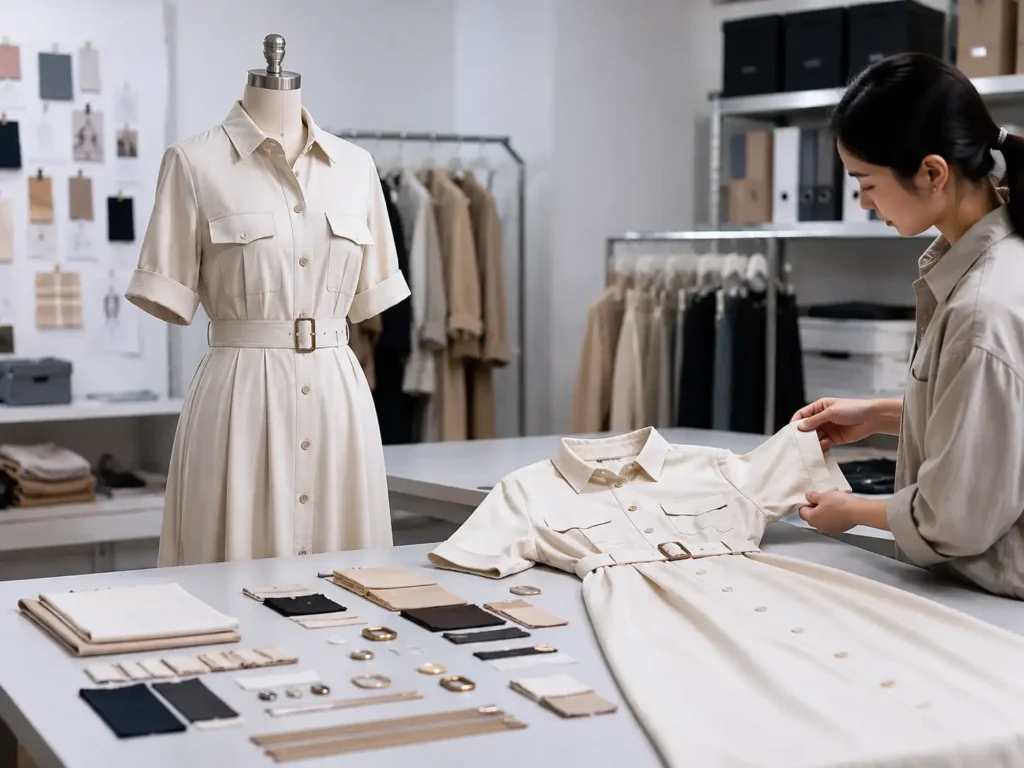
Sampling converts assumptions into a physical garment. The first sample tests whether the pattern, material, construction, fit, and overall appearance reflect the intended product. It is not always expected to be ready for production, especially when the design contains support structures, complex draping, several fabric types, or a fit that has not previously been tested.
Comments should be specific and measurable. A note such as “make the waist fit better” gives the sample team little direction, while “reduce the waist circumference by two centimeters, raise the front neckline by one centimeter, shorten the straps by 1.5 centimeters, and remove excess fabric at the back armhole” creates a clear revision. Photographs with marked locations can support the written measurements.
A development sequence may include a first sample, fit sample, revised sample, photo-ready sample, pre-production sample, and sealed reference. Not every style needs every stage. A straightforward private-label dress may require an approval sample and PP confirmation, while a structured OEM style may need several rounds. Bulk cutting should wait until the approved fabric, color, measurements, trims, construction, labels, and finishing are recorded in one current file.
Bulk Controls
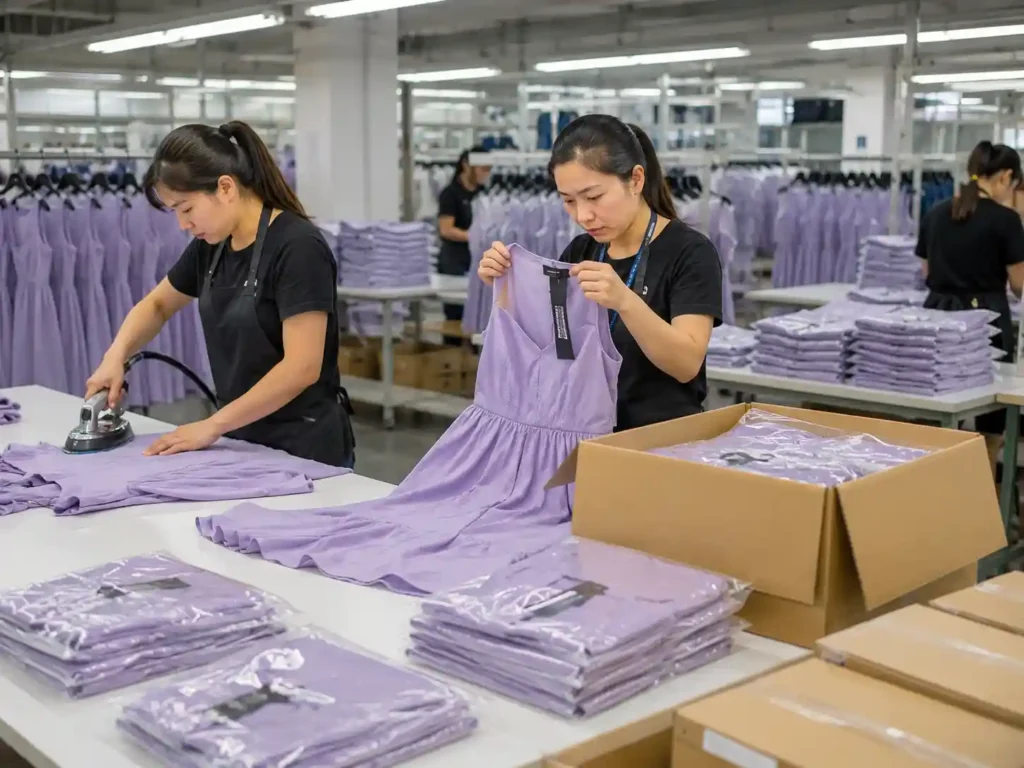
Bulk quality cannot be created by final inspection alone. It must be controlled from incoming materials through cutting, sewing, finishing, and packing. Fabric inspection should review width, defects, color, shrinkage, and shade differences. Cutting checks should confirm grain direction, print placement, and component accuracy. Sewing controls should identify recurring defects early enough to correct the line before they spread across the order.
Dress-specific controls depend on the material and structure. Satin requires attention to snagging, shine marks, seam puckering, and grain direction. Mesh requires checks for holes, stretch distortion, and lining alignment. Sequins need protection against shedding, scratching, and bulky seams. Bodycon styles need measurement and recovery control because small differences can change fit across the entire size range.
Measurement tolerances should be agreed by point of measurement and fabric type. A fixed woven bodice may need tighter control than a highly elastic skirt section. Some customers use an agreed AQL plan for final random inspection, separating critical, major, and minor defects. The inspection level should be written into the quality agreement rather than assumed, and higher-risk styles may require additional measurement or feature checks.
Labeling and Packing
Private-label materials should be approved before bulk finishing begins because labels, barcodes, hangtags, and custom packaging have their own production times and minimum quantities. The product file should confirm artwork, label positions, fiber content, care instructions, country-of-origin information, barcode data, SKU codes, folding, polybag size, carton quantity, and shipping marks.
Barcode control deserves particular attention. Codes should be checked against style, color, and size records before application. A barcode mistake may not be visible during a garment workmanship inspection, yet it can prevent warehouse receiving, inventory allocation, or retail sales. Mixed-size cartons should be verified against the approved assortment before sealing.
Packing must also protect the material and structure. Sequins may require tissue or protective layers. Satin should be folded to limit pressure marks. Structured bodices may need support so that cups and boning are not crushed during storage and transport. Packing is part of product quality because it determines whether the dress arrives in the same condition as the approved reference.
How Do You Choose the Right Dress Manufacturer?
Choose a dress manufacturer by examining relevant product experience, pattern and sampling capability, material knowledge, capacity, quality records, communication discipline, design protection, and repeat-order support. A reliable supplier should explain how the garment will be developed and controlled rather than relying only on a low price, a short lead time, or a broad claim that every style is possible.
Technical Capability
The first question is whether the manufacturer regularly handles the type of dresses in the planned collection. General garment experience does not automatically translate into strong results with occasionwear, fitted party dresses, satin, lace, mesh, sequins, or structured bodices. Ask for evidence involving similar silhouettes, comparable fabrics, lining methods, support structures, invisible zippers, lace placement, stretch patterns, grading, and sample correction.
A supplier may sew an attractive sample and still struggle to repeat it across several sizes or hundreds of garments. The development team should explain how the approved sample becomes a controlled production standard, including patterns, graded sizes, construction methods, measurement points, and inspection priorities. Strong dress development teams understand bust shaping, waist placement, hip ease, garment balance, neckline stability, and the relationship between fabric stretch and pattern dimensions.
Communication during the technical review is often an early indicator of capability. Manufacturers that ask specific, relevant questions are usually better prepared than those that confirm every request immediately without discussing fabric, fit, cost, or production risk. A professional factory should be comfortable explaining what it can produce reliably, which areas require testing, and where a design change could improve repeatability.
Capacity and Quality Evidence
Capacity should be evaluated in relation to product complexity rather than only as a monthly number. A factory capable of producing large quantities of simple knit dresses may have limited availability for corset structures, sequin work, lace matching, or multi-layer occasionwear. Ask which sewing lines and technical teams will handle the specific fabric and construction, how many styles can run at once, and how peak-season demand is managed.
Quality evidence should show control at several stages. Useful records include fabric inspection reports, shade grouping, cutting checks, inline reports, measurement records, final inspection results, and packing audits. A final report alone cannot show whether recurring defects were identified early enough to protect the order. Anonymized documents can demonstrate the system without disclosing another customer’s confidential information.
Experienced teams do not claim that defects never occur. They explain how problems are detected, contained, corrected, recorded, and prevented from spreading. That response is more credible than a guarantee of perfect production. It also shows whether the supplier has a practical corrective-action process or depends on final sorting after the order is already complete.
Commercial Fit
The right manufacturer must fit the collection’s order structure, development style, price level, and launch rhythm. A technically capable supplier may still be unsuitable if its MOQ, material network, scheduling model, or communication process does not match the business. Confirm the MOQ per style and color, material minimums, sample charges, expected revisions, payment terms, production window, packing responsibilities, inspection arrangements, freight terms, and repeat-order process.
MOQ should be discussed alongside the full collection plan. Jinfeng Apparel’s standard custom production starts from 200 pieces per style and color, subject to fabric availability, color development, trims, construction complexity, packaging, and production schedule. That quantity can work efficiently for a focused collection, but a range divided across many colors and narrow size groups creates a different production structure and should be costed accordingly.
Price comparisons should use the same specification. One quotation may include lining, pattern work, custom labels, barcode application, inspection, and branded packing, while another assumes a simpler garment with standard packaging. A lower figure is not meaningful when the scope is different. Long-term value also depends on whether the supplier retains approved patterns, measurements, fabric references, trim records, and packing instructions for repeat production.
Questions Before Quotation
A useful quotation request provides enough information for the manufacturer to assess the style accurately. Send the design file or reference, planned quantity, color plan, size range, fabric direction, target market, branding requirements, and required delivery date. Ask whether a new pattern is required, which material is recommended, what minimums apply, which details create the greatest risk, and how many sample rounds are likely.
The request should also clarify what the sample charge includes, what is excluded from the garment price, which inspection checkpoints will be used, how labels and packaging are controlled, whether the pattern and specifications will be retained, how repeat orders are handled, and whether NDA-based cooperation is available. Clear answers make it easier to compare manufacturers on the same commercial and technical basis.
For fashion companies evaluating Guangdong production, Jinfeng Apparel supports OEM, ODM, and private-label womenswear from technical review and fabric sourcing through pattern development, sampling, bulk production, inspection, branded packing, and export coordination. Its documented production system includes six owned women’s fashion factories, more than ten long-term satellite partners, 18+ sewing lines, two sample rooms, 20+ sample machinists, seven or more senior pattern makers, 15+ quality inspectors, and capacity exceeding 100,000 garments per month depending on product complexity and scheduling.
- Is a new pattern required, and who will own the final files?
- Which fabric, trim, or packaging minimums will affect the order?
- How many sample rounds are likely for this structure?
- Which checkpoints, reports, and approval records will be used?
- How are repeat orders, pattern retention, and NDA protection handled?