Skip to content

The lowest quotation often feels like the safest commercial choice because it is easy to measure and easy to defend. The trouble is that a dress is not a commodity with one fixed specification. Its final cost is shaped by fabric width and stability, pattern accuracy, lining, internal support, sewing difficulty, grading, quality control, packing, and the ability to meet a selling calendar. Two factories can quote the same reference image while quietly pricing two different garments. One may assume a lighter satin, simpler seams, generic trims, basic packing, and limited inspection. The other may include the construction and controls needed to produce a retail-ready dress that performs consistently across sizes and repeat orders.
Compare dress manufacturers by first standardizing the product specification, then measuring total landed cost, sample accuracy, bulk repeatability, category expertise, available capacity, quality controls, delivery planning, communication, compliance, and repeat-order support. The best supplier is the one that protects margin, launch timing, and brand reputation across the full order cycle.
A sourcing team once saved a little over one dollar per unit on a satin corset dress, only to spend far more on zipper repairs, re-pressing, and airfreight after the original shipment missed its campaign date. Nothing in the opening quotation looked alarming. The real difference was hidden in what the cheaper factory had not priced, documented, or controlled. That is the comparison this article is designed to make visible.
What Does the Unit Price Include?
A useful unit-price comparison begins with one shared product specification. Confirm that every quotation covers the same fabric, lining, trims, construction, measurements, size range, labels, packaging, inspection, quantity split, payment terms, and Incoterm. A lower figure is not a saving when it reflects a lighter material, simplified workmanship, incomplete packing, or unpriced quality controls.
Are All Quotes Based on the Same Specification?
A reference photograph is rarely detailed enough for a fair quotation. It may communicate silhouette and styling, but it does not define fabric composition, weight, stretch, lining, zipper grade, seam construction, internal support, measurement tolerances, label requirements, or packing. One factory may assume an unlined polyester dress with routine overlock finishing, while another prices stretch satin, full lining, cups, boning, clean-finished openings, branded labels, barcode packing, and final inspection. Those prices should not be placed in the same column without adjustment.
The safest approach is to issue one quotation package with a style number, revision date, annotated design, base-size measurements, size range, fabric and lining specifications, trim details, order quantity by color and size, workmanship notes, and delivery basis. When a detail is unknown, ask each factory to record its assumption instead of silently selecting a convenient option. The assumptions page often tells you more about technical maturity than the final number, because experienced teams make uncertainty visible before it reaches sampling or production.
Price validity also matters. Fabric markets, dyeing availability, freight, and exchange conditions can move between an early estimate and a confirmed order. A quotation should state its validity period, payment structure, sample charges, mold or development fees, and what triggers a requote. If one supplier offers a fixed price without confirming material, color, quantity, or construction, treat it as a preliminary figure rather than a reliable production cost.
| Costing Item | Quote Must Confirm | Common Price Difference |
| Main fabric | Composition, weight, width, finish, stretch | Lighter or lower-grade substitute |
| Lining | Full, partial, stretch, non-stretch | Excluded or simplified lining |
| Construction | Seams, cups, boning, fusing, gathering | Labor-intensive operations omitted |
| Trims | Zipper, elastic, hooks, hardware | Generic trims instead of approved grade |
| Size range | Base size, grade rules, extended sizes | Pattern and consumption changes |
| Packaging | Labels, hangtags, polybags, barcodes | Garment-only versus retail-ready |
| Inspection | Inline, final, third-party responsibility | Inspection excluded or separately charged |
| Trade term | EXW, FOB, CIF, DAP, or DDP scope | Different freight and risk coverage |
Which Fabric Factors Change the Price?
Fabric should be compared by usable garment cost, not just price per meter. Width, usable width, shrinkage, roll defects, directional cutting, pattern placement, shade consistency, and marker efficiency all change the amount consumed by each dress. A slightly more expensive fabric can produce a lower garment cost when it cuts efficiently, arrives consistently, and needs fewer recuts. The opposite is also common: a cheap narrow fabric creates waste that is invisible in the quoted meter price.
Material behavior affects construction as well as consumption. Satin requires attention to surface shine, snagging, pressing marks, seam puckering, and color variation. Mesh needs controlled stretch direction, recovery, transparency, lining, and protection from small holes. Lace may require motif placement, scalloped-edge planning, manual trimming, or matching. Sequin fabrics increase cutting waste, needle breakage, seam bulk, skin-comfort work, and protective packing. Each of these points adds labor or risk even when the visual design appears simple.
Stock status and minimums should be checked before the quotation is treated as final. A garment order may meet the sewing factory’s minimum while failing to meet the mill’s custom-dye, print, lace, or special-finish minimum. Confirm whether the quote uses stock fabric, a custom color, a custom print, or a temporary sampling substitute. Also ask whether bulk fabric must be approved through lab dips, strike-offs, hand-feel swatches, shrinkage testing, or shade-band review, because those steps affect both cost and calendar.
How Does Dress Construction Affect Cost?
Construction can create a larger price difference than the visible design suggests. A corset dress may include cups, boning channels, fusing, lining, reinforcement tape, shaped panels, and controlled top-edge tension. A bias-cut satin dress may require careful spreading, one-direction cutting, hanging time, delicate sewing, and hem balancing. A mesh style with measured ruching may look minimal in a photograph but demand repeated handling and careful symmetry. Removing one or two hidden operations can lower the quote while changing fit, support, comfort, or durability.
Ask the factory to identify the major cost-driving operations. Useful questions cover whether the garment is fully or partially lined, whether seams are overlocked, bound, enclosed, or clean finished, whether cups and boning are included, and whether gathers are controlled by measurement or by visual judgment. Print matching, lace placement, multiple skirt layers, deep necklines, cut-outs, hand-applied trims, narrow rolled hems, invisible zippers, and sequin restoration at seams all increase standard minutes and therefore affect production capacity.
Pattern shape also influences fabric yield. A simple A-line dress can often be arranged efficiently in a marker, while an asymmetric one-shoulder style in directional satin may create substantial unused areas. When one quotation is significantly lower, request a structured explanation of fabric, lining, internal construction, seam finish, and packing assumptions. The purpose is not to obtain every factory labor rate; it is to confirm that the lower figure still represents the product your customer will receive.
Do Packaging and Testing Appear in the Quote?
A sewn garment and a retail-ready garment are not the same commercial unit. After sewing, dresses may need thread trimming, pressing, measurement checks, metal detection where required, folding, labels, hangtags, barcode stickers, polybags, tissue, protective inserts, assortment packing, carton marks, and warehouse labels. One quotation may include these items while another covers only the finished garment. The difference becomes significant when hundreds or thousands of units require destination-specific presentation.
Testing should be separated from general marketing claims. Depending on product and destination, a program may require fiber-content verification, colorfastness, dimensional stability, restricted-substance documentation, flammability testing, needle or metal controls, or third-party inspection. The cost depends on the number of materials, colors, test items, laboratories, and markets involved. Confirm whether testing is included, optional, paid directly by the brand, or still to be quoted after the final fabric is selected.
Certification scope needs the same discipline. A document may apply to a fabric mill, a production site, a management system, or one specific material. It should not be treated as proof for every product without checking the holder, validity date, scope, and link to the actual order. A transparent manufacturer will distinguish verified documents from services that depend on the client’s test plan, nominated laboratory, and destination requirements. That distinction is more credible than promising that every certificate automatically applies.
Which Costs Exist Beyond the Factory Price?
Costs beyond the factory price include product development, inspection, freight, insurance, duties, customs clearance, warehousing, defects, repairs, replacements, delays, emergency transport, returns, and internal management time. Compare total landed cost and cost per usable garment, because a slightly higher factory quotation can deliver a lower commercial cost when quality and timing are controlled.
What Is the Total Landed Cost?
Total landed cost is the complete expense required to move a finished dress from production to the point where it can be stored, distributed, or sold. The garment price is only the starting line. A realistic calculation may include private labels, packaging, sampling, laboratory work, third-party inspection, inland transport, export handling, freight, insurance, duties, customs brokerage, port charges, destination delivery, and warehouse receiving. Comparing only the factory price leaves several predictable cost layers outside the decision.
Incoterms change what is included and when risk transfers. EXW usually places more transport and export responsibility on the client than FOB. CIF covers defined freight and insurance to a named port but normally does not include import clearance or final delivery. DAP and DDP can include more destination services, yet the exact tax treatment, importer role, delivery access, and exclusions still need written confirmation. A low price under one term should never be compared directly with a higher price under another.
Use one landed-cost worksheet for every shortlisted factory, even when some values are estimates. The process forces the team to expose missing information and prevents small charges from being ignored because they sit in different budgets. Add a risk allowance when a supplier has uncertain packing, documentation, or quality performance. That figure does not need to be perfect. Its purpose is to acknowledge that poor execution has a financial probability rather than treating every risk as free.
| Illustrative Cost Layer for 2,000 Dresses | Supplier A | Supplier B |
| Factory price per dress | $17.20 | $18.10 |
| Packaging per dress | $0.45 | Included |
| Inspection allocation | $0.18 | $0.12 |
| Freight and insurance | $1.35 | $1.20 |
| Duty and clearance | $2.10 | $2.18 |
| Estimated repair and defect cost | $0.70 | $0.20 |
| Estimated cost per usable dress | $21.98 | $21.80 |
How Do Defects Increase the Real Cost?
A defective dress costs more than its invoice value because it may need sorting, repair, re-pressing, relabeling, repacking, replacement, refund, or markdown. If the problem reaches the end customer, the brand may also pay return freight, payment fees, customer-service time, and the long-term cost of weak product reviews. Fit defects are especially expensive because they can affect an entire size run and are harder to correct than loose threads or removable stains.
Cost per usable garment is a more revealing measure than invoice price divided by ordered quantity. Suppose 2,000 dresses are purchased at $18 each. If 100 require repair and 40 cannot be sold, the invoice remains $36,000, but only 1,960 units are commercially usable before repair costs. The effective product cost has already risen to about $18.37 per usable unit. Once repair labor, replacement freight, warehouse handling, and lost selling time are included, the gap can widen quickly.
High-impact dress defects often include bust, waist, or hip measurements outside tolerance, unstable necklines, uneven straps, zipper rippling on satin, twisting lining, inconsistent ruching, incorrect slit height, mesh holes, lace mismatch, sequin loss, and wrong size or barcode labels. The useful evaluation question is not simply whether a factory performs inspection. Ask which defects are checked, at which stage, against what standard, and how failed units are repaired and rechecked before packing.
How Do Delays Affect Profit?
A delayed fashion order can lose value even when every garment is physically acceptable. Occasion dresses, graduation styles, holiday collections, and resortwear often depend on narrow selling windows. A shipment that arrives after the campaign, event, or retailer delivery date may require discounting before the product has enjoyed a full-price sales period. The margin impact can be larger than the original unit-price saving that influenced the factory choice.
Delay costs may include emergency airfreight instead of planned sea freight, cancelled photography, missed influencer content, retailer penalties, split-shipment handling, overtime, expedited materials, extra warehouse receiving, cancelled customer orders, and excess inventory after demand falls. These expenses are rarely visible in the first quotation, yet they are common enough to deserve a line in supplier evaluation. A factory with a credible schedule may be more valuable than one offering a short promise unsupported by material and capacity planning.
Request a timeline that separates material approval, sourcing, sample rounds, pre-production approval, production booking, cutting, sewing, finishing, inspection, packing, and transit. Regular samples using available materials often fall within roughly 7 to 15 days, while complex corsetry, lace placement, custom trims, or difficult fabrics may require 15 to 25 days or longer. Bulk production is commonly planned around 25 to 45 days after approvals and material readiness, but the actual schedule must reflect style complexity, quantity, and peak-season loading.
Which Internal Costs Are Often Missed?
Internal management time is a real sourcing cost even though it never appears on the factory invoice. A low-priced supplier can consume many additional hours from design, product development, sourcing, quality, logistics, and finance teams. Repeating technical comments, correcting incomplete quotations, chasing material updates, rebuilding measurement files, and resolving packing mistakes all reduce the apparent saving. The effect becomes larger when several styles and seasons are managed at once.
Track the number of hours spent following each supplier and the number of decisions that need to be reopened. A dependable partner should reduce uncertainty by showing completed milestones, current status, open approvals, risks, responsible people, and next dates. Technical communication should explain what is possible, what is risky, which alternatives exist, and how each option affects quality, cost, or lead time. Fast replies are useful, but a rapid “no problem” is not valuable when it hides unresolved production questions.
Repeat-order efficiency is another hidden cost. When approved patterns, measurements, fabric references, trim details, packing instructions, and inspection standards are preserved, the next order can start from a stable base. When records are weak, teams spend time reconstructing old decisions and risk introducing new variation. A supplier that stores and retrieves accurate order history may justify a modest price premium through lower administrative work and faster replenishment.
How Do You Compare Sample and Bulk Quality?
Compare sample and bulk quality through technical interpretation, material accuracy, fit, grading, construction, documentation, and repeatability. A strong sample has limited value unless the approved fabric, measurements, trims, sewing methods, workmanship, and packaging can be transferred into bulk production and controlled across every color, size, production line, and shipment.
Can the Factory Interpret Your Tech Pack?
A tech pack should be reviewed rather than merely acknowledged. Experienced pattern and production teams look for missing information, conflicting measurements, unsuitable materials, construction risks, and details that may be difficult to repeat in volume. The quality of questions asked before sampling often predicts the quality of decisions made during production. A team that identifies risks early can prevent repeated samples, fabric waste, and late changes.
A useful technical review may discover that the chosen fabric lacks recovery for the intended bodycon fit, that a non-stretch lining restricts a stretch outer shell, or that the zipper opening is too short for dressing. It may question whether a neckline can support the requested cup structure, whether slit height remains appropriate across larger sizes, or whether a light satin can carry heavy ruching without distortion. These questions are not resistance; they are product engineering.
Category knowledge should be visible in plain-language explanations. For a corset dress, the team should discuss cup placement, boning, top-edge stability, lining, and closure reinforcement. For a bias-cut slip dress, it should consider fabric direction, seam growth, hanging time, and hem balance. For a ruched mesh style, it should address stretch recovery, lining, transparency, and measured gather distribution. Practical detail is stronger evidence than a broad statement that every style is possible.
Which Samples Should You Review?
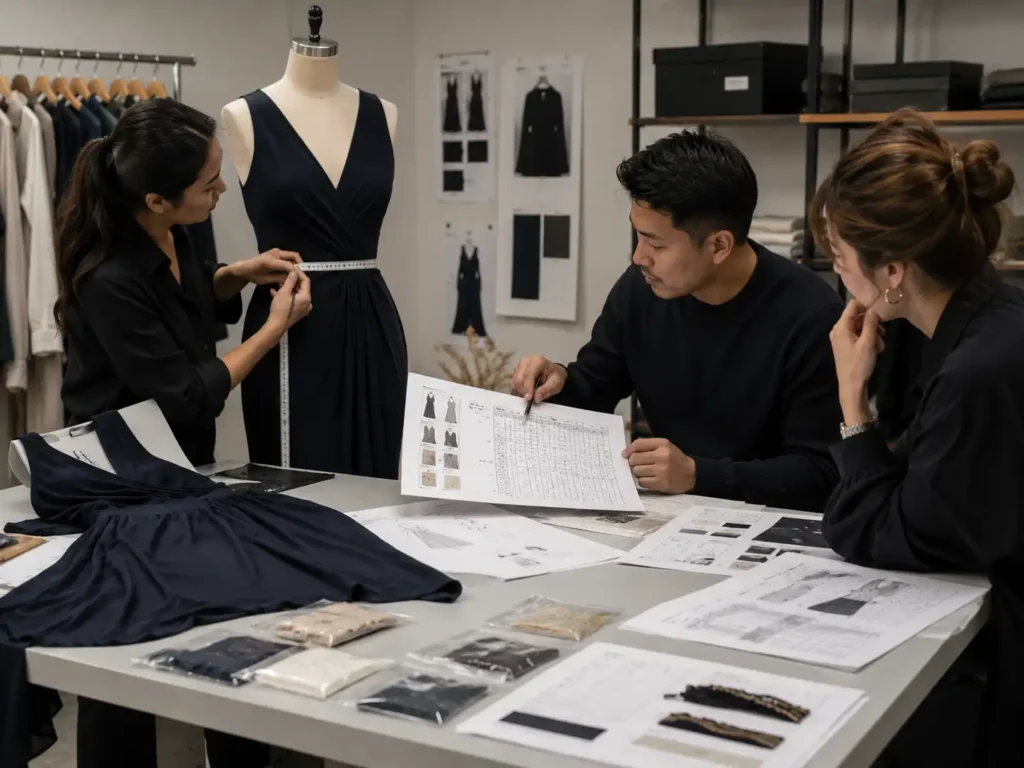
Different samples answer different questions, and confusing their purpose creates approval gaps. A first sample tests the factory’s interpretation of silhouette and construction. A fit sample focuses on measurements, balance, and movement. A revised sample checks whether comments were executed. Photo or salesman samples support commercial presentation, while the pre-production sample should bring final fabric, trims, construction, measurements, labels, and finishing together before bulk cutting.
The first sample should not be judged as though it were already the final production standard. Its value lies in exposing structural questions and establishing a shared direction. Fit reviews should be completed on an appropriate model or form, not only on a flat table. Revised samples should be checked against a numbered comment sheet so that completed changes, rejected changes, and outstanding decisions remain visible. This prevents the same issue from being discussed through several disconnected message threads.
The PP sample is the critical bridge into production. It should represent the intended bulk materials and workmanship as closely as possible. Once approved, a Golden Sample can be sealed with the final tech pack, measurement chart, BOM, sewing instructions, and packing standard. The sample itself is useful, but the combined reference system is what allows production workers and inspectors to judge bulk garments consistently.
| Sample Stage | Main Purpose | Approval Focus |
| First sample | Interpret design and construction | Silhouette, structure, general direction |
| Fit sample | Review measurements and balance | Bust, waist, hip, length, movement |
| Revised sample | Confirm requested changes | Comment-by-comment execution |
| Photo sample | Support campaign content | Appearance, color, drape, camera readiness |
| Salesman sample | Support range presentation | Commercial appearance and consistency |
| PP sample | Final pre-production approval | Fabric, trims, construction, labels, measurements |
| Golden Sample | Control production and inspection | Sealed reference for bulk consistency |
Is the Fit Consistent Across Sizes?
A successful base-size sample does not prove that the complete size range will fit correctly. Grading affects bust, waist, hip, shoulder, armhole, neckline, strap length, dress length, slit position, lining, and internal support. Some measurements can follow a regular grade rule, while others require controlled adjustments so the garment remains wearable and visually balanced. This is especially important for fitted dresses, corsetry, cut-outs, and deep necklines.
Many apparel programs use tolerances somewhere around plus or minus 0.5 cm to 1.5 cm, depending on the point of measurement, fabric behavior, garment type, and brand standard. A fitted bust or waist may need tighter control than a loose skirt opening. The exact tolerance should be defined by style rather than copied from one generic chart. The inspection method should also state whether the garment is measured relaxed, stretched, fastened, or after conditioning.
Review the base size, grade increments, points of measurement, stretch assumptions, length grading, strap rules, neckline depth, lining dimensions, slit height, and extended-size construction before bulk production. Corset cups, boning positions, and support may need structural adjustment rather than simple enlargement. Where risk is high, request a size set or at least samples from the lower and upper ends of the range. The extra development cost is usually lower than correcting a size-wide fit problem after production.
Can the Sample Be Repeated in Bulk?
Sample making and bulk production are related but different capabilities. A sample machinist can spend several hours perfecting one dress. Bulk production must repeat the result through different operators, bundles, sizes, colors, fabric rolls, and production days. The factory should be able to show how an approved garment becomes a repeatable production standard, rather than relying on the memory of one sample worker or merchandiser.
A practical production handover normally includes the approved PP and Golden Sample, final patterns, graded sizes, measurement tolerances, approved fabric and trim references, BOM, sewing instructions, critical quality points, quantity breakdown, label files, packing instructions, and escalation rules. First-piece approval should check the earliest production garments before the line continues. Inline inspection should then focus on high-risk operations while correction is still possible and before hundreds of units carry the same error.
Substitution control is essential. The fabric, lining, zipper, elastic, fusing, cups, boning, and support materials used in the approved sample should be documented for bulk. Even a small change in lining stretch, zipper stiffness, elastic recovery, or fusing weight can alter fit and appearance. The strongest evidence is not a promise that bulk will look the same. It is a system showing how every approved detail is recorded, distributed, checked, and corrected.
How Do You Evaluate Production Reliability?
Production reliability depends on category expertise, available capacity, skilled labor, material control, realistic scheduling, documented quality checks, and clear responsibility. Factory size alone is not enough. The right manufacturer must have the appropriate pattern, sewing, inspection, finishing, and planning capabilities for the exact fabrics, structures, quantities, size ranges, and delivery dates in your dress program.
Is the Factory Right for Your Dress Category?
A factory can be excellent in one apparel category and weak in another. Basic knitwear, woven resort dresses, stretch bodycon styles, structured occasionwear, and embellished party dresses require different pattern knowledge, machines, operator skills, finishing methods, and quality checks. Similar appearance in a portfolio is not enough. The relevant question is whether the factory has repeatedly produced the same type of fabric and construction under commercial quantities.
Satin programs need control over shine direction, snagging, seam puckering, zipper smoothness, pressing marks, and wrinkle-resistant packing. Mesh styles depend on stretch direction, recovery, transparency, lining, neckline stability, and hole prevention. Lace may require motif placement and clean edges. Sequin dresses create cutting, needle, comfort, and packing issues. Bodycon products rely on recovery and negative ease, while corset dresses need cup position, boning, support, and reinforced closures.
Ask for category-relevant samples and category-specific answers. A team that truly understands satin should be able to explain how it prevents zipper rippling and pressing shine. An experienced sequin team should discuss seam allowance preparation, needle damage, skin contact, and garment protection. A corset specialist should discuss grading the support structure across sizes. These practical responses are stronger evidence than a claim that the factory can make every kind of dress.
Can Capacity Support Your Order Structure?
Headline monthly capacity is useful, but it is not the same as available capacity for your order window. A factory may produce 100,000 garments per month while having limited room for new work during peak season. Order structure matters as much as quantity. A 20,000-piece single-style order is easier to plan than a 20,000-piece collection containing 25 styles, six colors, eight sizes, multiple fabrics, and several delivery dates.
Evaluate available sewing lines, flexible lines, sample-room workload, pattern-team capacity, cutting, specialist operators, finishing, pressing, QC, packing, and the number of parallel customer programs. Ask where each style will be produced and whether any work will move to a partner factory. Satellite or subcontracted capacity is not automatically negative, but the management, technical handover, quality standard, and final responsibility must remain clear.
Capacity should be qualified by construction. A line that can produce several thousand simple dresses per week will produce far fewer corset, lace, sequin, or heavily draped styles. Reliable planning uses estimated standard minutes, operation balance, material readiness, color changeovers, size complexity, inspection, and finishing. A manufacturer that explains these limits is more credible than one that promises maximum output for every product without reviewing the actual collection.
Which Quality Checks Are Documented?
Quality control should begin before cutting and continue through shipment. Final inspection alone cannot prevent defects that have already spread across a line. A controlled program may include fabric and trim inspection, shade and lot checking, relaxation, marker review, cut-panel inspection, first-piece approval, inline measurement checks, sewing checks, pressing review, final garment inspection, packing verification, and a statistical or client-specified shipment inspection.
The control points should match the product risk. For corset dresses, inspectors may focus on cup position, boning, neckline shape, and zipper insertion. For ruched mesh, they may monitor gather distribution, lining alignment, and side-seam balance. Satin slip dresses may need attention to puckering, strap symmetry, panel twisting, and hem leveling. Generic inspection lists miss the defects that matter most to the specific garment.
Request an anonymized inspection report, blank QC checklist, first-piece record, measurement report, or sample production schedule. These documents show whether inspection is connected to measurable standards or described mainly in sales language. Also ask how nonconforming units are marked, segregated, repaired, rechecked, and prevented from returning to packing. The process after a defect is found is as important as the inspection that found it.
Are Defect Standards Clearly Defined?
“Good quality” is not a usable purchase standard because different teams interpret it differently. The order should define measurement tolerances, fabric and color requirements, construction, workmanship, trim function, appearance, labeling, folding, packing, inspection method, defect categories, reinspection, and corrective responsibility. When these points remain informal, disagreements appear after the garments are finished and the options for correction are limited.
Apparel inspections commonly classify defects as critical, major, or minor. A critical defect can create a safety, legal, or serious compliance risk. A major defect may make the garment unsellable or likely to be returned. A minor defect affects appearance or workmanship without normally preventing use. AQL 2.5 for major defects and AQL 4.0 for minor defects are widely used reference levels, but they are not universal rules. Lot size, inspection level, defect definitions, and acceptance limits must be agreed for the program.
AQL is a sampling method, not a promise that every garment has been individually inspected. High-risk features may still need 100 percent process checks, measurement screening, metal control, or extra inline inspection. The goal is not to claim that production can never contain a defect. The goal is to show how defects are prevented, found early, recorded, repaired, rechecked, and prevented from recurring in the next batch or repeat order.
How Do You Verify Delivery and Service?
Verify delivery and service through a stage-by-stage timeline, production-update system, change-control process, named project owner, and documented escalation method. Reliable service does not mean agreeing to every request. It means identifying risks early, explaining their effect on cost and timing, and keeping materials, approvals, production, inspection, packing, and shipment aligned with the launch calendar.
Is the Lead Time Based on a Real Timeline?
A reliable lead time is built from milestones rather than one broad promise. Ask for expected dates covering quotation review, fabric selection, lab dips or print approval, trim development, first sample, fit comments, revisions, PP approval, material purchase, production booking, cutting, sewing, finishing, final inspection, packing, and shipment. The schedule should also define which approval or payment activates each stage.
Material availability often controls the calendar. Stock fabric may be available quickly, while custom dyeing, exclusive prints, specialty lace, unique hardware, or custom packaging can require several weeks. Approval speed also matters. A factory cannot safely finalize patterns or begin cutting while fit comments, fabric shade, labels, or packaging remain open. The commercial timeline therefore depends on both supplier execution and timely client decisions.
A realistic plan includes buffer for fabric inspection, shade issues, repair, final inspection, and packing. Extremely compressed promises often remove these buffers rather than remove the underlying risk. Compare the logic behind each schedule, not only the shortest stated number. A factory that explains dependencies, capacity limits, and potential delay points is usually more dependable than one that accepts every deadline without reviewing materials and construction.
How Are Production Updates Managed?
Production visibility lowers uncertainty and allows problems to be addressed while options remain open. A useful update should show completed milestones, current work, open approvals, quantity progress, inspection findings, corrective action, expected completion, packing status, and shipment booking. Photos or short videos can support the report, but they should be linked to a date, style, quantity, and specific production stage rather than sent without context.
Reporting frequency should match the project phase. Daily messages may be unnecessary during routine fabric production, while rapid communication is essential when a shade, fit, or quality issue requires approval. Weekly updates are often practical during normal bulk production, with additional reports at material arrival, cutting, first-piece approval, inline inspection, final inspection, and shipment. The objective is not constant messaging; it is predictable visibility at decisions that affect risk.
Version control is equally important. Tech packs, measurement charts, artworks, label files, packaging instructions, and comment sheets should carry a revision number or date. A named merchandiser or project owner should coordinate the sample room, pattern team, material suppliers, production line, QC, packing, and logistics. When ownership is divided across several people without one accountable coordinator, accurate information can still be lost between otherwise capable departments.
What Happens When Requirements Change?
Fashion orders change. Quantities increase, colors are removed, materials become unavailable, packaging is revised, or launch dates move. The issue is not whether changes occur but how they are controlled. Every change should be reviewed against product quality, cost, material minimums, sample status, production schedule, packing, and delivery. The impact should be recorded before production continues so that the team is not working from conflicting instructions.
A fabric substitution may require a new sample because stretch, weight, shrinkage, drape, transparency, and hand feel can change fit and construction. Adding a color after fabric purchase may trigger a new dyeing minimum. Changing the size ratio after cutting can create shortages. Updating packaging after printing may cause waste and replacement expense. Small requests can affect several departments, so the supplier should summarize the change, revised price or timeline, and approval needed.
A professional manufacturer may say that a request is possible but requires five additional days or a revised cost. That is not poor service; it is accurate project management. The dangerous response is an unconditional yes followed by a late surprise. Written change control protects both sides because it shows what was requested, who approved it, which version is active, and how the commercial plan changed as a result.
Is Communication Technically Useful?
Communication quality should be judged by clarity, technical value, and follow-through rather than friendliness alone. A useful response answers the question, identifies the risk, offers realistic options, states the effect of each option, and names the next action. “We can do it” may sound reassuring, but it does not tell the design or sourcing team whether the fabric, construction, cost, or timing has been properly evaluated.
Consider a stretch bodycon dress with a non-stretch lining. A weak response simply confirms production. A technically useful response explains that the lining may restrict fit, then offers a stretch lining or additional ease, with the cost and appearance impact of each choice. The second response turns a hidden risk into a manageable decision. This is the type of communication that reduces sample rounds, protects fit, and creates a reliable production record.
Observe how the factory handles bad news. Problems can occur even in well-managed production. The stronger supplier reports the issue early, explains the cause, provides photographs or data, proposes corrective action, and updates the schedule. A supplier that hides a problem until the shipping date creates a much larger commercial risk. Language fluency is helpful, but accurate technical translation between the client, pattern team, sewing floor, QC, and logistics is more important.
How Do You Build a Manufacturer Scorecard?
Build a manufacturer scorecard by weighting the factors that determine product success: quotation transparency, technical ability, sample accuracy, bulk quality, capacity, delivery, communication, compliance, packaging, logistics, and repeat-order support. Score evidence rather than promises, apply the same scale to every factory, and adjust the weights to match the dress category, sales calendar, and operational risk.
Which Criteria Should You Score?
A scorecard turns a subjective supplier discussion into a repeatable decision. It prevents one low quotation, attractive sample, polished presentation, or fast reply from dominating the evaluation. The criteria should reflect what can damage the order or strengthen long-term performance. For dress programs, the main categories usually include product capability, quotation transparency, sample accuracy, fit, grading, bulk quality, capacity, delivery, communication, compliance, packaging, logistics, and repeat-order support.
Each category should be connected to evidence. Technical ability can be supported by category-relevant samples, pattern questions, construction analysis, and the accuracy of the first sample. Quality control can be supported by inspection forms, measurement reports, first-piece records, and corrective-action procedures. Delivery can be assessed through milestone planning, material control, available line capacity, and previous performance. Avoid vague criteria such as “professional factory,” because that is a conclusion rather than a measurable input.
A five-point scale is usually sufficient. A score of one can mean unacceptable or unsupported, two weak, three adequate, four strong, and five excellent with clear evidence. Use the same questions and evidence requirements for every shortlisted factory. The scorecard does not remove professional judgment, but it makes that judgment visible and prevents the decision from being rewritten after a problem occurs.
How Should Each Criterion Be Weighted?
Not every dress program needs the same weighting. A complex eveningwear collection should place greater weight on technical construction, sample accuracy, fit, and workmanship. A frequent-launch ecommerce program may prioritize development speed, flexible capacity, communication, and replenishment. A retailer with a fixed launch window may increase delivery weighting, while a repeat basic style may give more weight to cost stability and consistent reorder execution.
The weight should follow commercial risk rather than internal habit. If a corset or embellished collection can fail because of one construction issue, technical and quality categories may reasonably represent half of the final score. If the collection depends on a short seasonal window, delivery and material readiness deserve a larger share. Cost still matters, but price should be scored after quotation assumptions and total cost have been normalized.
The purpose is not to create a mathematically perfect answer. It is to expose what the team values and allow design, sourcing, quality, operations, and finance to discuss the same facts. A supplier can win the scorecard without having the lowest unit price when its quality, timing, and management performance reduce the larger commercial risks. That outcome is exactly what a beyond-price comparison is intended to identify.
| Evaluation Category | Suggested Weight | Evidence to Review |
| Technical and category capability | 15% | Relevant samples, construction review, pattern feedback |
| Sample accuracy and fit | 15% | Samples, measurements, revision control |
| Bulk quality system | 20% | QC procedures, reports, defect handling |
| Delivery and capacity | 15% | Line plan, timeline, available capacity |
| Cost transparency | 10% | Detailed quote, assumptions, exclusions |
| Communication and project control | 10% | Update format, response quality, ownership |
| Compliance and traceability | 5% | Current documents, material and site records |
| Packaging and logistics | 5% | Packing specifications, shipping documents |
| Repeat-order support | 5% | Pattern retention, material records, reorder process |
| Total | 100% | Weighted final score |
What Evidence Should You Request?
A credible evaluation relies on documents, physical samples, and observable processes. Useful evidence can include relevant garment samples, quotation breakdowns, material specifications, sample comments, measurement reports, PP and Golden Sample procedures, production timelines, QC checklists, anonymized inspection reports, corrective-action examples, packing specifications, current audit documents, production-site information, and repeat-order records. The aim is not to collect paperwork for its own sake, but to verify the claims that matter to the program.
Confidentiality should be respected. A professional manufacturer may not reveal customer names, unpublished designs, private prices, or complete order data. Anonymous reports, blank forms, process records, production photographs with sensitive details removed, and category-relevant samples can still demonstrate capability. Check document dates and scope. An expired audit, a certificate held by another facility, or a material document unrelated to the quoted fabric provides limited protection.
Also confirm where the order will actually be produced. If part of the work is assigned to a satellite or partner factory, ask how patterns, sewing instructions, approved materials, QC points, and final responsibility are managed. A multi-factory system can provide flexibility and scale, but it should operate under one technical standard and one accountable project team. Evidence should answer a practical question: can this supplier repeat the required product, quality, timing, and documentation under real production conditions?
Which Manufacturer Offers Better Long-Term Value?
The strongest manufacturer is not necessarily the one with the highest score in every category. It is the supplier whose strengths match the risks and commercial priorities of the program. A brand may rationally accept a higher price when the factory delivers more accurate samples, stronger fit, lower defect risk, clearer tracking, reliable timing, better materials, faster reorders, accurate packing, and less internal management work.
Long-term value increases when approved patterns, measurement charts, fabric references, trims, construction notes, packing instructions, and inspection standards are retained. Repeat orders can then begin from a stable technical base rather than rebuilding the garment each season. The factory also learns the brand’s fit, quality thresholds, preferred materials, communication rhythm, and launch calendar. That accumulated knowledge can reduce both development time and inconsistency.
Before appointing a strategic supplier, use a controlled trial project to test the complete relationship: technical review, quotation accuracy, sampling, approvals, production planning, communication, QC, packing, and shipment. After completion, compare actual performance with the scorecard. Review sample rounds, defect levels, delivery, unexpected charges, response quality, and corrective action. The trial is not about placing the smallest possible order; it is about testing the full system before a larger commitment.
A unit price remains important, but it should be treated as one result inside a larger operating system. The most dependable comparison begins by normalizing the product, then follows the money and risk through sampling, production, inspection, packing, shipping, and repeat orders. When a factory explains assumptions, documents approvals, plans realistic capacity, reports problems early, and preserves technical records, its value becomes measurable long before the shipment reaches the warehouse.
Jinfeng Apparel supports custom dress development from tech packs, reference garments, sketches, and design files, with fabric sourcing, pattern development, sampling, bulk production, quality control, private-label packing, and export coordination. Since 2008, the company has built a Guangdong-based production network that includes 6 owned women’s fashion factories, more than 10 long-term satellite production partners, and scalable capacity for multi-style dress programs. Standard custom production starts from 200 pieces per style and color, subject to material and construction requirements.