 Skip to content
How Do You Prevent Uneven Dress Hems in Sampling and Production?

Your trusted Women’s Apparel Manufacturer from China

An uneven hem can make a well-designed dress look unfinished in seconds. The skirt may sit perfectly on a hanger, then rise at the center front when worn, drop along the sides after one night, expose the lining near a seam, or develop a visible wave after pressing. These problems are often blamed on the hem operator, yet the real cause may have appeared much earlier in the pattern, fabric grain, cutting direction, fit balance, lining relationship, or handling method.
To prevent uneven dress hems, stabilize the fabric before cutting, align every panel to the correct grain, confirm front-to-back pattern balance, let bias or fluid garments settle before final leveling, mark the hem from a consistent floor reference, and inspect shell, lining, seams, pressing, and finished length before bulk approval. The best results come from controlling the entire process rather than correcting only the final edge.
A level hem is therefore not one operation. It is the visible outcome of many small decisions that agree with one another. Picture a floor-length satin sample approved on Friday because every measurement looks correct. By Monday, the quarter panels have dropped below the center front, while the lining remains unchanged. Nothing dramatic happened at the sewing machine; the fabric simply had not finished moving. Knowing when a dress is stable is what separates a quick cosmetic fix from a repeatable production standard.
What Causes Uneven Dress Hems?
Uneven dress hems usually result from fabric growth, incorrect grain placement, unbalanced patterns, body-shape differences, inaccurate cutting, stretched seams, lining tension, or inconsistent pressing. The defect appears at the bottom of the dress, but the force creating it may begin at the shoulder, bust, waist, zipper, side seam, or lining attachment. Effective correction starts by finding the first point where balance is lost.
Fabric Grain and Gravity
Fabric does not hang equally in every direction. The lengthwise grain is usually the most stable, the crosswise grain often has slightly more give, and the bias can extend because the yarns shift diagonally. A straight skirt keeps most panels close to stable grain directions, while a circular, flared, or handkerchief skirt places straight, crosswise, and bias sections around the same hem. Those sections respond differently once gravity begins acting on the finished garment.
That difference explains why a dress can look level immediately after sewing and appear uneven the next day. The center front and center back may remain close to their original lengths while the quarter or side sections gradually drop. Long skirts often show more change because the lower fabric adds weight. Grain distortion may also begin during spreading when fabric is pulled, skewed, or cut before it relaxes. On maxi panels, the grainline should be checked near both the waist and hem, since a small angular error becomes obvious over a long distance.
Fit and Body Balance
A paper pattern lies flat, but a dress travels over a three-dimensional body. The bust, abdomen, hips, and seat each use part of the available vertical length. When the pattern does not provide enough length over a fuller area, the hem rises below that point. A fitted dress can lift at the center front because of the bust or abdomen, while the back may rise when the seat projection is greater than the pattern allows.
Equal paper measurements therefore do not guarantee a visually level worn hem. Pelvic tilt, rounded posture, uneven shoulders, asymmetric hips, and an incorrect waist position can all change the result. Before trimming the bottom edge, inspect the upper garment. A horizontal waist seam, vertical side seams, stable shoulder placement, and centered zipper are strong signs that the dress is balanced. When the waistline is pulled upward or the side seams swing forward, shortening the low area only hides the fit problem and may create a second imbalance in another size.
Pattern and Grading Errors
Pattern errors often create the same hem defect across every garment in a size. A front side seam that is longer than the back may be eased during sewing, but the excess length still has to move somewhere. It can twist the seam, distort the waist, or create a low point near the hem. Pattern pieces should be compared along the stitching lines, with waist points, hip notches, slit positions, panel joins, and finished hem intersections checked before cutting.
Fitting changes can disturb a hem even when the original pattern was balanced. Increasing the hip, lowering the waist, changing a dart, or reshaping the center back alters how the lower skirt hangs. The hemline should be redrawn after major corrections instead of being copied automatically from the previous version. Grading needs the same discipline. A strong base size may become uneven when front length, back length, flare, or panel width is graded inconsistently, so the smallest, middle, and largest planned sizes deserve early comparison on fitted, bias, or floor-length styles.
Sewing, Lining, and Pressing
Sewing can pull a correct pattern out of balance. Lightweight panels stretch during handling, one layer may feed faster than another, and curved or bias seams may grow as they move around the machine bed. A zipper inserted under unequal tension can shorten one side of the center back. Uneven gathers, pleats, or waist-seam feeding also change the vertical length below them, even though the raw cut panels matched before assembly.
The lining often reveals or creates the problem. A lining that is too short can lift the shell, while an off-grain lining can twist and pull one side upward. Pressing may then magnify the difference. Heavy steam can relax one area more than another, and dragging the iron along a curved edge can stretch the hem. Final measurements should be taken only after the garment cools and rests, because warm or damp fabric can temporarily appear longer, shorter, or flatter than it will be in the finished condition.
Visible Defect | Likely Cause | First Check | Practical Response |
Side sections hang lower | Bias growth in flared panels | Grain direction and hanging change | Let the garment settle, then re-level the hem. |
Center front rises | Insufficient front body length | Bust, abdomen, and waist balance | Correct the pattern before trimming the bottom edge. |
Center back rises | Insufficient seat or back length | Hip projection and back-waist position | Add the required back length and recheck the waistline. |
One side hangs lower | Cutting skew or unequal seam feeding | Panel grain, left-right length, and side seams | Compare paired panels and the sewn seam lengths. |
Lining shows below shell | Lining growth or shell restriction | Lining grain, length, and attachment | Rebalance the lining and shell before final hemming. |
Hem looks wavy | Edge stretching or excessive tension | Stitch, feed, pressing, and fold consistency | Stabilize the edge and reset the operation method. |

Which Fabrics Are Most Likely to Drop?
Bias-cut, fluid, loosely constructed, heavy, and highly elastic fabrics are most likely to change length after cutting or sewing. Satin, chiffon, viscose, rayon, lightweight crepe, stretch mesh, jersey, and full circular skirts deserve particular attention. Fabric name alone is not enough; weave, weight, finish, stretch, recovery, garment length, lining, embellishment, and panel direction determine how far and how unevenly a hem may move.
Bias-Cut Fabrics
Bias-cut garments are placed diagonally to the fabric grain so they can drape closely around the body. That flexibility creates the soft movement expected from slip dresses and bias gowns, but it also makes the garment more sensitive to gravity, seam tension, steam, and handling. The change is rarely uniform. One section may grow only a few millimeters while another drops enough to be visible, particularly when seams, zippers, or linings restrict neighboring areas.
A small swatch test helps reveal stretch and shrinkage, but it cannot fully predict the finished dress. A complete garment carries its own weight and includes construction details that change the load. Long panels, heavy hems, and dense trims increase the downward pull. During development, record measurements at the center front, front quarter, side seam, back quarter, and center back before and after hanging. When the numbers continue changing after the first observation, the garment has not stabilized, and trimming at that stage is likely to create another uneven edge later.
Chiffon, Satin, and Viscose
Chiffon is light, yet it can be difficult to control because stacked plies slide during spreading and cutting. A tall cutting lay may appear efficient, but upper and lower layers can shift enough to create visible panel-length differences. Chiffon also stretches easily along curved and bias edges after repeated handling. Satin presents a different risk: its smooth surface slips during cutting, and its reflective face makes small puckers, waves, or length differences more noticeable under light.
Viscose and rayon are valued for fluid drape, but many constructions relax after spreading, sewing, steaming, or hanging. Some also respond strongly to moisture. These materials should be tested in the exact garment construction rather than judged by fiber name alone. Lining type, seam method, hem depth, skirt length, and care instructions all influence the result. The useful question is not simply whether the fabric is chiffon or satin, but how that specific construction behaves in the intended dress after cutting, sewing, pressing, resting, and movement.
Jersey and Stretch Fabrics
Knitted fabrics change length through loop extension and recovery rather than woven bias movement. A fabric may stretch easily around the body but fail to return fully after sewing or wear. Horizontal stretch also affects apparent dress length. When a bodycon style expands across the bust or hips, some fabric is pulled sideways, leaving less available length vertically and making the front or back hem rise.
Stretch percentage should therefore be evaluated together with recovery. Two fabrics can both extend by 40 percent, yet one returns almost to its original size while the other remains longer. Garment weight, negative ease, elastic attachment, seam type, differential feed, and pressing temperature add further variables. A production sample should be measured after sewing, after pressing, and after resting. Heavy knit midi and maxi dresses also benefit from hanging checks, because the garment weight may create vertical growth even when the style is not intentionally bias-cut.
Construction Details
Design details redistribute weight and grain direction around the skirt. Circle panels, godets, gathered tiers, pleats, ruffles, asymmetric sections, and layered hems rarely settle as evenly as a simple straight skirt. Sequins, beads, and dense embroidery add local weight, so a decorated front panel may drop more than an undecorated back. Godets insert bias edges between stable panels, while gathered tiers add several horizontal seams where feeding and distribution can vary.
Linings may move differently from the shell. A woven lining can stay stable while a bias satin outer layer drops, or a lightweight lining may grow and become visible below a stable shell. Each layer should be observed in its natural hanging position rather than cut to one common raw edge for convenience. The more visually complex the design becomes, the more measurement points are needed. Complexity is not a reason to accept an irregular hem; it is a reason to build additional control into sampling, cutting, hanging, and final leveling.
Material or Construction | Main Risk | Practical Evaluation Window* | Key Control |
Bias satin | Diagonal growth and seam twisting | 24-48 hours | Measure center, quarter, and side points before leveling. |
Chiffon | Ply movement and curved-edge stretch | 24-48 hours | Use controlled lay height and stable spreading. |
Viscose or rayon | Relaxation and moisture response | 24-72 hours | Test shrinkage, steaming, and hanging behavior. |
Jersey | Vertical growth and weak recovery | 12-24 hours | Test stretch, recovery, garment weight, and resting change. |
Circle skirt | Multiple grain directions around one hem | 24-72 hours | Level only after the complete skirt has settled. |
Layered or sequin skirt | Different growth by layer or local weight | 24-72 hours | Check each layer and decorated area separately. |
*The evaluation windows are practical development ranges rather than universal rules. The actual fabric, garment weight, construction, and measurement change should determine when the hem is stable enough for final leveling.
How Do You Prepare and Cut the Fabric?
Stable hems begin before the sewing line. Fabric should be relaxed or pre-treated as required, checked for shrinkage, bow, skew, stretch, and directional appearance, then spread without tension. Every pattern piece must follow the approved grain, while front, back, side, and lining lengths are verified before bulk cutting. Once inaccurate panels are assembled, correction becomes slower, more expensive, and less consistent across sizes and production batches.
Relaxation and Shrinkage
Fabric relaxation allows tension from knitting, finishing, rolling, packing, and transport to release. Pre-shrinkage exposes the material to heat, steam, water, or the approved care method so dimensional change can be measured. These controls are related, but they are not interchangeable. A knit roll may need to rest before cutting even when wash shrinkage is acceptable, while a viscose dress may require both relaxation and care-method testing.
The test should reflect how the finished garment will be treated. A washable viscose style may need laundering data, whereas formal satin may require controlled steaming rather than machine washing. Measure both length and width before and after conditioning. A two-percent length change equals two centimeters over a one-meter panel, which is enough to alter a midi or maxi hem visibly. The aim is not to force every material to remain perfectly static; it is to understand movement early enough to adjust the pattern, process, and measurement standard before the order reaches bulk cutting.
Grain and Direction
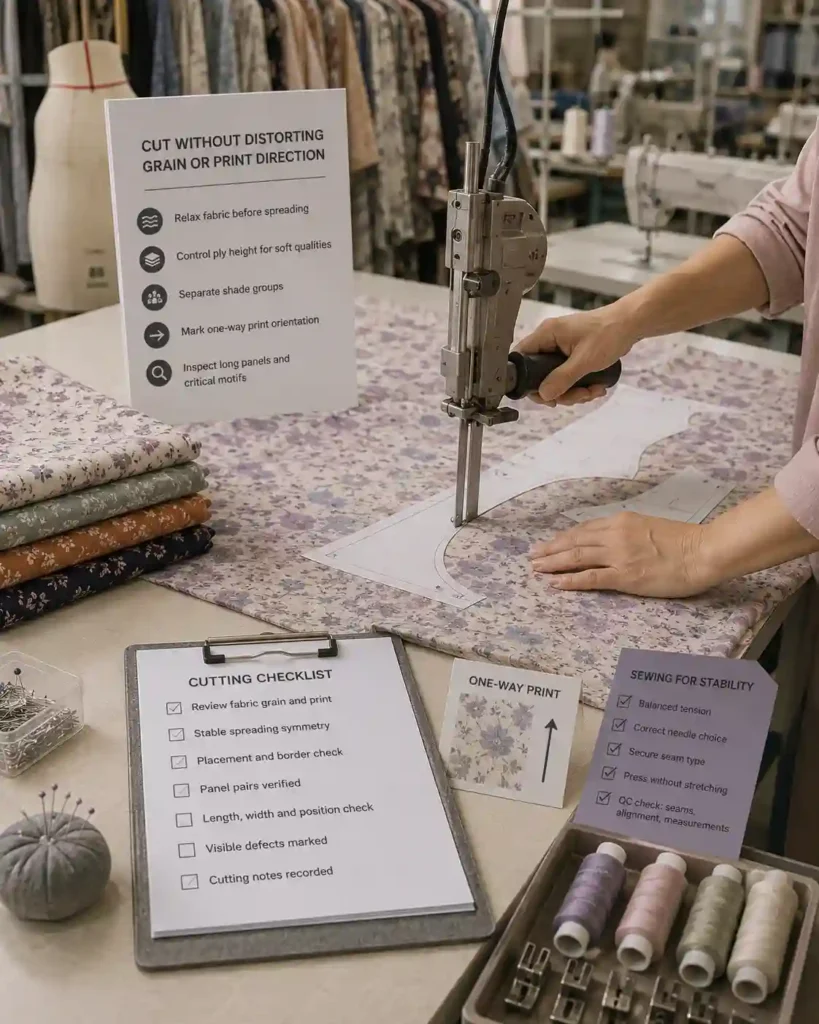
Every major pattern piece needs a clear grainline or stretch-direction instruction. Long dress panels should be checked at both ends because a small deviation near the waist becomes much larger at the hem. The cutting team should also confirm nap, one-way prints, satin shine, rib direction, pile direction, and any face difference when the fabric is rotated. Velvet, brushed materials, sequins, and directional prints usually require consistent orientation across the garment.
Bow and skew can mislead the cutting team even when the pattern looks correctly placed. Bow occurs when crosswise yarns curve across the width, while skew places them diagonally. Both conditions can cause side seams to twist after sewing or washing. Stretch fabrics also need the direction of greatest extension matched to the pattern requirement. A bodycon pattern developed for four-way stretch may become too short in a fabric that stretches mainly across the width, so composition alone is not a sufficient approval criterion.
Pattern and Panel Checks
Pattern checking before cutting is one of the least expensive ways to prevent an uneven hem. Front and back side seams should be walked together along the stitching line, with waist points, hip notches, slit positions, panel joins, and hem intersections compared. The hem turn-up must also suit the curve. A deep straight allowance forced around a strongly curved edge can create excess fullness, rippling, or a twisted finish even when the skirt length itself is correct.
Multi-panel skirts require more than a center-front measurement. Each panel should be checked from a consistent upper reference, and the lining should be reviewed as part of the same pattern system. Before full cutting, a first-panel or first-bundle review allows one complete component set to be measured against the approved pattern and size chart. If grading, marker placement, notch position, or grain alignment is wrong, the problem can be corrected before hundreds of pieces are cut and bundled into the sewing flow.
Cutting Control
Cutting methods should follow fabric stability rather than maximum lay height. Slippery satin, chiffon, lace, and stretch mesh often need fewer plies, paper support, vacuum control, sharper tools, or more frequent checks. A high lay can save spreading time, but it increases the chance that upper and lower plies shift. A difference of five to ten millimeters may be hard to notice in cut bundles yet become obvious at a finished hem.
Paired panels should remain together and be clearly identified by size, color, and position. Left and right pieces may look nearly identical while carrying different shaping, notches, or print placement. Long chiffon and maxi panels also need support after cutting. Allowing them to hang from one end during transport can stretch the bias sections before sewing begins. Moving bundles flat, limiting drag from table edges, and verifying the first complete cut set create a more reliable foundation than trying to correct mismatched lengths after assembly.
Control Point | Measurement or Check | Release Guide |
Fabric relaxation | Length and width before and after resting | Continue resting when dimensions are still changing. |
Shrinkage test | Percentage change in length and width | Use the approved care method and customer limit. |
Grain alignment | Distance from grainline to reference at both ends | Keep both measurements consistent along long panels. |
Side-seam match | Front and back stitching-line comparison | Match the approved pattern and all balance notches. |
Left-right symmetry | Mirrored panel shape and length | Accept no unexplained difference between paired pieces. |
Lining relationship | Shell and lining finished length | Follow the approved style-specific clearance. |
First-bundle review | Complete component set against pattern and size chart | Release bulk cutting only after approval. |
How Is the Hem Leveled and Sewn?
A dress should be leveled only after its fit, waist position, side seams, lining, and fabric settlement are correct. Place the garment on the intended wearer or a suitable form, mark from a consistent floor reference at multiple points, blend the curve smoothly, and choose a hem finish that suits the fabric, edge shape, stretch, and desired drape. Recheck the dress after sewing, pressing, cooling, and movement.
Floor and Pattern References
Pattern measurements and floor leveling answer different questions. Pattern measurements confirm whether the garment matches the approved technical specification. Floor leveling confirms whether the hem looks even when the dress is worn. A pattern can be dimensionally correct yet appear uneven because the wearer’s bust, abdomen, hips, seat, posture, or footwear changes how the fabric travels toward the floor.
Use both references in sequence. First verify the technical lengths, waist position, side seams, and zipper. Then assess the worn garment from a reliable floor line. Thick carpet, sloped platforms, or uneven fitting areas can create false readings, so the marking tool must remain at one fixed height. For production, the approved leveled shape should be transferred back to the pattern. Otherwise, every bulk garment depends on manual trimming, which creates variation between operators, sizes, colors, and production batches.
Fitting Position
The dress must be worn as intended before marking. Zippers and buttons should be closed, adjustable straps set, internal cups or corsetry positioned correctly, and the waist seam placed at its designed level. The wearer should stand naturally rather than looking down, lifting the chest, holding the abdomen, bending one knee, or shifting weight onto one hip. Even small posture changes can alter a floor-length hem.
Footwear matters for formal and occasion styles. A gown approved with flat shoes may become too long when styled differently, while a shorter hem can expose the shoe more than intended. Before marking, confirm that the neckline, shoulder, bust, waist, hip, side seams, zipper, slit, and lining all sit correctly. Marks should be placed frequently enough to reveal dips between major seams. A full circle skirt may need reference points every ten to fifteen centimeters, while a stable straight skirt can use wider spacing.
Shell and Lining
The shell and lining should hang independently without fighting each other. A lining that is too short or attached under tension can lift the shell, while one that is too long may show below the hem or bunch inside. Check both layers for grain, twist, side-seam alignment, and attachment at the neckline, armholes, waist, zipper, slit, and hem. A lining can match the flat measurement and still pull diagonally when one seam is rotated.
The finished lining clearance depends on the style. A fitted mini dress may need only a modest difference, while a fluid maxi dress generally needs more room because the outer skirt moves during walking. Sheer layers, high slits, transparent mesh, and high-low hems require their own visual rules. Layered skirts should settle naturally and be leveled one layer at a time. After hemming, hang and move the dress again, because a lining that looks correct while stationary may become visible when the skirt swings.
Hem Finish and Pressing
The hem finish affects both appearance and stability. Narrow double-turn hems are common for chiffon and lightweight wovens, rolled hems suit very fine edges, blind hems work for many tailored or formal fabrics, and faced hems support deeper curves or structured silhouettes. Stretch dresses often use coverstitch or twin-needle finishes, but differential feed and recovery must be controlled. The fastest operation is not always the finish that preserves the intended drape.
Machine tension, stitch density, presser-foot pressure, and feed should be tested on the actual layered fabric. Operators need to support the garment weight and avoid pulling along the curve. Pressing requires equal care: the iron should be lifted and placed instead of dragged across a bias edge, and temperature and steam must suit the fabric. Final measurements should be taken only after the dress cools. Satin can show shine and seam impressions, while viscose may continue relaxing under steam, so pressing is part of dimensional control rather than a purely cosmetic step.

How Do Factories Control Hem Balance?
Factories control hem balance through connected checkpoints rather than a final visual inspection alone. Pattern review, fabric testing, sample fitting, garment settling, PP-sample approval, first-bundle cutting checks, in-line measurement, lining control, pressing review, and final QC must follow the same approved standard. The earlier a defect is identified, the fewer garments require repair and the easier it is to correct the root cause.
Sample Development
Sample development is where the factory learns how the design, pattern, fabric, and construction behave together. The first sample should not be approved only because it resembles a sketch or reference image. It must also show that the waist stays level, side seams remain vertical, lining hangs freely, and the skirt reaches a stable length after resting. Center-front, center-back, side-seam, and quarter-point measurements provide a more useful record than one total-length number.
When the side sections drop after twenty-four or forty-eight hours, the pattern may be correct and the fabric may simply need a defined settling step. When the center front rises only on the body, the issue is more likely fit balance. Corrections should be placed where the problem begins. Pattern issues belong in the pattern, cutting issues in the marker or spreading method, and sewing issues in the operation instructions. A hand-trimmed sample can look excellent, but it is not a dependable bulk standard until the approved result is translated into repeatable technical information.
PP Approval
The pre-production sample should represent the final garment rather than an approximate development version. Fabric, lining, trims, pattern, measurements, construction, hem type, pressing method, labels, and packaging should match the planned order. Hem approval must define where dress length is measured, whether the reference is the highest shoulder point, waist seam, center back, or another agreed location, and how the shell and lining relationship is evaluated.
A practical specification may include total length, center-front skirt length, center-back length, side length, lining clearance, slit height, and hem depth. Tolerances should reflect the garment and the customer’s standard. Many commercial dress programs work with selected length tolerances around plus or minus 0.5 to 1.0 centimeter, but the approved measurement chart always takes priority. Bias, floor-length, layered, or highly fluid styles also need visual criteria because one number cannot describe the complete hem curve, drape, and floor relationship.
Cutting and In-Line Control
Bulk cutting should begin only after fabric behavior and the final pattern are confirmed. The first complete component set is compared with the approved pattern before the remaining quantity is released. During sewing, hem balance is monitored before the hem operation itself. Inspectors review side-seam matching, waist alignment, zipper balance, gather distribution, pleat depth, lining attachment, slit position, and garment length because the hem operator cannot fully correct problems that already exist above the bottom edge.
The first garments from the line deserve closer attention. A repeated difference between center-front, center-back, and side lengths often points to pattern shape, cutting movement, or operation handling. Stopping after a few affected garments is far less expensive than finding the same defect in several hundred finished pieces. Multi-size orders need early checks beyond the base size, especially for fitted, flared, bias, and floor-length dresses. Long panels should also be supported between operations so they do not trail, hang from machine tables, or stretch before final leveling.
Final and Repeat-Order Control
Final inspection combines measurement with visual judgment. The dress should be checked in a consistent condition, with closures fastened, straps adjusted, lining settled, and major wrinkles removed. Depending on the style, inspection may be performed flat, on a hanger, on a dress form, or through more than one method. Inspectors compare left and right sides, center front and center back, quarter sections, side-seam direction, lining exposure, slit position, hem width, stitching, pressing, and the overall relationship to the floor.
Repeat orders should not restart from memory. The factory needs the final pattern version, grading rules, fabric reference, shrinkage and relaxation records, grain instructions, hem construction, pressing notes, approved sample, and previous corrective actions. A new fabric lot still requires confirmation because weight, finish, stretch, and recovery can change. Useful records describe the actual correction, such as adding front length, reducing lining tension, relaxing fabric before cutting, adjusting feed, or hanging the garment for a defined period. Vague notes such as ‘check the hem carefully’ do not prevent the same defect from returning.
Production Gate | Hem-Related Evidence | Release Decision |
Pattern review | Walked seams, balanced lengths, graded-size comparison | Approve the pattern or revise before sampling. |
Fabric approval | Shrinkage, stretch, recovery, relaxation, and directional checks | Approve the fabric for the specific style. |
Sample development | Fit, drape, lining, grain, and hanging behavior | Revise pattern, process, or material when needed. |
PP sample | Final length, hem finish, visual balance, and measurement method | Authorize bulk production only after full confirmation. |
First cut bundle | Panel length, grain, symmetry, and notch accuracy | Release remaining cutting after component approval. |
First line output | Seam balance, lining, zipper, and pre-hem length | Continue, correct, or stop the line. |
Final inspection | Measurement, floor-level appearance, stitching, and pressing | Pack, repair, recheck, or reject. |
Repeat-order review | Archived pattern, fabric record, and corrective actions | Reconfirm the standard for the new fabric lot and batch. |
A level hem is one of the clearest signs that a dress has been developed as a complete product rather than assembled as a collection of separate operations. Pattern balance, fabric behavior, cutting accuracy, sewing control, lining length, pressing, and final inspection all have to agree. When a team fixes only the visible low point, the next size, color, or reorder may repeat the problem. When the root cause is documented, the improvement can be carried into bulk production and future collections.
Jinfeng Apparel supports custom dress development from technical review and pattern making through fabric sourcing, sampling, bulk production, quality control, private-label packaging, and export coordination. The production system includes six owned womenswear factories, more than ten long-term satellite production partners, two sample rooms, more than twenty sample machinists, seven or more senior pattern makers, and fifteen or more QC inspectors. Custom production generally starts from 200 pieces per style and color, depending on fabric availability, trims, construction complexity, color development, packaging, and scheduling. Brands can send a tech pack, reference sample, size chart, target quantity, and launch timeline to request a development and production quotation.

Jerry Lee
Share This Article :
Categories

Latest blogs

Table of Contents
Here, developing your OEM/ODM private label clothing collection is no longer a challenge—it’s an excellent opportunity to bring your creative vision to life.

