Skip to content

Finding a women’s dress manufacturer in China looks easy until a brand begins comparing real suppliers. Search results, B2B platforms, sourcing agents, and factory websites often repeat the same promises: custom production, fast sampling, good quality, and competitive pricing. But a fashion brand does not need a supplier that only looks good in a directory. It needs a manufacturer that understands fit, fabric behavior, construction details, measurement tolerance, private-label presentation, and bulk consistency. A satin mini dress, a mesh bodycon dress, a lace cocktail dress, and a structured corset dress may all be called dresses, but they require different pattern logic, sewing control, inspection points, and packaging care. The real question is not whether China has dress factories. It is how to identify the factory that fits your product, your sales channel, your quality standard, and your long-term order plan. Choose poorly, and the lowest quote can become expensive through revisions, delays, returns, and customer complaints. Choose well, and your manufacturer becomes part of your product engine, helping you turn design ideas into stable, retail-ready dresses season after season.
To find a women’s dress manufacturer in China, define your product type, prepare clear development files, shortlist factories with proven dress specialization, verify OEM/ODM and private-label capability, test them through sampling, inspect quality before bulk production, and choose a partner with stable factory capacity, communication discipline, and repeat-order support.
Many brands do not lose money because they chose China; they lose money because they chose the wrong factory type. The following guide breaks the decision into practical checks that experienced dress buyers use before sending a deposit.
What Makes a China Dress Manufacturer Reliable?
A reliable China dress manufacturer is not simply the one with the lowest quote or fastest reply. It should have proven dress experience, clear factory capacity, OEM/ODM development ability, sampling discipline, quality control steps, private-label support, and the ability to repeat approved quality in bulk production.
Reliability starts with category fit. Women’s dresses are not basic cut-and-sew products. A mini satin dress, a mesh bodycon dress, a lace cocktail dress, a corset evening dress, and a resort maxi dress all sit under the word dress, but the factory risks are completely different. The supplier must understand fabric behavior, fit pressure points, lining decisions, seam tension, zipper quality, hem balance, measurement tolerance, and packing control.
A serious factory should be able to explain what happens before production begins. It should ask about your tech pack, reference sample, fabric, lining, trims, color plan, size range, quantity, target market, and packaging. If a supplier gives a full price from one picture without asking any technical questions, the quote may be fast, but it is usually not reliable.
For mid-to-large fashion brands, reliability also means production structure. A small workshop may handle one simple style, but brands with multi-style dress collections need factory matching, development records, quality checkpoints, and repeat-order stability. Jinfeng Apparel is a Guangdong-based custom women’s fashion manufacturer with 6 owned women’s fashion factories and more than 10 long-term satellite production partners, supporting dress development, sampling, bulk production, quality control, private-label packaging, and export delivery.
The strongest suppliers are usually not the ones that say yes to everything. They are the ones that can tell you where the risks are, which details need confirmation, and what must be approved before bulk production begins.
Factory or Middleman?
The first thing to check is whether the supplier controls production or only connects you to someone else. A trading company is not always bad, but hidden layers create risk. When sampling, fit comments, fabric decisions, production scheduling, and inspection all pass through several parties, small mistakes become expensive. A real dress manufacturer should be able to explain its production setup, product categories, sampling process, quality checkpoints, and factory matching logic. It should know which team handles woven dresses, which team handles stretch styles, and which production unit is better for complex fabrics such as lace, mesh, satin, or sequin.
| Checkpoint | What to Ask | Strong Signal | Risk Signal |
| Factory identity | Are you a manufacturer or trader? | Clear factory structure and production role | Vague answer or only showroom photos |
| Product focus | What dresses do you make most? | Specific dress types and fabric experience | “We make all clothing” with no detail |
| Sampling control | Who makes the sample? | In-house or directly managed sample room | Outsourced sample with unclear feedback |
| QC process | When do you inspect? | Fabric, cutting, sewing, measurement, final check | Only final visual check |
| Repeat orders | Do you keep records? | Patterns, size charts, trims, packing files retained | Every order starts from zero |
A factory with real production control may not always give the lowest first quote, but it usually gives fewer surprises after approval. For a buyer, fewer surprises are often worth more than a small unit-price difference.
Dress Specialization
Dress specialization matters because dresses are fit-sensitive and visually unforgiving. Poor bust shaping, unstable waist placement, twisted side seams, rough zipper insertion, uneven hems, and weak lining control can make a style fail even when the fabric looks good. A good dress manufacturer should understand how different dress types behave on the body. Bodycon dresses need stretch recovery and side seam stability. Satin dresses need clean seam tension and careful pressing. Mesh dresses need transparency control and lining decisions. Lace dresses need placement planning. Sequin dresses need comfort control around seams and zippers. Maxi dresses need drape, balance, and packing care.
A factory that mainly produces hoodies, uniforms, basic T-shirts, or sportswear may understand sewing, but that does not mean it understands fashion dress development. For a dress brand, the right question is not only “Can you make dresses?” The better question is “Which dress structures and fabrics do you produce regularly, and what are the common risks?”
OEM, ODM, and Private Label
Reliable suppliers should support different cooperation models. OEM is suitable when you already have a tech pack, measurement chart, construction notes, fabric requirements, and packaging details. ODM is useful when you have a brand direction, reference images, sample garments, or a line sheet, but need help turning the idea into a production-ready style. Private label is essential when the final product must carry your brand identity.
Private-label support should include more than sewing a label into the neck seam. It may include woven labels, size labels, care labels, hangtags, barcode stickers, SKU labels, polybags, carton marks, and warehouse labels. For ecommerce and retail-ready brands, these details affect more than appearance. Incorrect labels or unclear carton marks can delay warehouse receiving. Poor packaging can damage the first customer impression. A professional factory treats private-label execution as part of production accuracy, not as a last-minute add-on.
Overseas Standards
A supplier working with overseas brands should understand that quality is not only about the garment looking acceptable in a photo. Buyers in the United States, United Kingdom, Europe, Australia, and Canada often care about size consistency, packaging discipline, launch calendars, customer return rates, product photography, and documentation. A strong factory should confirm details in writing. Fabric, trims, sample comments, size chart, packaging, carton marks, delivery schedule, and inspection standards should not rely only on chat messages.
Reliable manufacturers also know when to push back. If a requested fabric may not support the target fit, if a neckline needs more structure, if a slit is too high for the size range, or if a custom trim may increase lead time, a serious supplier should say so early. A “yes to everything” factory can feel easy at first, but it often becomes risky once production begins.
Which Dress Manufacturer Fits Your Product?
The right dress manufacturer depends on your style type, fabric, fit level, order structure, target price, and brand positioning. A factory good at simple woven dresses may not be right for corset dresses, stretch bodycon styles, sequin party dresses, or lined occasionwear.
Many buyers make the mistake of choosing a factory before classifying the product. In women’s dresses, the product category is only the surface. The real production challenge comes from structure and material. A simple A-line woven dress, a ruched jersey bodycon dress, and a satin evening dress may all be one-piece garments, but they require different pattern logic and quality checks.
Start by separating your collection into product families. Put mini, midi, and maxi dresses into one length-based group. Put party, cocktail, evening, wedding guest, graduation, and club dresses into an occasionwear group. Put bodycon, corset, slip, backless, halter, strapless, and one-shoulder dresses into a structure group. Put satin, mesh, lace, chiffon, sequin, jersey, and velvet dresses into a fabric-risk group.
This classification helps you ask better questions. Instead of asking “Can you make this dress?” you can ask “How do you control stretch recovery on bodycon dresses?” or “How do you prevent seam waves on satin?” The second question tells you much more about whether the supplier fits your product.
A specialized women’s fashion manufacturer can also help you decide whether one production unit can handle the whole collection or whether different style groups should be assigned to different teams. This matters when your order includes several fabrics, fits, and delivery batches.
Length and Silhouette
Mini, midi, and maxi dresses each have different production controls. Mini dresses are short, but they are not necessarily easier. Because the garment is close to the body and visually exposed, the factory must control hip fit, hem balance, lining coverage, and movement comfort. A small length mistake can make the dress feel too revealing or off-proportion. Midi dresses require balance. If the waistline, skirt flare, or hem position is wrong, the dress can look heavy even when the sewing is clean. Maxi dresses need more attention to drape, side seam straightness, fabric weight, lining length, and packing.
| Dress Type | Common Length Focus | Key Fit Risk | Factory Control Point |
| Mini dress | Short hem, close proportion | Hip ease, lining exposure, hem balance | Length tolerance, lining length, movement check |
| Midi dress | Mid-calf balance | Heavy look, wrong waist proportion | Waistline, skirt sweep, drape |
| Maxi dress | Long drape | Uneven hem, twisting, packing creases | Side seam, hem leveling, pressing |
| Bodycon dress | Fitted body length | Overstretch, side seam twisting | Fabric recovery, grading, seam stability |
| Corset dress | Structured upper body | Bust support, waist pressure | Boning, lining, zipper strength |
For serious buyers, a factory’s answer should go beyond “we can make mini and maxi.” It should explain what it checks during pattern development, sample fitting, and bulk inspection.
Occasion and Party Dresses
Party and occasion dresses have higher customer expectations because they are often bought for important moments: weddings, birthdays, graduations, evening events, vacations, club nights, and special dinners. These products are photographed, reviewed, and compared closely. Common risk points include bust support, neckline security, zipper smoothness, slit height, lining comfort, seam strength, and fabric appearance under light. A satin cocktail dress may look beautiful on a hanger but fail if the seam tension creates waves across the body. A sequin dress may look strong in photos but feel uncomfortable if the inside finishing is poor.
A suitable manufacturer should understand that occasionwear is not simply “regular dress plus better fabric.” It needs better development control. The sample should be tested on the body, not only checked flat on a table. For styles with corset panels, high slits, transparent mesh, open backs, or structured busts, sample review may require more than one correction round.
Fabric Capability
Fabric is one of the biggest reasons dress production succeeds or fails. A factory that handles cotton well may struggle with satin. A factory that sews jersey well may not be strong in lace placement. A supplier that can make chiffon resort dresses may not be ready for heavy sequin eveningwear. Satin needs careful cutting, sewing tension, needle selection, pressing, and packing. Mesh needs control of stretch direction, transparency, lining, and seam distortion. Lace requires placement thinking and clean edge finishing. Sequin fabric requires planning around seam allowance, comfort, zipper placement, weight, and shedding risk.
A good supplier should be able to discuss fabric alternatives when your target price, MOQ, or launch schedule does not match the original material. This is where experience has real value. Cost optimization should not mean downgrading blindly. It should mean finding a fabric that still supports the fit, hand feel, appearance, and customer expectation.
Product Expansion
Many fashion brands do not stop at dresses. Once a dress style sells well, the next step may be a matching skirt, crop top, jumpsuit, romper, or two-piece set using the same fabric story or design language. That is why choosing a supplier with wider womenswear capability matters. Jumpsuits require torso length, crotch depth, hip ease, zipper placement, and movement comfort. Matching sets require color consistency between pieces, size coordination, and packaging accuracy. Crop tops and skirts may share fabric with dress styles, but the fit logic is different.
A factory that can support related product categories gives your brand more flexibility. It can help build a collection instead of producing isolated items. For seasonal launches, this reduces development friction because the manufacturer already understands your fabric preferences, measurement logic, label placement, and packing standard.
How Do You Find Real Dress Factories in China?
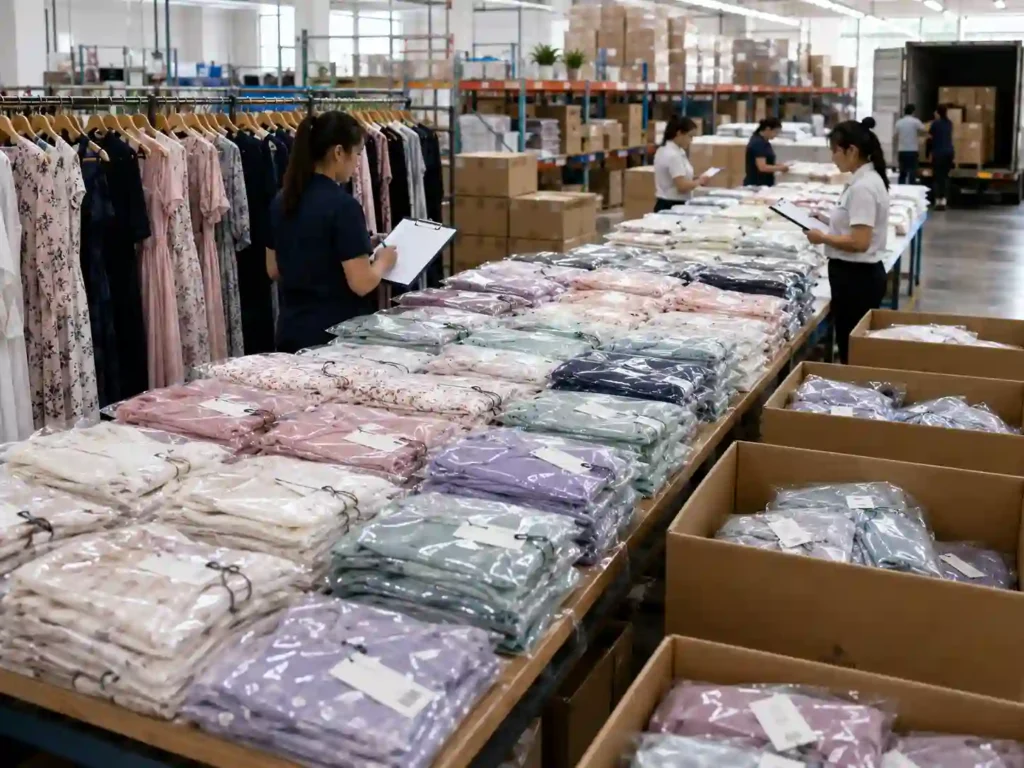
You can find real dress factories in China through Google, supplier websites, B2B platforms, trade shows, referrals, LinkedIn, and direct factory contact. The channel matters less than the verification method. Always check specialization, sampling ability, factory structure, quality control, MOQ logic, and communication quality.
Most buyers begin with a search engine or marketplace. That is normal, but it is only the first step. A supplier appearing on a platform is not automatically a good fit. A website with polished photos is not automatically a strong manufacturer. A factory that replies in five minutes is not automatically technically capable.
The smarter approach is to build a shortlist from several channels, then test each supplier with the same information. Send the same product brief, same quantity plan, same fabric direction, and same packaging requirement. Compare not only the quotation, but also the quality of their questions. A professional factory usually asks about details before giving a serious answer.
When searching, use product-specific terms rather than broad phrases. “Women’s clothing manufacturer China” is broad. “Custom satin dress manufacturer China,” “private label party dress manufacturer,” or “OEM mesh bodycon dress factory” usually brings you closer to suppliers that understand your category.
The goal is not to find the most suppliers. The goal is to reduce the list to factories that are technically relevant, commercially realistic, and capable of supporting your order beyond the first sample.
Google and Factory Websites
Google is useful because it shows how a factory explains itself without the limitations of a marketplace profile. A strong manufacturer website should make its product focus, customer type, manufacturing model, MOQ, sampling process, QC process, private-label support, and factory capacity easy to understand. When checking a website, look for specific product pages. If the supplier claims to make dresses but only has generic clothing categories, the product focus may be weak. A supplier with dedicated content around party dresses, occasion dresses, satin dresses, mesh dresses, lace dresses, sequin dresses, bodycon dresses, private-label dresses, and dress sampling is easier to evaluate.
Also check whether the supplier defines what it does not do. A factory that says yes to all orders, all categories, all prices, and all quantities may lack a clear production model. Clear boundaries are usually a sign of a more disciplined supplier.
B2B Platforms
Alibaba, Global Sources, Made-in-China, and similar platforms can help you discover suppliers, but they should not be your only filter. Platform rankings can be influenced by advertising, response behavior, and profile optimization. They do not replace product verification. Use platforms to collect options, then move into deeper checks. Ask for product-specific examples, factory structure, sampling steps, fabric handling experience, MOQ logic, and QC process.
A useful platform inquiry should be specific. Include your dress type, fabric direction, quantity, size range, target market, and private-label requirements. A vague message like “please quote this dress” often attracts vague answers. A strong supplier will usually respond with questions, not just a price.
Trade Shows and Referrals
Trade shows help because you can see samples, touch fabrics, and ask technical questions in real time. A supplier who can explain sample construction, fabric risk, and fit control at the booth is often worth following up with. When speaking with a supplier at a show, do not only ask for a catalog. Show a reference image and ask what production risks they see. Ask whether the style needs lining. Ask how they would control the hem. Ask if the fabric requires special handling. Strong factories are comfortable discussing problems, not just promises.
Referrals can also be valuable, but they must be product-matched. A factory recommended for denim jackets may not be suitable for satin occasion dresses. A supplier trusted for activewear may not be right for lace cocktail styles. Always connect the referral to your actual product category.
Direct Verification
After you create a shortlist, verify the supplier through a structured conversation. Ask who will handle your sample, who reviews the pattern, who confirms fabric, who checks measurements, and who manages bulk inspection. Good suppliers can explain the flow clearly. Ask for process evidence instead of only asking for photos. Photos can be selected. Process details are harder to fake.
A reliable dress manufacturer should be able to walk you through product review, fabric sourcing, pattern development, sample making, sample correction, PP sample approval, bulk cutting, sewing inspection, final inspection, packing, and shipment coordination. If the supplier cannot explain how it moves from sample approval to bulk consistency, keep looking.
What Should You Prepare Before Contacting a Factory?
Before contacting a dress factory, prepare your tech pack, reference images, original sample notes, fabric direction, trim details, size chart, quantity plan, color plan, target market, packaging needs, and timeline. Clear information leads to more accurate pricing, better sampling, and fewer production mistakes.
A single product image is rarely enough for a reliable quotation. It does not show fabric composition, weight, stretch, lining, seam finish, zipper quality, internal construction, measurement points, size range, packaging, or inspection expectations. If a supplier gives an exact bulk price from one image with no questions, the quote is likely based on assumptions.
The better your input, the better the factory can evaluate cost and risk. This does not mean every brand must have a perfect technical file. Many factories can begin from reference photos, sketches, original samples, line sheets, or moodboards. But the factory still needs enough information to understand what must be developed.
Clear preparation also shows that your inquiry is serious. Professional factories receive many vague price requests every week. A buyer who sends a structured brief with quantity, fabric direction, size range, and target market is much easier to prioritize.
For Jinfeng Apparel, development can start from tech packs, reference photos, original samples, line sheets, or sketches, with support for fabric sourcing, trim sourcing, pattern making, sampling, bulk production, QC, and private-label packing. The more complete the brief is, the easier it is to recommend the right development path.
Tech Pack Basics
A tech pack should help the factory avoid guessing. It should show what the garment looks like, how it should fit, what materials it needs, and what construction details matter. For dresses, the most important sections are design view, measurement chart, fabric, trims, construction, labels, packaging, and sample comments.
| File Item | Useful Details | Why It Matters |
| Front/back view | Sketch, photo, or flat drawing | Confirms shape and design lines |
| Size chart | Bust, waist, hip, length, strap, sleeve, slit | Controls fit and grading |
| Fabric info | Composition, weight, stretch, hand feel | Affects price, fit, sewing, MOQ |
| Trim details | Zipper, hooks, cups, boning, elastic, buttons | Affects construction and durability |
| Construction notes | Lining, seam finish, hem, ruching, pleats | Prevents wrong sewing method |
| Label/packing | Woven label, care label, polybag, barcode | Supports private-label delivery |
For fitted dresses, add more measurement points. A bodycon dress needs bust, waist, hip, body length, shoulder, sleeve or strap, hem opening, and stretch expectations. A corset dress needs bust structure, cup position, boning placement, waist pressure, zipper position, and lining. A maxi dress needs full length, hem sweep, lining length, slit height, and side seam balance.
Fabric and Trim Details
Fabric is not just a material choice. It affects fit, price, MOQ, lead time, sewing difficulty, inspection, and packing. If you know the fabric composition and weight, share it. If you do not, describe the effect you want: soft, structured, stretchy, shiny, fluid, sheer, sculpting, breathable, heavy, or lightweight.
Trim details should also be clear. Many dress issues come from small components: weak zippers, uncomfortable boning, poor elastic recovery, wrong lining, mismatched lace, rough hooks, or low-quality labels. If your brand has an approved zipper quality, label material, care label layout, or barcode format, provide it early.
For special fabrics, expect separate sourcing discussions. Custom dyeing, custom weaving, custom printing, certified fabrics, special lace, special sequin, special trims, and custom packaging may create separate supplier MOQ or longer preparation time. Jinfeng Apparel’s basic MOQ is 200 pcs per style/color, while special fabrics, custom dyeing, custom weaving, printing, certified fabrics, special trims, and custom packaging may have separate MOQ requirements.
Quantity and Size Range
A serious factory needs to know the expected quantity by style, color, and size. The total order volume affects fabric sourcing, production planning, cutting efficiency, sewing arrangement, QC workload, packing materials, and delivery schedule. A clear inquiry might say: “Style A, 800 pcs total, 400 black and 400 wine red, sizes XS-XL, US market, individual polybag with barcode sticker.” That is much more useful than “How much for this dress?”
Size range matters because grading affects fit. A dress that works in size S may not work in XL without adjustment. Strap length, bust coverage, waist placement, hip ease, dress length, slit height, and lining length should all be checked across the size range. For fitted, corset, backless, strapless, or stretch dresses, the size range should be discussed before sampling. If your brand already has a fit block, share it. If not, ask the factory how it normally approaches fit correction and grading.
Market and Timeline
Tell the factory where and how the dress will be sold. A product for a premium ecommerce brand has different needs from a boutique wholesale order, a resortwear drop, a partywear launch, or an occasionwear collection. The target market affects sizing, packaging, fabric weight, labeling, customer expectations, and seasonal timing.
Timeline should include sample target, approval window, bulk production expectation, and delivery deadline. If your launch date is fixed, say so at the beginning. A good factory can help plan backwards from the delivery date, but it cannot protect a deadline if key details are confirmed too late.
How Do You Test a Manufacturer Before Bulk Production?
Test a manufacturer through sampling, fit review, fabric confirmation, construction inspection, measurement checking, packaging review, and PP sample approval. Bulk production should not start until the approved sample, fabric, trims, size chart, label placement, packaging, and quality standard are clearly confirmed.
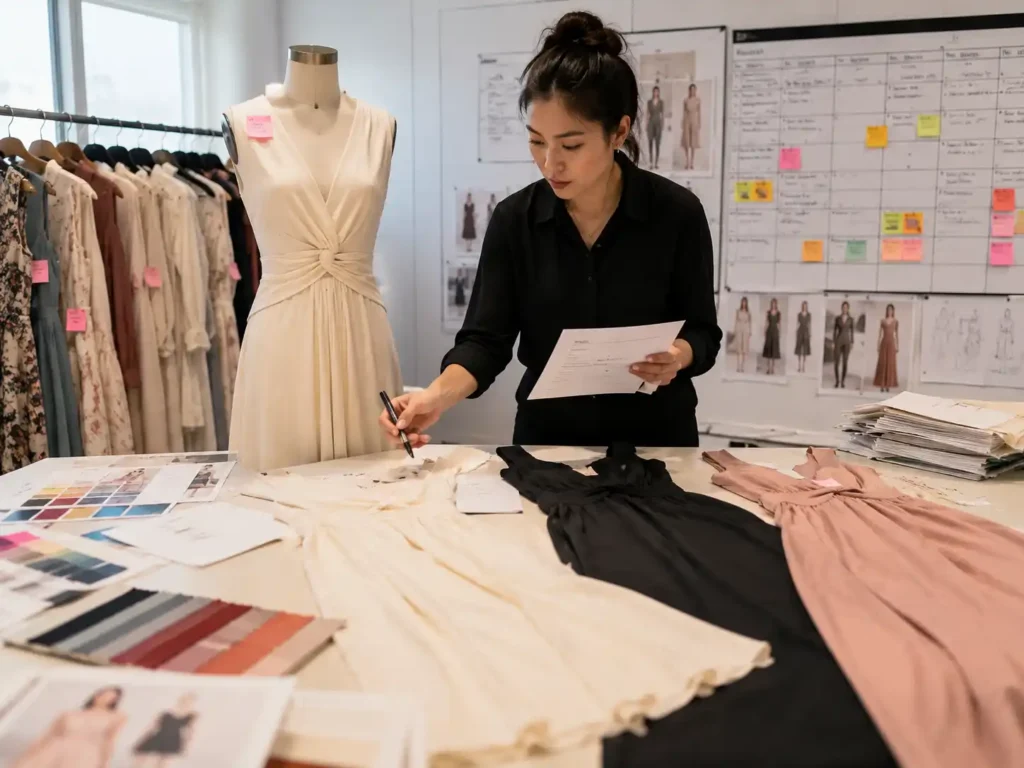
Sampling is not only a product preview. It is a test of how the factory thinks. A good sample process shows whether the supplier understands your design, catches risk early, communicates clearly, follows comments, and improves the garment in a controlled way.
The first sample does not always need to be perfect, especially for complex styles. What matters is how the supplier responds. If the neckline is unstable, does the factory suggest a construction fix? If the fabric is too thin, does it recommend lining or a better alternative? If the waist sits wrong, does it adjust the pattern properly? If the zipper waves, does it understand sewing tension and fabric support?
Do not rush from a good-looking photo into bulk production. A dress sample should be checked on the body, measured against the size chart, inspected inside and outside, and reviewed for comfort, movement, and finishing. The PP sample should become the final reference before bulk cutting.
Sampling Process
A normal sampling process starts with product review. The factory checks the style, fabric, construction, trims, measurements, and quantity plan. Then it develops or adjusts the pattern, prepares fabric and trims, sews the sample, checks measurements, and sends the sample for review. Many dress styles go through more than one sample round. This is not a failure. It is normal when the style involves body fit, stretch, lining, corset structure, transparent panels, drape, or special fabric. What matters is whether each revision is documented.
| Stage | Main Purpose | What to Confirm |
| Development review | Understand style risk | Fabric, trims, structure, size, quantity |
| First sample | Test shape and construction | Fit, fabric behavior, sewing method |
| Revision | Correct problems | Measurements, neckline, waist, hem, lining |
| Final sample | Confirm look and fit | Buyer approval details |
| PP sample | Set bulk standard | Final fabric, trims, labels, packaging |
| Bulk start | Begin production | Approved reference and written specs |
The PP sample should be treated as the production standard, not just another sample photo. If something is not right in the PP sample, fix it before production starts.
Fit and Measurement Review
Fit review should be specific. Comments like “make it better” are not helpful. Use photos, marked areas, measurement notes, and clear adjustment requests. For example, “reduce waist by 1 cm each side,” “raise neckline by 1.5 cm,” or “increase slit height only after size M review” is much clearer.
For dresses, check bust, waist, hip, shoulder, strap length, neckline depth, armhole, back coverage, dress length, slit height, hem balance, lining length, zipper area, and movement comfort. For bodycon dresses, check stretch and recovery. For strapless dresses, check security. For maxi dresses, check walking comfort and hem leveling. Measurement tolerance should match the style. A loose resort dress may allow more flexibility than a structured corset dress. For fitted dresses, even a small measurement change can affect customer comfort and returns.
Stitching and Construction
A sample should be inspected inside and outside. The outside shows appearance; the inside shows manufacturing discipline. Check seam finishing, loose threads, lining attachment, zipper smoothness, stitch tension, strap strength, hem finish, and stress points. Fabric-specific checks are also important. Satin should be checked for seam waves, shine marks, and pressing damage. Mesh should be checked for transparency, stretching, and seam distortion. Lace should be checked for placement and fraying. Sequin should be checked for shedding, zipper comfort, and inner seam irritation.
If the sample has obvious construction issues, do not assume bulk will improve automatically. Bulk production usually follows the approved sample. If the approved reference is weak, the final goods may repeat the same weakness at scale.
PP Sample Approval
The PP sample is the final gate before bulk production. It should use confirmed fabric, confirmed color, confirmed trims, confirmed labels, confirmed measurements, confirmed construction, and confirmed packaging. Once approved, it becomes the standard for cutting, sewing, inspection, and packing.
Before approval, check every customer-facing detail: garment appearance, fit, measurements, stitching, lining, zipper, labels, hangtags, barcode stickers, polybag, folding method, and carton information. If the product will be sold through ecommerce, also check whether the sample is photo-ready and whether packing will protect the garment during shipment. A simple rule works well: if you would not sell the PP sample to your end customer, do not approve it for bulk production.
How Do You Choose a Long-Term Dress Partner?
Choose a long-term dress partner by looking at product specialization, sampling discipline, factory capacity, QC control, private-label support, communication reliability, NDA protection, repeat-order records, and seasonal collection support. The right partner should reduce development risk over time, not restart the same problems every order.
A one-time supplier makes a product. A long-term manufacturing partner helps build your product system. This is especially important in women’s dresses, where body blocks, fabric choices, fit comments, size grading, labels, packing, and customer feedback often repeat across collections.
When a factory keeps accurate records, future development becomes faster and more stable. A best-selling bodycon dress can become a long-sleeve version. A satin midi can become a mini or maxi. A lace party dress can become a new seasonal color. A matching set can grow out of a dress fabric story. Without records, every repeat or variation becomes a new risk.
Long-term cooperation also helps the supplier understand your customer. Over time, the factory learns your preferred fit, fabric hand feel, size tolerance, packaging style, price level, and launch rhythm. This reduces repeated explanation and helps both sides make faster decisions.
Jinfeng Apparel supports long-term brand cooperation, seasonal collection development, repeat orders, and multi-batch production by keeping pattern records, fabric references, trim details, measurement files, and packing requirements for future production.
Quality Control
Quality control should not happen only at the end. By the time finished dresses are packed, many problems are already expensive to fix. A strong factory checks materials, cutting, sewing, measurements, appearance, pressing, labels, packing, and cartons at different points.
For dresses, the most important QC points are fabric defects, color difference, cutting direction, seam stability, measurement accuracy, zipper function, lining length, hem balance, label placement, and final presentation. A satin dress with poor pressing, a mesh dress with twisted seams, or a maxi dress with uneven length can fail even if the garment is technically complete. Ask your supplier how it handles in-line inspection and final inspection. Ask whether measurements are checked by size. Ask whether bulk goods are compared with the approved PP sample.
Private Label Support
Private-label support becomes more important as your brand grows. At the beginning, you may only need a main label and care label. Later, you may need size labels, hangtags, barcode stickers, SKU labels, custom polybags, thank-you cards, carton marks, warehouse labels, and packing rules for different sales channels.
The manufacturer should understand that packaging is not decoration. It affects warehouse receiving, ecommerce fulfillment, retail presentation, and customer experience. Incorrect barcodes, missing size stickers, poor folding, or unclear carton marks can create delays even when the garments are well made. A long-term partner should keep your label files, packing method, carton requirements, and SKU rules organized. This reduces repeat communication and prevents mistakes when you reorder or launch new colors.
NDA and Design Protection
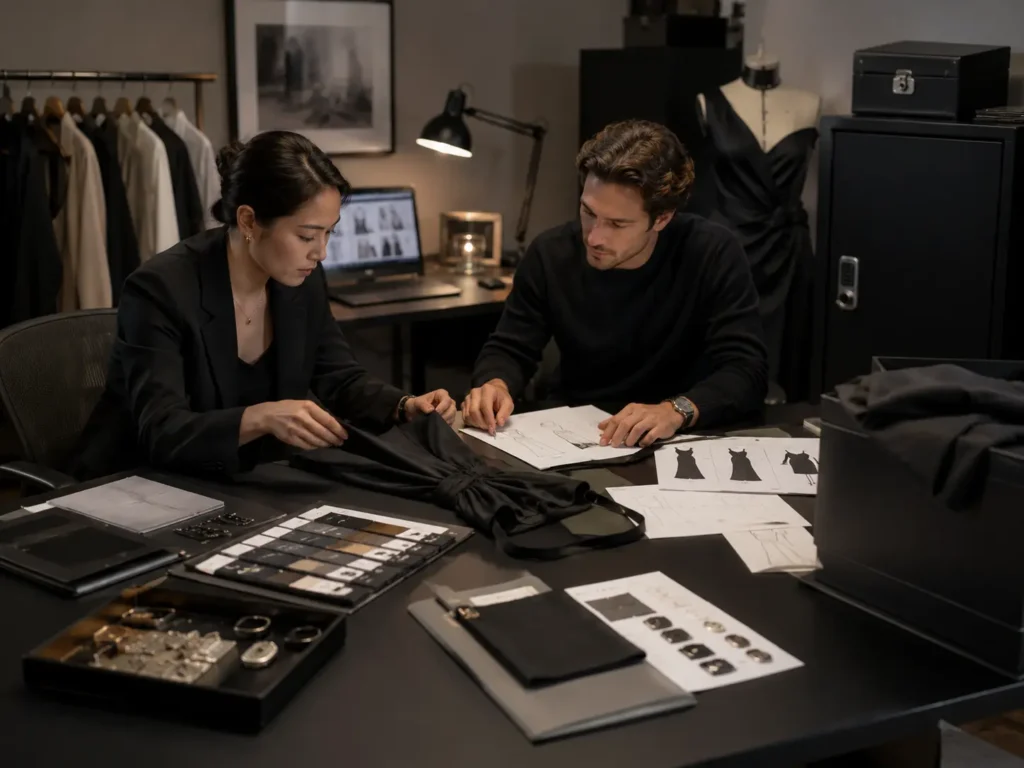
Design protection is a serious issue in custom fashion manufacturing. Before sharing tech packs, original samples, line sheets, unreleased designs, brand labels, packaging files, pricing, and launch plans, confirm whether the supplier supports NDA-based cooperation. A trustworthy manufacturer should not publish your brand name, logo, sample photos, original tech packs, patterns, packaging files, order quantities, prices, or unreleased styles without approval. Anonymous case descriptions are acceptable, but your confidential product information should stay protected.
This matters because a custom dress collection is more than fabric and sewing. It includes your market timing, customer research, styling direction, fit preference, and brand identity. A factory that treats confidentiality casually is not a good long-term partner, even if its price looks attractive.
Repeat Orders
Repeat orders are where long-term value becomes visible. The first order may require more development time. The second order should be smoother because the factory already knows the style, pattern, size chart, fabric, trims, label placement, packing method, and quality standard.
A repeat-ready supplier should keep pattern records, size charts, fabric references, color standards, trim details, sample comments, QC notes, label files, packaging rules, and carton information. This record system helps when a best-selling dress needs restocking, when a color sells out, when a style needs a fabric update, or when a seasonal collection uses the same fit block. For mid-to-large fashion brands, the goal is not to find a new factory for every order. The goal is to build a stable production rhythm that supports sample, bulk, repeat, and seasonal collection development.
Conclusion: Find a Manufacturer That Can Grow With Your Dress Brand
Finding a women’s dress manufacturer in China is not about collecting the longest supplier list. It is about identifying the manufacturer that fits your product, your quality level, your order rhythm, your private-label needs, and your long-term growth plan.
Start with a clear brief. Search with specific dress-related keywords. Check whether the supplier truly specializes in women’s dresses. Verify OEM, ODM, private-label, sampling, QC, MOQ, NDA, packaging, and repeat-order support. Test the factory through sampling before bulk production. Approve the PP sample carefully. Choose the partner that gives you fewer surprises, not just the lowest first quote.
For fashion brands, the right manufacturer becomes part of the product engine. It helps you develop better samples, control fabric risk, improve fit, protect your designs, manage packaging, ship more stable bulk orders, and prepare future collections with less friction.
Jinfeng Apparel is a Guangdong-based premium custom women’s fashion manufacturer specializing in dresses, skirts, jumpsuits, matching sets and private-label womenswear for global fashion brands and mid-to-large custom apparel clients. With OEM/ODM development, fabric and trim sourcing, sampling, bulk production, quality control, private-label packing, NDA support, and long-term repeat-order cooperation, Jinfeng Apparel is built for brands that need more than a simple sewing supplier.
If you are planning a custom dress collection, preparing a private-label womenswear line, replacing an unstable supplier, or developing seasonal party, occasion, resort, bodycon, satin, mesh, lace, or sequin styles, send your tech pack, reference images, sample photos, quantity plan, fabric direction, and target market to Jinfeng Apparel. The team can review your project, suggest the right development path, and help turn your dress ideas into production-ready garments.