
How to Protect Original Dress Samples Before Bulk Production

Your trusted Women’s Apparel Manufacturer from China

A strong original dress sample is more than a pretty prototype. For a fashion brand, it may hold months of design thinking, fabric testing, fit correction, styling direction, costing decisions and launch planning. The challenge is that many teams protect the sample too late. They wait until the sample is damaged, copied, revised incorrectly or poorly matched in bulk production before they realize the sample was never just a garment. It was a technical reference, a commercial asset and a production benchmark.
To protect original dress samples, brands should combine confidentiality control, clear technical documentation, physical sample management, written revision records, fabric and trim approvals, PP sample confirmation and bulk QC comparison. This protects design ownership, fit accuracy, material consistency and production repeatability before the style moves into mass production.
Picture a satin corset dress sample that looks perfect in the showroom. The fabric drapes cleanly, the waist feels sharp, the bust support is balanced and the zipper sits flat. Then it goes through informal comments, unclear sample handling and rushed production. The bulk version still looks similar in photos, but the waistline has shifted, the boning feels weaker and the neckline no longer sits right. That is why sample protection must begin before the first parcel leaves the brand’s office.
What Makes an Original Dress Sample Worth Protecting?
Professional fashion studio image showing an original dress sample on a mannequin beside a tech pack, measuring tape, fabric swatches and trim cards; clean natural light, premium womenswear manufacturing atmosphere, realistic B2B apparel development scene.
An original dress sample is worth protecting because it carries design ownership, fit logic, fabric behavior, pattern structure, construction method and future bulk production standards. If it is not controlled properly, the brand may lose design uniqueness, launch timing, production consistency and the ability to repeat a successful style accurately.
What does the original sample really contain?
An original dress sample contains more than the visible silhouette. It carries a combination of fit, construction, material behavior and design intent. A bodycon dress may depend on stretch recovery and side seam balance. A corset dress may depend on bust cup shape, boning placement and inner support. A chiffon maxi dress may depend on lining length, skirt sweep, hem balance and how the fabric moves after hanging. These details are not always obvious in a flat photo or short fitting video.
In practice, a sample should be treated as a package of evidence. The physical dress, photos, measurements, fabric swatches, trim card, sample comments, revision history and approval status all work together. If the original sample disappeared tomorrow, the brand and factory should still be able to understand what the style was meant to be. If that is impossible, the sample is not protected well enough.
Which details are most likely to change by mistake?
The most dangerous changes are usually small. A neckline lowered by 1 cm can change coverage. A waist seam moved by 1.5 cm can change the body proportion. A lining shortened by 2 cm under mesh or chiffon can make the garment look less refined. A zipper that looks similar but has weaker tape can cause waviness on satin or fitted styles.
Certain fabrics make these risks more visible. Satin exposes seam tension and pressing marks. Mesh exposes lining, transparency and edge finishing. Lace requires placement control. Sequin fabric needs direction, surface protection and seam comfort. Stretch jersey needs recovery control because a sample can fit well at first but grow after fitting, steaming or packing. Sample protection should focus on these high-risk details, not only the overall look.
How does protection support repeat production?
A protected sample gives the production team a stable reference. Without that reference, different people may follow different versions: the designer may remember the original, the merchandiser may follow a revised comment, the pattern maker may use a changed block and QC may check against an older measurement sheet. That is how bulk production drifts.
The sample must connect to a tech pack, pattern version, size chart, fabric record, trim card, PP sample and sealed production sample. When these records are aligned, the factory can repeat the product across multiple colors, sizes and batches. This is especially important for dress collections where one style may later become a new color, longer length, matching set, corset top or seasonal reorder.
|
Dress Detail |
Typical Control Range |
Why It Matters |
Common Risk |
|
Neckline depth |
+/- 0.5-1.0 cm |
Controls coverage and visual balance |
Too revealing or too conservative |
|
Waist position |
+/- 0.5-1.0 cm |
Defines body proportion |
Torso looks longer or shorter |
|
Bust / underbust |
+/- 0.5-1.5 cm |
Affects fit and support |
Gaping, tightness or weak shape |
|
Hip measurement |
+/- 1.0-2.0 cm |
Critical for fitted dresses |
Pulling, twisting or loose fit |
|
Strap length |
+/- 0.5-1.0 cm |
Controls neckline and comfort |
Slipping, pulling or poor coverage |
|
Slit height |
+/- 0.5-1.0 cm |
Affects movement and styling |
Too high, too low or uneven |
|
Lining length |
+/- 0.5-1.5 cm |
Controls transparency and finish |
Visible mismatch or low-grade look |
How Do You Protect a Dress Design Before Sharing It?
Secure apparel development workspace with a laptop showing a blurred tech pack, an NDA document, watermarked dress sample photos, fabric swatches and a garment sample in a protective cover; modern B2B fashion sourcing style, realistic and professional.
A dress design should be protected before sharing by using staged disclosure, NDA-based cooperation, controlled file access, watermarked photos, ownership notes and limited sample handling. Brands should share enough information for accurate review, but avoid exposing patterns, launch plans, private-label files or unpublished design details before trust and process are confirmed.
What should an NDA cover?
An NDA should cover more than the sketch or final dress image. In apparel development, confidential information may include the original sample, tech pack, pattern, size chart, fabric source, trim details, label artwork, packaging artwork, barcode files, target price, order quantity, launch schedule and communication records. A competitor may not need the entire design to copy the value. Sometimes the fabric direction, fit concept or launch timing is already sensitive.
A practical NDA should define what is confidential, who can access it, whether subcontracted production partners are included, how files and samples are handled and whether photos can be used for marketing. It should also state that unpublished designs cannot be shown publicly without written permission. For dresses designed for campaign drops, wholesale previews or seasonal launches, this protection is not optional; it is part of responsible product management.
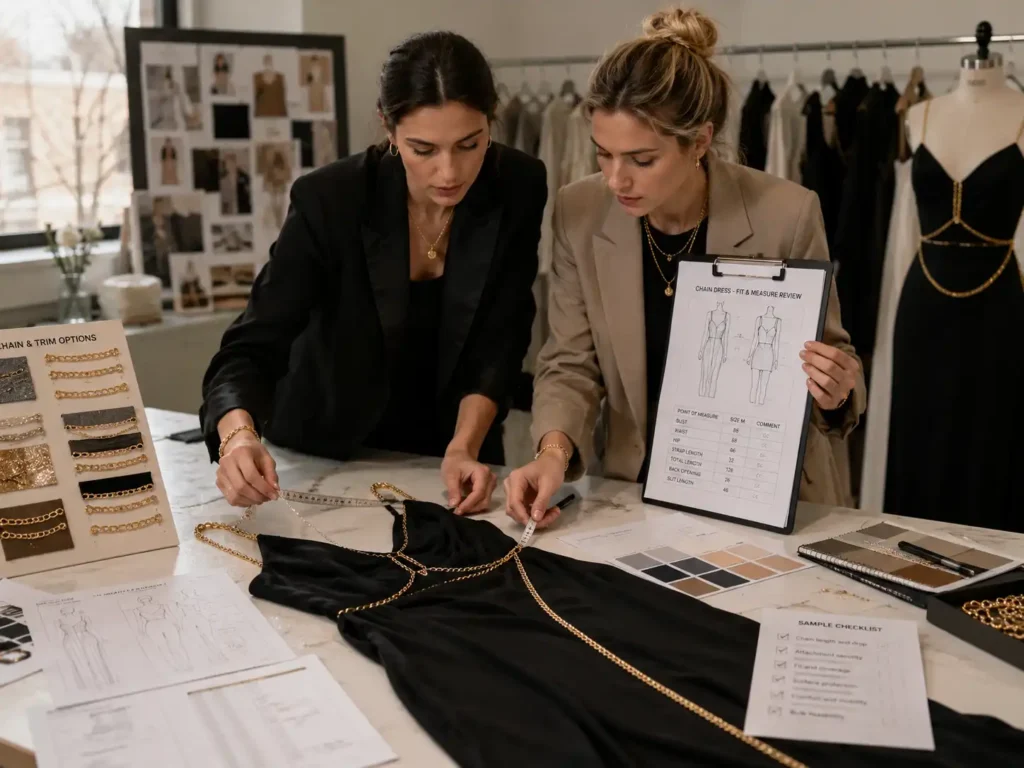
How should files be shared safely?
Not every supplier conversation requires full design access. At the first stage, brands can share product category, target fabric direction, estimated quantity, size range, target market and a limited set of non-sensitive reference images. After the manufacturer confirms capability, timeline, MOQ logic, sample process and confidentiality practice, the brand can share deeper files.
Sensitive files should be shared through a controlled folder, not scattered across chat threads. The folder should separate working files, approved files and archived versions. File names should include style number, version and date. A photo named ‘DR102_PP_front_approved’ is safer than ‘IMG_4821’. This keeps designers, merchandisers, pattern makers and QC teams working from the same standard.
Do suppliers need everything at once?
A supplier needs enough information to give a serious technical response, but not everything at the first message. Full access is usually needed once pattern work, fabric matching, trim sourcing and sample making begin. Before that, staged sharing is safer.
A professional manufacturer should be comfortable with this process. It should ask for the right details at the right stage: whether the sample is final or directional, which elements must remain unchanged, whether the fabric is original or replaceable and whether the design is unpublished. If the supplier only says, ‘Send sample and we copy,’ without discussing fit, construction or confidentiality, that is a warning sign. Original dress samples should be reviewed with technical care, not treated as casual garments.
|
File Type |
Sensitivity Level |
When to Share |
Recommended Control |
|
General style reference |
Low |
Early supplier screening |
Use non-campaign images if possible |
|
Target quantity and market |
Low to medium |
Early costing discussion |
Avoid launch-sensitive details too early |
|
Tech pack |
High |
After capability is confirmed |
Share through controlled folder |
|
Original sample photos |
High |
After project discussion |
Watermark or limit download access |
|
Physical original sample |
High |
After NDA or trusted cooperation |
Log shipment and receipt |
|
Pattern / CAD file |
Very high |
Only when needed for development |
Restrict to technical team |
|
Label and packaging artwork |
High |
After supplier selection |
Use version control |
What Documents Should Support the Original Sample?
Flat lay of a women’s dress tech pack, size chart, fabric swatches, trim card, zipper samples, labels, barcode sticker and measuring tools around an original dress sample; clean editorial product development look, realistic garment factory documentation scene.
An original dress sample should be supported by a tech pack, size chart, fabric swatches, trim card, BOM, sample photos, pattern record, revision log, label files and packaging requirements. These documents turn the physical sample into a repeatable production standard and reduce the risk of wrong fabric, wrong fit, wrong construction or wrong bulk details.
What should a tech pack record?
A tech pack should record the information needed to make the dress without guessing. At minimum, it should include style number, sketches or photos, measurement chart, graded size specs, BOM, fabric details, trim details, construction notes, stitch details, label placement, packaging requirements and approval records.
For dresses, the tech pack should go beyond a basic spec sheet. Neckline depth, bust width, underbust, waist, hip, strap length, sleeve opening, skirt length, slit height, sweep, lining length and zipper length may all affect the final look. For corset, strapless, backless, bodycon, cut-out and mesh styles, the tech pack should explain support, coverage, transparency and stretch behavior. A good tech pack does not remove communication, but it reduces interpretation errors.
Which measurements should be locked first?
Measurements should be prioritized based on the dress type. A bodycon dress needs close control of bust, waist, hip, length and fabric recovery. A corset dress needs bust cup position, underbust, waist, boning length and back closure stability. A maxi dress needs shoulder-to-hem length, lining length and hem balance. A halter or cut-out dress needs strap length and coverage control.
Not every point of measure needs the same tolerance. A fitted bodice may need tighter tolerance than a loose skirt sweep. A decorative bow may allow more variation than a neckline. The simple rule is this: if a measurement affects fit, coverage, comfort or the selling point of the design, it should be locked in the official file before bulk production.
How do fabric and trims support accuracy?
Fabric swatches protect what photos cannot show: hand feel, weight, stretch, shine, transparency, texture, color and drape. Two satin fabrics may look similar in photos but behave differently after sewing. One may fall softly; another may wrinkle, pull at seams or show pressing marks.
Trim cards are just as important. Zippers, hooks, buttons, boning, cups, elastic, strap sliders, labels, hangtags and packaging accessories affect both appearance and performance. A cheaper zipper may wave on a fitted satin dress. A different boning type may weaken a corset. A slightly different care label position may affect comfort. These details should be approved as physical references, not only written descriptions.
Why does the revision log matter?
A revision log protects the project from old mistakes coming back. Every sample change should show what changed, why it changed, who approved it and which sample version uses the change. ‘Make waist tighter’ is not enough. A safer note would say: ‘Reduce waist by 2 cm total on size S; update graded size chart; apply to Sample 2 and PP sample.’
This record is especially useful when several people are involved. Designers, buyers, merchandisers, pattern makers and QC teams may join the project at different stages. The revision log keeps the project history visible. Without it, people rely on memory, and memory is not a production standard.
|
Dress Type |
Measurements to Lock First |
Typical Tolerance |
Extra Check |
|
Bodycon dress |
Bust, waist, hip, length |
+/- 1.0-2.0 cm |
Stretch recovery after fitting |
|
Corset dress |
Bust cup, underbust, waist, boning |
+/- 0.5-1.0 cm |
Support and closure tension |
|
Satin slip dress |
Chest, neckline, strap, hip, length |
+/- 0.5-1.5 cm |
Seam smoothness and drape |
|
Mesh dress |
Body width, lining, sleeve, neckline |
+/- 0.5-1.5 cm |
Transparency and lining coverage |
|
Maxi dress |
Shoulder-to-hem, waist, lining, sweep |
+/- 1.0-2.0 cm |
Hem balance after hanging |
|
Cut-out dress |
Cut-out width, strap, waist, side seam |
+/- 0.5-1.0 cm |
Body coverage and stability |
|
Sequin dress |
Bust, waist, hip, hem, sleeve |
+/- 1.0-2.0 cm |
Surface damage and seam comfort |
How Is the Original Sample Managed During Development?
Garment sample room scene with a dress sample tagged with a style number, sample receipt form, pattern paper, comments sheet and sewing tools; organized fashion development workflow, realistic Guangdong womenswear factory environment.
During development, the original sample should be logged, photographed, measured, stored safely, reviewed by the technical team and linked to every revision. Each approved change should update the tech pack, pattern, BOM or measurement sheet, so the final approved sample becomes a controlled production reference instead of a loose interpretation.
How should sample receipt be controlled?
The moment a manufacturer receives an original dress sample, it should create a sample receipt record. This record should include received date, sender, style name, color, size, quantity, visible condition, attached files and the responsible project person. If the dress is delicate, the record should mention stains, pulled threads, loose sequins, broken zipper, missing trims, heavy wrinkles or fabric damage.
This protects both sides. The brand knows the sample arrived safely. The factory has proof of the condition before development begins. For high-value samples, photos should be taken before the garment enters the pattern room or sample room. The sample should then be tagged and stored in a clean place, especially when it involves satin, lace, mesh, tulle, chiffon, sequin or light-colored fabric.
What should the technical review check?
The technical review should happen before pattern correction or sample copying begins. The team should inspect silhouette, fabric, trims, lining, sewing method, fit points, internal structure and production difficulty. The goal is not only to reproduce the sample, but to understand which parts must remain unchanged and which parts may need adjustment for bulk production.

A handmade original sample may look beautiful but use a method that is difficult to repeat. A backless dress may need hidden support. A strapless dress may need inner grip or boning. A sequin dress may need seam cleaning for comfort. A lace dress may need motif planning to reduce waste and keep placement consistent. Technical review turns design admiration into production thinking.
Which revisions need written approval?
Every revision that affects fit, appearance, cost, construction, material, trims, label or packaging needs written approval. Casual comments such as ‘make it tighter,’ ‘improve the bust’ or ‘use nicer fabric’ should be converted into specific actions. More fitted where? Bust, waist, hip or back? By how many centimeters? Does the grading change too?
A controlled revision should state the issue, action, affected measurement, affected file, sample version and approval person. This does not slow the process down. It prevents repeated mistakes. In fast fashion development, a clear two-minute approval note can save days of re-sampling because the next sample maker knows exactly what was changed.
How are patterns and files updated?
Every approved sample change must be reflected in the official files. If the pattern changes but the tech pack does not, the project becomes unstable. If the BOM changes but the trim card does not, production may purchase the wrong trim. If the size chart changes but QC checks against the old version, finished goods may be judged incorrectly.
Pattern version control is especially important for fitted and structured dresses. Corset dresses, bodycon dresses, cut-out dresses, strapless dresses and backless dresses often need several small corrections. Each correction should connect to a sample version, fitting note and date. For repeat orders and seasonal collections, these records become valuable because they allow a successful style to be reproduced or updated without starting from zero.
How Do PP Samples Protect Bulk Production?
Pre-production sample approval table with an approved dress sample, fabric swatch, trim card, QC checklist and sealed sample tag; production line in soft background, modern custom dress manufacturing scene, realistic and clean.
PP samples protect bulk production by confirming the final approved standard before mass cutting and sewing. A PP sample should reflect the intended fabric, trims, measurements, construction, workmanship, labels and packaging direction. Once approved, it becomes the main comparison reference for production teams and QC inspectors.
What is the real purpose of a PP sample?
A PP sample is not just another sample. It is the point where development stops being exploratory and becomes production-ready. Before PP approval, the brand and factory may still adjust fit, fabric, trims, lining, stitching or cost. After PP approval, changes should be limited and clearly controlled.
For dresses, PP sample review should check more than appearance. It should cover fit, measurements, fabric hand feel, color, lining, zipper, seam tension, strap strength, neckline position, slit height, hem balance, label placement and packaging direction. If the PP sample is approved too casually, bulk production may repeat the same problem across the whole order.
How is a sealed sample used?
After approval, the PP sample should become a sealed sample. A sealed sample is the fixed reference used during production and inspection. It should be tagged with style number, color, size, approval date, version number and any agreed exceptions. It should not be altered, borrowed casually or mixed with earlier samples.
A sealed sample is especially important for styles where visual balance matters: satin slip dresses, lace dresses, corset dresses, bodycon dresses, mesh dresses, sequin dresses and long occasion dresses. These styles may pass rough measurement checks but still fail visually if the production team does not compare them against an approved physical reference.
Which bulk checks should compare the sample?
Bulk comparison should happen at several points, not only at final inspection. Fabric receiving should compare color, hand feel, weight, stretch and defects against the approved swatch. Trim receiving should compare zippers, labels, buttons, elastic, boning and cups against the trim card. Cutting approval should check grainline, placement, shade control and size ratio.
The first output check is one of the most useful steps. Once the sewing line finishes the first units, the factory can compare them to the sealed sample before full production continues. If the zipper waves, neckline stretches, lining pulls or hem is uneven, the issue can still be corrected early.
Are TOP samples still useful?
TOP samples, or top-of-production samples, are useful when the order is large, the style is complex, the fabric is unstable or the brand wants extra confidence before shipment. Unlike a sample-room piece, a TOP sample comes from actual production, so it shows whether the approved result can be repeated under real production conditions.
Sample-room sewing and bulk sewing are not the same. A sample maker may sew slowly and carefully, while bulk production involves repeated operations, cutting layers, machine settings, pressing routines and delivery pressure. For fitted, structured or delicate dresses, TOP samples can reveal size growth, poor pressing, lining tension, strap weakness, sequin abrasion or hem imbalance before the full order is packed.
|
Production Checkpoint |
What to Compare |
Practical Control Point |
Risk Reduced |
|
Fabric receiving |
Color, hand feel, weight, stretch, defects |
Compare with approved swatch |
Wrong fabric or shade variation |
|
Trim receiving |
Zipper, label, button, elastic, boning, cups |
Compare with trim card |
Wrong trims or weak support |
|
Cutting approval |
Grainline, placement, size ratio, panel direction |
Check first marker and first cut panels |
Twisting, shade panels, print errors |
|
First output |
First finished pieces from line |
Compare with sealed sample before continuing |
Repeated sewing mistakes |
|
Inline inspection |
Measurements, seam quality, construction |
Check during production |
Large-scale defect spread |
|
Final inspection |
Appearance, fit points, measurements, finishing |
Use sealed sample and spec sheet |
Bulk inconsistency |
|
Packing inspection |
Label, hangtag, polybag, barcode, carton mark |
Compare packing requirement |
Warehouse or retail delivery errors |
How Do You Choose a Manufacturer That Protects Samples?
Professional meeting between fashion brand buyer and women’s dress manufacturer team reviewing an original sample, NDA, QC checklist, pattern record and fabric cards; clean modern office and sample room background, trust-focused B2B apparel sourcing image.
Choose a manufacturer that protects samples through confidentiality control, technical review, organized sample handling, written revision tracking, PP sample approval, QC comparison and long-term record keeping. The right partner treats the original sample as a brand asset and production standard, not as a casual garment to copy.

Does the factory respect confidentiality?
A sample-protecting manufacturer should be able to explain how confidential files and garments are handled. It should know whether it signs NDAs, who can access files, how physical samples are stored, whether client photos are used publicly and how partner factories follow the same rules. Confidentiality is not only a document; it is a daily working habit.
A responsible manufacturer should also avoid showing unpublished client samples in marketing without permission. Capability can be shown through approved cases, anonymous process examples, fabric knowledge, construction details and workflow explanations. If a supplier freely displays other clients’ unreleased samples, it may do the same with yours.
Can the team analyze the sample technically?
A safe manufacturer does not only receive a sample; it analyzes it. The team should understand pattern, fabric, trims, fit, sewing, QC and production planning. This matters because many dress problems are hidden until fitting or bulk production. A sample may look simple outside but require hidden support, careful lining, special pressing, controlled stretch or precise motif placement.
Good questions are a positive sign. Is the sample final or only directional? Which details must stay unchanged? Is the fabric available or should alternatives be approved? What size range will be produced? What is the target market? What parts of the style may affect cost or lead time? These questions show that the supplier is thinking beyond copying the surface.
Is the QC system linked to the sample?
A manufacturer that protects samples should connect QC directly to the approved sample. Quality control should start before sewing, with fabric and trim checks. It should continue through cutting, first output, inline inspection, measurement checks, garment appearance review, pressing, packing and pre-shipment inspection.
For dresses, QC should be style-specific. Bodycon styles need stretch and measurement control. Satin dresses need seam and pressing control. Mesh dresses need transparency and lining control. Lace dresses need placement and thread cleaning. Sequin dresses need surface protection and seam comfort. Maxi dresses need hem balance after hanging. A general QC checklist is useful, but original samples need style-specific inspection points.
Does the factory keep long-term records?
Record keeping turns a one-time sample into a long-term product asset. If a dress sells well, the brand may reorder it, change colors, adjust length, switch fabric or build a related collection. Without pattern records, measurement files, fabric references, trim details and packing notes, every repeat order becomes risky.
Long-term records also reduce communication time. A successful corset block may support several new styles. One approved satin quality may be reused across multiple colorways. One private-label packaging setup may apply to many SKUs. For brands planning repeat orders and seasonal collections, a manufacturer with organized records can help the brand move faster without losing control.
Protect the Sample, Protect the Collection
Protecting an original dress sample is not only about preventing copying. It is about protecting the commercial value of the collection. A sample carries fit, fabric, proportion, construction, launch timing, brand positioning and production expectations. If it is handled casually, the brand may lose time, money, originality and customer trust.
A practical protection system is not complicated. Use an NDA when the design is sensitive. Share files in stages. Record sample receipt and condition. Build a complete tech pack. Lock fabric swatches and trim cards. Track every revision in writing. Approve a PP sample before bulk. Use a sealed sample for QC comparison. Keep records for repeat and seasonal production.
For brands developing custom dresses, party dresses, occasionwear, bodycon dresses, corset dresses, mesh dresses, satin dresses, lace dresses, sequin dresses, jumpsuits, sets and private-label womenswear, the right manufacturer should protect both the design and the production outcome. Jinfeng Apparel supports OEM, ODM, private label and custom womenswear manufacturing for global fashion brands and mid-to-large apparel clients, with development support from tech packs, reference photos, original samples, line sheets or sketches, plus fabric sourcing, trim sourcing, pattern making, sampling, bulk production, QC and private-label packing.
Share This Article :

Jerry Lee
Categories

Latest blogs

Table of Contents
Here, developing your OEM/ODM private label clothing collection is no longer a challenge—it’s an excellent opportunity to bring your creative vision to life.

