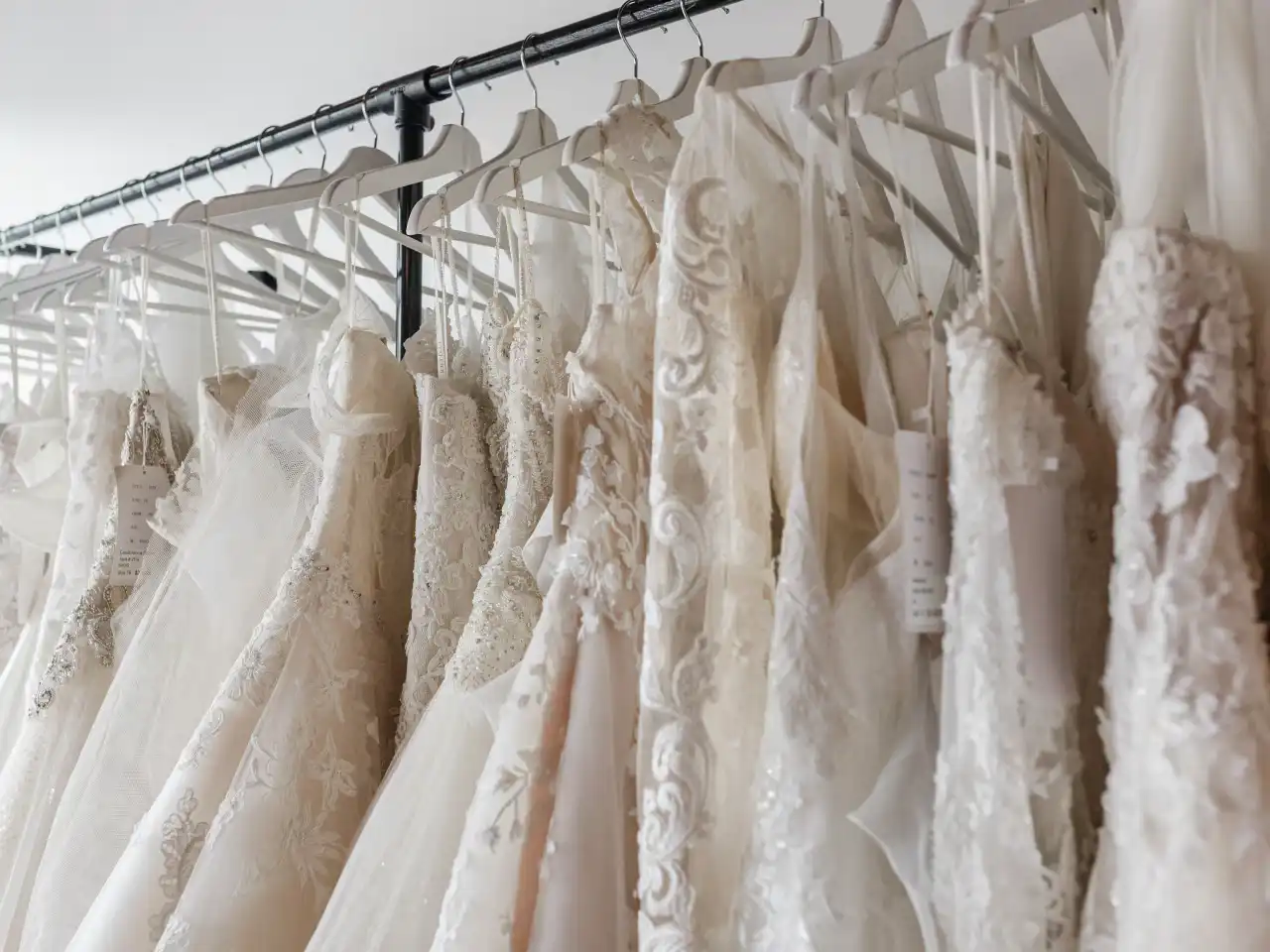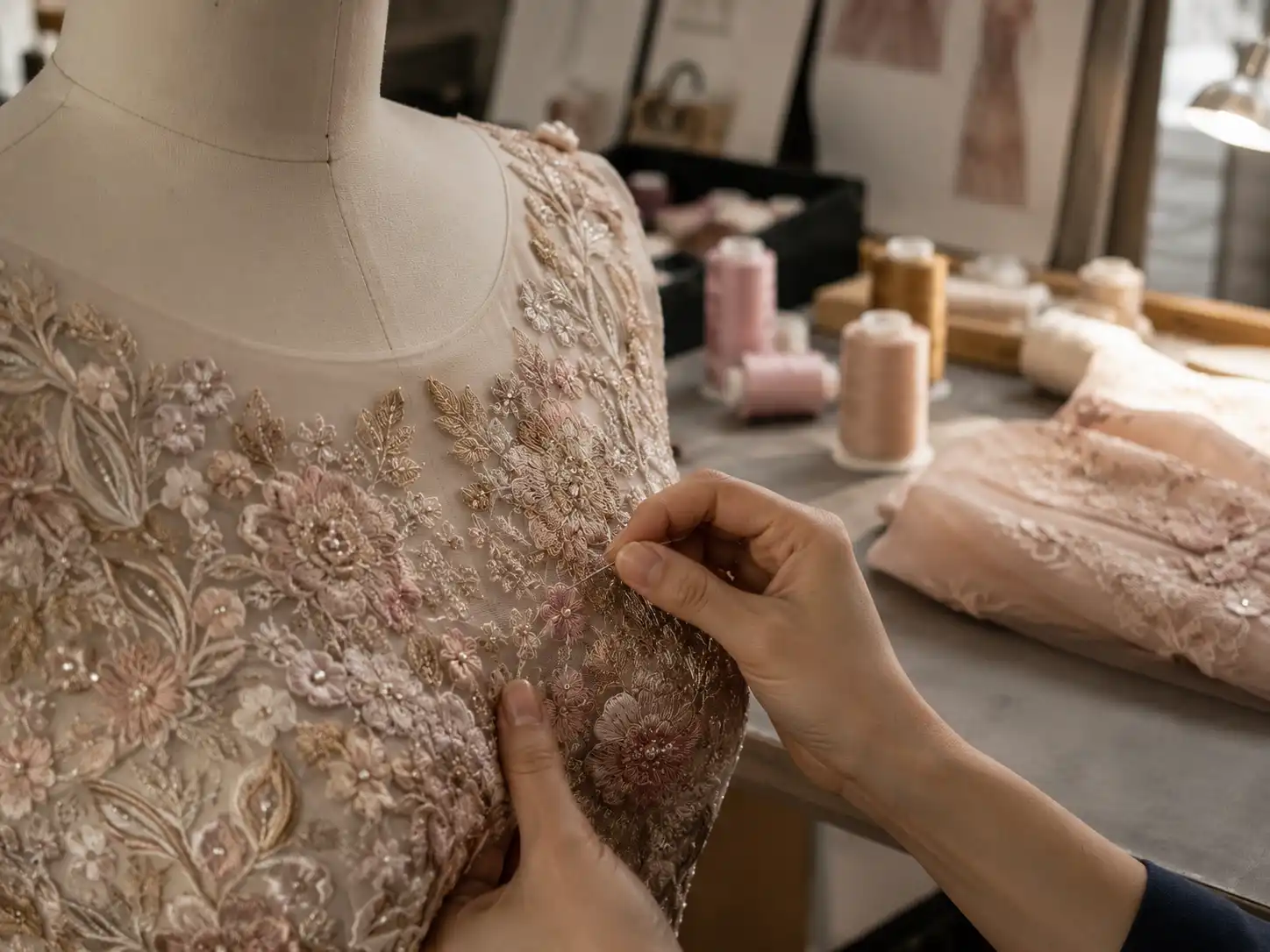
In fashion development, there is a silent misunderstanding that repeatedly causes sampling delays, inconsistent sizing, and unexpected bulk failures. Many assume that flat sketches define how a dress will be produced. In reality, sketches only show visual intention—silhouette, style lines, and design mood—while the actual construction logic is driven by measurement specifications.
In real production environments, factories do not build garments from drawings. They build from numerical precision: bust circumference, waist tolerance, hip grading, shoulder slope, armhole depth, and length distribution. A sketch may inspire creativity, but it cannot define how fabric behaves when tension, stitching balance, and grading rules are applied at scale.
Measurement specifications are more important than flat sketches in dress production because they define exact garment dimensions, grading rules, and fit tolerance. While sketches communicate design intent, only measurement specs control pattern creation, sampling accuracy, and bulk production consistency. Without precise specs, even perfect sketches lead to inconsistent sizing and repeated sampling errors across production lines.
In one real production case from a 3,000-piece dress order, a brand provided detailed sketches but incomplete measurement specs. The result was three sampling rounds, a 17% size deviation in bulk, and a two-week shipment delay. The correction only happened after a full measurement spec sheet was rebuilt from scratch.
This is where the real shift happens—design is imagination, but production is mathematics. And the gap between the two is where most manufacturing risk begins.
What Do Measurement Specs and Flat Sketches Actually Represent in Dress Production?
Measurement specs and flat sketches represent two completely different control systems inside dress manufacturing. Sketches represent visual intention—silhouette, proportion, and design language. Measurement specs represent execution logic—exact body dimensions, grading rules, and construction tolerances.
In real production flow, sketches act as the “visual agreement layer,” while specs act as the “engineering control layer.” A sketch can show a fitted waist dress, but only specs define whether the waist is 68 cm, 70 cm, or 72 cm, and how it changes across sizes.
Factories do not build garments from visual interpretation. Pattern makers convert measurement specs into base blocks, while sketches are used only to confirm style alignment. Once production starts, measurement specs override sketch interpretation in every step—pattern drafting, sample sewing, and bulk QC.
In structured dress production systems, missing or unclear specs increase sample revision rate by 2–3 cycles on average, while detailed specs reduce first-sample approval time by up to 40%.
What Is a Measurement Specification Sheet in Real Production?
A measurement specification sheet is a structured technical document that defines garment dimensions at specific body points. It includes size breakdown, tolerance range, and grading logic used for scaling.
In actual factory use, a complete spec sheet usually contains 20–45 measurement points depending on garment complexity. For a midi dress, typical key points include bust, waist, hip, shoulder width, armhole depth, back length, front length, and hem sweep.
Each measurement is not isolated—it connects to pattern structure. For example, a 1 cm increase in waist affects dart intake, side seam curvature, and hip transition balance. Without structured specs, pattern makers rely on assumptions, which leads to inconsistent fit across samples.
| Measurement Area | Function in Production | Risk if Missing |
|---|---|---|
| Bust / Waist / Hip | Defines core fit block | Size distortion |
| Shoulder Width | Controls upper balance | Dropped/raised silhouette |
| Armhole Depth | Movement comfort | Tightness / restriction |
| Dress Length | Visual proportion | Style mismatch |
| Sleeve Length | Full-body proportion | Incorrect grading flow |
In production environments, spec sheets are referenced at every stage, while sketches are only reviewed during early development alignment.

How Do Flat Sketches Function in Manufacturing Communication?
Flat sketches function as visual communication tools that define garment structure without physical measurement control. They illustrate seam lines, silhouette shape, and proportion balance in a simplified technical drawing format.
In production communication, sketches help align expectations between design intent and factory interpretation. However, sketches lack measurable boundaries. For example, a sketch can show “slim fit,” but cannot define how slim—whether the waist reduction is 4 cm or 8 cm.
Different factories may interpret the same sketch differently based on internal pattern standards. This is why identical sketches can produce different fitting results across suppliers.
Sketches are also unable to reflect fabric behavior. A flowing chiffon dress and a structured satin dress may share identical sketch outlines but require completely different construction logic.
Despite limitations, sketches remain important during early sampling discussion because they reduce misunderstanding around design direction before technical data is finalized.
How Do Specs and Sketches Work Together in Tech Pack Development?
In real tech pack structure, sketches and specs operate in a hierarchical system. Sketches define “what the garment should look like,” while specs define “how the garment must be built.”
When conflicts occur, measurement specs take priority because they directly impact physical output. For example, if a sketch shows an oversized sleeve but the spec defines a narrow arm opening, factories follow spec data during pattern creation.
A standard tech pack typically integrates:
- Flat sketch (visual reference layer)
- Measurement spec sheet (execution layer)
- Fabric and trim details (material layer)
- Construction notes (process layer)
| Tech Pack Component | Function | Production Priority |
|---|---|---|
| Flat Sketch | Visual alignment | Low |
| Measurement Specs | Fit control | Highest |
| Fabric Details | Material behavior | High |
| Construction Notes | Sewing logic | High |
In actual production systems, measurement specs are repeatedly used across sampling, grading, and bulk QC, while sketches are mainly referenced at the beginning stage. This difference explains why specs carry higher production authority and directly determine garment consistency.
Why Do Measurement Specs Determine Fit Accuracy More Than Sketches?
Measurement specs determine fit accuracy because they directly control how a garment is constructed, shaped, and graded across sizes. In dress production, fit is not defined by appearance but by measurable body alignment. A sketch can suggest a slim waist or relaxed silhouette, but only measurement specs define the exact waist circumference, bust suppression, hip allowance, and vertical balance.
In real factory workflows, pattern makers convert measurement points into geometric construction blocks. Every 1 cm adjustment affects multiple connected areas. For example, reducing waist by 2 cm may shift dart intake, side seam curve, and hip transition line simultaneously. Sketches cannot manage these dependencies.
Across production data from structured OEM dress runs, clear measurement specs reduce fit deviation in bulk production from 3–5 cm variance down to 0.5–1.5 cm tolerance range, depending on fabric stability.
How Do Measurement Specs Translate Into Pattern Accuracy?
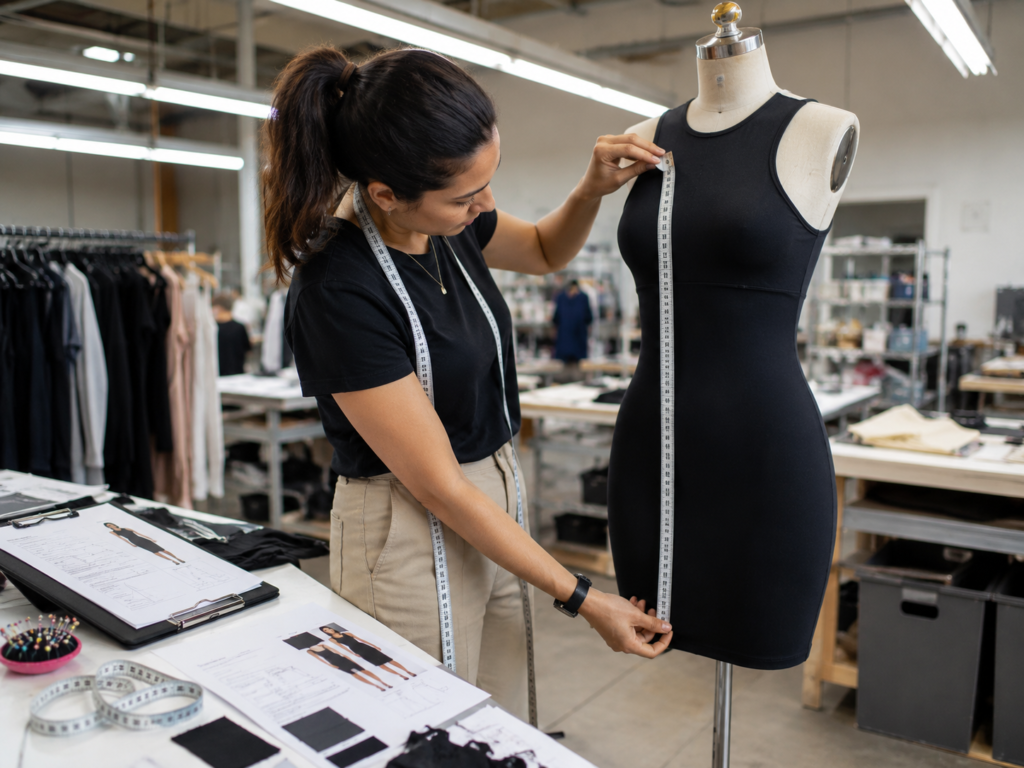
Measurement specs are converted into base patterns through CAD or manual drafting systems. Each measurement becomes a fixed reference point in a two-dimensional structure. Pattern makers do not interpret aesthetics—they follow numerical logic.
A standard dress pattern may include:
- Bust width control point
- Waist suppression ratio
- Hip expansion curve
- Armhole depth positioning
- Shoulder slope angle
These values determine how fabric behaves when cut and sewn. Even a 1 cm mismatch at bust level can change garment tension distribution and lead to pulling or wrinkling during wear.
Without structured specs, pattern creation becomes interpretive. Different technicians may produce different base blocks from the same sketch, which leads to inconsistent sample outcomes across factories or even within the same factory.
Why Sketches Cannot Control Body Proportion Accuracy
Flat sketches cannot ensure fit accuracy because they lack measurable constraints. They show proportion visually but do not define numerical relationships between body zones.
For example, a sketch may show:
- High waistline placement
- Tight body contour
- Balanced shoulder width
However, it does not define:
- Exact waist height from shoulder point
- Bust-to-waist ratio in centimeters
- Allowance for movement or fabric stretch
This creates interpretation gaps. Two factories may read the same sketch differently:
| Element | Factory A Interpretation | Factory B Interpretation |
|---|---|---|
| Waist position | Natural waist | Slightly above waist |
| Fit level | Semi-fitted | Body-hugging |
| Hip curve | Soft curve | Straight line |
In production reality, these differences become visible during first sample fitting, not during design review. That is why sketches alone cannot guarantee consistent fit execution.
How Do Specs Control Fit Consistency in Bulk Production?
Fit consistency in bulk production depends on whether measurement specs are standardized across sampling, grading, and sewing operations. Once a spec sheet is locked, every production stage follows the same dimensional rules.
Factories typically apply specs in three key stages:
- Pattern creation stage
- Sample validation stage
- Bulk QC measurement stage
Each stage uses the same reference sheet, ensuring no deviation in interpretation.
In controlled production systems, consistent specs reduce size deviation rate across batches from approximately 6–8% down to 1–2%, especially in fitted categories like bodycon, corset, and structured midi dresses.
| Production Stage | Role of Specs | Impact on Fit |
|---|---|---|
| Pattern making | Defines base structure | High accuracy |
| Sampling | Confirms first fit | Error detection |
| Bulk production | QC reference | Consistency control |
Without stable measurement specs, grading between sizes becomes inconsistent, leading to size M fitting closer to S or L in different production lines.
Why Measurement Error Has Greater Impact Than Visual Design Error
In dress production, visual differences are often less critical than dimensional errors. A slightly different seam angle may still look acceptable, but a 2 cm waist deviation can completely change garment fit perception.
Measurement errors directly affect:
- Body comfort level
- Movement flexibility
- Silhouette balance
- Brand size reliability
For example, in a fitted satin dress:
- Waist deviation of 1 cm → noticeable but wearable difference
- Waist deviation of 2–3 cm → size mismatch across markets
- Hip deviation of 3 cm → structural distortion in silhouette
Sketch-based guidance cannot prevent these issues because it does not define tolerances or scaling logic.
Measurement specs act as a control system that locks body proportions across all production units. That is why in professional dress manufacturing, specs are treated as the governing document for fit accuracy, while sketches remain supporting visual references only.
How Do Flat Sketches Support Design but Fail in Execution Control?
Flat sketches play a strong role in early design communication because they translate creative ideas into structured visual layouts. They define silhouette direction, seam placement, and proportion balance in a simplified technical format. In real development cycles, sketches are often the first shared document between design and production teams.
However, sketches only describe appearance logic, not construction logic. They show how a dress should look but not how it should be built. A sketch may indicate a fitted waistline or flared hem, but it does not define measurement depth, fabric tension allowance, or grading rules.
In practice, sketches reduce misunderstanding at concept level but cannot maintain control once production starts. Once pattern making begins, interpretation shifts from visual reading to numerical construction, where sketches lose authority.
Why Flat Sketches Fail in Production Execution
Flat sketches fail in execution control because they lack measurable constraints. They do not define exact dimensions, tolerance ranges, or grading increments required for consistent manufacturing.
In real production environments, multiple technicians may interpret the same sketch differently depending on experience and internal standards. This leads to variation in key areas such as waist position, sleeve volume, and dress length distribution.
For example, a “slim fit midi dress” sketch can result in different outputs:
| Interpretation Factor | Factory A Output | Factory B Output |
|---|---|---|
| Waist shaping | Moderate reduction | Strong reduction |
| Hip contour | Soft curve | Tight curve |
| Dress length | Mid-calf | Below knee |
| Sleeve width | Standard fit | Narrow fit |
Even small interpretation gaps create visible fit inconsistency during sampling stages. These differences are not design errors—they are execution gaps caused by missing measurement control.
Sketches also fail to account for fabric behavior. Stretch fabrics, woven fabrics, and structured fabrics respond differently during sewing and wear. Without measurement rules, sketches cannot adapt to material variation.
Where Flat Sketches Still Add Value in Development
Despite limitations in execution control, flat sketches remain essential in the early development stage. They help align visual direction before technical investment begins and reduce misunderstanding about garment silhouette and design intention.
Sketches are especially useful for:
- Confirming garment silhouette direction (A-line, bodycon, straight fit)
- Aligning design proportions between teams
- Visualizing seam placement and style lines
- Supporting initial sampling discussion before specs are finalized
However, their role is front-loaded in the development process. Once measurement specs are defined, sketches shift from decision-making tools to reference visuals.
In structured production systems, sketches are no longer treated as control documents. They function as communication support tools, while measurement specs become the operational standard.

Why Execution Control Requires Measurement-Based Systems
Execution control in dress production depends on measurable data rather than visual interpretation. Factories rely on numerical inputs to ensure repeatable results across sampling and bulk production.
A structured execution system typically includes:
- Measurement specification sheet (primary control document)
- Pattern block construction rules
- Grading increment logic
- Tolerance allowance system
Without these elements, sketches alone cannot maintain consistency across production stages.
| Control Area | Flat Sketch Role | Measurement Spec Role |
|---|---|---|
| Fit accuracy | Low control | High control |
| Pattern drafting | Reference only | Direct input |
| Bulk consistency | Weak | Strong |
| Size grading | Not defined | Fully structured |
| Production repeatability | Unstable | Stable |
In real factory operations, execution control depends on whether measurement data is locked before sampling begins. When specs are incomplete, even accurate sketches cannot prevent deviations during mass production.
This is why experienced manufacturing teams prioritize measurement systems over visual references once a design moves beyond concept stage.
How Do Measurement Specs Reduce Sampling Cost and Production Risk?
Measurement specs reduce sampling cost by locking garment dimensions before any physical sample is cut. In dress production, every sampling round consumes fabric, labor, pattern revision time, and fitting adjustments. When specs are unclear or incomplete, factories rely on interpretation, which often leads to 2–4 sample revisions per style.
A structured measurement spec sheet reduces this cycle by providing exact numerical targets for each construction point. Pattern makers can directly translate these values into base blocks without waiting for clarification. In structured production data, accurate specs reduce sampling iterations from an average of 3.2 rounds to 1.5 rounds per style.
Cost impact is direct. Each additional sampling round increases material usage and labor cost by approximately 12–18%, depending on fabric type and complexity.
How Do Specs Reduce Fabric Waste and Recutting Loss?
Fabric waste during sampling is often caused by incorrect pattern assumptions or repeated adjustments to fit issues. Without measurement specs, pattern revisions may require full recutting of sample pieces.
A complete spec sheet reduces fabric waste by stabilizing the first pattern draft. Measurements define exact seam lengths, dart positions, and garment balance points, which reduces trial-and-error adjustments.
| Sampling Scenario | Without Specs | With Specs |
|---|---|---|
| Sample rounds | 3–4 rounds | 1–2 rounds |
| Fabric waste per style | 2.5–3.5 meters | 1–1.8 meters |
| Pattern revisions | Frequent | Minimal |
| Time per sample cycle | 7–12 days | 3–6 days |
In structured OEM dress production, reducing just one sampling round across 50 styles can save significant cumulative fabric loss and production hours.

Why Measurement Specs Reduce Production Risk in Bulk Manufacturing
Production risk in dress manufacturing usually appears during scaling from sample to bulk. Small measurement inconsistencies at sample stage multiply when applied across hundreds or thousands of units.
Measurement specs reduce this risk by acting as a fixed reference system for grading and QC control. Once specs are locked, all production lines follow identical measurement thresholds.
Key risk areas controlled by specs include:
- Size inconsistency across production batches
- Fit deviation between sample and bulk output
- Misalignment in grading increments
- Incorrect seam balance during high-volume sewing
In real production cases, uncontrolled specs can lead to 5–8% size deviation in bulk production. With structured measurement control, deviation can be reduced to 1–2%, especially in fitted dress categories.
How Do Factories Use Specs to Prevent Rework and Delays?
Rework is one of the largest hidden costs in dress production. It usually occurs when bulk production does not match approved sample fit. Measurement specs prevent this by providing a shared control document for all production departments.
Factories use specs in three operational layers:
- Pattern team uses specs to build base blocks
- Sewing lines follow spec-based construction checkpoints
- QC team measures finished garments against spec tolerances
If any deviation exceeds tolerance range (commonly ±1 cm for key points), production is flagged before shipment.
| Production Stage | Role of Specs | Risk Without Specs |
|---|---|---|
| Pattern making | Structural guide | Incorrect base fit |
| Sampling | Fit validation | Multiple revisions |
| Bulk sewing | Execution reference | Inconsistent output |
| QC inspection | Final checkpoint | Shipment rejection risk |
Without this structured system, even small measurement drift can result in full batch rework, especially in fitted or structured dress categories.
Why Measurement Specs Improve Time-to-Market Efficiency
Speed in dress production is directly linked to how quickly first samples are approved. Measurement specs shorten development time by reducing communication loops between design interpretation and factory execution.
When specs are complete, factories can proceed directly to pattern making without clarification delays. This eliminates back-and-forth discussions that often extend sampling timelines by 5–10 days per round.
In practical production flow, strong measurement systems improve overall development speed by 25–40%, especially when multiple styles are developed in parallel.
The real advantage is not only cost reduction but also production predictability. Once specs are stable, scheduling, fabric booking, and bulk planning become significantly more reliable, reducing downstream disruption during peak production seasons.
What Makes a Measurement Spec Factory-Ready in Real Dress Manufacturing?
A factory-ready measurement spec sheet is not a simple size list. It is a structured production control document that defines garment dimensions, grading logic, tolerance limits, and construction logic in a way that pattern makers and production lines can directly execute without interpretation.
In real dress manufacturing, a usable spec sheet must eliminate ambiguity. Every measurement must be traceable to a pattern point and repeatable across sizes. A missing or unclear spec point often leads to pattern guessing, which increases sampling rounds and bulk inconsistency.
A complete spec sheet usually reduces first-sample correction rate by 30–50% compared to incomplete or visual-only instruction sets.
What Data Must Be Included in a Production-Ready Spec Sheet
A factory-ready spec sheet includes more than basic body measurements. It connects measurement data with grading rules and fabric behavior. Without these layers, production teams cannot guarantee consistent fit across sizes.
Key required data:
- Base size reference (S / M sample baseline)
- Full point-to-point measurement chart (20–45 points depending on dress type)
- Clear tolerance range for each critical point
- Grading increments for each size step
- Fabric stretch or shrinkage adjustment notes
- Construction-specific measurement notes (dart, pleat, seam type)
| Spec Component | Purpose in Production | Risk if Missing |
|---|---|---|
| Base size block | Pattern foundation | Inconsistent base fit |
| Measurement chart | Fit control system | Size deviation |
| Tolerance range | QC benchmark | Uncontrolled variation |
| Grading rules | Size scaling logic | Uneven sizing |
| Fabric behavior notes | Material adjustment | Fit distortion |
In fitted dress categories, missing even one key measurement (such as armhole depth or waist position) can lead to 1–2 cm deviation per size step, which becomes visible in bulk production.
How Factories Validate Measurement Specs Before Sampling
Before sampling begins, factories run a technical feasibility check on the measurement spec sheet. This step ensures that the data aligns with production capability, fabric behavior, and pattern construction logic.
Typical validation process includes:
- Checking whether measurement points match garment structure
- Reviewing grading increments for consistency across sizes
- Confirming fabric stretch allowance compatibility
- Ensuring seam construction supports listed dimensions
- Identifying missing or conflicting measurement points
Factories often reject or request revision of specs when:
- Bust-to-waist ratio is unrealistic for chosen fabric
- Armhole depth conflicts with sleeve design
- Length grading is inconsistent with silhouette type
- Tolerance range is missing or too wide for control
In structured production environments, this validation step reduces sampling rejection rate by up to 25–35%, preventing wasted sample cycles.
Common Measurement Spec Mistakes That Delay Production
In real dress development, most delays come from incomplete or inconsistent spec sheets rather than design complexity. Small errors at spec level multiply during sampling and bulk production.
Common mistakes include:
- Missing tolerance ranges for key measurement points
- Inconsistent grading increments between sizes
- No separation between stretch and non-stretch fabric rules
- Over-reliance on visual sketch instead of numerical definition
- Undefined reference size (S/M/L not clearly anchored)
| Mistake Type | Production Impact | Typical Result |
|---|---|---|
| Missing tolerance | QC rejection risk | Rework cycle |
| Wrong grading logic | Size inconsistency | Fit mismatch |
| Fabric assumption error | Pattern distortion | Sample revision |
| Undefined base size | Measurement confusion | Delayed sampling |
In structured manufacturing systems, correcting spec errors after sampling begins can increase total development time by 20–40%, especially in multi-style seasonal collections.
How Strong Measurement Specs Improve Production Efficiency
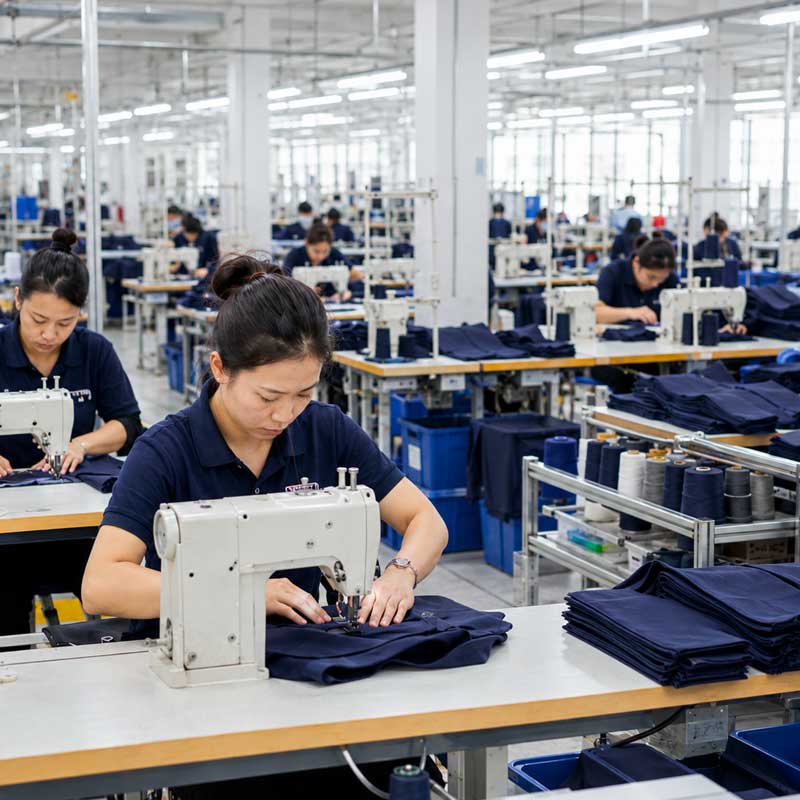
A well-structured measurement spec sheet improves efficiency across every production stage, from sampling to bulk delivery. The main advantage comes from eliminating interpretation gaps between design intention and factory execution.
Efficiency improvements typically include:
- Reduced sampling rounds from 3–4 cycles to 1–2 cycles
- Faster pattern development due to direct measurement input
- Lower communication delay between design and production teams
- Improved bulk consistency across size ranges
- More predictable production scheduling and fabric planning
In real production data, strong measurement systems can improve overall lead time efficiency by 25–40%, depending on garment complexity and fabric type.
The most important outcome is stability. Once measurement specs are properly defined, production becomes repeatable, scalable, and significantly less dependent on subjective interpretation, which is critical for maintaining consistent quality in large-volume dress manufacturing.
Conclusion
If a dress collection requires stable fit, reduced sampling rounds, and consistent bulk production, measurement specification discipline becomes the foundation of success.
Jinfeng Apparel supports global fashion brands with full technical development—from measurement spec building to sampling and bulk production. If there is a design concept ready for development, our team can help convert sketches into production-ready specifications and stable manufacturing output.
Send your tech pack or reference design to Jinfeng Apparel to start a professional OEM/ODM custom dress development process with controlled risk, faster sampling, and production-grade accuracy.