Skip to content

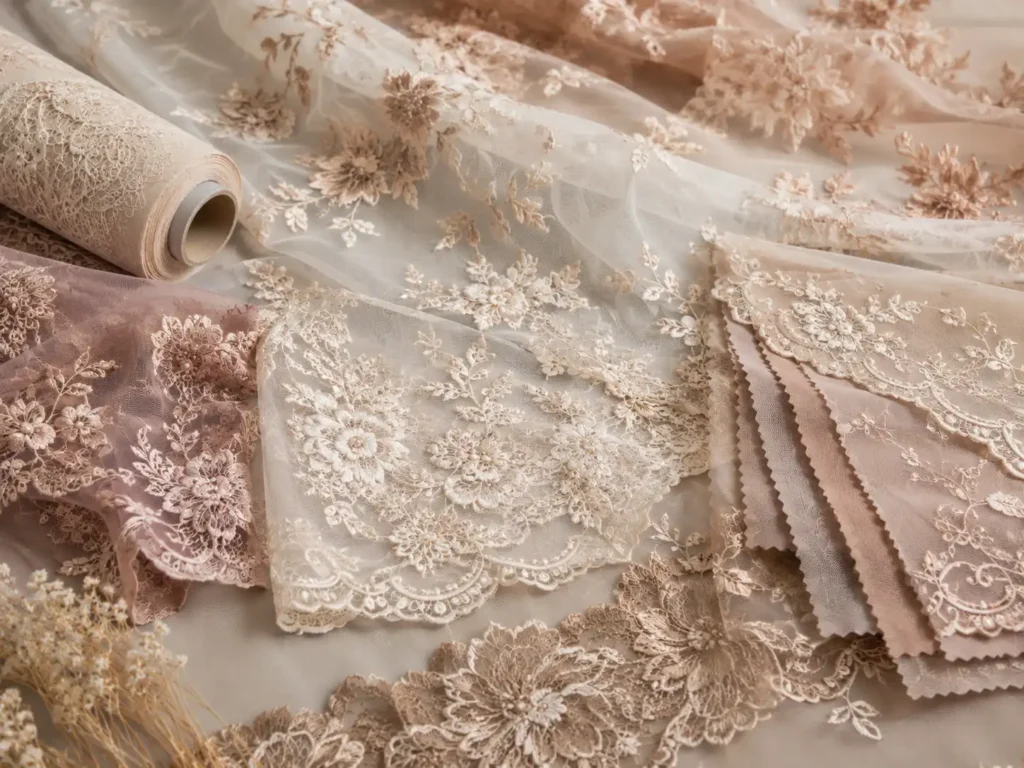
Lace can be deceptive on a sourcing table. Two swatches may share a similar floral motif, softness, transparency, and visual weight, yet behave like completely different materials once they become a fitted dress. One expands around the bust and hip, rebounds after movement, and allows a closer silhouette. The other stays comparatively stable, preserves decorative placement more predictably, and asks the pattern, lining, seams, and closures to create most of the garment’s shape. Neither behavior is automatically better, and choosing by appearance alone is one of the easiest ways to turn a promising design into a difficult sample.
Stretch lace is usually the better choice when a dress needs close-body movement, flexibility, or controlled elastic recovery, while non-stretch lace is often better when the design depends on stability, precise motif placement, scalloped edges, or structured shaping. The final decision should also consider stretch direction, usable extension, recovery, lining compatibility, pattern ease, closures, size grading, cutting yield, and whether the same behavior can be reproduced in bulk production.
A good example appears when a brand replaces an approved lace because a new option looks almost identical and costs slightly less. On the hanger, the change seems harmless. On the body, the waist may relax, the bust motif may open, the neckline may wave, or a formerly comfortable armhole may become restrictive. The real question is therefore not simply whether stretch lace or non-stretch lace looks better. It is which fabric behavior supports the dress you are trying to make, and whether that behavior survives fitting, grading, sewing, movement, and production at scale.
What Is the Difference Between Stretch Lace and Non-Stretch Lace?
Stretch lace extends under tension and is normally selected when the garment needs flexibility, close-body movement, or some fabric-driven shaping. Non-stretch lace is comparatively stable and relies more on pattern engineering, seams, darts, closures, and lining to create fit. The useful comparison goes beyond the label: stretch percentage, recovery, direction, motif stability, thickness, transparency, and intended garment function determine how each lace performs.
What Makes Lace Stretch?
Stretch lace can gain elasticity from elastane or spandex content, from its knitted construction, or from a combination of both. Fiber composition is useful information, but it should never be treated as a complete performance specification. Two laces with similar polyester-and-spandex percentages can still feel very different because yarn size, knit density, motif openness, finishing, and fabric weight change how easily the structure extends and how much force is needed to keep it stretched on the body.
For development work, a simple measured check is more useful than a supplier description such as “high stretch” or “soft stretch.” Mark a relaxed 10 cm section in the direction you want to test, extend it only to the point where the lace still looks healthy, and record the new length. If the 10 cm section reaches 14 cm comfortably, observed usable extension is about 40 percent. The same check should be repeated across the width and length because many fashion laces stretch far more in one direction than the other, which directly affects cutting orientation and body fit.
Maximum extension should not automatically become working stretch. A lace may physically reach 60 percent extension while the flowers open excessively, the ground becomes much more transparent, scallops flatten, or yarns begin to look strained. In that situation, the garment should operate well below the mechanical limit. The practical target is the range in which the fabric can move, recover, and still preserve the intended appearance of the dress.
How Do Stretch and Recovery Differ?
Stretch measures how far the fabric can extend; recovery measures how closely it returns to its original dimensions after tension is removed. For fitted dresses, recovery is often more important than an impressive maximum stretch figure because the wearer repeatedly sits, walks, raises her arms, bends, and pulls the garment on and off. A lace that extends generously but grows after movement may look excellent during the first fitting and noticeably softer around the waist, neckline, elbows, or hips later in the day.
A practical comparison can use the same marked 10 cm section. Extend it to a controlled working distance several times, release it, and measure what remains. If the mark settles at 10.1 cm, recovery is relatively strong in that simple comparison. If it remains at 10.6 cm or 10.8 cm, the fabric is showing residual growth. These numbers are not universal pass-or-fail limits, but they make two candidate laces easier to compare before a pattern is finalized.
The visual response under tension matters as much as the measurement. A floral lace may retain its motif shape while another with the same extension percentage becomes noticeably more open across the bust. A lining may also recover at a different speed from the lace shell, causing layers to shift after movement. That is why serious fabric approval considers extension, recovery, motif distortion, transparency, hand feel, and the actual lined garment rather than a single stretch number.
| Development Check | Stretch Lace | Non-Stretch Lace | Practical Meaning |
| Example 10 cm extension | May reach 12-15 cm or more depending on construction | Usually changes little under controlled pull | Measure the actual lot rather than relying on a category name |
| Recovery after release | Critical for fitted areas | Less central, but structural distortion still matters | Poor recovery can loosen waistlines, necklines, or sleeves |
| Stretch direction | Often strongly directional | Usually relatively stable | Cutting orientation can change fit and garment length behavior |
| Motif under tension | May open or distort | Usually stays more consistent | Check bust, hip, sleeve, and side-panel placement on body |
| Pattern dependence | Fabric can contribute to fit | Pattern carries more of the fit | Do not transfer one pattern between the two without review |
| Closure requirement | Some styles can rely partly on elasticity | Fitted styles often need a zipper or opening | Entry method must be designed with fabric behavior in mind |
What Does Non-Stretch Lace Mean?
Non-stretch lace should be understood as relatively stable rather than completely rigid. Open structures may still show slight mechanical give, diagonal movement, or local distortion between motifs, especially when the lace is lightweight. That behavior is different from elastic recovery. A stable lace can move softly and drape beautifully without providing enough extension to replace the wearing ease, seams, darts, panels, or openings that a fitted garment needs.
Because the fabric contributes less to body conformity, pattern shaping becomes more important. Bust contour, waist suppression, hip allowance, armhole dimensions, sleeve width, and the amount of ease through sitting and walking must be engineered into the garment. A fitted non-stretch lace dress may require an invisible zipper or another opening where a more elastic style could potentially rely on fabric stretch for entry. The lining can also become part of the structure rather than simply an opacity layer.
Stability can be a major advantage when decorative control matters. Large floral motifs tend to stay closer to their planned scale, scalloped edges are easier to preserve, and placement across center front, bust, waist, sleeve, or hem remains more predictable because the surface is not continuously opening and contracting. In lace-dress development, those placement decisions need to be considered together with lining color, edge comfort, hole risk, and sample-to-bulk consistency rather than treated as purely decorative details.
Which Lace Works Best for Different Dress Styles?
Stretch lace generally suits silhouettes where the fabric needs to follow the body and move with it, while non-stretch lace is often stronger for structured shapes, stable overlays, controlled motif placement, and decorative precision. The best choice depends on what the lace is doing in the garment – main shell, sleeve, overlay, fitted panel, neckline, trim, or insert – rather than whether one category sounds more fashionable or premium.
Which Lace Works for Bodycon Dresses?
Bodycon dresses place continuous tension on the fabric, especially across the bust, waist, hip, seat, and upper thigh. Stretch lace with dependable recovery is often a strong choice when the lace itself is expected to participate in fit because it can follow the body without requiring every millimeter of shaping to come from seams or darts. The important word is dependable: high extension with weak recovery can create a dress that looks sharp for five minutes and noticeably softer after normal movement.
During fitting, the garment should be assessed in zones rather than judged by one general impression. The bust needs enough expansion without turning the lace excessively transparent. The waist needs recovery strong enough to preserve shape. The hip and seat must allow walking and sitting without pulling side seams forward. If the style has sleeves, the upper arm and elbow need movement while the shoulder and neckline remain stable. A fabric that performs well in one zone can still create problems in another.
Non-stretch lace can also produce a close, body-conscious silhouette, but the engineering is different. The pattern must provide more deliberate contouring, and closures usually become more important. A well-developed non-stretch lace mini over a shaped lining can look sharper and more sculpted than a very soft stretch version. The right question is not whether bodycon always requires stretch, but whether the fabric and pattern together can deliver comfort, recovery, visual stability, and repeatable sizing.
Which Lace Works for Occasion Dresses?
Cocktail dresses, wedding-guest dresses, evening styles, and other occasion pieces often place more emphasis on motif position, controlled transparency, waist shaping, scalloped borders, photography, and refined drape than on maximum elasticity. Non-stretch lace can be especially effective when the design uses large floral repeats or decorative borders because the artwork stays visually stable across the bodice, skirt, and sleeves rather than expanding differently over different body zones.
Imagine a midi dress with a prominent floral motif centered over the front bodice. On a highly elastic lace, that flower can spread significantly across the bust and appear smaller at the waist where tension is lower. A more stable lace keeps the repeat closer to the intended scale, making left-right symmetry, center-front placement, and scalloped hem treatment easier to control. The trade-off is that the pattern, zipper, lining, and movement allowance must do more of the work.
Stretch lace remains useful in occasionwear when comfort and close fit are part of the design. Fitted sleeves, slim skirts, flexible side panels, and lingerie-inspired evening shapes can benefit from measured elasticity. For collections combining formal appearance with long wear time, the strongest result often comes from placing stretch only where movement is needed and keeping more stable lace where motif definition and structure matter most.
Which Lace Suits Sleeves, Panels, and Trims?
A dress does not need the same lace behavior in every area. In fact, some of the most successful commercial styles use different constructions by zone. Stretch lace sleeves can improve elbow and upper-arm movement even when the bodice uses a stable overlay. Elastic side panels can add flexibility to a close-fitting silhouette without changing the front artwork. Non-stretch scalloped lace can work beautifully at a neckline or hem where a crisp decorative border matters more than expansion.
Before combining materials, map where tension travels during wear. A highly elastic side panel sewn between two rigid body panels may stop expanding at the seam, concentrating stress in the stitching. A flexible neckline can become effectively rigid if it is stabilized too aggressively. A stable overlay can wrinkle if the lining underneath grows significantly during movement. The seam between two materials often determines how the garment behaves more than either fabric does alone.
A practical product review should ask whether each zone is decorative or structural, whether it bends or expands during normal movement, whether the motif must remain symmetrical, whether the edge touches skin, and whether a scalloped border is part of the design. This zone-by-zone approach is more useful than classifying an entire dress as simply stretch or non-stretch, especially for fashion styles that combine lace with satin, mesh, jersey, lining, boning, or other supporting materials.
How Does Lace Stretch Affect Fit and Patterns?
Lace stretch changes how body measurements translate into garment measurements. Greater usable stretch can allow closer fit and less ease, but only when recovery, lining, and construction support it. Non-stretch lace requires more of the silhouette to be built into the pattern. Changing lace after fitting can therefore affect bust, waist, hip, neckline, armhole, length, movement, and grading even when the paper pattern appears unchanged.
How Does Stretch Change Garment Ease?
Ease is the difference between body measurements and garment measurements. With stable fabrics, positive ease is normally needed so the wearer can breathe, sit, and move without forcing the seams. Stretch fabrics make the relationship more dynamic because part of the movement allowance can come from fabric extension rather than extra garment width. In close-fitting designs, some areas may even be developed with negative ease, where the garment measurement is intentionally smaller than the body measurement and the fabric stretches to create the silhouette.
That principle should not be applied mechanically. Two laces can both show 40 percent extension in a simple swatch test yet behave very differently on the body. One may stay visually dense and recover strongly at 15 to 20 percent working stretch, while another becomes much more transparent, distorts its motif, and retains growth. Applying the same negative-ease percentage to both would create different coverage, pressure, and appearance even if the paper patterns were identical.
For fitted dresses, ease should therefore be reviewed by body zone. Bust and hip need movement capacity, while waist and neckline often need stronger recovery. Upper arms need mobility, but shoulders should not sag. The working range should remain comfortably below the point where the lace looks strained. The goal is not to use as much stretch as possible, but to use only as much as the silhouette needs while preserving appearance and recovery.
Do Both Laces Use the Same Pattern?
A pattern approved for stretch lace should not automatically be transferred to non-stretch lace, and a pattern developed around stable lace should not automatically be used with a significantly more elastic replacement. The outline may look identical on the cutting table, but the relationship between body measurement, garment measurement, fabric tension, and movement has changed. Even switching from one stretch lace to another can justify review when recovery, thickness, direction, or motif openness changes substantially.
Consider a fitted mini dress originally developed in a lace that expands comfortably across the body. Replacing it with a similar-looking stable lace may reduce effective bust and hip room, make dressing difficult, increase zipper tension, restrict sitting, distort the armhole, or pull the hem upward. Simply adding width everywhere is not always a clean solution because waist shaping, strap position, neckline fit, and overall proportions can shift at the same time.
The opposite substitution creates another set of risks. If a pattern contains positive ease for non-stretch lace and the new fabric has generous extension, the waist may appear loose, side seams can ripple, the neckline may grow, and the intended sculpted effect can disappear. For professional development, fabric approval and pattern approval are therefore linked decisions. Pattern teams should evaluate bust, waist, hip, length, neckline, straps, slits, lining, and fabric behavior together rather than treating the lace as a cosmetic replacement.
| Fit and Pattern Variable | Stretch Lace Consideration | Non-Stretch Lace Consideration |
| Bust | Check tension, opacity, motif opening, and recovery | Build contour through seams, darts, panels, or lining |
| Waist | Recovery must hold the intended shape | Pattern suppression must create the waist definition |
| Hip/seat | Allow walking and sitting without excessive growth | Provide sufficient wearing ease and closure access |
| Neckline | Stabilize enough to prevent growth | Avoid cutting so tight that movement becomes restricted |
| Sleeve | Confirm upper-arm and elbow mobility | Add sufficient bicep and elbow ease in the pattern |
| Length | Watch vertical stretch and riding-up behavior | Control hem balance through pattern and fabric drape |
| Closure | Some designs may use fabric stretch for entry | Fitted styles commonly need zipper, buttons, or another opening |
| Grading | Recheck tension and transparency across sizes | Recheck ease, motif position, and mobility across sizes |
How Does Stretch Affect Size Grading?
A base-size sample can look excellent and still produce problems after grading. Lace makes this especially visible because the motif does not scale with the garment. If a floral repeat is 8 cm wide, it remains 8 cm in XS, M, and XL. As the pattern pieces become wider, the number of visible repeats, their relationship to the bust and waist, and where they meet the side seams can change even when the technical grade is mathematically correct.
Stretch adds another variable because different sizes can place different levels of tension on the surface. A motif that looks balanced on a medium sample may open more across a larger bust or hip if the negative ease is not adjusted intelligently. Transparency can increase, neckline tension can change, and side seams may shift. For broader size ranges, the same percentage reduction from body measurements does not always create the same visual result in every size.
Grading review should therefore include bust-waist-hip increments, neckline stability, armhole comfort, sleeve mobility, zipper or opening length, lining growth, hem balance, side-seam position, motif centering, and transparency under worn tension. Larger sizes should not be treated as simple enlarged versions of the base sample. The goal is to preserve the intended proportion, coverage, and movement across the range rather than just reproduce a mathematical grade rule.

Do You Need a New Fit Sample After Changing Lace?
When a replacement lace has meaningfully different stretch, recovery, thickness, weight, direction, drape, or transparency, another fit sample is usually the safer decision. A simple color change within the same approved base cloth may not require the same level of re-development, but changing the fabric specification itself can alter the garment far more than the sketch suggests. The lined garment should be reassessed rather than relying on hand feel from a swatch.
Fit review should include front, side, and back views; bust coverage; waist placement; hip fit; strap tension; neckline contact; hem balance; walking comfort; sitting comfort; and how the dress recovers after movement. If the garment contains sleeves, slits, cut-outs, or a low back, those areas should be reviewed under motion because a fabric substitution may shift the tension path and expose problems that do not appear in a static fitting.
For production continuity, approved changes need to enter formal records instead of remaining only in emails or chat messages. A disciplined development process updates the pattern, size chart, measurement tolerances, BOM, fabric reference, sewing instructions, QC checkpoints, and PP-sample comments before bulk production. That approach is especially useful for lace because a seemingly small material substitution can change fit, appearance, workmanship, and bulk consistency at the same time.
How Do Lining and Sewing Methods Differ?
Stretch lace performs best when its lining, seams, and finishes allow the intended movement without creating uncontrolled growth, while non-stretch lace can use more stable constructions but still needs compatible drape, weight, and support. In both cases, an unsuitable lining, rigid seam, bulky zipper, or poorly controlled edge can cancel the advantages of the lace itself and create fit, comfort, or appearance problems.
Which Lining Works With Stretch Lace?
For fitted stretch-lace garments, lining behavior should be considered at the same time as the outer fabric. A highly elastic lace placed over a rigid lining may look like a stretch garment on the hanger but behave like a stable dress on the body because the lining becomes the limiting layer. The opposite can also happen: a very elastic lining under a weaker-recovery lace may continue to move after the shell has reached its intended working range, creating ripples or layer shift.
A compatible lining does not need exactly the same stretch percentage, but the two materials should move predictably together through the garment’s real use range. Weight matters too. A heavy lining can drag delicate lace downward and affect neckline or shoulder position, while an extremely light lining may fail to provide the opacity, smoothing, or support the design needs. For a fitted party dress, the lining may be expected to improve coverage and body feel while still allowing the outer lace to recover cleanly.
Color changes the perceived density and character of lace more than many teams expect. A close-tone lining can make motifs look richer and more continuous, a contrast lining emphasizes the open structure, and a skin-tone base creates an illusion effect. None of these is automatically more premium. During fitting, the finished two-layer garment should be checked after walking and sitting to see whether the layers recover together, side seams remain vertical, and lining stays hidden at hems, slits, armholes, and necklines.
Which Lining Works With Non-Stretch Lace?
With stable lace, the lining often becomes a larger part of the garment’s structural system. It can provide opacity, help control body shaping, protect skin from textured motifs, cover seam allowances, or create the color foundation that gives the lace its finished appearance. Because the shell contributes less elastic movement, the lining, seams, and pattern together must provide the comfort and mobility that a stretch fabric might otherwise contribute.
The common mistake is assuming that non-stretch lace always needs a rigid lining. A soft lace overlay on a fluid midi dress may need a lining with similar drape so both layers fall naturally. A more structured bodice can benefit from a firmer foundation, especially when the style includes shaped cups, boning, or a defined waist. Matching the movement and weight of the layers is more important than assigning one generic lining to every stable lace.
Length and exposure also need deliberate control. If the lining finishes too close to a sheer scalloped hem, it can create a visible horizontal line that interrupts the lace. If it finishes too short, the garment may look more revealing than intended. At necklines, slits, and armholes, the lining should stay hidden without pulling the shell inward. These are visual details, but they also affect comfort, returns, photography, and whether the approved sample can be reproduced consistently.
How Should Seams and Zippers Be Built?
A seam can become the least flexible part of an otherwise highly elastic garment. If the stitch, binding, reinforcement, or zipper tape does not allow enough movement, tension concentrates along that line rather than spreading through the fabric. Stretch lace side seams therefore need sufficient flexibility for body movement, while shoulders and necklines often need selective stabilization because unlimited extension is undesirable in those areas.
Non-stretch lace places less pressure on seam elasticity but more emphasis on precision. A technically strong seam can still look poor if a large flower is cut abruptly at center front or if the left and right panels do not balance. Where motif matching is important, the cutting plan and seam location should be considered together. At the same time, demanding perfect matching on every seam can increase fabric consumption and labor, so production teams should identify the high-visibility areas that actually justify additional control.
Invisible zippers deserve special attention. Zipper tape is comparatively stable, so installing it into soft or elastic lace can create waves if the surrounding area is stretched during sewing. In a stable lace dress, the zipper may be essential for entry, but the seam allowance, lining, waist seam, and top stop still need to lie flat. Construction changes should be documented in sewing instructions and QC checkpoints rather than left as individual operator decisions during bulk production.
How Should Lace Edges Be Finished?
Lace edges are often part of the design rather than something to hide. Scallops, eyelash borders, embroidered contours, and shaped floral edges can create a more refined neckline, sleeve, or hem when they are planned into the pattern from the beginning. If a scalloped border is intended for the hem, pattern pieces may need to follow that border rather than being nested solely for maximum cutting yield, which can increase consumption but preserve the look that made the lace attractive in the first place.
Skin contact is another practical issue. Some lace edges feel soft in the hand but become irritating around the underarm, neckline, waist, or inner sleeve after several hours. A soft binding, lining extension, underlay, or repositioned motif can solve the problem without changing the visual concept. For lingerie-inspired dresses and fitted occasionwear, comfort around the armhole and neckline deserves as much attention as the front view used for product photography.
Stretch edges require additional control because repeated extension can produce waving or growth, particularly at necklines and armholes. Stable edges can remain cleaner but may restrict movement if an opening is cut too close to the body. Bulk specifications should therefore define where decorative borders start, how much variation is acceptable, whether trimming is allowed, and how the edge should look after pressing and packing so the approved sample appearance is not gradually lost across production.
What Should You Check Before Bulk Production?
Before bulk cutting, confirm the approved lace lot, stretch and recovery, direction, motif repeat, color, lining compatibility, finished fit, edge treatment, seam method, placement standards, cutting plan, and production documents. Lace should be approved as part of the complete garment rather than as an isolated swatch because small material changes can affect measurements, appearance, cutting yield, sewing time, cost, MOQ, and sample-to-bulk consistency.
How Do You Test Stretch and Recovery?
A useful internal check begins with a repeatable method. Mark a fixed length, record the direction, extend the swatch to a controlled working distance, release it, and repeat the movement several times. The aim is not to replace a laboratory method with a homemade test. It is to prevent subjective descriptions such as “stretchy enough” from becoming the only reference used by sourcing, pattern, sampling, and production teams.
A practical record can include original length, comfortable extension, maximum observed extension, immediate recovery, residual growth after repeated cycles, transparency change, motif distortion, and any visible yarn strain. The same procedure should be used on the sample fabric and the bulk lot so that differences become visible before thousands of pieces are cut. If the bulk lace feels softer, tighter, heavier, more open, or slower to recover, the same pattern may no longer produce the same fit.
For fitted styles, fabric-lot comparison and garment measurement control are closely connected. A seemingly small change in recovery multiplied across bust, waist, hip, and length can alter the finished silhouette. The check should therefore be repeated in the direction that actually runs around the body and, where relevant, in the vertical direction as well. The goal is not to chase one ideal percentage but to confirm that the bulk fabric behaves close enough to the approved development reference.
How Do You Control Lace Placement?
Lace placement is one of the first details experienced apparel teams notice because poor positioning is visible immediately. Large flowers, leaves, medallions, or geometric repeats can create unintended focal points if they land differently across the bust, center front, waist, or hip. A placement plan should therefore identify the most visible zones before bulk cutting rather than relying on operators to make aesthetic decisions piece by piece.
Perfect matching across every seam is not always commercially sensible. A large repeat can create substantial cutting waste when every flower must align precisely. A more practical approach is to define critical locations – center front, left-right bodice symmetry, bust coverage, neckline, sleeve pair, and scalloped hem – and establish controlled tolerance in lower-visibility areas. That keeps the design intentional without creating unnecessary fabric consumption and labor.
The relationship between placement and lining also matters. Open floral motifs can reveal lining color differently depending on where dense embroidery falls, and stretch can change the apparent spacing once the dress is worn. For repeat orders, keeping an approved placement photo, marker reference, pattern notes, and cutting instructions can reduce variation between seasons or fabric lots. The strongest lace production systems treat placement as a measurable production requirement, not simply a matter of operator taste.
| Bulk Control Point | What to Record | Common Risk if Uncontrolled |
| Stretch direction | Widthwise and lengthwise behavior | Panels cut in inconsistent directions fit differently |
| Recovery | Residual growth after repeated extension | Waist, neckline, sleeve, or hip relaxation |
| Motif repeat | Repeat size and critical placement points | Uneven front panels and accidental focal points |
| Scalloped edge | Start/end position and acceptable variation | Uneven hems or mismatched sleeves |
| Lining | Color, composition, stretch, length | Transparency shift, layer pulling, exposed lining |
| Seam method | Stitch, allowance, stabilization, zipper handling | Puckering, broken thread, rigid seam lines |
| Approved sample | PP/Golden reference and measurement record | Bulk drifts away from the confirmed fit and finish |
| Packing | Fold points and edge protection | Creased motifs, crushed scallops, distorted presentation |
How Do Samples Reduce Production Risk?
Sampling turns assumptions into evidence. The first sample can reveal whether the lace has enough movement, whether the waist sits correctly, whether the lining works with the shell, whether motif placement is acceptable, and whether the proposed sewing method is realistic for repeat production. A revised sample should then solve recorded issues rather than simply produce another garment, giving the pattern, construction, and fabric decisions a clear trail from design concept to production standard.
For complex lace, mesh, sequin, evening, or structured styles, one first sample may not be enough to settle fit and workmanship. A disciplined development path can move from first sample to revised sample, then to a pre-production or PP sample after core appearance, fit, fabric, color, trims, and construction have been approved. A final sealed reference can then serve as the physical standard that production and QC compare against during bulk manufacturing.
The real value of sampling comes from documentation. Approved comments should update patterns, size charts, measurement tolerances, BOM records, fabric and trim references, sewing instructions, QC checklists, and packing requirements. For teams working with Jinfeng Apparel, this first-sample-to-PP-to-Golden-sample logic is part of the documented development workflow, so fabric behavior, fit corrections, and construction changes are transferred into formal production records rather than remaining only in message threads.

How Do Lace Choices Affect Cost and MOQ?
Lace cost is not determined only by the price per meter. Two materials with similar purchase prices can create very different garment costs because cutting yield, motif repeat, scalloped borders, lining requirements, sewing difficulty, defect risk, and matching standards change the amount of material and labor required. A large-repeat lace that needs controlled center-front placement may create more waste than a small all-over pattern even when the base fabric price is lower.
Special constructions can also change sourcing minimums. A factory may have one production MOQ while the lace mill or supplier has a separate minimum for custom colors, special embroidery, unique scalloped borders, or newly developed bases. Jinfeng Apparel’s current standard production MOQ starts from 200 pieces per style and color, while special fabrics, trims, dyeing, printing, or packaging can carry separate supplier minimums depending on the project. That distinction matters when a collection contains many colors or multiple lace qualities.
Cost review should therefore include fabric, lining, trims, pattern work, cutting loss, sewing time, pressing, QC, packaging, testing where applicable, and logistics. A cheaper lace does not always create a cheaper dress if it requires more matching, extra stabilization, slower sewing, or higher wastage. The most useful cost optimization protects the approved appearance and fit first, then looks for smarter material, construction, or marker solutions instead of weakening the product simply to reduce the fabric price.
Which Lace Should You Choose for Your Collection?
Choose stretch lace when controlled flexibility is part of the garment’s fit and movement; choose non-stretch lace when stability, structured shaping, motif control, or decorative precision matters more. For a commercial collection, the strongest decision considers silhouette, size range, transparency, lining, closures, stretch direction, recovery, cutting yield, cost, MOQ, and repeatability together, then confirms the choice through an actual fitted and lined sample.
Which Questions Should You Ask First?
Start with the garment specification rather than the lace category. Ask how close the dress should fit, where the wearer needs movement, whether the lace is the main shell or only an overlay, sleeve, insert, side panel, neckline, or trim, and whether the garment will use a zipper or depend partly on stretch for entry. Define the acceptable level of transparency and the intended lining before comparing dozens of swatches that may look attractive but perform very differently.
Commercial requirements should be considered at the same time. Planned size range, style and color quantities, target cost, motif repeat, scalloped-border requirements, launch timing, repeat-order potential, and supplier fabric minimums can all change which lace is realistic for a collection. A highly specialized lace may be perfect for one hero style but inefficient across ten colors and several short seasonal drops, while a more repeatable construction may support a larger program much more smoothly.
For custom development, the sourcing and factory team can make better decisions when they receive a tech pack or clear reference, target silhouette, size chart, lining direction, planned quantity, and expected wear occasion. Jinfeng Apparel can use that kind of development information to connect fabric sourcing with pattern work, sampling, revision, and bulk preparation, which is far more reliable than selecting lace in isolation and trying to force the garment to accommodate it later.
When Is Stretch Lace the Better Choice?
Stretch lace is usually the stronger candidate when the outer fabric needs to participate actively in fit. Bodycon minis, slim midi dresses, fitted sleeves, lingerie-inspired dresses, flexible side panels, and close party styles can all benefit when the lace provides measured extension and reliable recovery. The useful combination is not maximum stretch. It is appropriate stretch, controlled recovery, acceptable opacity, compatible lining, and a construction that keeps the intended shape after normal movement.
A lace with extreme extension can still be a poor choice if it grows around the waist, opens too much across the bust, loses shape at the neckline, or becomes difficult to stabilize at a zipper. The intended size range also matters. A fabric that looks balanced on a medium sample may become more transparent or visually distorted when tension changes in larger sizes unless grading and ease are adjusted intelligently.
Stretch lace is therefore most valuable when movement is genuinely part of the design language and when production can control the same behavior from approved sample to bulk. It can reduce the amount of structural shaping needed in some garments and improve comfort in sleeves or close skirts, but its advantage disappears if recovery, lining, seam construction, or size grading is ignored. Functional elasticity is useful only when the whole garment has been engineered to use it.
When Is Non-Stretch Lace the Better Choice?
Non-stretch lace is often the stronger option when decorative stability, motif clarity, scalloped borders, controlled overlays, structured bodices, and precise shaping matter more than fabric-driven flexibility. Its comparatively stable surface can help large floral patterns stay closer to their intended scale, making it particularly attractive for cocktail dresses, wedding-guest styles, structured evening dresses, and pieces where the lace sits over a shaped foundation.
The trade-off is that the pattern and construction carry more responsibility. Bust, waist, and hip shaping must be engineered accurately. The garment needs enough room for sitting and walking. Closures become more important, and fitted sleeves or armholes cannot borrow movement from elastic recovery that the fabric does not provide. These requirements are not disadvantages when the style is designed around them; they are simply a different route to fit.
Stable lace can also make placement more predictable, but large motifs and scalloped borders may still increase consumption because pattern pieces cannot always be nested for maximum yield. A non-stretch fabric should therefore be chosen because its structure supports the design, not because it appears easier to sew. The lined sample remains the final judge because drape, softness, thickness, and mechanical give vary widely between laces that are all described as non-stretch.
How Can Sampling Confirm the Final Choice?
The final fabric decision should be made on the garment rather than the swatch. A sample shows how the lace behaves with the actual pattern, lining, seams, zipper, trims, body shape, and intended wearing tension. It also exposes issues that a fiber-content label or stretch percentage cannot predict, such as motif opening across the bust, lining migration, neckline growth, hem imbalance, zipper waves, skin irritation, or side seams that twist after movement.
During review, check front, side, and back views, then ask the wearer to walk, sit, raise her arms, and move naturally. Recheck bust coverage, waist definition, hip fit, neckline stability, sleeve mobility, hem balance, lining visibility, motif position, and recovery. If the dress looks correct only while standing still, development is not finished. The fabric needs to perform during the movement conditions the style is likely to experience after purchase.
For complex custom collections, keeping the approved sample, pattern, measurements, fabric reference, construction instructions, and QC standards together makes repeat production far more reliable. That is also the point at which a manufacturing partner can add real value: not by declaring one lace universally better, but by helping the design team verify whether the selected material works with the intended fit, cost, size range, and production plan before bulk cutting begins.
Final Thoughts
Stretch lace and non-stretch lace solve different garment problems, and the best choice becomes much clearer once the discussion moves away from fabric names and toward actual dress behavior. Stretch lace is valuable when the material needs to participate in movement and close fit, while non-stretch lace is valuable when stability, decorative control, and deliberate pattern shaping are more important. Neither choice can be separated from recovery, lining, seam construction, closures, grading, motif placement, and the way the garment will be produced repeatedly.
For brands developing lace dresses, the most reliable process is to define the silhouette and wear requirements first, compare candidate fabrics with measured observations, build the pattern around the approved behavior, and verify the finished combination through sampling before bulk cutting. If a lace substitution changes stretch, recovery, structure, thickness, or transparency, treat it as a development decision rather than a cosmetic swap. That habit prevents many of the fit and consistency problems that are much more expensive to solve after production has already started.
Is Stretch Lace Better Than Non-Stretch Lace?
Neither is universally better. Stretch lace is usually more suitable when a dress needs close-body movement, flexible sleeves, bodycon fit, or easier mobility, while non-stretch lace is often stronger when the design depends on stable motifs, scalloped borders, structured shaping, or controlled overlays. The better material is the one whose behavior matches the pattern, lining, size range, construction, and intended wearing conditions of the specific garment.
Can You Use Non-Stretch Lace for a Bodycon Dress?
Yes, but the close fit must come primarily from pattern engineering rather than fabric elasticity. A non-stretch bodycon dress normally needs accurate bust-waist-hip shaping, sufficient movement allowance, and a suitable opening such as an invisible zipper. A structured lining can help create a smooth silhouette, but the sample still needs sitting and walking checks because a stable lace cannot compensate for insufficient ease by stretching around the body.
How Much Stretch Should Lace Have for a Fitted Dress?
There is no single percentage that works for every fitted dress because usable stretch depends on recovery, motif distortion, opacity, lining, body zones, and the amount of ease built into the pattern. A 10 cm swatch test can help compare options, but the working stretch should stay within the range where the lace still looks healthy and recovers well. The final decision should be confirmed on a fitted sample rather than from a percentage alone.
Does Stretch Lace Need a Stretch Lining?
A fitted stretch-lace dress often benefits from a lining that can move with the shell, but the two materials do not need identical stretch percentages. What matters is that they work predictably together through the garment’s intended movement range. A rigid lining can cancel much of the comfort of stretch lace, while an overly elastic lining may create layer shift. Weight, recovery, opacity, color, and finished fit should all be evaluated together.
Can Stretch Lace and Non-Stretch Lace Be Used Together?
Yes, and combining them can be very effective when each material is placed according to function. Stretch lace can be used in sleeves, side panels, or areas requiring movement, while non-stretch lace can preserve motif definition on bodices, overlays, necklines, or scalloped hems. The seam between the two constructions needs careful engineering because a rigid join can prevent the stretch panel from working, while an unstable join can create distortion or uneven tension.
Does Lace Stretch Affect Dress Sizing and Grading?
Yes. Stretch and recovery change how garment measurements relate to body measurements, so grading cannot be treated as a simple enlargement exercise. The same floral motif remains the same physical size across XS, M, and XL, while body tension and transparency may change. Fit review should therefore consider bust-waist-hip increments, neckline stability, sleeves, lining, hem balance, motif placement, and the amount of working stretch used in each size.