 Skip to content
How Does Anti-Slip Silicone Tape Work in Strapless Dresses, and Which Type Should You Use?

Your trusted Women’s Apparel Manufacturer from China

A strapless dress can look perfectly balanced on a hanger and still become frustrating the moment the wearer starts moving. With no shoulder straps to share the load, the bodice has to control gravity, body movement, fabric stretch, bust volume, waist position, and the changing shape of the torso during sitting, walking, dancing, and raising the arms. Anti-slip silicone tape is often added because it can increase friction at the upper edge, but experienced dress developers know that the trim only works well when the rest of the support system is already doing its job.
Anti-slip silicone tape helps a strapless dress stay in position by increasing friction between the inside upper edge of the bodice and the wearer’s skin. The most suitable option is usually a garment-grade silicone gripper tape or silicone-backed elastic matched to the dress fabric, stretch, neckline construction, and comfort target. It should support correct upper-bust fit, boning, cups, lining, and waist anchoring rather than replace them.
That distinction becomes important when a sample begins to slip. A stronger gripper may seem like the quickest answer, yet the real cause can be an upper bust that is too large, a cup sitting too low, a lining that stretches more than expected, or a boning layout that lets the bodice collapse. In one structured strapless program, the anti-slip detail had to be reviewed together with cup position, boning, bust coverage, and waist shaping before the style was ready for production. The small strip inside the neckline was only one piece of a much larger fit story.
What Is Anti-Slip Silicone Tape for Strapless Dresses?
Anti-slip silicone tape is a garment trim placed along the inside upper edge of a strapless dress to increase friction against the body and reduce downward movement. It is normally treated as part of the support system, not a stand-alone fix. Its performance depends on the gripper construction, upper-bust fit, fabric stretch, lining, boning, cups, closure, and sewing tension working together.
What Is Silicone Gripper Tape?
Silicone gripper tape used in dresses is usually a narrow textile or elastic base with silicone applied to the surface that faces the wearer. The silicone may appear as one or more continuous lines, a dotted pattern, or a broader grippy area. What matters in development is the behavior of the complete trim: how far the base stretches, how well it recovers, how much bulk it adds to the neckline, how the silicone feels against bare skin, and how consistently the tape can be sewn without twisting or being unintentionally stretched.
Two grippers that look nearly identical on a sourcing card can produce different results once they are stitched into a real bodice. A firmer woven base may keep a structured satin edge neat but feel restrictive on a stretch mini dress. A very soft knitted elastic may feel comfortable yet curl or relax more than expected after repeated movement. For this reason, the tape should be sampled with the actual shell fabric, lining, seam allowance, and pressing process rather than approved only by touch. In Jinfeng Apparel’s trim system, anti-slip tape is managed alongside cups, boning, underwires, elastic, and linings as a functional support component, with specification, comfort, durability, cost, and production risk reviewed through sampling and bulk production.
Component | Primary Function | Built Into Garment? | Main Development Risk |
Silicone gripper | Adds surface friction at skin contact | Usually yes | Wrong stretch, excessive pressure, uneven placement |
Fashion/body tape | Temporary garment-to-skin adhesion | Usually no | Skin compatibility and short wear duration |
Standard elastic | Controls edge tension and recovery | Yes | Over-compression or relaxation |
Boning | Maintains vertical shape and resists collapse | Yes | Poor placement, stiffness, visible distortion |
Bra cups | Shapes bust and controls coverage | Yes on structured styles | Wrong volume, height, or position |
Is Silicone Gripper Tape the Same as Fashion Tape?
Silicone gripper tape and fashion tape address a similar symptom but use different mechanisms. A silicone gripper built into the garment increases friction between the dress and the body. Fashion or body tape normally uses temporary adhesive to bond clothing to skin for a short period. One belongs to the garment construction; the other is typically an optional styling aid applied by the wearer. That difference matters because a production sample should not rely on disposable body tape to disguise a loose upper bust or an unstable internal structure.
A customer may still choose fashion tape for extra confidence at a wedding, party, or performance, and there is nothing unusual about that personal styling choice. The manufacturing question is different: can the dress perform as designed without temporary adhesive acting as a hidden repair? If the answer is no, the development team should first review circumference, cup position, back stability, boning, lining, and the gripper specification. Stronger adhesion is not a substitute for accurate pattern work, and stronger silicone friction is not a substitute for a bodice that distributes weight correctly.
Where Is Silicone Tape Used in a Dress?
The most common location is the inside upper edge of the strapless bodice where the garment maintains direct contact with the body. Placement should follow the actual neckline and internal structure rather than being copied mechanically from another style. A straight bandeau, sweetheart corset, low-back party dress, and structured evening gown do not create the same contact pressure around the torso. Some areas may need continuous grip, while other sections are already stabilized by cups, internal facing, boning, or a firm back construction.
The layer carrying the tape also matters. Fine lace, lightweight mesh, or delicate satin may not be the best structural foundation for direct attachment, particularly when visible puckering or distortion is a risk. In many premium strapless dresses, the gripper is attached to a more stable internal facing or lining construction so the outer fabric remains clean. Termination points around the center-back zipper, hooks, or lace-up opening should also be controlled. Excessive overlap adds bulk and pressure, while an inconsistent gap can create a local area with noticeably less grip. Once the sample works, those start and stop points should be photographed and documented for production.
How Does Silicone Tape Keep a Strapless Dress Up?
Silicone tape helps a strapless dress stay up by increasing resistance between the garment and the skin, especially around the upper bust. That friction reduces sliding but does not carry the whole dress. Reliable strapless fit usually combines controlled upper-bust circumference, waist anchoring, lining, cups, boning, closure stability, and appropriate fabric tension, with silicone grip providing additional stabilization at the neckline.
How Does Silicone Grip Reduce Slipping?
A strapless dress is exposed to repeated forces that are easy to underestimate during a short fitting. Walking creates vertical motion, sitting changes torso length, raising the arms alters the upper-chest contour, and torso rotation changes tension between front, side, and back panels. Silicone adds resistance where the neckline touches the body, so the garment requires more force to slide than a smooth lining or plain elastic edge would. That extra friction is useful because it helps the upper edge remain closer to the position established during fitting.
Maximum grip is not the goal. If the upper edge is already too tight, a very aggressive silicone surface can create pinching, visible marks, or uncomfortable drag. If the bodice is too loose, a high-friction tape may delay movement but cannot create body contact where the pattern has left too much circumference. The meaningful test therefore happens in the finished sample, not by rubbing a finger across a loose trim swatch. Sewing tension, seam bulk, lining behavior, pressing, and actual body movement can all change how the tape performs after construction.
Is Silicone Tape Enough on Its Own?
Usually not. When a strapless sample repeatedly drops, the upper-bust circumference should be checked before the team automatically searches for a stronger tape. If the upper edge does not follow the body, the silicone cannot maintain consistent contact. The under-bust and waist also matter because structured dresses often transfer part of their weight lower on the torso. A waist that is too loose can let the entire dress settle downward even when the neckline itself has substantial grip.
Cup shape and boning are equally important. A cup with excess volume can create empty space at the neckline, while a cup positioned too low changes the apparent bust point and pulls the visual balance downward. Boning that is too short, too soft, or poorly positioned can allow the bodice to fold where it should stay vertical. Fabric recovery adds another variable: a stretch shell can fit closely at first and become looser after movement if the material does not recover well. A stronger silicone strip cannot reliably correct these structural errors; at best, it hides the symptom for a limited time.
How Do Fit and Support Work Together?
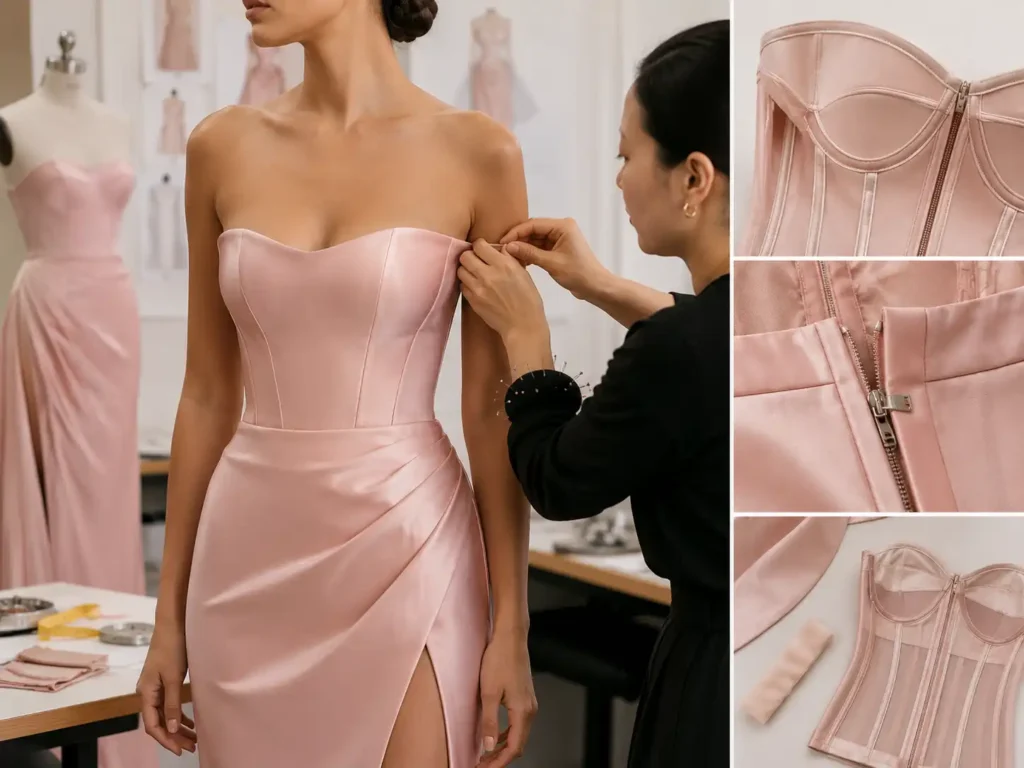
Stable strapless construction works as a system. The pattern defines the relationship between upper bust, bust, under bust, waist, and back. Lining or an internal bodice gives the dress a stable foundation. Cups shape the bust and control coverage. Boning helps the torso section resist collapsing. The closure maintains the intended circumference, and silicone adds friction at the skin-contact edge. Changing one element can improve one problem while creating another, so fit comments need to describe the symptom precisely rather than simply asking for more grip.
For example, reducing the upper-bust measurement may stop gaping but compress the cup edge. Increasing boning stiffness may improve vertical stability yet make sitting uncomfortable. Pulling the gripper tighter can hold the neckline while creating ripples in satin. Lowering the back can improve the design visually but remove part of the structure that previously resisted downward movement. The documented Jinfeng Apparel pattern system uses 7+ senior womenswear pattern makers, 2 sample rooms, and 20+ sample machinists to control points such as upper bust, under bust, waist, lining, support, and wearing safety. Those controls are especially relevant to strapless styles because a small upper-torso error can affect the entire balance of the dress.
Which Silicone Tape Is Best for Strapless Dresses?
The best silicone tape is the one whose stretch, recovery, grip level, softness, thickness, and sewing behavior match the specific dress. There is no universal tape for every strapless style. A stretch bodycon mini, structured satin corset, lace occasion dress, and mesh party dress place different demands on the gripper, so selection should be confirmed in the real upper-edge construction before bulk production.
Which Tape Construction Should You Choose?
Start by separating structured garments from stretch garments. In a corset or evening dress, much of the support may already come from lining, cups, boning, waist shaping, and a relatively fixed back closure. The gripper mainly controls small movements at the upper edge, so an extremely elastic tape may not be necessary. In a pull-on bodycon dress, by contrast, the neckline must expand when the garment is dressed and recover afterward. The gripper base therefore needs to cooperate with the fabric rather than behave like a rigid ring around an otherwise elastic bodice.
Physical trial is more reliable than choosing from photographs or supplier descriptions alone. A sensible early development round may compare two or three shortlisted gripper constructions on the actual shell and lining, especially when the style is technically important or expected to repeat. This is not a universal industry rule; it is a practical way to avoid spending several sample rounds trying to force an unsuitable tape to work. Once the preferred option is approved, keep a physical reference with the BOM and sample archive so future purchasing teams can compare repeat-order material against something more useful than a generic phrase such as ‘silicone elastic.’
Which Properties Matter Most?
Six properties deserve close attention: finished width, extension, recovery, silicone profile, softness, and sewability. Width affects the available grip area but also changes seam bulk. Extension describes how far the base can stretch, while recovery shows how well it returns after repeated extension. Poor recovery can be more damaging than moderate grip because the neckline gradually becomes larger even though the silicone itself is still intact. Silicone layout matters because narrow lines, dots, and broader coated areas create different contact patterns and different sensations on the skin.
Comfort should be judged in the finished garment rather than from a loose swatch. A tape can feel soft in the hand but become harsh once seam allowances, binding, and neckline pressure are added. Sewability also deserves attention: the gripper must feed consistently through the machine without curling, twisting, or being stretched unpredictably. Where formal performance or compliance limits are required, rely on supplier technical data and client-approved testing methods rather than invented factory thresholds. For internal comparison, however, a simple repeatable swatch record can reveal whether one option is clearly better matched to the intended construction.
Property | What to Record | Practical Sample-Room Check |
Finished width | Millimeters from approved trim | Measure relaxed tape at 3 locations |
Extension | Relative length change under a defined pull | Compare equal starting lengths using one repeatable method |
Recovery | Length after repeated extension | Re-measure after 3-5 controlled stretch cycles |
Silicone profile | Lines, dots, or broader coated area | Photograph and retain approved physical swatch |
Hand feel | Soft, medium, or firm relative to approved sample | Wear-test against the finished neckline |
Edge behavior | Flat, curling, or rippling | Sew into the actual shell and lining |
Sewing response | Stable or difficult feeding | Run a short production-machine trial before approval |
Which Dress Fabrics Need Different Grip Decisions?
Satin is visually unforgiving, so excessive gripper tension can create rippling or puckering along an otherwise clean neckline. Stretch jersey and bodycon fabrics create the opposite challenge because the edge must expand during dressing and then recover without becoming loose. Mesh and lace often require a stable internal layer because the decorative shell may not be strong or dimensionally stable enough to carry the gripper cleanly. Structured woven corset fabrics typically allow clearer separation between structural support and surface grip.
The fabric name by itself is therefore too broad a sourcing instruction. Satin can be used on a soft draped dress or a heavily reinforced corset, and those garments need different internal engineering. The development team should consider stretch percentage, recovery, weight, lining, neckline shape, intended compression, closure type, and garment weight together. A floor-length embellished gown also places more downward load on the bodice than a lightweight mini, even if both use the same shell fabric. The correct tape is the one that works with the total architecture of the dress, not the one that looks most powerful on a sample card.
How Should Silicone Tape Be Built Into a Strapless Dress?
Silicone tape should be attached to a stable internal edge where it can maintain controlled contact with the wearer. Its position, tension, seam method, and relationship with lining, cups, boning, and closures should be finalized during sampling. Production operators should not determine tape tension by feel, because inconsistent stretching can change upper-bust measurement, neckline appearance, comfort, and the final holding effect.
Where Should the Grip Tape Sit?
The tape should sit where the garment can maintain reliable body contact, most commonly along the inside upper edge of the bodice. That does not automatically mean every centimeter of the neckline needs the same treatment. Sweetheart necklines, straight bandeau edges, low backs, and asymmetric internal structures distribute pressure differently. The center front may already be controlled by cups, the sides may carry stronger circumference tension, and the back may be interrupted by a zipper or lace-up opening. Placement should follow the approved fit rather than a generic sewing habit.
The attachment layer should also be stable enough to carry the trim without distorting the outer appearance. Delicate lace, soft mesh, and fine satin can show puckering if the gripper is attached carelessly, so a facing or internal lining may provide a better foundation. Around closure points, avoid bulky overlaps that create a hard spot against the skin, but also avoid uncontrolled gaps that remove grip exactly where the back edge tends to move. Once the sample is approved, internal photographs and construction sketches should show these details clearly so production does not have to recreate them from memory.
How Should Tape Tension Be Controlled?
Tape tension should be established during sampling and transferred into a repeatable production method. Excessive stretch during sewing can contract the upper edge, distort a sweetheart curve, or create visible waviness in satin. Too little control can leave the trim technically present but too relaxed to maintain consistent contact. Before changing the paper pattern, confirm whether an unexpected upper-bust measurement comes from the pattern itself or from the way the gripper was fed through the machine. Altering the pattern to compensate for an unstable sewing operation usually creates a second problem instead of solving the first.
A practical construction record should identify the approved tape, silicone face direction, starting and finishing points, stitch position, handling at curves, relationship with the zipper, and finished upper-edge measurement. If the construction uses a controlled tape length, that reference should be documented as well. The first pieces from bulk sewing deserve close comparison with the Golden Sample because this is where sample-room technique meets production speed. If several otherwise identical garments show different neckline tension, investigate feeding, machine handling, and operator method before changing the pattern or switching materials.

How Do Boning and Cups Work With Silicone Tape?
Boning, cups, and silicone solve different parts of the support problem. Boning helps the bodice resist vertical collapse and preserves shape through the torso. Cups manage bust volume, position, projection, and coverage. Silicone adds friction at the contact edge. When one component is asked to do another component’s job, the result is usually either unstable or uncomfortable. A stronger tape cannot correct a cup that sits too low, and a firmer bone cannot repair an upper-bust circumference that is simply too large.
The components should therefore be fitted in sequence. Establish the main pattern proportions first, then review cup shape and height, boning position, waist control, back tension, and finally the amount of upper-edge stabilization required. Moving a boning channel can change where the bodice bends; changing a cup can alter neckline contact; tightening the waist can shift the entire garment upward. The company’s documented strapless development logic explicitly reviews anti-slip tape, boning, upper-bust fit, cup shape, and bust support together, which reflects the way these parts behave on the body rather than the way they appear as separate lines in a BOM.
How Should the Construction Change by Dress Style?
A soft stretch mini, structured party dress, and floor-length evening gown may all be strapless, but they should not share one internal support formula. A soft bodycon style often depends more on fabric recovery, controlled circumference, and an elastic upper edge. A corset mini can distribute support through cups, boning, waist shaping, lining, and back closure, leaving the gripper to control smaller movements. A long gown introduces additional skirt weight, so asking the silicone edge to carry more load instead of strengthening the underlying structure is rarely a sensible solution.
Low-back styles deserve special attention because removing fabric from the back also removes part of the circumference that normally helps stabilize the dress. Side-body fit, front structure, and waist anchoring may need to work harder. Lace-up backs add another variable because the wearer controls part of the tension during dressing. A manufacturer should therefore define where the garment weight is supported, how much the bodice stretches, where stable skin contact exists, and how the closure changes circumference before deciding the gripper specification. The anti-slip strip should be the final refinement of a workable structure, not the first answer to every strapless problem.
How Do You Test Silicone Grip During Sampling?
Silicone grip should be tested only after it is built into the complete dress. Review upper-bust contact, neckline position, cups, side seams, back stability, and comfort while the wearer stands, walks, sits, raises the arms, reaches forward, and rotates the torso. If the sample slips, gaps, twists, or feels excessively tight, identify whether the root cause is fit, structure, tape selection, or sewing before changing several components at once.
How Do You Check Strapless Fit?
Begin with the wearer standing naturally and allow the dress to settle rather than repeatedly pulling it into a picture-perfect position. The upper edge should follow the body without obvious gaping or sharp compression. Check the center front, both cup edges, side body, upper back, and closure because strapless problems are often asymmetric. The waist also deserves attention: in structured styles, a meaningful share of the garment’s stability can come from a well-fitted waist and under-bust area rather than from pressure at the neckline alone.
Then review cup and internal structure. The bust point should sit appropriately within the cup shape, the under-bust should align with the intended pattern, and the side seams should remain balanced. If a side seam rotates forward or backward, the issue may be tension distribution rather than the gripper. Jinfeng Apparel’s documented pattern system identifies upper bust as a critical control point for strapless, corset, and bustier styles, and its pattern-development resources include 7+ senior pattern makers, 2 sample rooms, and 20+ sample machinists. Those resources are relevant because fit correction often requires pattern, sewing, and trim changes to be judged together rather than in isolation.
How Do Movement Tests Reveal Slippage?
Static fitting is only the first check. A practical wear review should include normal standing, several arm raises, reaching forward, torso rotation to both sides, repeated sitting and standing, a short walk, and a gentle forward bend. There is no universal number of repetitions that every factory must use, so the important point is consistency: use the same sequence when comparing the first sample, revised sample, and PP sample. After each movement, note whether the center front, side seams, cups, and upper back return close to their starting positions.
Comfort should be recorded at the same time. A neckline that never moves because it is excessively tight is not a successful fit. Ask whether the wearer feels pinching, skin drag, pressure at tape termination points, rolling at the lining, or cup displacement. Stretch garments can also change after repeated loading, so a sample that feels secure immediately after dressing should be reassessed after it has been worn through several minutes of movement. Photographs taken from the same front, side, and back positions make it easier to compare sample rounds without relying entirely on memory.
What Problems Require a Sample Revision?
Repeated downward movement is an obvious reason to revise, but gaping, cup lifting, back dropping, asymmetric tension, visible neckline rippling, lining rolling outward, and excessive skin indentation are equally important. A useful troubleshooting order is pattern first, structure second, trim third, and sewing method fourth. Check upper bust, bust, under bust, waist, and back circumference before changing the tape. Then review cups, boning, and lining. Only after those points are understood should the team change gripper construction or grip level.
This sequence reduces the risk of making several uncontrolled corrections in one round. If the upper bust is reduced, the cup is changed, a bone is moved, and a stronger silicone tape is added simultaneously, the next sample may look better but the team will not know which change solved the problem. Controlled revisions create a technical history that becomes valuable when the style is reordered months later. The company fact base specifically lists strapless slipping as a fit risk addressed through upper-bust control, anti-slip tape, boning, and back structure, which is a more useful diagnostic approach than treating the tape as the single cause.
How Should the Final Construction Be Approved?
Final approval should freeze the combination that actually worked on the body: final pattern version, measurement chart, approved gripper, cup specification, boning arrangement, lining construction, and sewing details. A PP Sample or Golden Sample is valuable because the complete garment shows interactions that individual documents cannot capture. Internal photographs can record details such as tape termination, cup attachment, boning channels, and facing construction, while the BOM identifies the approved trim for purchasing and repeat orders.
One documented structured-dress program provides a useful example. An anonymous UK designer label developed 6 corset mini, structured mini, and strapless styles totaling approximately 4,800 pieces. The materials included satin, lace, structured woven fabric, and lining, while the construction used corset structure, boning, built-in cups, anti-slip tape, and lace-up backs. Development moved through five defined stages: First Sample, Fit Sample, Revised Sample, PP Sample, and Golden Sample. The anti-slip issue was reviewed together with cup shape, boning position, upper-bust fit, bust coverage, and waist shaping, which is exactly the level of coordination needed before a structure-sensitive style is released for repeatable production.

How Do Manufacturers Control Silicone Tape in Bulk Production?
Bulk control turns an approved strapless sample into repeatable specifications. Manufacturers should verify the incoming gripper, control its position and tension during sewing, measure the finished upper edge, and compare completed garments with the approved sample. Checking only whether silicone tape is present is not enough; upper-bust dimensions, cups, boning, lining, closures, and overall neckline appearance must remain consistent across sizes, colors, lines, and batches.
What Should the Tech Pack Specify?
A useful tech pack should say far more than ‘add silicone tape at neckline.’ The BOM should identify the approved gripper clearly enough for purchasing to repeat the same construction, including supplier reference where available, material description, finished width, color, and other supplier-defined specifications. Technical drawings should show start and end positions, which face contacts the body, where the stitching runs, and how the tape meets the center-back zipper, hooks, or lace-up area. If the sample uses a controlled tape length, that information should be recorded rather than left to operator judgment.
Measurements that influence support need their own controls. Upper bust is usually critical, but bust, under bust, waist, and back dimensions may also matter depending on the style. Cup and boning positions should be documented because a garment can meet the external circumference tolerance and still fit badly when internal support shifts. Version control is equally important. When a Revised Sample changes the upper-bust pattern or gripper, earlier BOMs and construction sheets should be retired or clearly superseded so merchandising, purchasing, sample room, production, and QC are all working from the same approved stage.
How Do You Check the Tape Before Sewing?
Incoming inspection should confirm that the delivered gripper corresponds to the approved reference before it reaches the sewing line. Start with identity, width, color, base construction, and silicone layout. Then look for interruptions, contamination, uneven coating, damaged edges, or obvious differences between rolls. Where stretch and recovery are important to the style, compare the new lot with the retained approved reference using the same starting length and the same repeatable extension method. Formal acceptance limits should come from the client specification, supplier technical data, or approved test method rather than invented percentages.
A short sewing trial on the actual production fabric is useful whenever there is a new batch, approved substitution, or meaningful material change. This quickly reveals unexpected curling, difficult feeding, altered seam bulk, or a different hand feel that a loose-roll inspection can miss. The company’s documented accessory control process covers specification, comfort, durability, lead time, cost, and QC risk through both sampling and bulk production. Its broader incoming QC system likewise separates material inspection from cutting, sewing, and garment inspection so a trim problem can be caught before hundreds of bodices have already been assembled.
How Do You Control Sewing Consistency?
The first pieces from bulk production are where the approved sample-room method meets real line speed, so they should be compared closely with the PP or Golden Sample. Check upper-edge measurement before judging appearance alone, then review whether the neckline is smooth, symmetrical, and free from unexpected contraction. Inspect the silicone face direction, starting and finishing points, handling at curves, and the way the trim meets the closure. Where the dress includes cups and boning, confirm that those components remain in the approved positions because a perfectly sewn gripper cannot compensate for displaced internal support.
In-line inspection is more efficient than waiting until final QC. A focused check can verify the correct gripper, correct orientation, consistent placement, stable feeding, and finished upper-edge measurement. If several garments show different neckline tension, the team should first examine operator technique, feeding, presser-foot behavior, and tape handling. Changing the paper pattern because one operation is being sewn inconsistently can spread the error into later batches. The documented Jinfeng Apparel production system includes 18+ sewing lines, 26+ flexible production lines, and 15+ QC inspectors, which makes clear technical references especially important when a style needs to remain consistent across more than one production unit.
How Do You Inspect Finished Strapless Dresses?
Final inspection should answer two questions: was the garment built according to the approved specification, and does the completed construction still represent the fit approved during sampling? Construction checks cover the correct anti-slip tape, attachment position, seam quality, lining, cups, boning, zipper or other closure, measurements, pressing, and visible appearance. Functional consistency requires comparison with the approved fit reference because a flat measurement alone cannot show whether the cup edge lifts, the upper back gaps, or the bodice settles lower than intended on the body.
Inspection frequency and AQL settings should follow the client’s agreed quality plan rather than a universal number invented for every brand. The company’s documented QC system includes incoming material QC, cutting QC, sewing QC, in-line inspection, garment inspection, pressing review, packing QC, AQL inspection, client-inspection support, and repeat-order records, with strapless and corset products identified as style-sensitive categories. Jinfeng Apparel also operates 6 owned women’s fashion factories and works with 10+ long-term satellite production partners. As production expands across sizes, colors, lines, and batches, the value of a precise Golden Sample, clear BOM, and repeatable neckline-control method becomes greater, not smaller.
Production Stage | Key Strapless Control | Useful Evidence |
Incoming trim | Correct gripper, width, appearance, recovery | Approved swatch and BOM |
Cutting | Correct pattern version and size bundle | Cutting record |
First-off sewing | Tape position, feeding, upper-edge measurement | Golden Sample comparison |
In-line inspection | Consistency across operators and bundles | In-line QC record |
Garment measurement | Upper bust, bust, waist, style-critical points | Measurement sheet |
Structural review | Cups, boning, lining, closure | Construction reference |
Final sampling | Client-agreed inspection and AQL plan | Inspection report |
Repeat order | Same approved pattern and trim references | Archived order file |
Conclusion
Anti-slip silicone tape is a small component with a surprisingly large influence on the wearing experience of a strapless dress, but its real value appears only when it is used in the right role. It should add controlled friction to an already workable structure, not compensate for a loose upper bust, incorrect cup, unstable lining, weak waist anchoring, or inconsistent sewing. When pattern, support components, trim selection, sampling, and production control are developed together, the neckline can remain secure without turning the top edge into an uncomfortable compression band.
For fashion brands developing strapless, corset, party, or occasion collections, the most productive conversation with a manufacturer is therefore not simply ‘Which silicone tape do you use?’ A stronger technical brief describes the target fabric, stretch behavior, neckline shape, cup and boning requirements, desired back construction, size range, and expected wearing situation. That information gives the sample room something concrete to engineer. It also makes later bulk control far more reliable because the approved grip system becomes part of the garment specification rather than a last-minute trim added after the fit has already gone wrong.
Share This Article :

Jerry Lee
Categories

Latest blogs

Table of Contents
Here, developing your OEM/ODM private label clothing collection is no longer a challenge—it’s an excellent opportunity to bring your creative vision to life.

