 Skip to content
Satin Dress Quality Control Checklist: What Should Brands Inspect Before Bulk Shipment?

Your trusted Women’s Apparel Manufacturer from China

Satin is one of those fabrics that can make a dress look expensive in seconds and expose weak production just as quickly. Its smooth, reflective surface turns small manufacturing differences into visible ones: a reversed panel can look like a different shade, a slightly tight seam can ripple under light, and an over-pressed zipper area can remain shiny after the garment has cooled. That is why a serious satin dress inspection cannot begin at the final packing table. It has to start with the approved fabric and continue through cutting, sewing, measurements, pressing, finishing, and shipment preparation. For fashion teams managing hundreds or thousands of pieces, the real risk is rarely one obviously defective dress. It is a repeated problem that appears across a size, color, fabric lot, sewing operation, or carton group. A useful checklist therefore has two jobs: it must catch individual defects, and it must show whether the production process is staying close to the approved standard. The most effective checks are specific enough to guide action but practical enough to use on a live production floor.
A satin dress quality control checklist should verify approved materials, shade and sheen direction, cutting accuracy, seam quality, measurements, fit, zipper and lining performance, surface condition, pressing, labels, packing, and final sampling results. Bulk garments should be compared with the approved PP or Golden Sample, size specification, BOM, and packing standard so repeated defects are identified before shipment rather than after retail delivery.
Consider a champagne satin maxi dress that looks perfect during the first sample approval. Bulk cutting begins, several rolls are mixed, and a portion of the skirt panels are laid in the opposite sheen direction. Every panel is technically champagne, yet completed dresses show obvious light-dark blocks in studio photography. By the time the problem is noticed, the fabric has already been cut, sewn, pressed, labeled, and packed. A checklist built around the real behavior of satin is designed to catch that mistake when it is still only a cutting-room problem.
What Should a Satin Dress Quality Control Checklist Cover?
A satin dress quality control checklist should cover the complete production path: approved references, incoming fabric, cutting direction, sewing, measurements, fit, surface appearance, pressing, labels, packing, and final inspection. Satin also needs dedicated checks for shade, sheen direction, snagging, puckering, needle marks, zipper waviness, lining stability, and creasing because its smooth reflective surface makes small defects unusually visible.
Approved Standards
A reliable inspection begins with a fixed definition of what the approved dress is supposed to be. The latest tech pack, measurement specification, BOM, approved bulk fabric or swatch, trim approvals, PP sample or Golden Sample, color reference, label files, construction notes, and packing instructions should all point to the same product version. If those references disagree, inspectors can measure accurately and still make the wrong decision because the production standard itself is unclear.
For satin, visual details deserve unusually explicit approval. Sheen direction, neckline depth, strap length, slit position, zipper placement, lining length, ruching distribution, hem shape, and pressing appearance can change how the dress looks even when the basic pattern is correct. A Golden Sample is especially useful because it gives cutting, sewing, finishing, and QC teams a physical reference for the approved silhouette and surface condition. It should support the technical files, not replace them, and any later change should be documented before bulk production continues.
QC Stages
Satin quality is easier to control when each stage has a clear gate. Incoming inspection stops unacceptable fabric from entering production. Cutting QC checks pattern version, direction, shade grouping, and panel accuracy. Sewing and in-line inspection identify repeated seam, zipper, strap, lining, or symmetry problems while the production line can still be adjusted. Finished-garment inspection then checks measurements, drape, appearance, function, and balance, while pressing and packing QC protect a garment that is already technically complete but still vulnerable to surface damage.
At Jinfeng Apparel, the documented QC flow covers incoming materials, cutting, sewing, in-line inspection, finished garments, pressing, packing, AQL inspection, and customer inspection support. That sequence matters because satin is not a forgiving fabric to repair repeatedly. Unpicking can leave needle holes, extra pressing can create shine, and replacing a zipper can distort the surrounding panel. The earlier the cause is corrected, the less rework is needed and the more consistent the bulk order is likely to remain.
| QC Stage | Core Checks | Typical Satin Risk | Primary Reference |
| Incoming fabric | Color, GSM, width, hand, shade | Shade variation, snags, creases | Approved fabric / swatch |
| Cutting | Pattern, face, direction, bundles | Reversed sheen, mixed shade lots | Pattern + cutting instruction |
| Sewing | Stitches, seams, zipper, lining | Puckering, needle marks, waviness | PP / Golden Sample |
| Finished garment | Measurements, fit, symmetry | Twisting, uneven hem, poor fit | Size spec + approved sample |
| Pressing | Surface finish, impressions | Shine, flattening, heat marks | Approved appearance |
| Packing | Labels, folding, carton ratio | Hard creases, abrasion, SKU errors | Packing specification |
| Final inspection | Defects, assortment, sampling | Repeated shipment-level issues | QC standard / AQL plan |
Satin-Specific Risks
General dress inspection is only a starting point because satin behaves differently from textured or matte fabrics. Light becomes part of the quality check. Two correctly dyed panels can appear different if their sheen runs in opposite directions, and a seam that is mechanically strong can still look poor if tiny puckers create a visible ripple. Satin also shows scratches, pulls, needle marks, oil stains, seam impressions, and pressure marks more readily than many fabrics with a busier surface.
Fabric weight changes the risk profile as well. Satin used for fashion dresses often sits roughly within an 80-220 gsm range, although specific constructions may fall outside it. Lighter qualities tend to expose seam tension, transparency, wrinkling, and handling marks more easily, while heavier satin can hold structure better but may create bulkier joins or stronger pressing impressions. A lightweight bias-cut slip dress and a structured satin corset dress therefore need different inspection emphasis even when the surface finish looks similar.
Inspection Records
A checklist becomes much more useful when findings are recorded in a way that production teams can trace. The record should identify the style, color, size, fabric lot or shade group, production line or bundle where relevant, defect type, defect location, quantity found, corrective action, and reinspection result. Photographs are particularly valuable for satin because visual defects such as puckering, zipper waviness, shade difference, reversed sheen, and pressing marks can be difficult to describe precisely in a short written note.
Records also become a practical tool for repeat orders. If the same satin style later returns in a new color, the team should already know whether the previous run had recurring zipper distortion, unstable strap length, shade sensitivity, or crease problems after packing. That history reduces the chance of repeating the same learning cycle. Good QC records are not paperwork created to prove an inspection happened; they are a production memory that helps the next batch start with better controls than the last one.
How Do You Inspect Satin Fabric Before Cutting?
Inspect satin before cutting by comparing bulk rolls with the approved fabric for color, weight, width, hand feel, stretch, drape, opacity, and surface finish. Rolls should then be checked for shade variation, snags, stains, permanent creases, and directional sheen. Shade groups, fabric face, and cutting direction should be identified before spreading so mismatched panels are not created during bulk cutting.

Fabric Approval
The first receiving question is not whether the satin looks attractive; it is whether the bulk material matches what was approved. Satin is a weave structure rather than one single fiber, so polyester satin, polyester-spandex satin, acetate-rich satin, crepe-back satin, matte satin, and silk-like constructions can behave differently in drape, stretch, opacity, friction, pressing, and recovery. A visually similar substitute can still change the fit or silhouette enough to create a production problem.
Bulk fabric should therefore be compared against the approved reference for color, luster, weight, usable width, hand feel, stretch where applicable, opacity, and surface finish. GSM is especially useful when a style depends on a specific balance between fluidity and structure. Around 80-110 gsm may suit lighter slip or summer silhouettes, while satin approaching 180-220 gsm can behave much more structurally. These are practical ranges rather than universal rules, and the approved fabric remains the final reference for the specific style.
Shade and Sheen
Shade control on satin requires more than holding two folded rolls side by side. Directional reflection can create an apparent light-dark difference even when the dye itself is consistent. A practical check is to compare swatches from selected rolls and different roll positions under consistent lighting, then rotate the swatches 180 degrees. If the apparent difference changes after rotation, sheen direction is influencing what the eye sees; if the difference remains, genuine shade variation may be present.
Once rolls are grouped, that information has to survive the rest of production. A shade band that is carefully created in the fabric warehouse is useless if cut panels from different groups are mixed at sewing. This is especially important for champagne, ivory, blush, silver, emerald, navy, and black satin, where reflection can exaggerate subtle differences. For dresses with large uninterrupted panels, such as maxi skirts or bias-cut slips, even a modest panel mismatch can become obvious in photography or retail lighting.
Surface Defects
Before spreading, inspectors should look for snags, pulled yarns, stains, oil marks, holes, abrasions, weaving irregularities, crushed areas, permanent creases, local gloss changes, and damaged edges. Satin can also leave the supplier in acceptable condition and become damaged inside the factory, so inspection should include the environment: rough table edges, damaged trolleys, metal burrs, exposed fasteners, sharp jewelry, and worn machine surfaces can all create pulls that were not present on the original roll.
Defect mapping is more useful than simply labeling a roll ‘bad’ or ‘good.’ Marking the position of a local snag or stain allows cutters to avoid that area while still using acceptable fabric around it. Permanent creases deserve a small recovery test before the roll is approved for cutting because some marks relax with controlled steaming or hanging while others remain visible due to surface deformation. Discovering that difference on a test piece is far less costly than learning it after hundreds of panels have been sewn.
Cutting Direction
Directional control is one of the defining satin cutting checks. Depending on weave and finish, rotating a panel by 180 degrees can alter how it reflects light enough to make the assembled dress look patchy. The cutting plan should clearly identify fabric face, grain, one-way or two-way marker requirements, stretch direction for stretch satin, shade group, size bundle, and left-right component identification. These details should be visible to the cutting team rather than left to memory.
A two-way marker may improve theoretical fabric utilization, but that saving has little value if opposing panels reflect differently and finished garments require sorting or replacement. The correct marker strategy should be confirmed on the actual bulk fabric under realistic light. Bias-cut satin needs additional care because panels can stretch and distort under their own weight. Accurate cutting must therefore be paired with consistent handling and storage so pieces do not lengthen unpredictably before they reach the sewing line.
How Do You Control Satin Cutting and Sewing Defects?
Control satin cutting and sewing defects by protecting the fabric surface, maintaining the approved panel direction, using the correct pattern version, and controlling stitch settings, thread tension, feeding, and handling. In-line QC should focus on seam puckering, needle marks, zipper waviness, strap symmetry, lining distortion, darts, side seams, waist joins, slits, and hems before repeated problems spread through bulk production.
Cutting Accuracy
Cutting QC starts with version control. Fashion styles often go through several pattern corrections during sampling, and using an earlier pattern can create an entire batch that is consistent with the wrong specification. Before bulk cutting, the team should confirm style number, pattern version, size range, fabric face, direction, shade group, quantity, and any one-way marker rule. Sampled cut panels can then be checked at critical points such as neckline edges, armholes, waist seams, hip lines, zipper openings, slits, and hem shapes.
Satin panels should be treated as visible finished surfaces from the moment they are cut. Rough bundle ties, exposed pins, dirty tables, or aggressive stacking can leave marks that later become impossible to hide. Shade identification also needs to stay attached to the bundle so operators do not mix visually similar pieces from different fabric lots. On bias-cut styles, cutting accuracy alone is not enough; consistent support and handling are needed because the panel can lengthen or shift while waiting for sewing.
Seam Puckering
Seam puckering is one of the most noticeable satin dress defects because reflected light emphasizes every ridge. It often appears along side seams, princess seams, waist joins, darts, zipper seams, and narrow curved areas. Possible causes include excessive thread tension, unsuitable stitch density, inappropriate needle or thread, uneven feeding between plies, seam construction, fabric slippage, and operator handling. The correct response depends on identifying which of those factors is actually producing the repeated distortion.
The key QC question is whether the problem is isolated or systematic. If several consecutive garments show the same ripple at the same operation, production should be adjusted before more pieces are completed. Trying to press puckering flat is usually a weak solution because the underlying tension remains and the ripple may return after cooling, hanging, or wearing. Extra pressing can also create its own gloss or seam impressions. A satin seam should therefore be judged while flat, while hanging, and under angled light.
Needle Marks
Needle damage matters on satin because the surface often records mistakes. When a seam is unpicked and resewn, the original needle holes may remain visible as a dotted track beside the new seam. A repair that looks mechanically correct can therefore still fail visually. This changes the economics of rework: preventing the first sewing error is often more valuable than assuming every mistake can be corrected later without evidence.
Operators should use appropriate, undamaged needles and avoid unnecessary unpicking, while in-line QC should catch repeated construction mistakes early. High-visibility areas such as the center front, neckline, bust, darts, zipper seams, and smooth skirt panels deserve particular attention. After any repair, the garment should be viewed from normal wearing distance and then under angled light. Inspecting only the new stitch line can miss the more obvious surface marks created by the first attempt.
Zippers and Linings
Zipper application is a frequent satin problem because zipper tape and shell fabric respond differently to feeding, tension, stabilization, and pressing. The result can be a wavy or bulging center-back seam even when the zipper opens and closes correctly. Inspectors should check smooth function, waist-seam alignment, top-stop position, fabric catching, and the flatness of the surrounding panel while the dress is hanging or fitted on a mannequin where appropriate.
The lining should support the garment without controlling the outer satin. If it is too tight, twisted, or attached unevenly, it can pull the shell inward and change the drape; if it is too long, it may appear below the hem or roll out at necklines and armholes. Straps, slit height, darts, ruching, and left-right symmetry should be checked at the same stage. Small construction differences become much easier to see on a smooth reflective dress because there is little surface texture to disguise imbalance.
Which Finished Satin Dress Checks Matter Most?
Finished satin dress inspection should focus on measurements, fit, symmetry, drape, hem balance, shade, sheen, stains, snags, zipper function, lining, seam appearance, and pressing quality. The garment should be checked both flat and hanging, then viewed from different angles under consistent lighting because some satin defects become visible only when the surface reflects light from a particular direction.

Measurements and Fit
Finished garments should be measured against the approved size specification rather than judged by whether they appear approximately right. The critical points vary by style, but satin dresses often demand close control at the bust, waist, hip, total length, strap length, neckline depth, slit height, and hem sweep. Tolerances should come from the approved specification because a tolerance that is reasonable for a wide hem can be unacceptable at a narrow strap or fitted bust.
Fit assessment should complement the numbers. A dress can sit within measurement tolerance and still twist because of grain direction, sewing imbalance, lining tension, or uneven stretching. Conversely, a small numeric variation may have little visual or functional impact. For fitted, bias-cut, corset-inspired, or low-neck satin styles, a controlled mannequin or fit check often reveals issues that flat measurement cannot. The strongest decision comes from combining measured compliance with how the garment actually hangs and moves on the body.
| Point of Measure | QC Importance | Main Risk if Off-Spec |
| Bust | High | Strain lines, gaping, neckline distortion |
| Waist | High | Silhouette change, zipper stress |
| Hip | High on fitted styles | Drag lines, twisting, restricted movement |
| Total length | High | Uneven proportion or hem balance |
| Strap length | High on slip styles | Neckline and armhole shift |
| Neckline depth | High | Coverage and symmetry problems |
| Slit height | Medium-High | Wearability and appearance issues |
| Hem sweep | Style-dependent | Changed drape and movement |
Drape and Hem
Satin should be allowed to hang naturally before the final visual judgment. Side seams should fall cleanly, the skirt should not spiral around the body, and the lining should not pull the outer shell. Hem balance is especially important on midi, maxi, and bias-cut styles because fabric can redistribute under gravity. A hem that was level immediately after sewing may become uneven after the garment has rested, particularly when large bias sections are involved.
Inspectors should compare front-to-back balance, left-right symmetry, side-seam position, hem level, slit height, lining length, cowl behavior, ruching distribution, and overall bust-to-waist balance. The dress should also be moved gently because satin is meant to reflect light in motion. Twisting, uneven drape, and local tension lines can become more obvious when the skirt swings. For ecommerce and occasionwear, that dynamic appearance matters because customers frequently evaluate dresses through video, social media, and mobile photography.
Light Inspection
One overhead lamp is not enough for satin. The garment should be viewed at more than one angle under a stable light source because directional reflection can reveal snags, needle marks, shade mismatch, puckering, and surface distortion that disappear when viewed straight on. Angled light is particularly useful for raised seams and pressing impressions, while more even front lighting helps compare the overall color and apparent sheen of connected panels.
Consistency matters more than theatrical equipment. Comparing one dress under warm light and another under cool light can create false shade judgments, so the inspection area should use repeatable conditions. A practical method is to review the garment at normal viewing distance, rotate it or change the viewing angle, then look again at the front bodice, zipper area, side seams, and skirt panels. Phone or studio photography can provide an additional check because cameras sometimes make subtle panel differences more obvious than they appear to the naked eye.
Pressing Quality
Pressing can improve a satin dress or permanently change its appearance, which is why final QC should treat it as a manufacturing operation rather than a simple wrinkle-removal step. Inspectors should look for local shine, flattened areas, seam or zipper impressions, moisture marks, heat discoloration, hard accidental creases, and distorted drape. If one area reflects much more strongly than the surrounding fabric, heat or pressure may have altered the surface finish.
There is no universal ‘satin temperature’ because polyester, acetate-rich, stretch, matte, and silk-like satins respond differently. The safe process should be tested on the actual bulk fabric and may involve lower heat, reverse-side pressing, a protective cloth, controlled steam, or reduced pressure. Particular attention is needed at waist seams, darts, zipper areas, hems, and bust construction where seam allowance can print through. After pressing, the garment should cool and hang before the final appearance is accepted.
How Are Satin Dress Defects Classified and AQL Applied?
Satin dress defects should be classified by their effect on safety, function, appearance, and saleability. Critical defects involve serious safety or compliance risk; major defects can materially affect use or customer acceptance; minor defects have limited impact. AQL sampling can then be applied using the customer’s agreed lot size, inspection level, sample size, defect categories, and acceptance limits before shipment release.
Defect Classification
Defect classification should reflect commercial impact, not simply the physical size of the problem. A small snag on the center-front bust can be more serious than a larger mark hidden inside the lining because customers will see it immediately. Critical defects normally relate to unacceptable safety, legal, or compliance risk. Major defects materially affect function, appearance, fit, or saleability, while minor defects are limited workmanship deviations that do not usually prevent normal use.
For satin dresses, major issues can include a broken zipper, severe panel shade mismatch, a conspicuous snag, excessive seam puckering, large measurement deviation, twisted construction, or visible pressing damage. Minor issues might include a small removable loose thread or a slight non-prominent finish variation, depending on the customer standard. Repeated minor defects also deserve attention because widespread small problems can point to weak finishing control even when each individual occurrence remains below the threshold for a major classification.
AQL Sampling
AQL is a statistical sampling framework, not another name for 100% inspection. In commonly used ISO 2859-1 or ANSI/ASQ Z1.4 style systems, lot size and inspection level determine a code letter and sample size; the chosen AQL then determines the acceptance and rejection numbers for major and minor defects. The exact plan should come from the customer specification, purchase order, quality manual, or agreed inspection instruction rather than being invented after production is complete.
General Inspection Level II is often used as a normal starting point in apparel, but it is not mandatory for every order. A premium retailer, a complex occasionwear program, or a style with an unusually high-risk construction may require a different level, tighter acceptance criteria, or targeted 100% checks on selected functions such as zippers or labels. Final AQL works best as a verification layer after incoming, cutting, sewing, measurement, finishing, and packing controls have already reduced process variation.
| Lot Size | Level II Code | Typical Sample Size |
| 281-500 | H | 50 |
| 501-1,200 | J | 80 |
| 1,201-3,200 | K | 125 |
| 3,201-10,000 | L | 200 |
| 10,001-35,000 | M | 315 |
Repeated Defects
Repeated defects should trigger corrective action at the source rather than endless individual repair. If twenty dresses show puckering along the same left side seam, the useful question is not how fast twenty pieces can be pressed or resewn. The team should identify the common factor: machine, operator, bundle, size, fabric lot, needle condition, stitch setting, pattern shape, or seam method. That analysis prevents the next hundred garments from carrying the same defect.
A practical response is to isolate affected pieces, define the defect with an approved example, trace the relevant production period, correct the process, and then increase inspection frequency after the change. Rework should only be used when the satin can be repaired without creating new needle marks, shine, abrasion, or distortion. The affected quantity should then be reinspected and the issue recorded. Those records become especially valuable when the same style is repeated later in another color or on another sewing line.
Shipment Decisions
Shipment release should follow the agreed inspection standard rather than last-minute commercial pressure. If the final sample exceeds the agreed acceptance criteria, practical options can include sorting, repair, replacement where feasible, extended inspection, or reinspection after corrective work. Satin requires caution because the repair itself can become a visible defect: unpicking may leave holes, aggressive cleaning may alter luster, and repeated pressing can create permanent shine or impressions.
Customer or third-party inspection can also be integrated before shipment. The factory should be ready to provide the approved sample, measurement specification, packing requirement, production quantity, and accessible finished cartons or garments according to the inspection plan. A useful quality system is transparent about both the result and the corrective action. Hiding or cosmetically masking repeated defects may achieve a short-term pass, but it transfers the risk to the retailer, warehouse, returns team, and ultimately the customer.
How Do You Verify Packing and Bulk Consistency?
Packing and bulk consistency are verified by comparing sampled garments with the Golden Sample, approved measurements, trims, labels, and packing specifications, then checking final appearance, folding, polybags, barcodes, size and color identification, carton ratios, and carton marks. Satin packaging should also minimize heavy compression, hard-component contact, and sharp folds that can create visible creases, impressions, or abrasion during transit.
Pre-Packing Checks
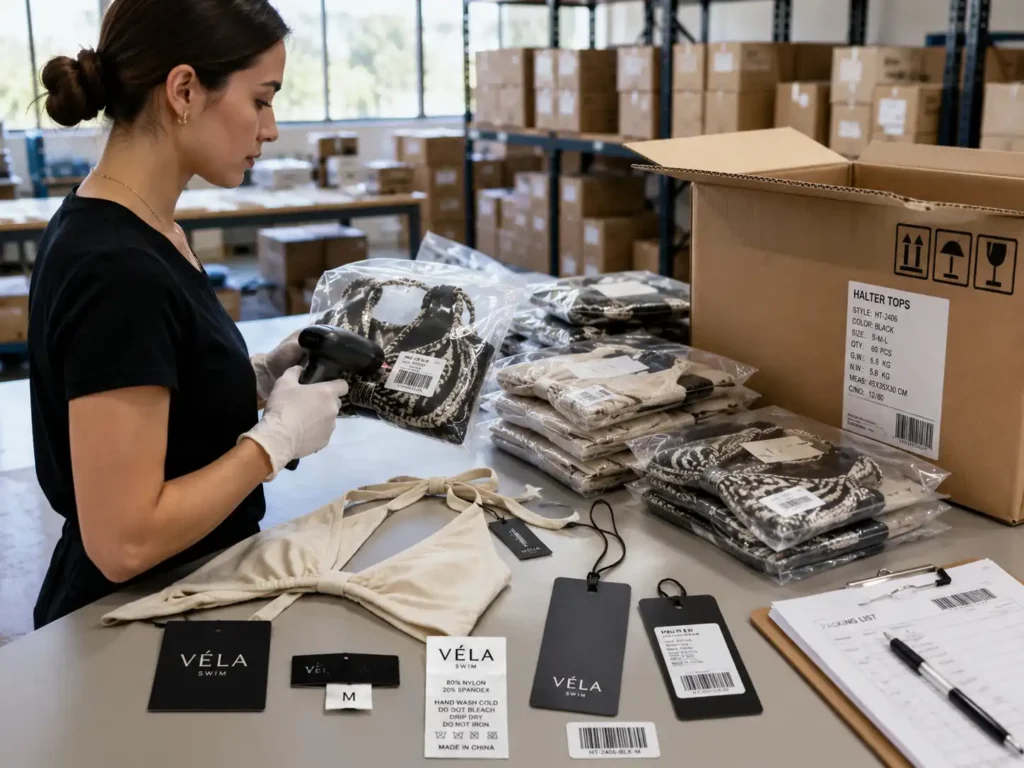
Packing should begin only after the garment has passed the relevant appearance, measurement, function, and pressing checks. Before folding, the team should confirm cleanliness, loose-thread removal, zipper or closure function, final pressing condition, main label, size label, care label, hangtag, barcode, SKU information where required, and the correct style-color-size combination. A satin dress packed with an unresolved snag or heat mark is unlikely to improve during transport; packing simply hides the problem until destination inspection.
Label and barcode accuracy belongs inside quality control because a perfectly sewn dress can still create serious operational problems if it is received under the wrong SKU or size. Multi-color satin collections need particularly clear identification because shades such as champagne, blush, pearl, ivory, and nude may look similar inside individual polybags. The packing team should work from an approved packing specification so folding, accessory placement, polybag size, sticker position, carton ratio, and carton marks are consistent rather than decided carton by carton.
Crease Control
Satin has moderate-to-high crease sensitivity depending on fiber, weight, finish, and construction, so packing methods should be tested on the actual garment. Long dresses may need carefully positioned folds rather than being forced into undersized polybags. Heavy trims, zipper pulls, hooks, buckles, or other hard components should not sit directly against a highly visible satin panel under carton pressure because they can create impressions or abrasion during weeks of storage and transport.
Carton density also matters. Overfilled cartons can create deep compression lines, while underfilled cartons may allow garments to shift excessively. A simple packing trial can reveal whether the chosen method is acceptable: pack several garments as they will ship, leave them compressed for a representative period, then unpack and check fold recovery, hardware marks, snags, zipper impressions, lining distortion, and overall presentation. The goal is not a completely wrinkle-free garment but avoidance of deep or permanent defects that normal hanging or steaming cannot reasonably recover.
Golden Sample Match
Final bulk comparison asks a straightforward question: does production still look and behave like the product that was approved? The review should cover fabric appearance, color, sheen, silhouette, measurements, neckline, straps, zipper, lining, trims, seams, hem, labels, pressing, and packing. The Golden Sample provides a visual anchor, while the tech pack and measurement specification provide numerical control. Neither works as well alone as they do together.
Bulk consistency is different from individual garment quality. A shipment can contain several excellent pieces and still be inconsistent overall. Samples should therefore be drawn across different sizes, cartons, shade groups, and production periods where practical. Satin makes this comparison especially useful because shade, sheen direction, zipper flatness, puckering, hem balance, and pressing may vary subtly from garment to garment. Ten champagne dresses viewed side by side can reveal a luster or shade drift that is easy to miss when each piece is inspected alone.
Repeat-Order Control
Repeat orders often create false confidence because the style has already been made successfully. In reality, fabric lots, trim batches, operators, machines, production lines, and seasonal conditions can change. The safest approach is to retain controlled references from the previous order, including approved patterns, measurement files, BOM details, fabric references, trim information, Golden Sample, construction notes, packing requirements, and QC records, then review them before the new run begins.
Previous problems should become early checkpoints rather than historical notes. If the first order showed zipper waviness in smaller sizes, that area should receive additional in-line attention next time. If a champagne satin showed strong lot variation, shade grouping should be emphasized at fabric receiving before cutting starts. This is where a long-term manufacturing relationship creates practical value: the supplier is not merely reproducing a dress, but carrying forward the production knowledge that keeps later batches closer to the original approved standard.
Conclusion
A useful satin dress quality control checklist is not a long list that inspectors complete at the end of production. It is a chain of controlled decisions that starts with the approved fabric and product references, continues through shade grouping, cutting direction, sewing, measurements, pressing, and packing, and finishes with a final sampling decision that reflects the customer’s agreed standard. Satin rewards that discipline because most of its costly failures are predictable: directional mismatch, puckering, snagging, zipper distortion, lining pull, heat marks, and transport creases all have earlier points where they can be prevented.
For brands developing custom satin dresses, the most productive time to discuss quality is before bulk fabric is cut. A manufacturer that reviews the fabric behavior, silhouette, lining, zipper construction, pressing sensitivity, and packing method during development can turn those risks into specific inspection points instead of discovering them after the order is complete. When a satin style is being prepared for sampling or bulk production, Jinfeng Apparel can review the technical package and production risks with the goal of building a QC standard that remains practical from sample approval through shipment and repeat orders.
Share This Article :

Jerry Lee
Categories

Latest blogs

Table of Contents
Here, developing your OEM/ODM private label clothing collection is no longer a challenge—it’s an excellent opportunity to bring your creative vision to life.

