A mesh fabric can look almost weightless on a hanger and still decide whether a fitted dress feels polished or disappointing once it reaches the body. Two black meshes can appear nearly identical in a sourcing room, yet one may hold a waistline cleanly while the other relaxes after an hour of wear. One may create soft, fluid ruching; the other may keep a cut-out edge stable. That gap between appearance and performance is the real reason the power mesh versus soft mesh decision deserves more attention than a simple touch test.
Power mesh is generally the better direction when a dress needs stronger recovery, controlled stretch, support, or dimensional stability. Soft mesh, usually meaning a lightweight stretch mesh with a softer hand, is better when fluid drape, light layering, transparency, and easy movement matter more. Neither is universally superior; the right choice depends on garment zone, stretch direction, recovery, layer count, lining, construction, and the intended silhouette.
The most revealing moment often arrives during fitting. A sample can photograph beautifully from the front, then show a growing neckline, a dropping waist, or uneven ruching after repeated movement. Experienced development teams learn to stop asking which mesh sounds more premium and start asking what each panel must actually do. Once that question changes, fabric selection becomes much more predictable – and the sample room becomes a place for confirmation instead of expensive surprises.
What Is the Difference Between Power Mesh and Soft Mesh?
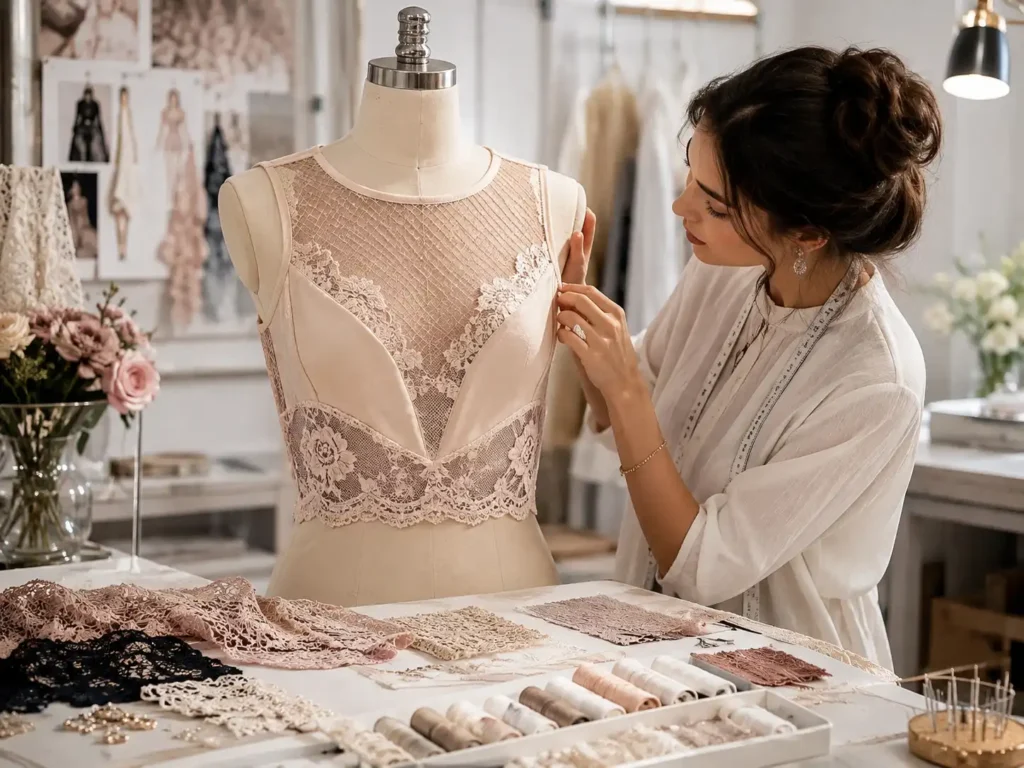
Power mesh is generally designed for stronger resistance, recovery, and support, while soft mesh prioritizes a lighter hand, fluid drape, transparency, and comfortable layering. The distinction is functional rather than absolute because “soft mesh” is not a standardized textile category. For dress development, GSM, knit density, stretch direction, recovery, transparency, and the job of each garment panel matter more than the fabric name alone.
What Is Power Mesh?
Power mesh is best understood by what it does under tension. It is a knitted stretch mesh selected when the garment needs noticeably more resistance and shape recovery than a very light fashion mesh can provide. In a dress, that can mean helping a waist panel stay controlled, supporting a fitted side section, reinforcing a cut-out edge, or providing an internal smoothing layer without adding a rigid woven structure. The useful property is not maximum stretch by itself. It is the balance between how far the fabric can extend, how much force it takes to extend, and how well the fabric returns after the load is removed. A strong power mesh can still be thin and visually sheer, while a lower-power version may feel soft enough for direct skin contact. This is why development teams should not equate the word “power” with heavy shapewear. The category covers different densities and performance levels, and the final selection should be made against the actual silhouette, expected wearing tension, and construction method.
What Is Soft Mesh?
Soft mesh is usually a sourcing description rather than a tightly standardized fabric name. In womenswear development, it commonly refers to lightweight stretch mesh chosen for a smooth hand, high transparency, flexible movement, and easier drape. It works naturally in ruched layers, soft sleeves, sheer overlays, illusion areas, and body-skimming shells where the fabric should follow movement rather than resist it. The weakness of the term is that two suppliers can both label a fabric “soft mesh” while supplying materially different constructions. One may have strong four-way stretch and good recovery; another may feel beautiful in the hand but relax significantly after sustained wear. The development team therefore needs to translate a visual request such as “soft nude mesh” into a measurable approval: composition, GSM, width, stretch by direction, recovery, transparency under tension, drape, color, and lining compatibility. That translation is what makes the result repeatable when sampling turns into bulk production. It also gives merchandising, pattern, sampling, and quality teams one shared reference instead of several subjective descriptions of the same fabric.
Are Soft Mesh and Stretch Mesh the Same?
Not necessarily. Stretch mesh is a broad functional family: it tells you the fabric stretches, but it does not tell you how soft, supportive, sheer, dense, or stable the fabric is. Soft mesh often describes the tactile and visual end of that family, while power mesh is also a stretch mesh but is chosen for a more controlled response. In practical sourcing, terms such as stretch mesh, power mesh, power net, micro mesh, sheer mesh, and soft mesh may overlap between mills. The safest approach is to treat names as a first filter and specifications as the real decision language. A useful material request should say what the garment must achieve – for example, “soft four-way stretch mesh for a double-layer ruched body with moderate recovery” – rather than relying on a generic name. Jinfeng Apparel’s documented mesh development scope distinguishes regular mesh, stretch mesh, power mesh, printed mesh, and double-layer mesh, while separately checking transparency, lining, stretch direction, dimensions after stretch, neckline finishing, print placement, and holes.
Which Mesh Offers Better Support and Recovery?
Power mesh normally provides stronger support and recovery, but the fabric name alone cannot guarantee either property. Stretch percentage only shows how far a mesh can extend; it does not show how strongly it resists extension or how well it returns afterward. For bodycon and fitted dresses, recovery, extension force, stretch direction, repeated-wear behavior, and the relationship between outer mesh and lining should be assessed together.
Which Mesh Gives More Support?
Power mesh usually gives more support because its construction is selected to create greater resistance while remaining elastic. That matters in areas that carry sustained tension, such as a close waist, fitted side panel, internal bodice layer, or cut-out edge. A soft outer mesh can make the dress look refined and lightweight but contribute very little structural control. If the pattern relies on that same fabric to stabilize the waist or bust, the fit can slowly become dependent on how much the textile relaxes during wear. More support is not automatically better, though. An overly firm mesh can flatten the bust, restrict the hip, make ruching look bulky, or shift the visual character from fashion to compression wear. Experienced developers therefore allocate support rather than maximizing it. The visible body can remain soft and fluid while a stronger mesh is used only at the internal waist, side body, or other high-load zones. The objective is not to make the garment tighter; it is to keep the intended silhouette stable with the least unnecessary resistance.
How Do Stretch and Recovery Differ?
Stretch describes extension; recovery describes return. A simple development example makes the distinction clear. Start with a marked gauge length of 100 mm. If the fabric reaches 150 mm under a controlled pull, that equals 50% extension. After repeated cycles, allow the strip to relax and measure it again. If it settles at 102 mm, the residual growth is 2%; if it settles at 106 mm, residual growth is 6%. Those numbers are illustrative, not universal pass/fail limits, but they show why two fabrics with the same maximum stretch can behave very differently in a dress. Weak recovery can appear as neckline opening, larger armholes, elbow bagging, reduced waist definition, migrating side seams, or ruching that drops after wear. For a fitted mesh style, the fabric should be evaluated under the kind of repeated tension the garment will experience, not pulled once by hand and described as “stretchy.” Recording the test direction and post-relaxation measurement also makes later fabric comparisons much more objective.
Do GSM and Spandex Content Matter?
GSM and elastane percentage matter, but neither should be used as a shortcut for predicting performance. GSM measures mass per square meter; it can influence opacity, body, layer weight, and handling, yet knit structure can change the way two fabrics of similar weight behave. Elastane percentage tells you part of the fiber recipe, but it does not reveal yarn quality, stitch density, finishing, or how strongly the fabric resists extension. In a real development meeting, the useful question is not “Which one has more spandex?” but “Which one gives the required recovery and hand at the required weight?” The same applies to cost optimization. A lighter mesh may lower material weight but require double layering or additional stabilization, while a firmer single layer may reduce construction complexity but change drape. Jinfeng Apparel’s fabric evaluation process documents composition, GSM, hand feel, drape, stretch, transparency, lining suitability, printing, close-fitting suitability, bulk stability, fabric MOQ, lead time, and cost so that material decisions are made as a system rather than from one specification.
| Development Check | How to Record It | What It Reveals |
| Stretch by direction | Measure a fixed gauge length; record widthwise and lengthwise extension % | Fit allowance and panel orientation |
| Recovery | Cycle the same gauge several times; record relaxed residual growth % | Risk of neckline, waist, sleeve, or hip relaxation |
| GSM | Record supplier value and verify by project method if required | Weight, layering bulk, drape and handling |
| Transparency | Review relaxed, stretched, single-layer and double-layer states | Coverage risk on the body |
| Hand and resistance | Keep an approved swatch plus sample comments | Comfort versus support balance |
| Seam response | Sew the intended seam and stretch it in the sample | Waviness, breakage and construction compatibility |
Which Mesh Works Best for Different Dress Styles?
Power mesh is usually more useful where a dress needs support, controlled stretch, or stable recovery, while soft mesh is generally better for sheer layering, ruching, sleeves, and fluid decorative effects. Many successful mesh dresses use more than one mesh specification. The fabric should be selected by garment zone because the bust, waist, sleeve, lining, overlay, and cut-out can have very different mechanical requirements.
Which Is Better for Bodycon Dresses?
Bodycon dresses expose weak mesh decisions quickly because the textile remains under continuous tension across the bust, waist, hips, and seat. A soft mesh can create a beautiful second-skin appearance, especially when used as a ruched or printed outer layer, but softness and generous stretch do not guarantee that the silhouette will remain stable after sitting, walking, and repeated dressing. Power mesh becomes valuable when the style needs stronger waist recovery, smoother internal support, cleaner cut-out edges, or a controlled inner layer beneath a softer shell. The common mistake is replacing the whole garment with a firmer mesh when only one zone is failing. That can solve waist relaxation but create new problems at the bust, hip, or gathered sections. A more precise solution identifies the load-bearing area first, then adds support only where it improves the fit. In mesh bodycon development, stretched dimensions also influence apparent transparency, skirt length, and the position of printed motifs, so fabric choice, pattern dimensions, and visual design must be reviewed together.
Which Is Better for Ruched and Sheer Dresses?
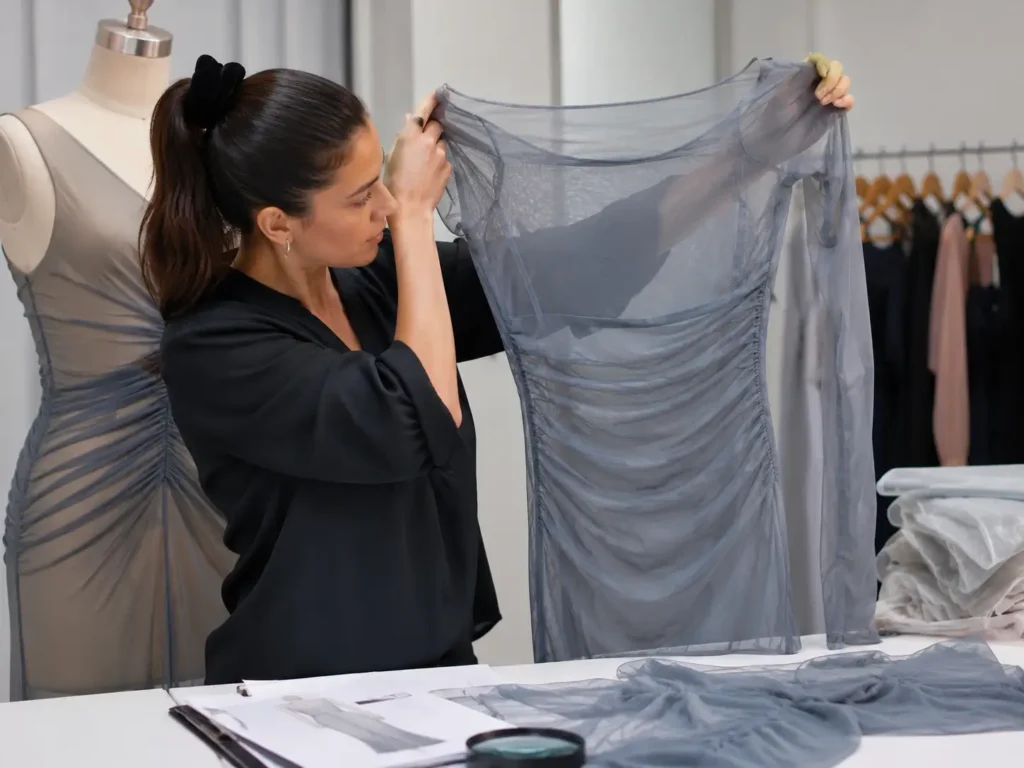
Soft stretch mesh usually has the advantage in ruching because it can fold into smaller, smoother layers without creating excessive stiffness. The important variable is not just the base fabric weight but the amount of material concentrated into the finished area. A development team might test the same fabric at 1.5:1, 2:1, and 2.5:1 gathering ratios to see when the folds become too bulky or the transparency becomes too dark. Those ratios are practical trial points rather than industry rules, but they show why a small flat swatch is not enough. Sheer styles add another challenge because opacity changes when mesh is stretched, doubled, gathered, or placed over different lining colors. A single layer may look almost invisible at the upper chest but become substantially darker over a ruched hip. The best result comes from approving the exact construction on the body: actual gathering ratio, actual lining, actual stretch, and actual garment length. Softness creates the visual effect, while adequate recovery keeps that effect from collapsing during wear.
Which Is Better for Corset Dresses?
A corset dress rarely depends on mesh alone for structure. Boning, cup shape, underbust engineering, seam placement, lining, closure design, and the pattern itself do most of the structural work. Power mesh can reinforce that system where controlled stretch is useful, but it should not be treated as a replacement for proper corsetry construction. The correct mesh depends on its location. An internal side panel may need strong recovery; a transparent section between boning channels may need a finer and more elegant appearance; a sheer back panel may need enough stability to carry closure tension; and a decorative overlay may need almost no support at all. This is a good example of why “one fabric per style” is often an unnecessary limitation. By separating structural and visual roles, a designer can keep the dress light where it should look delicate and controlled where it must remain stable. The sample should then confirm that these materials move together without puckering, pulling, or creating abrupt changes in pressure.
Which Works for Sleeves, Panels, and Linings?
Sleeves usually favor softer mesh because the shoulder, elbow, and underarm need freedom of movement, but very weak recovery can produce bagging around the elbow or cuff. Side panels are different: even when they appear decorative, they may carry significant horizontal tension between the front and back body. An illusion neckline prioritizes transparency, while an internal lining layer may prioritize support and remain almost invisible. This is where a simple fabric map becomes useful. Instead of writing one generic mesh code on the BOM, assign each material a role: outer body mesh, sleeve mesh, internal support mesh, and lining. Double-layer mesh can also be used to reduce transparency and improve wearing security without turning the garment into a fully lined construction. Jinfeng Apparel’s mesh-dress fact base specifically recognizes regular, stretch, power, printed, and double-layer mesh, and records related risks such as neckline deformation, armhole deformation, transparency, print position, and holes. That type of role-based specification is much easier to reproduce in bulk.
| Garment Zone | Likely Mesh Direction | Primary Need | Main Risk to Check |
| Bodycon outer shell | Soft stretch mesh | Drape, sheerness, surface appearance | Relaxation after sustained wear |
| Internal waist support | Power mesh | Recovery and controlled stretch | Excess compression or hard transition |
| Ruched overlay | Light soft mesh | Small folds and fluid gathering | Layer bulk and darkened opacity |
| Fitted sleeve | Soft multi-directional mesh | Mobility and comfort | Elbow bagging and seam growth |
| Corset side panel | Power mesh or firm stretch mesh | Tension management | Panel distortion |
| Illusion neckline | Fine stretch mesh | Transparency and clean edge | Gaping and neckline growth |
| Printed outer body | Printable stretch mesh | Artwork and fashion effect | Distortion under body stretch |
| Double-layer body | Lightweight mesh | Coverage with a sheer look | Heat, bulk and reduced drape |
How Do Sheerness, Drape, and Comfort Compare?
Soft mesh generally gives a lighter, more fluid, and delicate result, while power mesh tends to provide greater control. Yet transparency, drape, and comfort cannot be predicted from the fabric name alone. Mesh density, yarn size, GSM, color, stretch tension, layer count, finishing, seam construction, and lining all change how the fabric looks and feels once it becomes a finished dress.
Which Mesh Is More Transparent?
Soft mesh is often more transparent because many fabrics sold under that name are lightweight and finely knitted, but power mesh can also be highly sheer. Opacity depends on yarn thickness, opening size, knit density, color, surface finish, and how much the fabric is stretched on the body. Stretch is particularly easy to underestimate. As a mesh panel expands, the openings can widen and reveal more skin or lining, so a swatch that looks acceptable while relaxed may become much more transparent across the bust or hip. Color changes perception as well. Black mesh often appears visually denser because of contrast, while a well-matched nude can almost disappear against the skin even when physical openness is similar. Seams, darts, and gathers create areas of multiple thicknesses, meaning one dress can shift from highly sheer to nearly opaque within a few centimeters. A sensible transparency review therefore compares the fabric relaxed, under expected wearing stretch, in a single layer, and over the proposed lining. The worn garment is the reference that matters, not the fabric roll.
How Does Double Layering Change Coverage?
Double layering usually increases coverage because two mesh structures overlap and reduce the amount of open space visible from a direct viewing angle. The effect is not simply “twice as opaque,” because the two knit patterns, colors, and tensions interact visually. Layering also changes the mechanical behavior of the garment. Two light layers can feel very different from one heavier mesh because they can move against each other, distribute stretch differently, and build more thickness at seams. Extra layers increase material consumption, warmth, color depth, sewing time, and potential bulk, especially where ruching or binding already creates several thicknesses. If transparency is the problem, full lining is therefore not the only answer. A team can compare double mesh, partial lining, a denser mesh, a darker lining color, or a reduced-stretch pattern in the sensitive area. Each solution changes the silhouette differently. Jinfeng Apparel’s documented mesh development notes that double-layer mesh can be used to lower transparency, add visual depth, and improve wearing security, while still requiring control of lining, edge stability, and post-stretch dimensions.
Which Mesh Has Better Drape?
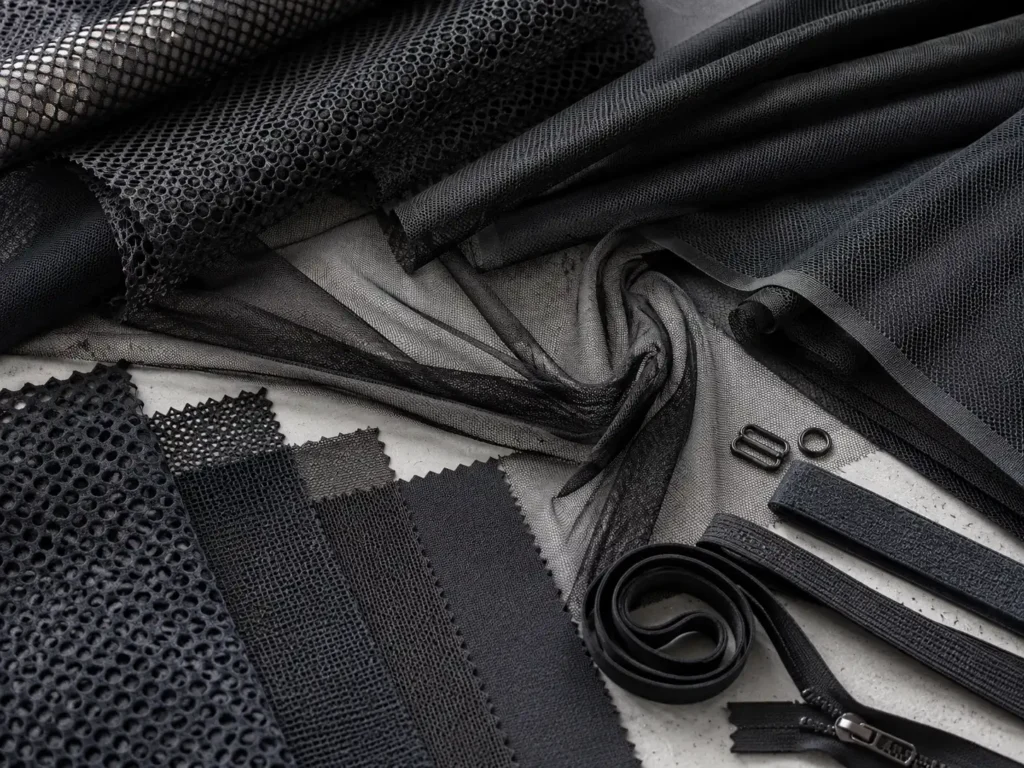
Soft mesh usually drapes more easily because lower resistance allows gravity and gathering to shape the fabric with less force. This makes it useful for ruched skirts, draped busts, sheer sleeves, asymmetric overlays, and soft body shells. Power mesh tends to produce a more controlled fall, which can be useful when the design should keep a sculpted line rather than collapse into loose folds. Drape should never be judged from a tiny sample alone. A 10 cm swatch can tell you whether a fabric feels smooth, but it cannot predict how a full-length skirt panel will fall or how a two-layer gathered section will move when walking. For development, hang a larger piece at the intended length, build the intended gathering ratio, and place it over the proposed lining. Then check how the fabric behaves in motion and after being compressed during sitting. If the reference image depends on soft cascading folds, the material must be evaluated in that geometry. Matching the generic fabric name is less important than matching the final silhouette.
Which Mesh Feels Softer Against Skin?
Soft mesh generally has an advantage for direct skin contact, but comfort is created by the whole construction, not only the face of the textile. A beautifully smooth mesh can become irritating if the seam allowance rubs under the arm, the binding is too tight, the overlock edge sits against sensitive skin, or several layers of ruching create concentrated pressure. A firmer power mesh can still feel comfortable when its surface is smooth and the pattern distributes tension evenly. Wear testing should focus on likely friction points such as the underarm, neckline, side bust, underbust, waist, inner sleeve, upper thigh, and zipper area. The sample should be moved in, not only photographed. Raise the arms, sit, twist, walk, and keep the garment on long enough to notice pressure or heat. Lining also changes the result by reducing direct contact but adding another layer of warmth and stretch interaction. The useful question is not simply “Is this mesh soft?” but “Does the finished dress remain comfortable where this material touches and controls the body?”
How Do These Meshes Affect Fit and Construction?
Mesh directly influences fit because elastic fabric changes dimensions under tension. Stretch direction, recovery, cutting orientation, seams, neckline finishing, lining, ruching, and printed motifs can all alter the finished garment. Power mesh can provide more control, while soft mesh may require selective stabilization. Pattern development and fabric selection should therefore happen together rather than treating mesh substitution as a late sourcing decision.
How Does Stretch Direction Affect Fit?
Stretch direction can change a dress almost as much as fabric weight. A mesh may stretch generously across the width but only moderately in length, while another behaves much more evenly in both directions. On a bodycon style, the greater stretch direction is often positioned around the body to accommodate bust, waist, and hip movement, but vertical stretch still matters because it can allow neckline depth, waist position, skirt length, or ruching placement to change when worn. Cutting orientation therefore needs to be documented, not assumed. In bulk production, marker efficiency can tempt a cutting room to rotate a piece to save fabric. With a stable woven material that may sometimes be acceptable; with directional stretch mesh, a 90-degree rotation can fundamentally change fit. A production-ready pattern should clearly indicate grain or stretch orientation, and the PP sample should be cut in the same direction intended for bulk. If the approved sample uses one orientation and production uses another, the fabric code can be identical while the garment behaves differently. Stretch direction is a fit specification, not a cutting-room convenience.
Do Necklines and Armholes Need Stabilization?
Often they do, especially in deep V necklines, halters, off-shoulder shapes, large scoops, and close-fitting bodies. Mesh edges are vulnerable because the fabric can stretch during cutting, handling, sewing, pressing, fitting, and wear. A neckline may look clean when the garment leaves the machine and begin to wave or gape after it has spent time on the body. Possible controls include elastic binding, stretch tape, clear elastic, lining support, self-fabric binding, pattern reduction, or more carefully controlled sewing tension. The correct solution depends on how the opening must function. Over-stabilizing an edge can be as damaging as leaving it uncontrolled, especially if the dress needs to stretch over the shoulders or hips during dressing. Sample review should compare the neckline before wear, during wear, and after the garment is removed, and the same logic applies to armholes. Jinfeng Apparel’s documented mesh-dress issues include neckline and armhole deformation, with control focused on stretch direction, post-stretch dimensions, edge finishing, and construction rather than treating every problem as a sewing defect.
How Do Lining and Ruching Change Mesh Choice?
Lining changes the mechanical system of a mesh dress because two materials with different stretch and recovery are being forced to move together. If the outer mesh stretches much farther than the lining, the lining may become the real limiter of fit. If it is too loose, it can wrinkle visibly under a transparent shell; if it is too tight, it may carry most of the body tension and make the mesh appear to fit poorly. Ruching changes the problem in another way by concentrating fabric mass and tension. A side seam may contain several layers of gathered mesh, lining, elastic, and seam allowance even when the base textile is lightweight. Before approval, the team should check gathering ratio, distribution of fullness, lining stretch, seam elasticity, bulk at joining points, recovery after wear, and transparency through both gathered and ungathered areas. If coverage is the only issue, partial lining or double mesh may preserve lightness better than a full lining. The correct solution comes from evaluating the complete construction, not approving each material independently.
How Does Printing Affect Mesh Selection?
Printed mesh adds a visual variable because the artwork stretches with the textile. A circular motif can become oval across the bust, a geometric grid can widen over the hip, and a floral placement near a cut-out can move away from its intended position once the panel is under tension. For repeated prints, direction and repeat size affect cutting; for placement prints, the relationship between artwork and body location becomes even more critical. The sample should review print direction, repeat, left-right symmetry, seam matching where required, distortion at expected wearing stretch, and color appearance over both skin and lining. Printed mesh also shows why flat measurements are not enough. If the panel is expected to expand substantially when worn, the artwork should be evaluated at that real garment tension rather than only on an unstretched roll. Jinfeng Apparel’s mesh-dress knowledge base specifically flags print direction, distortion after stretching, cutting-piece position, and symmetry as development concerns, making the fitted sample a visual proof as well as a construction check.
How Should Brands Choose Mesh for Bulk Production?
Brands should choose mesh through a documented fabric-and-sample approval process. Confirm composition, GSM, usable width, directional stretch, recovery, hand feel, drape, transparency, color, lining compatibility, printing, MOQ, and lead time. Then validate those variables in the actual garment, approve the production construction, and compare incoming bulk fabric against the agreed reference before cutting begins, so fit and appearance are not left to assumption.
Which Specifications Should Be Confirmed?
A supplier cannot reliably reproduce “soft black mesh” because those words do not establish measurable performance. A useful approval needs to connect technical information with the result the dress must achieve. At minimum, record fiber composition, GSM, usable width, stretch in both directions, recovery reference, hand feel, drape, transparency in relaxed and stretched states, approved color, lining relationship, printing requirement where relevant, and the supplier’s project-specific MOQ and lead time. Keep a physical approved swatch or clearly coded reference so that the bulk lot can be compared with something tangible. Not every style needs the same level of testing. A loose sheer sleeve is far less demanding than a fitted transparent bodice that carries bust tension. The specification depth should follow the risk of the garment zone. Jinfeng Apparel’s documented fabric review includes composition, GSM, hand feel, drape, stretch, transparency, lining suitability, printing, ruching, close-fitting use, bulk stability, supplier MOQ, lead time, and cost. That level of detail turns a visual fabric preference into a repeatable production instruction.
How Should Mesh Be Tested in a Sample?
The sample is where theoretical fabric data meets a real body. Start with appearance: transparency, color depth, drape, gathering, and how the proposed lining looks through the mesh. Then review fit under tension at the bust, waist, hip, neckline, armhole, sleeve, hem, and total length. Move beyond the first five minutes of fitting. Sit, walk, raise the arms, and look for areas that remain stretched or migrate. Construction should be checked at the same time: seam waviness, skipped stitches, broken mesh, edge curling, binding tension, lining movement, print distortion, and holes around stress points. If the fabric is replaced, assume the pattern may need revision too. A firmer mesh can reduce stretch enough to change circumference or length, while a softer mesh can require stabilization the original version did not need. Jinfeng Apparel’s documented revision process compares weight, hand feel, stretch, drape, transparency, cost, MOQ, and lead time, and then transfers approved changes into patterns, BOMs, fabric records, sewing instructions, and QC checklists before PP and Golden sample sealing.
How Do Brands Control Bulk Consistency?
Bulk consistency starts before the fabric reaches the sewing line. An approved sample does not guarantee that every later roll will behave identically, because knitting, dyeing, finishing, shade, and lot variation can affect hand, stretch, recovery, and transparency. Incoming fabric should therefore be compared with the approved reference for the attributes that matter to the style. Mesh-dress checks commonly include shade, usable width, holes, snagging, surface defects, stretch behavior, transparency, print placement, and direction. Once cutting begins, the focus shifts to construction because stretch mesh is sensitive to feed, needle choice, thread, stitch formation, and sewing tension. Excess pressure can create rippled seams even when the fabric itself is correct. A practical chain is approved fabric, sample development, fit revision, PP sample, bulk fabric confirmation, incoming material inspection, controlled cutting, in-line inspection, and finished-garment inspection. For repeat orders, preserve the exact fabric code, swatch, pattern version, BOM, seam method, and lining code. “Use last season’s mesh” is not a production specification when several visually similar fabrics exist.
Which Mesh Should You Choose?
Choose power mesh when support, controlled stretch, stronger recovery, or dimensional stability are the main priorities. Choose softer stretch mesh when fluid drape, light layering, transparency, ruching, and flexible movement matter more. For many fitted fashion dresses, the best answer is a planned combination rather than a single winner. A bodycon mesh style may use a soft outer shell, firmer waist support, a different sleeve mesh, and a separate lining across coverage-sensitive zones. That does not mean increasing complexity for its own sake; every material should have a clear function. When developing a custom mesh dress, provide the reference image or tech pack, intended silhouette, desired sheerness, target market, color, lining concept, size range, quantity plan, launch timing, and any area that needs unusual support or stretch. Jinfeng Apparel’s documented mesh capability covers regular, stretch, power, printed, and double-layer mesh, with decisions tied to transparency, lining, stretch direction, post-stretch dimensions, neckline stability, print placement, sampling, and bulk control. The strongest choice is the mesh that still performs correctly after stretching, sewing, layering, wearing, and repeat production.
| Approval Item | Record Before Bulk | Practical Check |
| Fabric identity | Supplier code, composition, color, approved swatch | Match incoming rolls to approved reference |
| Weight and width | GSM and usable width | Check consumption, hand and marker assumptions |
| Stretch direction | Widthwise and lengthwise extension % | Cut bulk in the same orientation as the PP sample |
| Recovery | Residual growth or approved comparative result | Recheck high-tension zones after repeated extension |
| Transparency | Single, stretched, double-layer, lining combination | Review on the body under realistic lighting |
| Construction | Seam type, binding, lining and gathering details | Use the PP/Golden sample as workmanship reference |
| Print control | Repeat, direction, placement and symmetry | Review artwork under expected wearing stretch |
| QC focus | Holes, snagging, seams, neckline, shade, print position | Apply incoming, in-line and finished-garment checks |
Power mesh and soft mesh are not opponents with one permanent winner. They are tools for different mechanical and visual jobs. Power mesh earns its place when a dress needs controlled stretch, recovery, and support; soft mesh earns its place when the design depends on fluid folds, transparency, light layering, and easy movement. The most reliable development process looks beyond the supplier name and asks how the fabric behaves when stretched, sewn, layered, lined, worn, and repeated in bulk. That is also where experienced manufacturing input becomes useful. If a new mesh style combines bodycon fit, sheer zones, ruching, printed panels, or internal support, Jinfeng Apparel can review the fabric direction alongside the pattern and sample rather than treating material sourcing as a separate decision. The aim is not to over-engineer a fashion dress. It is to make sure the softness seen in a campaign image and the stability expected in a production order can exist in the same garment.
Frequently Asked Questions
Is power mesh always thicker than soft mesh?
No. Power mesh is defined more by controlled stretch and recovery than by a single thickness. Some supportive meshes are relatively light and sheer, while some soft fashion meshes can become substantial once doubled or heavily gathered. A development team should compare GSM, knit density, resistance, recovery, and the actual layered construction rather than assuming that a fabric called power mesh will automatically be heavy or that soft mesh will always be ultralight.
Is power mesh better for bodycon dresses?
Power mesh can be better in bodycon areas that need stronger recovery, waist control, or stable cut-out edges, but it is not automatically the best choice for the entire dress. A very firm mesh can make ruching bulky or change the intended fashion silhouette. Many bodycon styles work better with a soft visible mesh combined with stronger support only in internal or high-tension zones, then confirmed through fitting and wear testing.
Do mesh dresses need lining?
Many mesh dresses need full or partial lining, especially through the bust, waist, hip, or skirt where coverage and wearing security matter. Other designs intentionally keep areas sheer, such as sleeves, illusion necklines, festival overlays, or beach cover styles. The decision should consider mesh density, color, stretch under wear, layer count, lining color, and the desired visual effect rather than applying the same lining rule to every mesh garment.
How can you test mesh recovery before production?
Use a fixed gauge length, record the original measurement, stretch the strip to a controlled extension, repeat the cycle several times, allow it to relax, and measure again. The difference between the original and relaxed measurement shows residual growth. The exact test method and acceptance limit should be defined for the project, but recording the same method across candidate fabrics gives a much more useful comparison than pulling each swatch once by hand.
Can power mesh and soft mesh be used in the same dress?
Yes, and that is often the most practical solution for complex fitted styles. A dress may use soft mesh for sleeves and ruched outer layers, power mesh for an internal waist or side support panel, and a separate lining for coverage. The important part is to define each material by garment zone in the BOM and confirm that their stretch, recovery, seam behavior, color, and thickness work together in the PP sample.
What causes mesh necklines to gape or become wavy?
Common causes include weak recovery, excessive stretch during sewing, unsuitable edge finishing, incorrect pattern reduction, mismatched lining behavior, or a cutting direction that places too much stretch along the neckline. The solution should follow the cause. Depending on the style, the development team may adjust the pattern, binding tension, elastic or tape, seam method, lining support, or mesh specification rather than simply sewing the same edge more tightly.
What information should a brand provide when developing a custom mesh dress?
Provide a tech pack or clear reference images, intended silhouette, size range, desired transparency, preferred color, lining concept, approximate quantity, target launch timing, and any zones that need special support, compression, ruching, printing, or cut-out stability. A fabric swatch or original sample is also useful when available. The clearer the intended on-body result is, the easier it is to compare suitable mesh options and avoid unnecessary sample rounds.