 Skip to content
Organza Dress Quality Control Checklist: What Should You Check Before Bulk Shipment?

Your trusted Women’s Apparel Manufacturer from China

Organza can make a dress look polished, airy, and expensive, but it also exposes weak production control faster than many opaque fabrics. Its crisp hand, high transparency, low stretch, and layered construction leave little room for careless cutting or rushed sewing. A small snag on the bodice, a wavy zipper, or one uneven skirt layer may be barely noticeable on the sewing table and immediately obvious under store lighting, event photography, or natural daylight.
A complete organza dress quality control checklist should cover pre-production approval, incoming fabric inspection, cutting accuracy, sewing quality, in-line checks, measurements, lining and transparency, layer balance, pressing, packing, and final shipment inspection. It should also define defect severity and release criteria, so the production team knows what can be reworked, what must be segregated, and what requires the lot to be held for further review.
The strongest QC systems catch problems when they are still cheap to correct. A distorted panel found before sewing may require one recut. The same distortion discovered after lining, zipper installation, finishing, and packing can trigger hours of rework across a whole production run. That is why organza QC works best as a series of connected checkpoints rather than a last-minute inspection before cartons are closed.
What Should an Organza Dress QC Checklist Cover?
An organza dress QC checklist should follow the garment from approved sample to shipment, covering fabric, cutting, sewing, in-line inspection, measurements, lining, appearance, finishing, packing, and final inspection. Organza also needs fabric-specific controls for transparency, fraying, pressure marks, layer balance, and surface damage because these defects can stay highly visible even when the basic construction is technically correct.
What Should Be Approved Before Production?
Reliable quality control starts before bulk fabric reaches the cutting table. The approved PP sample, final organza, lining, color, trims, size chart, measurement method, construction details, labels, and packing method need to describe one clear product standard. For layered organza, each layer should be identified by position, length, shape, and intended fullness rather than recorded vaguely as “three layers.” A small change in layer length or gathering can alter the silhouette substantially. The lining also needs its own approval because a warmer, darker, or more opaque lining can change the apparent shade of the outer fabric. Before production begins, the team should know which details are fixed, which have an agreed tolerance, and which require another approval if the material or construction changes. When that information is incomplete, final inspectors can find defects but may still disagree about what counts as a defect. A good PP package removes that ambiguity before expensive work begins.
Which QC Stages Should Be Included?
Organza is easier to manage when inspection is divided by production stage. Incoming QC asks whether the material is correct; cutting QC checks grain, panel shape, direction, and edge condition; sewing QC checks stitches, seams, zippers, gathers, and lining attachment; in-line inspection looks for repeating process problems before they spread; finished-garment inspection evaluates measurements, symmetry, cleanliness, transparency, and overall appearance. Pressing and packing require separate checks because pressure marks or crushed volume can be introduced after sewing is already complete. The practical value of staged control is speed of correction. If a zipper method is creating waviness, the issue can be corrected after the first production bundle rather than after hundreds of dresses have passed through the line. A serious repeat defect should trigger a hold-and-review decision, not a promise that everything will be repaired at the end. Final inspection is strongest when earlier checkpoints have already removed most preventable defects.
QC Stage | Main Organza Checks | Useful Record | Typical Hold Reason |
Pre-production | PP sample, fabric, lining, trims, measurements, layers | Approved sample and production file | Unconfirmed material or construction |
Incoming fabric | Shade, transparency, hand feel, width, surface defects | Fabric inspection record | Wrong lot or repeated visible defects |
Cutting | Grain, panel shape, direction, layer ID, edge condition | Cut-panel check | Distortion or wrong panel version |
Sewing | Seam quality, tension, puckering, zipper, gathers, lining | In-line QC record | Repeating workmanship defect |
Finished garment | Measurements, symmetry, layer balance, appearance | Final QC sheet | Out-of-tolerance or visual failure |
Packing | Labels, folding, protection, carton assortment | Packing checklist | Wrong SKU or damaging pack method |
What Should Be Compared With the Approved Sample?
The approved sample should be treated as a production reference rather than a styling reference. Start by looking at the garment from a normal viewing distance: skirt volume, waist position, shoulder balance, sleeve shape, hem level, and overall proportion should feel the same as the approved piece. Then move closer and compare transparency, crispness, seam appearance, gather distribution, layer lengths, zipper flatness, trim placement, and lining coverage. Lighting deserves attention because organza can reveal internal construction differently under daylight, strong retail lighting, and studio photography. Pale colors are especially unforgiving. A seam allowance that disappears on a dark inspection table may become obvious once light passes through the dress. The right question is not simply whether the bulk garment is wearable; it is whether it reproduces the approved product effect. A technically acceptable substitution in fabric weight, stiffness, or lining tone may still change the dress enough to create a commercial quality problem.
How Should QC Records Be Used?
QC records are most valuable when they stay attached to the style after shipment. Keep the approved PP or Golden Sample, fabric and lining references, final size chart, measurement tolerance, sewing instructions, defect photos, corrective-action notes, packing method, and final inspection findings together. Organza repeats often look simple on paper because the pattern may remain unchanged, yet a new color or new fabric lot can behave differently in transparency, shade, crispness, or pressure sensitivity. Historical records help the next production team understand what required extra attention before. If one seam needed a construction adjustment to reduce puckering, or one packing fold created visible compression lines, that knowledge should not be rediscovered during the next order. For long-running styles, the record becomes a practical manufacturing memory. It reduces repeated discussion, makes problem-solving faster, and gives production and quality teams a more consistent basis for comparing a repeat order with the version that previously passed inspection.
Which Organza Fabric Defects Must Be Checked?
Organza should be checked for holes, snags, pulled or broken yarns, stains, weave irregularities, shade variation, transparency differences, frayed edges, distortion, creases, and pressure marks. Fabric weight, width, hand feel, crispness, and lot consistency also matter because changes in the base material can alter volume, lining visibility, seam behavior, and the finished silhouette even when color appears similar.
How Do You Check Fabric Surface Defects?
Surface inspection should happen before cutting, when damaged areas can still be marked, isolated, or avoided. Organza’s clean, transparent surface can make tiny holes, broken yarns, snags, oil marks, water marks, permanent creases, and abrasion more obvious than they would be on a textured fabric. Lighting makes a real difference: side lighting can reveal pulled yarns and pressure lines, while transmitted light helps expose pinholes and uneven transparency. Pale organza benefits from being viewed against both light and dark backgrounds. Inspectors should also record whether a defect is isolated or repeating. A small mark near the selvedge may be manageable through marker planning, while a repeated line across the usable width can affect many garment panels and justify holding the roll. Location matters as much as size. A small snag hidden in a lower seam allowance is not commercially equivalent to the same snag at center front, on a statement sleeve, or across a clean upper bodice where the eye naturally goes first.
How Do You Check Shade and Transparency?
Shade and transparency should be evaluated together because layering changes how organza color is perceived. A roll that appears close to the approved swatch as a single layer may become visibly darker when two or three layers overlap. Compare roll-to-roll shade, within-roll consistency, panel-to-panel color, lining compatibility, and the completed garment under realistic light. For multi-layer skirts, evaluate the fabric in the same layer count used in the style instead of relying only on a single swatch. Transparency itself is not a defect; mismatch is the problem. If the approved sample intentionally uses a sheer sleeve, bulk production does not become “better quality” simply by using a more opaque fabric. The production goal is to reproduce the approved visibility, depth, and coverage. Light colors deserve an additional check for visible seam allowances, labels, or internal components. Where the lining changes the outer color noticeably, the lining shade should be controlled as carefully as the organza shade.
Is Fabric Weight Consistent?
Fabric weight is a useful quantitative checkpoint because organza used for fashion dresses commonly sits within a broad range of roughly 30-100 gsm, depending on fiber, weave, finish, and intended structure. That range is not a pass/fail specification by itself. A 35 gsm organza can be correct for a floating overlay while a heavier version may be needed for a sculpted sleeve or structured skirt. Bulk material should therefore be compared with the approved fabric specification or sealed reference, not with a generic industry number. Record weight together with usable width, hand feel, crispness, transparency, and lot number because the combination determines how the garment behaves. An unexpected weight change can reduce skirt volume, increase stiffness, change layering depth, or expose lining differently. When the bulk fabric feels clearly softer or harder than the approved swatch, it should be reviewed before cutting even if composition and color appear correct. Material approval is about reproducing garment performance, not merely matching a fabric name.
Fabric Factor | Typical Organza Profile | QC Meaning for Dresses |
Common weight | About 30-100 gsm | Compare against approved fabric, not a universal target |
Stretch | Normally low or none | Accurate cutting and measurement control are important |
Transparency | High | Lining and internal seam visibility must be reviewed |
Drape | Medium-low, relatively crisp | Changes can alter sleeve and skirt volume |
Wrinkle risk | Moderate | Handling, pressing, and packing need control |
Shade risk | Moderate | Compare rolls, panels, lining, and finished layers |
Lining need | Often required | Coverage and color interaction should be approved |
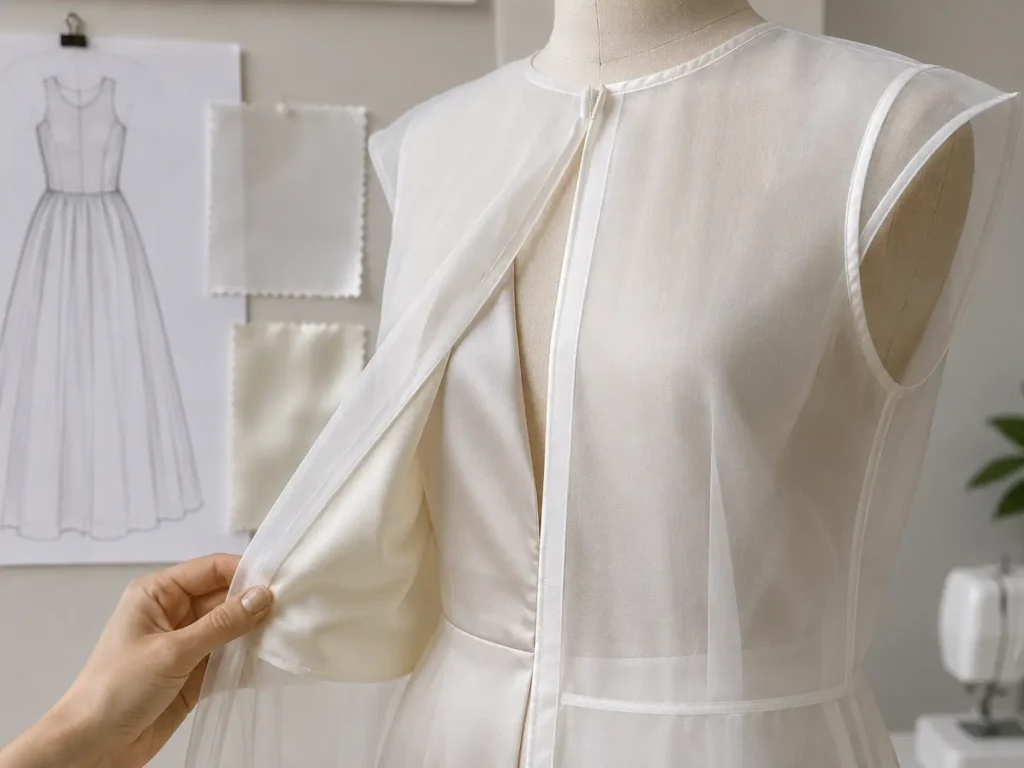
Does Organza Fray or Distort?
Fraying and distortion are practical production risks rather than abstract fabric properties. Cut edges can begin to open during bundling, sewing, or repeated handling, especially around curves, gathered joins, narrow seam allowances, and shaped hems. Inspect edge condition immediately after cutting; once yarn loss becomes severe, operators may struggle to keep an even seam allowance and the final edge can look rough through a transparent layer. Organza is usually non-stretch, but panels can still shift or lose shape during spreading, cutting, feeding, or pressing. Large skirt pieces, bias areas, and lightweight overlays deserve special attention. Seam slippage should also be separated from broken stitching. If the thread remains intact while woven yarns pull away from the seam, simply adding more stitches may make the area worse. Construction, seam allowance, reinforcement, and material behavior need to be reviewed together. During sample development, stressed areas such as zipper seams, armholes, waist joins, side seams, and heavy gathers should be checked before the method is released to bulk production.
How Should Cutting and Sewing Be Inspected?
Cutting and sewing inspection should confirm the correct pattern version, grain direction, panel dimensions, layer identity, clean edges, seam construction, stitch consistency, tension, seam allowance, zipper flatness, and symmetry. Organza requires close attention to puckering, needle marks, fraying, and distorted seams because its crisp, sheer surface makes production defects easier to see and harder to disguise later.
How Do You Check Organza Cutting?
Cutting accuracy has a direct relationship with final hem balance, layer alignment, and left-to-right symmetry. Each bundle should be checked against the correct pattern revision, size, panel quantity, grain direction, notches, left/right pairing, and any layer identification used in the style. When a dress contains several visually similar overlays, clear bundling prevents a slightly shorter or differently shaped layer from being sewn in the wrong position. Edge quality also deserves inspection before sewing. Ragged cuts, pulled yarns, and early fraying make accurate seam allowance harder to maintain and can create visible damage later. Large skirt panels can shift during spreading, so the team should not assume that the top layer of a cutting lay represents every layer underneath. The most expensive cutting errors are repeat errors: a wrong pattern version, incorrect direction, or inaccurate marker can affect an entire lay. In-line prevention starts here. One bad panel is a recut; a systematic cutting mistake can become a full-lot problem if it is not detected quickly.
How Do You Check Seam Quality?
A good organza seam needs to be secure without looking heavy. Inspect stitch formation from both sides and look for skipped stitches, broken stitches, loose loops, uneven tension, inconsistent seam allowance, open seams, twisting, and visible waviness. Transparency means the seam allowance and thread path may remain partly visible from the outside, particularly on pale colors, so inside workmanship directly affects outside appearance. Zipper seams deserve their own review because a zipper can function correctly while still creating a ridge or wave along the center back. The garment should be checked flat and hanging naturally; a seam that looks acceptable on a table may twist under its own weight. Sewing settings should also be style-specific. A floating overlay, fitted bodice, gathered skirt, and statement sleeve do not necessarily respond well to the same needle, thread tension, feed, or seam construction simply because all pieces are organza. When several consecutive garments show the same defect, the line should review the process rather than treating every piece as an isolated repair.
Is Seam Puckering Acceptable?
Puckering needs judgment rather than a blanket zero-tolerance rule. A slight natural ripple can be acceptable if it matches the approved sample and disappears when the garment hangs, while a persistent wave that distorts a zipper, side seam, waist join, or bodice line is a clear quality concern. Causes can include excessive thread tension, feeding imbalance, stitch density, seam construction, fabric movement, or pressing. Inspect suspected areas under side lighting and again with the garment hanging. Avoid relying on heavy pressing as the only correction because too much heat or pressure may exchange one defect for another by creating shine, flattening volume, or leaving pressure lines. Repeated puckering is particularly important during in-line inspection. If the first several pieces show the same wave, production should stop long enough to identify the cause before more garments are completed. Organza is unforgiving of “we will press it out later” thinking; many distortions become harder to correct once several layers, linings, or zippers are already assembled around the affected seam.
Are Needle Marks and Edges Acceptable?
Needle marks are easy to underestimate until a seam is opened for rework. Transparent, tightly structured fabrics can retain small holes or pulled yarns where the original stitches were removed. A repaired seam therefore needs more than a second stitch check; the surrounding surface should be reviewed to make sure the repair itself did not create a new cosmetic defect. Edge finishing also has to match the design and fabric weight. Depending on the style, production may use narrow hems, rolled hems, enclosed seams, lining, or another controlled finish, but no single technique is automatically correct for every organza dress. The inspection questions are practical: is fraying contained, is the edge secure, does the hem stay even, is unnecessary bulk avoided, and does the seam allowance remain discreet from the outside? On sheer garments, internal workmanship is often partially visible. A finish that would be considered hidden on an opaque fabric can become part of the customer-facing appearance once light passes through the outer layer.
How Do You Check Fit, Lining, and Construction?
Fit and construction inspection should combine approved measurements with visual balance. Check bust, waist, hip, length, style-specific points, left-to-right symmetry, lining coverage, layer lengths, gathers, pleats, ruffles, zipper position, and trims. Organza dresses should also be examined hanging or on a dress form because problems with volume, transparency, twisting, and layer interaction can be difficult to judge while the garment lies flat.
How Should Measurements Be Checked?
Measurements should follow the final approved size chart and the same measuring method used during sample approval. Bust, waist, hip, shoulder, armhole, sleeve length, and total dress length are common checkpoints, but organza styles often need additional points such as neckline depth, waist position, strap length, sleeve opening, ruffle width, skirt circumference, layer length, and the relationship between lining and outer hem. For multi-size orders, QC should not stop at the base size. Grading can preserve the numerical rule while still changing the visual proportion of a sleeve, bodice, or skirt in smaller and larger sizes. Record actual measurements rather than relying on memory or quick visual checks. When a measurement is outside the agreed tolerance, the next step is to understand whether the cause comes from pattern, cutting, sewing, pressing, or measuring technique. Numerical compliance also does not guarantee visual success. A dress can sit within individual tolerance limits and still look unbalanced, which is why measurements and appearance need separate but connected inspection decisions.
Is the Dress Symmetrical?
Symmetry should be checked visually as well as numerically. Look at neckline shape, shoulder height, armhole position, strap length, sleeve volume, waist seams, side seams, gathers, pleats, ruffles, and hem levels. Organza makes small differences easier to notice because structured sleeves and layered skirts create strong outlines. The garment should be inspected flat, hanging, and on a dress form or fit model when the style requires it. Front, back, and side views reveal different problems: one sleeve may contain more volume, one side seam may rotate forward, or one ruffle may sit higher even though the basic measurements appear acceptable. Gather distribution is a common example. Two skirt halves can contain the same amount of fabric yet look noticeably different if one side is packed more densely. The approved sample remains the best visual reference, particularly for intentionally asymmetric designs. Quality control should protect the intended balance rather than force perfect mathematical symmetry onto a style that was deliberately designed to be irregular.
How Should the Lining Be Checked?
Lining is part of the design system of an organza dress, not simply an added layer for modesty. Because organza is highly transparent, the lining changes apparent color, coverage, comfort, and the visibility of internal seams. Inspect coverage at the bust, waist, hip, seat, and skirt while the garment is worn or placed on a dress form. Pale colors should be reviewed under stronger light because insufficient coverage may not be obvious under normal factory lighting. The lining color also needs control; a slightly warmer or darker lining can shift the appearance of the entire garment once the organza is placed over it. Construction matters just as much. The lining should not pull the outer shell, hang below the approved level, twist around the body, become trapped in the zipper, or create ridges through a fitted bodice. For full skirts, it should allow the outer layers to move freely rather than catching them. A well-designed lining disappears visually while quietly controlling comfort, coverage, and silhouette.
Are Layers and Trims Aligned?
Layered organza dresses should be checked for layer order, quantity, length, position, fullness, and movement. A simple but useful test is to hang the dress, gently lift the skirt, and let the layers fall naturally. One section should not repeatedly catch, twist, or drop below the intended hem relationship. Ruffles and gathers need even distribution rather than merely correct attachment. Zippers should open smoothly and sit flat; straps should match in finished length; bows should be centered and shaped consistently; decorative trims should follow the approved placement without pulling the surrounding fabric. Heavier trims require extra attention because their weight can distort a lightweight layer even when stitching is secure. A trim can therefore pass a strength check and still fail visually. Construction QC should keep asking whether each component supports the intended silhouette. Organza dresses often derive their value from clean volume and controlled transparency, so misaligned layers or crooked details can undermine the design faster than a small hidden stitching imperfection.

Which Defects Are Critical, Major, or Minor?
Defects should be classified by their impact on safety, compliance, function, fit, appearance, and saleability. Critical defects involve serious safety or regulatory risk; major defects materially affect wear, durability, fit, function, or commercial appearance; minor defects have limited cosmetic impact. Clear definitions prevent different inspectors from giving the same problem different decisions and make rework and shipment release more consistent.
What Is a Critical Defect?
A critical defect is generally one that creates an unacceptable safety, legal, or serious compliance risk. It is not simply an unattractive seam or a slightly uneven hem. Examples can include a dangerous sharp component, hazardous contamination, or a serious mandatory-label problem where the product may not meet the applicable market requirement. Styles containing hooks, decorative stones, internal support pieces, beads, or other hardware should be checked for sharp exposure, insecure attachment, or anything that can injure the wearer. The exact classification should follow the brand specification and destination-market requirements because different products carry different risks. Critical should not be used as a dramatic label for ordinary workmanship defects; doing so weakens the inspection system. The category exists to separate genuine safety and high-severity compliance issues from problems that can be repaired or downgraded. When a potential critical defect is found, the sensible response is to hold affected product, investigate the source, determine scope, and document corrective action before release is considered.
What Is a Major Defect?
A major defect significantly affects function, fit, durability, appearance, or saleability. For organza dresses, examples may include obvious holes, severe snags, open seams, pronounced seam slippage, a broken zipper, major measurement deviation, strong shade mismatch, incorrect lining, severe puckering, a large stain, badly uneven layers, or clear asymmetry. Location changes severity. A small snag inside a low, hidden seam allowance may be manageable, while the same snag across the upper bodice or statement sleeve can become an obvious retail failure. Repeat frequency also matters. Five consecutive dresses with similar zipper waviness suggest a process problem that should be corrected immediately rather than five unrelated pieces sent to rework. Major defects are where in-line QC delivers the greatest commercial value because catching the pattern early prevents large repair queues. The goal is not to reject aggressively; it is to prevent a garment that does not represent the approved product from moving downstream simply because the sewing operation is technically complete.
What Is a Minor Defect?
A minor defect is a limited imperfection that does not materially affect safety, function, fit, durability, or the main commercial appearance of the dress. Small loose threads, slight non-critical stitch irregularity, or a minor removable finishing mark may fall into this category, depending on location and the brand’s quality standard. Minor does not mean irrelevant. A large number of small defects can indicate weak process discipline and create a poor impression when several appear on the same garment. Location should always be considered. A tiny issue hidden inside the garment and the same issue at center front are not commercially equal. The value of the minor category is practical: not every imperfection deserves the same response, and an inspection system becomes difficult to use if every loose thread is treated like a broken zipper. Clear examples, defect photos, and agreed appearance standards help inspectors make consistent decisions instead of relying on personal tolerance for what looks acceptable.
Defect Level | Typical Impact | Organza Dress Examples | Typical Action |
Critical | Safety or serious compliance risk | Sharp exposed component, hazardous contamination, serious mandatory-label issue | Hold, investigate, correct before release |
Major | Function, fit, durability, or clear visual failure | Hole, severe snag, open seam, broken zipper, major shade mismatch, severe puckering | Repair or segregate, then reinspect |
Minor | Limited cosmetic impact | Small loose thread, slight non-critical stitch variation | Correct where required and record |
How Do You Set Pass or Reject Criteria?
Pass or reject criteria should connect the approved sample, technical specification, measurement tolerances, defect definitions, and agreed sampling plan. Measurements need a defined method and tolerance; color needs an approved reference; construction needs the sealed sample and sewing instructions; subjective appearance points benefit from reference photos or agreed examples. A practical decision path is inspect, identify, classify, segregate or rework, reinspect, and then release or hold. Rework should never be assumed to restore quality automatically, especially on organza, where opening and resewing can leave permanent needle holes or pulled yarns. AQL sampling, when required, is a lot-acceptance tool rather than a substitute for in-process control. The specific acceptance levels should come from the client’s quality plan instead of being copied from another order as if one number were correct for every dress, defect category, and market. The strongest inspection standard is clear enough that production, QC, and the brand can all predict the same decision from the same finding.
How Is Final Quality Approved Before Shipment?
Final approval confirms that bulk organza dresses meet the agreed standard for measurements, workmanship, surface appearance, lining, layer balance, pressing, labels, packing, and carton assortment. Failed items should be corrected or segregated and reinspected before release. Where the quality plan requires AQL or third-party inspection, those checks should be completed before shipment authorization rather than treated as paperwork after cartons are already committed.
What Should Final Garment Inspection Check?
Final garment inspection should begin with the product as a shopper, merchandiser, or retail quality team will see it: overall silhouette, cleanliness, color consistency, balanced layers, and an appearance that matches the approved sample. Then move into measurements, seams, zippers, trims, labels, and detailed workmanship. Check correct style, color, and size; agreed measurement points; visible holes or snags; stains; transparency; lining coverage; layer balance; hem level; seam security; zipper function; trim position; loose threads; and label accuracy. Inspect at close range and from normal viewing distance. Close inspection finds skipped stitches and small surface defects, while stepping back reveals a tilted waistline, uneven sleeve volume, or a skirt layer hanging lower on one side. Occasion and event dresses are often judged visually before anyone examines the inside construction, so the final QC decision should not become a checklist exercise that loses sight of the whole garment. Technical compliance and presentation need to agree.
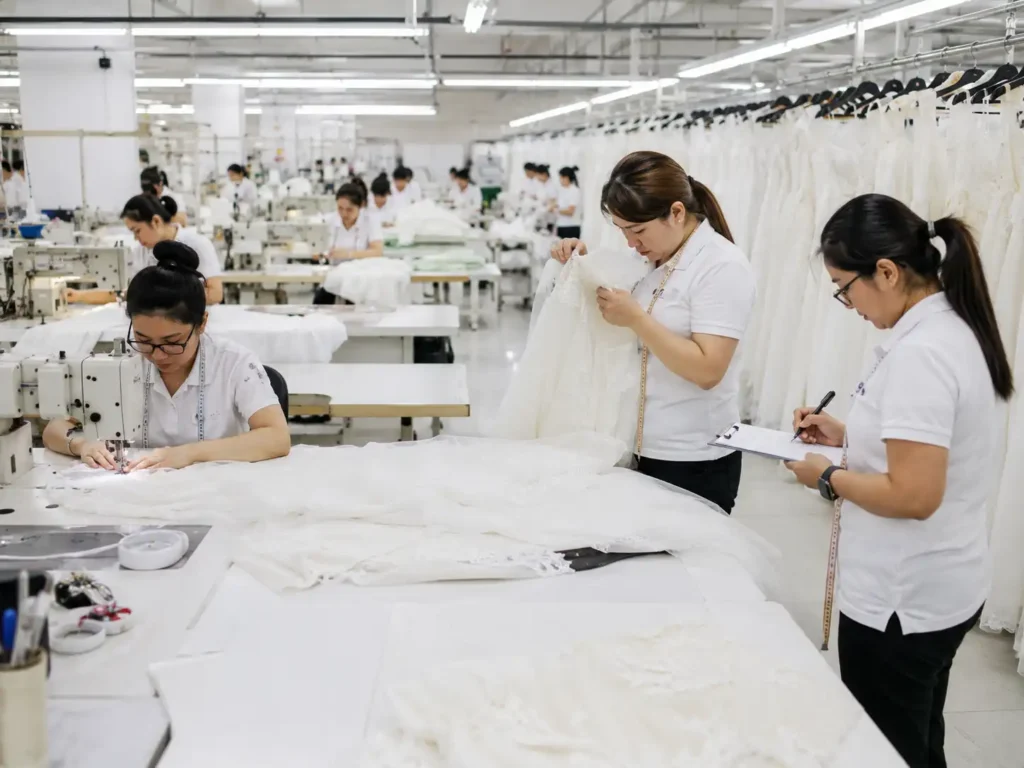
How Should Organza Be Pressed?
Pressing should remove handling wrinkles without changing the fabric’s intended crispness, shine, texture, or volume. Organza can react poorly to excessive heat, pressure, or prolonged contact, and a finishing team can accidentally create permanent lines where the garment previously had none. Inspect for pressure marks, unwanted shine, flattened ruffles, crushed sleeves, hard creases, distorted seams, water or steam marks, and loss of skirt volume. Special attention belongs around waist seams, zipper areas, multilayer edges, and internal seam allowances that can imprint through the outer layer. Pressing settings should be validated during development because different organza compositions and finishes may respond differently. A method that works on one polyester organza should not automatically be applied to every organza order. After finishing, allow the garment to hang and settle before making the final appearance decision. Temporary handling disturbance may relax naturally, while a permanent pressure mark or flattened sculptural detail will remain visible and needs correction before packing.
What Should Packaging QC Check?
Packaging QC has two jobs: confirm information accuracy and protect the garment’s appearance during storage and transport. Check the main label, size label, care label, hangtag, barcode, SKU, size sticker, polybag, folding method, color and size assortment, carton quantity, carton marks, and the approved packing ratio. Organza adds a physical protection challenge because a dress can leave the finishing area in excellent condition and arrive with crushed layers, hard folds, or pressure marks if it is compressed too tightly. Structured sleeves, bows, ruffles, and layered skirts may need a packing trial before the full order is sealed. One useful test is to pack a representative garment using the proposed method, leave it under realistic compression for a defined internal trial period, unpack it, hang it, and review recovery. The most space-efficient fold is not automatically the best packing method. Carton utilization matters, but the dress still has to arrive looking like the product that passed final inspection.
How Is a Bulk Lot Released?
A bulk lot should be released only after final inspection is complete, failed items have been corrected or segregated, reinspection has confirmed repairs where needed, packing has been verified, and any agreed client or third-party inspection requirement has been satisfied. The release record should connect back to the production references used to make the order, including the approved PP or Golden Sample, final size chart, fabric and color reference, sewing instructions, QC checklist, inspection findings, corrective-action notes, and packing standard. Those records become particularly useful when a successful dress returns in a new season. If a pale color required a different lining, a zipper seam needed extra control, or one fold created pressure marks, the lesson should feed directly into the repeat order. For brands developing custom organza programs, Jinfeng Apparel can support the process from sample and fabric review through bulk QC, final inspection, packing, and repeat-order records, giving design and production teams one connected standard rather than a collection of disconnected checks.
A reliable organza dress is not created by one inspector finding every mistake at the end of production. It comes from a chain of controlled decisions: approve the correct fabric, confirm transparency and lining, cut without distortion, use construction that suits the material, identify repeat problems during sewing, protect the surface during finishing, verify the finished silhouette, and pack the garment so that quality survives transport. Each stage removes a different kind of risk, and together they make the final inspection far more predictable.
For sourcing and product teams, the most useful question before shipment is simple: does the bulk order still look, fit, and behave like the dress that was originally approved? If the answer can be demonstrated through samples, measurements, inspection records, and clear defect decisions, the QC system is doing its job. If the answer depends mainly on last-minute repairs and subjective judgment, the production process needs stronger controls earlier in the line.
Share This Article :

Jerry Lee
Categories

Latest blogs
Table of Contents
Here, developing your OEM/ODM private label clothing collection is no longer a challenge—it’s an excellent opportunity to bring your creative vision to life.

